Introduction
Psychotic experiences are reported by an estimated 7.2% of the general population in meta-analysis of epidemiological surveys (Linscott & van Os, Reference Linscott and van Os2013). These psychotic experiences resemble hallucinations or delusions characteristic of schizophrenia and other psychotic disorders, but may be of less intensity, impairment, or persistence. Nonetheless, studies have shown that they are indicators of elevated clinical need across a range of indicators (for review, see Oh et al. Reference Oh, DeVylder and Chen2014). In particular, individuals who have experienced psychosis are also more likely to report suicidal ideation and behavior (Penagaluri et al. Reference Penagaluri, Walker and El-Mallakh2010; Kelleher et al. Reference Kelleher, Lynch, Harley, Molloy, Roddy, Fitzpatrick and Cannon2012 b, Reference Kelleher, Corcoran, Keeley, Wigman, Devlin, Ramsay, Wasserman, Carli, Sarchiapone, Hoven and Wasserman2013; DeVylder et al. Reference DeVylder, Jahn, Doherty, Wilson, Wilcox, Schiffman and Hilimire2015 a, Reference DeVylder, Lukens, Link and Lieberman2015 b; Koyanagi et al. Reference Koyanagi, Stickley and Haro2015), which is only partially explained by co-occurring depression (Honings et al. Reference Honings, Drukker, Groen and van Os2016). However, there has been little research investigating the subjective causal nature of this relationship, or whether it is explained by common risk factors or comorbidities that are associated with both psychosis and suicide. One study found that associations between psychotic experiences and suicidal ideation and attempts were largely eliminated when adjusting for socioenvironmental-shared risk factors such as exposure to sexual trauma and bullying (DeVylder et al. Reference DeVylder, Jahn, Doherty, Wilson, Wilcox, Schiffman and Hilimire2015 a). However, another study has shown that only psychologically distressing psychotic experiences were related to suicidal behavior, suggesting that there may be a more direct relation (Martin et al. Reference Martin, Thomas, Andrews, Hasking and Scott2015).
A straightforward and under-utilized approach to understand the relation between two clinical phenomena is to directly inquire about the subjective nature of the association through qualitative research, an approach previously taken to better understand suicidal behavior among people with schizophrenia (Skodlar et al. Reference Skodlar, Tomori and Parnas2008). In this study, we evaluated the subjective accounts of young adults who had previously reported a history of psychotic experiences and suicidal behaviors in a quantitative survey (DeVylder et al. Reference DeVylder, Jahn, Doherty, Wilson, Wilcox, Schiffman and Hilimire2015 a). The aim of this study was to better understand how people with psychotic experiences view the previously suggested connection between psychotic experiences and suicidal risk (Penagaluri et al. Reference Penagaluri, Walker and El-Mallakh2010; Kelleher et al. Reference Kelleher, Lynch, Harley, Molloy, Roddy, Fitzpatrick and Cannon2012 b, Reference Kelleher, Corcoran, Keeley, Wigman, Devlin, Ramsay, Wasserman, Carli, Sarchiapone, Hoven and Wasserman2013; DeVylder et al. Reference DeVylder, Lukens, Link and Lieberman2015 b; Koyanagi et al. Reference Koyanagi, Stickley and Haro2015) and respondents’ own accounts for the pathway from psychotic experiences to suicidal risk, if they think the two incidents are connected.
Methods
Procedure
Students from psychology classes at a Mid-Atlantic university completed an online mass testing survey that assessed a broad array of psychological constructs, including sub-threshold psychotic experiences (Prodromal Questionnaire-Brief; Loewy et al. Reference Loewy, Pearson, Vinogradov, Bearden and Cannon2011) and the suicidal ideation and behavior scale (Columbia Suicide Severity Rating Scale; Posner et al. Reference Posner, Brown, Stanley, Brent, Yershova, Oquendo, Currier, Melvin, Greenhill, Shen and Mann2011). Among students who provided written consent (n = 638), 477 expressed willingness to participate in the 3-month follow-up survey, and 172 respondents competed both baseline and follow-up online assessments (36.1% response rate). Findings of the quantitative part of the survey can be found in Nam et al. (Reference Nam, Hilimire, Jahn, Lehmann and DeVylder2018). For this study, participants were selected from the subsample (n = 477) based on the following criteria: if (1) participants answered ‘yes’ to at least one of the three hallucination questions, and also (2) endorsed a past history of suicide attempts or current suicidal ideation with intent or plan, they were identified as having co-occurring psychotic experiences and suicidal behavior. We chose only positive responses to the hallucination items since they have been shown to be the most valid measure of psychotic experience (specifically auditory hallucinations: Kelleher et al. Reference Kelleher, Harley, Murtagh and Cannon2011), and the least susceptible to social desirability biases (DeVylder & Hilimire, Reference DeVylder and Hilimire2015). Specifically, the three hallucination items asked: ‘Have you heard voices or sounds that no one else can hear?’ ‘Have you seen things that other people can’t see or don’t seem to see?’, and ‘Do you sometimes get strange feelings on or just beneath your skin, like bugs crawling?’ These and similar items assessing auditory, visual, and tactile hallucinations have previously been validated as indicators of sub-clinical psychosis (Loewy et al. Reference Loewy, Pearson, Vinogradov, Bearden and Cannon2011; Maijer et al. Reference Maijer, Hayward, Fernyhough, Calkins, Debbané, Jardri, Kelleher, Raballo, Rammou, Scott and Shinn2019). Participants with co-occurring psychotic experiences and suicidal behavior (n = 26) were recruited to participate in the follow-up survey, and n = 12 completed the follow-up assessment (46% response rate). This survey consisted of five open-ended questions that allowed respondents to describe their unique experiences and express their opinions regarding the subjective relationship between their unusual perceptions and suicidal behavior. All participation was voluntary and participants were compensated for the completion of this survey with a retail gift card valued at $10 USD. Study procedure ethics were approved by the Institutional Review Board of the College of William and Mary and the University of Maryland, Baltimore.
Measures
Open-ended questions asked respondents to describe hallucination-like experiences, if they felt that a connection existed between hallucinations and suicidal thoughts or behavior, if hallucinations and suicidal thoughts have occurred together, why hallucinations and suicide may be related and, finally, if they use helpful coping strategies to reduce distress associated with the hallucinations. Hallucinations or hallucination-like experiences were described as ‘unusual perceptions’ in survey questions. Specific question text is provided in the Results section, below, with accompanying responses.
Data analysis
Data analysis followed established phenomenological procedures, beginning with identifying themes through thematic analysis. Three investigators (ML, BN, and JD) read survey responses separately and compiled evident themes. Second, these investigators convened together and created a list of all common themes and determined subgroups that could be defined as emergent themes. Disagreements, which were minimal, were discussed until consensus was established.
Results
Participants
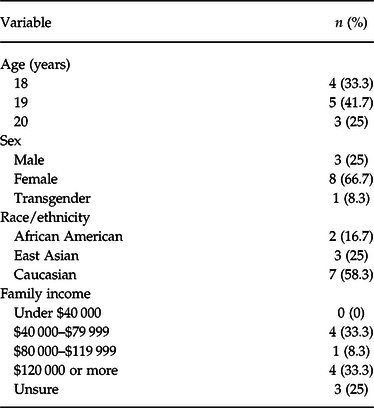
All participants (n = 12) were psychology students from the College of William and Mary. Students were between the ages of 18 and 20 years, with a mean of 19. The majority of the participants were female (n = 8) and one participant identified as transgender. The majority of the participants identified as Caucasian (n = 7), and students reported their family income ranging from 40 000 to 120 000 or more (see Table 1).
Descriptive demographic and clinical data for study participants (n = 12)

Survey results
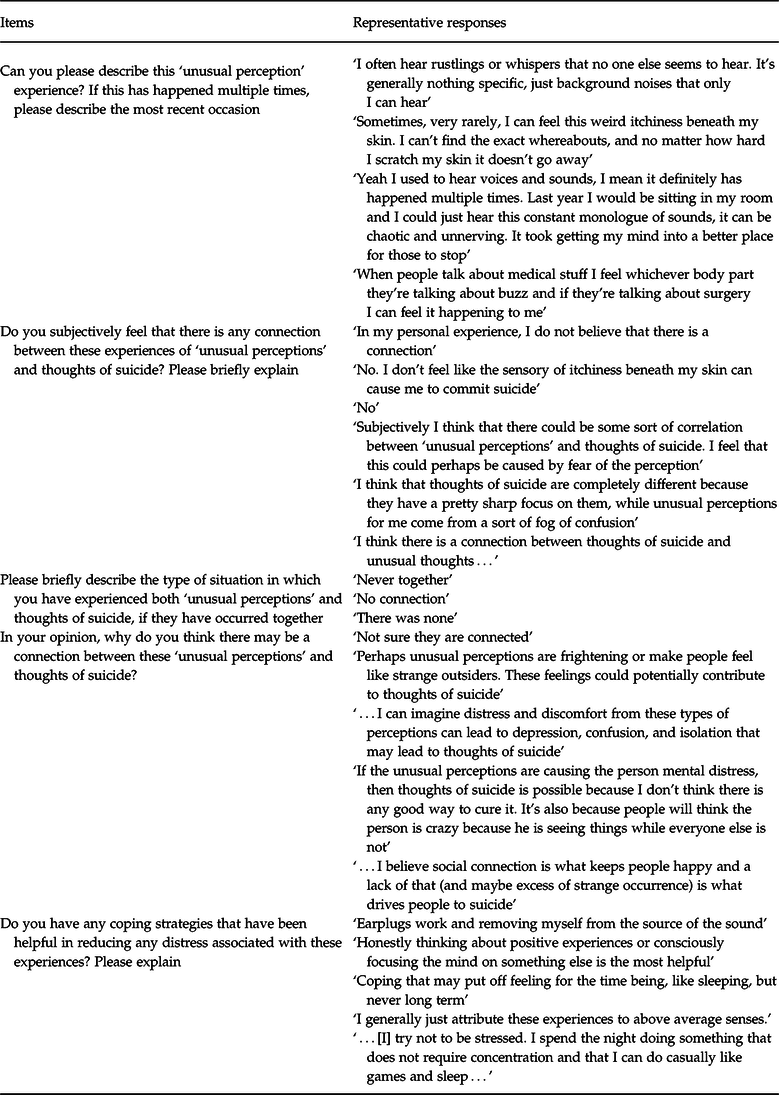
Findings from peer-reviewed analysis are presented by themes: (1) unusual experiences and perceptions; (2) indirect connection between psychotic experiences and suicidal thoughts and behaviors; (3) stigma as a potential mediator; and (4) coping mechanism. Illustrative examples of respondent statements are provided and organized by question in Table 2.
Responses to pertinent survey questions (n = 12)

Unusual experiences and perception
When asked to describe the subjective nature of the psychotic experiences, respondents endorsed a range of experiences including physical sensations and voices that, at the least severe end, may be better defined as unusual perceptions, and at the most severe end, appeared to resemble true hallucinations.
I often hear rustlings or whispers that no one else seems to hear. It’s generally nothing specific, just background noises that only I can hear.
Yeah I used to hear voices and sounds, I mean it definitely has happened multiple times. Last year I would be sitting in my room and I could just hear this constant monologue of sounds, it can be chaotic and unnerving. It took getting my mind into a better place for those to stop.
Indirect connection between psychotic experiences and suicidal thoughts and behaviors
When asked about the relationship between these experiences and thoughts of suicide, the majority did not report a subjectively direct connection (91.6%, n = 11), although several implied possible indirect connection. One endorsed that there could be a direct connection. All respondents denied experiencing psychotic experiences and suicidal ideation or behavior concurrently.
In my personal experience, I do not believe that there is a connection. (Participant #)
I think that thoughts of suicide are completely different because they have a pretty sharp focus on them, while unusual perceptions for me come from a sort of fog of confusion. (Participant #)
No. I don’t feel like the sensory of itchiness beneath my skin can cause me to commit suicide. (Participant #)
Potential mediators
When asked to explain why a connection between psychotic experiences and suicidal thoughts or behavior may exist, respondents either denied a direct connection or suggested that stigma would explain this relationship. Instead, respondents suggested potential indirect connections through stigma, lack of social connection, and fright caused by psychotic experiences.
I can imagine distress and discomfort from these types of perceptions can lead to depression, confusion, and isolation that may lead to thoughts of suicide. (Participant #)
I believe social connection is what keeps people happy and a lack of that (and maybe excess of strange occurrence) is what drives people to suicide (among people with psychotic experiences). (Participant #)
Perhaps unusual perceptions are frightening or make people feel like strange outsiders. These feelings could potentially contribute to thoughts of suicide. (Participant #)
Coping mechanisms
When asked about their coping skills used to deal with their experiences, responses ranged from completing an activity/action, changing their thoughts, or using physical coping aides. One respondent pointed out that copying mechanism like sleeping cannot be a long-term solution.
…[I] try not to be stressed. I spend the night doing something that does not require concentration and that I can do casually like games and sleep… (Participant #)
Earplugs work and removing myself from the source of the sound. (Participant #)
Coping that may put off feeling for the time being, like sleeping, but never long term. (Participant #)
Discussion
Respondents in this non-clinical sample of college students did not endorse a notable subjective relationship between psychotic experiences and suicidal ideation or suicide attempts. This finding is consistent with previous research that found that the association between psychotic experiences and suicidal ideation and attempts was largely eliminated when adjusting for socioenvironmental shared risk factors, suggesting that the relation between these phenomena is not direct or causal (DeVylder et al. Reference DeVylder, Jahn, Doherty, Wilson, Wilcox, Schiffman and Hilimire2015 a). Previous research has identified a relationship between psychotic experiences and suicidal ideation, primarily in epidemiological samples that benefit from large sample sizes but lack temporal resolution to determine whether psychotic experiences and suicidal thoughts occurred within the same moment or simply within the same year or lifetime (Kelleher et al. Reference Kelleher, Lynch, Harley, Molloy, Roddy, Fitzpatrick and Cannon2012 b, Reference Kelleher, Corcoran, Keeley, Wigman, Devlin, Ramsay, Wasserman, Carli, Sarchiapone, Hoven and Wasserman2013; DeVylder et al. Reference DeVylder, Lukens, Link and Lieberman2015 b; Koyanagi et al. Reference Koyanagi, Stickley and Haro2015). However, according to most of the respondents in this sample, these two symptoms are not co-occurring at the same moment, but they may be subjectively and indirectly connected, such as through stigma or social isolation.
Clinical implications
The relation between psychotic experiences and suicidal ideation identified in large epidemiological samples (Penagaluri et al. Reference Penagaluri, Walker and El-Mallakh2010; Kelleher et al. Reference Kelleher, Lynch, Harley, Molloy, Roddy, Fitzpatrick and Cannon2012 b, Reference Kelleher, Corcoran, Keeley, Wigman, Devlin, Ramsay, Wasserman, Carli, Sarchiapone, Hoven and Wasserman2013; DeVylder et al. Reference DeVylder, Lukens, Link and Lieberman2015 b; Koyanagi et al. Reference Koyanagi, Stickley and Haro2015) may be due to the high prevalence of both phenomena among individuals with extensive mental health comorbidities (Kelleher et al. Reference Kelleher, Keeley, Corcoran, Lynch, Fitzpatrick, Devlin, Molloy, Roddy, Clarke, Harley and Arseneault2012 a; DeVylder et al. Reference DeVylder, Burnette and Yang2014). Thus, both psychotic experiences and suicidal behavior may be indicators of severe psychological distress, even if they are not directly related to one another. It is also feasible that stigma, due to these broader psychological issues, may contribute to the expression of more severe symptoms such as suicidal ideation and psychotic experiences. Yanos et al. (Reference Yanos, Roe, Markus and Lysaker2015) found that internalized stigma reduced the individual’s hope and self-esteem, which lead to negative outcomes such as social avoidance and negative coping, all of which have strong correlations to suicidal ideation (Brausch & Decker, Reference Brausch and Decker2014).
Limitations and future research
Although sample size of this study is within the typical range for qualitative studies (Dworkin, Reference Dworkin2012), findings of this study may not generalize across all individuals experiencing psychotic symptoms with a history of suicidal behavior because of the small sample size. Generalizability is particularly a concern given the use of a college student convenience sample, as university students are likely to be high functioning and perhaps more resilient to stress (Braveman et al. Reference Braveman, Cubbin, Egerter, Williams and Pamuk2010), although all included individuals did score notably high on validated measures of psychotic experiences and suicidal ideation and behavior. Nonetheless, it is possible that a subjective connection between psychotic experiences and suicidal behavior may be limited to people with more significant symptoms that may have been missed in our sample. This speaks to a broader issue in measurement of psychotic experiences, which will benefit from further explanation of the types of experiences that qualify for a positive response on common psychosis measures among survey participants in the general population. Despite these limitations, the predominant rejection of a subjective connection between psychotic experiences and suicidal ideation or behavior in this sample argues against a subjectively causal relation but should be replicated in larger samples with more clinically significant symptoms. Future research should further investigate the specific timing of psychotic experiences and suicidal ideation in relation to one another and explore other potential mechanisms (e.g. shared social or biological risk, stigma due to general psychological distress) that may explain the frequent co-occurrence of these phenomena in general and clinical populations.
Acknowledgments
None.
Financial Support
This research received no specific grant from any funding agency, commercial, or not-for-profit sectors.
Conflicts of Interest
The authors have no conflicts of interest to disclose.
Ethical Standards
The authors assert that all procedures contributing to this work comply with the ethical standards of the relevant national and institutional committee on human experimentation with the Helsinki Declaration of 1975, as revised in 2008. The study protocol was approved by the ethics committee of each participating institution.