I. INTRODUCTION
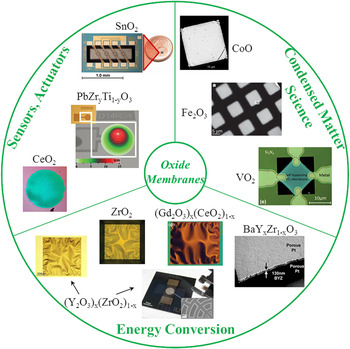
Membranes that possess selective transport properties are ubiquitous in everyday life, from inorganic devices such as batteries to biological ion channels in cell walls. Though vastly different in purpose, the underlying mechanism of operation is strikingly similar. The membrane serves to separate regions of dissimilar chemical potentials and allows selective permeation of a particular species that determines the overall functionality. In this review, we will focus on the emerging field of complex oxide nanomembranes having thicknesses in the range of 10–100 nm, with particular emphasis on their use in the context of energy conversion devices. We discuss fabrication challenges and complexities involved in forming stable suspended oxide membranes and representative enabling device technologies. The oxygen ion conducting electrolyte is used as a case study in the framework of an energy conversion device, namely thin film solid oxide fuel cells (TF-SOFCs), to exemplify specific advances in device fabrication and testing, but the ideology presented is widely pertinent to many oxide material systems. Figure 1 illustrates some oxide materials that have been realized as nanomembranes to date, grouped by respective functionality. Reference Elmi, Zampolli, Cozzani, Mancarella and Cardinali1–Reference Sim, Zhou and Ramanathan11 It is tremendously challenging to fabricate oxide membranes due to their inherent brittleness and the sensitivity of electronic properties to subtle composition changes such as cation or anion nonstoichiometry. The motivation for reducing dimensionality of these materials is linked to three main aspects: (A) exploring the ultimate limits of material functionality, (B) reduction of losses related to oxide separator components at the nanoscale, and (C) exploration of the interplay between science, engineering, and manufacturing for societally relevant technologies.
A brief survey of complex oxide nanomembranes with applications in sensors and actuators, energy conversion, and condensed matter science is shown. While there is overlap with the applications of many of these materials, they are grouped to demonstrate the versatility that complex oxides possess. Within sensors and actuators, a fully fabricated metal-oxide (MOX) sensing module with SnO2, Reference Elmi, Zampolli, Cozzani, Mancarella and Cardinali1 piezoelectric Pb(ZryTi1−y )O3 for micro-electromechanical systems (MEMS) systems, Reference Nguyen, Vu, Blank and Rijnders2 and CeO2 as an oxygen conductor or strain sensor. Reference Kossoy, Frenkel, Feldman, Wachtel, Milner and Lubomirsky3 Within energy conversion, ZrO2 for oxygen conduction in thin film fuel cells or oxygen sensors, Reference Ko, Kerman and Ramanathan4 large area YSZ membrane for transport studies, Reference Garbayo, Tarancón, Santiso, Peiró, Alarcón-Lladó, Cavallaro, Gràcia, Cané and Sabaté5 an integrated YSZ membrane for a TF-SOFC, Reference Rey-Mermet and Muralt6 mixed conducting CGO for TF-SOFCs or chemical strain sensors, Reference Greenberg, Wachtel, Lubomirsky, Fleig and Maier7 and proton-conducting BaY0.2Zr0.8O3 application in fuel cells. Reference Shim, Park, An, Gür, Kang and Prinz8 Within condensed matter science, a monolayer of CoO produced by self-assembly for nanosieves, Reference He, Kanjanaboos, Frazer, Weis, Lin and Jaeger9 self-assembled Fe2O3 for meta-materials, Reference Dong, Chen, Vora, Kikkawa and Murray10 and VO2 for low power switching. Reference Sim, Zhou and Ramanathan11 All figures have been reprinted with permission from respective publishers.

A. Fundamental oxide material considerations
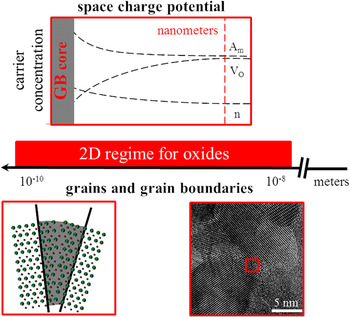
Figure 2 presents some of the length scales and physical phenomena of interest.
Reference Tsuchiya, Lai, Johnson and Ramanathan12
Of note is that two-dimensional crossover in complex oxides is not necessarily at the monolayer scale. Induced space charge potentials can be a function of dopant concentration, temperature, and oxygen partial pressure.
Reference De Souza13
The profile of carriers is significantly influenced at length scales on the order of tens of nanometers. The fundamental limitations of thickness reduction for a separation membrane can be related to the ability to selectively conduct, described by the transference number,
 ${t_{\rm{i}}} = {\textstyle{{{{\rm{\sigma }}_{\rm{i}}}} \over {{{\rm{\sigma }}_{\rm{i}}} + {{\rm{\sigma }}_{\rm{e}}}}}}$
, where σi and σe represent ionic and electronic conductivity, respectively. For example, consider the oxide electrolyte that must have electronic insulating properties in conjunction with selective ionic conduction, t
i = 1. In ultrathin films, the characteristic sample length can approach the Debye length (λ) which is expressed by,
 ${\rm{\lambda }} = \sqrt {{\textstyle{{{\rm{\varepsilon }}{{\rm{\varepsilon }}_0}kT} \over {2{F^2}{z^2}C}}}}$
, where εε0 is the dielectric permittivity, k is the universal gas constant, T is the absolute temperature, F is the Faraday's constant, z is the charge of the ionic species, and C is the bulk concentration of the majority carrier. λ is typically on the order of tens of nanometers, which can be comparable to film thicknesses in membranes. Two-dimensional effects such as anomalous inversion can set in at or below this length scale. In some cases, this is defined by an alternate dimension such as the electrical boundary width in an internal interface; for example, a grain boundary. Having such phenomena on similar length scales modifies the boundary conditions of Poisson's equation and can therefore have nontrivial effects on the carrier concentration profile as shown schematically in Fig. 2.
Reference Maier14,Reference Tuller15
λ can be considerably altered in aliovalently doped oxides, where the Mott–Schottky approximation is valid,
Reference Sze and Ng16
and as such, every case must be both theoretically and experimentally considered individually.
The common length scales discussed in this review and pertinent to complex oxide membranes in general. A generic carrier concentration profile for aliovalently doped oxides shows how singly charged acceptors (A m ), doubly charged oxygen vacancies (V O ), and electronic carriers (n) can vary spatially in regions on the order of tens of nanometers away from a grain boundary core. A representative transmission electron micrograph of polycrystalline YSZ Reference Tsuchiya, Lai, Johnson and Ramanathan12 and a schematic of a grain boundary are also shown. Micrograph used with permission.

Oxide heterostructures could have local regions of heterogeneous charge distribution leading to anomalous conduction behavior. Polycrystalline films have an inherent space charge region, originating from local areas of electrostatic charge such as grain boundary cores. A nonuniform chemical profile must exist in the near vicinity of such regions to maintain electrochemical neutrality. Reference Tuller, Litzelman and Jung17 Nanocrystalline materials, such as many of the thin films described herein, may have grain sizes that approach λ. This may result in substantially different transport properties of nanostructured films compared to bulk counterparts. For example, a significant research effort evaluating the effects of thickness scaling on films bound to a substrate, which is also related to film strain, on σi in the (Y2O3) x (ZrO2)1−x (YSZ) system has resulted in alternative observations of enhanced Reference Kosacki, Rouleau, Becher, Bentley and Lowndes18–Reference Sillassen, Eklund, Pryds, Johnson, Helmersson and Bøttiger21 and reduced Reference Gerstl, Friedbacher, Kubel, Hutter and Fleig22–Reference Navickas, Gerstl, Friedbacher, Kubel and Fleig25 σi. With regard to grain size reduction, it is generally accepted that the grain boundaries of ZrO2 and CeO2 based electrolytes are positive. Reference Kim and Maier26–Reference Tschöpe28 Therefore, decreasing grain size in these systems should lead to a decrease in σi and increase in electronic conductivity, which has been corroborated for YSZ. Reference Durá, López de la Torre, Vázquez, Chaboy, Boada, Rivera-Calzada, Santamaria and Leon29
Oxide films in the sub-100 nm thickness range also present chemical complexity in that dopant segregation can play an increasingly significant role in the optimal conductivity and phase stability. Early work on the enhancement of σi in YSZ and CeO2 thin films hinted at the difference in stoichiometry between nanocrystalline films and their bulk counterparts. Reference Kosacki, Suzuki, Petrovsky and Anderson30 Recent studies have shown that σi of (Gd2O3) x (CeO2)1−x (CGO) thin films with thickness comparable to grain size (20 nm) is over four times higher than that of bulk and can be attributed to reduction of grain boundary resistance in conjunction with Gd dopant segregation. Reference Huang, Gur, Saito and Prinz31 Dopant distribution in CGO, and hence the transport behavior, has been shown to be largely influenced by annealing conditions in controlled oxygen partial pressures. Reference Karthikeyan, Tsuchiya, Chang and Ramanathan32 Molecular dynamics simulations show that the conductivity of YSZ can increase two orders of magnitude at ultralow thicknesses (3–9 nm) due to dopant segregation at the film–substrate interface. Reference Sankaranarayanan and Ramanathan33 An enhancement of σi in YSZ films (1000-nm thickness) having a grain size in the range of 30–50 nm was observed at unexpectedly low Y2O3 doping concentrations, ascribed to the extension of the cubic phase below equilibrium doping levels expected from the bulk phase diagram due to nanocrystalline grain structure. Reference Jung, Hertz and Tuller34 It is noted here that most studies have been conducted with in-plane geometry on thin films bound to a substrate. Studies on suspended membranes could lead to unambiguous conclusions on the nature of charge conduction at these length scales. For example, Garbayo et al. Reference Garbayo, Tarancón, Santiso, Peiró, Alarcón-Lladó, Cavallaro, Gràcia, Cané and Sabaté5 have characterized the out-of-plane conductivity of YSZ membranes noting that σi was similar to that of bulk for film thicknesses in the range of 60–240 nm, though comparable films on a substrate were an order of magnitude lower. Fabrication and transport measurements on suspended oxide nanomembranes are an elegant way to probe some of the aforementioned scientific challenges but require significant experimental effort.
B. Electrochemical potential separation and membrane considerations
In electrochemical devices that utilize two electrodes separated by an electrolyte component, there are three main losses, one of which is associated ionic transport across the electrolyte.
Reference Singhal and Kendall35
In the case of oxygen conduction, the oxygen flux per unit area can be expressed by
 $j = {{\rm{\sigma }}_{\rm{i}}}{\textstyle{{{\rm{d\varphi }}} \over {{\rm{d}}x}}}$
, where
 ${\textstyle{{{\rm{d\varphi }}} \over {{\rm{d}}x}}}$
represents linear voltage gradient across the electrolyte, respectively.
Reference O'Hayre, Cha, Colella and Prinz36
In the limit
 ${\textstyle{{{\rm{d\varphi }}} \over {{\rm{d}}x}}} = {\textstyle{{\rm{\varphi }} \over h}}$
, where
 ${\rm{\varphi }}$
is the cell voltage and h is the electrolyte thickness, it can be deduced that the resistance takes a form similar to Ohm's law and is directly proportional to h. As a result, reducing the electrolyte thickness can effectively minimize transport loss through the separator. This formalism assumes that there is equivalent electrochemical activity across the surface of the electrodes, which is often not the case in heterogeneous porous electrodes. However, this assumption serves as a bound for discussion and motivation for the experimental work described herein.
As discussed in Sec. I. A, the effects of dimensionality and grain size can be understood through characteristic length scales such as λ; however, the influence of strain is not as straightforward and requires the consideration of multiple contributions, including local lattice distortion. In an effort to explain the origins of interface-induced enhancements of σi in ultrathin films, several theoretical works have emerged. First principle studies have indicated that oxygen diffusivity can increase up to a critical tensile strain and revealed that there are competing lattice strain and local bonding components of importance for macroscopic transport. Reference Kushima and Yildiz37,Reference Rushton, Chroneos, Skinner, Kilner and Grimes38 A recent experimental investigation of epitaxial YSZ has corroborated the former studies, showing an enhanced σi, with decreased activation energy for films below 15 nm. Reference Jiang, Hu, Shen, Ni and Hertz39 Work on CeO2 based materials has highlighted the importance of how processing routes can be a strong factor in determining lattice strain and thus, the effects on σi. Reference Rupp40 Further, recent work on CeO2 and YSZ has shown the coexistence of amorphous and crystalline materials in some nanostructured films processed by spray pyrolysis, Reference Rupp, Scherrer, Harvey and Gauckler41,Reference Scherrer, Heiroth, Hafner, Martynczuk, Bieberle-Hütter, Rupp and Gauckler42 which can hinder transport properties if not adequately considered during processing.
C. Synergistic benefits of membrane structures
Oxide membranes have the potential to provide insight into the aforementioned subjects as a robust tunable experimental platform. Structures made with oxide materials having a wide variety of applications are ripe for exploration across chemistry, physics, materials science, mechanics, and engineering. The ability to probe such structures requires detailed transport expertise, while new models to describe the behavior of the aforementioned physical phenomena require the cooperation of rigorous experimental and theoretical efforts. Figure 3 presents a schematic illustration of the various property relationships that can be probed using membrane structures described in this review.
A schematic example of the complex material research interplay described in this review, with symbols described in detail throughout the text.

The remainder of this review is organized into three sections focused on (II) membrane fabrication methods and design considerations; (III) a case study of energy conversion devices, TF-SOFCs, utilizing oxide membrane electrolytes; and (IV) future research directions and possibilities for oxide membranes.
II. FABRICATION OF SUSPENDED OXIDE MEMBRANES
The creation of a useful self-supported oxide membrane is a significant experimental challenge which can be approached by two main techniques: (A) chemical and (B) physical. The complexity and issues associated with electrical probing of suspended membranes are discussed in Sec. III.
A. Chemical approaches to membrane fabrication
Chemical approaches utilize a transfer process to span the thin film material over an opening or grid, whereas physical methods remove an underlying support layer to release the membrane. The former routes can be achieved using a Langmuir–Blodgett (LB) technique to transfer a film to a patterned substrate. Reference Lvov, Essler and Decher43 The LB technique utilizes a group of amphiphilic molecules that arrange to minimize surface energy, forming an ultrathin film at a liquid/air interface. This film can then be transferred to an arbitrary substrate by pulling vertically through the monolayer, assuming that the wetting characteristics are well known. Reference Roberts44 Some oxide membranes, such as graphene-oxide and Fe2O3, Reference He, Kanjanaboos, Frazer, Weis, Lin and Jaeger9,Reference Dong, Chen, Vora, Kikkawa and Murray10,Reference Cote, Kim and Huang45 have been fabricated in this way. Simple solution-based techniques, such as vacuum filtration explored in graphene oxide, Reference Eda, Fanchini and Chhowalla46 may also play a significant role in cost-effective fabrication of membranes. There are many other chemical approaches to forming ultrathin films for membrane applications, Reference Cheng, Campolongo, Tan and Luo47 however, the majority of techniques have not found utility for oxide materials and therefore their use remains limited in the context of this review.
B. Physical approaches to membrane fabrication
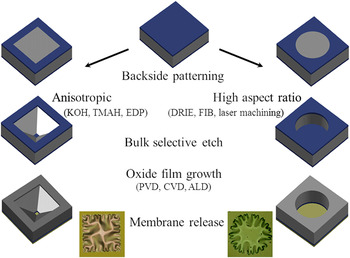
Utilizing a physical method typically involves the growth of a film on a patterned substrate followed by several selective etch steps to form the self-supported membrane. Oxide film growth can be carried out using a plethora of techniques that classify broadly into physical vapor deposition (PVD), chemical vapor deposition (CVD), and atomic layer deposition (ALD). These methods have been discussed recently in the perspective of oxide materials utilized for TF-SOFCs. Reference Will, Mitterdorfer, Kleinlogel, Perednis and Gauckler48,Reference Pederson, Singh and Zhou49 There are numerous factors influencing the choice of deposition process, but the end result, in the context of forming oxide membranes, is equivalent. A generic schematic outline of the membrane processing steps is depicted in Fig. 4. The method is broadly applicable provided the etch characteristics of a given substrate are established and can be used in a vast number of material systems. It should be noted that there are specific concerns, requiring due diligence to achieve pristine membranes. We will discuss this aspect in two central subcategories of (C) substrate etching and micromachining and (D) mechanics of suspended membranes.
An illustration of the physical procedure for producing oxide membranes on an easily etched substrate using conventional semiconductor processing techniques is shown. A barrier layer is needed on both sides of the substrate for pattern transfer and bulk micromachining, respectively. This backside is patterned using a lithographic technique and subsequently selectively etched to reveal the desired feature on the front side of the substrate. After the oxide film is deposited, the final support is etched away, creating a self-supported clamped membrane. Two schematic illustrations are shown and described in the text as anisotropic and high aspect ratio etches. A representative optical micrograph of a released YSZ oxide nanomembrane is shown for each case with a square of side length 160 μm and a circle of diameter 100 μm. Reference Kerman, Lai and Ramanathan50

C. Etching
Unlike much of the research described previously utilizing films on substrates, electrically interconnected membrane development requires significant microfabrication processing. Etching of the underlying substrate poses several complexities, such as geometric constriction, contamination, and postdeposition film stability. For example, in Si some common wet etchants used are potassium hydroxide (KOH), tetramethyl ammonium hydroxide (TMAH), or ethylene-diamine-pyrocatechol water (EDP).
Reference Williams and Muller51–Reference Korvink and Paul54
These solutions etch in an anisotropic manner, meaning that there is a significantly higher etch rate along certain crystallographic directions. There is an abundance of data on KOH and it is widely used in microelectromechanical systems (MEMS).
Reference Liu, Mungurwadi and Nandi53,Reference Korvink and Paul54
KOH has a selectivity, the ratio of etching rates along different directions, of up to 1:400 for (111)/(100). Therefore, when using this substrate–etchant combination, the geometric membrane design inherently possesses straight edges and hence, corners. Many self-supported YSZ membranes and TF-SOFCs fabricated to date have used this approach
Reference Garbayo, Tarancón, Santiso, Peiró, Alarcón-Lladó, Cavallaro, Gràcia, Cané and Sabaté5,Reference Evans, Bieberle-Hütter, Rupp and Gauckler55–Reference Litzelman, Hertz, Jung and Tuller59
; though a stress concentrator, such as a corner, is not traditionally desired. An anisotropic etch greatly hinders the active membrane area utilized per substrate. For example, fabricating a square membrane of side length 200 μm on a 500-μm-thick (100) Si substrate using KOH necessitates a square of side length 908 μm be patterned on the backside, leading to approximately 22% surface area utilization, defined as
 ${\textstyle{{{\rm{Are}}{{\rm{a}}_{{\rm{membrane}}}}} \over {{\rm{Are}}{{\rm{a}}_{{\rm{patterned}}}}}}}$
, not accounting for unused substrate area, which would further lower utilization. This aspect can be significantly improved as the membrane area is sizably scaled, though other stability and processing issues arise and additional support layers are necessary.
Reference Tsuchiya, Lai and Ramanathan60
Nevertheless, KOH is often used due to its low cost and fast etch rates. An additional benefit, not explored or discussed to date, is the possibility of generating H2 during microfabrication processes that could later be used as fuel in TF-SOFCs or other electrochemical devices. KOH etches Si through the following reaction
Reference Seidel, Csepregi, Heuberger and Baumgärtel61
;
 ${\rm{Si}} + 2{\rm{O}}{{\rm{H}}^ - } + 2{{\rm{H}}_2}{\rm{O}} \to {\rm{Si}}{{\rm{O}}_2}({\rm{OH}})_2^{2 - } + 2{{\rm{H}}_2}$
. Therefore, if evolved H2 gas was captured and stored during the processing of energy devices or MEMS, there could be a synergistic relationship between manufacturing and energy production. For example, KOH etching of an array of square membranes from a 500-μm-thick Si wafer having a diameter of 100 mm would result in the production of a few cubic centimeters of H2. Taking this to an industrial scale, i.e., thousands of wafers processed per day, indicates that this may be a feasible potential venture depending on capital costs.
An alternative to the commonly used anisotropic etchants described above are isotropic agents such as HF, which we will not discuss in detail as it typically etches oxide materials rendering it difficult to use, but there have been explorations into its feasibility for particular substrate film combinations. Reference Rupp, Muecke, Nalam and Gauckler62,Reference Bieberle-Hütter, Reinhard, Rupp and Gauckler63 In contrast, high aspect ratio micromachining can be achieved using methods such as deep reactive ion etching (DRIE), laser micromachining, focused ion beam (FIB), or powder blasting. Reference Liu, Mungurwadi and Nandi53,Reference Korvink and Paul54 While these methods are more costly and time consuming than the aforementioned anisotropic wet etches, they can lead to very high surface area utilizations. YSZ membranes for TF-SOFCs have been fabricated using DRIE processing. Reference Rey-Mermet and Muralt6 Corrugated oxide membranes, which have a larger projected geometric area than the actual patterned area, can also be made using a combination of DRIE and KOH techniques or nano-sphere lithography for TF-SOFC applications. Reference Su, Chao, Shim, Fasching and Prinz64–Reference Chao, Hsu, Cui and Prinz66 Other less common substrates, such as glass, have been micromachined using some of the aforementioned techniques to fabricate oxide membranes for use in TF-SOFCs. Reference Muecke, Beckel, Bernard, Bieberle-Hütter, Graf, Infortuna, Müller, Rupp, Schneider and Gauckler67
Once the micromachining has been carried out and the oxide film has been grown, the membrane must be released. This is achieved by removing the etch-stop, which in the case of Si, is typically SiO2 or Si3N4 since they possess slow etch rates in the previously described mediums. These barriers are removed by plasma etching using a combination of CF4, SF6, and O2 gases. Reference Liu, Mungurwadi and Nandi53,Reference Korvink and Paul54 During processing, the oxide film is passively exposed to the plasma environment and when the barrier layer is fully removed, the oxide is directly exposed. Therefore, the impact of these species on the physical properties of oxide films, such as surface morphology, film thickness, microstructure, and conductivity should be considered when developing processing schemes to fabricate oxide membranes. For oxygen conducting materials used in TF-SOFCs, such as YSZ and CGO, these final etches appear to have negligible effects. Reference Garbayo, Tarancón, Santiso, Peiró, Alarcón-Lladó, Cavallaro, Gràcia, Cané and Sabaté5,Reference Baertsch, Jensen, Hertz, Tuller, Vengallatore, Spearing and Schmidt56,Reference Huang, Nakamura, Su, Fasching, Saito and Prinz58,Reference Bieberle-Hütter, Reinhard, Rupp and Gauckler63 The well-known oxide etching characteristics of HF has detrimental effects on CGO, Reference Bieberle-Hütter, Reinhard, Rupp and Gauckler63 rendering it impractical for many oxide film processes. Substrate specific contamination must also be considered. For example, Si contamination plays a vital role in the electrode kinetics and oxygen incorporation at the surface of YSZ, which necessitates carefully controlled fabrication. Reference Hertz, Rothschild and Tuller68 Further, significant migration (11 at.%) of Si to the surface of YSZ films grown on Si3N4/Si substrates has been observed at annealing temperatures of 1000 °C, whereas only trace amounts (1 at.%) were detected for samples annealed at 600 °C. Reference Scherrer, Rossi, Martynczuk, Rossell, Bieberle-Hütter, Rupp, Erni and Gauckler69 Of course, as described previously, using ultrathin YSZ membranes enables the lowering of operating temperatures in TF-SOFCs, moving device temperatures away from this potential degradation mechanism.
D. Mechanics of suspended membranes
Deposition of the oxide film that will constitute the membrane is arguably the most important aspect of the fabrication process for numerous reasons, discussed below. Although the implementation and creation of robust oxide membranes are in their infancy, there is much to be gained from previous work in solid mechanics. The fundamental physical aspects of buckling in mechanically clamped membranes, often referred to as thin plates, is a well-studied problem.
Reference Timoshenko70–Reference Tallinen, Astrom and Timonen74
For square membranes, buckling deformations can be characterized by a scaled stress parameter;
 $\widetilde {{{\rm{\sigma }}_0}} = {\textstyle{{{{\rm{\sigma }}_0}} \over E}}{\left( {{\textstyle{L \over h}}} \right)^2}$
, where σ0, E, L, and h represent the residual stress, elastic modulus, side length, and thickness of the film assuming a constant value of Poisson's ratio. This result follows from a rescaling of the von Karman energy function and can be modified for arbitrary geometries using a similar formalism.
Reference Landau, Lifshitz, Kosevitch and Pitaevskiĭ71
Material selection dictates E, but other parameters are externally controllable, though not necessarily independent. In polycrystalline films, σ0 can be a result of atomic peening and thermally induced stress during growth, whereas in epitaxial films, σ0 is largely related to the substrate–film lattice parameter mismatch.
Reference Freund and Suresh75
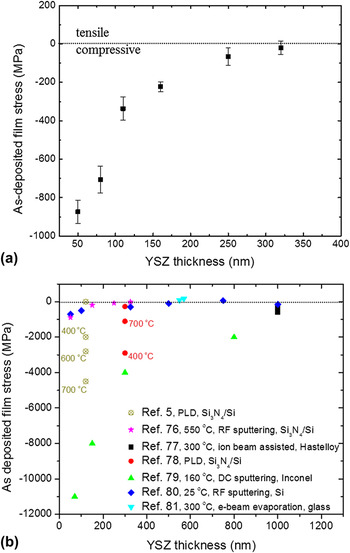
For polycrystalline YSZ grown by radio frequency (RF) sputtering, σ0 as a function of h is shown in Fig. 5(a)
The complexities of film deposition techniques on σ0 for polycrystalline YSZ with various dopant concentration, but all of cubic crystal structure; (a) thickness dependence of σ0 on RF sputtered YSZ deposited at 550 °C from an oxide target in 4.5 mTorr Ar on Si3N4/Si substrates Reference Kerman, Tallinen, Ramanathan and Mahadevan76 ; (b) an example of the various reported values of as-deposited film stress for YSZ using different PVD deposition techniques and substrates highlighting the importance of specific processes used during membrane fabrication. Reference Garbayo, Tarancón, Santiso, Peiró, Alarcón-Lladó, Cavallaro, Gràcia, Cané and Sabaté5,Reference Kerman, Tallinen, Ramanathan and Mahadevan76–Reference Xiao, He, Shao, Shao and Fan81

.
Reference Kerman, Tallinen, Ramanathan and Mahadevan76
The relaxation of the initial peening induced σ0 at larger film thicknesses is a result of crystallite coalescence, also referred to as grain growth.
Reference Freund and Suresh75,Reference Ohring82,Reference Spaepen83
It can be deduced that there is interplay between deposition conditions, which can control σ0, film thickness, and influence transport properties of the oxide film. Previous work on square micromachined membranes has outlined that buckling begins at
 $\widetilde {{{\rm{\sigma }}_0}}\∼{10^2}$
and that stable elastic configurations appear at
 $\widetilde {{{\rm{\sigma }}_0}}\∼{10^3}$
.
Reference Ziebart, Paul and Baltes72,Reference Kerman, Tallinen, Ramanathan and Mahadevan76
Deposition technique, conditions, and postprocessing can strongly influence the microstructure, crystalline quality, texture, and subsequently, σ0 of oxide films. Consequently, when designing an ultrathin oxide membrane, the region of stability using
 $\widetilde {{{\rm{\sigma }}_0}}$
remains valid, though the mechanisms by which it is achieved may differ depending on deposition techniques. A survey of σ0 as a function of film thickness for YSZ films grown by various techniques is plotted in Fig. 5(b),
Reference Garbayo, Tarancón, Santiso, Peiró, Alarcón-Lladó, Cavallaro, Gràcia, Cané and Sabaté5,Reference Kerman, Tallinen, Ramanathan and Mahadevan76–Reference Xiao, He, Shao, Shao and Fan81
showing the large spread of values for different film processing procedures on various substrates. Of particular note is that even the sign of the measured stress can be altered depending on the deposition technique. This is of extraordinary importance, indicating that individual film processing techniques and physical structures must be well described and characterized to produce robust membranes. For example, a systematic in situ study of the stress evolution of YSZ grown on Si by RF sputtering indicates that deposition rate is a key component in the steady state film stress, with larger compressive stresses appearing at slower deposition rates.
Reference Narayanachari and Raghavan84
This study does not take the significant aspect of growth stoppage and subsequent relaxation into account.
Reference Spaepen83
It also presents a constant stress value as a function of thickness up to 175 nm,
Reference Narayanachari and Raghavan84
confirming that postprocessing is of great significance when attempting to engineer
 $\widetilde {{{\rm{\sigma }}_0}}$
for stable membranes. Though we do not highlight growth pressure, deposition bias, or other key controllable aspects during film growth in Fig. 5(b), they are crucial parameters for as-deposited film stress and should be methodically studied for any prospective deposition process. This has been shown in brief for YSZ films.
Reference Quinn, Wardle and Spearing80,Reference Knoll and Bradley85
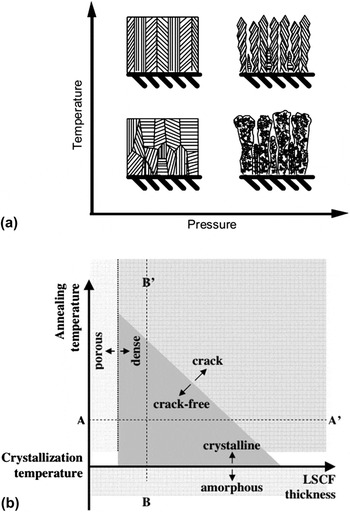
Figure 6(a) depicts an example temperature–pressure schematic of the microstructures obtained in YSZ and CGO films grown by pulsed laser deposition (PLD),
Reference Infortuna, Harvey and Gauckler86
illustrating that some of the microscopic complexity arising from film deposition must be addressed when attempting to form a stable oxide membrane. Recent work on the crystallization of YSZ films grown by PLD has highlighted how postannealing can determine microstructure, phase purity, and microstrain,
Reference Heiroth, Frison, Rupp, Lippert, Barthazy Meier, Müller Gubler, Döbeli, Conder, Wokaun and Gauckler88
which are of importance for film integration.
The effect of processing on microstructure: (a) a schematic illustration of the microstructural variation in YSZ and CGO films as a function of temperature and pressure Reference Infortuna, Harvey and Gauckler86 and (b) an example postprocessing diagram for LSCF thin films illustrating the complexity of engineering multiple oxides into a stable membrane structure. Reference Lai, Xiong, Tsuchiya, Johnson and Ramanathan87 Images are used with permission.

As described previously, microstructure such as grain size, shape, and orientation can have profound effects on transport properties. In the case of TF-SOFCs, a defect-free, gas tight YSZ membrane is necessary to maintain a potential difference; therefore any microstructural cracks or pinholes compromise the device efficiency. This aspect will be discussed in Sec. III but warrants consideration in the context of fabrication since great effort has been dedicated to making pin-hole free single layer, bilayer, and even trilayer oxide heterostructure membranes. Reference Lai, Xiong, Tsuchiya, Johnson and Ramanathan87,Reference Garbayo, Dezanneau, Bogicevic, Santiso, Gràcia, Sabaté and Tarancón89–Reference Lai, Kerman and Ramanathan94 When multiple dense oxide layers are desired in membrane form, the film deposition and postprocessing aspect is far more convoluted. Significant work on the postdeposition processing for sputtered films in the La x Sr1−x Co y Fe1−y O3 (LSCF)/YSZ self-supported membrane system has been undertaken by Lai et al. Reference Lai, Xiong, Tsuchiya, Johnson and Ramanathan87,Reference Lai, Kerman and Ramanathan92 A representative processing space for LSCF thin films is depicted in Fig. 6(b) and has been used to produce a robust manufacturing process for oxide heterostructure membranes for TF-SOFCs up to several millimeters in side length. Reference Lai, Xiong, Tsuchiya, Johnson and Ramanathan87
In addition to σ0, thermally induced strain, σ
T
, must be considered for membranes operating with a nonzero change in temperature (ΔT > 0). For a substrate and film having different linear coefficients of expansion,
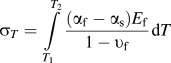 ${{\rm{\sigma }}_T} = \mathop \smallint \int\limits_{{T_1}}^{{T_2}} {{\left( {{{\rm{\alpha }}_{\rm{f}}} - {{\rm{\alpha }}_{\rm{s}}}} \right){E_{\rm{f}}}} \over {1 - {{\rm{\upsilon }}_{\rm{f}}}}}{\rm{d}}T$
.
Reference Ohring82
Here αf and αs represent the linear expansion coefficients of the film and the substrate, respectively and
 ${\textstyle{{{E_{\rm{f}}}} \over {1 - {{\rm{\nu }}_{\rm{f}}}}}}$
the biaxial modulus of the film. If αf ≠ αs, an additional tensile or compressive stress is generated when
 $|{\rm{\Delta }}T| > 0$
, which implies that careful optimization of σ0 is required to counteract an induced tensile fracture. This can occur in the event of σ
T
> 0 by classic tensile rupture or in the event of σ
T
< 0 by causing larger buckling deformations, in turn forming higher tensile bending stresses, potentially leading to failure. In the case of TF-SOFCs, the membrane fracture could lead to fuel air mixing, which has serious safety implications. Therefore, adequate material design and thin film engineering are necessary for robust membranes resistant to many thermal cycles and other external perturbations. In addition to σ
T
, the fabrication of complex oxide membranes undergoing a structural phase transition within the desired operating temperature requires knowledge of local lattice changes. A recent investigation on VO2 membranes elucidated that tensile stress associated with the metal–insulator phase transition led to spontaneous cracking which was accompanied by local twinning, signifying stress-induced plastic behavior.
Reference Balakrishnan, Ko and Ramanathan95
In fact, this tendency limited early research efforts on vanadium dioxide as domains could be permanently altered by the induced stress caused by the phase transition.
Reference Fillingham96
Nonetheless, vanadium oxide anodes have been successfully utilized in self-supported oxide membrane energy conversion and storage devices that are thermomechanically stable.
Reference Van Overmeere, Kerman and Ramanathan97
Complex oxides possess a unique nonstoichiometry induced stress discussed here as chemical stress, σc (also referred to as “chemical strain” in the literature).
Reference Kossoy, Frenkel, Feldman, Wachtel, Milner and Lubomirsky3,Reference Lubomirsky98–Reference Tuller and Bishop103
σc arises due to the fact that oxide crystals can exist with partially incomplete anion stoichiometry, the deviation frequently represented as δ. A recent theoretical study discussed the origins of σc being related to the formation of oxygen vacancies and the resulting cation radius change, which lead to respective lattice changes.
Reference Marrocchelli, Bishop, Tuller and Yildiz101
In the context of complex oxide membranes, σc must be adequately understood for a particular material system as well as fabrication process. For example, anomalous expansion of
 ${\rm{Ce}}{{\rm{O}}_{{\rm{2}} - {\rm{\delta }}}}$
materials at room temperature has been shown to lead to membrane instabilities over time.
Reference Kossoy, Frenkel, Feldman, Wachtel, Milner and Lubomirsky3,Reference Nair, Wachtel, Lubomirsky, Fleig and Maier104
In the context of TF-SOFCs, the construction of CGO–YSZ oxide alloys attempted to overcome some of the chemomechanical restraints of a material having large σc.
Reference Kerman, Lai and Ramanathan50
A recent study on the addition of ZrO2 to
 ${\rm{Ce}}{{\rm{O}}_{{\rm{2}} - {\rm{\delta }}}}$
has shown promise for reducing σc,
Reference Bishop, Marrocchelli, Fang, Amezawa, Yashiro and Watson102
possibly overcoming some of the additional mechanical challenges associated with chemical stress limiting the use of high σ
i
materials in membrane form. Additional information on the complexity and nature of σc can be found in the literature.
Reference Tuller and Bishop103,Reference Adler105,Reference Bishop, Duncan and Wachsman106
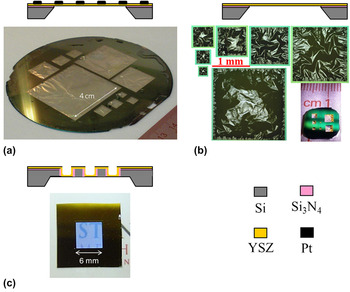
One of the crucial aspects toward the usage of oxide membranes is scalability. Despite the aforementioned challenges, Fig. 7 illustrates some of the triumphs in geometric scaling of YSZ membranes to date utilizing various unique approaches. Reference Tsuchiya, Lai and Ramanathan60,Reference Su and Prinz65 Grid-supported circular membranes having diameters up to five mm have also been fabricated. Reference Rey-Mermet and Muralt6 Another method leveraging a gel-supported technique was successful in fabricating square membranes with edge lengths up to five millimeters. Reference Johnson, Baclig, Harburg, Lai and Ramanathan107 Additional studies and investigations into the multifaceted nature of thermo-chemical-mechanical coupling in complex oxides is required to extend these auspicious initial results to a wider range of functional oxide materials. Similarly, a Weibull-type study on the failure statistics of fabricated membranes merits detailed investigation to supplement initial stress considerations. Reference Kerman, Tallinen, Ramanathan and Mahadevan76,Reference Evans, Prestat, Tölke, Schlupp, Gauckler, Safa, Hocker, Courbat, Briand, de Rooij and Courty78
The scalability of oxide membranes with YSZ thin films using three distinct techniques, namely grid support, stress control, and corrugation; (a) a grid supported design with membranes spanning several millimeters in side length, Reference Tsuchiya, Lai and Ramanathan60 (b) free-standing YSZ membranes with tuned internal film stress to span unsupported side lengths of up to 2.5 mm, and (c) a corrugated YSZ design with Si support showing an array of membranes. Reference Su and Prinz65 Images used with permission.

III. THIN FILM SOLID OXIDE FUEL CELLS
Integrating thin film electrolytes for fuel cells has long been considered a worthy goal. Reference Barnett108,Reference De Jonghe, Jacobson and Visco109 We discuss state of the art and challenging aspects of membrane integration by exploring (A) proof-of-concept energy conversion devices, (B) electrode challenges, and (C) new functionalities enabled by membrane technology.
A. Proof-of-concept thin film fuel cells with nanoscale electrolyte membranes
The motivation for using ultrathin oxide membranes for electrolytes in TF-SOFCs arises naturally since it enables lower operating temperatures and reduces transport losses, as discussed earlier. There has been a significant effort in fabricating and testing such structures, some of which have been described in brief elsewhere.
Reference Evans, Bieberle-Hütter, Rupp and Gauckler55
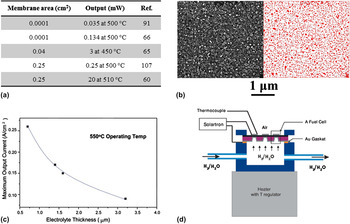
Figure 8(a) shows a representative survey of the areal scaling of YSZ membranes that have been incorporated into TF-SOFC structures.
Reference Tsuchiya, Lai and Ramanathan60,Reference Su and Prinz65,Reference Chao, Hsu, Cui and Prinz66,Reference Kwon, Son, Lee, Kim, Lee and Kim91,Reference Johnson, Baclig, Harburg, Lai and Ramanathan107
Theoretical limits on electrolyte thickness (h) reduction based on two distinct cases of electrode geometry describe the reduction of h in the context of electrode particle spacing (b), stating that h < 300 nm is not necessarily beneficial.
Reference Fleig, Tuller and Maier111
Nanoporous Pt electrodes, commonly used in TF-SOFCs, typically have particle spacing, and hence reaction sites, on the order of tens of nanometers as depicted in the micrograph shown in Fig. 8(b).
Reference Kerman, Lai and Ramanathan112
Linear reduction of Ohmic loss with electrolyte thickness is valid only when
 $h \gg b$
.
Reference Fleig, Tuller and Maier111
Therefore, based on the nanoporous electrodes utilized in TF-SOFCs, the benefits of electrolyte thickness reduction certainly stretch below 300 nm. In fact, subsequent work reviewing progress on dimensionality reduction of ionic conducting materials points out the advantage of devices having h ∼ 150 nm.
Reference Tuller, Litzelman and Jung17
Figure 8(c) shows an example of experimental scaling of the maximum current density (and hence power density) as a function of electrolyte thickness, showing an exponential increase.
Reference Ignatiev, Chen, Wu, Lu and Smith110
In addition, an ideal electrolyte area specific resistance (ASR) of 0.1 Ωcm2 or less is desired for SOFCs.
Reference Steele and Heinzel113
At 500 °C using stable, nonexotic electrolyte materials such as YSZ and CGO membranes, ASRs of 0.08 and 0.04 Ωcm2 have been reported.
Reference Kerman, Lai and Ramanathan50,Reference Kerman, Lai and Ramanathan112
(a) A survey of active area and total power output reported using free-standing YSZ membranes integrated into TF-SOFCs, Reference Tsuchiya, Lai and Ramanathan60,Reference Su and Prinz65,Reference Chao, Hsu, Cui and Prinz66,Reference Kwon, Son, Lee, Kim, Lee and Kim91,Reference Johnson, Baclig, Harburg, Lai and Ramanathan107 (b) a scanning electron microscope image and corresponding thresholded image showing the nanoporosity of Pt electrodes in TF-SOFCs, (c) the experimentally measured maximum current from a TF-SOFC as a function of electrolyte thickness, Reference Ignatiev, Chen, Wu, Lu and Smith110 (d) a test schematic of membrane structures utilized in TF-SOFC applications. Reference Huang, Nakamura, Su, Fasching, Saito and Prinz58 Images (c) and (d) used with permission.

Initial design aspects for TF-SOFCs described mechanical buckling as a failure, Reference Srikar, Turner, Andrew Ie and Spearing114,Reference Tang, Stanley, Wu, Ghosh and Zhang115 though a revised design space was later introduced, Reference Yamamoto, Quinn, Wicks, Hertz, Cui, Tuller and Wardle116 and a plethora of experimental evidence indicates that buckling is a necessary element for self-supported ultrathin oxide components. In addition to the thin film electrolyte, an anode and cathode where oxidation and reduction take place, respectively, are required to complete the TF-SOFC. Besides their electrochemical functions, the electrodes must have adequate electrical conductivity to draw electrons from the device and into an external load. Figure 8(d) shows a schematic of the transport processes and test structure used in typical TF-SOFC experiments. Reference Huang, Nakamura, Su, Fasching, Saito and Prinz58 Utilizing thin electrolytes has pioneered operation temperatures (T < 500 °C) previously inaccessible with equivalent materials and thus, high performance oxide electrodes are scarce at present. Therefore, many of the initial investigations have utilized porous metals as both the anode and cathode due to high electrocatalytic activity and electronic conductivity. However, commonly used metal films such as Pt often suffer from coarsening and dewetting effects at elevated temperatures and under electrochemical perturbations, Reference Mutoro, Günther, Luerßen, Valov and Janek117,Reference Galinski, Ryll, Elser, Rupp, Bieberle-Hütter and Gauckler118 which render the electrode microstructure of these proof-of-concept devices unstable.
A pristine membrane is essential for TF-SOFCs since the open circuit voltage (OCV) is determined by two factors; the thermodynamic redox potential of fuel/oxidant and adequate physical/electrical separation. The former is related to the catalytic activity of the electrodes and exact redox couple selected. For the most part, H2 and air (21% O2) have been used, which results in an OCV of approximately 1 V in the temperature range of interest (300 °C < T < 500 °C) for the electrochemical reaction,
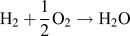 ${{\rm{H}}_2} + {1 \over 2}{{\rm{O}}_2} \to {{\rm{H}}_2}{\rm{O}}$
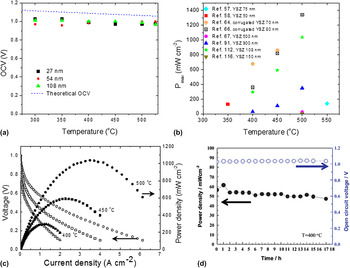
. The latter is a macroscopic culmination of the previously described complexities in oxide membrane fabrication. A gas tight seal can only be realized if there are no microstructural defects, such as pinholes or microcracks, through the thickness of the self-supported membrane. Further, any electronic leakage reduces the OCV and thus the voltage efficiency of the TF-SOFC. Figure 9(a) shows a plot of OCV as a function of temperature for several YSZ thicknesses, indicating that even with an electrolyte of 27 nm, a near ideal potential is maintained.
Reference Kerman, Lai and Ramanathan112
In the case of materials possessing mixed valent cations and thus 0 < t
i < 1, such as CGO, a percolative electronic path can emerge with critical compositions at the reducing interface.
Reference Kerman, Lai and Ramanathan50,Reference Kerman, Lai and Ramanathan120
OCVs have been shown to be stable over ranges of 10–50 h, indicating that the oxide membrane remains intact at high temperature under a chemical potential at these elevated temperatures.
Reference Kerman, Lai and Ramanathan50,Reference Kerman, Lai and Ramanathan112,Reference Kwon, Lee, Kim, Lee, Lee and Son119,Reference Wang, Huang, Holme, Tian and Prinz121
(a) Pt/YSZ/Pt TF-SOFCs showing a near ideal OCV with varying electrolyte thickness using 5% H2 as the fuel and air as the oxidant, Reference Kerman, Lai and Ramanathan112 (b) state of the art power densities for Pt/YSZ/Pt TF-SOFCs using both planar and corrugated membranes with YSZ membranes, Reference Johnson, Lai, Xiong and Ramanathan57,Reference Huang, Nakamura, Su, Fasching, Saito and Prinz58,Reference Su, Chao, Shim, Fasching and Prinz64,Reference Chao, Hsu, Cui and Prinz66,Reference Muecke, Beckel, Bernard, Bieberle-Hütter, Graf, Infortuna, Müller, Rupp, Schneider and Gauckler67,Reference Kwon, Son, Lee, Kim, Lee and Kim91,Reference Kerman, Lai and Ramanathan112,Reference Yamamoto, Quinn, Wicks, Hertz, Cui, Tuller and Wardle116 (c) current–voltage and current–power characteristics of a Pt/YSZ/Pt TF-SOFC at several temperatures using a 108-nm YSZ membrane electrolyte, Reference Kerman, Lai and Ramanathan112 and (d) an example of the temperature stability of performance and OCV of a Pt/YSZ/Pt TF-SOFC using a patterned Pt anode. Reference Kwon, Lee, Kim, Lee, Lee and Son119 Image (d) used with permission.

B. Electrode complexity and integration
A survey of the maximum power density of state-of-the-art TF-SOFCs utilizing Pt electrodes and YSZ membrane electrolytes is plotted in Fig. 9(b). Reference Johnson, Lai, Xiong and Ramanathan57,Reference Huang, Nakamura, Su, Fasching, Saito and Prinz58,Reference Su, Chao, Shim, Fasching and Prinz64,Reference Chao, Hsu, Cui and Prinz66,Reference Muecke, Beckel, Bernard, Bieberle-Hütter, Graf, Infortuna, Müller, Rupp, Schneider and Gauckler67,Reference Kwon, Son, Lee, Kim, Lee and Kim91,Reference Kerman, Lai and Ramanathan112,Reference Yamamoto, Quinn, Wicks, Hertz, Cui, Tuller and Wardle116 Power densities in excess of 1 W/cm2 have been routinely achieved at temperatures around 500 °C using H2 and air as the fuel and oxidant, respectively. Some current–voltage and current–power curves at various temperatures are shown for a planar YSZ-based TF-SOFC in Fig. 9(c). Reference Kerman, Lai and Ramanathan112 Unlike high temperature SOFCs, there appears to be a significant activation loss in these devices. This is largely undesirable since a sizable overpotential (driving voltage) is necessary to mediate the oxygen reduction reaction (ORR) on Pt, which has been a subject of intense research among the physical chemistry community in the context of proton exchange membrane fuel cells for years. Reference Marković, Schmidt, Stamenković and Ross122 Typically oxide cathodes do not exhibit this loss, which serves as motivation for material researchers to develop a stable high performance oxide cathode suitable for this temperature regime.
As seen in Fig. 9(b), there is variation in the performance of the Pt/YSZ/Pt devices, in part due to electrolyte thickness and configuration differences but largely owing to the microstructural complexity of the electrodes at elevated temperature and reducing conditions. Reference Kerman, Lai and Ramanathan112,Reference Wang, Huang, Holme, Tian and Prinz121 Additionally, the method of current collection strongly influences the maximum power being extracted from the cell. A power density increase by a factor of 1.6 was recently realized by adding a denser metallic current collecting grid onto a La x Sr1−x Co y O3 (LSC) cathode. Reference Noh, Hwang, Yoon, Kim, Lee, Lee and Son123 In the case of metal electrodes, only the triple phase boundaries, areas where the gaseous fuel, electrolyte, and electrode are in contact, are active reaction sites for oxidation and reduction. Consequently, engineering of the microstructure to create optimal porosity in the electrodes while maintaining an electrically interconnected network is of essence. However, as noted previously, the operational stability of such metallic electrodes is not at a desirable level. Reference Kerman, Lai and Ramanathan112,Reference Wang, Huang, Holme, Tian and Prinz121 Previous studies on Pt films on rigid substrates highlight the microstructural instability under TF-SOFC operating conditions, Reference Mutoro, Günther, Luerßen, Valov and Janek117,Reference Galinski, Ryll, Elser, Rupp, Bieberle-Hütter and Gauckler118 though there has been success in utilizing the dewetting effect to form regular and stable patterned Pt. Reference Baumann, Mutoro and Janek124 Further, recent work on TF-SOFCs has shown that the microstructure of Pt electrodes can be stabilized when using an anodized aluminum oxide template, showing losses of only 10% in power density after 17 h of operation, highlighted in Fig. 9(d). Reference Kwon, Lee, Kim, Lee, Lee and Son119 Nanosphere lithography is an alternative approach to engineering regularly patterned metallic electrodes that have been shown to be morphologically stable at elevated temperatures. Reference Brown, Wilke, Boyd, Goodwin and Haile125–Reference Lin and McIntyre127 However, the pattern density of such electrodes is far below what is necessary for high performance TF-SOFCs and thus may be limited to fundamental research similar to patterned complex oxide microelectrodes such as LSCF. Reference Simrick, Kilner, Atkinson, Rupp, Ryll, Bieberle-Hütter, Galinski and Gauckler128 In cells exhibiting power densities over 1 W/cm2, the anode triple phase boundary length per unit area was estimated to be 1,510,000 cm/cm2 from thresholded scanning electron micrographs. Reference Kerman, Lai and Ramanathan112 This is in the range of 800,000 cm/cm2 calculated from surface reconstruction experiments of traditional SOFC electrodes after operation. Reference Wilson, Kobsiriphat, Mendoza, Chen, Hiller, Miller, Thornton, Voorhees, Adler and Barnett129,Reference Wilson, Gameiro, Mischaikow, Kalies, Voorhees and Barnett130 Therefore, the porosity, tortuosity, and interconnectivity of random networks appear much more viable than regular patterning experimentally conceivable at present.
Efforts have been made to integrate complex oxide cathodes such as LSCF and Ba x Sr1−x Co y Fe1−y O3 (BSCF) onto YSZ membranes with varying degrees of success, forming bilayer oxide heterostructure membranes with porous platinum anodes. Reference Johnson, Lai, Xiong and Ramanathan57,Reference Tsuchiya, Lai and Ramanathan60,Reference Lai, Xiong, Tsuchiya, Johnson and Ramanathan87,Reference Lai, Kerman and Ramanathan92,Reference Kerman, Lai and Ramanathan93,Reference Johnson, Baclig, Harburg, Lai and Ramanathan107 Integration of these layers requires thorough knowledge of the various stresses resulting from fabrication described in Sec. II. D. BSCF suffers from a parasitic reaction with YSZ even at TF-SOFC temperatures, Reference Kerman, Lai and Ramanathan93 and is kinetically unstable over time at elevated temperature. Reference Mueller, De Souza, Weirich, Roehrens, Mayer and Martin131,Reference Niedrig, Taufall, Burriel, Menesklou, Wagner, Baumann and Ivers-Tiffée132 The power densities of LSCF/YSZ/Pt structures remain lower than that of Pt/YSZ/Pt counterparts but offer promise of the integration of dense oxide heterostructure membranes. As a proof of concept, LSCF/YSZ/LSCF membranes have been fabricated and survive thermomechanical stresses induced from fabrication and high temperature testing. Reference Lai, Kerman and Ramanathan94 However, it should be noted that oxide electrodes containing Sr, such as LSC, LSCF, and BSCF may suffer from the long-term issue of Sr surface segregation. Reference Bishop, Duncan and Wachsman133–Reference Huber, Falk, Rohnke, Luer, Gregoratti, Amati and Janek136
C. Novel capabilities of oxide membranes
The observation of low temperature protonic conduction in YSZ Reference Avila-Paredes, Barrera-Calva, Anderson, De Souza, Martin, Munir and Kim137,Reference Kim, Anselmi‐Tamburini, Park, Martin and Munir138 and similar oxides such as BaY x Zr1−x O3 (BYZ) has led to TF-SOFCs with protons as the mobile ionic species. Reference Shim, Park, An, Gür, Kang and Prinz8,Reference Pergolesi, Fabbri and Traversa139 Although the power densities reported in such systems is lower than what is shown in Fig. 9(b), proton-conducting ceramic membranes present opportunities in ultralow temperature (25 °C) power generation Reference Kim, Anselmi‐Tamburini, Park, Martin and Munir138 and steam permeation reforming of hydrocarbons. Reference Coors140 The challenges in designing oxide materials with chemical stability, ease of fabrication, and high protonic conductivity have been reviewed previously. Reference Fabbri, Pergolesi and Traversa141 Of course, reduction of Ohmic transport loss through the oxide makes membrane structures appealing in this class of rapidly evolving materials.
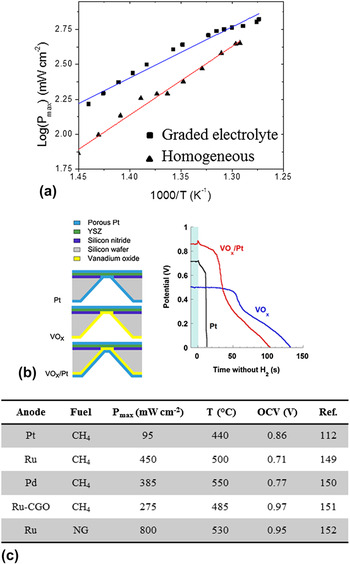
Thin film processing and membrane structures offer unique advantages not possible with bulk systems. For example, low temperature processing assisted by photon irradiation has been shown to lead to desired crystalline oxide phases. Reference Tsuchiya, Lai, Johnson and Ramanathan12,Reference Podpirka, Viswanath and Ramanathan142 Furthermore, to overcome structural limitations of CGO membranes due to σc, oxide alloys of CGO–YSZ were fabricated by co-sputtering at temperatures as low as 25 °C. Reference Kerman, Lai and Ramanathan50 This represents an enormous reduction in traditional processing temperatures in excess of 1300 °C needed to form solid solution mixtures of YSZ and CGO. Reference Price, Dong, Gu, Speakman, Payzant and Nenoff143,Reference Tompsett, Sammes and Yamamoto144 Tailoring of the electrolyte composition on the nanoscale is also possible when using bottom-up fabrication techniques. For example, superlattices of ALD-grown layers of Y2O3 and ZrO2 have been shown to form YSZ after high temperature annealing, exhibiting enhanced transport properties. Reference Ginestra, Sreenivasan, Karthikeyan, Ramanathan and McIntyre145 Similarly, studies on superlattices of SiO2 and CGO indicate that an apatite phase with high conductivity can be formed at the oxide interface. Reference Karthikeyan, Tsuchiya and Ramanathan146 Further, the addition of ALD surface layers (17.5 nm) of Y2O3-doped CeO2 on YSZ has been shown to increase ORR activity and overall performance of TF-SOFCs. Reference Fan, An, Iancu and Prinz147 An example of a compositionally graded electrolyte membrane that synergistically combines the mechanical stability of YSZ with higher σ i of CGO has been demonstrated using a co-sputtering process with varying deposition rates. Reference Kerman, Lai and Ramanathan120 It has recently been shown that CeO2 possesses a highly electrocatalytic surface, comparable to that of bare metals. Reference Chueh, Hao, Jung and Haile148 Therefore, using a graded membrane could lead to additional catalytic activity at the electrolyte–electrode interface, in addition to enhanced σi. As shown in Fig. 10(a), when comparing the kinetic behavior, shown in an Arrhenius plot, of a compositionally graded electrolyte with a homogeneous YSZ electrolyte operating with methane (CH4) as the fuel and air as the oxidant, there appears to be an advantage with the former. Reference Kerman, Lai and Ramanathan120 The activation barrier to maximum power of the compositionally graded electrolyte was calculated to be 0.72 eV, whereas that of the homogeneous electrolyte was 0.97 eV. Reference Kerman, Lai and Ramanathan120 Though this may be related to many factors, such as the surface energy contribution for metallic electrode spreading, the ability to create functionally graded structures for synergistic energy applications opens up a large design space for future materials. For reference, ionic transport in YSZ is typically characterized by an activation energy of ∼1 eV. Reference Garbayo, Tarancón, Santiso, Peiró, Alarcón-Lladó, Cavallaro, Gràcia, Cané and Sabaté5,Reference Guo23,Reference Kosacki, Suzuki, Petrovsky and Anderson30 Figure 10(b) shows an example of new device functionality in a TF-SOFC utilizing the mixed valence of vanadium oxide. Reference Van Overmeere, Kerman and Ramanathan97 In this scheme, with several proposed mechanisms related to hydrogen storage, oxygen concentration differences, or fuel-less redox of V at the anode, the TF-SOFC acts as both an electrochemical energy conversion and storage device. Reference Van Overmeere, Kerman and Ramanathan97 The key aspect of this work is demonstrating both fuel cell and battery characteristics in a single unique device. With practical application in mind, there have also been explorations into using abundant fuel sources such as CH4 and natural gas with TF-SOFCs. Recent results are briefly summarized in Fig. 10(c). Reference Kerman, Lai and Ramanathan112,Reference Takagi, Lai, Kerman and Ramanathan149–Reference Takagi, Kerman, Ko and Ramanathan152 However, long-term stability of electrodes using hydrocarbon fuels remains an open problem. Reference Atkinson, Barnett, Gorte, Irvine, McEvoy, Mogensen, Singhal and Vohs153–Reference Mogensen and Kammer155
Novel abilities in thin film processing exhibited by (a) an Arrhenius plot of the maximum power density in TF-SOFCs with a compositionally graded (CGO–YSZ) and homogeneous YSZ electrolyte, Reference Kerman, Lai and Ramanathan120,Reference Takagi, Lai, Kerman and Ramanathan149 (b) vanadium oxide anodes exhibiting the unique capability of both energy conversion and storage by using a multivalent complex oxide electrode in a TF-SOFC, Reference Van Overmeere, Kerman and Ramanathan97 and (c) a table summarizing the recent results of TF-SOFCs tested with fuels other than H2. Reference Kerman, Lai and Ramanathan112,Reference Takagi, Lai, Kerman and Ramanathan149–Reference Takagi, Kerman, Ko and Ramanathan152 . Figure (b) used with permission.

The integration of TF-SOFCs as a MEMS power system requires a wide-spanning collaborative effort. This ongoing journey has manifested itself in private ventures, Reference Schaevitz156 in addition to collaborative academic work. Reference Lai, Johnson, Tsuchiya and Ramanathan157–Reference Bieberle-Hutter, Santis-Alvarez, Jiang, Heeb, Maeder, Nabavi, Poulikakos, Niedermann, Dommann, Muralt, Bernard and Gauckler159 An enclosed TF-SOFC system utilizing butane as fuel targeted for rapid recharging of mobile devices has been developed. Reference Schaevitz156 Similarly, fabrication of highly scalable square membranes with a metallic support grid using KOH processing has been shown. Reference Tsuchiya, Lai and Ramanathan60 In an effort to facilitate stacking, micromachined wafer scale gas flow channels in Si have been explored. Reference Lai, Johnson, Tsuchiya and Ramanathan157 Researchers have also developed a battery replacement system with a thermally enclosed TF-SOFC power source. Reference Bieberle-Hütter, Beckel, Infortuna, Muecke, Rupp, Gauckler, Rey-Mermet, Muralt, Bieri, Hotz, Stutz, Poulikakos, Heeb, Müller, Bernard, Gmür and Hocker158 To utilize a wider abundance of fuels, an integrated microfuel reformer has been recently investigated, showing butane conversion rates of up to 85%. Reference Bieberle-Hutter, Santis-Alvarez, Jiang, Heeb, Maeder, Nabavi, Poulikakos, Niedermann, Dommann, Muralt, Bernard and Gauckler159 The path to commercialization will require the development of stable electrode materials, cost-effective manufacturing processes, fast start up times, ability to use widely available fuels such as natural gas, consideration of earth abundant materials, and most importantly continued investment of resources in the field of alternate energy.
IV. EMERGING RESEARCH DIRECTIONS IN TWO-DIMENSIONAL OXIDE MEMBRANES
Areas well-suited for study can be broadly categorized into (A) condensed matter science and (B) energy conversion technology, which we discuss briefly.
A. Condensed matter sciences and emergent phenomena
Complex oxide membranes can be utilized as a tunable experimental platform to probe fundamental limits of charge separation under various external perturbations, such as strain, electric field, partial pressure, and temperature. Studies on emergent transport in quasi-two-dimensional systems require intricate sample fabrication with geometrical conditions suitable for electrical measurement under external bias with negligible loss. This is of extraordinary relevance to avoiding artifacts in measurements (such as electron leakage currents). Film processing and device fabrication require great care since it is easy to create oxygen point defects during annealing steps, dry etching or ion beam-induced surface cleaning. Complex oxides are in part deemed “complex” due to the subtle interplay between the structure and the composition and the subsequent influence of electronic, magnetic, or electrochemical properties. For fundamental understanding of carrier transport and dimensionality effects in suspended membranes, it is therefore crucial to develop robust fabrication schemes.
Once such structures can be fabricated, oxide membranes create a powerful platform to probe dimensionality crossover; thereby answering questions pertaining to connections between intrinsic two-dimensional effects, many body correlations, gating in the presence of ionic liquids, and interfacial chemical phenomena. As described in Sec. I, the cross-over regime need not be down to atomic layers for complex oxides. Transport processes can often be elucidated by evaluating an externally controllable variable; therefore, robust complex oxide membrane structures offer a potential experimental platform to explore some of the cutting edge problems in condensed matter especially under strong electric fields. Initial studies on conduction in suspended VO2 membranes show a drastic shift in the metal–insulator transition temperature due to stress relaxation in the self-supported membrane, which could be of relevance for tuning operating temperatures for low power switching or sensor devices and understanding elementary mechanisms of the material response to electric fields in ionic liquid environments. Reference Sim, Zhou and Ramanathan11,Reference Balakrishnan, Ko and Ramanathan95 We anticipate that these methods could be of great interest in investigating correlated electron phenomena in suspended/confined structures and will see growth in the coming years.
B. Energy conversion technologies
Membrane-based gas separation technologies have long touted the benefits of thickness reduction for higher ionic throughput in selectively permeable oxide materials. Mixed conducting complex oxides, 0 < t
i < 1, such as LSCF and BSCF have applications in industrial processes for conversion of CH4.
Reference Zaman and Chakma160–Reference Balachandran, Ma, Maiya, Mieville, Dusek, Picciolo, Guan, Dorris and Liu162
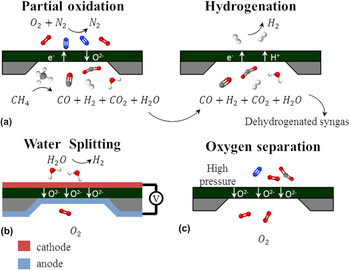
Several schematic examples of procedures possible are shown in Fig. 11.
Reference Norby and Larring163–Reference Dyer, Richards, Russek and Taylor165
Compared to steam-reforming,
 ${\rm{C}}{{\rm{H}}_4} + {{\rm{H}}_2}{\rm{O}} \to {\rm{CO}} + 3{{\rm{H}}_2}$
, the partial oxidation process,
 ${\rm{C}}{{\rm{H}}_4} + {1 \over 2}{{\rm{O}}_2} \to 2{{\rm{H}}_2} + {\rm{CO}}$
, is advantageous due to higher throughput and exothermic nature, rendering an external power source unnecessary.
Reference Tsai, Dixon, Moser and Ma166
Using several mixed conducting membranes in series can allow simultaneous generation and separation of H2 and N2, as shown in Fig. 11(a).
Reference Norby and Larring163
Oxide membranes having t
i = 1 have their use in the production of high purity oxygen from air
Reference Dyer, Richards, Russek and Taylor165
and generating H2 with an external current applied.
Reference Laguna-Bercero164
The operating principle of the latter is similar to SOFCs described in Sec. II but utilized in regenerative mode to produce H2 from H2O via electrolysis. To be economically feasible, these processes require large volumes of feedstock and hence high geometric membrane area. Additionally, high gas pressures on the order of hundreds of kilopascals are used in many cases to increase overall system conversion efficiency. Therefore, challenges in the synthesis of industrial scale thin film oxide membranes that can operate at high temperature and system pressure remain open and constitute a worthy research topic. Further, detailed understanding of the mechanics in ultrathin membranes under varying partial pressures and high ambient pressures warrants diligent attention.
Opportunities to use oxide membranes in gas separation and processing applications; (a) a two-step process illustrating the production of syngas and subsequent generation and separation of H2 and N2 using a partial oxidation then hydrogenation step with mixed conducting oxide membranes, Reference Norby and Larring163 (b) splitting water by electrolysis using an oxygen conducting membrane to separate H2 and O2, Reference Laguna-Bercero164 and (c) creation of ultra-high purity O2 by filtering air or other potential gases.

An opportunity exists to engineer such membranes into energy conversion and storage devices having ultra-low weight and hence high specific energies, assuming one can also scale the accompanying balance of plant accordingly. Such intriguing opportunities will find application in future generations of advanced electronics, sensors, and bioinspired design of autonomous vehicles that can exploit membranes. Moreover, as the field of robotics is rapidly advancing, small scale power sources simply do not exist at present to meet the desired capabilities for state of the art systems. Reference Wood, Finio, Karpelson, Pérez-Arancibia, Sreetharan and Whitney167 The extraordinary needs in autonomous systems that can operate in land, air, or sea in complex environments will be a major driving force for research in mobile energy sources in the coming years. Similarly, storing and converting energy for MEMS using a micropower supply has long been an overarching goal. Reference Koeneman, Busch-Vishniac and Wood168
In summary, we have highlighted research areas related to suspended complex oxide membranes, both films and heterostructures. Understanding the influence of processing and film stresses is vital for fabricating robust structures that can be electrically interrogated under a range of temperatures, oxygen pressures, and electric fields. The unique opportunities and preliminary results discussed in this review suggest that there is a great deal of scientific and engineering frontiers ahead, having implications in energy technology and condensed matter material sciences.
ACKNOWLEDGMENT
KK was supported by the Department of Defense through the NDSEG fellowship.