How does gender affect the attack strategies of political actors? Do men and women diverge in their propensity to go negative and in their choice of targets? Extant research has long sought to shed light on these questions (e.g., Brooks Reference Brooks2010; Kahn Reference Kahn1993; Krupnikov and Bauer Reference Krupnikov and Bauer2014; Proctor, Schenck-Hamlin, and Haase Reference Proctor, Schenck-Hamlin and Haase1994; Walter Reference Walter2013). Among all the possible determinants of attack behavior in elections, candidate gender has been one of the most “heavily studied” (Grossmann Reference Grossmann2012, 2). However, the relevant research focuses almost exclusively on the United States and therefore on a system with candidate-centered campaigns, weak party organizations, and winner-takes-all competitions. Notwithstanding the importance of the USA as a case and exporter of campaign techniques, such context is specific and likely to bias the results. The few pioneering studies that examine the role of gender in negative campaigning outside the U.S. (Carlson Reference Carlson2001, Reference Carlson2007; Walter Reference Walter2013) have addressed this question mostly by transferring the analytical framework of U.S.-based research to other political systems. Consequently, they have barely begun to incorporate the distinctive features of multiparty systems and strong party organizations as determinants of gender differences in attack behavior. The present article provides a novel argument about the role of party environments as a crucial context factor in party-centered political systems. Specifically we argue that in party-centered campaigns the gender balance within parties influences differences in the attack behavior of male and female politicians.
We test this argument by providing the most extensive analysis of gender differences in negative campaigning at the individual level in a European multiparty system to date. By moving from two-candidate races to multiparty competition with hundreds (even thousands) of individual party candidates, we are able to study the impact of gender not only on the use of attacks, but also on the selection of (male or female) targets.
To analyze attack behavior we examine almost 8,000 press releases issued by more than 680 individual politicians across four parliamentary elections in Austria, a system where parties are the dominant campaign actors. To the benefit of our research design, Austrian parties display great variation in gender balance and attitudes toward gender-related policy issues.
The results of the analysis show that (1) men use negative strategies more often, (2) women and men differ in their choice of targets, and (3) the gender balance within parties moderates the gender gap in target selection.
GENDER AND NEGATIVE CAMPAIGNING
Theoretical Arguments about Gender Differences in Negative Campaigning
Much of the theorizing on gender and negative campaigning is (implicitly) based on the premise that variation in aggressive behavior is strongly related to gender, either for biological reasons or because of social roles that ascribe less aggressive stereotypes to women rather than men (Archer Reference Archer2009; Eagly and Wood Reference Eagly and Wood1999).
Our argument builds on research that focuses on the social expectations that derive from gender stereotypes. Social role theory (Eagly Reference Eagly1987), for instance, argues that observable differences in the behavior of men and women are a consequence of the different roles they perform in occupational and private environments (Eagly, Wood, and Diekman Reference Eagly, Wood, Diekman, Eckes and Trautner2000), which in turn are a result of the interaction between physical sex differences (e.g., reproductive activities or upper-body strength) and the social, ecological, and economic environment (Eagly, Wood, and Johannesen-Schmidt Reference Eagly, Wood, Johannesen-Schmidt, Eagly, Beall and Sternberg2004, 271). As a consequence, women and men hold different places in society, for instance in family and professional life. The behaviors that are associated with the different positions the genders occupy then become stereotypically “male” or “female.”
Such discrepancies translate into distinct expectations of what constitutes “appropriate” social behavior for men and women. These expectations extend to the political realm and thus also to communicative behavior in electoral campaigning (Dinzes, Cozzens, and Manross Reference Dinzes, Cozzens and Manross1994, 68–69). They therefore influence the electoral calculus of rational political actors. Since the use of negative messages in election campaigning is typically not an impulsive (re)action but a calculated move, we can start from the assumption that actors who aim to maximize their (party's) electoral appeal will consider how gender stereotypes feed into their choice of campaign strategies.
As Walter (Reference Walter2013, 156) argues, female candidates may try to either dispel or exploit gender stereotypes, depending on whether they believe that conformity with or defiance of stereotypes is the more electorally promising strategy. Based on individual and environmental characteristics this calculation may produce very different outcomes. Herrnson and Lucas (Reference Herrnson and Lucas2006, 71), for instance, argue that most of the time gender stereotypes constrain female candidates in their choice of campaign strategies. Yet, they also suggest that women may find it easier than men to attack their opponents under specific circumstances (e.g., in the event of a sex scandal, marital infidelity, or domestic abuse).
Establishing a Baseline: Gender and Negative Campaigning in the United States
Much research has examined whether women and men differ in the use of negative campaigning. These empirical examinations are almost exclusively based on the analysis of Congressional races in the United States. The overall findings from the U.S. case are mixed, though. A few studies indicate a greater propensity of men to attack. Fox (Reference Fox1997), for instance, finds that men are more likely to use negative ads than women. Kahn and Kenney (Reference Kahn and Kenney2004) report a similar result. In addition, survey-based studies show that male candidates are more likely to endorse the use of attacks (Francia and Herrnson Reference Francia and Herrnson2007; Herrnson and Lucas Reference Herrnson and Lucas2006).
By contrast, a number of studies suggest that women use negative messages more frequently than men. Bystrom and Kaid (Reference Bystrom, Kaid and Rosenthal2002) and Kahn (Reference Kahn1993) report that women candidates are more likely than men to attack their opponents in TV ads.
Interestingly, however, many studies of negative campaigning—especially those that include gender as a control variable only—fail to uncover any significant gender differences (Bystrom et al. Reference Bystrom, Robertson, Banwart and Kaid2004; Grossmann Reference Grossmann2012; Kahn and Kenney Reference Kahn, Kenney, Thurber, Nelson and Dulio2000; Klotz Reference Klotz1998; Lau and Pomper Reference Lau and Pomper2001, Reference Lau and Pomper2004; Panagopoulos Reference Panagopoulos2004; Proctor, Schenck-Hamlin, and Haase Reference Proctor, Schenck-Hamlin and Haase1994). The evidence of actual differences in the use of attacks is thus not overwhelming.
While research on the impact of candidate gender is thus inconclusive, there is some evidence that points to an impact of opponent gender. As Fridkin, Kenney, and Woodall (Reference Fridkin, Kenney and Woodall2009) argue, male candidates are typically perceived as more aggressive, whereas women are viewed as more compassionate. This is why the backlash effect—the detrimental consequences of going negative for the attacker (Lau, Sigelman, and Rovner Reference Lau, Sigelman and Rovner2007, 1182–83) —should be smaller when targeting men. The authors find this expectation confirmed in their experimental design. Some earlier research also supports this evidence. For instance, Kahn (Reference Kahn1993) demonstrates that male politicians attack their female opponents less than their male ones because men anticipate that aggressive behavior toward men is more socially acceptable than towards women. Similarly, Lake (Reference Lake1984) finds in her interviews with congressional candidates that men shy away from negativity against female opponents for fear of being perceived as “beating up” on a woman. However, not all studies do find a significant relationship between opponent gender and attack behavior (Grossmann Reference Grossmann2012, 20).
As to the impact of attacks, it has often been assumed that the use of negative strategies may hurt female more than male politicians, since women are stereotypically seen as the kinder, more passionate gender (Eagly and Karau Reference Eagly and Karau2002). Yet, the empirical evidence does not necessarily support this claim. While Hitchon, Chang, and Harris (Reference Hitchon, Chang and Harris1997) show that neutral campaign messages are viewed as more socially desirable for women than either negative or positive ones, the findings reported by Gordon, Shafie, and Crigler (Reference Gordon, Shafie and Crigler2003) suggest that attacks can be a useful strategy for women to raise their perceived issue competence. Dinzes, Cozzens, and Manross (Reference Dinzes, Cozzens and Manross1994) report a positive impact of attack ads if the target is of the opposite gender as the respondent. By contrast, research from Fridkin, Kenney, and Woodall (Reference Fridkin, Kenney and Woodall2009) suggests that the evaluations of women candidates are less negatively affected by attacks. In another study, Craig and Rippere (Reference Craig and Rippere2013) do not find much evidence for gender-specific effects of negative messages. However, Krupnikov and Bauer (Reference Krupnikov and Bauer2014) show that there is a conditional impact of candidate gender. Voters punish women candidates more than men when they are the instigators of the attack and when they are of the opposite party.
Irrespective of the actual gender gap in the impact of negative messages, the wealth of research on the topic is testament to the fact that there are strong beliefs that attacks may have different consequences for men and women. Since negative messages in election campaigns are usually deployed only after taking account of the wider strategic context, we assume that political parties and individual politicians consider the role of gender stereotypes and gender-specific expectations in the electorate (Herrnson, Lay, and Stokes Reference Herrnson, Lay and Stokes2003).
For the purpose of this paper, our baseline assumption is that male and female politicians behave in congruence with gender stereotypes. The image of women as the kinder gender makes it electorally risky for female politicians to behave aggressively. Women should therefore engage in negative campaigning to a lesser extent. By the same logic, we expect that gender stereotypes limit the degree to which men can attack female opponents, since aggression against the stereotypically “weaker” gender is assumed to play less well with voters. Men should therefore be less likely than women to attack women. We thus derive two hypotheses:
H1:
Women are less likely than men to issue negative messages.
H2:
Men are less likely than women to attack women.
Gender and Negative Campaigning in Multiparty Systems
Only recently has the literature on negative campaigning produced systematic studies of multiparty systems, thereby focusing mostly on West European countries (Elmelund-Præstekær Reference Elmelund-Præstekær2008, Reference Elmelund-Præstekær2010; Hansen and Pedersen Reference Hansen and Pedersen2008; Nai Reference Nai2013; Nai and Walter Reference Nai and Walter2015; Walter Reference Walter2012, Reference Walter2014; Walter, van der Brug, and van Praag Reference Walter, van der Brug and van Praag2014). Within this emerging literature, only a handful of studies have dealt with the impact of gender.
The most thorough—and only cross-national—analysis to date suggests a greater propensity of attacks for parties headed by female candidates (Walter Reference Walter2013). Note, however, that this effect disappears when the British Conservative Party during the Thatcher years is removed from the analysis. In his study of Finnish TV ads, Carlson (Reference Carlson2001) finds small gender differences in what he terms “negative communication strategies.” Yet, since Finnish state regulations ban attacks on opponents, the operationalization of negativity relies on candidates “calling for change” or “taking the offensive on issues”—an empirical strategy that is at odds with most other work on attack politics. In another study of Finland, Carlson (Reference Carlson2007) reports a somewhat greater prevalence of attacks by male candidates. Most recently, Maier's (Reference Maier, Nai and Walter2015) analysis of TV debates in Germany reveals only very subtle gender differences.
As with all research that imports an analytical framework from one type of system to another, the question remains whether the concepts and empirical findings from the U.S. case apply to European systems. Walter (Reference Walter2013, 156) reads her findings to suggest that the “US literature on gender and negative campaigning does not travel to the European context.” Although the final verdict on this matter may not yet have been reached, it is not difficult to see why attack patterns would follow a different logic in candidate-centered two-party competition as opposed to party-centered multiparty politics. It is therefore crucial to adapt our theoretical expectations to the specific features of electoral competition in European systems.
The Role of Party Environments for Gender Differences
One of the most important differences between the United States and European countries is that parties are the central actors in the latter. Even though party leaders may have gained in relevance (Bittner Reference Bittner2011) and candidates are obviously important in systems with single-member districts or strong preferential voting systems, elections are largely still fought, won, and lost by parties.
That said, while parties are collective actors, they can act only through individuals. Although party groups often behave cohesively (e.g., in the legislative arena), there is still much room in party-centered systems for variation in individual-level behavior. In examining the impact of gender on negative campaigning we therefore view parties as crucial context factors, because they provide the social environment in which individual politicians operate. Parties thus influence negativity indirectly by shaping the actions of individual politicians. Not only have most professional politicians had long years of socialization within their party, adopting its customs, rules, and norms in the process, they also recognize that, most of the time, their political career hinges on their support within the party as much as on the party's electoral success. Yet, empirically, the behavior we seek to observe and explain ultimately takes place at the individual level.
One area where parties have an especially strong influence is the representation of women in public office. Ideological and institutional differences between parties are among the strongest predictors of the representation of women in parliaments (Caul Reference Caul1999; Kunovich and Paxton Reference Kunovich and Paxton2005; Sanbonmatsu Reference Sanbonmatsu2002). Moreover, there is large variation in how favorable an institutional and social environment parties create to promote women to positions of power. While some parties are strongly dominated by male politicians, others display a more equal gender distribution among their members, activists, and professional politicians. A more equal gender balance is often enforced with quotas (Caul Reference Caul2001; O'Brien Reference O'Brienn.d.) that, in turn, also encourage processes of socialization and learning (Bhavnani Reference Bhavnani2009).
The idea that gender diversity has an impact on behavior is a recurring theme in practically all social sciences. Collaboration and communication in small groups is enhanced by gender diversity (Bear and Woolley Reference Bear and Woolley2011; Myaskovsky, Unikel, and Dew Reference Myaskovsky, Unikel and Dew2005), and even firm performance is improved by greater female representation on corporate boards (Campbell and Mínguez-Vera Reference Campbell and Mínguez-Vera2008; Fenwick and Neal Reference Fenwick and Neal2001; Krishnan and Park Reference Krishnan and Park2005).
A similar idea applied to female political representation underlies critical mass theory. Starting from observations of the corporate world (Kanter Reference Kanter1977b, Reference Kanter1977a), Dahlerup's (Reference Dahlerup1988) seminal article theorizes on the conditions under which women, though a minority in most settings, can have an impact in a political system. This research was later often misread to stipulate that a qualitative shift in women-friendly political behavior will emerge after women pass a 30% representative threshold (Childs and Krook Reference Childs and Krook2008). While subsequent research has shown that no “magical threshold” exists (e.g. Studlar and McAllister Reference Studlar and McAllister2002), it has also been demonstrated that an enhanced presence of female politicians, no matter the exact proportions in a legislature, helps promote a women-friendly agenda (e.g., Bratton Reference Bratton2005; Thomas Reference Thomas1994; see Wängnerud Reference Wängnerud2009, for a recent overview).
Since differences in male and female behavior are shaped by the social context in which individuals operate, variation in the social context can serve to explain variation in gender-typed behavior (Eagly, Wood, and Johannesen-Schmidt Reference Eagly, Wood, Johannesen-Schmidt, Eagly, Beall and Sternberg2004, 280). As Archer (Reference Archer2009, 253) holds, this argument leads to the expectation that, “when gender roles are made more salient, the magnitude of the difference [between male and female behavior] should increase.” Since gender roles are largely shaped by the social environment, such as cultural differences across or within nation states, they should vary with it.
As political parties are the most relevant groups within which politicians operate, we assume that the gender balance within parties is an important mediating factor of individual-level behavior in election campaigns. More specifically, we posit that the impact of gender stereotypes on negative campaigning should decrease as the share of women in a party increases. In parties with a more equal gender distribution, women activists, candidates, or MPs are less “conspicuous” since female politicians are naturally a more common occurrence in an environment with higher overall female representation. Operating in a more gender-balanced setting should therefore make politicians less likely to respond to gender stereotypes in their behavior. We therefore hypothesize that the “negativity gender gap” assumed by our first two hypotheses is weaker in parties with a higher proportion of women.
This proposition applies to the assumed differences in the general propensity to use attacks ( H 1 ) as well as to the hypothesis about attacking women ( H 2 ). In both cases, the gender gap should shrink as the gender distribution in a party becomes more equal:
H3:
The gender gap in attack behavior is smaller the more gender-balanced the attacker's party.
H4:
The gender gap in targeting women is smaller the more gender-balanced the attacker's party.
CASE SELECTION AND DATA
These hypotheses will be tested with data from the four most recent parliamentary elections in Austria (2002, 2006, 2008, and 2013). Negative campaigning is hardly a new phenomenon in Austrian politics—nor is it in Western Europe more generally (Nai and Walter Reference Nai and Walter2015). As Dolezal, Ennser-Jedenastik, and Müller (Reference Dolezal, Ennser-Jedenastik and Müller2015) report, Austrian election campaigns were often quite negative even during the early postwar period—the “golden age” of consensus politics. In the more recent past, the populist radical right Freedom Party (FPÖ) has built much of its success on aggressive rhetoric toward the more established parties and the political institutions of the postwar Second Republic. Austria is a useful test case since there is ample variation in how well women are represented within the main parties, how representation is governed by intraparty rules (Eder and Müller Reference Eder and Müller2013; Steininger Reference Steininger2000), and what positions parties take on issues of gender equality and the roles of men and women in private and public life.
Whereas all Austrian parties subscribe to the principle of equal rights for men and women in the abstract, there are substantial divides on many gender-related issues, ranging from mandatory quotas for corporate boards, positive discrimination in the labor market, the provision of abortions in public hospitals, or the lower required retirement age for women to the use of gendered language and the inclusion of “daughters” in the national anthem in addition to “sons.”Footnote 1 These differences generally follow a left–right pattern and correlate closely with interparty variation in female representation. Concerning the empirical analysis, this strong relationship makes it very difficult to disentangle the effects of a party's gender composition and its left–right position. However, in line with much of the literature we argue that left–right ideology drives female representation (Caul Reference Caul1999; Kunovich and Paxton Reference Kunovich and Paxton2005), for instance, through the adoption of party gender quotas (Caul Reference Caul2001)—even though it is also possible that the presence of women shapes a party's issue profile (Kittilson Reference Kittilson2011). Assuming that the direction of causality runs (mostly) from ideology to female representation, we use the latter element in the causal chain to predict attack behavior.
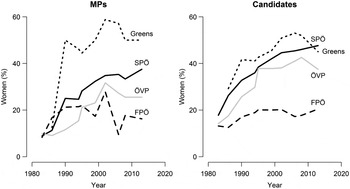
As Figure 1 shows, there has been substantial divergence in female representation between the parties since the 1990s. Around half of all Green MPs are women—a result of a stringent 50% women's quota in candidate selection procedures. The Social Democrats (SPÖ) have had around a third of their parliamentary seats occupied by women—somewhat below their self-mandated quota of 40%, despite standing more than 40% female candidates in the recent past. This reflects the fact that men occupy the more promising spots on election lists. The conservative Austrian People's Party (ÖVP) has stated as its goal to have one third of seats held by women. The party regularly nominates around 40% of female candidates, yet its share of female MPs has been closer to a quarter for the past twenty years. The FPÖ rejects gender quotas on principle and has consistently had the lowest share of women candidates (around 20%) and MPs (below 20%, on average) since the late 1990s.
Share of female MPs and parliamentary candidates in Austria, 1983–2013.

Finally, Austria is a country with strong and cohesive parties that run nationally coordinated election campaigns in which structural factors explain much of the variation in negative messaging (Dolezal, Ennser-Jedenastik, and Müller Reference Dolezal, Ennser-Jedenastik and Müller2015). It may therefore even be considered a hard case for uncovering individual-level differences in attack behavior.
The empirical analysis uses data generated by the Austrian National Election Study (AUTNES). All press releases issued by party candidates and other individual party actors during the six weeks prior to the elections in 2002, 2006, 2008, and 2013 were collected. We include only parties represented in parliament either before or after the election.
Press releases are a particularly relevant data source for the actor-centered study of negative campaigning, as their frequency and content is under the full control of politicians and parties (in contrast to media reports). For the present research question it is also important that they are not an exclusive domain of the party elites, but allow us to study the campaign communication of a much broader range of party actors, such as government ministers, MPs, or officials from subnational branches and ancillary organizations (as opposed to, for example, televised debates or TV spots). Press releases are thus a unique source for individual-level behavior of a wide range of party actors in a campaign environment.
What is more, these data allow us to observe attacks in an electoral system where individual candidates can freely chose whom to attack. Since candidates are not directly pitted against each other in single-member districts, every actor is free, in principle, to choose his or her target (even though shared regional background or policy focus is likely to influence target choice). This freedom allows for much more strategic target selection than U.S. campaigns where every candidate's opponent is fixed.
In Austria, press releases are distributed through the national news agency, APA, and are made freely available on a website (www.ots.at). This centralized distribution increases the messages' importance, especially for journalists, who are the usual target audience. Research has demonstrated that press releases strongly influence news coverage in many countries, including Austria (Haselmayer, Meyer, and Wagner Reference Haselmayer, Meyer and Wagner2015; Seethaler and Melischek Reference Seethaler and Melischek2014).
We select all press releases issued via the parties' central offices, their parliamentary groups, and their regional branches (excluding purely technical press releases such as reminders of upcoming campaign events). Among these, we include all press releases by actors relevant to the campaign: party leaders, members of government, party secretaries, MPs, factional leaders, and all other individuals who stand as candidates in the election.
The full data set covers more than 8,000 press releases from seven parties. All press releases were coded manually using a relational method that captures the relationship of actors (“subjects”) with either issues or other actors (“objects”). For our analysis we only use press releases that feature individuals (as opposed to parties) as subjects, bringing down the number of cases to 7,850. A variable called “predicate” connects subjects and objects and records their relation as either positive (1), negative (−1) or neutral (0). This method goes back to the work of Kleinnijenhuis and his collaborators (e.g., Kleinnijenhuis and Pennings Reference Kleinnijenhuis, Pennings and Laver2001) and was also used in comparative research on election campaigns and public debates (Kriesi et al. Reference Kriesi, Grande, Lachat, Dolezal, Bornschier and Frey2008; Kriesi et al. Reference Kriesi, Grande, Dolezal, Helbling, Höglinger, Hutter and Wüest2012). We have developed this approach further and apply it to various types of political text, for example party manifestos (Dolezal, Ennser-Jedenastik, Müller, and Winkler Reference Dolezal, Ennser-Jedenastik, Müller and Winkler2016).
Our coding of actor relationships is based on the content of a press release's title. While this discards some potentially relevant information, it should be noted that the titles are often quite long (up to a maximum of 138 characters). What is more, press releases are typically written (or, at least, checked) by professional press officers who know perfectly well how to condense the messages that politicians seek to send into a single sentence or phrase.
For each press release we record up to two subjects and three objects.Footnote 2 We follow the standard approach in the literature and define any negative relation, thus any form of criticism, directed at another party actor as negative campaigning (Geer Reference Geer2006, 26). This allows for a classification of all observations into four categories: (1) no target; (2) male target; (3) female target; (4) party as target.Footnote 3 The following examples include a press release with (a) two parties (FPÖ and SPÖ) as target and (b) with a (female) individual (Maria Fekter, the then finance minister) as target:
(a) BZÖ-Petzner: “FPÖ and SPÖ are stuck in a swamp of corruption in Carinthia”
(b) Schieder to Fekter: “For the finance minister ‘Black-Blue’ is more important than Austria”Footnote 4
For our test of H 1 and H 3 we collapse all targets (values 2 to 4) into one category. H 2 and H 4 are tested with the four-category dependent variable. Our main independent variables of interest are sender gender, a dummy that captures whether a female politician is present among the subjects,Footnote 5 and a party's share of women MPs and candidates.
The distribution of press releases and attack percentages by party and election year is given in the appendix. Parties that command greater resources because of their size (SPÖ and ÖVP) are the ones issuing the most releases. The overall level of negativity is around 41% and varies between just more than 28% (SPÖ 2013) and more than half (BZÖ 2008).
ANALYSIS
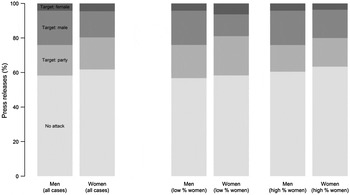
Before looking at the multivariate models, we present the distribution of attack patterns by gender and the share of female MPs in Figure 2. The modal category in our dependent variable is “no attack” (59%), followed by attacks on parties and male targets (18% each) and attacks on women (4%). Even when looking at attacks only, female targets make up only 11% of all attacks and 19% of all attacks directed at individuals.
Attack patterns by gender and share of women MPs.

To put these 19% into perspective it is useful to consider the gender distribution of the potential target pool. In other words, how many attacks on women vs. attacks on men should we expect if gender played no role in the selection of targets? There is no definite answer to this question, but a useful approximation is the proportion of female candidates (36%) or MPs (30%) across party-election observations. Even if we concede that political elites (especially party leaders)—who are the most popular individuals to be targeted—are more likely to be male than are rank-and-file MPs (Ennser-Jedenastik and Müller Reference Ennser-Jedenastik, Müller, Pilet and Cross2014, 74; Steininger Reference Steininger, Dachs, Gerlich, Gottweis, Kramer, Lauber, Müller and Tálos2006), for women to account for only 19% of all targeted individuals is still a low share. We therefore consider it highly likely that the balance between male and female targets would look different if gender played no role in target selection. In addition, it also needs to be considered that the “target pool” will be somewhat more gender-balanced for male-dominated parties (mostly on the right), since their competitors (mostly on the left) have more women among their ranks. The reverse is true for parties with higher female representation.
As Figure 2 shows, the “no attack” bar is higher for female than for male senders. In accordance with H 1 , men thus choose a negative strategy slightly more often than women (42% versus 38%, p < 0.01 in two-sided test). The difference is notable but not huge, and it remains to be seen whether it holds in a multivariate test. With respect to H 2 , we do not find the hypothesized relationship here. Both, men and women, target females in around 4% to 5% of press releases (p = 0.58). However, given the lower overall negativity for female senders, it could be argued that the better comparison is among attacks only. Here, the share of attacks directed at women is 12% for female and 10% for male senders (p = 0.17). This gap grows even larger when comparing only male and female targets: 23% of women's “individualized” attacks are directed at women, compared to 18% for men (p < 0.05).
For the interactive hypotheses, we break down the data into two equal-sized groups according to the share of women in the parliamentary party group (PPG) of the sender. The gender gap in general attack patterns ( H 3 ) does not appear to change much with intraparty gender balance. Men issue attacks slightly more often in both groups, the gaps are two percentage points for the less gender-balanced parties and three percentage points for those with a more equal gender distribution (differences not statistically significant).
We find a somewhat larger effect that conforms to H 4 . The gender gap in targeting women is two percentage points for parties with fewer women, but essentially zero for those with greater presence of female MPs (difference significant at p < 0.05). Female senders from strongly male-dominated parties attack women more frequently than their female colleagues from more gender-balanced parties do. As the share of female MPs increases, this gender gap disappears.
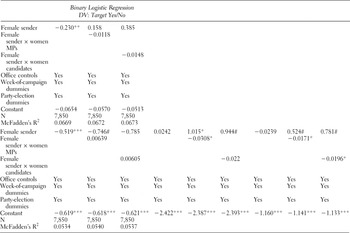
To see whether the results presented in Figure 2 hold in a multivariate analysis, we run three binary logistic regressions (0 = no attack; 1 = attack), and three multinomial logistic regressions (0 = target: none; 1 = target: male; 2 = target: female; 3 = target: party). All models are specified with fixed effects at the party-election level, thus controlling for variation in many structural factors (e.g., party size, ideology, government participation). The “no attack” category is chosen as the reference group in the multinomial regression. In order to provide a comprehensive picture of female representation within the parties, we employ two measures: a party's share of women MPs in the year of the election and the share of women candidates on the party's election list.
We also control for the week of the campaign (assuming that negativity may increase as the election approaches), and for a series of public and party offices that are likely to be correlated with both gender and going negative: party leader, government minister, president of parliament, parliamentary group leader, and general secretary of the party (Dolezal, Ennser-Jedenastik, and Müller Reference Dolezal, Ennser-Jedenastik and Müllern.d.). Recall that women politicians are typically underrepresented in political offices at the very top. Table 1 presents the results.
Explaining attack patterns—binary and multinomial logistic regression models

Note: Standard errors clustered on individual senders; #p < 0.1, *p < 0.05, **p < 0.01, ***p < 0.001. Office controls: head of government, government minister, member of the presidium of parliament, party leader, parliamentary party group leader, and party secretary.
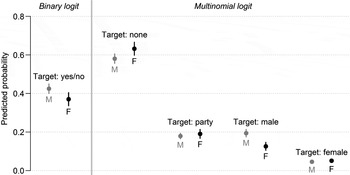
The binary logistic model shows that females attack less frequently than men. The coefficient of −0.23 translates into an odds ratio of 0.79, meaning that the odds of an attack decrease by 21% for female senders. This suggests that female senders have a substantially lower overall probability of attacking. Holding all other covariates constant, the predicted probability of an attack is 43% for male senders and 37% for female senders (see Figure 3 below). The expectation that men use negative messages more often than women ( H 1 ) is therefore supported by the data.
Predicted probabilities of attack ( H 1 ) and attack on woman ( H 2 ) by gender.

Interestingly, the effect for sender gender becomes significant only after the office-related control variables are introduced. This is because some political offices that strongly predict the use of (or abstention from) negative messaging are strongly correlated with gender. For instance, women are underrepresented among party leaders who rarely attack their competitors. By contrast, there have been many female party general secretaries who carry out much of the dirty work in election campaigns. As a consequence the bivariate relationship between female senders and attacks in Figure 2 obscures part of the gender gap in negative campaigning. The multivariate analysis, however, allows us to assess gender differences in attacking after controlling for the office covariates.
As to our second hypothesis (men are less likely than women to target women), the coefficient for “target: female vs. none” in the multinomial model is close to zero (0.024) and far from statistical significance. Women and men are thus equally likely to issue attacks against female targets (recall that we are comparing against the “target: none” baseline category). Changing the reference group to attacks on men would yield a positive and strongly significant effect (β = .54, p < 0.01). Yet, it is only for this subset of observations that we find a gender gap in target choice that conforms to H 2 .
The analysis clearly shows a gender gap that is different from our prediction in H 2 . We theorized that men would be less likely than women to attack women. However, the data show that men are more likely than women to attack men. There are thus no gender differences in targeting female politicians, but there is a substantial gap with respect to selecting male targets.
To illustrate these results Figure 3 displays the predicted probabilities of attacking in general (to the left of the vertical grey line) and of attacking any specific type of target (to the right of the gray line: none/party/male/female). The most relevant comparison is between male (M) and female (F) senders within each target type. As alluded to above, the predicted probability of attacking is six percentage points smaller for female senders (37% vs. 43%). Correspondingly, the predicted probability of the “target: none” outcome in the multinomial model is 57% for men and 63% for women. By contrast, both genders are predicted to target parties with a probability of just below 20%. A substantial gender gap emerges for male targets. Here, the predicted probability is 19% for men but only 13% for women, whereas both men and women attack female politicians with a predicted probability of about 5%.
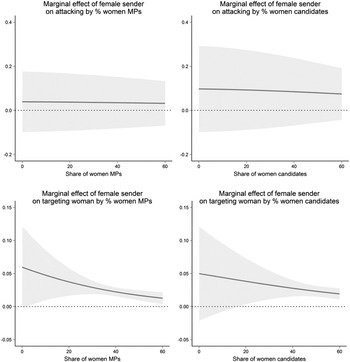
The interactive hypotheses are tested with data on the representation of women in parliamentary party groups and on party election lists—two closely correlated measures (see Figure 1). In the binary models in Table 1, the interaction effects are not significant, suggesting that the effect of gender on the prevalence of attacks is not moderated by the gender composition of parties. H 3 is therefore not supported by the data. By contrast, the multinomial models show that the effect of gender on selecting female targets shrinks as the share of women MPs and candidates in a party increases.Footnote 6 This suggests that the gender gap in attacking female targets is smaller in parties with a more equal gender balance. This result supports H 4 . Yet, interaction effects are difficult to evaluate comprehensively from the regression coefficients alone (Brambor, Clark, and Golder Reference Brambor, Clark and Golder2006). Figure 4 shows the marginal effects.
Marginal effects of gender on attacking by party gender balance.

The two top panels in Figure 4 clearly show that the effect of gender does not change with the share of women among MPs and party candidates. The marginal effect is constant across the empirical range of these two variables and the confidence intervals include zero at all times. There is thus no evidence for H 3 in our models.
By contrast, the two lower panels in Figure 4 show that the marginal effect of gender decreases as we move from male-dominated parties to more gender-equal distributions. While the confidence intervals are wide at the left side of the graph (a natural consequence of having fewer press releases issued by women in parties with a more skewed gender distribution), it is clear that the effect of gender is smaller in parties with a greater share of women among their MPs and candidates. These results clearly confirm the bivariate patterns in Figure 2 and lend strong support to H 4 .
Importantly, the figures also illustrate the way by which the gender gap assumed in H 4 closes. Females who are in a clear minority within their party choose to attack women to a higher degree than their male colleagues—and also more often than would be expected from the “natural” gender distribution among potential targets (see discussion above). As the gender distribution becomes more equal, the rate at which women are attacked becomes more similar across genders.
CONCLUSION
Gender is the most fundamental human category. Its impact on electoral behavior is part and parcel of any broader analysis of the political world. Most contributions to its analysis in the realm of negative campaigning have thus far focused on the United States. While U.S. researchers have invented and championed this research, as the study of negative campaigning in general, the presence of candidate-centered campaigns under a winner-takes-all system with only two organizationally weak parties has invited the formulation of a very specific set of research questions. The present article uses the opportunity arising from the study of a multiparty system with party-centered campaigns and proportional representation to address a novel research question: the relevance of intraparty context. This article expands our knowledge by addressing the question of what role the party-internal gender balance exercises on negative campaigning by male and female candidates. In addition, we examine not only whether the genders differ in their propensity to attack, but also whether men and women select different targets.
Studying candidate behavior in the four most recent elections in the multiparty system of Austria we answer both questions in the affirmative. Whereas the U.S. literature has yielded rather mixed results as to the impact of gender on negative campaigning (see overview in Grossmann Reference Grossmann2012) we find clear evidence showing that women are less likely to resort to attacks than men. However, in contrast to most U.S. research on the impact of opponent gender (Fridkin Reference Fridkin, Kenney and Woodall2009; Kahn Reference Kahn1993), we do not find that men attack women less frequently—what we observe is that women are less likely to attack men. We can only speculate about the reasons for these differences. One possibility is that gender stereotypes may be more powerful in keeping women from attacking men, but less so when they engage with female competitors.
As a more general point, our analysis shows that negative campaigning in European systems can be more complex than in systems with two-party competition and single-member districts. Politicians are free to choose which (male or female) competitor to attack—or they may even decide to simply attack an opponent party without naming any individual in their message. Whether to go negative is thus not just a binary choice, but one that also requires a more conscious decision about the selection of the target.
We also find evidence that party environments moderate the influence of gender on negative campaigning. Women in male-dominated parties are more likely than those in more equally balanced parties to select female targets. Yet, we find no proof that the share of women in a party moderates the impact of gender on the overall probability of using attacks.
At first sight, the effects we find are notable in some instances, but not huge in the grand scheme of things. However, it is important to consider that the effects of gender are also indirect. For instance, women are still underrepresented in many elite positions (e.g., among party leaders) that are an important factor in determining attack behavior. These indirect effects are eliminated by the office controls in our models. Thus, it is important to stress that our analysis uncovers only the direct impact of gender on negative messaging.
Clearly, the set of variables considered here does not exhaust the range of possible influences on negative campaigning. Personal characteristics, the media environment, or other campaign-related variables may exercise influence. Many of these are conceptually and empirically very challenging to address and they do not lend themselves to expectations that are clearer and more deeply rooted in human nature than the ones we have addressed in this article. What is more, several of the hard-to-capture factors that drive negativity (e.g., the occurrence of controversial campaign events or the revelation of political scandals) are typically uncorrelated with gender.
This paper contributes one of the few pieces of research conducted in a multiparty environment. While any single-country study is limited per se in its generalizability, it is worth recalling that, in many respects, Austria is a fairly typical West European multiparty democracy. Given that almost all research on negative campaigning and, in particular, its gender aspects focuses exclusively on the United States, any such expansion of the set of empirical cases is a building block to distinguish gender from system effects.
SUPPLEMENTARY MATERIAL
To view supplementary material for this article, please visit https://doi.org/10.1017/S1743923X16000532