Introduction
Chickens maintain a constant body temperature over a wide range of ambient temperature. However, the ability to maintain body temperature depends on balance between the internally produced heat and the rate of heat dissipation. Fast growing broilers have difficulties in dissipating heat production and to maintain body temperature at high environmental temperatures (Chwalibog and Eggum, Reference CHWALIBOG and EGGUM1989). Indeed, 0.57-0.85°C higher body temperatures were reported in broilers reared at higher temperatures compared to broilers reared at control (Yalçın et al., 1997). Although respiratory evaporative heat loss is an effective mechanism for heat dissipation, increased the ventilation is based on the upper respiratory track results an increase in panting (respiratory rate), blood pH, and decrease in blood Na+, K+, pCO2, and HCO3- characterizing a status of respiratory alkalosis in broilers exposed to higher temperatures (Borges et al., Reference BORGES, FISCHER DA SILVA, ARIKI, HOOGE and CUMMINGS2003). Thus, high ambient temperature from 3 to 7 weeks induces major economic losses by increasing mortality and decreasing growth rate of broilers. On the other hand, there is strong evidence that climate change is already occurring, and global temperatures will rise by between 1.4 and 5.8ºC during this century. This makes it necessary to improve strategies to alleviate the negative effects of high ambient temperatures on broilers.
Early thermal conditioning, exposure to 36°C for 24h at 5d of age, seems to be one of the most promising methods in increasing resistance of broilers to heat stress (Yahav and Hurwitz, Reference YAHAV and HURWITZ1996; Yahav and Plavnik, Reference YAHAV and PLAVNIK1999). Our previous studies (Yalçın et al., 2003 and 2004) showed that when broilers exposed to heat stress, conditioned broilers gained 3.2% more body weight than heat stressed broilers and had similar feed conversion to control from 21 to 42 d. Increases in body temperatures were average 0.57 vs. 0.76ºC in conditioning and control broilers, respectively, after exposure to 34°C for 8 h (Yalçın et al., 2005).
Incubation period is of particular importance in thermoregulation of poultry. Exposure to higher incubation temperatures during the critical periods can improve broilers capability for thermotolerance at later post-hatch age (Moraes et al., Reference MORAES, MALHEIROS, BRUGGEMAN, COLLIN, TONA, VAN AS, ONAGBESAN, BUYSE, DECUYPERE and MACARI2003; Yahav et al., Reference YAHAV, SASSON RATH and SHINDER2004; Yalçın et al., 2005). Yahav et al. (Reference YAHAV, SASSON RATH and SHINDER2004) concluded that exposing embryos to higher incubation temperature (38.5°C) for 3 h from 16 to 18 d had a positive effect on thermoregulation of broilers without affecting hatchability. It was demonstrated that 39ºC incubation temperature from either 11 to 20 d of incubation for 6 h/d (Iqbal et al., Reference IQBAL, DECUYPERE, ABD EL AZIM and KUHN1990) or from 13 to 17 d of incubation for 2 h/d improved broilers capability to combat with heat stress at later ages (Moraes et al., Reference MORAES, MALHEIROS, BRUGGEMAN, COLLIN, TONA, VAN AS, ONAGBESAN, BUYSE, DECUYPERE and MACARI2003 and 2004). Because thermal conditioning during incubation may become a practical tool to prevent the detrimental effect of heat stress, more information is needed to determine its effect on hatching performance and slaughter weight and carcass performance. The objective of the present study was to evaluate the effects of higher incubation temperature from 10 to 18 d of incubation on hatching and carcass performance in broilers reared at daily higher temperature from 21 to 42 d.
Recent research
In the first recent experiment conducted in our own laboratories, a total of 1700 eggs were used. Eggs were weighed individually and numbered before setting for incubation. Eggs were divided into two groups and set to either a high (INCHIGH, 39.6°C/6h/d from d 10 to 18) or control (INCCONT 37.8°C) temperature incubator. Using a thermometer (Braun Thermoscan) eggshell temperature was recorded on d 14 and 18 of incubation on 25 eggs/incubation temperatures. Between 464 and 510h of incubation, the number of embryos pipped externally and chicks hatched were recorded every 2 h. All unhatched eggs were broken to macroscopically determine fertility or stage of development at death. Total embryonic mortality was calculated as total of early, mid and late deaths and pipped but unhatched eggs. Malpositions were classified. Chicks hatched from fertile eggs (H/F) were also determined. On day of hatch, ten chicks from each incubation temperature were weighed, sacrificed by cervical dislocation, dissected, and residual yolk sac weight and weights of liver, heart, bursa of fabricius, spleen, and lungs were measured. Chick moisture was determined after chicks were dried at 110ºC for 24 h.
In a second trial, a total of 552 eggs were used and the same incubation process was repeated, except for temperature that was 38.5°C/6h/d from d 10 to 18 in the INCHIGH group. A total of 300 chicks (150 from each incubation temperature) were allotted to 12 floor pens. Room temperature was 33ºC at 1 d of age and decreased gradually 3°C/week until they reached 24°C at 21 d. From d 21 to 42, half of broilers from each incubation temperature were exposed to daily cyclic high temperature of 32 to 35°C from 10:00 to 17:00 h, while the other half was reared at optimum temperature (24°C, control). Birds had ad libitum access to diet and water. At 42 d, all birds were weighed and body temperatures of 12 male broilers during the daily cyclic high temperature were recorded. Twelve male broilers/incubation temperature/rearing temperatures were slaughtered after 8 h feed withdrawal. Weights of breast (with and without bone and skin), drumsticks, and wings were measured and yield was expressed as a percentage of carcass weight.
Hatching performance
Significantly higher shell temperature was obtained for eggs from INCHIGH at both 14 and 18 d of incubation (Table 1). This higher eggshell temperature could be a prerequisite for a higher thermoregulatory set-point during the post-hatch period (Tzschentke, Reference TZSCHENTKE2008). The higher incubation temperature may increase incubation weight loss and affect chick moisture. Indeed, Lourens (Reference LOURENS2008) found 11.5 and 12.4% weight loss between setting and transfer at 19 d of eggs that incubated at constant 37.8 and 38.9 ºC eggshell temperature from 9 to 19 d of incubation. However, in the present study, similar chick moisture levels were obtained (Table 1). This result could indicate similar weight loss between two incubation temperatures. This difference between studies may be due to duration and degree of higher incubation temperature.
There was no effect of incubation temperature on H/F. Hatchability was 79.9 and 80.2% for INCCONT and INCHIGH, respectively, being insignificant between groups (Table 1). Embryos incubated at INCHIGH pipped 7.2 h later compared to INCCONT embryos. Higher daily cyclic temperature treatment during incubation increased the duration of total incubation time as was previously demonstrated by Yalçın et al. (2006). Duration of total incubation was 495.5 h and 500.5 h for INCCONT and INCHIGH chicks, respectively.
Embryonic mortalities were not influenced by incubation temperature. Although the incidence of the malpositions was 0.47%, all was belong to the embryos from INCHIGH. Head under left wing constituted almost 62.5% of the malpositions, followed by head in the small end of egg with a frequency of 25.0% and feet overhead with a frequency of 12.5%. The incidence of blind embryos was 0.8% (data not shown in tables).
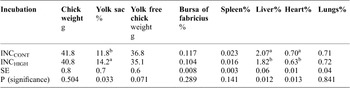
There was no effect of higher incubation temperature on chick weight (Table 2). Yolk absorption was greater for control chicks. Higher residual egg yolk content found in late-hatched INCHIGH chicks was consistent with the finding of Joseph and Moran (Reference JOSEPH and MORAN2005) who reported that late-hatched chicks had a greater residual yolk sac weight. Higher residual egg yolk content suggested that INCHIGH chicks were not efficiently utilising yolk reserves before hatching. On the other hand, higher residual yolk sac after hatch may be critical to growth and development (Turro et al., Reference TURRO, DUNNINGTON, NITSAN, PICARD and SIEGEL1994).
However, chicks had similar yolk-free chick weights. There were no differences between incubation temperature groups for relative weights of bursa of fabricius, spleen, and lungs. Relative weights of liver and heart were higher in chicks from INCCONT than those from INCHIGH chicks. Sklan et al. (Reference SKLAN, HEIFETZ and HALEVY2003) reported that greater growth rate birds had larger liver weight which may reflect the level of metabolic activity. The lower liver weight of INCHIGH chicks may be related to the lowered metabolic activity of the INCHIGH chicks. The findings of a reduction in plasma T3 concentration in chicks from INCHIGH (Yahav et al., Reference YAHAV, SASSON RATH and SHINDER2004) also support this result. A negative association between incubation temperature and cardiac cell division was reported by Leksrisompong et al. (Reference LEKSRISOMPONG, ROMEO-SANCHEZ, PLUMSTEAD, BRANNAN and BRAKE2007). Thus, lower heart weight in INCHIGH chicks might be expected due to lower number of mitotically active myocytes of the heart under higher incubation temperatures. Wineland et al. (Reference WINELAND, MANN, FAIRCHILD and CHRISTENSEN2000) also found lower heart weight when embryos incubated at higher temperatures.
Weights of chick (g) and relative weights (%) of yolk sac, bursa of fabricious, spleen, liver, and lungs of chicks from control (INCCONT) and higher incubation (INCHIGH)1.

INCHIGH: 39.6°C from 10 to 18 d of incubation
a,bMeans in columns not sharing a letter differ significantly
Body temperatures under daily cyclic high ambient temperature and carcass performance of heat acclimated broilers during incubation
In the present study, if cyclic higher incubation temperature from 10 to 18 d of incubation induces long-term acquisition of thermotolerance was also investigated. The increased thermotolerance of INCHIGH broilers was reflected in their body weight when exposed to daily cyclic high temperatures from 21 to 42 d. Although, broilers from INCHIGH exhibited significantly lower body weight when reared at control temperatures from 21 to 42 d, INCHIGH broilers were heavier than INCCONT when reared at daily cyclic high temperature (Table 3). Under daily high temperature, slaughter weight of INCCONT broilers was lower about 6.5% whereas INCHIGH broilers gained 135 g more (relative advantage was 5.2%) body weight than INCCONT. On the other hand, the lower body weight of INCHIGH broilers at control ambient temperature was associated with lower body temperature. The INCHIGH broilers had lower body temperatures than INCCONT broilers at both control and daily higher rearing temperatures (Table 3). This result suggested that higher incubation temperature from 10 to 18 d of incubation appears to induce long-term thermal adaptation to heat stress expressed by the lower body temperatures at daily cyclic higher ambient temperature. This may be related to lower metabolic rate of INCCONT broilers.
Daily cyclic high temperature reduced total breast yield but increased drumsticks yield regardless of incubation temperature (Table 3). The decreased in breast meat yield but increased in leg yields by heat stress support previous conclusions (Rosa et al., Reference ROSA, FARIA FILHO, DAHLKE, VIEIRA, MACARI and FURLAN2007; Akşit et al., Reference AKŞIT, YALÇIN, ÖZKAN, METIN and ÖZDEMİR2006; Yunis and Cahaner, Reference YUNIS and CAHANER1999). The magnitude of the reduction in breast meat yield of INCCONT broilers at high ambient temperature was almost similar to body weight of those birds. However, INCHIGH broilers tended to have heavier breast meat yield compared with broilers from INCCONT. Heavier breast yield obtained from INCHIGH broilers suggested that although INCHIGH reduced slaughter weight of broilers reared at optimum temperatures, advantage on breast meat yield was greater when exposed to either control or higher ambient temperatures from 21 to 42 d. Higher breast meat yield of INCHIGH broilers may be related to accelerated cell differentiation and increased total number of fibres in the breast (Halevy et al., Reference HALEVY, KRISPIN, LESHEM, MCMURTRY and YAHAV2001). Neither incubation temperature nor rearing temperature had an effect on wing yield (Table 3).
Body temperature, slaughter weight and carcass part yields (% of carcass) of broilers from control (INCCONT) and higher incubation (INCHIGH)1.

1 INCHIGH: 38.5°C from 10 to 18 d of incubation
2 with bone and skin
a,b Means in a raw within an incubation temperature not sharing a letter differ significantly (P<0.05)
x,y Means in a raw within a rearing temperature not sharing a letter differ significantly (P<0.05)
Conclusions
The results of the recent experiments indicated that higher incubation temperature from 10 to 18 d of incubation to acclimate the chicks to the higher post hatch ambient temperatures had no effect on hatchability and chick weights, and minimized the negative effect of post hatch heat stress on body temperatures and weights of slaughter and breast meat. These data suggest higher daily cyclic incubation temperatures from 10 to 18 d of incubation improved the ability of broilers to cope with higher environmental temperatures from 21 to 42 d of age during postnatal period.