Introduction
Phonological systems vary widely across languages in systematic ways (Maddieson, Reference Maddieson1984), providing a background for considering the effects of early bilingualism on the course of language acquisition. Early sequential bilinguals are children who begin learning language in a monolingual environment (their home language, or L1), and first receive regular exposure to a second language (the community language, or L2), when they enter school, typically between the ages of 3 and 5 (McLaughlin, Reference McLaughlin1984; Anderson, Reference Anderson2004; Paradis, Reference Paradis2005). In the U.S., sequential bilingual children form a large subset of bilingual children. A defining characteristic of sequential bilinguals is their use of what they have learned about language in L1 to gain language skills in L2 (McLaughlin, Reference McLaughlin1984). Early sequential bilinguals begin acquisition of their second language before their first language is completely established.
In the current study, we explore the effect of L2 (English) on the L1 (Spanish) phonological system. We analyze vowels, consonants, and syllable and word shapes produced by six sequential Spanish–English bilinguals. These children were from home environments where standard Mexican Spanish was spoken and were first regularly exposed to English when they began attending an English-speaking Head Start classroom between the ages of 3 and 4. We compared single-word samples of the children's L1 productions at two time points: at the beginning of the school year when they were first introduced to English (T1), and after 8 months of regular L2 exposure (T2) in their school setting.
Spanish and English phonology
To understand the possible effects of English on Spanish, phonologies of standard Mexican Spanish and standard American English are compared.Footnote 1 Generally, English is more complex in vowel and syllable structure relative to Spanish. There are fewer consonant (18 vs. 24) and vowel (5 vs. 11) phonemes in Spanish. Consonants of English and Spanish are similar, with both languages containing /b p d t g k m n l tʃ s f j w/.Footnote 2 But there are phonemic and phonetic differences in these shared consonants. For example, /t/ and /d/ are produced using dental placement in Spanish but are produced on the alveolar ridge in English. In Spanish, voiced stops are frequently produced as a homorganic approximant (/b d g/ as [β ð ɤ]), except after a nasal or a pause. Spanish consonant phonemes with no equivalent English phoneme include /x ɲ ɾ r/. Spanish phonology does not include the English consonant phonemes /ŋ v θ z ʃ ʒ h dʒ ɹ/. In Spanish, [v] can occur as an allophone of /b/, and [h] can occur as an allophone of /x/ (Goldstein, Reference Goldstein2001).
Standard Spanish contains five vowels, /i e a o u/, while Standard American English contains eleven, /i I eI; ɛ æ ʌ ɝ ɑ oω u ʊ/. Spanish does not employ the phonemic tense–lax contrast of English, nor do the two Spanish mid-vowels have the allophonic diphthong quality of the mid-front (eI) and mid-back (oω) vowels of English. Many English phonemic vowel contrasts have allophonic status in Spanish. For instance, the Spanish /i/ is between the American English /i/ and /I/ in vowel quality and duration. The Spanish vowels /u o e/ differ in vowel quality from their English counterparts (Bradlow, Reference Bradlow1995). Spanish has no equivalent to the English mid-central /ʌ/, or to the low front and low back vowels /æ/ and /ɑ/. The vowel quality of the Spanish low central vowel /a/ is between these three vowels.
Permissible syllable and word shapes differ markedly between Spanish and English as well. In Spanish, unlike in English, there are few complex word-final clusters, and only the coronal consonants /n s ɾ l d/ are likely to appear word-finally. In general, consonant clusters in every word position are more limited in type and frequency in Spanish than in English, although multisyllabic words occur with much greater frequency.
Phonological development
As a framework for exploring the effects of English exposure on Spanish, we provide a brief overview of phonological development. Unless stated otherwise, our discussion of phonological development refers to the sounds and sound patterns that children produce. Monolingual children across languages produce highly similar sound and sequence properties until approximately 18 months of age. They have been described as producing a consistent “motor core” of similar patterns, including stops, nasals, and glides at the labial and alveolar place of articulation, and low front and central vowels (MacNeilage, Davis, Kinney, and Matyear, Reference MacNeilage, Davis, Kinney and Matyear2000). In addition, children in a variety of language environments produce utterances with simple syllable and word shapes, primarily CV and CVCV, and infrequent use of clusters and final consonants (Oller and Eilers, Reference Oller and Eilers1982; Vihman, Ferguson and Elbert, Reference Vihman, Ferguson and Elbert1986; Anderson and Smith, Reference Anderson and Smith1987; Boysson-Bardies and Vihman, Reference Boysson-Bardies and Vihman1991; Davis and MacNeilage, Reference Davis and MacNeilage1995; Gildersleeve-Neumann, Reference Gildersleeve-Neumann2001; Goldstein and Cintrón, Reference Goldstein and Cintrón2001).
Some aspects of early phonological development are language-specific. By age 2, Spanish-learning children are reported to have mastered production of the Spanish vowel system (Goldstein and Pollock, Reference Goldstein and Pollock2000), earlier than reported for English learners (Stoel-Gammon and Herrington, Reference Stoel-Gammon and Herrington1990). This earlier vowel mastery in Spanish than English has been attributed to the less complex Spanish vowel system (Goldstein and Pollock, Reference Goldstein and Pollock2000). Between ages 2 and 5, utterances produced by typically-developing monolingual children increasingly reflect their ambient language phonology. Most monolingual Spanish-learning children demonstrate a fairly complete Spanish phonological system in their speech by age 4 (Linares, Reference Linares and Padilla1981; Jimenez, Reference Jimenez1987; Acevedo, Reference Acevedo1993; Goldstein, Reference Goldstein2001; Nuñez-Cedeño, Reference Nuñez-Cedeño2007). At 4, only cluster reduction, final consonant deletion, and unstressed syllable deletion are typically observed at error rates greater than 10% (Goldstein and Iglesias, Reference Goldstein and Iglesias1996; Yavaş and Goldstein, Reference Yavaş and Goldstein1998; Goldstein and Washington, Reference Goldstein and Washington2001). By age 5, Spanish-speaking children are reported to have mastered the production of all Spanish consonants except /r/, which is mastered by approximately 85% of children at this age (Acevedo, Reference Acevedo1993). Similar ages for accurate production of late-developing phonemes and syllable shapes have also been observed in monolingual English learners (Stoel-Gammon and Dunn, Reference Stoel-Gammon, Dunn, Stoel-Gammon and Dunn1985; Porter and Hodson, Reference Porter and Hodson2001).
Often the phonological properties that take the longest to master are those considered articulatorily more complex or less frequent in the language. In English, monolingual children accurately produce clusters, some fricatives, affricates, and liquids later in development. In Spanish, complex clusters, the tap, and the trill emerge later in phonological development. An example of the potential role of frequency in the adult language is seen in development of final consonants in Spanish. Final consonant deletion persists for a longer period in Spanish-learning than in English-learning children. This developmental difference has been attributed to fewer final consonants in Spanish than in English (Anderson and Smith, Reference Anderson and Smith1987; Morales-Front, Reference Morales-Front, Martínez-Gil and Colina2007).
Phonological development is most frequently described for children learning one language. However, some literature is available examining transfer effects in simultaneous bilinguals. This literature suggests that some aspects of the development of the bilingual child's phonological system differ, resulting in slightly different rates of phonological development and error patterns for bilinguals compared to monolinguals (Goldstein and Washington, Reference Goldstein and Washington2001; Kehoe and Lleó, Reference Kehoe and Lleó2003; Gildersleeve-Neumann, Kester, Davis, and Peña, Reference Gildersleeve-Neumann, Kester, Davis and Peña2008). Goldstein and Washington (Reference Goldstein and Washington2001) observed language-specific error patterns in single-word productions in 12 four-year-old Spanish–English simultaneous bilingual children. Transfer of phoneme properties from one language to the other has also been reported. Gildersleeve-Neumann et al. (Reference Gildersleeve-Neumann, Kester, Davis and Peña2008) found that the English of 33 three- and four-year-old simultaneous bilingual Spanish–English children contained a greater number of occurrences of spirantization and final consonant deletion than did the English of their monolingual peers. The authors proposed that there was an effect of the children's Spanish phonological system on their English. Kehoe and Lleó (Reference Kehoe and Lleó2003) examined syllable-shape acquisition in five monolingual German, three monolingual Spanish, and three bilingual German–Spanish toddlers longitudinally. The bilingual children demonstrated earlier emergence of complex syllable shapes in Spanish when compared to the monolingual Spanish children, suggesting the effect of the more complex syllable shapes of German in the bilingual children.
Two longitudinal case studies of simultaneous bilinguals have also proposed effects of the vowels of one language on the vowels of the other language. In one study, three bilingual (Spanish–German) children were similar in the development of stressed vowels in Spanish to two monolingual Spanish children, but their development of stressed vowels in German was delayed compared to the three monolingual German children (Kehoe, Reference Kehoe2002). This difference was suggested to result from the greater complexity of the German vowel system in comparison to the Spanish vowel system. Johnson and Lancaster (Reference Johnson and Lancaster1998) noted that vowel productions in a simultaneous bilingual Norwegian–English toddler were highly variable, particularly in the use of tense–lax distinctions. These findings in two different language pairs suggest that there will be a greater number of errors and a slower timeframe for development of accurate production of vowels than in the less contrastive language.
Research on sequential bilinguals has shown different patterns of influence on consonant development between languages. Holm and Dodd (Reference Holm and Dodd1999) documented continued effects of English phonology on the Cantonese in two Cantonese-speaking children from 2½ to 3½ years of age, in the process of learning English. The children were reported as having typical sound patterns in Cantonese prior to English exposure. After exposure to English, atypical patterns such as initial consonant deletion and voicing were noted in both English and Cantonese. In contrast, Anderson (Reference Anderson2004) found little transfer of consonant properties between languages in longitudinal case studies of five sequential preschool-aged bilingual children from a variety of home language environments (Korean, Russian, French) learning English as their L2. She established similar developmental levels for children in both language environments, with appropriate language-specific consonant phonetic inventories for each child. In general, consonant error patterns appeared specific to each language environment, although Anderson noted limited transfer of phonetic information from one language to the next. Examples of transfer include the erroneous production of [θ] in French by the French–English sequential bilingual, and the erroneous interdental production of /s/ in English by the three Korean–English bilingual children (the Korean /s/ is produced dentally).
Sequential bilingualism and language competition
The unified competition model (MacWhinney, Reference MacWhinney, Kroll and De Groot2005) provides a framework to examine transfer of speech properties in sequential bilingual language learning. Within this framework, language learning is conceptualized as learning to process and decode information. Information that is frequent and reliable is proposed to have strong cue strength and to be acquired more easily. In a dual-language environment, there will necessarily be competition between linguistic input of the two languages, causing a shift in cue strength across the two systems. Thus, frequent and reliable speech cues in both languages will be strengthened and lead to rapid development or positive transfer in both languages. Negative transfer effects are likely to be seen when low frequency forms differ in each language and distribution of the cues across both lowers their overall frequency in the input affecting both languages. Consistent with a “languages-in-contact” (Döpke, Reference Döpke2000) perspective, forms that have subtle differences between them in the two languages may also be subject to transfer effects. For example, in English, /I/ and /i/ are distinct vowel phonemes, but in Spanish, /I/ is an allophonic variant of /i/.
A child in a bilingual environment must sort out the language-specific input, eventually developing skill to communicate accurately in both languages. In sequential bilinguals, it is likely that during early L2 development, children initially utilize the phonological knowledge from their first language to produce sounds in their second language, more like an adult learner. But children who become sequential bilinguals in the first five years of life are likely still developing aspects of their L1 phonology and are still mastering speech production capabilities for their L1. Hence, it is possible that the L2 information (or cues) will affect continued development of L1.
Because Spanish and English have many similar consonant properties, particularly for consonants produced by the majority of preschool-aged children, consonant cue reliability in preschool sequential bilinguals is expected to be strong. Sequential bilingual children may rely successfully on similar consonants of Spanish in their acquisition of English consonants, with more fine-grained phonetic distinctions, such as VOT differences, slowly gaining accuracy. Complex syllable shapes differ between Spanish and English, with final consonants and complex clusters less frequent, and multisyllabic words more frequent, in Spanish. These unambiguous differences in syllable shapes are not predicted to result in negative transfer from English to Spanish. In addition, many consonants that differ between Spanish and English, such as rhotics, clearly differ in acoustic and in articulatory properties. Complex consonants and syllable shapes that differ between Spanish and English are primarily later-developing. Because of their differences and the fact that they are not likely to be mastered in 3- and 4-year-olds, it is not expected that learning complex consonants or syllable shapes in English will result in negative transfer to complex consonants or syllable shapes in Spanish.
In contrast to the consonant systems, the Spanish and English vowel systems differ considerably. As a result, cue reliability for Spanish vowels may not be as strong as for consonants for a sequential bilingual child learning English as L2. The five Spanish vowels must be mapped onto eleven English vowel phonemes, likely requiring conceptual reorganization and resulting in lower cue reliability when Spanish-speaking children are learning English. To illustrate, MacWhinney (Reference MacWhinney, Kroll and De Groot2005) suggests that for vocabulary the greatest transfer-produced errors may occur when the L1 blocks a contrast that is necessary in L2. He proposes that this lack of contrast necessitates conceptual reorganization in the sequential bilingual. We propose that this conceptual reorganization is the case for phonology as well. Because Spanish has fewer vowel phonemes, Spanish-speaking children learning English will need to recognize and produce English phonemic distinctions that are allophonic or do not exist in Spanish.
Previous case studies of simultaneous bilinguals suggest an effect of low cue reliability for bilingual vowel development when languages differ in vowel complexity. The result, in simultaneous bilinguals, appears to be slower acquisition of the more complex vowel system (Kehoe, Reference Kehoe2002), or variability of vowel accuracy use in the two languages (Johnson and Lancaster, Reference Johnson and Lancaster1998). It is not known, however, if low cue reliability across languages has an effect on L1 development in sequential bilinguals.
Analysis of how the introduction of the L2 English sound system affects the L1 Spanish sound system in sequential bilingual children exposed initially to Spanish can further test the influence of cue reliability on L1. We examined Spanish in preschool-aged children at the point when English was first introduced, and after eight months of English exposure. Consistent with MacWhinney's (Reference MacWhinney, Kroll and De Groot2005) unified competition model, we anticipated small effects of English exposure on areas of little ambiguity between the languages. Consonant and word-shape error patterns specific to Spanish or that exist in both English- and Spanish-learning children were hypothesized to not be affected strongly by English exposure. Developmental patterns (or errors) were hypothesized to continue decreasing as they would in monolingual Spanish learners. We also hypothesized that exposure to English would affect the children's vowel system in Spanish, the area of greatest difference between the two languages. Productions of Spanish vowels are likely to be affected because of the overlapping nature of vowel phonemes and allophones in English and Spanish and because of the more limited vowel inventory in Spanish than in English. These effects were hypothesized to occur as increased vowel error pattern rates in Spanish.
Method
Participants
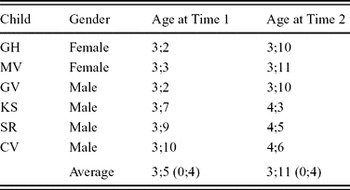
Picture naming responses were gathered from six children at a central Texas Head Start site where we conducted a larger study of bilingual Spanish–English phonological development in English (Gildersleeve-Neumann et al., Reference Gildersleeve-Neumann, Kester, Davis and Peña2008). These six children did not speak English when they entered the Head Start classroom in the fall. All six were from Mexican Spanish-only home environments and were described as developing speech typically. Typical speech and language development was established through researcher observation, parent report, and testing procedures, including performance on the Spanish versions of the Expressive and Receptive One-Word Picture Vocabulary Tests (Gardner, Reference Gardner1985, Reference Gardner1990), the Comprehension Subtest of the Stanford Binet Intelligence Scale (fourth edition) (Thorndike, Hagen and Sattler, Reference Thorndike, Hagen and Sattler1986), and dynamic assessment procedures (Kester, Peña and Gillam, Reference Kester, Peña and Gillam2001). The average age of the children (2 females, 4 males) was 3;5 years at the study onset (range: 3;2–3;10). Table 1 shows ages at both data collection points.
Gender and age (years;months) of participants. Standard Deviations are shown in parentheses.

Data collection
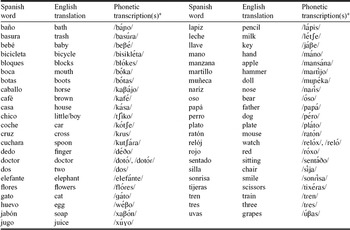
Single-word speech samples were collected in Spanish from these six children in the first month of their Head Start school year (T1) and eight months later, at the end of their school year (T2). Children attended school approximately four hours per day, providing 20 hours of English exposure per week. Productions of 45 words were analyzed, a total of 270 word types across the six children. Words were elicited with a picture identification task designed to include the consonants and vowels of Spanish in stressed syllables. At least three words for each Spanish phonemic monophthong were included, targeting the Spanish vowels /i e a o u/. Words of one to four syllables with varying syllable-shape complexity were included (see Appendix A). Words included items from the tests Assessment of Phonological Disabilities – Spanish (Iglesias, Reference Iglesias1978) and Assessment of Phonological Processes – Spanish (Hodson, Reference Hodson1986).
Fluent Spanish-speaking graduate student clinicians in speech-language pathology administered the picture naming task to the children at T1 and T2. Children were encouraged to produce words spontaneously but delayed imitation of the words was also accepted. A Marantz PMD-201 portable analog tape recorder and a Sony Lavaliere microphone were used to audio-record all speech samples.
Data analyses
The primary author transcribed all data phonetically. Phonetic transcriptions were entered for computer analysis using Logical International Phonetics Program, version 2.02 (LIPP, Oller and Delgado, Reference Oller and Delgado2000). Ten percent of the children's utterances were re-transcribed by a fluent English–Spanish bilingual with extensive child speech phonetic transcription experience. Mean inter-transcriber agreement was 95.5%. Disagreements in transcription were discussed and the two transcribers reached mutual consensus on the final transcription used for analyses.
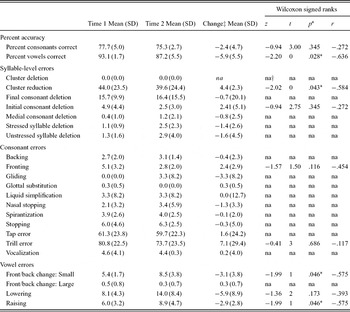
At each time point, independent analyses were completed to determine whether phonetic inventories of sounds produced were correct or incorrect. Independent analysis determined phonetic inventories of consonants, vowels, syllables, and word shapes. These results were analyzed descriptively, for the group and for individual children. Relational analyses were conducted to determine percent consonant accuracy (PCC, see Shriberg et al., Reference Shriberg, Austin, Lewis, McSweeney and Wilson1997), percent vowel accuracy (PVC, see Shriberg, Reference Shriberg1993), and rate of 22 phonological error patterns (see Appendix B). These error patterns were selected because of reported occurrence during development in children from a variety of language backgrounds (e.g., cluster reduction, final consonant deletion) and specific occurrence in Spanish speech development (e.g., tap error, trill error), and to provide a greater understanding of vowel errors in Spanish (e.g., vowel raising, vowel lowering). In addition, error patterns were analyzed to examine cross-linguistic effects because of their reported occurrence in English (e.g., gliding, glottal substitution). The frequency of these error patterns in the six children is shown in Table 2.
Descriptive statistics and statistical comparisons for average phoneme accuracy and error pattern frequencies at both points in time and for change over time (N = 6).

‡Positive mean difference in Percent Correct measures indicates that the first group in the pair produced phonemes with a greater accuracy rate; positive mean differences in syllable-level and segmental error patterns measures indicates that the first group had a lower error pattern frequency.
*p < .05
†Not applicable (na) indicates error patterns that were not statistically analyzed due to the low frequency of occurrence (less than 4% average occurrence at both points in time) or the low rate of change over time (less than 2 percentage point change).
Ten of the phonological error patterns were found to occur at rates of less than 4% at T1 and T2 (cluster deletion, medial consonant deletion, stressed syllable deletion, unstressed syllable deletion, backing, gliding, glottal substitution, liquid simplification, nasal stopping, and large front/back vowel change). Because of their low frequency, these phonological error patterns were not analyzed further. Five other error patterns (final consonant deletion, spirantization, stopping, tap error, vocalization) changed by an average of two percentage points or fewer from T1 to T2. To control for Type I error, change over time in error patterns was compared statistically only for the seven error patterns meeting two criteria: (i) occurring at an average rate of 4% or greater at T1 or T2, and (ii) changing over time by at least two percentage points. Two of these error patterns were consonant substitution patterns (fronting, trill error), three were vowel substitution patterns (small front/back change, lowering, raising), and two affected syllable shapes (cluster reduction, initial consonant deletion).
Change over time was examined for PCC, PVC, and phonological error patterns using Wilcoxon signed-rank test, the non-parametric equivalent of a dependent t-test, corrected in SPSS for multiple comparisons. PCC, PVC, and error patterns were independent variables, with time as the within-subjects factor. A significance level of p = .05 was adopted. Effect size was calculated and interpreted as .10 < r < .30 = small effect, .30 < r < .50 = moderate effect, .50 < r = large effect (Cohen, Reference Cohen1988). In addition, relational analyses were examined descriptively to provide detail regarding statistical results.
For PVC and phonological error patterns centered on vowels, only vowel errors that would negatively affect intelligibility were considered. For example, vowel differences perceptible to an English speaker because of tense–lax distinctions were not considered errors (e.g., tijeras /tixeɾas/ “scissors” produced as [tixɛɾas]). Production of [ə] for /a/ in unstressed syllables was also not considered an error.
Results
Phonemic inventory
All six children were typically-developing preschoolers and produced the vast majority of sounds that occur as phonemes in Spanish. Children produced all of the vowels, most of the consonants and consonant allophones, and a variety of Spanish word shapes at both time points. In addition, many children produced English-influenced consonants and vowels at T2, but not at T1, consistent with our predictions.
Consonant inventory
At T1, four of the six children produced an inventory including all 18 consonant phonemes of Spanish while the other two did not produce one Spanish phoneme (child GH did not produce /tʃ/ and child GV did not produce /r/). At T2, three children produced all 18 phonemes and three children did not produce one phoneme (GH and GV: /r/, SR: /ɲ/). Allophones of Spanish phonemes were produced by all children in these single-word productions. They included [ð ɤ β λ h v] and were all produced at T1 and at T2. At T2, many phones not considered allophones in Spanish were also produced – all demonstrated English influences; for example, children produced the English-influenced phones [ɹ ŋ ʃ dʒ ʒ]. Examples of use of these include the production of [ɹ] by MV: [foɹɛs] for /floɾes/, [ʃ] by GV: [leʃe] for /letʃe/, and [ʒ] by SR: [ʒiko] for /tʃiko/. SR was the only child who produced [dʒ] and [ʒ]; all other English-influenced phones were produced by more than one child. Phones produced that were not influenced by Spanish or English were a lateralized /s/, produced by GV at both time points and by KS at T2.
Vowel inventory
All six children produced the five Spanish vowel phonemes /i e a o u/ at both time points. In addition, the children produced lax allophones of these vowels at both time points. The most frequent were [I ɛ ʊ]. [ʌ] or [ə] were often produced for /a/ in unstressed syllables. At T2 only, non-allophonic vowel phones were produced that reflect the influence of English. These were [ɝ] and the rhotic [ɑɹ]. All of these English-influenced vowel phones were produced by more than one child in Spanish. Examples include MV: [manə] for /mano/, GH: [pəo] for /pero/, KS: [maɹtijo] for /maɾtijo/, and GV: [pɝo] for /pero/.
Phoneme accuracy and error patterns
In addition to examining phonemic inventory, we examined change over time in single-word productions for 22 vowel, consonant, and word-shape error patterns. Table 2 shows descriptive and statistical results for all of these analyses. In general, error and accuracy rates were similar to those reported in previous research on bilingual Spanish–English children (Goldstein and Washington, Reference Goldstein and Washington2001). Overall consonant accuracy and the frequency of most consonant error patterns did not change. These results are consistent with our hypotheses, as they occurred in areas of little ambiguity between the two languages, cluster reduction and trill errors; or areas where similar developmental error patterns have been noted cross-linguistically, such as consonant fronting. In contrast, significant changes in vowels were observed, resulting from a significant increase in vowel errors. Increases in vowel errors are consistent with our hypotheses due to the differences in the English and Spanish vowel systems. Specific findings for accuracy and error patterns are discussed below; details of statistical results are found in Table 2.
Consonant accuracy
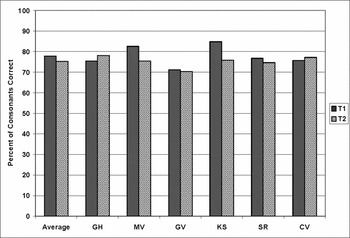
Percent of consonants correct (PCC) was compared at T1 and T2. Figure 1 shows change in PCC over time for each child and the average for the group. The average PCC for T1 was 78%, ranging from 71% to 85%. At T2, the average PCC had dropped slightly, to 75%, with a narrower range of 70%–78%. This decrease in consonant accuracy was not significant, z = −0.94, p = .345.
Group and individual percent of consonants correct (PCC) in Spanish at study onset (T1) and after 8 months of English exposure (T2).

Consonant error patterns
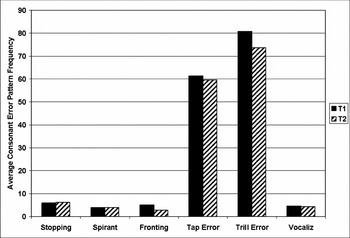
Of the 11 consonant-level phonological error patterns originally explored, six occurred at average rates of greater than 4% (see Figure 2). Of these, fronting and trill error decreased at rates greater than two percentage points. Statistical analyses demonstrated no significant differences from T1 to T2 for consonant fronting (T1 = 5.1%, T2 = 2.7%) and trills (T1 = 81%, T2 = 74%). There was individual variation in some consonant error patterns. While there was virtually no change in consonant fronting, there was increased variability for stopping, tap, and trill errors. Stopping decreased by 2–7 percentage points in three children, did not change in one child, and increased slightly in two (KS and GV). Error patterns affecting later-developing Spanish sounds showed greater variability. Three children decreased in trill errors, all by 25–30 percentage points: KS produced trills with 50% accuracy at both points in time, GV never produced a trill correctly, and GH increased from 60% to 100% occurrence of trill error. Error rate for taps was above 40% for all children at both points in time but differed by child in change over time. Tap errors decreased by more than 20% for SR and GV, did not change for CV and KS, and increased by 20% for MV and GH.
Average change over time in consonant error patterns occurring at rates of 4% or greater for the group (N = 6).

Vowel accuracy
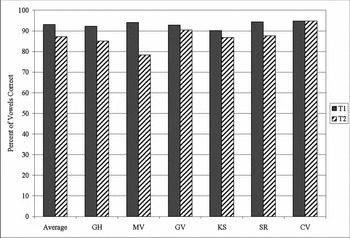
Percent of vowels correct (PVC) was compared at T1 and T2. Figure 3 shows PVC for Spanish vowels. PVC rates were significantly higher at T1 than at T2, z = −2.20, p = .028, with the average accuracy rate decreasing from 93% to 87%. Only the oldest child, CV, maintained the same level of vowel accuracy. This change in PVC had a large effect size with an increase in vowel error rate over time for the group (r = −.636).
Group and individual percent of vowels correct (PVC) in Spanish at onset and after 8 months of English exposure.

Vowel error patterns
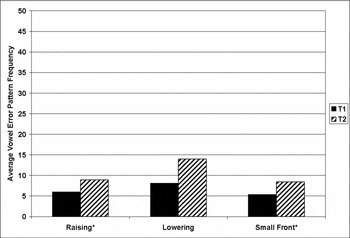
Of the five vowel-level phonological error patterns explored, three occurred at rates greater than 4% and changed over time at rates greater than 2%; these three vowel error patterns were further explored statistically. Figure 4 shows that all three increased in frequency and two (vowel raising and small front/back errors) increased significantly. Vowel raising increased from T1 (6%) to T2 (9%), z = −1.99, p = .046. Small front/back errors increased three percentage points, from 5.5% at T1 to 8.5% at T2, z = −1.99, p = .046. There was a large effect size for both of these vowel error patterns (r = −.575). Five of the six children demonstrated this increase in vowel raising; only SR demonstrated a slight decrease, from 5% to 4%. Small front/back errors increased for all children except SR, who decreased from 4% to 3%.
Average change over time in vowel error patterns occurring at rates of 4% or greater for the group (N = 6).
Note: *p < .05.

While vowel lowering increased for the group from 8% to 14%, the change was not significant. This non-significant change was accounted for by four children increasing rate of vowel lowering, KS decreasing (from 15.5% to 9.5%), and SR lowering vowels with approximately the same frequency (4% at T1, 3% at T2). Nevertheless, vowel lowering demonstrated a moderate effect size in error rate change.
Syllable- or word-level patterns
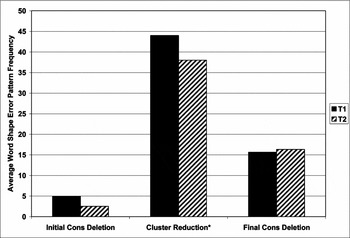
Three of the seven syllable- or word-level phonological process error patterns explored for change over time occurred at rates of 4% or greater at T1 or T2. These three error patterns are shown in Figure 5. Error patterns with highest frequency were cluster reduction and final consonant deletion. Cluster reduction showed a significant decrease, z = −2.02, p = .043 with a large effect size (r = −.584), and was observed in all six children. In contrast, final consonant deletion did not change, and averaged approximately 16% at both T1 and T2. At the individual level, however, there was high variability. Two children deleted final consonants at approximately equivalent rates at both time points, two children decreased (CV from 13% to 6% and MV from 33% to 0%), and two children increased in their rate of final consonant deletion (GV from 6% to 25%, GH from 20% to 43%). Initial consonant deletion decreased from 5% to 2.5%, a non-significant change. At the individual level, initial consonant deletion decreased in four of the six children, never occurred in one child (CV), and increased in the sixth child (MV, from 0% to 6%).
Average change over time in syllable shape error patterns occurring at rates of 4% or greater for the group (N = 6).
Note: *p < .05.

Discussion
These six children provide an example of the very early stages of Spanish–English sequential bilingualism (Grosjean, Reference Grosjean1989; Baker, Reference Baker2001). In general, error and accuracy rates were similar to reports in previous studies of Spanish-learning children and bilingual Spanish–English children (e.g. Goldstein and Washington, Reference Goldstein and Washington2001). Our preliminary exploration of sequential bilingual speech sound acquisition, based on single-word responses to pictures, suggests two issues of interest. In these preschool Spanish monolingual children, speech sound accuracy in L1 was affected by the introduction of their L2, English. The effect was observed in vowels particularly clearly. In addition, developmental errors typical for monolingual and simultaneous bilingual children also occurred in the children. These developmental errors continued to decrease or did not change in frequency even after exposure to L2. Some examples of these errors include the continued cluster reduction, final consonant deletion, and tap and trill substitution errors.
As predicted, and consistent with the unified competition model (MacWhinney, Reference MacWhinney, Kroll and De Groot2005), the most consistent pattern was the increase observed in Spanish vowel error patterns across the six children. As Table 2 shows, the variability of vowel accuracy in children increased over time, while variability or the standard deviation for consonant accuracy decreased. Monolingual 3- and 4-year olds are usually described as producing vowels accurately (Stoel-Gammon and Herrington, Reference Stoel-Gammon and Herrington1990; Goldstein and Pollock, Reference Goldstein and Pollock2000). Across the period of this study, there were significant decreases in vowel accuracy and corresponding increases in vowel front/back errors. These increases in vowel errors are consistent with our hypotheses, suggesting influence of L2 in areas of greater difference between the two languages. It appears that vowels are particularly vulnerable in Spanish-learning children at this age because of the potential reorganization created by exposure to a more complex English vowel system. Whether this increase in errors would happen in sequential bilinguals where the L2 had a less complex vowel system needs to be investigated further. Also warranting further investigation is whether similar effects occur in older monolingual Spanish-speaking children or adults who acquire English as L2.
Increase in vowel errors during speech acquisition is not frequently reported. Here in the emerging sequential bilinguals studied, an L1 with a smaller vowel system was negatively affected when acquiring an L2 vowel system with a more complex vowel inventory. Vowel errors have been reported in the more complex vowel system in simultaneous bilinguals (Johnson and Lancaster, Reference Johnson and Lancaster1998; Kehoe, Reference Kehoe2002). Consistent with the competition model, we suggest that the vowel error increases observed in Spanish result from a loss of cue reliability for Spanish vowels in the introduction of additional English vowel input. It is possible that the lack of phonemic similarity in vowel systems between Spanish and English resulted in the negative transfer of English vowel properties to the children's L1, Spanish. Our findings, albeit with a small sample from only six children, suggest that the acquisition of an L2 with a larger vowel inventory may require reorganization of the child's underlying phonological system, affecting L1 vowel production in the sequential bilingual. This effect is likely related to reorganization of the vowel phonological system rather than loss. Research suggests that the effects of one phonological system on another are a temporary phenomenon, and that the child eventually develops complete and separate phonological systems (Genesee, Reference Genesee1989; Holm and Dodd, Reference Holm and Dodd1999; Goldstein, Reference Goldstein2004).
Consonant error patterns presented a more variable picture in these six children. Overall, there was little obvious effect of English exposure on consonants or syllable-structure patterns of Spanish. For consonants, overall accuracy did not change, nor did the frequency of most consonant error patterns. Fronting, trill errors, and cluster reduction decreased in most children. These patterns are consistent with our hypotheses. MacWhinney (Reference MacWhinney, Kroll and De Groot2005) suggests that the closer the conceptual similarity of properties cross-linguistically, the more likely a successful positive transfer to a child's L2 will be. For consonant and syllable-structure patterns, the decreases we observed as well as the higher frequency of trill and tap errors are expected developmentally.
Further studies will need to be conducted to determine if rates of decrease are similar to those of monolingual or simultaneous bilingual children. A study including more children will be necessary to explore the variable rates of error observed for consonants and word structures; at this time, it is not possible to determine if the variability observed is typical or varies by age or bilingual language exposure. The significant decrease in cluster reduction observed suggests that children are progressing in their sequencing of consonants, a skill that is required in both English and Spanish.
In summary, these findings suggest that speech development in emerging sequential bilingual children may show effects of the new language on a child's first language. Statistically significant increases in Spanish vowel errors after English exposure suggest permeability of the L1 by the L2, at least temporarily. Further research of effects on L1 after L2 exposure is warranted to determine the time course of this effect of L2 on L1 phonology.
Spanish stimulus word listFootnote ‡

‡ Resources for many stimulus words were the Assessment of Phonological Disabilities − Spanish (Iglesias, Reference Iglesias1978) and the Assessment of Phonological Processes − Spanish (Hodson, Reference Hodson1986).
* We show the most frequent pronunciations of the target words in Mexican Spanish; however, any pronunciation that represented correct pronunciation in a Mexican Spanish dialect was accepted as correct.
Appendix B. Phonological error patterns analyzedFootnote *
Syllable-level error patterns
• Cluster Deletion. The deletion of a consonant cluster sequence.
/plato/ “plate” → [ato]
• Cluster Reduction.* A consonant cluster sequence produced as a singleton consonant.
/tɾes/ “three” → [tes]
• Final Consonant Deletion. The deletion of any consonant phoneme in final word position.
/pan/ “bread” → [pa]
• Initial Consonant Deletion.* The deletion of a consonant phoneme in initial word position.
/gato/ “cat” → [ato]
• Medial Consonant Deletion. Deletion of any consonant singleton phoneme in medial word position.
/teneðoɾ/ “fork” → [teneoɾ]
• Stressed Syllable Deletion. The deletion of a stressed syllable in a multisyllabic word.
/plaátano/ “banana” → [tano]
• Unstressed Syllable Deletion. The deletion of an unstressed syllable in a multisyllabic word.
/plaátano/ “banana” → [plaáno]
Segmental-level error patterns: Consonants
• Backing. A consonant produced further back in the oral cavity.
/plato/ “plate” → [plako]
• Fronting.* A consonant produced further forward in the oral cavity.
/kutʃaɾa/ “spoon” → [tutʃaɾa]
• Gliding. A liquid produced as a glide.
/lapis/ “pencil” → [japis]
• Glottal Substitution. Any consonant produced as a glottal stop.
/deðo/ “finger” → [?e?o]
• Liquid Simplification. A glide produced as a liquid.
/weβo/ “egg” → [leβo]
• Nasal Stopping. A nasal consonant released orally.
/mano/ “hand” → [bado]
• Spirantization. A non-fricative produced as a fricative “unless accurate allophonically for Spanish”.
/gato/ “cat” → [gaso]
• Stopping. A fricative or affricate produced as a stop.
/xaβon/ “soap” → [gaβon]
• Flap/Tap Error. A tap produced in error, typically as a stop or a trill.
/floɾes/ “flower” → [flodes] or [flores]
• Trill Error.* A trill produced in error, typically as a tap, liquid or stop.
/pero/ “dog” → [pedo] or [pelo] or [peɾo]
• Vocalization. A liquid produced as a vowel or glide.
/letʃe/ “dog” → [jetʃe]
Segmental-level error patterns: Vowels
• Front/Back Change − Small.* A front vowel produced as central, or central vowel produced as back, or vice versa
/pero/ “dog” → [pʌro]; / xuɤo/ “juice” → [xʉɤo]
• Front/Back Change − Large. A front vowel produced as a back vowel, or vice versa.
/kutʃaɾa/ “spoon” → [kitʃaɾa] or [kytʃaɾa]
• Lowering − 1 Level.* A high vowel produced as a mid vowel, or a mid vowel produced as a low vowel.
/uβas/ “grapes” → [oβas]; /deðo/ “finger” → [dæðo]
• Raising − 1 Level.* A low vowel produced as mid, or a mid vowel produced as high.
/dos/ “two” → [dus]; /kasa/ “house” → [kʌsʌ]