Implications
Successful selection of resistant animals both between and within breed is an optional worm control approach that can cope with anthelmintic resistance and other additional drug hazards. Selection of animals having superior genetic pool can be made by a combination of different parameters both by artificial and by natural infection trials. Quantitative trait loci of various parameters in resistant stock would provide an additional aid to the practiced parameters. The use of genetically resistant animals in breeding programs based on phenotypic markers (parasitological, haematological, biochemical and immunological) will influence the epidemiology of infection and the re-infection rate. Decrease in pasture contamination by relatively resistant flocks would be helpful in upgrading both animal health and productivity, but breeding for resilience does not inevitably mean lower parasitic burdens on pasture.
Introduction
The production of small ruminant industry is not ideal owing to high prevalence of gastrointestinal nematodes (GINs). Overreliance on broad-spectrum chemotherapeutic agents and/or their irrational utilization has resulted in the development of anthelmintic resistance in GINs of small ruminants (Jabbar et al., Reference Jabbar, Iqbal, Kerboeuf, Muhammad, Khan and Afaq2006; Saddiqi et al., Reference Saddiqi, Jabbar, Iqbal, Babar, Sindhu and Abbas2006). In parallel, the current demand for chemical-free milk and meat by producers and consumers has also been taken seriously by researchers. To overcome anthelmintic resistance dilemma and to market chemical-free high-value products, evaluation or breeding of genetically resistant/resilience stock would be a feasible and practical strategy. Resistance is the ability of the host to moderate the pathogen or parasite life cycle, that is, maintenance of low faecal egg count (FEC) under GINs challenge. Occasionally, ‘tolerance’ is used to explain a host's ability to resist the pathogenic consequences of infection (Bishop and Morris, Reference Bishop and Morris2007), which is more related to resilience. Resilience is the ability of animals to uphold performance in the face of a disease challenge, that is, to resist anaemia irrespective of FEC of blood-sucking parasites (Bishop and Morris, Reference Bishop and Morris2007; Burke and Miller, Reference Burke and Miller2008). A major difference between resistance and resilience is that the extent of parasite resistance is based on FEC and worm load while resilience is associated with changes in packed cell volume (PCV) and body weight (Chiejina et al., Reference Chiejina, Behnke, Musongong, Nnadi and Ngongeh2010). Incorporation of relatively resistant/resilient sires into breeding programs can yield long-lasting effects in terms of production owing to heritability of parasite resistance (Burke and Miller, Reference Burke and Miller2008). Successful selection of such sires is linked to the parameters used to determine resistance/resilience status, correlation with other factors, heritabilities and the cost of testing.
Several parasitological, biochemical, haematological and immunological traits have been used to categorize animals with increased resistance to infection (Beh and Maddox, Reference Beh and Maddox1996; Dominik, Reference Dominik2005). Generally, FEC and PCV are practiced in ideal circumstances, but the selection of both FEC and PCV is desirable (Taylor et al., Reference Taylor, Hunt, Wilson and Quick1990; Vanimisetti et al., Reference Vanimisetti, Greiner, Zajac and Notter2004), keeping in mind that PCV is a relevant trait of resilience status preferably in the case of blood-sucking parasites. Evidence for the genetic control of these traits comes from the comparison of different small ruminant breeds and statistical estimates of the heritability of resistance from studies within breeds (Gray, Reference Gray1991; Gamble and Zajac, Reference Gamble and Zajac1992).
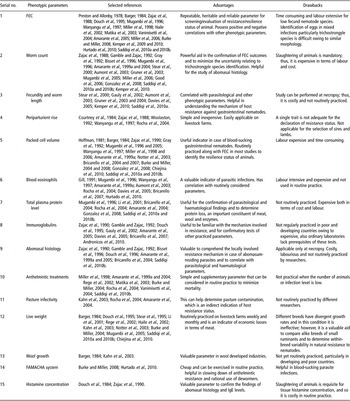
Immunological responses to parasites can also be exploited as markers. Immunity against intestinal parasites consists of the production of specific immunoglobulin (Ig) E antibodies, eosinophilia and mucosal mastocytosis (Urban et al., Reference Urban, Madden, Svetic, Cheever, Trotta, Gause, Katona and Finkelman1992; Miller, Reference Miller1996). It is dependent on the activation of T helper type 2 cells (Finkelman et al., Reference Finkelman, Pearce, Urban and Sher1991), but the efficient components of this response vary with respect to different parasite species and also with the developmental stages of infection with the same helminth species, which is due to the definite ecological niche occupied by the invading parasites at different points of the life cycle, the parasitic microenvironment and subsequently the occurrence of specific host–parasite interactions (Harris and Gause, Reference Harris and Gause2011). It was also concluded that number of mast cells, globule leucocytes, eosinophils and the concentrations of histamine, IgA anti-L3 and IgA anti-L5 are positively correlated. Mast cells produce histamine and give rise to globule leucocytes (Huntley et al., Reference Huntley, Newlands and Miller1984; Balic et al., Reference Balic, Bowles and Meeusen2000a). Sheep with increased numbers of mucosal mast cells had more globule leucocytes, eosinophils and IgA plasma cells against Teladorsagia (Tel.) circumcincta larval antigens (Stear et al., Reference Stear, Bishop, Doligalska, Duncan, Holmes, Irvine, McVririe, McKellar, Sinski and Murray1995). Live weight and worm burden are other imperative parameters for evaluating the resilience and resistance status, respectively (Woolaston and Baker, Reference Woolaston and Baker1996; Burke and Miller, Reference Burke and Miller2004), but live weight may vary depending on the breed. As the reliability of individual parameters and trials is generally questioned, so valuable and acceptable facts can be compiled by pooling data from a large number of trials as well as parameters (Woolaston and Baker, Reference Woolaston and Baker1996); however, in the absence of infection, quantitative trait loci (QTL) may facilitate the selection process, but the trait selected for would be dependent on the results obtained (Miller et al., Reference Miller, Bishop, Cockette and McGraw2006). In this paper, we have covered the most commonly performed markers to determine the resistance/resilience status of small ruminants with their limitations (see Table 1) and practical use.
Phenotypic markers used to evaluate the resistance status of sheep breeds, with their advantages and drawbacks

FEC = faecal egg count.
Parasitological parameters
FEC
It is an established fact that shedding of nematode ova/eggs in faeces is an indication of a nematode infection in the gut of an animal and this is why resistance status has generally been assessed in terms of FEC during an infection period in live animals or worm counts at necropsy. Among phenotypic parameters, FEC is the most reliable, practical and frequently used indicator to assess the host resistance/tolerance potential against GINs in natural infection (Gray, Reference Gray1991; Woolaston, Reference Woolaston1992; Kemper et al., Reference Kemper, Elwin, Bishop, Goddard and Woolaston2009). In lambs, it is well documented that FEC is highly correlated with worm counts (McKenna, Reference McKenna1981; Eady, Reference Eady1995; Stear et al., Reference Stear, Bishop, Doligalska, Duncan, Holmes, Irvine, McVririe, McKellar, Sinski and Murray1995; Douch et al., Reference Douch, Green, Morris, Mcewan and Windon1996; Woolaston and Baker, Reference Woolaston and Baker1996; Good et al., Reference Good, Hanrahan, Crowley and Mulcahy2006), particularly when infections are of Haemonchus (H.) contortus and Trichostrongylus (T.) colubriformis. Selection based on low FEC has satisfactory upshots as GINs will not adapt quickly to sheep bred for nematode resistance (Kemper et al., Reference Kemper, Elwin, Bishop, Goddard and Woolaston2009). The phenotypic correlation of the daily weight gain of lambs and FEC is reported to be mostly negative on a medium level. Bishop et al. (Reference Bishop, Bairden, McKellar, Park and Stear1996) estimated negative phenotypic correlations between FEC and live weight in Scottish Blackface lambs. Eady et al. (Reference Eady, Woolaston, Lewer, Raadsma, Swan and Ponzoni1998) reported that the genetic correlation between FEC and growth is much stronger following infection with Tel. circumcincta than H. contortus. There is mounting evidence that genetic differences in FEC will be far more pronounced after the immune system has been triggered by an initial worm infection (Gamble and Zajac, Reference Gamble and Zajac1992). The immunological reactions caused by infective larvae appear to differ in sheep and goats with different resistant status. Age is probably less critical than previous exposure to parasites in determining the optimal time to measure FEC (Gruner et al., Reference Gruner, Aumont, Getachew, Brunel, Pery, Cognié and Guérin2003; Saddiqi et al., Reference Saddiqi, Iqbal, Khan and Muhammad2010a).
Despite some limitations, experimental evidence shows that FEC can be used to assess the resistance/susceptibility status within and between breeds of sheep (Eady, Reference Eady1995) and that it is both a repeatable and a heritable trait. It is the most convenient way of measuring resistance with heritability ranging from 0.2 to 0.3 (Baker et al., Reference Baker, Watson, Bisset, Vlassof and Douch1991) or 0.2 to 0.4 (Bishop and Morris, Reference Bishop and Morris2007). Differences in FEC could be due to a number of factors such as inhibition of infective larvae, suppression of egg production or marked differences in the proportion of males and females (Bricarello et al., Reference Bricarello, Gennari, Oliveira-Sequeira, Vaz, Goncalves de Goncalves and Echevarria2004). Direct selection for resistance using parasitological measurements requires artificial or natural challenge infection. However, it is time-consuming, subject to sampling errors and may interfere with other traits under selection. It is also labour extensive for the less fecund species such as Teladorsagia owing to the relatively poor relationship between worm burden and FEC. Another limitation of this parameter is that in mixed infection, several trichostrongyle species are involved and eggs of these species cannot be distinguished morphologically. They also differ in fecundity, seasonality, pathogenicity, immunogenicity and susceptibility to the host's immune response. There are also fluctuations in time even for individual animals and to overcome this either a large number of faecal samples or a large number of animals are required.
FEC is the outcome of complex interactions between parasite populations and their hosts. Tel. circumcincta infection has clarified the situation in sheep (Stear and Bishop, Reference Stear and Bishop1999; Stear et al., Reference Stear, Strain and Bishop1999), showing that worm length is positively associated with fecundity. Worm length, and hence fecundity, declines as worm numbers increase. Lambs have a capability to control worm length but not worm number. Resistance to H. contortus has been linked to the lengthening of prepatent periods, lower FEC, lower parasite establishment rate, lower adult worm burden and increase in larval inhibition in the abomasal mucosa (Altaif and Dargie, Reference Altaif and Dargie1978; Stear et al., Reference Stear, Bishop, Doligalska, Duncan, Holmes, Irvine, McVririe, McKellar, Sinski and Murray1995). Stear and Bishop (Reference Stear and Bishop1999) found a curvilinear relation between worm length and fecundity in Tel. circumcincta. Host–parasite association assessed by FEC seems to be governed by numerous genes, each with variable significance based on the infection and host conditions (Kemper et al., Reference Kemper, Elwin, Bishop, Goddard and Woolaston2009). QTL may enable the selection of superior animals in terms of genetic resistance against GINs even in the absence of infection, but the trait selected for would depend on the results that are found after the trial (Miller et al., Reference Miller, Bishop, Cockette and McGraw2006). Studies in sheep for the detection of QTL for nematode resistance are ongoing in different regions of the world (Matika et al., Reference Matika, Pong-Wong, Woolliams and and Bishop2011). Full or partial genome scans have exposed QTL for FEC on Chromosome 1, 6 and 19 for H. contortus (Cockett et al., Reference Cockett, Bishop, Davies, Hadfield, Eng and Miller2005) and Chromosome 3 near the interferon gamma locus (Marshall et al., Reference Marshall, van der Werf, Maddox, Graser, Zhang, Walkden-Brown and Kahn2005).
Worm count at necropsy
According to Woolaston and Baker (Reference Woolaston and Baker1996), resistance status has also been assessed in terms of worm counts at necropsy. Resistance is the ability to suppress the establishment or the growth of worm infection while resilience is the capability of an animal to maintain acceptable health/performance under worm challenge mainly blood-sucking parasites like H. contortus (Albers et al., Reference Albers, Gray, Piper, Barker, Le Jambre and Barger1987). It has been found in many studies that FEC is highly correlated with the worm burden (McKenna, Reference McKenna1981; Eady, Reference Eady1995; Stear et al., Reference Stear, Bishop, Doligalska, Duncan, Holmes, Irvine, McVririe, McKellar, Sinski and Murray1995). If the differences between breeds or individuals in FEC are ambiguous then worm count could be a powerful aid to assess host genetic resistance to H. contortus. Mugambi et al. (Reference Mugambi, Audho and Baker2005) have reported that despite the absence of significant breed differences in FEC, Red Maasai and 3/4 Red Maasai had significantly fewer worms than Dorper and 3/4 Dorper. Likewise, Gruner et al. (Reference Gruner, Cortet, Sauve, Limouzin and Brunel2002) found that resistant rams, based on FEC necropsied, had higher burdens than susceptible rams. In contrast, Amarante et al. (Reference Amarante, Craig, El-Sayed, Desouki, Ramsey and Bazer1999a) found that resistant animals had fewer worms than susceptible ones, which may probably be due to the rapid rejection of most of the H. contortus larvae. Similarly, Gamble and Zajac (Reference Gamble and Zajac1992) reported that Saint (St.) Croix lambs had 99% fewer worms in the abomasa compared with Dorset lambs and had higher levels of acquired resistance in response to both natural and artificial infections. On the basis of the above findings, worm count may be considered a valuable criterion in the declaration and assessment of resistance/tolerance status of a host.
Worm length
Worm length is also another valuable parameter to assess the resistant potential of small ruminant flocks and has been used by different workers (Gauly et al., Reference Gauly, Kraus, Vervelde, van Leeuwenb and Erhardt2002; Saddiqi et al., Reference Saddiqi, Iqbal, Khan, Sarwar, Muhammad, Yaseen and Jabbar2010b). It is the main factor that influences egg production as well as the number of eggs in utero possibly due to IgA (Strain and Stear, Reference Strain and Stear2001). Strain and Stear (Reference Strain and Stear1999) observed an increase in local IgA level led to decrease Tel. circumcincta worm length. Worm length, and hence fecundity, decline as worm numbers increase. Relatively resistant H. contortus female worms were found to be shorter, with fewer eggs in utero in the F1 generation than the parent INRA 401 lambs (Gruner et al., Reference Gruner, Aumont, Getachew, Brunel, Pery, Cognié and Guérin2003).
Periparturient rise (PPR)
In identifying breeds of sheep that may be resistant to GINs, the absence of or a reduced PPR may be a simple and inexpensive tool. Sheep breeds with resistance to nematode infection often display reduced PPR in FEC compared with susceptible breeds (Courtney et al., Reference Courtney, Parkerm, McLure and Herd1984; Wanyangu et al., Reference Wanyangu, Mugambi, Bain, Duncan, Murray and Stear1997; Kahn et al., Reference Kahn, Knox, Brown and Lea2003; Bishop and Morris, Reference Bishop and Morris2007), but this independent trait alone is not sufficient to determine the resistance status of a particular breed.
Haematological parameters
PCV
PCV percentage is another highly valuable parameter that is positively correlated with weight gain and negatively correlated with FEC (Chauhan et al., Reference Chauhan, Rout, Singh, Mandal, Singh, Roy and Singh2003). Gauly and Erhardt (Reference Gauly and Erhardt2001) proposed that haematocrit is a useful indicator only if blood-sucking parasites are dominant species such as H. contortus. The effects of blood-sucking parasitism on animal health are generally monitored by measurements of PCV. Any worm that feeds on blood like H. contortus will cause anaemia, with expected losses in production and, potentially, death. Low values for PCV are thus commonly associated with high FEC due to sucking of copious amounts of blood from abomasa by adult parasites (Baker et al., Reference Baker, Rodriguez-Zas, Southey, Audho, Aduda and Thorpe2003; Saddiqi et al., Reference Saddiqi, Iqbal, Khan and Muhammad2010a and Reference Saddiqi, Iqbal, Khan, Sarwar, Muhammad, Yaseen and Jabbar2010b). PCV has also been reported to be slightly higher in resistance than susceptible breeds but it is not true for all the cases (Gray, Reference Gray1995). Resistant breeds such as St. Croix, Florida Native, Red Maasai, Gulf coast Native and Crioula have also demonstrated higher levels of PCV when infected with H. contortus than susceptible sheep breeds (Zajac et al., Reference Zajac, Krakowka, Herd and McClure1990; Mugambi et al., Reference Mugambi, Wanyangu, Bain, Owango, Duncan and Stear1996; Amarante et al., Reference Amarante, Craig, El-Sayed, Desouki, Ramsey and Bazer1999a; Li et al., Reference Li, Miller and Franke2001; Bricarello et al., Reference Bricarello, Gennari, Oliveira-Sequeira, Vaz, Goncalves de Goncalves and Echevarria2004). In addition, it has also been reported that single-born lambs have a higher PCV percentage than multiple-born lambs and also lambs from first-parity dams have a lower PCV than those from later parities (Rege et al., Reference Rege, Tembely, Mukasa-Mugerwa, Sovani, Anindo, Lahlou-Kassi, Nagda and Baker2002).
Blood eosinophils count
Eosinophilia has been reported to be a good indicator of parasite infection and protective immunity against parasites (Buddle et al., Reference Buddle, Jowett, Green, Douch and Risdon1992) and may be used for the evaluation of resistant or tolerance status. Normal eosinophil numbers in blood range from 0 to 1000 cells/μl in sheep (Hoffman, Reference Hoffman1981). Dawkins et al. (Reference Dawkins, Windon and Eagleson1989) reported that eosinophils are frequently associated with the expression of higher resistance to nematodes and have been proven to be a heritable criterion involving H. contortus infection (Davies et al., Reference Davies, Stear and Bishop2005). Eosinophil count has a negative correlation with FEC and worm length (Davies et al., Reference Davies, Stear and Bishop2005; Terefe et al., Reference Terefe, Lacroux, Andreoletti, Grisez, Prevot, Bergeaud, Penicaud, Rouillon, Gruner, Brunel, Francois, Bouix, Dorchies and Jacquiet2007), that is, susceptible hosts have a low eosinophil count than resistant ones as eosinophils immobilize invasive larvae by adhering onto the surface of L3 of H. contortus (Rainbird et al., Reference Rainbird, Macmillan and Meeusen1998). Bambou et al. (Reference Bambou, García, Chevrotière, Arquet, Vachiéry and Mandonnet2009) also observed significantly higher FEC and circulating eosinophilia in susceptible kids. Mandonnet et al. (Reference Mandonnet, Menendez-Buxadera, Arquet, Mahieu, Bachand and Aumont2006) reported a genetic association of blood eosinophils with high FEC and low PCV but, from a phenotypic perspective, this relationship was negligible.
Biochemical parameters
Total plasma protein and albumin levels
Gastrointestinal infections can lead to hypoproteinaemia and thus total plasma protein and albumin levels (g/dl) may be important determinants for the evaluation of resistant status and, in turn, the selection of resistant breeds. Bricarello et al. (Reference Bricarello, Gennari, Oliveira-Sequeira, Vaz, Goncalves de Goncalves and Echevarria2004) showed that susceptible Corriedale sheep had greater parasite burdens that resulted in hypoproteinaemia and hypoalbuminaemia, whereas Crioula animals (relatively resistant) showed only a slight decrease in the total serum protein and albumin concentrations. Mugambi et al. (Reference Mugambi, Wanyangu, Bain, Owango, Duncan and Stear1996) and Amarante et al. (Reference Amarante, Craig, El-Sayed, Desouki, Ramsey and Bazer1999a) also observed significant differences in the total serum protein concentrations when they compared sheep breeds for resistance to haemonchosis.
Immunological parameters
The level of immunoglobulins may also be helpful in determining the resistance and/or the tolerance potential of the host against GINs as infection involves the production of parasite-specific immunoglobulins such as IgA, IgG1 and IgE (Pfeffer et al., Reference Pfeffer, Douch, Shaw, Gatehouse, Rabel, Green, Shirer, Jonas and Bisset1996; Harrison et al., Reference Harrison, Pulford, Gatehouse, Shaw, Pfeffer and Shoemaker1999 and Reference Harrison, Pulford, Hein, Barber, Shaw, McNeill, Wakefield and Shoemaker2003; Gill et al., Reference Gill, Altmann, Cross and Husband2000; Huntley et al., Reference Huntley, Redmond, Welfare, Brennan, Jackson, Kooyman and Vervelde2001; Strain and Stear, Reference Strain and Stear2001) and these are powerful aids to verify the results of other practiced phenotypic parameters. Stear et al. (Reference Stear, Bishop, Doligalska, Duncan, Holmes, Irvine, McVririe, McKellar, Sinski and Murray1995) reported a strong correlation between immunoglobulins and worm burden in a study carried out on Rhön sheep. An increase in the IgG level was also noted in the case of haemonchosis (Amarante et al., Reference Amarante, Susin, Rocha, Silva, Mendes and Pires2009) and it coincided with the mean FEC. Here, the role and variability of IgA and IgE in resistant and susceptible breeds in response to GINs infections is summarized briefly.
Immunoglobulin A (IgA)
A marked difference has been reported among the levels of IgA and IgG in different breeds (Zajac et al., Reference Zajac, Krakowka, Herd and McClure1990) having different resistance status. Gill et al. (Reference Gill, Husband, Watson and Gray1994) reported that the response of IgA-parasite-specific antibody-containing cells to H. contortus infective larvae was significantly greater in resistant Merino sheep than in random-bred Merino sheep. Similarly, serum IgG1 and IgA levels in pasture-reared resistant sheep (18 months old) were also significantly higher than those in random-bred sheep between 10 and 31 days after challenge infection with H. contortus (Gill et al., Reference Gill, Gray, Watson and Husband1993). The differences appeared to be more pronounced when the comparisons of cell counts and IgA response were made between resistant and susceptible sheep/goats of the same breed and vice versa. IgA may be the major component in controlling the fecundity of H. contortus and the magnitude of the IgA response is influenced by the quality of the diet (Strain and Stear, Reference Strain and Stear2001). Stear et al. (Reference Stear, Bishop, Doligalska, Duncan, Holmes, Irvine, McVririe, McKellar, Sinski and Murray1995) suggested that the main immunological mechanism that regulates worm length and fecundity in the case of Tel. circumcincta is the quantity and specificity of parasite-specific IgA, while immediate hypersensitivity reactions regulate worm numbers. Inflammatory cells and IgA in the abomasum were inversely associated with H. contortus worm burden and FEC, indicating that they may have a role in the within-breed variation of resistance potential. Amarante et al. (Reference Amarante, Bricarello, Huntley, Mazzolinb and Gomes2005) found an inverse relationship between FEC and IgA anti-L3 and IgA anti-L5, indicating that IgA in mucus was involved in regulating the fecundity of H. contortus during the judgments of within-breed variability in genetic resistance.
Immunoglobulin E (IgE)
Resistant or responder animals have a high number of IgE-bearing cells and might be used as an additional marker for resistance (Bricarello et al., Reference Bricarello, Zaros, Coutinho, Rocha, Kooyman, De Vries, Goncalves, Lima, Pires and Amarante2007). Huntley (Reference Huntley1992) indicated that IgE may be involved in the rapid expulsion of incoming larvae from the gut but the mechanism is not clear. In the case of haemonchosis, expulsion of worms is carried out by sensitization of mast cells by IgE, which leads to the production of histamine (another applied parameter to appraise resistance status).
Abomasal histology
Rapid rejection or immune elimination of GINs L3 is also a well-established phenomenon in sheep hypersensitized by recurring infection (Kemper et al., Reference Kemper, Elwin, Bishop, Goddard and Woolaston2009). It has also been studied that larval penetration of tissue is low in a previously infected group (Jackson et al., Reference Jackson, Greer, Huntley, McAnulty, Bartley, Stanley, Stenhouse, Stankiewicz and Sykes2004), which may be due to the different tissue niches occupied by different GINs larval stages. Tel. circumcincta infective larvae habitually penetrate and establish deeply in the crypts of the abomasal tissue as compared with H. contortus L3, which prefer more surface niches (Balic et al., Reference Balic, Bowles and Meeusen2000b). This mechanism leads to the higher removal of H. contortus L3 from abomasal tissues than that of Tel. circumcincta larvae on thorough washing. It has been confirmed that both mast cells and intraepithelial mucosal mast cells (globule leucocytes) are present in substantial numbers in abomasal tissue niches of hypersensitized and relatively resistant animals. Additionally, mucosal tissue eosinophilia, increased mucus production and the presence of inhibitory substances in the mucus have been consistently observed in relation to the development of immunity to GINs in ruminants (Huntley et al., Reference Huntley, Newlands and Miller1984 and Reference Huntley, Newlands, Jackson and Miller1992; Pfeffer et al., Reference Pfeffer, Douch, Shaw, Gatehouse, Rabel, Green, Shirer, Jonas and Bisset1996; Harrison et al., Reference Harrison, Pulford, Gatehouse, Shaw, Pfeffer and Shoemaker1999; Balic et al., Reference Balic, Bowles and Meeusen2000b; Bricarello et al., Reference Bricarello, Gennari, Oliveira-Sequeira, Vaz, Goncalves de Goncalves and Echevarria2004). Differences in cellular counts in resistant and susceptible individuals/breeds and their possible role as parameters are summarized in the following.
Mast cells
Data on the role of mast cells in nematode resistance are often ambiguous. Some authors suggest that these cells are activated during nematode rejection in sheep (Emery et al., Reference Emery, Wagland and McClure1993), while others believe that sheep can express high levels of resistance without increasing the number of these cells and ‘therefore’ this increase is not a prerequisite for worm expulsion (Huntley et al., Reference Huntley, Newlands, Jackson and Miller1992). Bricarello et al. (Reference Bricarello, Gennari, Oliveira-Sequeira, Vaz, Goncalves de Goncalves and Echevarria2004) found similar mast cell counts in Crioula Lanada sheep (resistant) and in Corriedale (susceptible) lambs, but a higher number of globule leucocytes in the resistant breed.
It has been reported that mast cell counts in both the abomasal and the intestinal mucosa have an inverse relation to the length of female worms in both resistant and susceptible rams (Gruner et al., Reference Gruner, Cortet, Sauve and Hoste2004) with Tel. circumcincta, and a positive correlation between mast cells and worm fecundity has also been reported. Although globule leucocytes seem to posses stronger association with host resistance, yet increase in mucosal mast cells has been observed in many situations corresponding to changes in the host resistance with respect to age, physiological state and vaccination; thus, failing in understanding their precise role in this mechanism (Harrison et al., Reference Harrison, Pulford, Gatehouse, Shaw, Pfeffer and Shoemaker1999). Mucosal mast cells appeared to be involved in expulsion of worms within 2 to 4 h of a challenge infection via an intense IgE-mediated hypersensitivity reaction (Miller, Reference Miller1984). As mast cells produce histamine and give rise to globule leucocytes (Huntley et al., Reference Huntley, Newlands and Miller1984; Balic et al., Reference Balic, Bowles and Meeusen2000a), the association between these three variables was expected. Stear et al. (Reference Stear, Bishop, Doligalska, Duncan, Holmes, Irvine, McVririe, McKellar, Sinski and Murray1995) also observed that sheep infected with Tel. circumcincta had increased numbers of mucosal mast cells and globule leucocytes, eosinophils and IgA antibodies. A positive correlation was found between the density of cells (globule leucocytes and mast cells) in the abomasal and in the intestinal mucosa, despite some differences in the timing of the development of worm species in these two organs. This observation suggests that there is a coordinated response to invading parasites within the digestive mucosa (Yacob et al., Reference Yacob, Duranton-Grisez, Prevot, Bergeaud, Bleuart, Jacquiet, Dorchies and Hoste2002).
Globule leucocytes
Stear et al. (Reference Stear, Bairden, Bishop, Buitkamp, Epplen, Gostomski, Mckellar, Schwaiger and Wallace1996) described that the genetic control of an acquired immune response to Tel. circumcincta developed in two stages: first, in association with the development of a specific local IgA response that resulted in the reduction of average egg production per worm; and second, in association with the production of globule leucocytes in the abomasal mucosa that resulted in the control of number of worms. In several studies, the number of globule leucocytes was negatively correlated with the number of worms, suggesting that this cell type has a specific role in the resistance of the host (Douch et al., Reference Douch, Harrison, Elliott, Buchanan and Greer1986; Stear et al., Reference Stear, Bishop, Doligalska, Duncan, Holmes, Irvine, McVririe, McKellar, Sinski and Murray1995; Balic et al., Reference Balic, Bowles and Meeusen2000b; Gruner et al., Reference Gruner, Cortet, Sauve and Hoste2004). Significant differences in the globule leucocyte counts were also reported in St. Croix (resistant) and Dorset (susceptible) sheep (Gamble and Zajac, Reference Gamble and Zajac1992) and Crioula Lanada sheep (resistant) and in Corriedale (susceptible) lambs (Bricarello et al., Reference Bricarello, Gennari, Oliveira-Sequeira, Vaz, Goncalves de Goncalves and Echevarria2004). Bisset et al. (Reference Bisset, Vlassoff, Douch, Jonas, West and Green1996) evaluated the immunologic response in naturally infected Romney sheep and found higher numbers for globule leucocytes, mast cells and eosinophils in the mucosa of animals with low FEC. However, no significant differences in the cell counts were found between resistant Santa Ines and susceptible Suffolk and Il de France sheep (Amarante et al., Reference Amarante, Bricarello, Huntley, Mazzolinb and Gomes2005), Florida Native (resistant) and Rambouillet susceptible lambs (Amarante et al., Reference Amarante, Craig, Ramsey, Davis and Bazer1999b), in Florida native St. Corix (resistant) and Dorset/Rambouillet sheep (Zajac et al., Reference Zajac, Krakowka, Herd and McClure1990). In the light of the above-mentioned facts, the globule leucocyte count may be considered an additional imperative parameter to other phenotypic markers to evaluate and declare the resistance status of experimental animals.
Tissue eosinophils
Tissue eosinophil count has also been included in many studies for the evaluation of resistance status of different small ruminant breeds (Gill et al., Reference Gill, Altmann, Cross and Husband2000; Terefe et al., Reference Terefe, Lacroux, Andreoletti, Grisez, Prevot, Bergeaud, Penicaud, Rouillon, Gruner, Brunel, Francois, Bouix, Dorchies and Jacquiet2007). Eosinophils possess extremely potent mediators that can damage and kill infective larval stages of most if not all helminth parasites (Meeusen and Balic, Reference Meeusen and Balic2000). Nematodes release chemoattractants for eosinophils that may lead to rapid mobilization to the site of infection (Adams and Colditz, Reference Adams and Colditz1991). It has been reported that the injection of dexamethasone, a synthetic analogue of hydrocortisone, into parasitized sheep, reduced gut submucosal levels of globule leucocytes, mast cells and eosinophil leucocytes and resulted in increased FEC (Douch et al., Reference Douch, Harrison, Elliott, Buchanan and Greer1986; Buddle et al., Reference Buddle, Jowett, Green, Douch and Risdon1992). The role of eosinophils in parasitic infection is acknowledged universally but there are controversial statements about their concentration in resistance and susceptible animals. Gill et al. (Reference Gill, Altmann, Cross and Husband2000) reported that a resistant line of Merino lambs exhibited higher densities of eosinophils in the mucosa in response to haemonchosis than random-bred lambs. Similarly, Amarante et al. (Reference Amarante, Bricarello, Rocha and Gennari2004) also accounted higher eosinophil means in Santa Ines than Ile de France and Suffolk lamb naturally infected with GINs.
Anthelmintic treatments
It has been suggested that if differences between two breeds in parasitological, haematological and biochemical parameters are underestimated, then the number of drenches given to the animals can be considered in the interpretation of other parameters (Amarante et al., Reference Amarante, Craig, El-Sayed, Desouki, Ramsey and Bazer1999a; Matika et al., Reference Matika, Nyoni, van Wyk, Erasmus and Baker2003). Resilience has been assessed in terms of productivity under nematode challenge compared with productivity in non-infected animals (Albers et al., Reference Albers, Gray, Piper, Barker, Le Jambre and Barger1987) and the number of anthelmintic treatments required over a given period of pasture challenge (Bisset and Morris, Reference Bisset and Morris1996). Burke and Miller (Reference Burke and Miller2004) reported that Katahdin lambs required more anthelmintic treatments than Dorper lambs, indicating the susceptibility of Katahdin lambs than Dorper lambs. Likewise, Red Maasai (resistant) crosses entailed fewer drenches than Dorper (susceptible) lambs and had a higher survival rate at 1 year of age (Reynolds et al., Reference Reynolds, Baker, Sherington and Njubi1992). Different criteria exist in the literature for salvage treatments in order to prevent animal mortality. The two most applied criteria are FEC and PCV (for blood-sucking parasites) with different cutting edge values set by different workers. For instance, FECs higher than 4000 EPG or with a PCV < 21% (Amarante et al., Reference Amarante, Bricarello, Rocha and Gennari2004), PCV < 17% or FAMACHA score >2 for blood-sucking GINs (Burke and Miller, Reference Burke and Miller2004), PCV < 15% and FEC > 2500 EPG (Miller et al., Reference Miller, Bahirathan, Lemarie, Hembry, Kearney and Barras1998), FEC > 4000 EPG or PCV < 21% (Rocha et al., Reference Rocha, Amarante and Bricarello2004), PCV < 18% (Vanimisetti et al., Reference Vanimisetti, Greiner, Zajac and Notter2004), FEC > 2000 EPG (Rege et al., Reference Rege, Tembely, Mukasa-Mugerwa, Sovani, Anindo, Lahlou-Kassi, Nagda and Baker2002), FEC > 1500 EPG and/or PCV < 20% (Matika et al., Reference Matika, Nyoni, van Wyk, Erasmus and Baker2003). The FAMACHA test based on five-colour charts is also a useful tool for the determination of deworming time both for sheep (van Wyk et al., Reference van Wyk, Malan and Bath1997) and goats (Vatta et al., Reference Vatta, Letty, van der Linde, van Wijk, Hansen and Krecek2001). FAMACHA may be a useful and practical field tool for the assessment of the resilience status of animals (Burke and Miller, Reference Burke and Miller2008). Varying degrees of anaemia are depicted comparing the colour of chart with the colour of mucous membranes of the eyes of sheep and goats. Animals are graded on a scale ranging from non-anaemic (red) to severely anaemic (pale), and based on this chart, they are considered to be in danger of succumbing to the effects of haemonchosis and are timely and wisely treated.
Although a significant positive correlation between FAMACHA and FEC has been reported by different workers (Kaplan et al., Reference Kaplan, Burke, Terrill, Miller, Getz, Mobini, Valencia, Williams, Williamson, Larsen and Vatta2004; Burke et al., Reference Burke, Kaplan, Miller, Terrill, Getz, Mobini, Valencia, Williams, Williamson and Vatta2007), however, when using this system to choose resilient lambs/sires, farmers should have awareness that susceptible lambs may be more vulnerable to GINs due to more pasture infectivity. By careful monitoring of farms, producers can apply the FAMACHA system to recognize not only resilient but also resistant lambs/sires (Burke and Miller, Reference Burke and Miller2008).
Pasture infectivity
Sheep and goat breeds that are resistant to GINs possess a potential of reducing pasture contamination when compared with susceptible breeds. Amarante et al. (Reference Amarante, Bricarello, Rocha and Gennari2004) found that if Santa Ines lambs had been raised in a separate paddock, pasture contamination would have been reduced over time, which would have reduced pasture exposure, and as an outcome growth would be better. Herbage collection techniques have been used to determine the extent of pasture infectivity in which herbage samples are generally collected along a W track in the paddock by cutting as close as possible to the ground level (Taylor, Reference Taylor1939). Herbage is then processed to recover larvae by various means, one of which has been described by Amarante and Barbosa (Reference Amarante and Barbosa1995).
Live weight
The difference in weight gain/loss of resistant and susceptible flocks may be attributed to the genetic performance of small ruminant breeds. Weight gain/loss as a criterion for natural resistance/resilience has been considered a useful tool by many workers (Li et al., Reference Li, Miller and Franke2001 and Reference Li, Meyer, Van Tassell, Sonstegard, Conner, Van Amburgh, Boisclair and Capuco2006; Haile et al., Reference Haile, Tembely, Anindo, Mukasa-Mugerwa, Rege, Alemuyami and Baker2002; Chauhan et al., Reference Chauhan, Rout, Singh, Mandal, Singh, Roy and Singh2003; Matika et al., Reference Matika, Nyoni, van Wyk, Erasmus and Baker2003; Notter et al., Reference Notter, Andrew and Zajac2003). This parameter is feasible to perform besides FEC, as negative phenotypic correlations have been reported between FEC and live weight in Scottish Blackface lambs (Bishop et al., Reference Bishop, Bairden, McKellar, Park and Stear1996). The usefulness of weight gain/loss criterion in the evaluation of different breeds of animals seems to depend on the uniformity or dissimilarity in the genetic performance potential and/or the size of the animals. Live weight may not be appropriate to evaluate resistance/resilience status as some studies have shown a very small difference between relatively resistant/resilient and susceptible experimental flocks (Amarante et al., Reference Amarante, Bricarello, Rocha and Gennari2004; Mugambi et al., Reference Mugambi, Audho and Baker2005; Saddiqi et al., Reference Saddiqi, Iqbal, Khan and Muhammad2010a and Reference Saddiqi, Iqbal, Khan, Sarwar, Muhammad, Yaseen and Jabbar2010b). Vanimisetti et al. (Reference Vanimisetti, Greiner, Zajac and Notter2004) and Bricarello et al. (Reference Bricarello, Zaros, Coutinho, Rocha, Kooyman, De Vries, Goncalves, Lima, Pires and Amarante2007) also observed insignificant differences between resistant and susceptible groups.
A number of other techniques that may be used to indicate resistance to GINs include haemoglobin concentration, pepsinogen, histamine and fructosamine concentrations (Sayers and Sweeney, Reference Sayers and Sweeney2005). Perhaps these markers could upgrade the use of FEC; however, the contrasts discussed in the above parameters may reflect differences in age, the breed of the animals used and, most importantly, differences in the protocols of the experiment. The differences appeared to be more pronounced when comparisons of cell counts were made between resistant and susceptible animals of the same breed, but less so when comparisons were made among resistant and susceptible breeds.
Acknowledgements
This article was organized during IPFP and TTS tenures supported by Higher Education Commission of Pakistan.