Had a symposium on factor markets in the early modern world appeared sixty years ago it is safe to assume that there would have been no article on West Africa. For it was then generally thought that pre-colonial economies produced little for the market besides slaves for export across the Atlantic and Sahara. Hence there would have been insufficient derived demand to support a labour market, while, whatever the pull of market forces, land was alienation-proof because of religious taboos. In the light of subsequent research pre-colonial West Africa still appears very different from European experience, but no historian today should assume that pre-colonial societies were characterized by a general absence of factor markets. Rather, the forms of property, and some of the other institutions with or within which factor markets operated, were different from those which spring to mind in European history, such as regular wage labour, land titling, and financial intermediation.
The work of the first generation of professional economic historians of West Africa (as opposed to earlier individual pioneers) was signalled by K. O. Dike's Trade and politics in the Niger Delta (1956),Footnote 1 and was compellingly synthesized and carried forward in A. G. Hopkins's An economic history of West Africa (1973). Hopkins arranged his book around the theme of markets, including factor markets, which existed, even if the main and most ubiquitous kind of labour market took the form of trade in persons rather than in their working hours. Where a factor market did not exist, as was usually the case with land, its very absence could itself be explained in terms of market economics – as will be confirmed below.Footnote 2 Since 1973 a second generation of continuous research has revealed more about the scale and characteristics of market transactions in factors of production: showing that slave trading and slave holding within West Africa became increasingly common during and in the aftermath of the Atlantic slave trade, and enquiring further into the implications of different political and institutional arrangements for the operation of markets.
This work has involved systematic use of a body of sources rather more extensive than was appreciated before, including some texts from Muslim scholars in West AfricaFootnote 3 as well as accounts written originally in a range of European languages. The latter comprise contemporary publications and archival deposits of government, company and missionary papers.Footnote 4 The written sources provide sometimes contrasting perspectives: those of slave traders, freed slaves and abolitionists, as well as merchants, for whom credit was an occupational necessity, and missionaries, who strongly disapproved of debt. There remains a fundamental problem, albeit one that has been gradually ameliorated, with the slowly expanding body of recovered sources. For c.1500–c.1890 European accounts provided much more information on the coast than on the interior. This was true especially up to 1795, when Mungo Park began his first journey from the mouth of the Gambia river to the state of Masina in what is now Mali, the written account of which can be seen as opening a new era.Footnote 5 This statement requires qualification because of writings not only from the centres of Muslim learning in the towns of the Sudan,Footnote 6 but also from transcriptions of oral testimonies and formal oral traditions.Footnote 7 Almost by definition, however, the testimonies (the reminiscences of eyewitnesses or their immediate descendants) collected after the period relate only to the later nineteenth century, while formal traditions focused on dynastic rather than economic events, though they could still contain important statements about land settlement, for example. Overall, the density of sources is regionally and chronologically uneven. Qualitative observations about transactions and institutions, and general comments on resources and economic activities, are more common than measurement – though this imbalance is much less true for intercontinental trade than for the domestic economy. Information about prices of slaves and goods is increasingly being collated and converted, with varying degrees of confidence, into consistent data – especially, but not exclusively, in the external trade.
Hopkins argued that the pattern of property and markets in factors of production in early modern West Africa was a response to what we might call ‘Nieboer’ conditions: relative abundance of cultivable land, relative scarcity of both labour and capital.Footnote 8 In view of more recent research, it will be suggested here that this analysis can be put in the starker form of the Domar model: that whereas Hopkins insisted that slavery rather than free labour was a choice, in economic terms there could have been no labour market without coercion.Footnote 9 Again, the large scale of the contribution of slavery and, relatedly, of human pawning to the growth of production for the market in various parts of the region, as or after the Atlantic slave trade declined, is something that has only become fully apparent as a result of the accumulation of research over the last generation. The article seeks to make two further contributions to the literature on West Africa, as well as making it more accessible to comparative historians and historical sociologists. First, it argues that the (by definition) selective availability of resource rents accounts for the occasional instances of payment for land rights during the early growth of agricultural exporting and, in part, for the distribution of slave-purchasing capacity between different societies within the region. Second, it offers an exploratory review of the social costs as well as the effectiveness of the markets concerned, and of the institutions through which they operated.
This article has six substantive sections. The first discusses periodization and thereby outlines parts of the economic and political contexts. The second describes the fundamentals underpinning factor markets: the resource endowments and commodity markets. These introductory sections are followed by three which consider the evidence on markets in each factor of production in turn. Then, in view of the potential of states and laws or customs for enforcing, regulating or otherwise intervening in factor markets, I discuss the relationships between political structures and factor markets.
PERIODS AND CONTEXTS
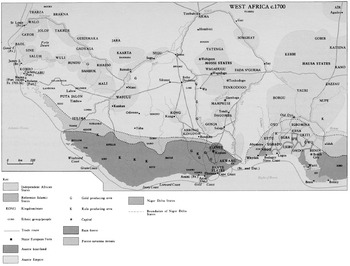
Applying periodizations derived from the history of one part of the world to that of another can be problematic. For West Africa, the term ‘early modern’ is most readily applicable to the era during which the Atlantic slave trade was expanding. Slaves were part of European-African maritime trade from its fifteenth-century beginnings. Measured in total value per decade, slaves exceeded the combined total of other exports from West and West-Central Africa from the 1690s until the 1840s.Footnote 10 The upward trend of slave exports reversed in the 1780s, and the process of abolition – very gradual, as it turned out – began to take effect following the British abolition law of 1807. Atlantic commerce entangled the history of West Africa with that of early modern Europe. Within Africa, the gains from this trade created incentives for the construction of militaristic states, and the revenues and imported guns facilitated their expansion (though were not solely responsible for it), as with the kingdoms of Asante and Dahomey and the Oyo empire (whose army was based on cavalry rather than gun-regiments). (See Figure 1.)
West Africa c.1700. (Source: J. F. A. Ajayi and Michael Crowder eds., with Elizabeth Dunstan, Alick Newman and Paul Richards, Longman historical atlas of Africa (Harlow, UK, 1985), section 35, adapted and used by permission.)

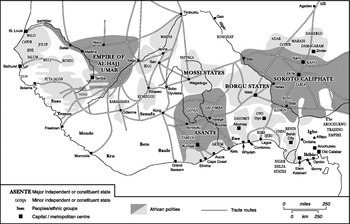
Taking 1807 as an appropriate closing date is consistent with Hopkins's proposal, in 1973, that the post-1807 transition in the composition of African exports in the Atlantic trade, from slaves to ‘legitimate’ commerce in commodities such as palm oil and peanuts, should be seen as ‘the start of the modern economic history of West Africa’.Footnote 11 His point was that it inaugurated the commercial structure that has persisted more or less ever since: production of agricultural products for export, and by small producers as well as large. This structure contrasted with the domination of the slave trade by rulers and large merchants.Footnote 12 The extent of this discontinuity has been much debated, and qualified.Footnote 13 But it can be reinforced and reinterpreted by pairing it with a second major change, beginning in 1804: the formation of the Sokoto Caliphate, which was to cover much of what is now northern Nigeria and parts of neighbouring countries (see Figure 2). This was one of a series of jihads by which Islamic reformers overthrew ‘corrupt’ regimes and established new states across much of the Sudan.Footnote 14 In the Sokoto case, it had the unintended consequence of creating an institutional framework conducive to economic growth: the most populous state and market in West Africa, whose expanding cotton textile industry was fed by raw cotton and indigo grown to a great extent in villages or plantations staffed by slaves captured by the Caliphate's armies in their regular campaigns against ‘pagans’.Footnote 15 Kano, the commercial capital of the Caliphate, became the centre of a wider economic sub-region in the Central Sudan, as well as trading with the neighbouring forest zone to the south, such as the Yoruba states and the kingdom of Asante (in what is now Ghana).Footnote 16
West Africa c.1850. (Source: J. F. A. Ajayi and Michael Crowder eds., with Elizabeth Dunstan, Alick Newman and Paul Richards, Longman historical atlas of Africa (Harlow, UK, 1985), section 45, adapted and reproduced by permission.)

Invoking the formation of the Sokoto Caliphate, and the development of a Central Sudan economy whose circuits were largely internal (and whose main external links were through the trans-Saharan caravan trade rather than the Atlantic),Footnote 17 ameliorates a serious disadvantage of the period divisions adopted here, namely that they overlook continuities and internal sources of change. The basic source of change in African agriculture was the same throughout 1500–1890, and before and after: the selective adoption of new crops and crop varieties.Footnote 18 However, with the onset of the Atlantic trade the Americas became a source, indeed the main source, of such importations (as well a recipient of African cultigens too). Again, from the 1740s until the European Scramble, the biggest source of change in the boundaries and policies of West African states was not the Atlantic trade but the wave of jihads (though the two interacted).Footnote 19 Further, James Webb has argued that in the desert-edge economy of the Western Sahel, from 1700 to at least 1850, trade within the continent was larger than the maritime trade, while the biggest source of economic change was environmental: growing aridity.Footnote 20 These elements of continuity, and of relative autonomy from the Atlantic trade, militate against 1807 as a period marker. On the other hand, we have seen that – crucially though perhaps fortuitously – the jihad that made the most distinct economic difference began in the same decade.
The approach taken here is to examine both the c.1500–1807 and post-1807 parts of the pre-colonial era (the latter ending at different times in different parts of the region, mostly during 1879–1903). For the later period, containing a general expansion of slave holding within West Africa, and the emergence of land sales (admittedly still exceptional), provides an illuminating perspective on the earlier period. It is particularly relevant because the property-rights institutions themselves, as opposed to supply and demand, do not seem to have changed between the two periods.
RESOURCE ENDOWMENTS AND COMMODITY MARKETS
Given that factor markets are responses to relative scarcities, it is necessary to introduce the supply of resources, and the prevailing factor ratios. Throughout the period, West Africa as a whole – and in most localities too – was characterized by an abundance of cultivable land in relation to labour and capital.Footnote 21 In most parts of the region the first reasonably accurate censuses of population date from well into the twentieth century. During the colonial era they seem to have had a tendency to undercount, because of limited government resources and popular desire to avoid possible exposure to direct taxation. Hopkins's figure of about 36 million for 1910Footnote 22 still seems as good as any.Footnote 23 All estimates of the region's population for earlier years are backward projections, therefore dependent not only on questionable census returns but also on their authors' assumptions about natural growth rate and the impact of the Atlantic and Saharan slave trades. One ‘guesstimate’ of the population of Africa in 1750 as a whole implies a density of 2.3 to 5.8 per square kilometre; a more recent one, for tropical Africa, implies 2.3 to 3.0 per square kilometre.Footnote 24 In the early censuses, West Africa emerged as, on average, less thinly populated than other major regions of Sub-Saharan Africa. By 1960, the West African population seems approximately to have doubled from its 1910 level.Footnote 25 Even so, the ratio of population to agricultural land was estimated to be still only 27 per square kilometre as late as 1959.Footnote 26 A rare attempt to quantify land use, which examined a relatively highly populated area – around the Asante capital of Kumasi – in 1907 found that a substantial proportion of the forest was left outside the crop rotation, which itself was on a long (probably 15–20 year plus) cycle.Footnote 27 Though there were ‘islands’ of intensive cultivation where people had literally taken to the hills or swamps to avoid slave raiding,Footnote 28 the general pattern is very clear: the expansion of agricultural output was not constrained by a physical shortage of land.Footnote 29
Two important qualifications should be made to the generalization of labour scarcity and land abundance. First, the general abundance of land did not preclude scarcities of particularly fertile land with relatively cheap access to markets. Resource and locational rents could be available in some areas, as we will see. Second, though labour was scarce during the busy periods of the agricultural year, it tended to be underemployed, or at least less productively employed, during much of the dry season, between the end of the harvest and the beginning of land clearance for the next planting. The low opportunity cost of dry-season labour facilitated gold mining (where it was possible), handicraft production and human porterage. The latter was essential for transport in the forest zones and parts of the savanna, where the animal form of sleeping sickness prevented the use of large animals.Footnote 30
Meanwhile, opportunities for fixed-capital formation were constrained by environmental obstacles, such as thin soils and the disease restriction on the use of large animals, to the provision of capital goods that would be efficient in West African contexts. This, more than transaction costs, was to prove a deterrent, even in later periods, to imports as a solution to shortages of capital. So, in this era, fixed-capital formation mainly took the form of the application of labour using simple tools: to make looms and smelters, dig gold pits and bring primary forest land into a long cycle of rotation and fallow.Footnote 31 Meanwhile working capital was much needed for long-distance trading, which often involved journeys of several months, as well as in the form of seed and food funds to enable producers to survive the stress periods imposed by the agricultural cycle. The economies could be described as semi-monetised: trade within and between the various markets within West Africa operated mainly using commodity currencies. Not surprisingly in the context of this, and of the generally low level of income per head, liquid capital was scarce.Footnote 32
While most food was produced within the consumers' own households, it is now well established that extra-subsistence production was a vital part of local economies throughout the region.Footnote 33 In certain areas this included regular production of grain for sale, notably by sedentary agriculturalists in the savanna to satisfy the nomads of the Sahara.Footnote 34 Further, some towns in the more arid regions through which the Niger flowed depended on regular supplies of grain brought in by canoe.Footnote 35 Again, according to Philip Curtin, ‘many Senegambian towns were far from self-sufficient. Hundreds of tons of foodstuffs were marketed each year to supply incipient urban centers.’Footnote 36 The same applied to towns in what are now Ghana and Nigeria.Footnote 37 Even rural areas were not always immune from the need to buy basic foodstuffs: there are cases from as far apart as northern Ghana and The Gambia where it seems that poorer farmers had frequent recourse to the market for grain to tide them over the ‘hungry season’ before the harvest.Footnote 38
Households that were well supplied with most nutrients nevertheless relied on the market for meat and livestock (bought from pastoralists). Muslims in the Central Sudan bought kola nuts grown in the forests, notably in Asante, as a stimulant permitted by their religion.Footnote 39 Salt, from the sea or preferably the desert, was the most ubiquitous case of what Richard Roberts described as the ‘ecologically specialized trade of pre-colonial West Africa’.Footnote 40
But the market had other foundations too. Even within the same ecological zone, some people invested their labour in acquiring and selling specific natural products. Thus within the forests of Asante and the Gold Coast there was an important trade in edible snails.Footnote 41 It was often the channel (for many the only one available) by which were obtained the goods that mattered for self-realization and social and political life: to get married, to acquire desirable things such as iron goods and fancier cloths, to obtain the more expensive forms of weaponry (horses – ultimately from North Africa – for some savanna states, and firearms from the coast).Footnote 42 Cloth is particularly significant, as illustrating what, in material – but not necessarily social – terms, was discretionary consumption. Curtin commented that ‘It was … theoretically possible for a village to meet its own textile needs’, yet ‘A caravan carrying one type and quality of cloth might well meet another carrying a different type and quality in the opposite direction.’Footnote 43 In the nineteenth century, Hausa merchants conveyed the cotton cloths of Kano into a very far-reaching commercial network, extending far beyond the Central Sudan. The German explorer Heinrich Barth stayed there in Kano in 1851. He remarked, ‘There is really something grand in this kind of industry, which spreads to the north [as far as Libya, to the west as far as Timbucktu on the Niger Bend, and] to some degree even as far as the shores of the Atlantic, the very inhabitants of Arguin [a town on the coast of Mauretania] dressing in the cloth woven and dyed in Kano.’Footnote 44
It should be added that trade in basic foodstuffs was closely integrated with trade in other commodities. For instance, the Soninke, living in what are now the borderlands of Mali, Senegal and Mauretania, produced regular surpluses of millet and sorgum which they exchanged with desert-based nomads in return for salt and cattle. Soninke caravans then set off south, to re-sell some of the salt and cattle, and also to trade cloth and craft products produced in their own villages.Footnote 45
A major component of the internal trade of West Africa was currency materials. During the ‘early modern period’ all the major commodities used as currencies in the region were imported, except for gold and, in Senegambia, cloth. Iron and copper, silver dollars and, above all, cowry shells were variously imported in different parts of the region. By the nineteenth century the cowrie, or cowrie and gold (for higher denominations), zone had spread over the majority of the region.Footnote 46 Significantly, the purpose of importing currencies was not to facilitate trade with the Europeans, for the Europeans did not accept the currencies back. Rather, currency materials were imported to facilitate transactions within West Africa, and are thus testimony to the vitality of internal markets.Footnote 47
Despite the Atlantic trade, West African economies, especially in the interior, remained to a great extent oriented to local and regional circuits of goods exchange;Footnote 48 lubricated, however, in most of the region, by imported commodity currencies. Enough has been said in this section to show that commodity markets were sufficiently developed to create the derived demand required for factor markets, providing there was a means to deny some labourers independent access to land. That means was supplied, not by alienation of land, but rather by slavery and pawning.
LAND
The issue of the market value of ‘land’ rights requires sub-division, responding to the contrast between the general abundance of cultivable land and the scarcity of access to specific, commercially valuable natural resources: minerals, trees and the ‘right kind’ of cultivable land (that suited to the growing of a crop for which there was market demand, and situated with cheap access to the market).
Cultivable land was not only physically relatively abundant; usually it was also easily and extremely cheaply accessible in institutional terms. This is perhaps most pertinently conveyed by drawing a contrast with what was to happen in the early and middle twentieth century, in those areas where cultivation rights became economically valuable under the stimulus of larger populations and greatly expanded export markets. Then the tendency was for immigrant farmers to be allowed to rent land but not to buy it; the newcomers and their descendants would retain indefinitely the status of strangers.Footnote 49 In contrast, in the pre-colonial era landowning authorities at all levels, from kings to household heads, wanted more people with whom to subdue nature and, if necessary, their neighbours, providing that the newcomers respected their authority. For household heads this meant acquiring slaves and pawns, as we will see. For the heads of villages or provincial chiefdoms or independent states, it meant encouraging strangers to settle, to become subjects, by giving them land indefinitely in return for merely token payments that signified their acceptance that the land itself (as opposed to the use rights) ultimately belonged to the original owner.Footnote 50 Whether you were a stranger or a local, man or woman, free or even slave, in most times and places in early modern West Africa you could clear and plant land belonging to the household, clan or chief without paying more than token sums in rent.
In this setting, we do not need to invoke cultural resistance to land alienation to explain why markets in land were rare. Indeed, where a political or economic imperative for land alienation occurred, religious objections to the transfer of lands seem to have been overridden or bypassed. The emergence of an export market for palm oil in the early nineteenth century elicited a widespread supply response on the Gold Coast (southern Ghana). Among the societies involved were the Krobo who lived on and around ‘Krobo Mountain’, where their ancestors and elders had taken armed refuge against the risk of slave raids. Lacking sufficient land of their own on which to create palm plantations, they succeeded in purchasing it outright from their Akyem neighbours (and they retained it through later legal challenges, during and since the colonial era).Footnote 51 But it is essential to emphasize how rarely the issue of buying land arose. A further well-documented exception turns out to prove the rule. In eighteenth- and nineteenth-century Asante there were many cases of lands being transferred in settlement of sums of money owed, usually resulting from fines imposed by the Asantehene (king's) courts. Given that the transfers were driven by the state rather than by scarcity, it would be misleading to regard them as a real market.Footnote 52 In any case the value of the lands concerned was fiscal (the right to charge for a proportion of the monetary value of gold or kola nuts extracted from them) and demographic-cum-political (the transfer of the land was associated with the transfer of allegiance of the inhabitants to the new landowner).Footnote 53 This is in contrast to the Krobos, who were buying land precisely as a factor of production, in a situation in which, untypically for the period, land was relatively scarce. This contrast is related to the change from the ‘early modern’ era of the Atlantic slave trade to the ‘late modern’ era of agricultural exports. In the former, land was so widely abundant that it is hard to find any evidence of a market in cultivation rights. In the latter, the growth of agricultural exports began gradually to make land scarce, though the process is not complete even at the time of writing. The Krobo purchase of land on which to cultivate oil palms was a very early and localized instance of the emergence of a factor market in land.Footnote 54
Rents could be captured from control of particular natural resources that were both scarce and inelastic in supply. Hence, despite the general lack of commercial value in cultivation rights, landowning authorities would normally insist or retaining ownership of the land itself, not only for political reasons (to claim authority, at least in name, over all residents) but also partly in order to charge genuine rentals or royalties for the exploitation of any commercially valuable natural resources extracted from them.Footnote 55 In the periods under discussion such resources were usually limited to minerals (notably gold, in parts of what are now Mali and Ghana) or wild kola nuts (as in the Asante–Kano trade mentioned earlier) or rubber (West Africans, for example in what is now Guinea, participated in the world rubber frenzy of the late nineteenth century, without the intervention of the colonial coercion associated with Leopold's Congo).Footnote 56 However, there were also cases where cultivation rights did have commercial value. In the post-jihad Hamdullâhi Caliphate of Masina (c.1818–1862), pastoralists were charged rentals for access to state-owned grazing lands.Footnote 57 This took advantage of the fact that, in this generally arid region, grazing lands were scarce. A better-known and financially larger-scale case is that of migrants from the interior, Soninkes and others, who came to the banks of the Gambia river to cultivate peanuts for export. Especially in the early decades, from the 1830s to 1870s, the terms on which they worked were those of tenants rather than labourers. They paid the landlords (in money, in a share of the crop, and increasingly often in a share of their labour-time) for access to land that would support the crop that was in most demand, in an area where transport costs were low enough for producers to earn returns sufficient to justify their long journeys and often 2–3-year absences from home.Footnote 58
Charging for grazing rights was probably not a nineteenth-century innovation, but the emergence of land sales in Akyem and of labour-tenancy around the Gambia river, were harbingers of more widespread commercialization of land rights during and after the colonial period. They were part of the transition from the ‘early modern’ period of West African economic history.
CAPITAL
A nineteenth-century dictionary (1881) shows the existence of an explicit concept of capital in the Akan language of the forest zone of what is now Ghana: dwetiri, ‘a capital or stock of money to begin trade with; a fund employed in business or any undertaking’.Footnote 59 For the largest Akan state, the kingdom of Asante, I have argued elsewhere that ‘The process of raising and investing capital was a normal part of becoming an economic and social adult, and then of continuing to live up to the social ideal of self-enrichment through hard work.’Footnote 60 This was surely not unique, or even exceptional, in the region, considering what has been written (without perhaps making this specific point) on societies from the Soninke in the northwest to the Igbo in the southeast.Footnote 61 Further, it was definitely possible to hire finance. As would be expected from the scarcity of liquidity, it had a price: ‘Money does not go out to earn its livelihood and come back empty-handed’, as an Asante saying observed.Footnote 62 There is plenty of evidence of interest being paid in other West African societies in these periods.Footnote 63 Even in the Muslim communities, while interest was not explicit, instruments existed for bypassing its prohibition.Footnote 64
But all this is not sufficient to show that there was a capital market, in Cournot's sense of a market as a space in which there is a tendency for prices to be equalized through competition.Footnote 65 There are several complications and qualifications.
First, capital markets were not clearly (if at all) distinguished from transactions in consumption loans. This reflected the fact that most units of production were also usually units of consumption: households of various forms, including families dispersed within an ethnic or religious trading diaspora.Footnote 66
Second, the prevailing interest rates seem to have been often extremely high. Visiting Asante in 1817, T. E. Bowdich reported the rate to be ‘33 1/3 per cent for every forty days, which is accompanied after the first period by a dash of liquor’.Footnote 67 This was an extreme case, and it has been suggested that interest rates declined in Asante over the nineteenth century.Footnote 68 But any rate remotely so penal would seem to exclude loan finance as a realistic basis for a profitable business. Rather, they suggest money sharks attacking desperate consumers or, in some cases, taking advantage of strangers far from home.Footnote 69
Third, equity participation and lending, for example in ventures such as long-term trading expeditions, seem generally to have taken place within specific extra-economic relations. Against the risk of being cheated, the investor or lender relied on personal acquaintance, family connection, patronage, or common membership in the ‘moral community’ constituted by the ethnic and/or Muslim diasporas that dominated most long-distance trades in the region.Footnote 70 In Akan society, for example, in this era a loan between individuals was ultimately a deal between the families of the individuals concerned.Footnote 71 Such arrangements facilitated buying and selling, but not necessarily the equalization of prices, because transactions could be fragmented into particular social contexts and even individual relationships. What was needed to link discrete interactions between particular supply and demand schedules, and thereby generate Cournot-style markets, was collateral and/or a legal system that enforced private contracts.
With land lacking in economic value, it is not surprising that lending on land was rare. The best-documented exception was in Lagos just prior to its annexation by Britain in 1861. The imperial intervention was in part a response to petitions by both European and African merchants, who wanted the British to provide what the Lagos chiefs would not, namely a system of land registration to make it easier to mortgage real property in order to finance trade.Footnote 72 This was very much a phenomenon of the new era of agricultural exports.
Rather than mortgages of land, in most of the region (the exception being at least some of the Muslim areas) substantial loans were secured on pawns, physical or human: precious ornaments or a human dependent (a junior kinsman or kinswoman, or in some societies perhaps a slave). The pawn would be returned by the creditor when the debt payments were complete. In the case of a human pawn, his or her labour seems to have been regarded as sufficient interest in itself in most West African societies,Footnote 73 though in Asante, loans secured on pawns still bore interest, just at a lower rate than unsecured loans.Footnote 74 The provision of a pawn was certainly a very tangible guarantee that the lender would not lose on a loan. But intra- and inter-family relationships were still important: in Asante the debtor's family were obliged to replace a pawn who fled or died, and pawns were expected to perform their duties out of obligation to their own kin.Footnote 75
Royal or chiefly courts might settle commercial disputes, as might shrines in some politically decentralized societies. But the courts could be far from neutral, and even where they were impartial, the resort to such arbitration tended to be costly, even for the victor.Footnote 76
So borrowing could be extremely expensive; and the penalties for failing to meet the payments could include the permanent loss of a pawn, or punishment by a possibly biased court. There was also the risk of creditors taking the law into their own hands, by seizing the debtor or one of his or her kin or neighbours: a practice known as panyarring. For the lender or investor, risks were reduced by the receipt of pawns, and in many cases by personal information and relationships. Overall, it was a costly system, or set of institutions, especially for the pawns (who may or may not have incurred the original debt) and the debtors themselves.Footnote 77
Not surprisingly, borrowers – and perhaps especially investors – used alternative methods of finance. Profits could be re-invested by the individual but also by partners, taking it in turns, or trusted to an agent. In some parts of the region rotating credit societies existed, at least in the nineteenth century. The best-documented example of such an institution before the colonial period is the Yoruba esusu clubs, of which there were said to be 300 in a single town in 1861,Footnote 78 and which were spread to Sierra Leone by freed Yoruba slaves. It is unclear how much of esusu lending should be regarded as for production rather than consumption, though certainly loans to acquire trade goods, for example, were considered a legitimate use of the funds. Rotating credit clubs were not without problems (the risk of the member who has received the current loan defaulting), and they were far from ubiquitous in pre-colonial societies.Footnote 79
Did all these loans and equity investments amount to a market, or to a vast range of discrete bargains between parties who would not have had the information to offer or receive competing terms from others? To answer this properly, there is need for a tabulation of observations of the interest rates said to prevail in particular areas at particular times. This laborious task, complicated by problems of context and often uncertainty about the terms of the loans concerned, largely remains to be done.Footnote 80
However, the existence of contemporary observations about prevailing interest rates in specific societies or geographical areas in itself suggests that each party to a loan (or to an equity investment in a trading venture) would have a sense of the opportunity cost of money. Again, as already noted for Asante, there is evidence – albeit typically based on few observations – that interest rates altered over time, indicating that they were not fixed by custom or law. Further, the networks of regular market places, together with the Muslim trading diasporas who controlled most of the very long-distance, trans-polity trades within the region (especially the various Juula networks from Burkina Faso and Ivory Coast westward, and the various Hausa networks from that operated from Ghana and Niger eastward), provided conditions for minimizing information asymmetries and promoting trust, thus facilitating credit.Footnote 81
Given these opportunities for moving money to the highest bidder, the basic constraint on the formation and expansion of credit and capital markets was the absence of intermediation. It seems clear that there were cases of people depositing savings with others for safe keeping. But, as Robin Law comments for the kingdom of Dahomey, it is not at all clear that the further step was taken of lending such funds out to third parties (let alone with payment of interest to the depositors).Footnote 82 As far as we know so far, even in the Muslim commercial cities like Kano (with their literate scholars and merchants) there was nothing to parallel the informal network of intermediaries which linked lenders and borrowers in eighteenth-century Paris.Footnote 83 Further research may qualify this picture; the existence of individual firms providing an equivalent to the service provided by the Paris notaries is not inconceivable in the Muslim commercial world surrounding the Sahara – one in which, for example, sums could be transferred by written promissory note across hundreds of miles, both within West Africa and across the desert.Footnote 84
LABOUR
According to Mungo Park, describing his travels in Senegambia and what is now Mali in the 1790s, ‘Hired servants, by which I mean persons of free condition, voluntarily working for pay, are unknown in Africa …’.Footnote 85 Actually, the payment of wages to Africans by Africans was not unknown in early modern West Africa, but it was vanishingly rare. There were enough instances to confirm Hopkins's argument that it was not culturally unthinkable, but (apart from the material rewards that might be given to groups of youths for casual help) these were usually in the European enclaves. For the kingdom of Asante, for instance, I was unable to find any proof that long-term hiring of labour (even for a season, let alone a year) happened at all before the colonial occupation and the growth of cocoa farming.Footnote 86
Rather, the recruitment of labour from outside the family relied on the practice or threat of coercion: in the form of pawning, sometimes corvée, and above all, slavery. Of all the West African institutions mentioned in this article, the various indigenous forms of slavery have been the subject of by far the most research and debate. In the 1960s and 1970s it was commonly held that African forms of slavery were so different from New World slavery as not to fit usual scholarly understandings of the term; that slavery was a social rather than an economic institution; and that it was relatively uncommon in West Africa at least before the Atlantic slave trade.Footnote 87 Research published since then has revised this analysis in three major ways.
First, slavery in African societies was indeed different from that in the New World, primarily in that slave status was only partly inherited. In other words, the descendants of slaves were absorbed and integrated into their masters’ society, though the process could take two or three generations and still be incomplete (especially where slave descent was a disqualification for chiefly office). Even so, the assimilative aspect of African slavery itself obliged slave owners to keep trying to acquire captives, thus reproducing the demand for slaves and so reinforcing the internal slave trade.
Second, different categories of slave varied in the ways in which they were valuable to their owners. In matrilineal inheritance, as among the Akan, a free man would inherit from his mother's brother, for example, rather than from his father, who by definition belonged to a different matrilineage. In this setting, men might marry slave women in the hope of having children who could inherit from them, unlike their sons by free mothers, because the slave was considered to have no kin of her own.Footnote 88 This helps to explain why in West Africa female slaves tended to be more expensive than male.Footnote 89 But it is clear that both women and men were valued for their productive labour, albeit to different extents.Footnote 90
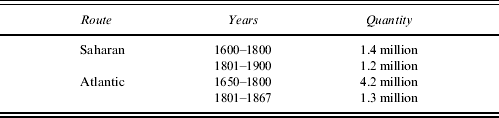
Third, from monographic research on various areas of West Africa it is clear that the incidence of slave holding increased both during the Atlantic slave trade and during the phase of ‘legitimate’ commerce that followed.Footnote 91 This may seem surprising, given that buyers of slaves for use within the region were in competition with massive external demand, from the Atlantic, and also from the Saharan trade, which both preceded and outlived the much more intense Atlantic one (see Table 1).
Estimated slave exports from West Africa, 1600–1900

Source: Paul E. Lovejoy, Transformations in slavery: a history of slavery in Africa (2nd edn; Cambridge, 2000), 62, 81, 142, 146.
It is less surprising when one considers that the external trades, and especially the Atlantic one because of its volume, induced a huge increase in the supply of slaves. The commercial aspect was the development of an elaborate credit system reaching far into the interior. The political aspect was that revenues available to sellers of slaves encouraged or reinforced militaristic behaviour by states and enslavement as the punishment for those convicted, on whatever grounds, of offences. Thus the overseas competition affected the price of slaves from both directions: bidding it up on the demand side but pushing it down on the supply side. Sellers (or re-sellers) of captives to Europeans also retained a share of the captives (particularly female ones, whereas the majority of slaves bought by the Europeans were male).Footnote 92
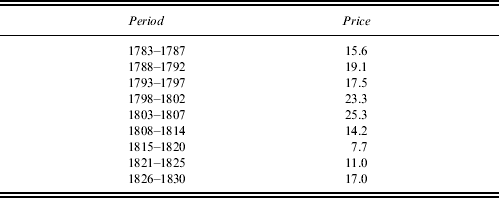
With this enlarged slave-supplying system in place, the decline in European-American demand for slaves in the early nineteenth century, following British withdrawal from the trade from 1 January 1808, made slaves cheaper for West African buyers. Conversely, the substantial recovery of slave prices that followed (see Table 2) reflected the increasing demand for slaves to produce palm oil, kola nuts, raw cotton or other ‘legitimate’ commodities (whether the produce was for the maritime or intra-regional markets).Footnote 93 This relatively late expansion of slave numbers confirms the view that the incidence of slavery had probably been substantially lower at the time the Europeans started buying slaves on the coast. But there is no dispute that slavery there predated the European arrival. The Portuguese were offered captives to buy in the kingdom of Benin and actually had a trade re-selling them on the Gold Coast.Footnote 94 Again, the nineteenth-century expansion of slave numbers was clearly economically motivated: the economic uses of these slaves, and the rise in the effective demand for extra-familial labour, is documented in the case-studies,Footnote 95 whereas there is no evidence of, for example, a change in inheritance practices that would have hugely expanded the ‘social’ demand for slaves. Equally significantly, where slaves were used in relatively large concentrations before the Atlantic slave trade it was as means of production. The major instance was the slave plantations or estates established by or in the sixteenth century at many sites along the Niger river inside the Songhay Empire (mostly in what is now Mali). There were said to be 1,700–2,700 slaves at one site alone. The slaves produced the grain upon which the major political and religious centres of the empire depended.Footnote 96 In West Africa, as was often true elsewhere in the world, slavery (as distinct from serfdom) was a form of coercion highly associated with the market; while this form of labour market, and by extension the commodity markets that the slaves served, were sustained by coercion. In the Songhay case, the exceptional degree of concentration of slaves was made possible by the presence of an unusually powerful state.
Real prices of slaves in West Africa, 1783–1830Footnote a

a Base: 1783–1787 mean price in British pounds (£).
Source: Paul E. Lovejoy and David Richardson, ‘British abolition and its impact on slave prices along the Atlantic coast of Africa, 1783–1850’, Journal of Economic History 55:1 (1995), Table 3 (p. 113).
Estimating slave numbers in pre-colonial African societies presents related conceptual and source problems. Were foreign observers, who are the usual source of such estimates, able to distinguish a slave from a ‘free’ subject? In Akan societies, such as Asante, yes: at least in that the majority of first-generation slaves there were distinguished from the rest of the population by ritual scars on their faces (from their places of origin in the savanna north of the Akan forests) and their very limited capacity to speak the local language.Footnote 97 On the other hand, the children of slaves – usually, of free fathers and slave mothers – had a still subordinate but slightly improved status, could speak the language and were not distinguished by ritual scars from the free population. Like their mothers, they were obliged to provide labour for their masters, but they are impossible to count. The most systematic data for the incidence of slavery in West Africa come from French censuses/surveys carried out in 1894 and 1904 (by the latter date, many slaves had left on their own initiative). Martin Klein has examined this source in detail. He estimates that at the turn of the century about 30 per cent of the population of French West Africa as a whole were slaves.Footnote 98
So what accounts for this reliance on slave (and pawn) rather than free wage labour? Like Hopkins, I have argued that this was a response to the prevailing ‘Nieboer’ conditions. In this market-oriented but land-abundant, capital-scarce economy in which economies of scale were generally lacking,Footnote 99 there were three possibilities for a principal seeking to expand output beyond that possible with his or her own labour, and that of free family members. One was to settle for the family unit: and there is at least one relatively well-documented case of a society, the politically decentralized Sereer-Safèn, near the southern coast of Senegal, who not only resisted slave raiders but also seem not to have practised slavery themselves.Footnote 100 But in most of the region, responding to the opportunities to expand the output of goods for the market when they arose, that option was rejected, if it was ever considered. The second possibility is the one emphasized by Hopkins, who sees wage labour as having been a real alternative to slavery.Footnote 101 The third possibility is that the Domar version of the Nieboer hypothesis applied: that wage labour, even if it was a cultural possibility, was not an economic option because there was no wage rate which it would have been mutually profitable for an employer to offer and for a worker to accept. Elsewhere I have compared the latter two scenarios for the Asante case, using both quantitative and qualitative sources, which both point to the same conclusion: that there, at least, the Domar version applies. Slaves could be typically acquired for the product of only a few months of extra-subsistence labour, such as in gold mining. When wage labour first appeared in Asante, at the beginning of the colonial period, the daily rate for unskilled labour was almost exactly the same as the contemporary estimates of the average daily winnings of a gold digger (as one would expect in a competitive labour market). Thus a principal wanting to induce someone to work for him or her instead of independently had to resort to buying slaves or to debt bondage (lending on the working security of human pawns).Footnote 102 It remains to be investigated whether the Domar or the Hopkins model applies in other West African societies. One isolated observation that supports the former comes from Mungo Park. Staying at Kamalia, a small town just west of Bamako, for several months in 1796–1797, he gave an account of gold mining among the Manding: ‘Generally speaking, if a person uses common diligence in a proper soil, it is supposed that as much gold may be collected by him in the course of the dry season as is equal to the value of two slaves.’Footnote 103 In that case, it seems inconceivable that an employer could make a profit by paying free people enough to persuade them to accept employment rather than working for themselves.
A related but different question is the profitability of investment in slaves. In principle, they might be cheap to acquire yet unproductive and therefore yield low returns on the investment. The indications, admittedly from mostly scattered observations, are unambiguously to the contrary. Kenneth Swindell and Alieu Jeng note that in the late 1820s or early 1830s on the Casamance river, a male slave could produce nearly enough peanuts in a single year to buy another slave. Further south, in the forest of Upper Guinea, ‘in Sierra Leone on the north side of the Freetown estuary, chiefs of the Bullom area were using slaves to produce rice for the Freetown market, and one declared that each earned him over and above the cost of their subsistence, about £7 10s annually, whereas the average selling price was only £10’.Footnote 104 A few estimates are available from the interior of the Western Sudan. For example, referring to Gumbu, a Soninke area in Mali, Claude Meillassoux estimated that a slave household of two adults and five children could generate for its master the price of a slave in one to three years by weaving and growing grain for exchange with the nomads.Footnote 105 In later work, Meillassoux quoted several estimates, mostly from French observers in different places and times over the nineteenth and very early twentieth centuries, variously putting the time required for a slave to produce commodities worth his own purchase price at from one to six years. If we look for a modal figure, in 1904 a colonial official responsible for collating reports on slavery from local administrators all over French West Africa estimated it at three years.Footnote 106
The slave trade within West Africa was largely a market in labour, thus a factor market. By the late eighteenth and early nineteenth centuries, at least – probably before, but data are lacking – it appears to have been a relatively integrated one. Paul Lovejoy and David Richardson have combined thirty observations of slave prices in the savanna interior of West Africa, closer to the terminals of the Saharan than to those of the Atlantic export trades, from 1780 to 1850. They comment that the price differentials are relatively low, within West Africa and between prices in the domestic markets and in the export termini.Footnote 107 It has to be said that the data are too few to be conclusive. In their tables, there are only three years for which there are as many as three observations for the same year, and as the authors emphasize, the sources give variable attention to the ‘quality’ of the slaves concerned. But their research points the way forward: to combining observations from the savanna with more from the forest, for example, and unearthing more observations from previously unpublished or unconsidered documentation. In principle, it would be surprising if there was not a considerable degree of price convergence, given that the human commodities were mobile and were forced to move along intersecting networks of routes and markets across West Africa.
The external costs of the trade, whatever the ultimate destination of the slaves, were grievously high, not only for the captives but also for the politically decentralized societies that were often raided (though not without resistance and refuge), and for the region as a whole in the sense that slave trading and the use of slaves in production provided a material incentive or reinforcement for militaristic ruling elites.
Despite the social costs, the internal slave trade does appear to have performed the basic function of a labour market, in channelling labour to areas where the returns were relatively high. This is no surprise, given that it was in the areas where commercially valuable resources existed that masters had the most purchasing power. The routes of free labour migration in the twentieth century were generally broadly similar to those of the internal slave trade of the century before, for example from the savanna areas of what is now Burkina Faso, southeastern Mali and northern Ghana and Ivory Coast, to the gold-bearing, later cocoa-producing, districts of southern Ghana and Ivory Coast.Footnote 108
GOVERNING THE FACTOR MARKETS: STATE AND PRIVATE SOLUTIONS
Pre-colonial West Africa was characterized by a changing mixture of polities of different levels of centralization, from independent village confederacies to large kingdoms and tributary empires. This can be attributed primarily to the abundance of land, which made it hard for rulers to tie down subjects and tax them.Footnote 109 This in turn limited their coercive and administrative capacity, denying them the option of making land artificially scarce.Footnote 110 In this context, it is not surprising that markets were often controlled by, or operated through, private arrangements. The implications for the efficiency of markets appear to have been mixed.
The most widespread private-order system facilitating trade was the ethnic-cum-religious trading diaspora, mentioned above, which provided a framework of values and social sanctions in which problems of contracting over long distances, and across political and cultural boundaries, could be solved.Footnote 111 It is a fair assumption that the trading diasporas made possible larger volumes of transactions than would otherwise have been the case. However, it seems very likely that there were also some social costs, in the form of monopoly rents on certain routes.Footnote 112
Again, Lovejoy and Richardson have documented the role of a hostage system in facilitating contracting between African sellers and European buyers of slaves at Old Calabar in southeast Nigeria.Footnote 113 But their subsequent study of the rival slave port of Bonny argues that the system there – by which the local ruler regulated the trade and ensured that bargains were kept – was more successful commercially. Bonny steadily outdistanced its competitor in the volume of human traffic it conducted.Footnote 114 Meanwhile – or rather, about 1838 – the Asante state is said to have suppressed panyarring, the kidnapping of a debtor's relatives or neighbours in order to force repayment. Conversely, the practice revived when the government's authority was weakened by an incipient civil war.Footnote 115 These examples may appear contradictory: in the former, government regulation promoted the sale of captives; in the latter it forbade the seizure of hostages. But in both cases, in the context of what were legal trades (whether specifically in humans or generally), government regulations reduced transaction costs. On the other hand, it seems likely that the kings of Dahomey and Asante, jealous of purely private associations, also prevented or repressed the adoption of rotating credit societies in their realms,Footnote 116 state actions that were not conducive to the efficient allocation of financial resources.
Given its defining military power, the state's most important areas of intervention in factor markets were participation in the capture of slaves, protection and participation in slave trading and enforcement of slave status internally. Slaving and slave holding could be found also in some politically decentralized societies. Indeed, one of the most notorious sources of slaves for the Atlantic trade in the eighteenth century was southeast Nigeria. There the small Igbo polities settled their disputes at the shrine of Arochukwu, whose priests effectively condemned convicts to captivity and exportation.Footnote 117 Yet in the context of slavery within West Africa, it is very plausible, as Emmanuel Terray suggested, that the larger and more centralized polities were able to enforce slave status more harshly, and with more gradual remission over succeeding generations, than in ‘stateless’ communities and micro states.Footnote 118 A major case which fits this is the disintegration of the slave estates which grew millet for the markets of the Niger Bend towns: after the Songhay empire fell to the Moroccan invasion of 1591, the power to keep this slave-based agricultural order together gradually disintegrated, and the towns, unable to feed themselves, experienced declining populations.Footnote 119
CONCLUSION
West African history offers practitioners of comparative history patterns and paths different from those often regarded, from Western experience, as characteristic of the evolution of factor markets. In pre-colonial West Africa the ‘Nieboer’ conditions applied even more strongly than specialists have previously thought, such that if labour markets were to exist it seems that they had to involve coercion to reduce the supply price. Hence the main means of purchasing labour power was the slave trade, while debt bondage linked the labour and credit markets. Borrowing at interest was common, but financial intermediation appears to have been very largely absent. Tendencies towards the purchase or rent of land as a factor of production appear to have begun only when the growth of agricultural exports in place of the Atlantic slave trade helped to inaugurate the ‘late modern’ period in West African economic history. It is important to specify that this new trend, such as it was, towards the commercialization of land rights as yet by no means reflected a shift in land:labour ratios as such. Rather, it derived from demand for the specific kinds of land in specific places that was suitable for profitable production of export commodities.
In their context, the presence or absence of markets in rights over particular productive resources in pre-colonial West Africa, during and after the Atlantic slave trade, is broadly consistent with a logic of scarcity, in political economy terms. The internal slave trade seems broadly to have brought labourers to where the returns on labour were greatest. But this article has sought also to underline the costs of these institutions. By its nature, slavery denied labourers the returns on their labour services that they could have obtained working for themselves, while debt bondage, as a hostage system, had social costs that were less only than those of panyarring. Interest rates appear to have been too high to allow the price of money to channel it effectively into its most productive uses. That depended, rather, on retained profits, and cooperation in their deployment.
As the case of land tenure shows, the institutions permitted some flexibility with respect to changing economic conditions. With regard to labour, the growth of commodity production in the nineteenth century, both for overseas export and within the Central Sudan, owed much to the growth of slave holding within the region, via the internal slave trade. Slavery in general was compatible with economic growth, as parts of the New World showed. But whereas the plantation economies in the Americas were able to deploy African slaves while avoiding the external costs entailed in their initial supply, West Africa as a whole suffered those externalities in full. This surely constrained prospects for long-term economic growth.
ACKNOWLEDGEMENTS
I thank the organizers of the Global Economic History Network workshop in Utrecht in June 2005 for the stimulus to write this paper, and for suggestions for revision. I am also grateful to those who commented on the original paper, especially Jean-Laurent Rosendal and Peer Vries, and to Tine De Moor and the journal's anonymous readers. This revised article draws on research done in 2007, supported by the UK Arts and Humanities Research Council. The maps were adapted by Mina Moshkeri (London School of Economics).