Introduction
Marianne Sommer's Bones and Ochre traces the interpretive history of a fossil skeleton originally unearthed by William Buckland in the Paviland Cave (Sommer Reference Sommer2007). In chapter 8, she describes in detail the method by which a later scientist, William Soller, compares the size and shape of the skulls of Australian native peoples with those of the Neanderthals, showing them to be remarkably similar. A superimposed image clinches Soller's case (ibid. 157). With the confidence that he is uttering a cliché, Soller asserts his central interpretive tenet: “in scientific questions, it is all a matter of evidence and inference” (ibid., 189). Engaging Soller's work from a skeptical point of view, probing beneath the surface of this naïve methodological assertion, Sommer shows that his interpretation supports a racist claim, one that ties the Australian native peoples to the Neanderthals, in his view an inferior hominid species, a loser in the struggle for existence. This superimposed pair of images and its interpretation is a reconstruction. Such reconstructions, according to Sommer, “constitute theories and contain elaborate arguments” (ibid., 259),Footnote 1 arguments that professional skepticism tells us may not, after all, be “all a matter of evidence and inference.”
Sommer's exegesis presupposes a distinction made by Paul Ricoeur in On Interpretation, a work in which Ricoeur places himself firmly within a hermeneutic tradition beginning with Friedrich Schleiermacher and including such prominent theorists as Rudolf Bultmann and Hans-Georg Gadamer. Hermeneutics has a dual role in this tradition, one clearly enunciated by Schleiermacher: “to understand the text at first as well as and then even better than its originator (Urheber)” (Schleiermacher Reference Schleiermacher, Kimmerle, Duke and Forstman1977, 112; idem 1959, 87). Ricoeur renames Schleiermacher's first modality a hermeneutics of faith, “faith that has undergone criticism, post-critical faith” (Ricoeur Reference Ricoeur1965, 38; idem 1970, 28). Its product is a “restoration of a meaning addressed to me (m'est adressé) in the manner of a message” (Ricoeur Reference Ricoeur1965, 37; idem 1970, 27; emphasis mine). The me is crucial: the first hermeneutic modality is not a transfer of meaning; it is a virtual interpersonal exchange. Another interpretive stance is possible, however, one in which we act “as if every ideology, as an instance of false consciousness, could not only yield its generally accepted meaning, but also could be understood in its ‘true’ sense – for example, as an expression of an interest of dominance” (Gadamer 1976, 122; emphasis his). In Ricoeur's formulation this is the modality of suspicion: the result is “a demystification . . . a reduction of meaning, a reduction of illusions and lies of consciousness” (Ricoeur Reference Ricoeur1965 37, 42; idem 1970, 27, 32).
In a later essay that attempts to effect a peaceful accommodation between these two interpretive stances, Ricoeur says:
I do not want in any way to abolish the difference between [a] hermeneutics [of faith] and a critique of ideology. Each has its place and, if I may say so, different regional preferences: on the one hand, an attention to cultural heritages, focused most decidedly perhaps on the theory of the text; on the other hand a theory of institutions and the phenomena of domination, focused on the analysis of reifications and alienations. (Ricoeur Reference Ricoeur and Thompson1981, 100; Reference Ricoeur and Castelli1973, 61)
This seems like a precise description of Sommer's stance. A hermeneutics of faith allows her to reconstruct Soller's message as science; a hermeneutics of suspicion permits her to deconstruct it as ideology, an assertion of domination. At this point, her exegesis comes to a halt, a temporary resting-place. To commit to one's interpretation under the ever-present shadow of possible revision is to recognize that “perceiving the historical process is in itself a historical process. Attaining distance from the object through neutral observation is impossible. The seemingly objective picture of historical processes is always stamped with the personality of the observer, who is himself or herself historical and can never be a spectator standing outside historical time” (Bultmann Reference Bultmann1965, 129; emphasis in the original). Self-reflection prevents us from succumbing to the most stubborn of illusions: the illusion that we are finally free from illusion.
Although Sommer employs Ricoeur's distinction, she gives no indication that she is aware of it, or indeed of hermeneutics. This attitude seems typical of historians of science who integrate visual representations into their accounts; it is certainly true of all accounts of which I am aware.Footnote 2 But without an explicit understanding the role of images in the conduct of scientific arguments, historians of science cannot with confidence incorporate visual exegesis into their disciplinary practices. In this paper, I attempt to make explicit an interpretive model I deem adequate to scientific communications in which words and images are equally in play. My model has two modules: a perceptual one ruled by the principles of Gestalt psychology and a cognitive one ruled by Peirce's semiotics. Employing Ricoeur's dual hermeneutics as a framework in which this model operates, I analyze the division of semiotic labor between words and images in two contexts: that of the history of science and that of its historians: I analyze Lyell's important but largely neglected The Geological Evidences of the Antiquity of Man Footnote 3 and the parallel accounts of the discovery of the J-psi particle by two highly respected historians of science, Andrew Pickering and Peter Galison. In the first case, I offer an account of the creation and communication of meaning by means of verbal-visual interaction, and an explanation of why the unity of the book is impaired, one based on the differing semiotic trajectories of the verbal and visual; in the second case, by reconciling two apparently opposed accounts, I am able to re-interpret a visual representation central to J-psi’s discovery.
An interpretive model
Images differ from words in at least four ways that affect their employment in scientific arguments. First, they differ in how they are perceived. We see images; we see through words to their underlying concepts: that is what learning to read means. Secondly, images are unlike words in that they can be subjected to meaningful spatial transformations: they can be rotated on their axes; they can be superimposed, one on another. Moreover, these manipulations can be performed with epistemic intent, that is, they can be about cognition, not just about perception. Third, in contrast to words, among whose components consistent internal connection exists, as between subject and predicate, in images, only contiguity rules: their components are organized spatially into synchronous hierarchies or nested sets. Finally, images differ from words in semiotic valence. Unlike words, which exist always in the realm of the symbolic, images can be, alternately, symbols standing for some aspect of the world, icons representing some aspect or event in the world, or indices pointing to causal relationships in the world (Clark and Paivio Reference Clark and Paivio1991, 151–52; see also Paivio Reference Paivio2007, 37 and 39).
It is an important corollary of the differences between words and images that there can be no arguments – and a fortiori no scientific arguments – whose components are exclusively visual.Footnote 4 To argue is to enter the realm of the propositional; it is to make claims and to provide evidence for those claims. Evidence, of course, need not be propositional. A photograph can count as evidence; for it to do so, it must be truth-bearing, that is, it must be true to what it depicts.Footnote 5 But this is only a necessary, not a sufficient condition for argumentative status. To be incorporated into an argument, the photograph must also be shown to be relevant to a claim. And relevance must be established propositionally: some state of affairs must be said to be either true or false based on a photograph that is assumed to be true to what it depicts. For example, “when we affirm or deny the proposition The moon is nearer to the earth than the sun, neither the moon alone nor the earth, nor the sun, nor the spatial distance between them is the proposition. The proposition is the relation asserted to hold between them” (Cohen and Nagel Reference Cohen and Nagel1934, 27–29). A photograph can certainly depict the spatial relationships that prevail among moon, earth, and sun; it certainly contains spatial information from which propositions about these three entities can be derived. But a photograph cannot assert a proposition about these entities nor about their relationships. A proposition must consist of terms and their predicates: the moon, the earth, and the sun are terms; is nearer than is a predicate. An image of the earth is not a term; the distance between the earth and the sun is not a predicate.
This argument against exclusively visual arguments has been seconded by two cognitive psychologists, Oestermeier and Hesse. They point out that epistemic predicates such as “I believe,” argumentative predicates such as “I agree because,” causal predicates such as “is an effect of,” and logical operators such as “all” and “if” cannot be successfully visualized (Ostermeier and Hesse Reference Oestermeier and Hesse2000, 94).Footnote 6 They infer that “verbal comments and explanations are integral parts of visual forms of communication . . . and the interplay of visualizations and speech acts has to be addressed by all relevant theories of mediated causal cognition” (Oestermeier and Hesse Reference Oestermeier and Hesse2000, 75). This seems exactly right. It implies that the analysis of scientific arguments that incorporate the visual must be grounded in a theory that takes seriously the marked differences between the visual and the verbal.
That there are no visual arguments does not mean that visuals are not vital components of scientific argumentation. Their importance stems from a central fact about the visual. Although images are not propositional, they contain more information, that is, more elements open to interpretation within a structured optical field, than any set of propositions that can be derived from these elements and their relationships. Art historian William M. Ivins Jr. makes this characteristic of the visual clear:
the moment that anyone seriously tries to describe an object carefully and accurately in words, his attempt takes the form of an interminably long and prolix rigmarole that few persons have either the patience or the intelligence to understand. A serious attempt to describe even a simple piece of machinery, such as, let us say, a kitchen can-opener with several moving parts, results in a morass of words that only a highly trained patent lawyer can cope with, and yet the shape of the can-opener is simplicity itself as compared to the shape of such a thing as a human hand or face. (Ivins 1980, 57)
Larkin and Simon see this difference as crucial to scientific problem-solving: “the fundamental difference between our diagrammatic and sentential representations is that the diagrammatic representation preserves explicitly the information about the topological and geometrical relations among the components of the problem, while the sentential representation does not” (Larkin and Simon Reference Larkin and Simon1987, 66).Footnote 7
Chandrasekaran and Narayan show us how images can be fully integrated into arguments. In their example, we infer that a child playing in front of a window will be hurt by a rock about to be thrown against it. Concerning the reasoning exhibited in this case, Chandrasekaran and Narayan say:
the first inference about the rock hitting the window pane was made by scanning the scene along a predicted trajectory. Thus, this reasoning involved perceptual and motor operations applied to the environment (eye movement for scanning) as well as computations on an internal representation of the environment (predicting a trajectory). The second inference about the effects of a collision between the rock and the window pane was done by an internal visualization guided by our experiential knowledge. Thus this reasoning involved imaginal operations applied to an internal representation of the environment. The third inference about the child being hurt was made by applying conceptual knowledge to information derived from the visualization. (Chandrasekaran and Narayan Reference Chandrasekaran, Narayanan and Sterling1993, 69–70)
First, by computing the rock's trajectory, we infer that it will hit the window-pane, an inference made by means of internal visualization. In turn, this internal visualization provides the context that constrains our next step: an inference about the effects of the collision. To make this inference, internal visualization combines with experiential knowledge: because we know that glass shatters, we infer that the window-pane will shatter. In a final inferential step, we integrate conceptual knowledge: because we know that flying glass shards will damage human flesh, we infer the effect of the shattering on the child. In this case, images function not as propositions, but as integral, truth-bearing components in arguments that necessarily contain conceptual elements. This use of images is commonplace in scientific argument. For example, it was on account of images employed in this manner that geologists became convinced that sea-floor spreading was real (Giere Reference Giere and Baigre1996). It was an image of the double helical structure of DNA, not a proposition, that formed the penultimate step in Watson and Crick's deductive inferential chain. Their concluding step, the biological implications of the model, was a verbal inference constrained by the information derived from this image.
Our model of scientific argument as a product of integration of words and images has two modules: a perceptual module ruled by the principles of Gestalt psychology and a cognitive module ruled by Peirce's semiotics. The first is concerned with the perception of words and images, the second with their interpretation. Köhler and his followers were certainly mistaken when they hypothesized that perceptual processes were actually organized along Gestalt lines, hard-wired into the brain (Köhler Reference Köhler1947). Given the current state of our knowledge of such processes, it would probably be best to regard the Gestalt “laws of organization [as] opportunistic guides to the viewer as to what will afford desired visual information,” and to support the view “that they probably vary widely in level, speed, and power” (Hochberg Reference Hochberg and Hochberg1998, 291). On one plausible accounting, there are six Gestalt principles. According to figure-ground, we see objects automatically as shaped, framed against a shapeless background, one that may, in fact, also have a shape, though we do not perceive it as such. When this background actually does have a shape – as in the case of the cell structure of tables or the latitude-longitude coordinates of maps – we can direct our attention alternately to it and to the foreground of data elements. We see a second Gestalt principle in operation, good continuation, when we complete in our mind's eye the rectangular shape of a whiteboard despite the fact that the man standing in front of it is partially blocking our view. Scientific tables are characterized by a third Gestalt principle, enclosure; on the other hand, relationships among their cells are highlighted by means of the fourth principle, similarity and contrast. A fifth principle, proximity, groups adjoining letters of the alphabet into words even in the case of an early Greek manuscript in which there is no actual separation (Pinker Reference Pinker and Freedle1990, 84; Hochberg Reference Hochberg and Hochberg1998, 260–61; see also Pinker Reference Pinker1983). Prägnanz is a final principle, our sense of the whole: we see not a nose, ears, and a mouth, but a face.
Gestalt patterns become meaningful insofar as they participate in a system of value-laden differences. Ferdinand de Saussure articulates this necessary step toward meaningfulness within the verbal system:
In all these cases what we find, instead of ideas given in advance, are values emanating from a linguistic system. If we say that these values correspond to certain concepts, it must be understood that the concepts in question are purely differential. That is to say they are concepts defined not positively, in terms of their content, but negatively by contrast with other items in the same system. What characterizes each most exactly is being whatever the others are not. (Saussure [1986] Reference Saussure, Bally, Sechehasye, Riedlinger and Harris1916, 115; emphasis in the original)
Saussure's principle may be generalized to apply to any semiotic system, verbal or non-verbal. For example, traffic signals and electrical wiring diagrams are non-verbal systems that also rely for their interpretation on value-laden differences. To differentiate these systems from languages, let us call them codes.
In our model, patterns of perception made potentially meaningful by means of Saussure's principle will be interpreted according to Peirce's semiotic categories. Patterns recognized as verbal will be interpreted as Peircian symbols. The relation between these and their objects may be, but need not be, arbitrary. Alphabets are systems of wholly arbitrary signs; ideograms are symbols that are only partially so. The components of the verbal system may also be aural; or, in the case of Braille, tactile. We perceive them, however, not as sights or sounds, or textures, but as messages. Patterns of perception recognized as non-verbal will be treated differently; they will be understood either as symbols, as icons, or as indices. Symbols have already been defined. An icon is a sign that depicts; a photograph or a drawing of a microbe is an icon. An index is a sign whose relation to its object is causal or indicative. Geiger counter readings are causally linked to the external world; in a photograph, an arrow pointing to a cell nucleus is merely indicative. To avoid ambiguity, we will call this latter category of signs deictic.
Within a particular category of sign, semiotic transformations are possible. For example, a photograph of an eye may be used to construct a drawing of that eye, a shift from one iconic mode to another. Other transformations involve a shift from one category of sign to another. The iconic may be transformed into symbolic: photographs of an eye may become a diagram of the eye. The iconic may be transformed into the indexical: a chest x-ray may reveal the cause of a persistent cough. Thomas Sebeok makes the essential point about the plasticity of Peirce's categories:
In general, it is . . . inane to ask whether any given subject “is,” or is represented by, an icon, an index, or a symbol, for all signs are situated in a complex network of syntagmatic and paradigmatic contrasts and oppositions, i.e., simultaneously participate in a text as well as a system; it is their position at a particular moment that will determine the predominance of the aspect in focus. (Sebeok Reference Sebeok1976, 1433n)
As Gérard Deladalle points out:
we must insist . . . on the functional character of these distinctions: what is an index in one semiosis may be a symbol in another. Take, for instance, the symptom of an illness. . .. If this symptom is referred to in a lecture on medicine as always characterizing a certain illness, the symptom is a symbol. If the doctor encounters it while he is examining a patient, the symptom is an index of an illness. (Deladelle 2000, 19–20)
The contention of Sebeok and Deladalle that context is central to semiotic interpretation is a corollary of Saussure's principle that meaning originates in difference.
It is my contention that argument is the engine of these Peircian transformations, an engine we will see in operation in our examination of Lyell's Antiquity of Man. Under the aegis of a hermeneutics of faith, I reconstruct Lyell's arguments. The reconstruction of one of these arguments, however, triggers a hermeneutics of suspicion. Under its aegis, a contradiction is revealed: two semiotic modalities, the verbal and the visual, part company.
Applying the model to an historical text
In 1863, Lyell published The Antiquity of Man, the first of three editions in that same year. Clearly, Lyell's was a topic of great interest not only to scientists, but also to the educated reading public of nineteenth-century Britain: the now incontrovertible evidence that for a long period much of the earth was covered by a sheet of ice perhaps a mile thick, and that following this Ice Age, human beings inhabited the earth from a time far earlier than Biblical chronology would sanction. In the half-century between 1863 and 1914, a flood of books on this topic were to appear, among them John Lubbock's Pre-Historic Times (Reference Lubbock1875); John Evans's Ancient Stone Implements, Weapons, and Ornaments of Great Britain (Reference Evans1872); Hodder M. Westropp's Pre-Historic Phases (Reference Westropp1872); James Geikie's Great Ice Age and Its Relation to the Antiquity of Man (Reference Geikie1877) and his Prehistoric Europe: A Geological Sketch (Geike Reference Geikie1881); W. Boyd Dawkins’ Cave Hunting (Reference Dawkins1874) and his Early Man in Britain (Dawkins Reference Dawkins1880). At the end of this period we have Geikie's Antiquity of Man in Europe (Reference Geikie1914). The popularity of this topic during this period is hard to exaggerate. Between 1865 and 1913, Lubbock's work went through seven editions. But it is Lyell's book that was central. The philosopher, William Whewell, made this clear when he wrote to the author that he was reading Antiquity “as all the world is doing or has done” (Grayson Reference Grayson1983, 200). Within a week of its publication, the 4000 copies of the first edition had been sold (Cohen Reference Cohen1998, 90). Lyell's prominence was such that an envious paleontologist, Hugh Falconer, complained: Lyell was, he said, taking a position vis-à-vis geology that Louis XIV took toward the state: “La Géologie: c'est moi!—l'Ancienneté; c'est moi aussi” (Bynum Reference Bynum1984, 221).
Charles Darwin and Alfred Wallace accurately characterize Lyell's approach. Writing to J. D. Hooker, Darwin says that the book “is a compilation; but of the highest class, for where possible the facts have been verified on the spot, making it almost an original work” (Darwin Correspondence Project, Letter 4009, 2/24/63; my emphasis). Speaking of Lyell's whole body of work, Wallace supplements this view:
A most striking feature of these works is, that they give the fullest and most accurate scientific details, and the most philosophical discussion of principles and results, without for a single page ceasing to be interesting to any well educated and thoughtful man. Perhaps no author has attained in so perfect a degree the art of making science popular without ever attempting to popularize it, or has produced a series of works which are equally acceptable to the experienced geologist and to the general reader. (Wallace Reference Wallace1873, 462)Footnote 8
In his review, Wallace fails to mention that The Antiquity of Man is, in fact, three books in one, a compilation in search of a unifying theme. Early reviews of the first edition spoke of Lyell's “trilogy on the Antiquity of Man, Ice and Darwin” (Cohen Reference Cohen1998, 84; emphasis mine). In a letter to Darwin, American botanist Asa Gray corroborated: Antiquity was “three books.—1. A capital resumé and examination of what we know about the evidence of antiquity of man . . . 2. a treatise on Glacial Per[iod]. . . . 3. [an essay] on transmutation matters” (Darwin Correspondence Project, Letter 4112, 4/20/63; emphasis in the original). In what follows, I analyze Lyell's arguments in each of these three “books,” in each case treating their force as a synergy of two very different semiotic vectors: images and words. In so doing, I define and exemplify the visual argument to which Sommer refers. This is an exercise in the hermeneutics of faith. Finally, I offer an explanation of why the unity of Antiquity of Man is impaired, based on the independent semiotic trajectories of words and images. In so doing, I shift to a hermeneutics of suspicion, reaching a conclusion parallel to that of Sommer in her close reading of the Definitive Report of the Paviland find, the last case with which her monograph deals: “below the surface of unity and finality, it is internally contradictory” (Sommer Reference Sommer2007, 279).
Book I: The antiquity of man
Lyell devotes the first part of his book to the establishment of human antiquity. In doing so he relies exclusively on correlation and comparison among archaeological finds. Nineteenth-century British scientists could not do otherwise, as they lacked modern techniques, such as radio-carbon dating. Moreover, in the absence of human fossils, they were forced to rely on artifacts as surrogates for human presence. In the ideal case, they hoped to find such artifacts in the vicinity of the remains of extinct fauna; in addition, they hoped to find them firmly embedded in a stratum so low in the geological column as to be unquestionably ancient. But such a find could be called scientific only if supervised by professional scientists using methods that allowed relative positions to be accurately calibrated and recorded. This was the case for the first time in the excavation in Brixham cave, a dig begun in 1858 (Van Riper Reference Van Riper1993, 85–100). Unfortunately, Brixham was a cave. This meant that it was still possible that subsidence, sedimentation, or subsequent human intervention had disturbed the original position of any artifacts and extinct faunal remains. To convince virtually every scientist, no matter how skeptical, and virtually every member of the educated reading public, no matter how uninformed, of the extreme antiquity of man, it was necessary to find excavation sites that were free from these suspicions. Lyell grasped the fact that the gravel pits at St. Acheul, near Amiens in the valley of the Somme, was such a site.
In his book, Lyell reproduced a stratigraphy of a section of a pit at St. Achuel that is rotated 90o on its side in order to reveal its geological structure (fig. 1). Gestalt principles of enclosure, contrast, and good continuation permit us to differentiate and extend the order of the strata; contrast permits us to locate anomalies. A code of shapes hovering between the iconic and the symbolic permits us to differentiate sand from gravel and chalk, pebbles from flints. For the identification of what we perceive as salient, recourse must be had to deictic symbols. A code of numbers permits us to locate the various strata; a code of letters allows us to locate the elephant molars, the flint hatchet and a stratal anomaly whose explanation is in the figure legend. The deictic X marks the spot of the highest salience. Proximity to X suggests a relationship between the objects designated b and c: it places them in the perceptual and conceptual foreground.
Section of a gravel pit containing flint implements at St. Acheul, near Amiens, observed in July, 1860 (Lyell Reference Lyell1863, 135). Layer 1 is vegetable soil and made ground, two to three feet thick. Layer 2 is brown loam with some angular flints, in parts passing into ochreous gravel, filling up indentations on the surface of layer 3, three feet thick. Layer 3 is white silicious sand with layers of chalky marl, and included fragments of chalk, for the most part unstratified, – nine feet. Layer 4 is flint-gravel, and whitish chalky sand, flints subangular, average size of fragments, three inches diameter, but with some large unbroken chalk flints, intermixed, cross stratification in parts. Bones of mammals, grinder of elephant at b, and flint implement at c, – ten to fourteen feet. Layer 5 is chalk with flints. a. is part of an elephant's molar, eleven feet from the surface; b is entire molar of E. primigenius, seventeen feet from surface; c is position of flint hatchet, eighteen feet from surface; d is a projecting ridge consisting of gravel cemented or frozen together.

This image is iconic: it depicts the sought-for juxtaposition of human artifact and extinct fauna. But it is also symbolic: it stands for an entire research program: “between 1830 and 1860, the works of [pioneering French geologists] demonstrated the existence of extinct faunal assemblages and human lithic industries, including handaxes, in fossil fluvial deposits” (Bahain Reference Bahain, Falguères, Laurent, Voinchet, Dolo, Antoine and Tuffreau2005, 356). Finally, the image is indexical: this conjunction of the human and animal points to the long history of humankind. At the time, geologists and archaeologists could only guess how long.Footnote 9
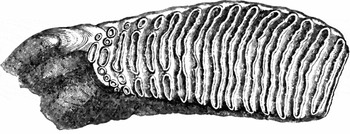
The molar depicted in figure 2 is of the same species of extinct elephant as the one actually found at St. Acheul. Gestalt perception reveals the object's Prägnanz, its overall symmetrical patterning, a characteristic that differentiates it from the surrounding flint-gravel and chalky sand. It is this Prägnanz that licenses its classification as faunal. The molar is indexical as well as iconic: it points to the extreme age of any human artifact found firmly embedded in its vicinity (fig. 2).
Elephas primigenius. Penultimate molar, lower jaw, right side, approximately one-half natural size, Post-pliocene. Coexisted with man (Lyell Reference Lyell1863, 133).

Figure 3 is a flint hatchet similar to the one actually found in the vicinity of the elephant molar at St. Acheul. Prägnanz reveals its symmetry from both side and front. By the Gestalt principle of contrast, we perceive within this symmetrical shape a network of indented areas, some crossed by shallow parallel grooves (fig. 3). It is this combination of features that allows us to classify this flint as a tool, the product of human intervention. The hatchet is indexical as well: it points to its maker, early man. Finally, it is symbolic. It stands for a level of civilized behavior: Old Stone Age society characterized by a division of labor, a designated maker of tools. If we were to attempt to fashion this hatchet ourselves with no more assistance than a stone hammer, its “primitive” nature would not mislead into underestimating the skill of its “professional” maker (Evans Reference Evans1872, chap. 1).
Flint implement from post-pliocene drift of Abbeville and Amiens. a. Oval-shaped flint hatchet from Mautort, near Abbeville, approximately size of original, which is five-and-a-half inches long, from a bed of gravel underlying the fluvio-marine stratum. b. Same seen edgewise. c. Shows a recent fracture of the edge of the same at the point a, or near the top. This portion of the tool, c, is drawn approximately twice the natural size, the black central part being the unaltered flint, the white outer coating, the layer which has been formed by discoloration or bleaching since the tool was made.

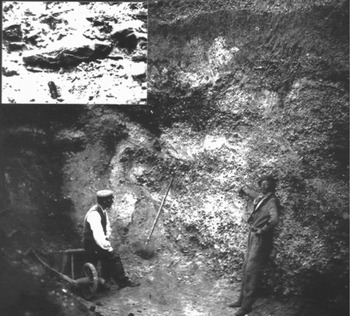
Figure 4 is a photograph depicting Prestwich and Evans’ discovery of an Old Stone Age implement at St. Acheul (fig. 4). So far as we know, this is the first photograph to be integrated into an argument as evidence of archaeological discovery (Cohen Reference Cohen1998; Gamble Reference Gamble2008). It is mentioned by Lyell, but not reproduced: the half-tone process by which such photographs could be included in books and journals had not yet been invented. But of Prestwich's report to the Royal Society, and its accompanying photograph, Lyell says that it “not only satisfied many inquirers, but induced others to visit Abbeville and Amiens” (Lyell Reference Lyell1863, 103). Rightly so. Unlike the diagrams and drawings, it counted as incontrovertible evidence of an Old Stone Age tool in its original matrix. For its audience, this photograph unequivocally demonstrated man's extreme antiquity. It was iconic; it displayed the event. At the same time, it was indexical; it pointed to a long human past. Finally, it was symbolic; it vouched for the credibility of those who had insisted for three decades that humankind had a history longer, much longer, than previously affirmed.
Two unknown men, one pointing to Prestwich and Evans's discovery of an Old Stone Age flint tool. The inset shows a similar tool. The actual tool has since been identified. Taken on Wednesday, April 27, 1859 (Gamble, “Breaking the Time Barrier”).

Figures 1 to 4 form a suite that exhibits a division of semiotic and epistemic labor between words and images. Without the assistance of the verbal, the visual cannot be identified, much less explained in terms of a general theory of the development of the earth and of its human inhabitants. In equal measure, words alone cannot provide the crucial and convincing evidence for any such theory. In this particular case, visual evidence is integrated into an argument of the form: if tools and extinct faunal remains are discovered together in lower geological strata, the extreme antiquity of man is demonstrated. These depictions count as evidence for the co-presence of such tools and extinct faunal remains in a lower geological stratum. Therefore, the extreme antiquity of man is demonstrated. In this hypothetical syllogism, the minor “premise” is not propositional. These is a deictic: it points to the evidence, the truth-bearing images. It is the words that show us the relevance of these images to the argument Lyell is making.
Book II: The Ice Age prelude
No one could survive in a terrain covered by a sheet of ice a mile thick; moreover, the frigid temperatures at the glaciers’ edges would soon drive southward both early human beings and the animals on which they fed. As the ice receded, humans could safely return to the north; as it receded, however, the ice would have left clues as to its force. In the second part of The Antiquity of Man, Lyell takes up the task of explaining the ice-age cause of these clues, one of which consists of erratics, boulders that form debris fields across landscapes in which they seem geologically out of place. Figure 5 illustrates one of these configurations. By means of the Gestalt principle of Prägnanz, we perceive this image as a fan of radiating lines within a dark frame. Closer inspection reveals several dark irregular shapes, some dark wavy lines, and a network of words. We have two semiotic codes, visual and verbal. In the visual code, the darker frame stands for the Alps and the Jura; the dark irregular shapes stand for lakes; the dark wavy lines, for rivers; the radiating dots of the fan, for the expansion of the extinct glacier. The verbal content is coded as well: large caps represent mountain ranges, small caps and italic, cities; upper-lower case italics, rivers; upper-lower case Roman, individual mountains. The stages of glacial flow are marked by capital letters; the debris field, by lower case italics.
Map showing the supposed course of the ancient and now extinct glacier of the Rhone, and the distribution of the erratic blocks and drift conveyed by it to the great valley of Switzerland (Lyell Reference Lyell1863, 299).

It was the truth-bearing quality of Figure 5 that convinced Lyell that the causal agent of this erratic configuration was direct glacial action: the Alpine erratics in question “instead of being scattered at random over the Jura and the great plain of Switzerland, are arranged in a determinate order, strictly analogous to that which ought to prevail if they had once constituted the lateral, medial, and terminal moraines of the great glaciers” (ibid., 298). According to this theory, the glacial flow starts at A (my right-most deictic arrow), proceeds by way of B and F toward I over a frozen Lake Geneva (my left-most deictic arrow), as well as toward G at Chasseron and K just above Soleure (my top-most deictic arrow). The evidence for this glacial action is the distribution of the debris field beginning at c and n, just below A: it is this that constitutes its “footprint.” The argument has the form: if the debris field forms a fan-like pattern, that pattern requires as its explanation a force commensurate with its formation, a force only a massive glacier can produce. This debris field forms a fan-like pattern. Therefore, its cause is glacial action. The minor “premise” of this hypothetical syllogism is not propositional. This is a deictic: it points to the evidence.
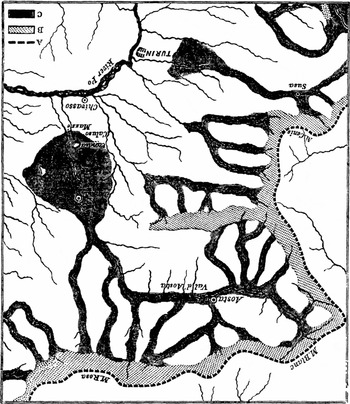
Figure 6 is a companion map of Italian glacial moraines, located just across the Swiss border. To emphasize the kinship between Figures 5 and 6, I have rotated the latter 180° clockwise. As a consequence, it can be seen that both figures share the same open-fan structure, a similarity that licenses an induction classifying these two configurations as equally the result of the activity of extinct glacial movement. This conclusion, inferred from visual inspection, is confirmed by the presence in Northern Italy of “groups of detritus [that contain] exclusively the wreck of such rocks as occur in situ on the Alpine heights of the hydrographical basins to which the moraines respectively belong” (ibid., 305).
Map of the moraines of extinct glaciers extending from the Alps into the plains of the Po near Turin. Legend: A. crest or watershed of the Alps; B. snow-covered Alpine summits which fed the ancient glaciers; C. moraines of ancient or extinct glaciers (Lyell Reference Lyell1863, 306).

This kinship does not imply that important differences do not exist between the character of the Swiss and Italian moraines. In the Italian case:
after passing through the valley of Aosta, [the glacier] issued from the narrow defile above Ivrea. From this vomitory, the older glacier poured into the plains of the Po that wonderful accumulation of mud, gravel, boulders, and large erratics, which extends for fifteen miles from above Ivrea to below Caluso, and which, when seen in profile from Turin, have the aspect of a chain of hills. (ibid., 307)
Nevertheless, the differences between these two geological configurations are solely a consequence of the differing terrains through which these two extinct glaciers advanced. They in no way imply a different causal agent.Footnote 10 In the Italian as in the Swiss case, visual evidence is integrated into an argument of the form: if a debris field forms a pattern that can be accounted for only by a force equivalent to that of a massive glacier, then a massive glacier must be hypothesized. These depictions count as evidence of the effects of such a force. Therefore, a massive glacier must be hypothesized. In this hypothetical syllogism, the minor “premise” is not propositional. These is a deictic: it points to the evidence, the truth-bearing qualities of the images. In Figures 5 and 6, by means of argument, a hypothesized past is superimposed on the geological present, an epistemic imposition that transforms the iconic into the indexical. To understand these maps fully, we must animate the hypothesized glacier as, over time, it begins its journey moving inexorably outward.
Book III: Man's evolution
After the Ice Age whose traces we have just examined, man emerged; after he emerged, he evolved. In the third part of Antiquity, Lyell fully accepts both these claims. But while he concurs with evolutionary descent, or transmutation, he objects to “the deification of natural selection” as its mechanism (Lyell Reference Lyell1881, 431). In the last chapter of his book, which deals with man's “place in creation,”Footnote 11 he gives voice to his reluctance to endorse Darwin's preferred mechanism over design as the creative force behind variation and development in the living world: “The whole course of nature,” he says, “may be the material embodiment of a preconcerted arrangement, and if the succession of events be explained by transmutation, the perpetual adaptation of the organic world to new conditions leaves the argument in favor of design, and therefore of a designer, as valid as ever” (Lyell Reference Lyell1863, 506).
In these matters, Lyell was neither a dogmatist nor a religious zealot. He simply felt that the arguments in favor of natural selection were far from compelling. That his formulation left room for the actions of a Diety was, of course, more than an incidental benefit to a believer. But it was the scientific evidence, or rather the lack of it, that was determinative for him. We can see that this was the case when we look at his attack on the famous anatomist, Richard Owen. Owen, Lyell felt, made his case for the special creation of man only by stubbornly ignoring or willfully distorting the scientific evidence. Such behavior was, simply, impermissible.
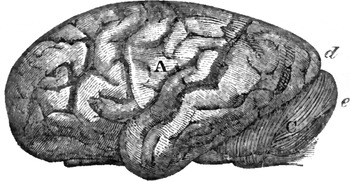
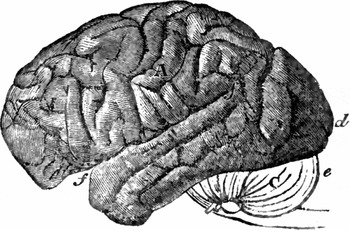
Owen's arguments depended on alleged differences in brain anatomy between the higher apes and human beings. In humans, he claimed, but not in apes, the cerebrum overlapped the cerebellum, the cerebrum “attain[ing] its maximum of extent in Man.” This characteristic Owen associated with “peculiar mental powers” that demanded taxonomic reclassification: “the genus Homo [is] not merely a representative of a distinct order, but of a distinct sub-class of the mammalia, for which I propose the name of Archencephala” (ibid., 481).Footnote 12 A Gestalt contrast provides perceptual evidence for the case Owen wants to make (see figs. 7 and 8). In figure 7, the larger area, identified as the human cerebrum, clearly overlaps the smaller area to its right, identified as the cerebellum. In contrast, in the chimpanzee brain illustrated in figure 8, the cerebrum clearly does not overlap the cerebellum. Lyell's counter-argument denied that the chimpanzee brain Owen depicted was iconic of the chimpanzee brain. This denial was supported by the mea culpa of the erring Dutch anatomists’ themselves, from whom Owen borrowed the engraving, and by the independent arguments of Thomas Henry Huxley and the French anatomist, Louis Pierre Gratiolet.
Side view of human brain (from Gratiolet) namely, that of the bush-woman called the Hottentot Venus. Showing the backward extension of the cerebrum A at d; beyond the cerebellum C at e; f is the fissure of Sylvius (Lyell Reference Lyell1863, 483).

Distorted side view of brain of Chimpanzee (from Schroeder van der Kolk and Vrolik) showing at e the extension of the disputed cerebellum C beyond the cerebrum at A at d (Lyell Reference Lyell1863, 482).

Owen's error can be clearly inferred from a comparison between figure 7 and figure 9. In this case, visual evidence is integrated into an argument of the form: if the relevant features of chimpanzee and human brains are equivalent, then they cannot demonstrate that there is an unbridgeable gap between human beings and the higher apes. These depictions count as evidence of the equivalence of the relevant cerebral features. Therefore, an unbridgeable gap between humans and the higher apes cannot be demonstrated on their basis. In this hypothetical syllogism, the minor “premise” is not propositional. These is a deictic: it points to the evidence, the truth-bearing images.
Correct side view of Chimpanzee's brain (from Gratiolet) showing the backward extension of the cerebrum A at d; beyond the cerebellum C at e; f is the fissure of Sylvius (Lyell Reference Lyell1863, 482).

Impaired Unity
Up to this point, a hermeneutics of faith has served us well, allowing us to reconstruct the ways in which Lyell has synthesized words and images to create and communicate his arguments in each of the three sections of Antiquity. Our analysis, however, has also given substance to the claims of the early reviewers that the unity of Antiquity is impaired, that this one book is really three books in one. Thus an analysis according to the hermeneutics of faith has triggered one of suspicion: Is Book II, Lyell's geological section, at best only marginally relevant to the whole? In the fourth edition, published ten years after the first, Lyell indicates his awareness of the problem. In his preface, he acknowledges “that many persons have failed to recognize the natural connection of the three separate parts of this work.” This failure, he says, was especially acute in the case of the “geological section I have called Book II.” Many felt, apparently, that it was irrelevant to the main subject, the antiquity of man. Lyell assures us that this will no longer be true now “that so much discussion is going on whether man is pre-glacial or post-glacial” (Lyell Reference Lyell1873, vi). In the fourth edition, to correct this misapprehension, Lyell places the three parts “under three distinct titles” (ibid., v): “I. Geological memorials of man”; “II. The Glacial period considered with reference to the antiquity of man”; “III: The origin of species as bearing on man's place in nature.”
In this case, a rhetorical flourish unsuccessfully attempts what science could not at the time accomplish. For Lyell, unity among the book's three parts was out of disciplinary reach, given the state of knowledge concerning the relationship between early man and successive glaciations. He was aware of James Geikie's work on pre-glacial and interglacial periods of relative warmth suitable for human habitation (ibid., 209–10), but Geikie's masterwork, The Great Ice Age, had yet to appear. In this book, Geikie's position is clear: “the paleolithic deposits [of south-east England] are of pre-glacial and interglacial age” (Gieke Reference Geikie1877, 448; emphasis added). This position, which was to become the scientific consensus (Bahain Reference Bahain, Falguères, Laurent, Voinchet, Dolo, Antoine and Tuffreau2005, 360), would have permitted Lyell to better integrate the three sections of his book into a united whole. His would have been an early version of the story we now tell, a narrative in which the spread of an emerging humankind is alternately inhibited and encouraged by a succession of ice ages.
There is, however, a second, more fundamental reason for the impaired unity of Antiquity: a contradiction at its very heart that a hermeneutics of suspicion reveals. Lyell inhabits an era in which the life sciences were becoming fully modern, a time when anthropology and divine revelation were not necessarily at odds. The transformation that made them so entailed a shift that Darwin's Origin of Species prefigures, an explanatory regime restricted entirely to natural causes. It is this view of humankind to which Lyell so strenuously objects. He does not feel that Owen's error undermined a position they both shared: that human beings were special because God made them so. Lyell felt that, in addition to getting brain anatomy wrong, Owen made a more fundamental mistake: he assumed that “each advance in psychical power depends on an improvement in bodily structure.” In other words, he assumed that an advance in “psychical power” must involve anatomical change. But, Lyell argued, “why may not the soul, or the higher intellectual and moral faculties, play the first instead of the second part in a progressive scheme?” (Lyell Reference Lyell1863, 493). From the point of view of the conceptual coherence within the context of a modern life science, Lyell's argument is unfortunate because it entails a history of humankind in which purely natural forces cannot bridge the gap between us and the higher apes. First, comes the Ice Age, an age, according to Lyell, that is entirely a product of natural forces exactly like those operating today, though at a lower intensity. Then, comes man, whose “earliest signs are of post-glacial date” (ibid., 229), a product, it would seem, of forces for which nature on its own cannot fully account. Lyell's commitment to the special creation of humankind makes any scientific grand narrative combining geology, archaeology, anthropology, and evolutionary biology impossible.
But while Lyell's text tells a story of design and special creation, the images that he uses are free of this conceptual baggage: they form a separate semiotic trajectory. I have discussed three image sets: those relating to an Old Stone Age tool, to the glacial debris fields, and to the homologies between the chimpanzee and the human brain. These image sets are not uniquely Lyell's. In The Antiquity of Man, to make his arguments, he relies, not only on the intellectual efforts, but also on the images of others: less than 40 per cent of the illustrations in the book are uniquely his. Moreover, the kinds of images he employs – realistic representations, maps, geological sections, diagrams – are all the common graphic property of the emerging disciplinary formation of which he was a part (Rudwick Reference Rudwick1976). They are used routinely by such colleagues as John Evans, John Lubbock, Hodder Westropp, James Geikie, and W. Boyd Dawkins. Taken together, these will over time provide evidence for a consistent and coherent argument for the emergence of humankind within nature's realm, one in which arguments from design and for ensoulment are not welcome. In Antiquity, a hermeneutics of suspicion reveals that Lyell's words and his images are seriously at odds, forming two divergent semiotic vectors, the former leaving a space for divine intervention, the latter insisting that no such space need exist.
Applying the model to historians’ texts
The usefulness of Ricoeur's distinction between a hermeneutics of faith and one of suspicion is not exhausted in the elucidation of the meaning of visual representations in scientific texts; it may also be employed in the elucidation of their meaning in the texts of historians who analyze such visual representations. Two well-respected historians of high energy physics offer us an opportunity to illustrate this utility: Andrew Pickering's Constructing Quarks and Peter Galison's Image and Logic recount the same episode, the discovery of the J-psi particle, an important step in the creation of an new intra-atomic model in quantum physics, one that included charm, a quantum mechanical property inferred from the particle.
Pickering's account is avowedly a hermeneutics of suspicion, his target the “scientist's account” of the relationship between theory and experiment. In such accounts, Pickering claims, theories are proposed, then experiments are conducted conclusively to test their truth. This account is mistaken, he feels, because in both realms, experiment and theory, human judgment intervenes in the face of uncertainty. For simplicity of exposition, I will focus one of the teams who discovered the particle, the team that named it J. J’s reality, the reality behind the peak exhibited in figure 10, was clearly a matter of judgment just as Pickering claims. In their ground-breaking paper, Ting et al. assure us that “many experimental checks” were performed to determine that the peak was not an artifact and that the particle was therefore “real” (Aubert et al. Reference Aubert1974, 1405). Ting's personal account of the discovery also makes it clear that the announcement was delayed four weeks simply so that his team could conduct further checks; in fact, even then the decision to publish was made “under pressure” (Ting Reference Ting1976, 336), since Ting felt that another, complementary discovery of importance was just around the corner. Pickering, then, has made two points well-supported by the evidence. Ting and his group did not see their experiment as a test of whether the reigning theory, quantum electrondynamics (QED), still held; and, at each stage of their process of discovery, human judgment significantly intervened. In this case at least, the “scientists’ account” of the relationship between experiment and theory cannot be upheld.
Mass spectrum showing the existence of J. Results from two spectrometer settings are plotted showing that the peak is independent of spectrometer currents. The run at reduced current was taken two months later than the normal run (Aubert et al. Reference Aubert1974, 1405).

Galison is also engaged in a hermeneutics of suspicion; his target is Pickering's account. The issue is not Pickering's claim that judgment is involved at every stage of experimental physics. On this point, Galison and Pickering are in full agreement. Examining the products of Mark 1, the instrument that detected the particle, Galison states that
[human] scanners were taught to look for a timing of 5 or 6 nanoseconds, though they were instructed to be alert for slower particles. There would typically be a low shower counter pulse, less than 30 units of energy deposited, but the counter could cause a cascade, precipitating a much higher pulse. “Obviously, the data are not ‘black and white,’” the guide cautioned, “so questions will be the best way to get the feel of what is happening.” It is precisely this “feel” that lay behind the demand for hand scanning in the first place, a sense that a human being could pick out events from the thousands recorded that raised specific or systematic questions about the automatic sorting routines. But would it make sense to call the human classification “interpretation” and the computer-based operation merely data “provision”? I think not. . . . Judgment enters at every stage, whether explicitly, in open debates about the status of a particular event, or implicitly, in the programs, counters, and analysis programs that separated wheat from chaff. (Galison Reference Galison1997, 531)
Galison's suspicions focus instead on Pickering's claim that the shift from the old to the new physics, from QED to quantum chromodynamics (QCD), involved experimental and theoretical discontinuities so great that it would be possible to say that “the old and new physics constituted, in Kuhn's sense, distinct and disjoint worlds” (Pickering Reference Pickering1984, 409). Galison claims that this is most emphatically not the case. An independent experimental tradition in physics provided continuity throughout the theoretical crisis the discovery of J-psi precipitated. This claim is supported by the fact that there is no evidence that the experimenters experienced a crisis, a point that Pickering does not make, but that his account does not contradict.Footnote 13 Galison's claim is also supported by Ting's account: “One eminent physicist,” Ting says, “made the remark that this type of spectrometer is only good for looking for narrow resonances – and there are no narrow resonances. Nevertheless, since I usually do not have much confidence in theoretical arguments, we decided to proceed with our original design” (Ting Reference Ting1976, 330). Indeed, while theory was certainly discontinuous between QED and QCD, theoretical practice was not.
But Galison's account cannot be unreservedly endorsed. In arguing for his claim that experimental practice is routinely free from concerns of high theory, he states that he can “find not a single endorsement of the charm hypothesis in any published document by the Mark 1 collaboration prior to 11 November [the day of the simultaneous discovery]. Stranger still, even in the days after 11 November such traces do not appear in the experimental literature” (Galison Reference Galison1997, 541). But they did appear in Ting's group: there is evidence that suggests Ting's was guided by theories and theorists at every turn: Victor Weisskopf, Sidney Drell, T.T. Wu, and Sheldon Glashow are thanked in the acknowledgements and in Ting's personal account Weisskopf is singled out for special praise; indeed, Ting intended to announce the discovery of J at Weisskopf's retirement dinner. Moreover, Ting's paper explicitly links experiment to high theory: “the most striking feature of J is the possibility that it may be one of the theoretically suggested charmed particles, or a's or Zo's” (Aubert et al. Reference Aubert1974, 1407).Footnote 14 Galison's error may be plausibly attributed to his insistence on an experimental practice wholly independent of high theory. The expression “stranger still” is an index of the polemical turn his account has taken at this point.
Pickering's account is biased by his commitment to a radical view: the incommensurability of paradigms, the complete disjunction of experimental and theoretical practices in the old and new physics; Galison's is biased by his insistence that high theory seldom if ever figures significantly in the quotidian business of experimental physics. Once we jettison these biases, we can see Pickering's and Galison's core accounts as mutually reinforcing. Within this common context, we can re-interpret figure 10. In this re-interpretation, its curve bears a metonymic relationship to the reality it represents: it is, in effect, a footprint made by that reality, attesting to J-psi’s existence in exactly the same way the footprint in the sand in Robinson Crusoe attested to Friday's existence. Moreover, figure 10's footprint is the product of an experimental tradition independent of high theory and at the same time aware of it, an éminence grise hovering always and significantly in the background of bench work: from this perspective, experimental practice is continually alive to the possibility that its findings may have an impact on high theory. The J-psi is constructed, just as Pickering's bold title, Constructing Quarks, implies, but only in the sense that belief in J-psi's reality is a product of experimental and theoretical physicists’ interactions with each other and with the world as mediated through appropriately calibrated instrumentation. Shorn of Pickering and Galison's provocative penumbrae, this conclusion is, happily, unremarkable. One is reminded of the remark with which J. L. Austin begins How to Do Things With Words: “What I have to say here is neither difficult nor contentious; the only merit I should like to claim for it is that of being true, at least in parts” (Austin Reference Austin, Ormson and Sbisà1975, 1).
Conclusion
I am not practicing history; I am reflecting on historical practice. Still, I would contend, reflection on historical practice is itself a historical practice. In other words, I would agree with Wilfrid Sellars when he says that
the historian reflects not only on historical events themselves, but on what it is to think historically. It is part of his business to reflect on his own thinking – its aims, its criteria, its pitfalls. In dealing with historical questions, he must face and answer questions which are not, themselves, in a primary sense, historical questions. But he deals with these questions as they arise in the attempt to answer specifically historical questions. (Sellars Reference Sellars1991, 2)
I would argue that the hermeneutic tradition I have invoked is germane to the historian's task; I would contend that it is a necessary part of that task to reflect on the proper interpretation of those texts, so common in the history of science, where meaning arises out of the interaction of words and images. In this paper, I have made explicit a way of understanding such texts, an exegetical application of Riceour's hermeneutics of faith and suspicion. Employing this method both on a historical text and on historical accounts, I hoped to suggest its general utility and, consequently, the advisability that historians of science consider its incorporation in their everyday practice. In my view, its regular employment will supplement, enrich and, on occasion, correct their accounts.