Healthcare-associated infections (HAIs) affect 4% of patients admitted to hospitals, with an estimated added cost of $9.8 billion annually in the United States. In response, hospitals have implemented patient bathing with chlorhexidine (CHX), showing documented success in reducing a variety of HAIs.Reference Milstone, Passaretti and Perl 1 CHX has activity against a broad spectrum of microbes and acts by various mechanisms, including inhibition of membrane enzymes and permeability disruption. Although the risk of acquired resistance to CHX is regarded as small, there is concern that use of CHX will promote the emergence of CHX-resistant staphylococci.Reference Kampf 2 We examined the CHX susceptibility of hospital-associated S. aureus as well as carriage of resistance genes qacA/B, before and after implementation of routine CHX patient bathing over a 7.5-year period.
METHODS
Clinical Setting and Study Design
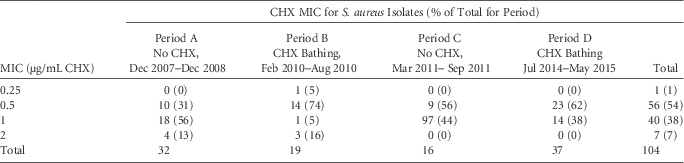
Prior to February 2009, CHX bathing was not used for hospitalized patients at the Nebraska Medical Center, a 689-bed academic medical center. From February 2009 to August 2010, regular CHX patient bathing was implemented via bed baths with 4% chlorhexidine gluconate (Hibiclens, Molnlycke Healthcare, Gothenburg, Sweden) as previously described.Reference Rupp, Cavalieri and Lyden 3 In the last 6 months of the project (February 2010 to August 2010), all inpatients were regularly bathed with CHX. Following this experimental period, CHX was removed from September 2010 to September 2011 and then reintroduced in October 2011. Therefore, CHX was used for patient bathing during 2 periods, each of which was preceded by at least a year when CHX bathing was not in use. The 4 time periods are labeled A–D in Table 1.
Number (%) of Staphylococcus aureus Isolates in Each Period at Respective Minimum Inhibitory Concentrations (MICs) of Chlorhexidine (CHX)Footnote a

a MIC for each isolate was the lowest concentration of CHX at which no growth was detected. The maximum MIC detected was 2 µg/ml.
Staphylococcus aureus Isolates
Isolates were retrieved from a freezer bank containing initial S. aureus bloodstream isolates from hospitalized patients. Isolates responsible for hospital-associated bacteremia, defined as bacteremia occurring greater than 72 hours after admission, were characterized. Staphylococcus aureus isolates recovered from patients known to be previously colonized with MRSA were excluded as non-nosocomial.
Bacterial Isolation, MIC Testing, and Determination of qacA/B Gene Presence
Chlorhexidine minimum inhibitory concentration (MIC) testing was performed utilizing Clinical Laboratory Standards Institute (CLSI) methodologies. Plates were incubated at 35°C for 16 hours. qacA/B genes were detected by polymerase chain reaction (PCR) using a single primer pair designed by National Center for Biotechnology Information: reference sequences pSA1379 (qacA) and pTZ2162 (qacB): 5’CCCAACAGTTATGGATAGTTG3’ and 5’CGTCTAACATTGGATCAGAAC3’. A strain of MRSA known to contain both qacA and qacB was utilized as a positive control (Courtesy: J. Edgeworth, Guy’s and St. Thomas’, London, UK).
Statistical Analysis
The Kruskal-Wallis test was used to compare the distribution of MICs between periods. The Mann-Whitney test (for pairwise comparisons) was used to compare time periods, along with the Bonferroni method for P value adjustment. P<.05 was considered statistically significant.
RESULTS
Of 122 S. aureus strains meeting the nosocomial criteria, 104 were available for testing. Results of MIC testing are listed in Table 1. The highest chlorhexidine MIC was 2 µg/mL, for 4 isolates in the non–CHX-use baseline period (period A) and 3 isolates in the CHX-use period (period B). MIC mean and standard deviation (µg/mL) were 0.97 (SD, 0.46; period A), 0.75 (SD, 0.57; period B), 0.72 (SD, 0.26; period C), and 0.69 (SD, 0.25; period D). A statistically significant difference was observed in the distribution of MIC across the 4 periods (P=.008). Specifically, the mean MIC for period A was greater than for period B and was also greater than for period D (P=.048 and P=.024, respectively). None of the isolates tested contained qacA or qacB as assessed by PCR.
DISCUSSION
Chlorhexidine is a broadly active antiseptic that has been used in healthcare for more than 50 years. Due to increased concern regarding HAIs, CHX has been more broadly employed. Examples of CHX use include oral rinses to prevent ventilator-associated pneumonia, skin disinfection to prevent catheter-related bloodstream infections, and whole-body bathing to prevent acquisition and transmission of multidrug-resistant organisms.Reference Milstone, Passaretti and Perl 1 The increasing use of CHX has triggered concern regarding the possible emergence of CHX resistance.
Low-level CHX resistance, also known as tolerance, is well-described in staphylococci and is due to the activity of multidrug-efflux pumps mediated by genes qacA and qacB.Reference Paulsen, Brown, Littlejohn, Mitchell and Skurray 4 Although the clinical significance of low-level CHX resistance remains debatable, qacA/B-positive S. aureus has been associated with elevated vancomycin MIC and bacteremia.Reference McNeil, Kok and Vallejo 5 In combination with resistance to mupirocin, qacA/B has been implicated with MRSA decolonization protocol failure.Reference Lee, Macedo-Vinas and Francois 6 The prevalence of qacA/B in MRSA varies widely based on geography.Reference Kampf 2 In the United States, most studies examining the emergence and prevalence of CHX-resistant S. aureus have been reassuring. McGann et alReference McGann, Kwak, Summers, Cummings, Waterman and Lesho 7 characterized 5 qacA/B(+) MRSA strains recovered in 2003, but they did not find any qacA/B(+) MRSA among several hundred strains recovered from patients in 2010 and 2011 from an East Coast healthcare network.Reference McGann, Kwak, Summers, Cummings, Waterman and Lesho 7 McDanel et alReference McDanel, Murphy and Diekema 8 noted that low-level chlorohexidine resistance and qacA/B presence in only 0.6% of 829 MRSA isolates obtained from 3,806 nursing home residents in California. Warren et alReference Warren, Prager and Munigala 9 characterized 504 nasal swab MRSA isolates obtained during 2005–2012 after implementation of a daily CHX bathing protocol and found qacA/B in 6.2% of strains in 2005 and 7.7% in 2012. However, a cautionary report noted that organisms causing central-line–associated bloodstream infections were more likely to have reduced susceptibility to CHX if the patients were cared for in a unit that utilized daily CHX patient bathing.Reference Suwantarat, Carroll and Tekle 10 McNeil et alReference McNeil, Kok and Vallejo 5 noted qacA/B positivity in 22.7% of 247 nosocomial S. aureus strains.
The present study provides reassurance that broad use of CHX in hospitalized patients does not easily prompt the de novo development of CHX resistance. Several unique features are worthy of emphasis. First, the 2 distinct and prolonged periods of hospital-wide CHX use for patient bathing, preceded and separated by long periods of nonuse, provided a strong natural experiment to test the impact of CHX use on emergence of CHX resistance. Second, only isolates of S. aureus clearly responsible for invasive hospital-associated infection were analyzed. Notably, some of the previous studies on this subject are potentially flawed by broadly testing all S. aureus isolates, including community-associated strains that presumably were not subjected to the pressure of CHX exposure. Third, testing for CHX resistance was performed by both phenotypic and genotypic methods.
Several limitations of this study should also be noted. Although observation spanned 7.5 years, this was a single-center study and involved relatively few S. aureus isolates. Although there was no obvious linkage between the patients and no major ongoing MRSA outbreak, molecular epidemiologic testing was not performed to assess for clonality. Finally, no attempt was made to search for cross resistance with other biocides or antibiotics, and no testing for CHX resistance in other bacterial species was performed. We did not attempt to detect smr, which also confers decreased susceptibility to chlorhexidine. However, due to the lack of increased chlorhexidine resistance in our population, the presence of this gene is unlikely.
The results of this study provide reassurance that CHX can be used broadly in hospitalized patients without selecting for CHX-resistant S. aureus. However, these results do not exclude the emergence of resistance in the future, and continued surveillance for resistance is warranted. Meanwhile, this institution has strenuous programs to ensure hand hygiene, environmental disinfection, and limitation of fomites, which will hopefully reduce the spread of resistant staphylococci if they are introduced into the hospital environment. We believe that bathing patients with CHX provides additional benefits in the prevention of HAIs and transmission of multidrug resistant organisms, and this measure integrates effectively with our infection prevention program.
ACKNOWLEDGMENTS
We thank Dr J Edgeworth, Guy’s and St. Thomas’, London, for providing the qacA/B-positive strain of MRSA and Ms Sandy Nelson for secretarial support.
Potential conflicts of interest: M.E.R. receives research support from 3M in the form of contracts to the University of Nebraska Medical Center. All other authors report no potential conflict of interest.
Financial support: No financial support was provided relevant to this article.