Despite years of empirical examination, scholars still know little about whether public opinion influences federal circuit court judges—some of the most active appellate judges in the country. Perhaps more important, there is little agreement as to why public opinion might influence them. What is more, many of these public opinion theories are observationally equivalent, which complicates theory testing. Our goal is to tackle two major questions: Does public opinion influence federal circuit court judges, and if so, why?
To answer these questions, we empirically examine state public opinion, national public opinion, and over 22,000 federal circuit judge votes from 1960 to 2002. A number of empirical tests reveal that public opinion does indeed influence circuit court judges but not for the reasons scholars typically believe. While there is some evidence to suggest that federal circuit court judges change just like everyone else, they also appear to follow public opinion for reputational reasons. The data show that native-born judges—those who were born and educated in the states they ultimately go on to “represent” as federal circuit court judges—are more likely to vote liberally (conservatively) as their states become more liberal (conservative).
These findings make at least three contributions. First, they show that at least some federal circuit court judges modify their votes in line with state-level public opinion. This finding upends the conventional wisdom about countermajoritarian judges. Second, the article makes a broader point about judicial behavior. The findings suggest that circuit court judges follow public opinion for reputational reasons. If reputational goals influence these federal judges, they likely influence others as well. In this respect, the findings support the theoretical insights of Baum (Reference Baum1997, Reference Baum2006) and others (Posner Reference Posner1993)—insights that have not yet received sufficient empirical attention and demand further investigation. Third, the results provide evidence to policy makers who seek to shape the judiciary. If policy makers (or the public) desire judges who reflect public opinion, they might consider appointing judges with deep roots in their states. Alternatively, if they desire insulated judges, they might consider appointing judges who lack such roots.
Public Opinion and Federal Judges
A host of studies debate whether federal judges (most often, Supreme Court justices) follow public opinion.Footnote 1 They ask whether judges are more likely to rule conservatively as public opinion becomes more conservative and more liberally as public opinion becomes more liberal. Over the course of their careers, the theories go, judges will exhibit changes in their behavior consistent with changes in prevailing public opinion. The reasons why they might follow public opinion, however, vary.
Some scholars believe judges’ attitudes change with public opinion, not because of any instrumental reasons but because judges are just like other people who change over time. That is, they rise and fall with social tides, just like the rest of society (e.g., Giles et al. Reference Giles, Bethany and Richard2008). Justice Cardozo (Reference Cardozo1921, 168) put it best when he stated, “The great tides and currents which engulf the rest of men do not turn aside in their course and pass the judges by.” As the public becomes more liberal or conservative on an issue, so too will the attitudes of federal judges. Advocates of this theory might point toward same-sex marriage as an example: as the public’s attitudes changed toward same-sex marriage, judges’ attitudes changed as well. One could point toward other areas of attitudinal change, such as interracial marriage, women’s rights, and desegregation. As public attitudes toward those issues changed, so too did judges’ attitudes—and votes. Judges follow the broad contours of public opinion, under this argument, because they are caught up in changing social forces just like the rest of us.
Other scholars suggest judges follow public opinion for instrumental reasons. One of these reasons is to protect their courts’ legitimacy (e.g., McGuire and Stimson Reference McGuire and James2004; Casillas et al. Reference Casillas, Peter and Patrick2011; Enns and Wohlfarth Reference Enns and Patrick2013, Reference Enns and Patrick2017; Black et al. Reference Black, Owens, Wedeking and Patrick2016b). Federal courts lack an electoral connection to voters. This constitutional design, while enhancing judicial independence, also shears judges of conventional arguments for institutional legitimacy based on popular sovereignty. Without electoral mandates, the courts rely on goodwill for institutional legitimacy. Judges must consider public opinion, then, because frequent rulings against the public could cause the courts to lose legitimacy. As Murphy (Reference Murphy1964, 20) states, “A series of wrong or imprudent judgments … can undermine public faith in the [judiciary].” And the courts need that faith to sustain themselves. In short, because a consistent pattern of shirking public opinion could damage judicial legitimacy, judges must stay out of trouble by following the broad contours of public opinion.
Similarly, scholars also theorize that judges might follow public opinion to prevent noncompliance with their rulings. Because it is elected officials who have the responsibility of funding and implementing many judicial decisions—and those officials are reluctant to act against public opinion—judges might need to calibrate their decisions with public opinion (Epstein and Knight Reference Epstein and Jack1998). McGuire and Stimson (Reference McGuire and James2004, 1022) make the point cogently in their analysis of the Supreme Court: “The Court requires the cooperation of legislative and executive officials, many of whom are themselves careful auditors of mass opinion. For that reason, the members of the Court must reflect on how well their preferred outcomes will be received and supported by implementers.”
Finally, some suggest (but no one to our knowledge has examined empirically) that judges may concern themselves with public opinion for reputational reasons. Since some readers may be less familiar with the reputational theory (because scholars examine it less often), we spend a bit more time discussing it. As Baum (Reference Baum2006, 66) puts it, judges “might respond to public opinion for another reason altogether, their interest in personal approval from the mass public.” He argues that nearly all humans desire prestige, esteem, and acceptance. Bernheim (Reference Bernheim1994, 842) agrees, stating that “most social scientists agree that individual behavior is motivated in large part by ‘social’ factors, such as the desire for prestige, esteem, popularity, or acceptance.” The desire for acceptance is a strong human attribute, and pressure to conform can be compelling. In fact, Harsanyi (Reference Harsanyi1969) argues that people’s behavior can be explained largely in terms of economic gain and social acceptance (see also Baum Reference Baum1997, 48). One study declares that “the proposition that people are motivated to maintain and enhance their self esteem has achieved the rare status of an axiom” (Leary and Downs Reference Leary and Deborah1995, 123).
These same human concerns may influence judges. Judges, after all, are humans. They live in communities. They visit with neighbors, friends, and acquaintances. They, too, may care how others—even members of the public they do not know—perceive them. Indeed, Justice Jackson once wrote, “I do not know whether it is the view of the Court that a judge must be thick-skinned or just thick-headed, but nothing in my experience or observation confirms the idea that he is insensitive to publicity. Who does not prefer good to ill report of his work?”Footnote 2 Baum (Reference Baum2006, 32) makes precisely this argument, stating that “if judges are like other people, they care about the regard in which they are held for its own sake. In turn, their interest in the esteem of others can be expected to influence their work as judges.” Similarly, Canon and Johnson (Reference Canon and Charles1999, 52) state that “we can expect judges to be sensitive to social and political considerations in their environment.” Of course, it may be that reputational factors influence judges subconsciously (e.g., Braman Reference Braman2009). Regardless, because they are human, judges may be motivated by these very human concerns.Footnote 3
The reputational theory is somewhat ambiguous as to two features, however. First is the question of whether judges care about their reputations among the general public or among elite actors in their states and communities.Footnote 4 This ambiguity is most frustrating as applied to federal appellate judges. After all, they are probably more likely to interact with elites than the general public. And they do not sit for reelection. As an empirical matter, though, it may not matter. Strong evidence suggests that various socioeconomic groups within the public tend to update their preferences at the same time (e.g., Page and Shapiro Reference Page and Robert1992; Soroka and Wlezien Reference Soroka and Christopher2008; Wlezien and Soroka Reference Wlezien and Stuart2011). For instance, studies find that people with different levels of education change opinion “at the same time, in the same direction, and to about the same extent” (Enns and Kellstedt Reference Enns and Paul2008, 433). The same holds true for people of various income levels (Kelly and Enns Reference Kelly and Peter2010; Enns and Wlezien Reference Enns and Christopher2011) and for voters and nonvoters (Ellis, Ura, and Robinson Reference Ellis and Jenna2006). What is more, cross-sectional survey data from scholarship on public opinion and political representation indicate that the median citizen and economic elites have very similar preferences on most policy issues (Gilens and Page Reference Gilens and Benjamin2014; Enns Reference Enns2015). Enns (Reference Enns2015) compares the policy preferences of the median citizen against citizens at the 90th percentile on the income distribution (using data from Gilens and Page [Reference Gilens and Benjamin2014]) and finds that they are roughly interchangeable.Footnote 5 What this means is that even if judges concern themselves primarily with elites rather than the general public, one may still look to general public opinion as a rough measure of elite opinion.
Second is the question whether all judges concern themselves with public opinion for reputational reasons or whether only certain judges do. It seems reasonable to believe that reputation-minded judges with deeper roots in their states are more likely to consider state opinion than are judges who lack those connections. They have long acquaintances with people in their states. They often take pride in their states. Their futures, as well as their pasts, are anchored in those states. They, more than judges without such experiences, are likely to pay attention to public opinion in their states. And their voting decisions will reflect that behavior. In other words, a judge’s concern with reputational considerations and public opinion is likely to be conditional on his or her attachment to the community in which he or she lives.
To help contextualize the argument, consider Seventh Circuit Judge Michael Stephen Kanne. Kanne has deep roots in his state and may follow public opinion there. Kanne was born in Indiana, received his bachelor’s and law degree from Indiana University, and practiced law there. However, Seventh Circuit Judge David F. Hamilton, who also is from Indiana, has a different background and may be less likely to consider Indiana opinion when deciding cases. Hamilton left Indiana to go to Haverford College in Pennsylvania. After that, he went to Yale Law School and traveled to Germany on a Fulbright scholarship. Hamilton’s connection to Indiana is not as close as Kanne’s, and, consequently, his desire to manage his home-state reputation may be diminished.
Combined, then, we see four main theories of public opinion and judges: one that argues that judges change just like the rest of us, one that argues that judges track public opinion to ensure institutional legitimacy, one that argues that judges track public opinion to ensure compliance with their decisions, and one that argues that (some) judges follow public opinion to protect their reputations.
All these theories link judges to public opinion. But they also provoke the question, How do judges even know what public opinion is? Judges are fairly removed from the day-to-day business of politics and public policy and therefore cannot be expected to have the same kind of awareness about public opinion as elected officials. This may be true, but according to proponents of these public opinion theories, it remains likely that judges nevertheless are aware of public mood (e.g., Enns and Wohlfarth Reference Enns and Patrick2017). Through experience, interactions with others, publicly reported polls, and election results, they learn about the broad contours of public opinion. What is more, their experience in their states most certainly helps them to understand the state’s “mood.” (This is particularly true of native-born and educated judges.) The news media provide an additional source of information for judges to learn about public opinion (Davis Reference Davis1994). As Justice Breyer once said, “Judges read newspapers, just like everybody else” (Farias Reference Farias2015). Judges can also acquire information about public mood from their legal cases. It seems reasonable, then, to believe that judges (particularly native-born judges) have a sense for public opinion in their states. And while the federal judge’s thermostat is not as sensitive to public mood as the elected official’s, it surely informs the judge of heat and cold.
Another question these theories must address is, Does the public really care about the courts? Are they informed enough? The public knows little about courts in general and perhaps even less about circuit courts in particular. So, why would judges feel the need to worry about public opinion? For starters, legal and political elites follow the courts and their decisions. Elites, in turn, translate judicial opinions to the public. So, even if the public is not instantly informed about a decision, it can become informed—quickly (Enns and Kellstedt Reference Enns and Paul2008). And the probability it will become informed of a decision surely increases as the decision itself bucks public opinion. Perhaps more important, public opinion theories do not hinge on whether the general public actually reads, or even in fact knows about, circuit court opinions. It is sufficient that judges believe that the public may become informed. Judges may operate under the belief that the media, elites, or others will alert the public to important decisions and thereby induce widespread public attention, similar to how members of Congress find themselves “running scared” (King Reference King1997). Recent research suggests that this is the case for Supreme Court justices (see, e.g., Casillas et al. Reference Casillas, Peter and Patrick2011; Black et al. Reference Black, Owens, Wedeking and Patrick2016a; Enns and Wohlfarth Reference Enns and Patrick2017). Unpopular policy decisions can activate the attention of a dormant public (Key Reference Key1961, 266; Arnold Reference Arnold1990, 68). The threat of a negative response, then, may be enough to cause judges to care about public opinion.
It is also worth pointing out that few studies test these theoretical arguments on federal circuit courts. And those that do examine circuit courts do not examine the effect of state-level opinion.Footnote 6 For example, Calvin et al. (Reference Calvin, Collins and Matthew2011) show that circuit judges are no more likely to vote liberally (conservatively) when national or circuit-level public opinion becomes more liberal (conservative). Hall et al. (Reference Hall, Justin and Jason2015) find that circuit judges rule against national public mood. As national public opinion becomes more liberal (conservative), they argue, ideologically liberal (conservative) groups think they have a better chance of winning cases and, therefore, file lower quality suits. And when the number of low-quality suits increases, the courts rule more frequently against the parties who file them, making it look as though courts buck national public opinion. Simply put, scholars have forwarded a number of theories about public opinion and judging, but there is little consensus about their accuracy.
Data and Measures
To investigate whether and why public opinion influences circuit court judges, we examined over 22,000 circuit judge votes in cases from 1960 to 2002. We began our sample in 1960 because that is the first year in which the Enns and Koch (Reference Enns and Julianna2013) data (described below) yield a public mood estimate for every state. We conclude our sample in 2002 because that is the final year of data available in the US Appeals Court Database, from which we draw much of our data.Footnote 7 Our unit of analysis is the judge vote per three-judge panel case. We exclude decisions from the DC Circuit Court of Appeals, given that its jurisdiction and judges’ positions in the federal judiciary are uniquely national.Footnote 8
Our dependent variable—Liberal Vote—measures whether the judge cast a liberal (=1) or conservative (=0) vote in the case. To determine the disposition of the judge’s vote, we relied on the US Appeals Court Database.Footnote 9
State Public Mood
Our main covariate of interest measures public opinion in the state in which the judge lives. To measure State Public Mood, we turn to recent innovations in the measurement of state-level public opinion (Enns and Koch Reference Enns and Julianna2013, Reference Enns and Julianna2015). Enns and Koch use multilevel regression and poststratification (MRP) to generate state-level estimates of public mood over time, aggregating information from more than 740,000 survey respondents to reduce both sampling and measurement error. These state-level public opinion measures are ideal for our purposes because they were conceived as, and thus best reflect, direct indicators of state (citizen) demand for more or less government on nationally relevant policy issues.Footnote 10 What is more, the Enns and Koch (Reference Enns and Julianna2013) measures most effectively capture changes in state public opinion over time, which is important given our data reflect more than 40 years of circuit court decisions (see also Enns and Koch Reference Enns and Julianna2015). Larger (smaller) values of State Public Mood represent a state that is more liberal (conservative). We expect a positive relationship between State Public Mood and our dependent variable.
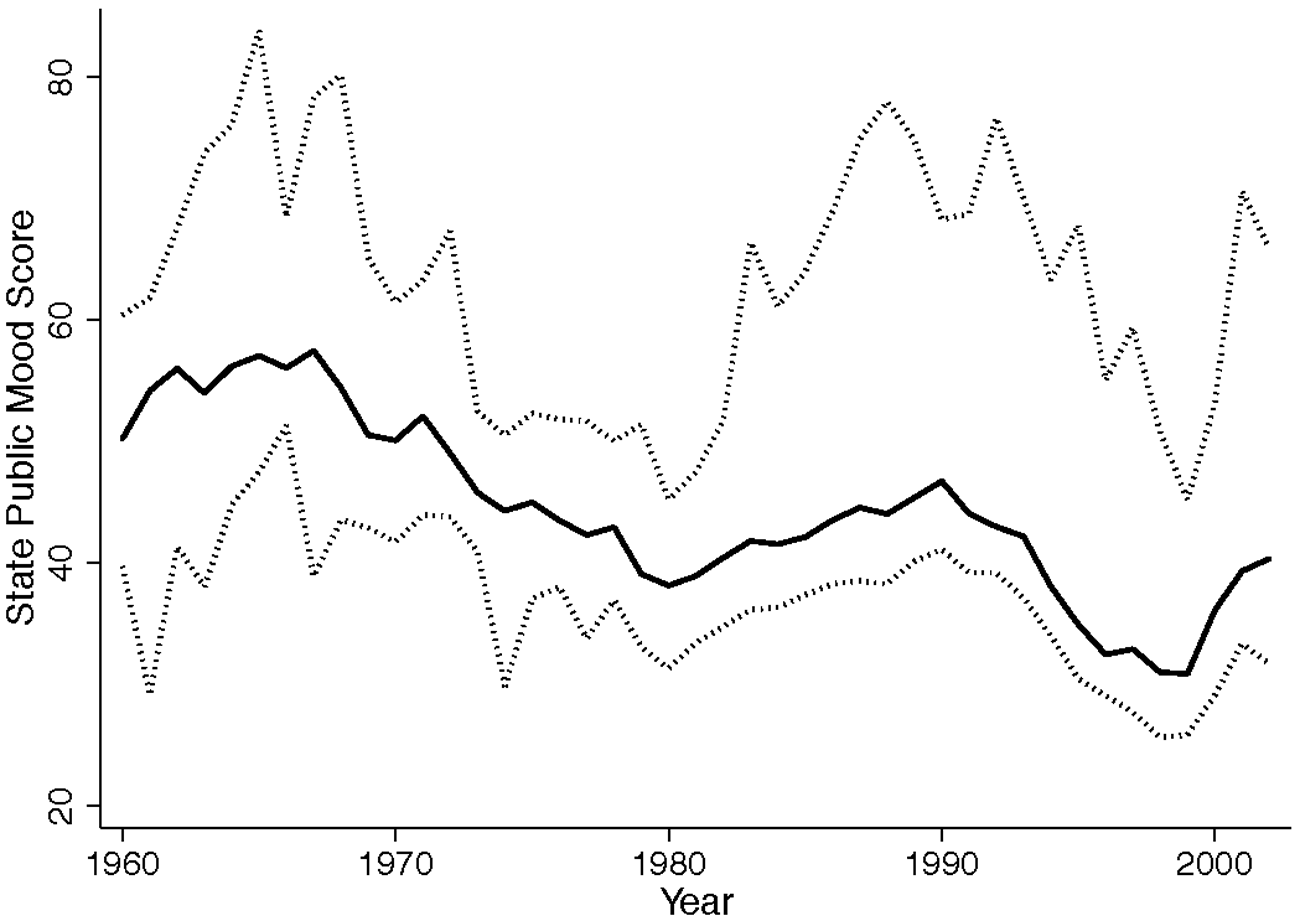
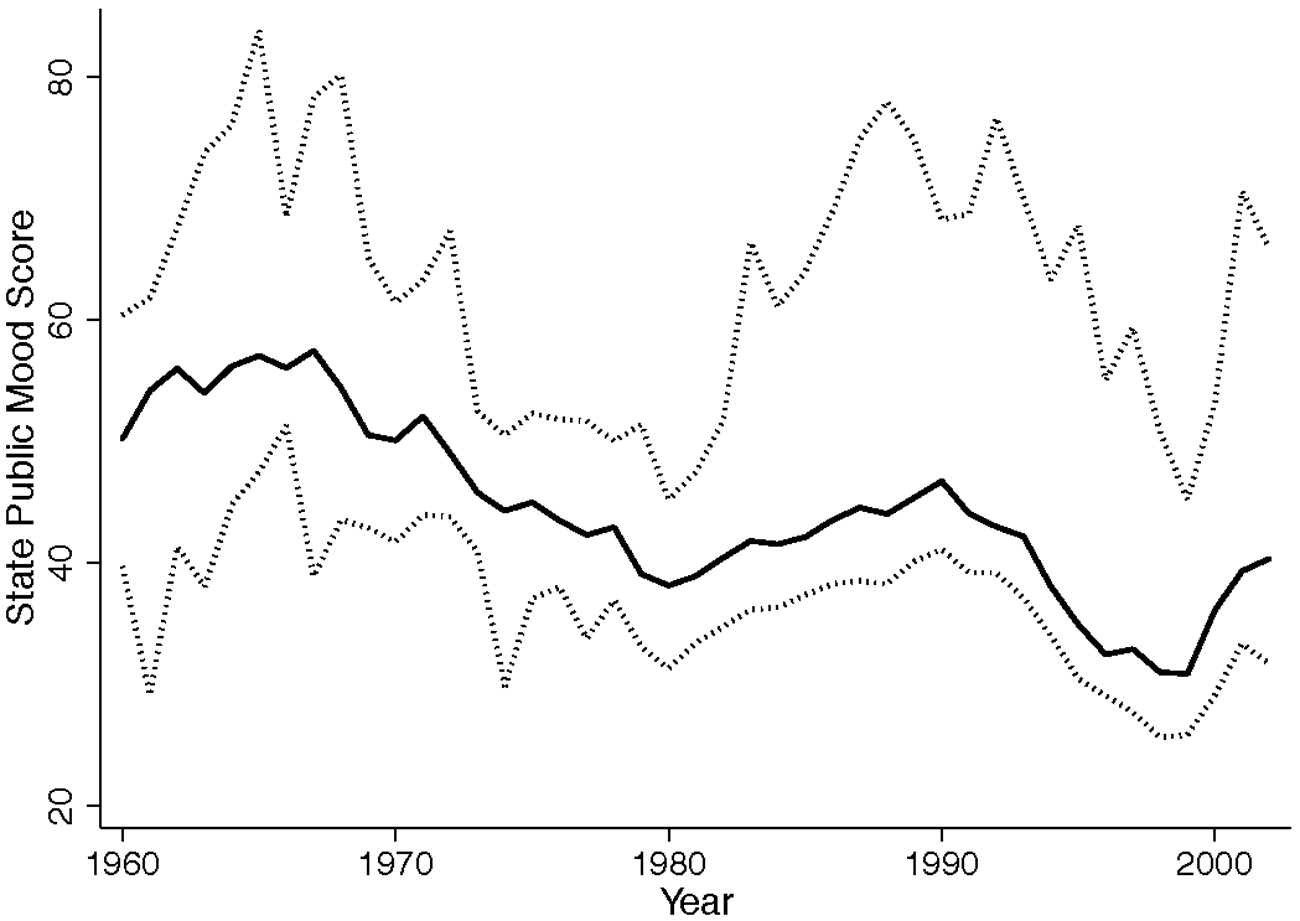
Figure 1 illustrates the variation in State Public Mood over time. It reports the temporal change in the median state mood score (represented by the solid line), with dashed lines signifying the minimum and maximum state scores. The data illustrate that the states as a whole have become more conservative over time. The median state in 2000 was approximately 14 units more conservative than the median state in 1960—a shift of nearly 2 standard deviations.Footnote 11 Additionally, the minimum-to-maximum range of state mood scores each year has been expansive for much of the observed time period, reflecting as much as a 40-point difference. And, as Enns and Koch (Reference Enns and Julianna2013) demonstrate, there can be important differences between temporal changes in state- versus national-level public mood, even though the two levels of public opinion share substantial variance.Footnote 12
Median State Public Mood score, 1960–2002. Dashed lines, minimum and maximum scores each year.
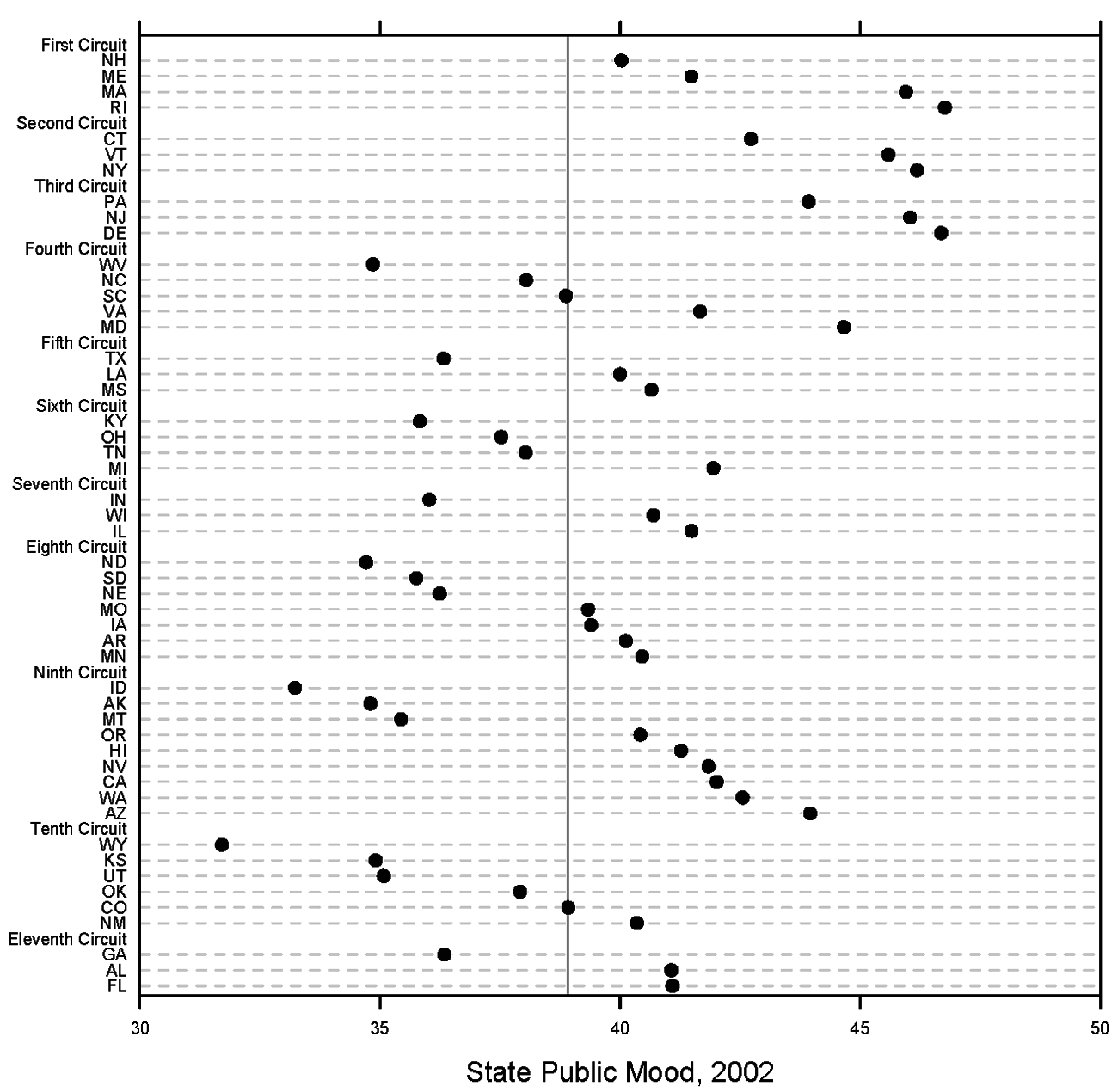
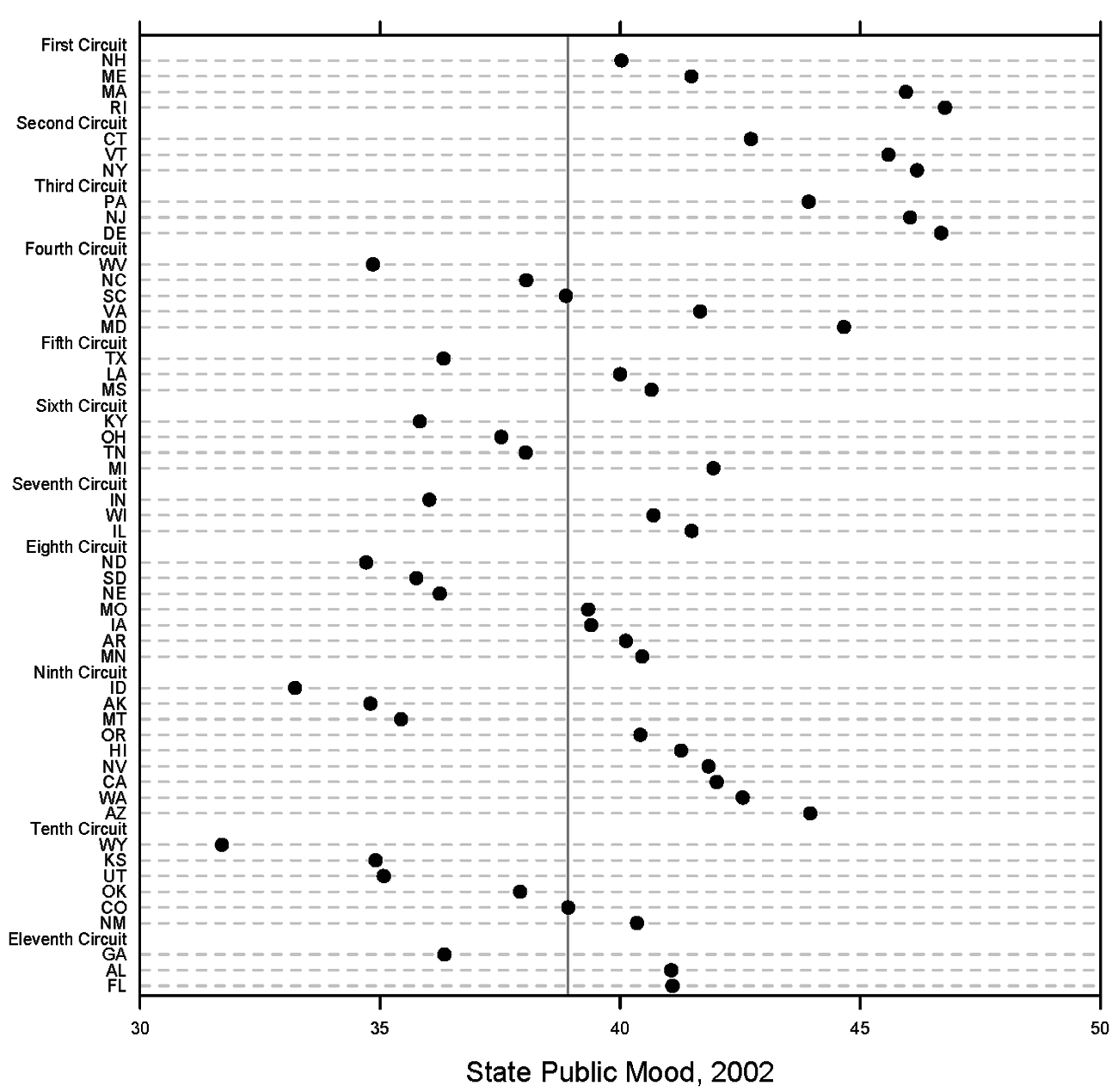
To get a sense of the cross-sectional variance in State Public Mood, figure 2 reports the distribution of individual state mood scores in 2002, arranged by circuit. The vertical line marks the median state (Colorado) mood score in that year. The figure shows that the political climate across individual states in 2002 ranged from a conservative value of 31.71 (Wyoming) on the State Public Mood scale to a more liberal score of 46.77 (Rhode Island).Footnote 13 What is more, the data suggest there is substantial interstate variance in state mood within most judicial circuits. For instance, the individual mood scores within the Ninth Circuit region exhibits an interstate range of 10.73 units. Similarly, the Fourth Circuit’s interstate range in 2002 is 9.81 units, and the Tenth Circuit exhibits a range of 8.64 units.
State mood scores in 2002, arranged by judicial circuit. Vertical line, median state score.
Native Born and Educated
As we suggested above, we suspect that while all judges may be influenced to some degree by public opinion, some judges may be more influenced than others. Judges with deeper ties to a state—whom we call native-born and educated judges and who are represented by the variable Native Born and Educated—may be more inclined to track public opinion than those with shallow ties to it, at least if the reputation theory is correct. To determine whether a judge was native born and educated, we first looked to the Attributes of U.S. Federal Judges Database (http://artsandsciences.sc.edu/poli/juri/attributes.htm) and then cross-checked these data using the Federal Judicial Center’s Biographical Directory of Article III Federal Judges (https://www.fjc.gov/history/judges).
We coded whether the judge was born in the state, received his or her bachelor’s degree there, and received his or her law degree there. If so, we coded Native Born and Educated as 1, and 0 otherwise. It is important to remember that to be coded as 1, all three of these conditions must be met. Our goal, after all, is to isolate judges with deep roots in their states.Footnote 14 Using this variable, we also create an interaction term with State Public Mood, which examines whether the impact of state mood is greater among these native-born judges compared to non-native-born judges.
Judge Ideology
We account for each judge’s ideological preferences using the Judicial Common Space, or JCS (Giles, Hettinger, and Peppers Reference Giles, Virginia and Todd2001; Epstein et al. Reference Epstein, Andrew, Segal and Chad2007).Footnote 15 JCS scores are not endogenous to our dependent variable, as they turn on the preferences of home-state senators who select the judges (or the president, in the absence of senatorial courtesy). The JCS scores in our data range from −.699 (liberal) to .608 (conservative). It is worth noting that we also considered both random- and fixed-effects approaches to account further for unobserved differences across judges. These model results are substantively consistent with the results we report below.Footnote 16
Circuit Court Ideology
Judges might also render decisions with an eye toward the ideological composition of their entire circuit. That is, they might vote strategically so as to avoid en banc review and reversal. We created Circuit Court Median, which represents the median judge on the judge’s circuit each year, as identified by the JCS.
Supreme Court Ideology
It is also possible that circuit judges cast their votes with an eye toward the ideological composition of the US Supreme Court. They might adjust their votes to avoid review and reversal by the Supreme Court. We created Supreme Court Median, which represents the median justice on the high court each year, as identified by the JCS.
Position of the United States
The United States wins its cases in federal courts regularly and can exert a significant degree of influence over judicial decision making (e.g., Wohlfarth Reference Wohlfarth2009; Black and Owens Reference Black and Ryan2012). As such, we controlled for whether the United States advocated a liberal position in the case. If so, we coded US Position as 1. If the United States advocated a conservative position in the case, we coded US Position as −1. And if the United States was not involved in the case, we coded US Position as 0.
Political Panel Effects
We next accounted for the possibility of circuit panel effects. Panel effects occur when the composition of a three-judge panel influences the votes judges cast (Cross and Tiller Reference Cross and Emerson1998; Boyd, Epstein, and Martin Reference Boyd, Lee and Andrew2010). We created five separate dummy variables that identified (a) whether the judge under analysis was a Democrat or Republican and (b) the number of total Democrats on the panel.Footnote 17 Our omitted baseline category is a Republican judge with no Democrats on the panel.
The Effect of General Social Forces
As the rising-tides theory suggests, judges might become more liberal or conservative as broader social forces act on them. We measured State Murder Rate, which reflects the rate of homicides in the judge’s home state at the time of the circuit case.Footnote 18 We suspect that a rising crime rate may increase the judge’s probability of voting conservatively, just as it tends to make the public more conservative. We also included State Unemployment, which reflects the level of unemployment in the judge’s state during the year of the circuit case.Footnote 19 It is possible that as the unemployment rate increases, judges—like members of the public (e.g., Durr Reference Durr1993; Stevenson Reference Stevenson2001; Erikson, MacKuen and Stimson Reference Erikson, Michael and James2002)—will become more likely to support liberal policies. We also control for national social currents that could shape the attitudes of judges over time. We included National Public Mood using the indicator created by Stimson (Reference Stimson1991, Reference Stimson1999).Footnote 20 Stimson’s public mood is a longitudinal indicator of the public’s general preference for more or less government over time. It is an aggregate, dynamic reflection of the general tenor of public opinion (and preference over desired public policy) on the standard liberal-conservative dimension (Stimson Reference Stimson1991). Scholars who examine public opinion in the courts use this measure frequently (e.g., McGuire and Stimson Reference McGuire and James2004; Giles et al. Reference Giles, Bethany and Richard2008; Casillas et al. Reference Casillas, Peter and Patrick2011; Epstein and Martin Reference Epstein and Andrew2011; Enns and Wohlfarth Reference Enns and Patrick2013; Hall et al. Reference Hall, Justin and Jason2015; Black et al. Reference Black, Owens, Wedeking and Patrick2016a). Larger values of National Public Mood reflect a more liberal public, while smaller values reflect a more conservative public.
Compliance Concerns
If the compliance theory is correct, judges may vote in line with public opinion out of concerns that elected officials might not implement judges’ decisions. We included two dummy variables—Unified Democratic Control and Unified Republican Control—to reflect contemporaneous unified party control of the state’s legislative and executive branch in the state where the case originated.Footnote 21 The variable equals 1 if there was unified party control; it equals 0 for a divided government. Because some of the cases in our sample also involve federal implementation, we included President Ideology, which accounts for the president’s JCS score.Footnote 22
Method and Results
Because our dependent variable (Liberal Vote) is dichotomous, we estimate logistic regression models with robust standard errors. We also weight the observations using probability sampling weights to account for the US Appeals Court Database’s sampling process, which randomly selected a fixed number of circuit cases within each circuit-year. Because the population size of published federal appellate court decisions has varied considerably over time and across circuits, estimating our models with probability weights ensures that the analysis of the sample best reflects the population of circuit cases.
Does Public Opinion Influence Circuit Court Judges?
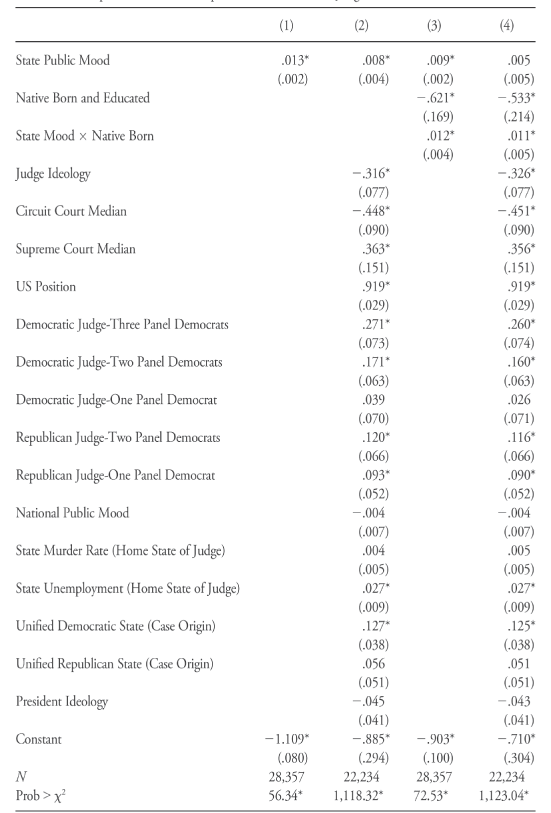
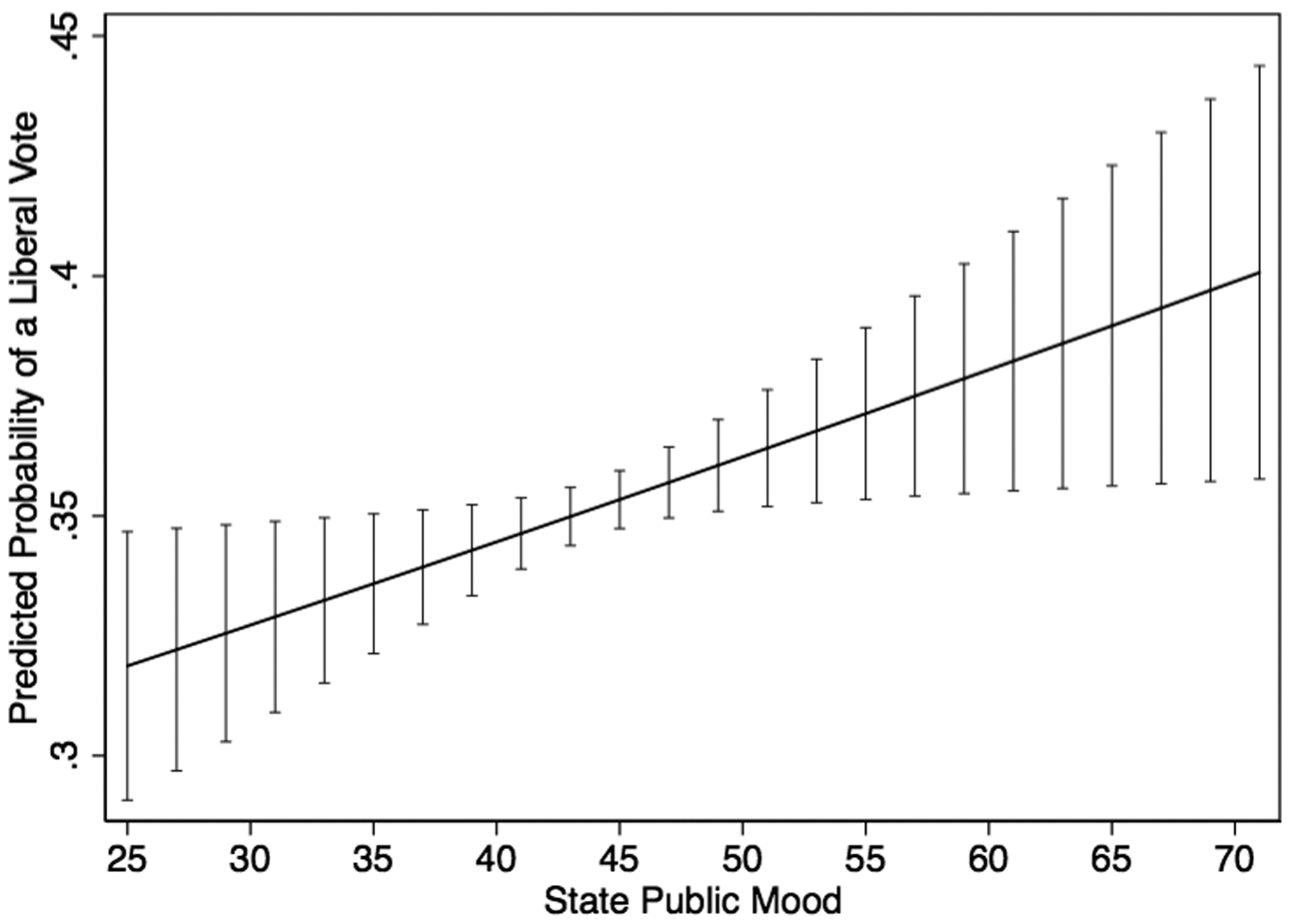
Our first task is to examine the average, unconditional impact of State Public Mood on circuit judges. Models 1 and 2 in table 1 display these results. Model 1 shows a bivariate model, while model 2 includes all control variables in a multivariate model. The results show that, on average, state public opinion influences how circuit court judges vote. That is, as State Public Mood becomes more liberal (conservative), judges are more likely to vote liberally (conservatively). Figure 3 displays the magnitude of state public opinion’s impact. It reports the predicted probability that a circuit judge votes liberally across the minimum-to-maximum range of State Public Mood (using results from model 2). The probability that a circuit judge living in a state with the most-conservative state mood score will vote liberally is .32 [.29, .35]. By contrast, a judge living in a state with the most-liberal mood score has a .40 [.35, .45] probability of voting liberally. Thus, a minimum-to-maximum change of .08 exhibits a 25% total increase in the likelihood that a circuit judge votes liberally.Footnote 23 While this effect is modest on average, it does represent a substantively meaningful effect. For instance, the magnitude of the average impact of State Public Mood (across its observed range) is nearly equivalent to the impact of Judge Ideology, which exhibits a total minimum-to-maximum change of .09 in the probability of a liberal vote (across the full observed range of the JCS in the sample). And we retrieve these results while controlling for many competing considerations known to affect circuit judges’ votes.Footnote 24
The Impact of State Public Opinion on Circuit Court Judges, 1960–2002
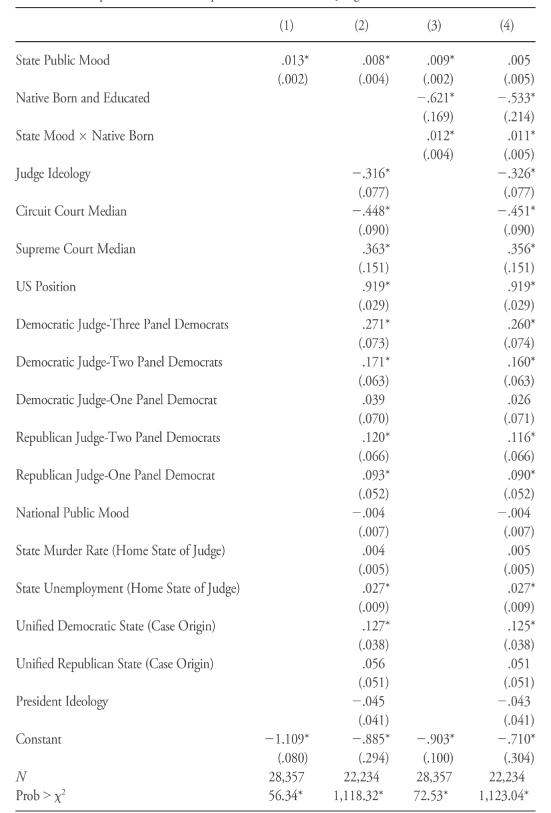
Note.— Logistic regression estimates with robust standard errors in parentheses. The dependent variable represents the ideological direction of individual circuit judge votes. The data reflect a (probability) weighted sample of circuit court cases, 1960–2002, as compiled by the US Appeals Court Database, among three-judge panel decisions (DC Circuit excluded).
* p < .05 (one-tailed).
Predicted probability that circuit judges cast a liberal vote (with 90% confidence intervals) across the range of State Public Mood using results from model 2 in table 1.
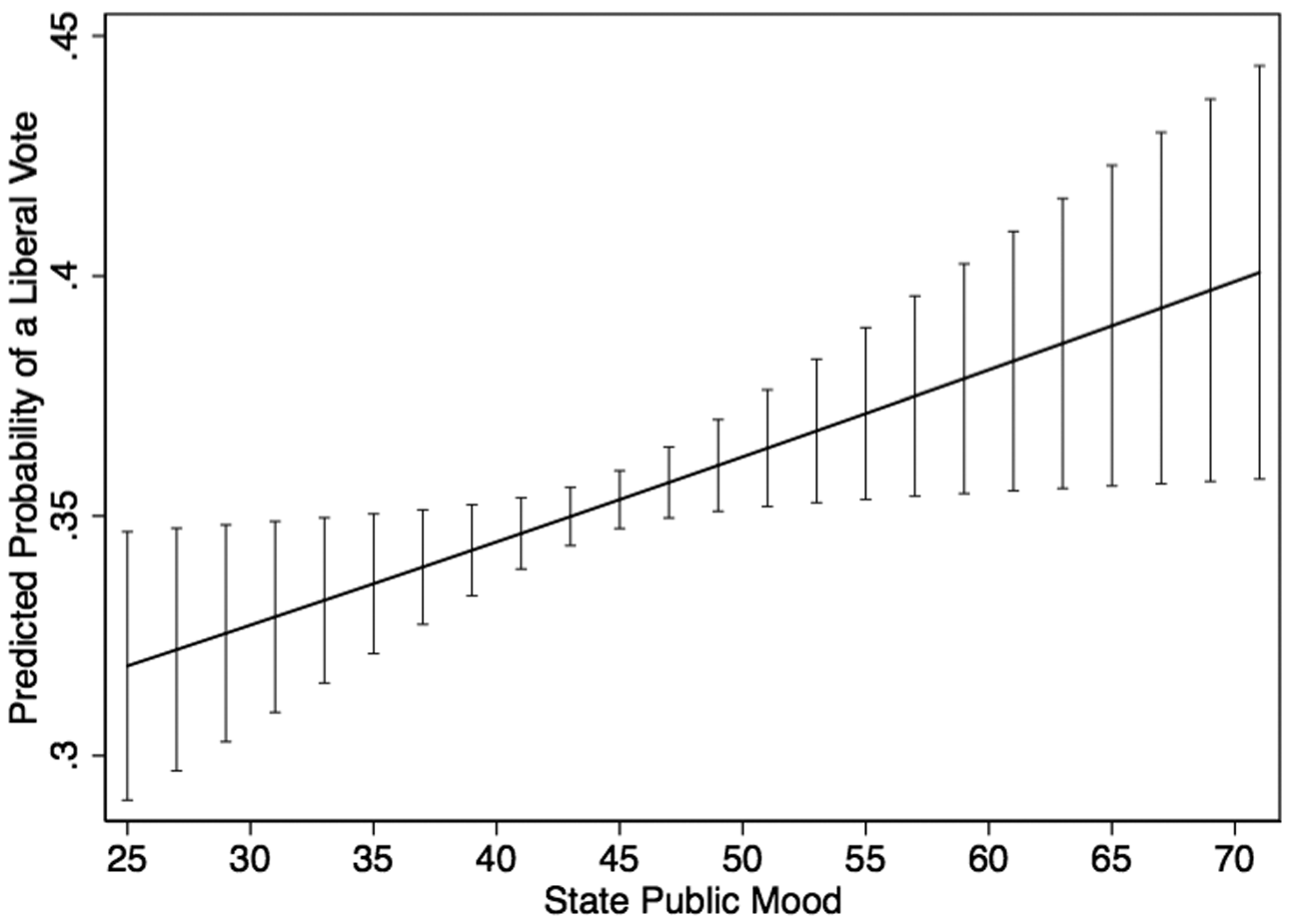
The empirical results offer baseline support for the proposition that circuit judges, on average, vote in a manner that is consistent with state public opinion. This is a new and important finding on its own. Yet these basic results do not explain why such a relationship exists. So, we next consider each individual theory and attempt to disentangle them.
Does the Rising-Tides Theory Explain the Results?
As we discussed above, one major theory holds that judges change with public opinion because they simply become more or less liberal like everyone else in society. The models in table 1 include variables for the state murder rates, state unemployment rates, and national mood. State unemployment exhibits the expected positive, statistically significant impact. As state unemployment increases, so too does the likelihood that judges vote liberally. This provides some support for the rising-with-the-tides theory. Of course, it is worth pointing out that the coefficient on State Public Mood has remained significant even when accounting for these other features, which suggests the rising-tides theory does not fully explain the influence of public opinion. What is more, by controlling for national public mood, we have captured national social currents that might affect citizens across individual states. Thus, it appears that judges become more or less liberal as the public does but beyond a simple rise and fall. That is, the effects we uncover reflect judges deviating from changes in national sentiment to suit the political climate of their individual states.
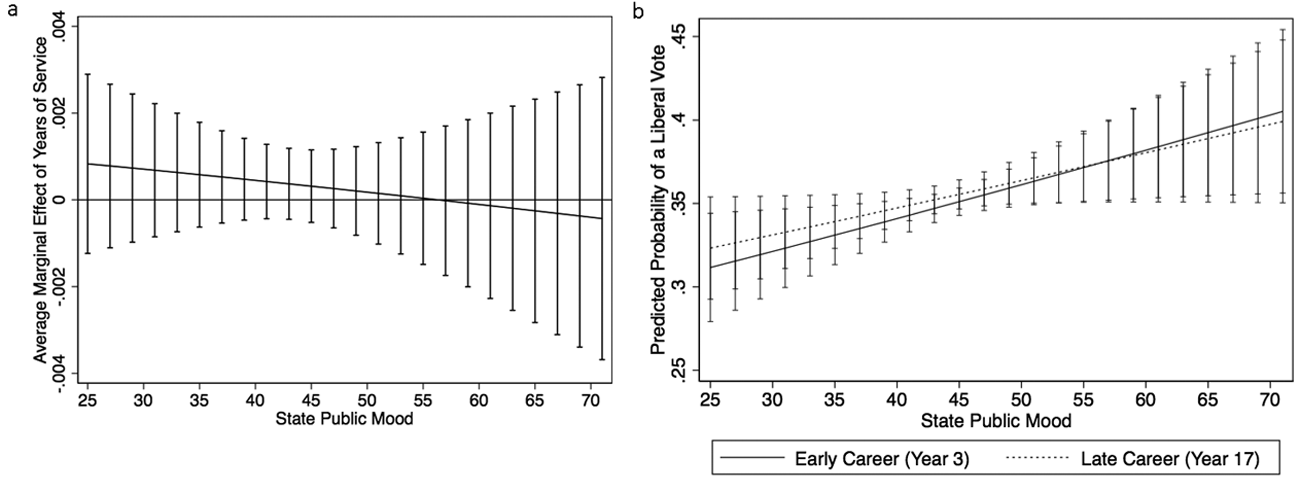
One might wonder whether circuit judges’ apparent responsiveness to State Public Mood is driven by unobserved changes in their ideology (i.e., due to factors in each state that are independent of the state murder rate, state unemployment, and national public mood) that parallel temporal shifts in state mood. That is, unobserved attitudinal change that parallels over-time shifts in state public opinion might explain the results from model 2 in table 1. To address this argument further, we examined whether the impact of State Public Mood is conditional on a judge’s years of service. We interacted State Public Mood with Years of Service—an indicator for the number of years the judge has served on the bench at the time of his or her vote—in a model with all control variables.Footnote 25 Here is the important takeaway: if unobserved ideological drift was the only explanation for the significant impact of State Public Mood, judges later in their tenure (when the ideology variable is less accurate) would be more likely to follow public opinion than judges early in their tenure. They are not.
Figure 4a displays the average marginal effect of Years of Service across the range of State Public Mood. If it was the case that our ideology measure is less accurate in later years—and that judges’ ideologies simply change over time in a rising-tides manner—then the slope on the marginal effects line would be positive and significant. That is, an increase in Years of Service would make a judge in a conservative state less likely to cast a liberal vote and a judge in a liberal state more likely to cast a liberal vote. Nothing of the sort happens, as figure 4a shows. Figure 4b supplements these findings. It shows the predicted probability that an early-career judge (solid line) and late-career judge (dashed line) cast a liberal vote across the range of State Public Mood.Footnote 26 The figure shows that the substantive impact of State Public Mood is nearly identical for early- and late-career judges.
Impact of state public opinion on circuit judges, conditional on years of service. a, Average marginal effect of Years of Service across the range of State Public Mood. b, Predicted probability an early-career judge (solid line) and late-career judge (dashed line) cast a liberal vote across the range of State Public Mood (with 90% confidence intervals). Early- versus late-career judges reflect 1 standard deviation below and above the mean, respectively, of Years of Service.
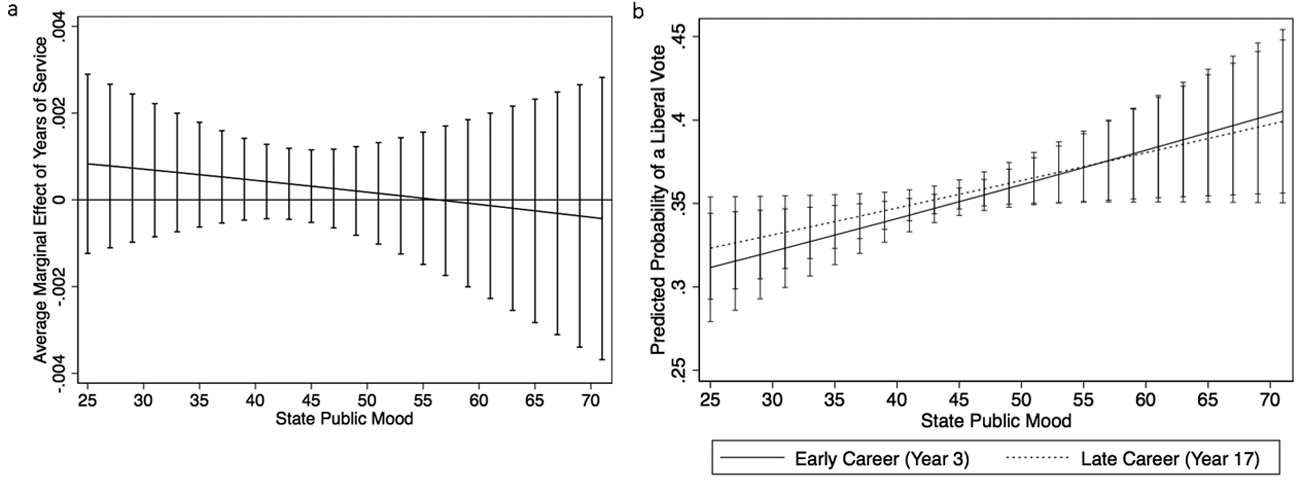
In short, while there is some evidence that judges may change their views just as the rest of us across society change, there is reason to believe this “rising with the tides” theory does not capture all, or even most, of these judges’ observed voting patterns.
Does the Legitimacy Protection Theory Explain the Results?
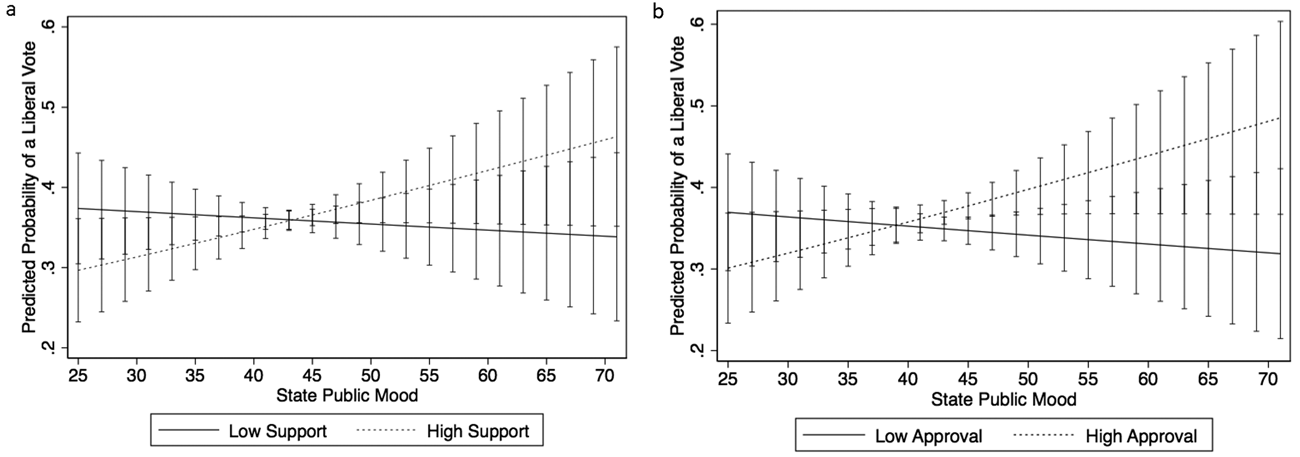
If judges follow state mood for institutional support reasons, we might expect them to be more likely to follow public opinion when the public’s general support for government institutions is low. That is, they will work extra hard to gain public support when it is needed. To test this expectation, we consulted existing over-time measures of public support for the Supreme Court (Durr, Martin, and Wolbrecht Reference Durr, Andrew and Christina2000) and for Congress (Durr, Gilmour, and Wolbrecht Reference Durr, John and Christina1997). To measure support for the Supreme Court, Durr et al. (Reference Durr, Andrew and Christina2000) used the Roper Center for Public Opinion Research archives to aggregate all individual public opinion survey results reflecting public attitudes toward the Court (and that were “administered in the exact same form more than once”) from 1973 to 1993.Footnote 27 The resulting measure was a comprehensive, semi-annual indicator of broad trust and confidence in the Supreme Court that was related to comparable indicators involving the president and Congress.Footnote 28 Importantly, variance in this measure is also related to the general ideological divergence between the Court and mass public (Durr et al. Reference Durr, Andrew and Christina2000). To measure congressional approval, Durr et al. (Reference Durr, John and Christina1997) similarly aggregated individual survey items from Roper that reflected public attitudes toward Congress from 1973 to 1993. As Durr et al. (Reference Durr, Andrew and Christina2000, 772) stated, this measure captures changes in “the myriad factors that shape affect toward government: economic conditions, events such as wars and domestic crises, and social factors such as concern about crime and violence.” Taken together, we have two reliable indicators that reflect over-time changes in general attitudes toward national governmental institutions.
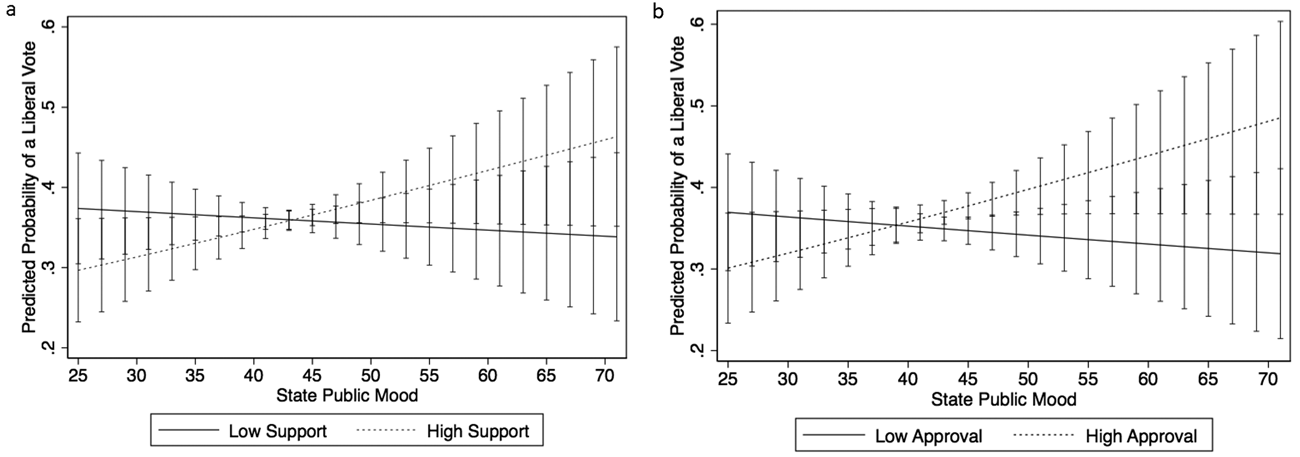
With these two measures in hand, we examined whether the impact of public support for governmental institutions conditions circuit judges’ responsiveness to State Public Mood, among judges’ votes from 1973 to 1993. We estimated two separate regression models—one for each institutional support measure—in which we interact the degree of institutional support with State Public Mood to predict judges’ votes (while including all other control predictors from model 2 in table 1). Figure 5 displays the results of each respective interaction effect. Figure 5a shows the predicted probability of a liberal vote under conditions of low Supreme Court Support (the solid line) and high Supreme Court Support (the dashed line) across the range of State Public Mood.Footnote 29 Figure 5b displays the predicted probability of a liberal vote under conditions of low Congressional Approval (the solid line) and high Congressional Approval (the dashed line) across the range of State Public Mood. The data provide no evidence that concerns over low institutional support drive the impact of state public opinion on circuit judges.Footnote 30 If the data were to exhibit such a relationship, then lower institutional support—and not greater support—should induce judges from more liberal (conservative) states to be more (less) likely to issue liberal votes. Instead, the slope of both solid lines is slightly negative.
Impact of state public opinion, conditional on support for the Supreme Court and congressional approval. a, Predicted probability of a liberal vote across the range of State Public Mood during times of high (dashed line) versus low (solid line) Supreme Court support (with 90% confidence intervals). b, Predicted probability during times of high (dashed line) versus low (solid line) congressional approval (with 90% confidence intervals). Low and high support (approval) reflect 1 standard deviation below and above the mean, respectively.
As a further robustness check, we examined the behavior of circuit judges before and after major national scandals and controversies. There is evidence to suggest that general faith in institutions suffers harm after national scandals and controversies (see generally Ura and Wohlfarth Reference Ura and Patrick2010). If judges follow public opinion because they are concerned about their courts’ institutional support, they may be more likely to follow public opinion immediately after a national scandal or controversy than they were before it. So, we examined the behavior of circuit judges before and after Watergate, the Iran-Contra affair, President Clinton’s admission about his affair and perjury, the Abe Fortas resignation from the US Supreme Court, and the US Supreme Court’s decision in Bush v. Gore (2000). The data (shown in the appendix) reveal that circuit judges’ votes generally do not vary systematically after these scandals than before them, suggesting that they do not seem to follow public opinion to protect the judiciary’s institutional support.
Does the Compliance Theory Explain the Results?
If judges follow public opinion to ensure compliance with their decisions, we would expect the identity and ideology of the implementers to influence them. Model 2 in table 1 shows that judges are significantly more likely to issue liberal votes when deciding cases that originated in a state with a unified Democratic government at the time of the court’s decision. Yet there is no effect for unified Republican control, nor does it appear that the president influences the judges’ votes. Most important, however, is the fact that the coefficient on State Public Mood is statistically significant even while controlling for these factors. In short, the correlation between state mood and judge voting does not appear simply to be driven by compliance concerns.
Does the Reputational Theory Explain the Results?
Models 1 and 2 in table 1 show that the average, unconditional impact of State Public Mood is statistically and substantively significant. And we have pursued various empirical approaches to gain leverage on alternative explanations for this relationship. These previous arguments do not fully explain the baseline, unconditional relationship between state mood and circuit judges’ votes. We now consider the reputational theory. Do circuit judges—particularly those with deep roots in their states—respond to state public opinion because they are concerned with their reputations? It appears so.
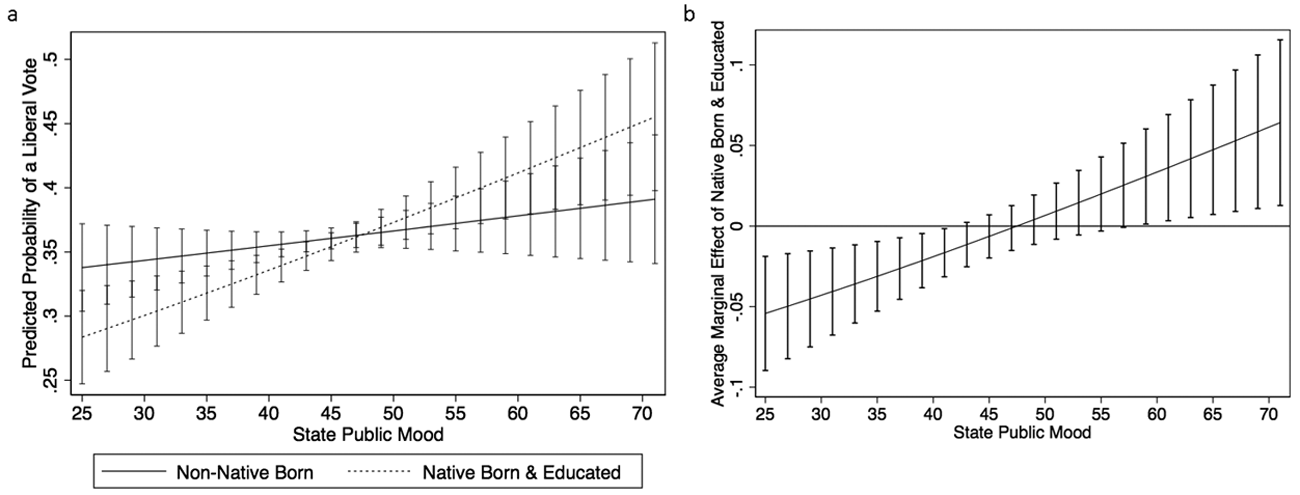
Models 3 and 4 in table 1 display the regression results while interacting State Public Mood and Native Born and Educated.Footnote 31 Model 3 shows a baseline model, while model 4 includes all control variables in a multivariate model. Two features stand out. First, the impact of state mood on non-native-born judges (in model 4, including all control predictors) is positively signed but statistically indistinguishable from zero, suggesting that public opinion fails to influence non-native-born judges systematically. Second, State Public Mood has a positive, statistically significant impact on native-born judges’ voting. This significant impact among native-born judges is evident when examining a baseline regression with just the interactive effect between State Public Mood and Native Born (and no controls), and it is also evident in the fully specified model with a full complement of controls.
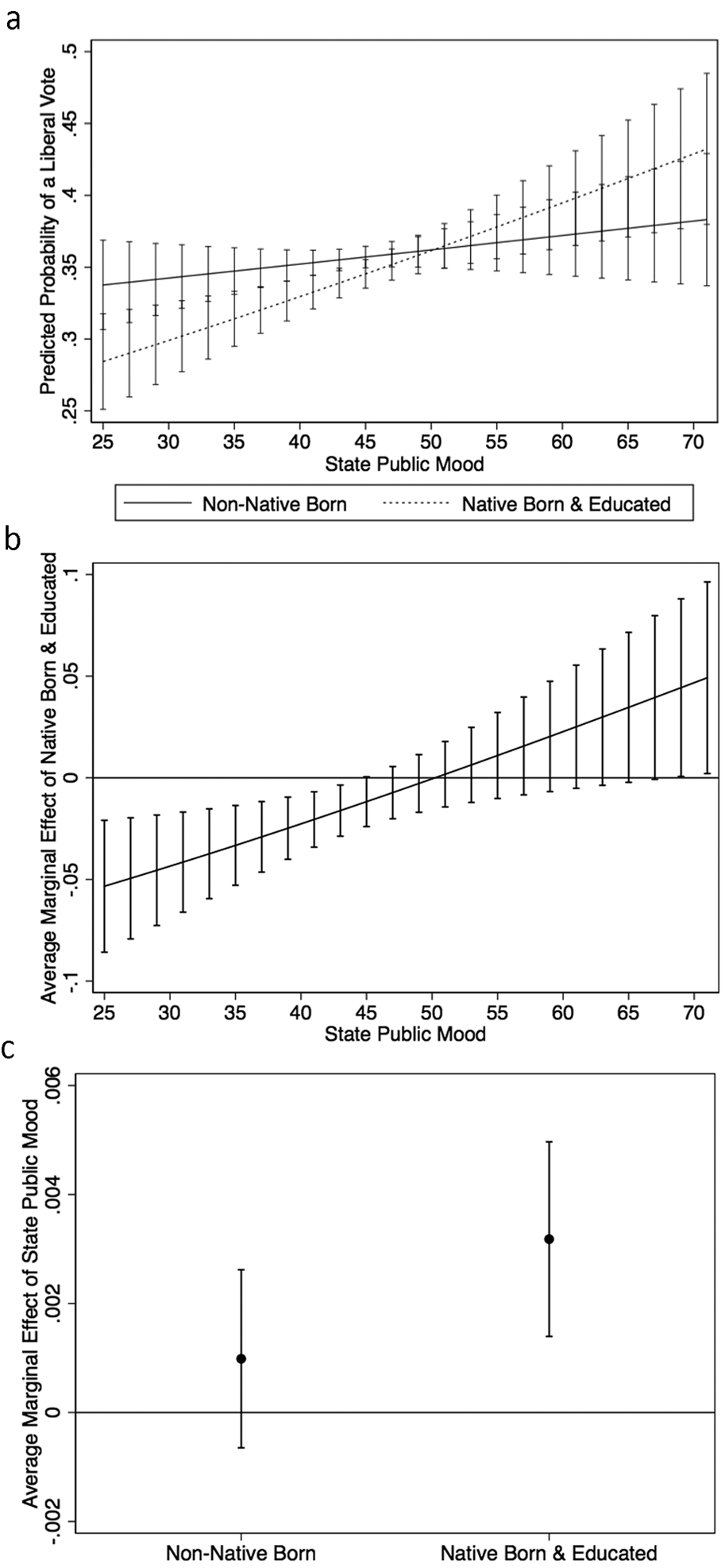
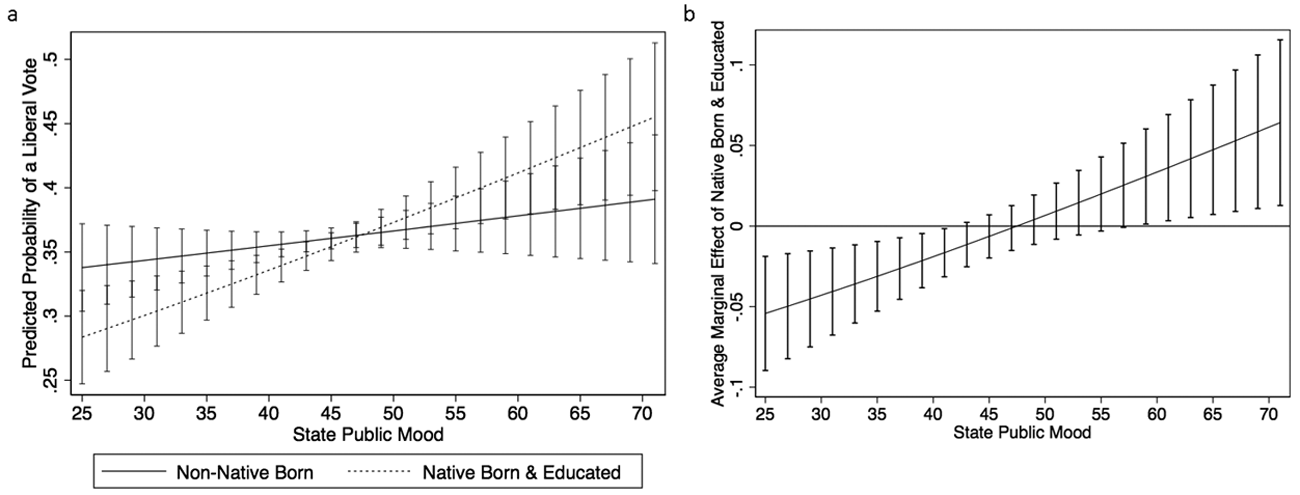
Figure 6a shows the predicted probability (estimated as the average adjusted prediction while holding control predictors at their observed values) that a judge casts a liberal vote across the observed range of state mood. The solid line reflects the votes of non-native-born judges. The dashed line reflects the votes of native-born judges. Consider the native-born judge. A native-born judge living in the most conservative state in our sample has a .28 [.24, .32] probability of casting a liberal vote. But a native-born judge living in the most liberal state in our sample has a .43 [.37, .50] probability of casting a liberal vote. This .15 difference—a 54% average increase—is not only statistically significant; it is substantively meaningful. In fact, the predicted impact of state mood among native-born judges is nearly double the size of state mood’s unconditional, average effect (from model 2 in table 1). To be sure, the effect is smaller when examining more moderate shifts in opinion, as one would expect. For example, a 1-standard-deviation shift from the mean of State Public Mood in the liberal direction yields an expected .025 increase in the probability of a liberal vote—a nearly 10% increase above the mean prediction. Nevertheless, this is still a noteworthy shift, particularly when considering that the state mood coefficient achieves statistical and substantive significance even while controlling for the judge’s ideology, partisanship, and the threat of review from the circuit en banc or the Supreme Court on appeal (in addition to controls for social currents and compliance concerns).Footnote 32
Impact of state public opinion on native-born circuit court judges, 1960–2002. a, Predicted probability that circuit judges cast a liberal vote (with 90% confidence intervals) across the range of State Public Mood. Dashed line, votes by native-born judges; solid line, observations from non-native-born judges. b, Average marginal effect of Native Born and Educated across the range of State Public Mood (with 90% confidence intervals). c, Average marginal effect of State Public Mood for each value of Native Born and Educated (with 90% confidence intervals).

What is more, figure 6b shows that the average marginal effect of a judge being identified as Native Born and Educated is statistically significant across a substantial range of State Public Mood—specifically, among states that are below 45, and above 67, on the state mood scale (representing approximately 54% of judge votes in the sample). Importantly, this does not indicate that State Public Mood fails to exhibit a statistically significant impact on native-born circuit judges in more moderate states but rather that these judges exhibit a (statistically significant) responsiveness to state mood that is not statistically different from the behavior of non-native-born judges. Figure 6c shows the average marginal effect plot for State Public Mood comparing all native-born to non-native-born judges. Simply put, the data show a strong correlation between state mood and the votes of native-born and educated circuit court judges. And we believe that this relationship is a function of judges seeking to protect their reputations at home.
To examine more precisely the relationship between voting and reputational concerns, we opted to look at the behavior of the “expatriate” judge—the judge who was born and educated in one state but moved to another before becoming a circuit court judge. If our theory is correct, these expatriate judges will not follow state public mood where they live when they decide cases because they do not have the same state roots and reputational concerns.
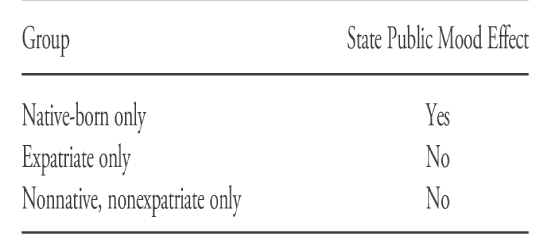
As summarized in table 2, we examined the behavior of native-born and educated judges, expatriate judges, and “all other” judges by splitting the sample using these three groups (see the appendix for the full model results). The results accord with our expectations. When we exclude expatriate judges and “all others” and fit our model examining only native-born and educated judges, we find a statistically significant effect for state mood. Next, when we exclude native-born and educated judges and “all other” judges, thereby fitting the model with only expatriate judges, we find no state mood effect. That is, state mood of their current states does not influence whether expatriate judges vote liberally or conservatively. When we examine only the “all other” judges (and exclude native-born and educated and expatriate judges from the models), we find no influence of state mood on whether the “all other” judges vote liberally or conservatively. These findings suggest to us that reputational concerns motivate native-born and educated judges to follow public opinion in the states where they were born, educated, and live.Footnote 33 Along similar lines, we also examined whether expatriate judges followed public opinion in their originating states. For example, does a judge who is born and educated in, say, Arizona but who sits in California still track Arizona public opinion? The answer is no. These expatriate judges follow neither their current state’s public opinion nor their originating state’s public opinion.Footnote 34
Effect of State Public Mood on Circuit Judges, by Type of Judge: Summary of Results
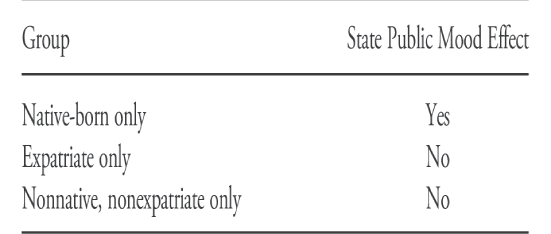
Note.— See the appendix for the full model results.
It is important to note, additionally, that the results we present include cases that are decided on the merits as well as those decided on threshold issues. If we instead follow the approach taken by Hall et al. (Reference Hall, Justin and Jason2015) and remove these “weak” (i.e., threshold) cases, our results are even stronger. That is, when we remove cases that involve a “threshold issue,” as indicated by the US Appeals Court Database, the results for State Public Mood are even more compelling, as figure 7 shows.Footnote 35 In particular, figure 7a shows that a minimum-to-maximum change in State Public Mood exhibits an expected .17 change in the probability of a liberal vote among native-born judges—a 61% increase. We take the more conservative approach (i.e., the approach that cuts against our theory) by presenting both merits and threshold cases. But the reader should know that our results are stronger when dropping these threshold cases.
Impact of state public opinion on native-born circuit court judges, among cases without a threshold issue. a, Predicted probability that circuit judges cast a liberal vote (with 90% confidence intervals) across the range of State Public Mood. Dashed line, votes by native-born judges; solid line, observations from non-native-born judges. b, Average marginal effect of Native Born and Educated across the range of State Public Mood (with 90% confidence intervals).
The finding that reputational concerns appear to influence judges is novel, but perhaps it should not be. After all, evidence suggests that reputational concerns may have influenced how some federal judges voted in desegregation cases. For example, Peltason (Reference Peltason1971) highlights how local public opinion influenced many southern federal court judges after Brown v. Board (1954). As he put it, “A judge who makes rulings adverse to segregation is not so likely to be honored by testimonial dinners, or to read flattering editorials in the local press, or to partake in the fellowship at the club. He will no longer be invited to certain homes; former friends will avoid him when they meet him on the street” (9). This, presumably, is disappointing. John R. Brown, then chief judge of the Fifth Circuit Court of Appeals, likewise once stated that “lifetime tenure insulates judges from anxiety over worldly cares for body and home and family. But it does not protect them from the unconscious urge for the approbation of their fellow men” (quoted in Giles and Walker Reference Giles and Thomas1975, 920).
Vines (Reference Vines1964) examined the voting behavior of southern district court judges and found that they were “influenced by local factors” (357) in race cases. In another study, Giles and Walker (Reference Giles and Thomas1975) examined how a judge’s geographical distance to the public school influenced his votes on desegregation. They found judges were more reluctant to desegregate schools closer to their courts (928). The supposition, of course, was that judges, concerned about how their immediate neighbors would respond to desegregation rulings, modified their behavior. These judges, facing hostility within their communities, had to decide whether to serve as links in the judicial chain or to manage their status in the social hierarchy. Many chose social status. In a study on judges during the Vietnam War, Cook (Reference Cook1977) found that federal judges doled out more lenient sentences to draft evaders as national, regional, and state public opinion toward the war grew more negative.Footnote 36 Reputation matters for most people. And judges, it would seem, are like most people.
Conclusion
Contemporary scholarship often resurrects ancient debates. So too here. When the Anti-Federalist Brutus wrote in opposition to the proposed constitution, he argued that federal judges would be independent of the people. He argued that they would be “independent of the people, of the legislature, and of every power under heaven” (Brutus 1788). He was partially correct. Although judges have tenure protection and other institutional securities, that does not mean they are independent of the people. Many still care about their reputations. Indeed, later, when debating the Judiciary Act of 1789 (creating the first federal judicial hierarchy), William Loughton Smith (Federalist-SC) said the following words to assuage Anti-Federalist opposition: “The [federal] judge will be elected from among the citizens of the State where he is to exercise his function, and will feel every inducement to promote the happiness and protect the liberties of his fellow-citizens…. Should the [federal] judge be under any bias, it is reasonable to suppose it would be rather in favor of his fellow-citizens, than in favor of foreigners, or the United States” (Casper Reference Casper1992, 287; emphasis added).
If our data have anything to say on the matter, it is that public opinion can and does influence the voting behavior of federal circuit court judges. Moreover, among native-born and educated judges, these ties can influence them dramatically. Their reputations matter to them, so much so that they adjust their voting behavior.
To be sure, arguing that judges are motivated to enhance their reputations is difficult. Judges rarely admit to such goals. The public seems not to know much about courts. Causal evidence is also difficult to amass, as there are a number of alternative explanations that could explain why judges follow state public opinion. Nevertheless, we know that most people want to be liked and respected (Leary and Downs Reference Leary and Deborah1995; Baum 2006). And we know from historical evidence that many judges bucked Supreme Court precedent to save their social status (Peltason Reference Peltason1971; Canon and Johnson Reference Canon and Charles1999). So perhaps the theory ought not to be so hard to accept after all. Indeed, for judges with deep roots in their states, it seems reasonable to believe that they might consider their reputations in those states. Judges have frailties and vanities like the rest of us.
Of course, we cannot affirmatively rule out all possible alternative explanations. It could be that judges change with the rest of society. Indeed, we suspect they do. The question is whether these general social forces explain all of their change. We believe not. It could also be that our findings are time bound. Some of the time period in our sample observed the parties shaking out ideologically, with southern Democrats moving to the Republican Party and northern Republicans losing out to Democrats. Perhaps some kind of partisan realignment played a role.Footnote 37 Or perhaps there was something unique about this time in American history that led judges to be more reputation minded. Additionally, during the latter portion of this period, national conservative legal groups became much more involved with helping presidents nominate politically trustworthy individuals. We would not be surprised if their involvement influenced behavior.Footnote 38 It could be, as well, that circuit judges are mostly concerned with the elites within their states. As we mentioned above, it is impossible here to disentangle (legal) elite opinion from mass opinion. We hope future scholars devise measures of mass versus elite opinion that may exist but are today unknown. All these are possibilities, but given the number of robustness checks we employed, we believe there is strong evidence to support the reputation theory.
These results inform policy debates over the courts. For policy makers who want a more responsive federal judiciary, these results offer a path forward. Our results suggest that native-born and educated judges are particularly responsive to their states. Filling circuit court vacancies with such native-born judges may keep the circuits closer in line with local preferences than a circuit filled with judges who have shallower ties to the state. Policy makers who do not desire a responsive judiciary, however, may want to avoid nominating people who were born, raised, and educated in their home states. There is no right or wrong choice—but at least there is now more data on the matter so as to make informed decisions.
Recently, Epstein and Knight (Reference Epstein and Jack2013) called on political scientists to reexamine the goals we think judges keep. As they put it, “It is impossible to deny that political scientists have offered an extremely unrealistic conception of judicial behavior for far too many years. It’s time to move toward a more realistic understanding…. If the process of judicial decision making is best characterized as a complicated mix of motivations, then the motivational framework should allow us to accommodate this complexity and, perhaps, to distinguish the conditions under which different types of motivations apply” (24). We agree. Our data suggest that for at least some federal judges, public mood and reputational concerns can influence their behavior.