Background
Posttraumatic stress disorder (PTSD) is highly prevalent and often severe among military veterans, with a lifetime prevalence in a nationally representative sample of veterans recently estimated at 9.4% (Wisco et al., Reference Wisco, Nomamiukor, Marx, Krystal, Southwick and Pietrzak2022). In fiscal year 2020, of approximately 5.9 million veterans receiving care in the Veterans Health Administration (VHA), 703,496 (11.9%) were diagnosed with PTSD (Harpaz-Rotem & Hoff, Reference Harpaz-Rotem and Hoff2021). Treating PTSD is therefore a high priority for VHA, which has offered specialized residential treatment for PTSD since the 1980s (Rosenheck, Fontana, & Errera, Reference Rosenheck, Fontana and Errera1997). Services have evolved into 46 specialty PTSD residential rehabilitation treatment programs (RRTPs) that provide treatment to veterans whose needs exceed those that can be treated in outpatient settings. Like outpatient PTSD programs, PTSD RRTPs have increasingly adopted evidence-based practices including first-line trauma-focused psychotherapies such as Prolonged Exposure (PE; Foa, Hembree, Rothbaum, & Rauch, Reference Foa, Hembree, Rothbaum and Rauch2019) and Cognitive Processing Therapy (CPT; Resick, Monson, & Chard, Reference Resick, Monson and Chard2017), with adjunctive programming for common co-occurring difficulties like substance misuse (Cook et al., Reference Cook, Simiola, Thompson, Mackintosh, Rosen, Sayer and Schnurr2020). National evaluation of the RRTPs indeed reveals that most veterans experience PTSD symptom improvement during residential treatment (Cook et al., Reference Cook, Schnurr, Simiola, Thompson, Hoff and Harpaz-Rotem2019; Gross et al., Reference Gross, Smith, Holliday, Rozek, Hoff and Harpaz-Rotem2022; Holliday et al., Reference Holliday, Smith, Holder, Gross, Monteith, Maguen and Harpaz-Rotem2020).
CPT and PE are both identified by several recently published clinical practice guidelines, including the guideline published by the Department of Veterans Affairs and Department of Defense (Department of Veterans Affairs and Department of Defense (VA/DoD, 2017), as first-line treatments for PTSD. However, there have been few direct comparisons of CPT and PE intended to determine their comparative effectiveness. An early RCT (Resick, Nishith, Weaver, Astin, & Feuer, Reference Resick, Nishith, Weaver, Astin and Feuer2002) found that both treatments were efficacious and performed similarly among women rape survivors. Most recently, Schnurr et al. (Reference Schnurr, Chard, Ruzek, Chow, Resick, Foa and Shih2022) randomly assigned 916 veterans recruited from 17 VA facilities to individual CPT or PE. PE (pre-post-treatment d = 0.99) slightly outperformed CPT (d = 0.71), but the between-groups effect size was small (d = 0.17). The treatments performed nearly identically with respect to depressive symptoms (PE d = 0.51, CPT d = 0.50). Using administrative data from outpatient VA PTSD clinics, Maguen et al. (Reference Maguen, Madden, Holder, Li, Seal, Neylan and Shiner2021) found that completion of >8 sessions of either PE or CPT within 24 weeks outperformed participation in non-EBPs, and when directly compared, veterans who completed >8 PE sessions reported more improvement on the PCL (8.3 points) than veterans who completed >8 sessions of CPT (7.0 points) – but the difference was not statistically significant.
To date, the effectiveness of CPT and PE has not been compared among veterans in a residential setting. Extending previous comparative effectiveness work from RCTs and outpatient settings to veterans seen in RRTPs is essential given that these veterans are typically among the most complex and severely symptomatic patients treated in VA. Valuable treatment resources should therefore be directed toward whichever treatment or treatments have the most promise for meeting these veterans' needs, with respect to both PTSD and depression, which is highly common among patients with PTSD (Wisco et al., Reference Wisco, Marx, Wolf, Miller, Southwick and Pietrzak2014) and can interfere with PTSD treatment response (Sripada et al., Reference Sripada, Pfeiffer, Rampton, Ganoczy, Rauch, Polusny and Bohnert2017).
The objective of the current study was to compare change in PTSD and depressive symptoms across baseline, discharge, four months and 12 months following discharge among veterans who received individual CPT or PE within VA RRTPs. Given previous research (Maguen et al., Reference Maguen, Madden, Holder, Li, Seal, Neylan and Shiner2021; Schnurr et al., Reference Schnurr, Chard, Ruzek, Chow, Resick, Foa and Shih2022), we expected that veterans would exhibit meaningful improvement in both treatments, the magnitude of which would not differ.
Method
Participants and procedures
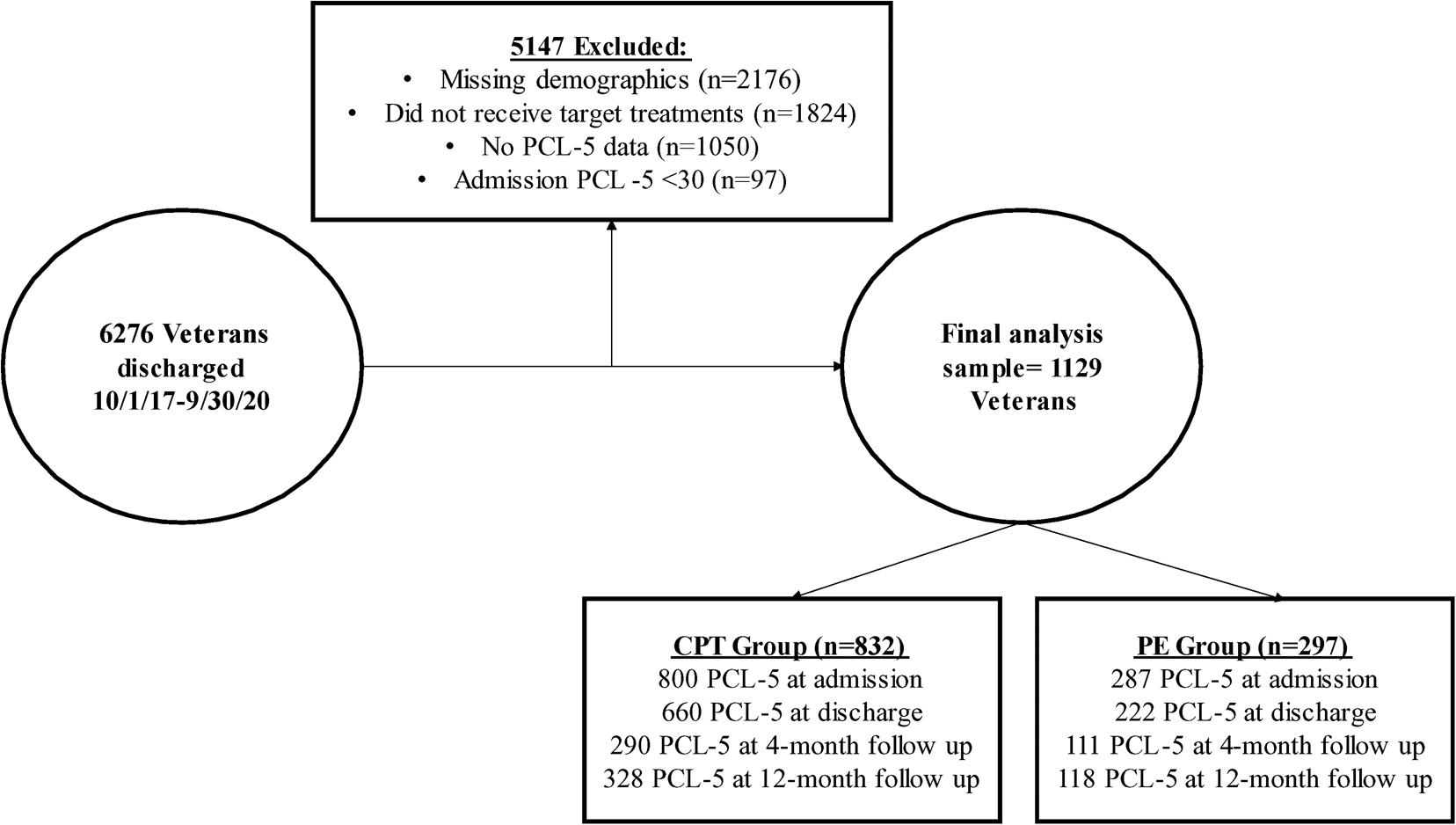
This study included veterans who were discharged from VA PTSD RRTP treatment in fiscal years 2018 through 2020 (i.e. 1 October 2017 through 30 September 2020) and who had self-reported PTSD symptoms that indicated a likely PTSD diagnosis at admission [PTSD Checklist for DSM-5 (PCL-5; Weathers, Reference Weathers2013) ⩾ 31; Bovin et al., Reference Bovin, Marx, Weathers, Gallagher, Rodriguez, Schnurr and Keane2016]. The Northeast Program Evaluation Center (NEPEC) routinely collects program evaluation data from all VA PTSD RRTPs across the nation. All data used in the present study except comorbidity data were collected as part of routine program evaluation of standard clinical care. Data were derived from measures administered at program admission and discharge. All veterans discharged from PTSD RRTPs were mailed voluntary follow-up measures at approximately four- and 12-months post-discharge; veterans who did not return them by mail were then contacted by NEPEC interviewers and asked to complete the measures via telephone. Online Supplemental Tables S2–S4 display the comparisons between study completers and those lost to discharge, four-month follow-up, and 1-year follow-up, respectively. The current study included participants with data for both outcomes (see below) from at least two timepoints; due to missing data (see Fig. 1), the final sample was derived from 35 of the 40 (87.5%) PTSD RRTPs.
Study participant flow.
Note: PCL-5 = PTSD Checklist for DSM-5.

VA RRTPs deliver approximately six to eight weeks of intensive treatment for PTSD in a residential setting with 24/7 support. Veterans must have a diagnosis of PTSD to be eligible for VA PTSD RRTPs; qualifying diagnoses are derived from methods including clinical interview, chart review, information from referring providers, and treatment history/historical diagnoses. Typical admission criteria to PTSD RRTPs include: (1) not currently meeting criteria for an acute psychiatric or medical admission, (2) previous participation in a less restrictive treatment alternative (if available), (3) requiring a more intensive level of care, (4) not being at significant acute risk of harm to self or others, and (5) capability of basic self-care (Department of Veterans Affairs, 2019). This study was approved by the VA Connecticut Healthcare System Institutional Review Board. The authors assert that all procedures contributing to this work comply with the ethical standards of the relevant national and institutional committees on human experimentation and with the Helsinki Declaration of 1975, as revised in 2008.
Measures
Demographics
Veterans provided demographic information on the admission form, including gender, age, race (‘White,’ ‘Black,’ ‘American Indian/Alaskan,’ ‘Asian,’ ‘Pacific Islander,’ ‘Other’), ethnicity (‘Hispanic’ v. ‘not Hispanic’), and years of education. The American Indian/Alaskan (n = 59, 5.2%), Asian (n = 10, 0.9%), Pacific Islander (n = 6, 0.5%), and ‘Other’ (n = 42, 3.7%) racial categories had small sample sizes and were therefore collapsed into an ‘Other’ race category for analysis. Veterans endorsed exposure to combat (yes v. no; ‘Did you ever receive friendly or hostile fire from small arms, artillery, rockets, mortars or bombs?’) and other potentially traumatic events by answering the question, ‘Which type of traumatic incident (include both military and non-military) have you suffered within your lifetime? (Check all that apply): (1) military sexual trauma, (2) non-military sexual trauma, (3) vehicle accident, (4) other accident, (5) victim of violence, (6) natural disaster, (7) none.’ Clinicians completed discharge forms indicating whether the veteran completed RRTP treatment, type of treatment received [EBP for PTSD (including CPT or PE) v. no EBP], and whether or not they received substance use disorder treatment while in the PTSD RRTP (yes v. no). All veterans identified as having received CPT or PE completed at least seven hours of the respective EBP in the RRTP. Total number of physical and psychiatric comorbid conditions were characterized with the Elixhauser Indices (Elixhauser, Steiner, Harris, & Coffey, Reference Elixhauser, Steiner, Harris and Coffey1998); score represents the sum of conditions. These indices were obtained from administrative medical record data.
PTSD symptoms
PTSD symptom severity at admission, discharge, 4-month follow-up and 12-month follow-up were measured with the PCL-5 (Weathers, Reference Weathers2013). The 20 PCL-5 items correspond to the DSM-5 diagnostic criteria for PTSD with Likert scale response options (0 ‘Not at all’ to 4 ‘Extremely’). Scores are summed, with total scores ranging from 0 to 80 and higher scores indicating more severe symptoms. The PCL-5 has excellent psychometric properties (Bovin et al., Reference Bovin, Marx, Weathers, Gallagher, Rodriguez, Schnurr and Keane2016) and is the most widely used instrument for assessing response to PTSD treatment in the field. Cronbach's alpha in the current sample was 0.88, 0.96, 0.90, and 0.91 at admission, end of treatment, 4-month follow-up, and 12-month follow-up, respectively. Again, veterans who did not meet the threshold for minimally severe PTSD (PCL-5 < 31; n = 97) were excluded from the current study.
Depressive symptoms
Depressive symptoms at admission, discharge, 4-month follow-up, and 12-month follow-up were measured with the Patient Health Questionnaire-9 (PHQ-9; Kroenke, Spitzer, & Williams, Reference Kroenke, Spitzer and Williams2001). The nine PHQ-9 items correspond to DSM-IV-TR (American Psychiatric Association, 1994) diagnostic criteria for major depressive disorder. Items are scored on a Likert scale (response options range from 0 ‘Not at all’ to 3 ‘Nearly every day’) and summed (ranging from 0 to 27), with higher scores indicative of more severe symptoms. The PHQ-9 is widely used for screening and assessment of depressive symptoms within VA and other settings and similarly has well-established psychometric properties (Kroenke et al., Reference Kroenke, Spitzer and Williams2001). Cronbach's alpha for the PHQ-9 in this sample was 0.81, 0.89, 0.83, and 0.80 at admission, end of treatment, 4-month follow-up, and 12-month follow-up, respectively.
Statistical analysis
We assessed differences in baseline characteristics between the two treatment groups (CPT v. PE) using Wilcoxon rank sum test for continuous variables and χ2 test for discrete variables. Linear mixed models were used to assess differences in PTSD symptom reduction (primary outcome) and depressive symptom reduction (secondary outcome) between the two treatment groups at discharge, four-month and 12-month follow-up. These outcomes were assessed as estimated marginal means with post-hoc contrasts between the treatment groups. Both estimated models (one for the primary and one for the secondary outcome) included random intercepts for treatment sites and for individuals. Fixed effects included time (with three levels: discharge, four-month follow-up, 12-month follow-up), treatment group (with two levels: CPT or PE), and treatment group by time interaction. Median years of education received was entered as a continuous covariate because the groups differed on this variable.
We assumed missing data to be missing at random and thus did not impute missing data because under these circumstances mixed-effect models provide relatively robust estimates (Detry & Ma, Reference Detry and Ma2016). We used p < 0.01, a more conservative threshold than the conventional p < 0.05, to indicate statistical significance because of our large sample size. All analyses were conducted in the R environment using version 4.0.3. The analyses were conducted between February 2022 and August 2022. We did not conduct an a priori power analysis because we used all available data (such that there was no way to increase power through a larger sample size) and because such analyses are often misleading and are not recommended by statisticians (Althouse, Reference Althouse2021; Dziak, Dierker, & Abar, Reference Dziak, Dierker and Abar2020; Heckman, Davis, & Crowson, Reference Heckman, Davis and Crowson2022).
Results
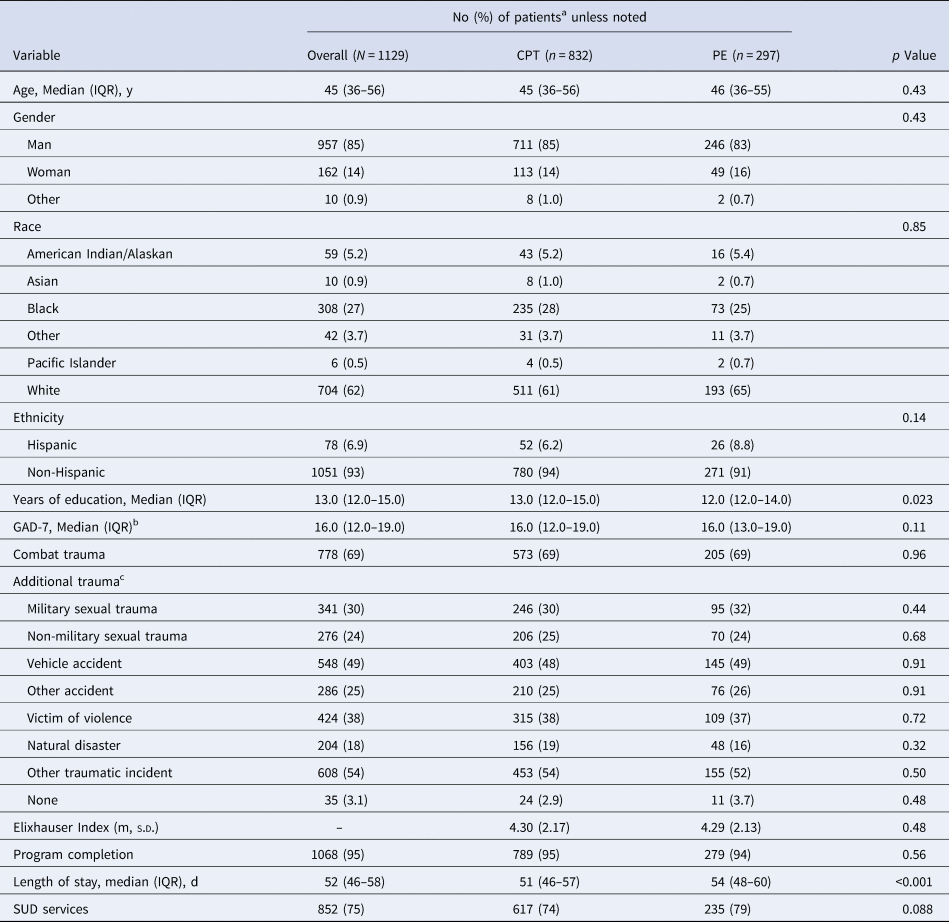
Figure 1 outlines the flow of participants into and through the study. The final sample consisted of 1129 veterans discharged in fiscal years 2018–2020, including 832 treated with CPT (73.5%) and 297 with PE (26.5%). Veterans self-identified their gender as ‘man’ (n = 957, 84.7%), ‘woman’ (n = 162, 14.3%), ‘transgender man’ (n = 10, 0.9%), or ‘other.’ The groups differed with respect to the number of years of education received and the median days spent in the RRTP, with the CPT group having received more years of education and having had shorter stays than the PE group. Sample characteristics are detailed in Table 1. Of the included veterans, complete data on PTSD severity at admission, discharge, four-month follow-up, and 12-month follow-up was reported by 1087 (96.3%), 882 (78.1%), 401 (35.5%), and 446 veterans (39.5%), respectively. Study completers and those lost to discharge and follow-up timepoints did not differ in terms of treatment received (PE v. CPT) severity of PTSD or depressive symptoms, nor other study variables, with the exception of those lost to four-month follow up being younger (see online Supplemental Tables S2–S4).
Demographics and characteristics of participants for overall sample and by treatment

Abbreviations: GAD-7, Generalized anxiety disorder – 7 item; SUD, Substance abuse disorder.
a Percentages have been rounded and may not total 100.
b Scores range from 0 to 21, with higher scores indicating worse symptoms. There were missing data resulting in the following sample sizes for this item: Overall, n = 1089; CPT, n = 799; PE, n = 287.
c Multiple answers could be given.
Primary outcome
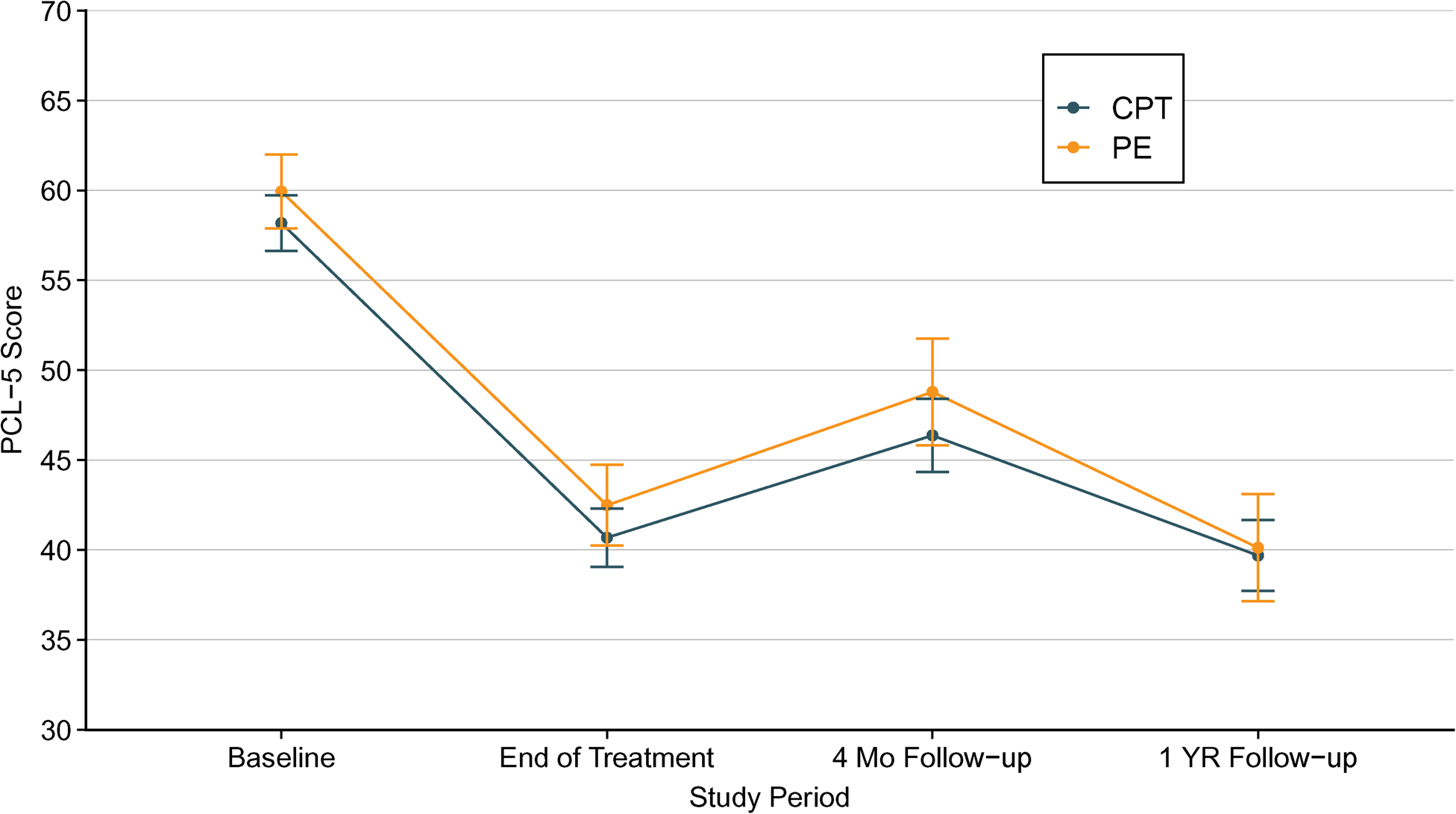
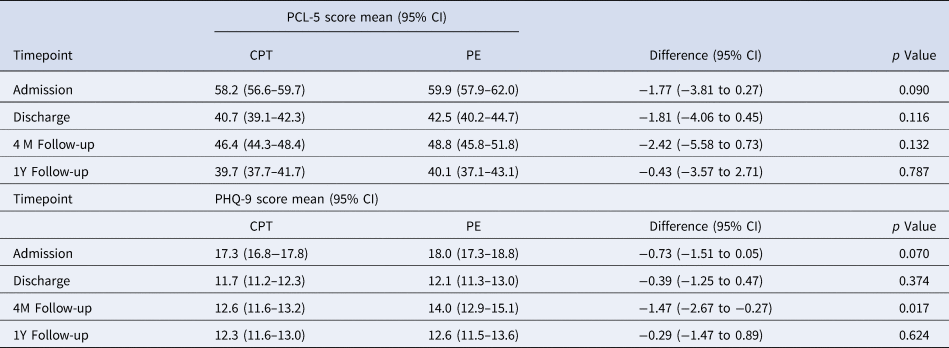
The PE and CPT groups' PTSD symptom severity did not differ significantly at any time points: differences in PCL-5 scores at admission −1.77, (95% CI −3.81 to 0.27), p = 0.090, discharge −1.81 (95% CI −4.06 to 0.45), p = 0.116; four-month follow-up −2.42 (95% CI −5.58 to 0.73), p = 0.132; and 12-month follow-up −0.43 (95% CI −3.57 to 2.71), p = 0.787 (also see Table 2 and Fig. 2). Both groups showed within-group, large-sized reductions in mean PCL-5 score from baseline to 12-month follow-up (Cohen's d = 1.41, 95% CI 1.06–1.78 for the CPT group and Cohen's d = 1.51, 95% CI 1.10–1.92 for the PE group). Changes in PTSD symptoms from admission to discharge and both follow-up timepoints for both the CPT and PE groups exceeded the recommended cut points for minimal clinically important differences (MCID; midpoint 7.9, range: 5.7–10.2) on the PCL-5 (Stefanovics, Rosenheck, Jones, Huang, & Krystal, Reference Stefanovics, Rosenheck, Jones, Huang and Krystal2018). We also tested the interaction between baseline symptoms [categorized as low (PCL-5 = 30–49, n = 212); medium (PCL-5 = 50–64, n = 470); and high (PCL-5 = ⩾65, n = 390)] and treatment group to explore whether veterans with different baseline severity scores had differential responses to PE v. CPT; trajectories did not differ by treatment.
Change in PCL-5 scores by Treatment Group during and after VA PTSD RRTP participation.
Note: Possible scores on the PTSD Checklist for DSM-5 (PCL-5) range from 0 to 80, with higher scores indicating more severe PTSD symptoms. VA, U.S. Department of Veterans Affairs; RRTP, residential rehabilitation treatment program.

Between group differences in PTSD and depressive symptom treatment outcomesa

Abbreviations: PCL-5, Posttraumatic Stress Disorder Checklist for DSM-5; PHQ-9, Patient Health Questionnaire-9.
a The presented data is from mixed-model analyses.
Secondary outcome
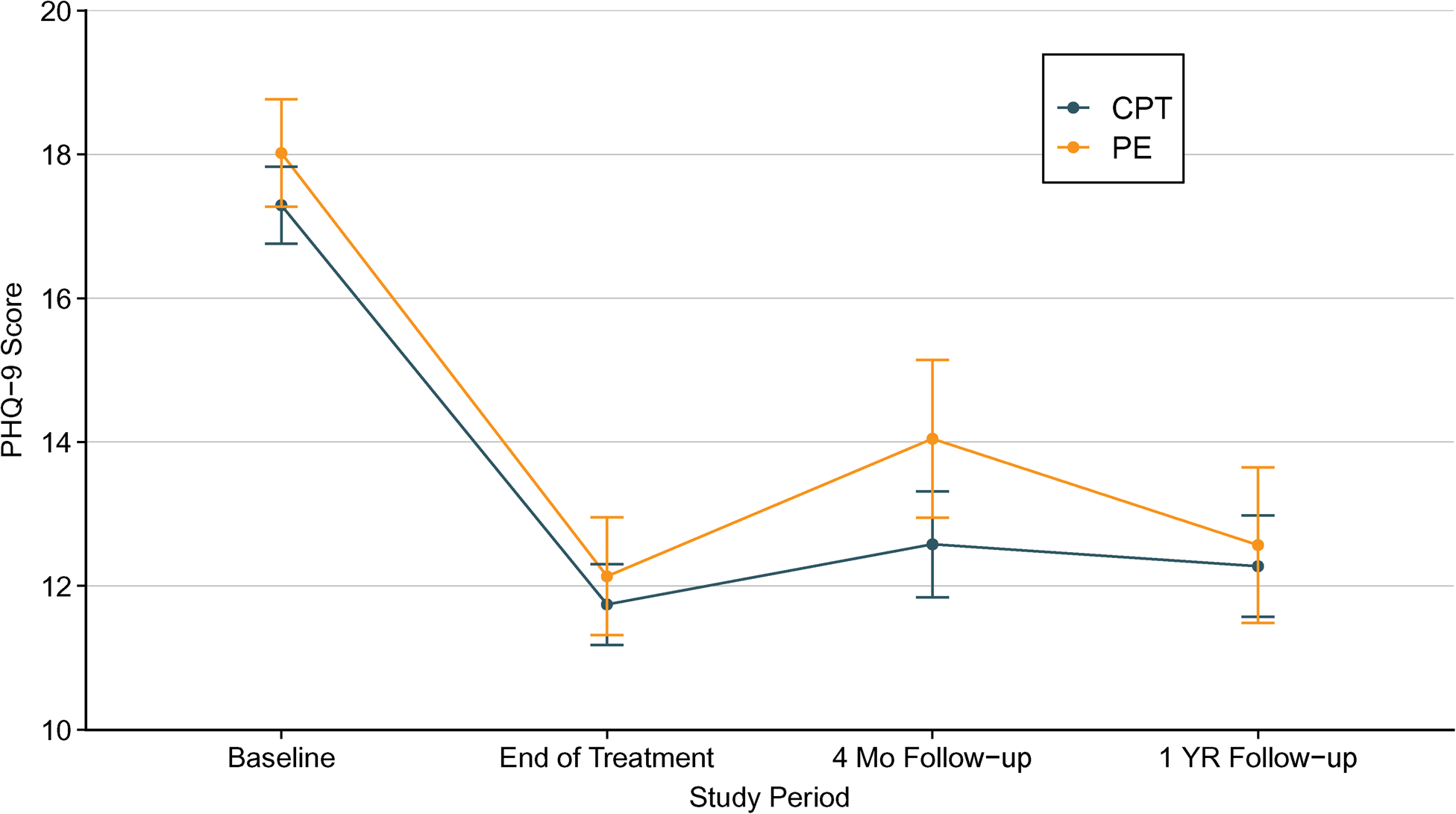
Depressive symptoms did not differ between the groups at any time point: at admission: −0.73 (95% CI −1.51 to 0.05), p = 0.070, discharge: −0.39 (95% CI −1.25 to 0.47), p = 0.374; four-month follow-up: −1.47 (95% CI −2.67 to −0.27), p = 0.017, and 12-month follow-up −0.29 (95% CI −1.47 to 0.89), p = 0.624 (also see Table 2 and Fig. 3). Both groups showed large-sized within-group reductions in mean PHQ-9 score from baseline to 12-month follow-up (Cohen's d = 1.01, 95% CI 0.74–1.28 for the CPT and Cohen's d = 1.09, 95% CI 0.78–1.40 for the PE group).
Change in PHQ-9 scores by Treatment Group.
Note: Possible scores on the Patient Health Questionnaire–9 (PHQ-9) range from 0 to 27, with higher scores indicating more severe depressive symptoms. VA, U.S. Department of Veterans Affairs; RRTP, residential rehabilitation treatment program.

Discussion
The present study is the first examination of the comparative effectiveness of individual PE and CPT in a national sample of veterans receiving VA Specialty PTSD residential treatment. Findings revealed no differences in PTSD symptom improvement between veterans treated with PE and CPT at any follow-up timepoint (discharge, four-month follow-up, and 12-month follow-up), with both groups showing large-sized reductions in PTSD symptom severity from admission to 12-months post-discharge (d = 1.41 for CPT group and d = 1.55 for PE group). Likewise, there were no differences in depressive symptom improvement across groups at any follow-up timepoint, with both groups showing large-sized reductions in depressive symptoms from admission to 12-months post-discharge (d = 1.01 for CPT group and d = 1.09 for PE group).
Findings are consistent with previous studies showing a lack of differences in symptom reduction between PE and CPT, including RCTs in veterans (Schnurr et al., Reference Schnurr, Chard, Ruzek, Chow, Resick, Foa and Shih2022) and civilians (Resick et al., Reference Resick, Nishith, Weaver, Astin and Feuer2002), as well as outpatient effectiveness work with veterans (Maguen et al., Reference Maguen, Madden, Holder, Li, Seal, Neylan and Shiner2021). The current study adds to the extant literature by providing the first evidence that outcomes for PE and CPT do not differ in the residential setting, among a highly complex population of veterans with severe PTSD that is difficult to manage in an outpatient setting, several comorbid conditions, and complicating psychosocial factors. Consistent with Maguen et al. (Reference Maguen, Madden, Holder, Li, Seal, Neylan and Shiner2021), our real-world effect sizes were smaller than those observed in RCTs, likely due, at least in part, to differences in treatment delivery (e.g. stronger therapist fidelity in RCTs) and participants' severity of PTSD and comorbid conditions (i.e. stricter exclusionary criteria for RCTs) across study types. Further, consistent with other studies of outpatient and residential PTSD settings (Gross et al., Reference Gross, Smith, Holliday, Rozek, Hoff and Harpaz-Rotem2022; Sripada et al., Reference Sripada, Blow, Rauch, Ganoczy, Hoff, Harpaz-Rotem and Bohnert2019, Reference Sripada, Ready, Ganoczy, Astin and Rauch2020), in spite of meaningful symptom improvement, many veterans exhibited significant post-treatment symptom severity. And although PTSD symptom improvement exceeded the MCID threshold, the magnitude of the effects we observed did not meet the criteria for reliable or clinically significant change recently identified by Marx and colleagues-i.e., 15–18 points and 28 points, respectively (Marx et al., Reference Marx, Lee, Norman, Bovin, Sloan, Weathers and Schnurr2022.) Continued research is needed to maximize the benefits of both CPT and PE, and residential PTSD treatment more broadly, at discharge and over time. Nonetheless, our results provide initial evidence that both PE and CPT are associated with meaningful improvement in PTSD and depression both at discharge and over a one-year time period, among a highly complex population.
As previously noted, both PTSD and depressive symptoms improved from baseline to discharge in both treatments, which is consistent with previous findings of depressive symptoms improving alongside PTSD symptoms in EBPs for PTSD (Brown et al., Reference Brown, Jerud, Asnaani, Petersen, Zang and Foa2018; Liverant, Suvak, Pineles, & Resick, Reference Liverant, Suvak, Pineles and Resick2012). However, while PTSD symptoms continued to improve through one-year follow-up, depressive symptoms did not show further improvement after discharge. It is possible that these veterans needed treatment more specifically focused on relapse prevention for depressive symptoms.
Limitations
The primary limitation of our study is that we cannot make causal conclusions about the comparative effectiveness of PE and CPT because veterans were not randomly assigned to these treatments. Although we did not detect significant differences in demographic characteristics or co-occurring psychiatric and medical conditions between the groups, different sub-groups of veterans may have chosen or allocated to different therapies by their providers. Related, we were not able to examine whether the PE and CPT groups differed on psychiatric medication use; we would not expect this, in part due to previous research showing minimal differences in receipt of medication among outpatients receiving PE and CPT (roughly 67 and 69%, respectively Maguen et al., Reference Maguen, Li, Madden, Seal, Neylan, Patterson, DuVall and Shiner2019). Our limited internal validity is, however, balanced by the external validity afforded by real-world clinical data.
Furthermore, our analysis is limited by a lack of statistical power to examine moderators of treatment response (i.e. which treatment is optimal for which patient), which is a critical next step to improving the effectiveness of CPT and PE. Examination of mediators of treatment response (i.e., mechanistic studies) is also needed to inform strategies for improving effectiveness of CPT and CPT. Examination of additional recommended trauma-focused treatments, such as Eye-Movement Desensitization and Reprocessing, is also warranted. Finally, while outside the scope of this analysis, it could be valuable to examine the role of healthcare utilization between discharge and follow-up timepoints to further elucidate factors that impact maintenance or loss of gains during residential treatment.
Data should be interpreted with caution given the large proportion of missing data at follow-up timepoints; missing data may limit generalizability, particularly if not missing at random. Additional limitations common to treatment studies in real-world settings include the use of self-report data, lack of randomization to treatment (though the two treatment groups were well-matched), lack of data confirming fidelity to treatment protocols, and inability to account for variability in treatment preferences and/or which treatments were available at each residential site. Findings also may not be generalizable to civilian samples, or veterans treated outside of VA. It is also worth noting that racial inequity continues to be a serious problem in PTSD treatment research, and PTSD clinical trials for PE and CPT do not adequately represent individuals who identify as a member of an ethnoracial minority group, especially those who identify as Latinx, Asian American, or American Indian/Alaskan Native (Grau et al., Reference Grau, Kusch, Williams, Loyo, Zhang, Warner and Wetterneck2022). In the current study, the collapsing of American Indian/Alaskan, Asian, Pacific Islander, and ‘Other’ veterans into an ‘Other’ race category due to small group sizes is a limitation.
Clinical implications
These and previous findings of comparable effectiveness for PE and CPT suggest that providers and veterans can, regardless of which EBP is delivered, anticipate PTSD symptom improvement during RRTP care. When both treatments are available, patient preference should be used to guide shared decision making and, hopefully, maximize treatment participation and response (Zoellner, Roy-Byrne, Mavissakalian, & Feeny, Reference Zoellner, Roy-Byrne, Mavissakalian and Feeny2018). Most veterans with PTSD do not initiate or complete EBPs (Maguen et al., Reference Maguen, Li, Madden, Seal, Neylan, Patterson, DuVall and Shiner2019), and dropout from VA outpatient and residential PTSD treatment remains a significant problem, with over one in four veterans prematurely terminating PTSD residential treatment (Smith, Sippel, Rozek, Hoff, & Harpaz-Rotem, Reference Smith, Sippel, Rozek, Hoff and Harpaz-Rotem2019). Shared decision making is a collaborative process in which the patient has agency and is actively involved in treatment planning, and has been shown to promote participation in VA outpatient EBPs for PTSD (Hessinger, London, & Baer, Reference Hessinger, London and Baer2018). For example, evidence suggests that PE may have higher rates of dropout than CPT (Schnurr et al., Reference Schnurr, Chard, Ruzek, Chow, Resick, Foa and Shih2022), thus allowing the patient to choose between the two may promote participation. Research is needed to examine the role of shared decision making in the context of VA residential PTSD treatment, as actively involving veterans in their treatment decisions, including but not limited to offering a choice between PE and CPT when available, may enhance participation and effectiveness (Zoellner et al., Reference Zoellner, Roy-Byrne, Mavissakalian and Feeny2018).
Supplementary material
The supplementary material for this article can be found at https://doi.org/10.1017/S0033291723000375
Financial support
This research received no specific grant from any funding agency, commercial or not-for-profit sectors.
Conflict of interest
None.