Introduction
Autoimmune diseases (AID) include over 80 different disorders that cumulatively affect up to 10% of the population and represent the third leading cause of morbidity in Western countries.Reference Shapira, Agmon-Levin and Shoenfeld1 AID have a broad range in organ-specific diseases such as diabetes type 1, multiple sclerosis (MS) and primary biliary cirrhosis and in systemic non-organ diseases such as systemic lupus erythematosus (SLE), rheumatoid arthritis (RA) and Sjögren's syndrome (SS). The onset of AID is related to a breakdown of tolerance, with the immune system unable to discriminate between self- and non-self-antigens. Genetic and environmental factors have been implicated, although the exact mechanisms causing AID remain poorly understood.Reference Youinou2
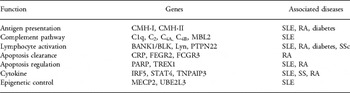
Among the genetic risk factors associated with AID,Reference Sirota, Schaub, Batzoglou, Robinson and Butte3 the most important is related to the antigen presentation process, with a particularly significant contribution from the major histocompatibility complex class II system. In addition, minor genetic risk factors have been characterized, revealing the importance of additional processes including lymphocyte activation, the complement pathway, the process of apoptosis, the clearance of immune-complexes and genes acting as key regulators of epigenetic control (Table 1). From these studies, it is now well established that the genetic background is important but not sufficient to develop an AID. This assertion has been supported by analysis of the concordance rate between monozygotic twins (MT) compared with dizygotic twins (DT) or relatives.Reference Ballestar4 Indeed, the concordance rate in MT reaches ‘25–60%’, which is higher than the ∼5% observed in DT and relatives, but not close to ‘100%’. This then confirms a requirement for other endogenous and exogenous factors.
Genetic risk factors associated with autoimmune diseasesReference Chang and Gershwin6, Reference Hewagama and Richardson72

SLE, systemic lupus erythematosus; RA, rheumatoid arthritis; SSc, scleroderma; SS, Sjögren's syndrome.
Epigenetics is a novel area of research in AID, which can be defined as reversible and potentially heritable changes in gene expression that do not affect the genetic code.Reference Brooks, Le Dantec, Pers, Youinou and Renaudineau5 In organ- and non-organ-specific AID, the epigenetic contribution is supported by several observations. First, AID is found predominantly in women, it increases with age and can be exacerbated by external factors (infection, exposure to sunlight, drugs, etc.) or internal factors (sex, pregnancy, stress). Second, among the approximately 100 drugs that have been reported to induce AID, most of them induce epigenetic modifications as observed with hydralazine, procainamide and isoniazid.Reference Chang and Gershwin6 Third, at the cellular level, epigenetic dysregulations in AID are related to modifications in gene transcription (DNA methylation and histone modifications), mRNA transcript dysregulation (micro-RNA) and protein post-translational modifications. With regard to the relevance of the epigenetic process in AID, the present review will focus on the immune system and summarize recent data showing that epigenetic control of B- and T-lymphocyte regulation is defective in patients with AID.
Chromatin accessibility in AID
The DNA methyl transferases (DNMT) catalyze the transfer of a methyl group from the methyl donor S-adenosyl-l-methionine (SAM) to the 5′carbon of the cytosine ring in cytosine guanine (CpG) pairs. Among the five known DNMTs, DNMT1 methylates hemi-methylated substrates, whereas DNMT3a and DNMT3b methylate unmethylated DNA. DNMT3L and DNMT2 display weak, if any, DNMT activity. CpG pairs have been conserved through evolution, within clusters referred to as CpG islands, which are concentrated in the promoter regions of coding genes and act as regulators of transcription. When demethylated, CpG pairs allow binding of transcription factors. The CpG methylation process is counterbalanced by DNA demethylation, which can be passive during the cell cycle or active as recently demonstrated.Reference Yuan, Jefferson, Popescu and Reynolds7–Reference Popp, Dean and Feng9
In addition to a direct repressive effect on transcription factor binding, methylated CpG pairs can recruit repressive partners including DNMTs and methyl-CpG-binding proteins (MBD). In turn, the repressive partners recruit super-complexes such as the Mi2/NuRD (nucleosome remodeling and deacetylase). As a result, the nucleosome, a basic subunit of chromatin composed of 146 bp of DNA associated with an octamer of histones (H2A, H2B, H3 and H4), is subjected to post-translational modifications that affect chromatin accessibility. The main repressive modifications are related to histone acetylation under the control of histone deacetylase (HDAC) and histone methylation by histone methyl transferases such as suv39H1 and G9a. Histone post-translational modifications are not stable. Histone acetylation is reversed by histone acetyl transferases whereas histone methylation can be reversed by demethylating enzymes. Of note, in some cases, histone methylation is not repressive but active. In addition, although less characterized, phosphorylation, ubiquitination and deimination can also affect the nucleosome complex.Reference Dieker and Muller10
DNA methylation
DNA methylation status in AID
The importance of DNA methylation in AID and especially in SLE was established in the 1960s and has been further strengthened since.Reference Cannat and Seligmann11 The pioneer ascertainment was related to the observation that two DNA demethylating drugs, procainamide and hydralazine, induce an SLE-like disease after long-term administration in normal mice. This effect disappeared when the drug was removed, and variations exist depending on the animal strain, sex and age. Of note, 5-azacytidine, another inhibitor of DNA methylation, delays the disease when added to the lupus-prone mice MRL/Lpr.Reference Yoshida, Yoshida, Merino, Shibata and Izui12 The implication of lymphocytes was provided by two groups, showing, respectively, after passive transfer of pretreated cells, the demethylated CD4+ T cells and demethylated B cells in the autoreactivity process.Reference Quddus, Johnson and Gavalchin13, Reference Mazari, Ouarzane and Zouali14 Translating this to humans, it was confirmed that DNA demethylation is defective in patients with AID.Reference Corvetta, Della Bitta, Luchetti and Pomponio15–Reference Mastronardi, Noor, Wood, Paton and Moscarello18 Indeed, a lower content of DNA 5-methylcytosine is characteristic in peripheral blood mononuclear cells (PBMC) in patients with SLE, synovial mononuclear cells and synovial tissues in RA patients and cerebral cells in MS patients. The main point that emerges from the studies is the fact that cells with DNA hypomethylated are different from one AID to another. Thus, it explains why PBMC are not the gold standard to highlight epigenetic modifications as described in dermatomyositis, MS and primary biliary cirrhosis.Reference Javierre, Fernandez and Richter16, Reference Baranzini, Mudge and van Velkinburgh19, Reference Mitchell, Lleo and Zammataro20
Endogenous retroelements are deregulated in AID
Scattered throughout the genome, there are approximately 3 million endogenous retroelements. They are divided into long terminal repeats (LTR) including human endogenous retrovirus (HERV) and non-LTR elements, accounting for 8% and 34% of the genome, respectively. Endogenous retroelements have been considered for a long time as susceptible markers for autoimmunity as DNA demethylation increases their expression. This was demonstrated for non-LTR Alu retroelements that represent 55% of the cell-free DNA in SLE patients v. 13% in controls,Reference Li and Steinman21 and for expression of HERV elements that are detected at a higher frequency in AID.Reference Balada, Ordi-Ros and Vilardell-Tarrés22 Additionally, allelic variants are associated with the development of AID: HTLV-1 related endogenous retroviral sequence (HRES-1) in SLE and HERV-K18 in MS and diabetes type 1.Reference Pullmann, Bonilla, Phillips, Middleton and Perl23–Reference Marguerat, Wang, Todd and Conrad25 As a consequence, the direct implication of endogenous retroelements in the development of AID may be suspected, and several observations support this hypothesis. First, Alu RNA retroelements can form auto-antigenic complexes with nascent histones or ribonucleoproteins.Reference Tsuchiya, Saëgusa and Taira26 Second, when transcribed, the HERV proteins, like the HRES-1 p30 gag protein, can be recognized by antibodies (Ab) and such Ab cross-react with the SLE auto-antigen U1-snRNP. The anti-HRES-1 p30 gag/U1-snRNP Ab are detected in up to 50% of SLE patients v. less than 5% in controls.Reference Gergely, Pullmann and Stancato27 Another example is the HERV-W envelope protein that can act when overexpressed in MS as a super antigen, leading to the expansion of autoreactive T cells.Reference Perron and Lang28 Third, when integrated into or adjacent to an immune-related gene, an endogenous retroelement could interfere with expression of the gene. One example is the HERV-CD5 endogenous retrovirus integrated upstream of the cd5 gene 25–50 million years ago at the time of divergence between Old and New World monkeys.Reference Renaudineau, Vallet and Le Dantec29
DNA methylation controls lymphocyte autoreactivity
Lymphocyte differentiation is a step-wise process that starts in the bone marrow from hematopoietic multipotent stem cells, and each step leads to specific epigenetic modifications.Reference Weishaupt, Sigvardsson and Attema30, Reference Attema, Papathanasiou and Forsberg31 The alteration of DNA methylation/demethylation is necessary for cytokine polarization in T helper cells, the selection of regulatory T cells and possibly B cell and the control of lymphocyte autoreactivity via rearrangement of the antigen receptor gene. Indeed, blocking DNA methylation with specific inhibitors in activated B- and T-cells leads to the emergence of autoreactive lymphocytes and development of an SLE-like disease with detection of anti-nuclear antibodies when demethylated lymphocytes are reinjected into mice.Reference Quddus, Johnson and Gavalchin13, Reference Mazari, Ouarzane and Zouali14
The implication of DNA methylation in the control of lymphocyte autoreactivity is reinforced by the analysis of lymphocytes in the immunodeficiency centrometric region instability and facial anomalies syndrome (ICF), which is characterized by a non-functional DNMT3b. In these patients, there is an absence of mature T cells and accumulation of immature B cells with an autoreactive B cell receptor.Reference Blanco-Betancourt, Moncla and Milili32
The DNA methylation process is impaired in AID
DNA methylases are downregulated
Currently, most studies on DNMTs have been performed on CD4+ T cells, revealing that the activation of DNMT1 is impaired in patients with SLE, systemic sclerosis and dermatomyositis.Reference Lu, Renaudineau and Cha33 DNMT3a and DNMT3b variations are also reported but their contribution in lymphocytes seems minor when compared with DNMT1.Reference Lu, Renaudineau and Cha33, Reference Garaud, Le Dantec and Jousse-Joulin34 More recently, DNMT1 defects have been observed in B cells from SLE patients and synovial fibroblasts from RA patients.Reference Karouzakis, Gay, Michel, Gay and Neidhart17, Reference Garaud, Le Dantec and Jousse-Joulin34 In CD4+ T cells from SLE patients, a defect in the PKC delta kinase has been proposed to lead to the downregulation of the Raf/MEK/ErK/DNMT1 pathway.Reference Gorelik, Fang, Wu, Sawalha and Richardson35 Not surprisingly, the PKC delta knock-out mice develop an SLE-like disease with B cell expansion and autoantibody production.Reference Miyamoto, Nakayama and Imaki36 Of note, the DNMT defect is more pronounced when cells are stimulated by phytohemagglutinin for CD4+ T cells and IgM for B cells, explaining the conflicting results when using unstimulated cells and/or PBMC. Reference Balada, Ordi-Ros and Serrano-Acedo37, Reference Liu, Ou and Wu38 Another source of discrepancies is related to the selection of controls since variations are observed between young and old and between females and males.Reference Grolleau-Julius, Ray and Yung39
DNA demethylases are upregulated
Whereas DNA methylation has been extensively studied in eukaryotes, the demethylation process is poorly understood. A two-step model has been proposed recently in zebrafish embryosReference Rai, Huggins and James40 and confirmed in mice.Reference Bhutani, Brady and Damian8, Reference Popp, Dean and Feng9 In the first step, an apolipoprotein in B editing catalytic polypeptide deaminase (Apobec), such as the activation-induced cytidine deaminase (AICDA), converts 5 methyl-cytosine to thymidine. In the second step, the MBD4 DNA glycosylase repairs T:G mismatches by converting the thymidine to an unmethylated cytidine. The apobec/MBD4 complex requires a third partner, the UV radiation stress sensor Gadd45-alpha, to be active.
In CD4+ T cells from SLE patients, the levels of Gadd45-alpha and MBD4 are inversely proportional to the global DNA methylation content, suggesting that an active demethylation process is at work in these cells.Reference Balada, Ordi-Ros and Serrano-Acedo41, Reference Li, Zhao and Yin42 In B cells, AICDA expression is controlled by DNA demethylation,Reference Tatemichi, Hata and Nakadate43 and an AICDA knock-out protects lupus-prone mice from lupus nephritis, suggesting that DNA demethylation is also active in SLE B cells.Reference Jiang, Foley and Clayton44
The polyamine hypothesis
A sufficient level of the methyl group donor SAM is required for an effective DNA methylation process.Reference Li, Liu, Strickland and Richardson45 As a consequence, increased SAM degradation impacts intracellular DNA methylation. Based on the fact that SAM decarboxylase activity is positively regulated by putrescine, a polyamine precursor, a new theory linking SAM reduction, polyamine overexpression and autoimmunity has been proposed.Reference Brooks46 The theory is reinforced by the observation that blocking putrescine production inhibits disease manifestations in a lupus-prone mouse model.Reference Claverie, Pasquali and Mamont47 Furthermore, increased polyamines and reduction of the SAM level have been demonstrated in sera from SLE patientsReference Puri, Campell and Puri-Harner48 and in synovial fluids and urine from RA patients.Reference Furumitsu, Yukioka and Yukioka49, Reference Yukioka, Wakitani and Yukioka50 Such a hypothesis links environmental factors, such as the Epstein–Barr virus,Reference Bajaj, Murakami and Cai51 and interferon,Reference Furumitsu, Yukioka and Yukioka49 with the DNA demethylation process through the polyamine pathway. As a consequence, blocking the polyamine cycle and/or SAM decarboxylase may reveal the potential of epigenetic-based therapeutic treatment.Reference Brooks, McCloskey and Daniel52
Histone modifications in AID
DNA methylation and histone post-translational modifications are closely linked. As a consequence, it is not surprising to observe that DNA demethylation in SLE CD4+ T cells is associated with histone acetylation and with histone H3 demethylation at position K9.Reference Hu, Qiu and Luo53 The observation that trichostatin A, an HDAC inhibitor, improves the disease when used in spontaneous autoimmune mouse models was surprising.Reference Lu, Ju, Shi, Zhang and Sun54 One explanation is that HDAC inhibitors target cells unaffected by DNA demethylation. Indeed, among the differences of DNMT inhibitors that induce lymphocyte autoreactivity and autoAb production, trichostatin A blocks cytokine production by dendritic cells and upregulates regulatory T cells.Reference Salvi, Bosisio and Mitola55, Reference Reilly, Thomas and Gogal56 However, the rationale for the use of HDAC inhibitors in AID patients is still debated, since a risk exists that inhibition of HDAC would result in aberrant gene expression in those demethylated cells.
Micro-RNAs
miRNA and autoreactivity
miRNAs are genome-encoded 21- to 23-base pair (bp) RNAs that target the 3′ untranslated region (UTR) of specific messenger RNAs (mRNA) for degradation or translational repression. In humans, one thousand miRNAs are suspected to exist, each of them having the capacity to target up to 100 transcriptional genes, suggesting that much of the transcriptome is regulated by miRNAs. miRNAs play a pivotal role in both innate and adaptative immunity, and in immune cells by controlling their development, maturation and functions. In mice expressing high levels of miR-17-92 in lymphocytes, it was observed that miRNA dysregulation leads to AID.Reference Xiao, Srinivasan and Calado57 These mice develop lymphoproliferative disorders associated with an SLE-like disease that includes nephritis with anti-dsDNA deposition. In all, two miR-17-92 targets have been characterized: the pro-apoptotic protein Bim and the tumor suppressor PTEN.
miRNA and DNA methylation
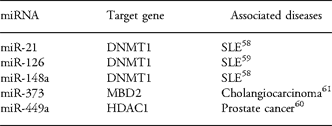
Like regular genes, miRNAs could be regulated by DNA methylation, but the opposite is true since miRNAs can target DNMT1 (miR-21, miR-126, miR-148a, miR-152), HDAC1 (miR-449a) and MBD2 (miR-373), leading to an amplification loop (Table 2).Reference Pan, Zhu and Yuan58–Reference Chen, Luo, Tian, Sun and Zou61 It can also be speculated that each of these miRNAs are counterbalanced by other miRNAs.
Micro-RNAs control chromatin accessibility
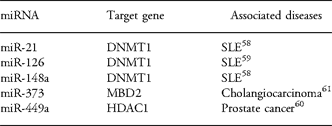
SLE, systemic lupus erythematosus.
Altered miRNA expression in AID
miRNA dysregulation has been reported in several AID including SLE, RA, pSS, diabetes and MS.Reference Brooks, Le Dantec, Pers, Youinou and Renaudineau5 In addition to the identification of miRNAs associated with AID, functional analysis has highlighted the contribution of miRNA as an overlap mechanism in AID. First, miR-155, known to be implicated in cellular proliferation and cytokine production, is commonly detected in defective regulatory T cells from SLE patients,Reference Divekar, Dubey, Gangalum and Singh62 RA peripheral blood and fibroblast-like synoviocytes from RA patients,Reference Stanczyk, Pedrioli and Brentano63 and in salivary glands isolated from pSS patients [Y.R. and P.Y. unpublished data]. Second, miR-146 is differentially regulated between SLE and RA. In the latter, miR-146 overexpression controls the IFN pathway but not in the former.Reference Chan, Satoh and Pauley64 Third, three miRNAs (miR-21, miR-126 and miR-148a) contribute to DNA demethylation in CD4+ T cells by targeting DNMT1 directly or indirectly.Reference Liu, Ou and Wu38–Reference Zhao, Wang and Liang59 This provides another explanation for the DNA demethylation process observed in CD4+ SLE T cells. However, these miRNAs can be upregulated when using inhibitors of DNA methylation, thus suggesting that they are not a primary event but contribute to amplification of the process.Reference Saito, Friedman and Chihara65
Post-translational modifications and AID
Citrullinization and antigen presentation
Pepdityl arginine demininase (PADI) enzymes catalyze the conversion of arginine residues in proteins into citrulline residues. Among the five human PADI, PADI4 is the only one able to move to the nucleus upon cellular activation. In the nucleus, PADI4 can operate on arginine or methylated arginine residues in N terminal regions of histones H2A, H3 and H4. As a consequence, transcription is repressed by preventing active histone modifications.Reference Cuthbert, Daujat and Snowden66 Furthermore, regarding its influence on transcription, PADI4 overexpression in RA contributes to the production of autoAb against citrullinated peptides. Many proteins have been described as targets of antibodies to citrullinated Ab (ACPA) that bind fibrin, vimentine, collagen and alpha-enolase. The recent description of PADI in the peridontal pathogen porphyromonas gingivalis provides a link between an environmental factor and the development of RA.Reference Wegner, Wait and Sroka67 In MS, the PADI2 promoter is demethylated, thus causing overexpression and, as a consequence, the citrullinization of myelin basic protein (MBP) increases, resulting in a loss of myelin stability.Reference Mastronardi, Noor, Wood, Paton and Moscarello68
Histone modification and autoantibodies
Histone post-translational modifications are important to control transcription, replication, cellular division, activation, necrosis and apoptosis. The latter is suspected to play a central role in numerous AID, and consequently, it is not surprising to observe that, related to cell death, histone post-translational modifications are associated with autoimmunity, such as H3K27me3, H2BK12ac, H3ac and H4ac.Reference Dieker and Muller10 The importance of this process in AID is reinforced by the observation that administration of a very low dose of H4 peptides containing autoepitopes in lupus-prone mice reduces autoantibody production, extends the lifespan and protects the kidneys from glomerulonephritis.Reference Kang, Chiang, Liu, Ecklund and Datta69
CD5 B cell model
SLE B cells are characterized by a high production of IL-6, a DNA demethylation profile, and a reduction of the B cell receptor (BCR) with dampened CD5 at the cell surface.Reference Garaud, Le Dantec and Jousse-Joulin34 Observing that CD5 expression was regulated by DNA methylation inhibitors and by blocking the IL-6 autocrine loop on SLE B cells, we have suspected and demonstrated that IL-6, by controlling DNA methylation, regulates CD5 cell surface expression. First, it was demonstrated that IL-6 controls DNMT1 expression and DNA methylation at the CD5 locus by blocking the cell cycle. Second, DNA demethylation at the CD5 locus is associated with overexpression of an alternative transcript, called CD5-E1B, which results from the fusion of an HERV element with exon 2 of CD5. Finally, when expressed, CD5-E1B codes for a truncated variant that interacts with the classic form of CD5 and downregulates its cell surface expression.Reference Garaud, Le Dantec and Berthou70, Reference Renaudineau, Hillion, Saraux, Mageed and Youinou71 Following this line of reasoning, blocking the autocrine IL-6 loop restores the DNA demethylation in SLE B cells and prevents autoantibody production, thus providing a new therapeutic strategy.
Conclusion
In contrast to the importance of epigenetic studies performed in cancer, and in cardiovascular diseases, only a small number of laboratories have studied epigenetic mechanisms in the context of AID. As a consequence, epigenetics in AID is at its infancy. However, the results appear to confirm the role played by the epigenetic process in AID development. Undoubtedly, the development of novel epigenetic technologies, the characterization of epigenetically dysregulated genes and the development of new therapeutic strategies based on epigenetic control will provide new avenues in AID.
Acknowledgements
The authors are grateful to Geneviève Michel and Simone Forest for their secretarial assistance.
Statement of interest
None