It is a vast archeological museum containing thousands of exhibits labeled and minutely described.
—David L. Cohn on the Sears, Roebuck catalogFootnote 1In her essay in the most recent Re: Sources column, Sharon Marcus argues for the importance of theatrical scrapbooks as historical resources and notes that, to date, they have been largely neglected.Footnote 2 I offer the current essay as a companion piece to Marcus's in that I would like to argue for the importance of another largely neglected resource for theatre researchers: trade catalogs. Specifically, I will focus on the mail-order trade catalogs of magic supply houses that were prevalent throughout the twentieth century until Web sites took over as the primary marketing tools for these establishments. I also draw upon Christopher B. Balme's idea that historiographic rewards can be earned by paying close attention to the information contained in theatrical playbills.Footnote 3 Balme posits that one reason playbills have been neglected is because they are considered to be further removed from a theatrical performance than visual evidence such as photographs, designs, or videos:
In comparison to theatre iconography—which in superficial readings would seem to offer the promise of access to the theatrical event, a performance on the stage (which of course it seldom does)—the playbill is foreplay but not the act itself. Like most foreplay, the playbill is clearly designed to excite, to stimulate; but for the scholar in search of the real thing, the transcendent experience and enchantment that is the “performance,” playbills represent a kind of archival ludus interruptus. Footnote 4
One might assume that trade catalogs are even further removed from the theatrical event than playbills are since they do not actually reference a specific performance; but Balme points out that since some playbills represent performances that never took place, one cannot automatically privilege the information found in one type of source over another. The questionable nature of all resources undergirds the maxim that one must try to double- and treble-check information no matter what the source.
Although catalogs have been part of the American retailing industry since the mid-nineteenth century, they really became popular with the American public when Sears, Roebuck and Co. first published their influential catalog in 1894. Sears instituted a catalog filled with catchy descriptions, slogans, and drawings of the products, a format that numerous retailers followed. In addition to providing information about the material culture of turn-of-the-century America, the Sears, Roebuck catalog also served as an archive of American life. In his paean to the book, David L. Cohn recognizes the cultural memory contained in the publication:
As my now-fascinated eyes stared longer and longer at the catalog pages, and as I delved deeper and deeper into them, it seemed to me that they constituted an invaluable record of American life; that they were a diary of the times created by the people; a measure of the desires and ambitions of millions. I thought, moreover, that if all the records of the catalog's years should be lost, and only the catalog preserved, a scholar stumbling upon it in the remote future could recreate from its pages the way in which men had lived in America for fifty years.Footnote 5
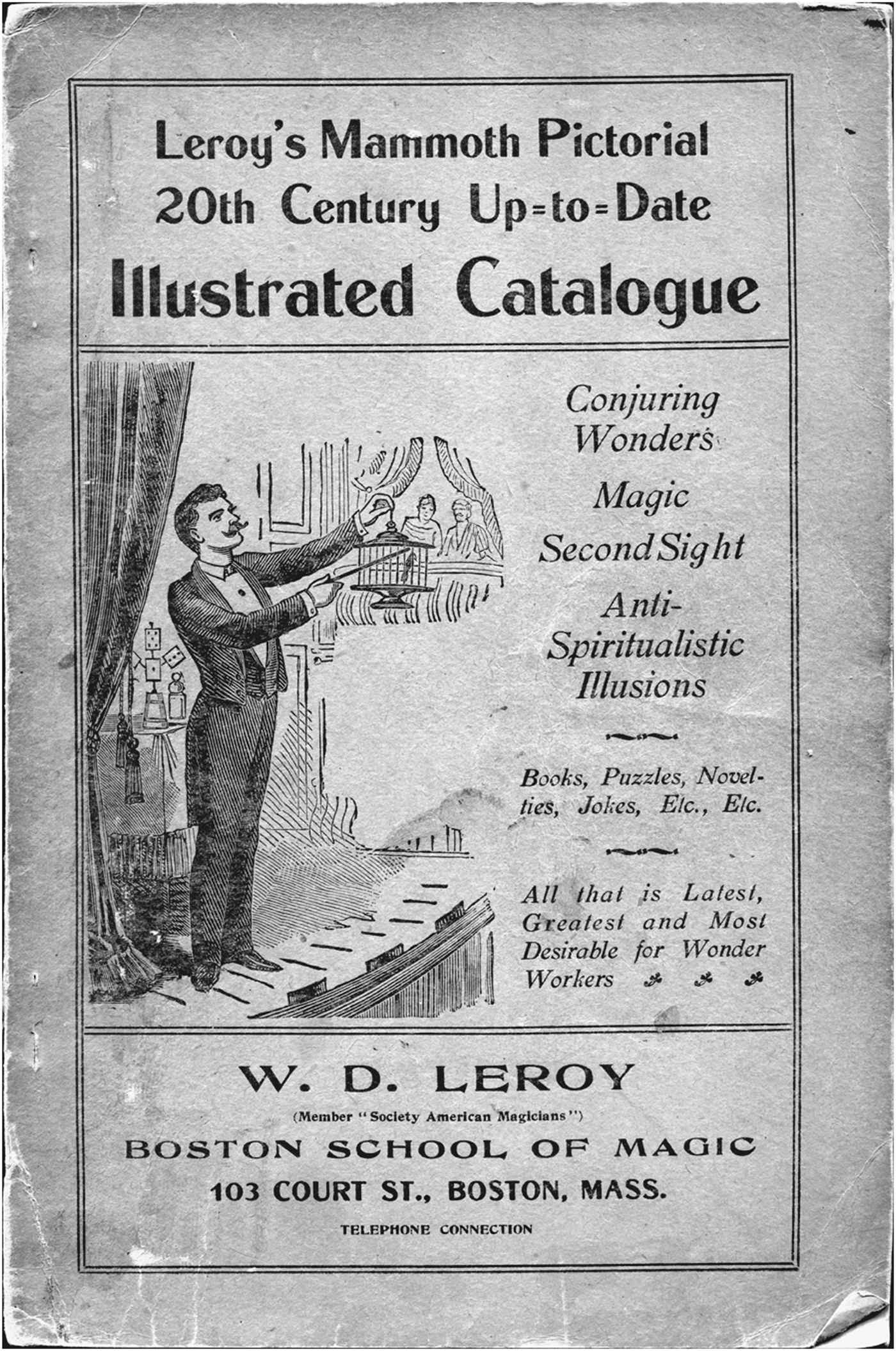
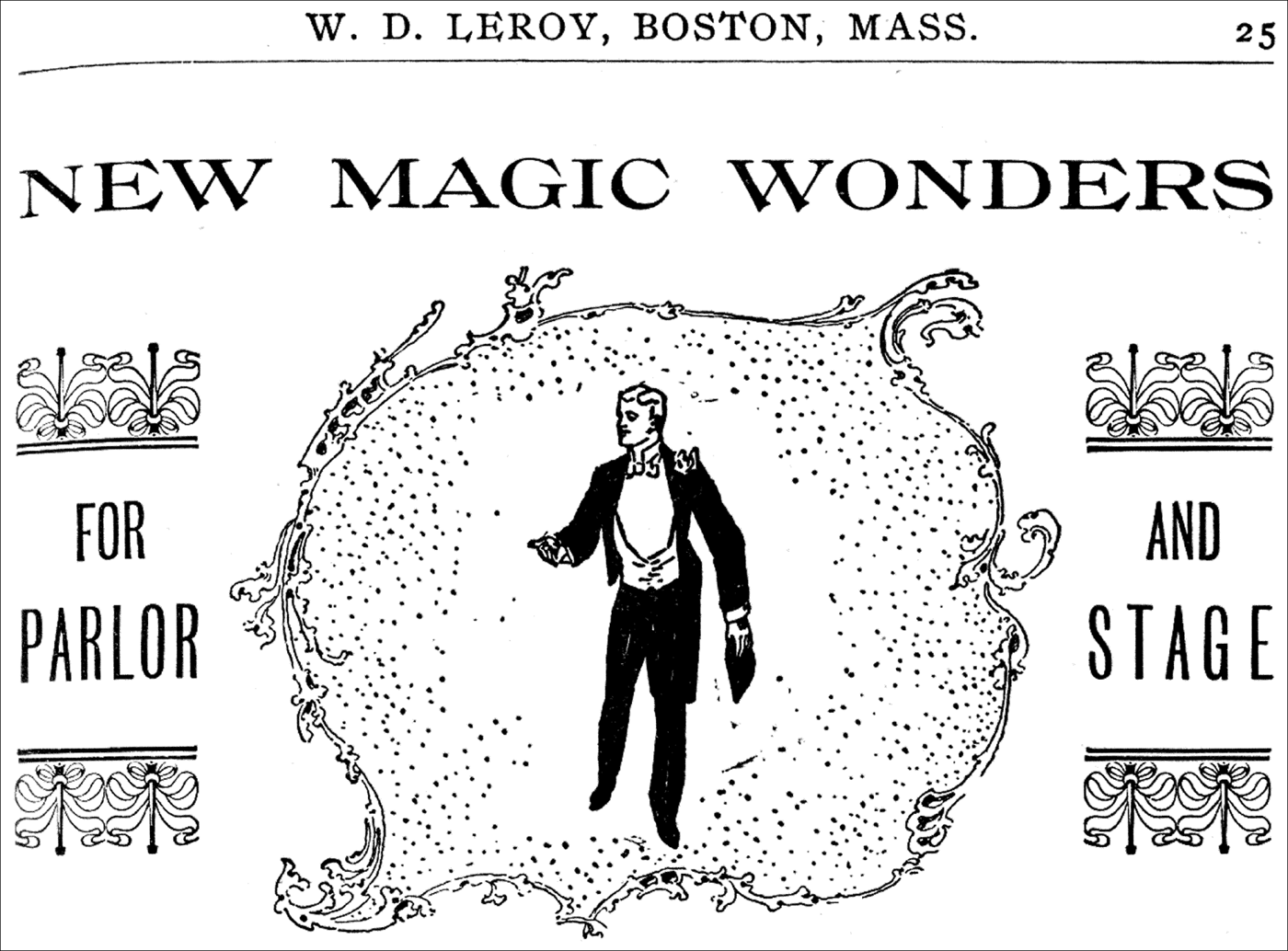
At the beginning of the twentieth century, in recognition of the success that mail-order sales could bring, many retailers began printing their own catalogs, offering consumers an opportunity to “window-shop” from home. This trend also resulted in the creation of unique publications with information for future researchers to mine. Because some of these catalogs were devoted to niche markets, they offer historians the possibility of eavesdropping on the discussions circulating within certain fields, including those of specialized entertainments such as magic and conjuring (Fig. 1).
Cover of W. D. Leroy's catalog, Boston School of Magic, ca. 1908.

Early in the twentieth century, magic supply houses sprang up in order to provide materials for the many vaudeville performers who were touring the circuits, and the numbers of these suppliers continued to grow for several decades. The Thayer's catalog from 1943, for example, lists twenty-seven distributors and manufacturers of magicians' supplies who were advertising in the trade magazine Genii at that time,Footnote 6 and this list would have represented only the largest of the magic retailers. Most of these supply houses published a new mail-order catalog every few years, and many offered periodic supplements even more frequently. With so many magic suppliers competing for business, advertising became crucial, and magicians' trade catalogs became ubiquitous among members of the profession, interested amateurs, and hobbyists.
One reason that magic supply house catalogs can provide a unique window into performing history is that many of these retailers were run by magicians who were practicing members of the profession. Nelson Enterprises, for example, was established in Columbus, Ohio, in 1921 by Robert A. Nelson and his brother, Lawrence, two professonal performers who were touring with a mentalism act known as Allah Rageh & Company. Another professional magician, Max Holden, retired from the vaudeville circuit to open a magic shop in New York City in 1929. Holden established another shop in Boston in 1936 under the management of Herman Hanson, who for years served as stage manager and understudy for the late Howard Thurston. Prior to that time his act, Hanson and the Mystic Maids, had toured the Keith, Orpheum, Loew, and Pantages vaudeville circuits.Footnote 7 W. D. Leroy (Leroy's Magic Co., established circa 1893), Gerald Heaney (Heaney's Magic Co., established mid-1910s), and Percy Abbott (Abbot's Magic Co., established 1934) were also proprietors who had worked as professional magicians before opening their businesses. Their status as performers gave these entrepreneurs insight into what was happening in the field of entertainment and offered them direct contact with many other professional performers. Often the “bricks-and-mortar” buildings that housed the shops run by these compeers became regular meeting places for professional conjurers, and this provided the establishment owners even more opportunity to keep up with what was happening in the field. As Robert Nelson notes in his 1939 catalog: “We have supplied, equipped and produced more successful mental acts and attractions than all other organizations combined. As a result of our past experience, and our constant touch with the leaders of the profession, we feel that we are in a position to be of value to you.”Footnote 8 Little did Nelson know that he would also be in a position to be of value to future theatre researchers as well, through his mail-order catalogs.
Synchronic Occurrences and Diachronic Trends
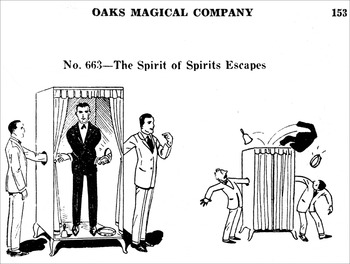
In her article, Sharon Marcus notes how scrapbooks often contain replicated material: “Finally, at least some of the material in these albums (such as newspaper clippings) is often duplicated elsewhere, making their contents easily seem redundant.”Footnote 9 Magic-trade catalogs also share this characteristic in that much of the material contained in one catalog might be duplicated, either in subsequent catalogs published by a single supply house or in catalogs of various suppliers who were distributing merchandise manufactured by other companies. Although at first glance such redundancy seems to limit the amount of new information that can be gleaned from trade catalogs, this factor actually offers opportunities for both synchronic and diachronic exploration: many of these establishments existed simultaneously, and several of them remained in existence for decades. By tracking the advertising copy of a particular company through several catalogs, one can note changes that might point to shifts in public taste or identify sociological forces that were in play. Effects that were featured in a store's catalog for an extended period of time, for example, may indicate that some products remained popular and were still finding their way into the conjuring repertory throughout several decades. Many of these long-standing favorites have become classics, such as T. Nelson Downs's Miser's Dream, Houdini's needle swallowing, the Davenports' spirit cabinet (Fig. 2), and Harry Blackstone Sr.'s buzz saw routine. These illusions can still be purchased from magic supply houses and remain in the repertoire of stage magicians to the present day.
Drawing of one version of a spirit cabinet illusion, Oaks catalog, Oaks Magical Co., Oshkosh, WI, ca. 1918.

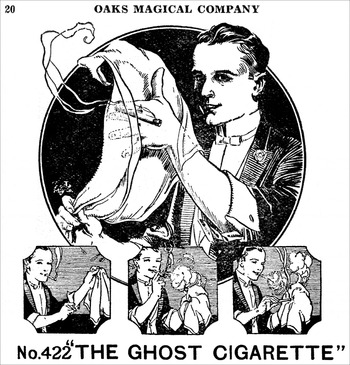
Other sociological trends are highlighted by the types of trick that are prevalent throughout the catalogs at any given time. In the 1943 Douglas catalog, for example, six pages are devoted to cigarette tricks and an ad for a Smoketrix Combination that features tricks using cigarettes and matches, because of the “great popularity of Tricks for Smokers.”Footnote 10 One certainly does not find tricks using cigarettes featured by today's magic suppliers. These tricks are still available, but there are far fewer of them because of the changes in societal attitudes toward smoking. Also, many magicians avoid these tricks because most venues strongly enforce a no-smoking policy, a regulation that was not in effect in theatres and nightclubs in the early and mid-twentieth century (Fig. 3). This change in societal attitudes has had a definite effect on the performance magicians put together and on the advertising magic supply houses use. These changes have been reflected in the catalogs.
Advertisement for a popular cigarette effect from the Oaks catalog, ca. 1918.

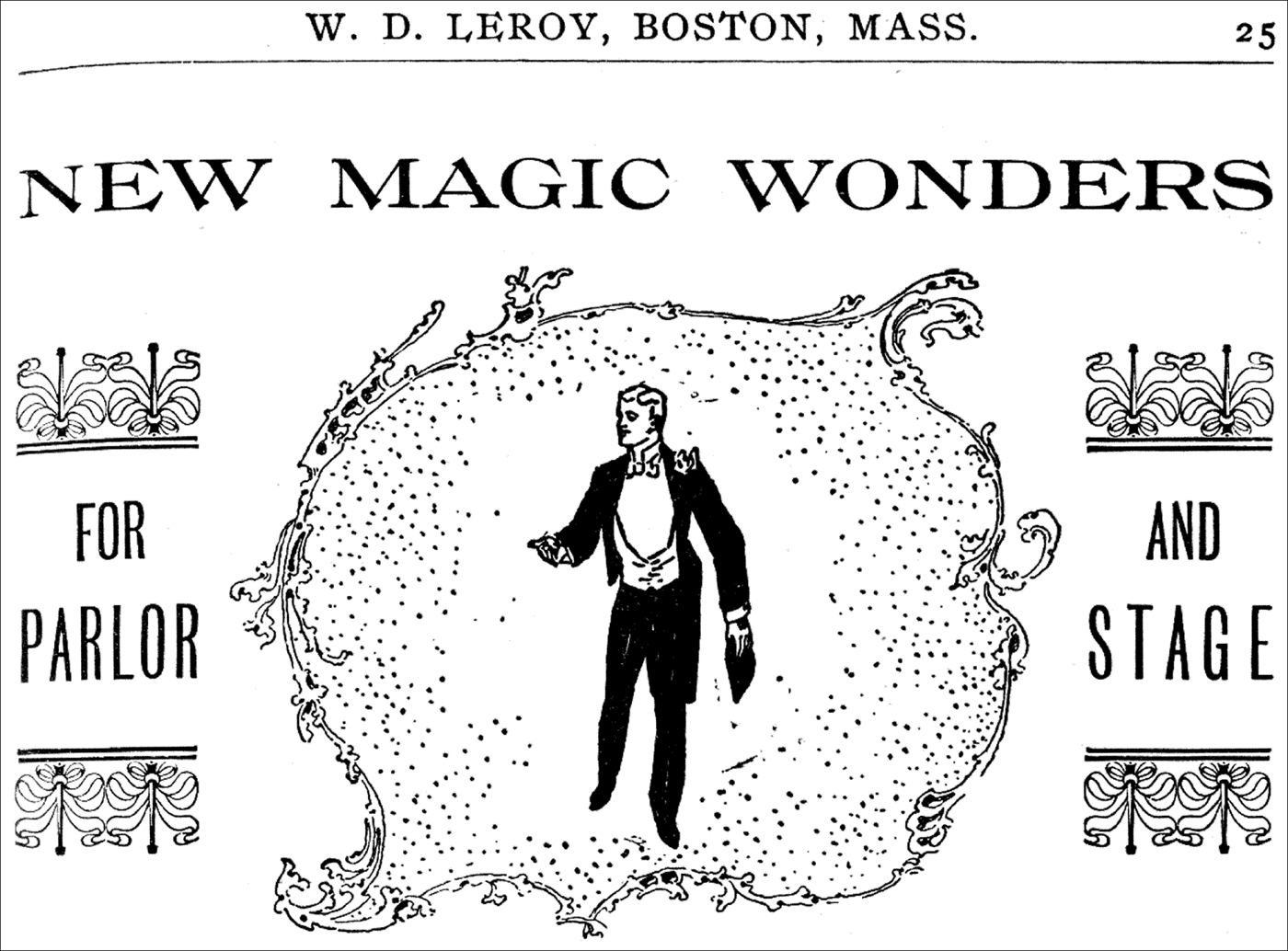
Noting similarities across various magic catalogs that were published at about the same time can uncover synchronic occurrences, pointing to what was in vogue in the profession at a particular moment. For example, the 1943 Holden catalog offers “a production cabinet designed to meet the growing demand for tricks that can be performed surrounded by the audience.”Footnote 11 This ad points to the rise of the nightclub and the growing need for entertainers who could perform in flexible spaces. Several other publications and advertisements from the same time bear this out. The concurrent catalog from Douglas Magicland, for example, features the Nite Club Girl Vanish,Footnote 12 and other catalogs from that time almost universally mention that certain illusions are suitable for performance in nightclubs (Fig. 4).
Advertisements in magic catalogs often note for what type of venue each effect is suited. Reproduced from Leroy's Mammoth Pictorial 20th Century Up-to-Date Illustrated Catalog (Boston: W. D. Leroy, n.d. [ca. 1908]).
“Accomplished by Normal Means”
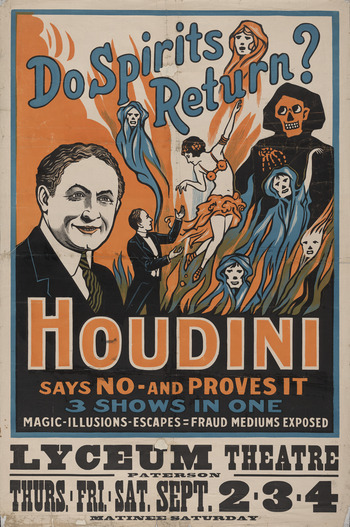
Early in the twentieth century many psychic mediums claimed that they possessed the ability to contact “the other side,” all the while using standard tricks and illusions employed by magicians. This caused quite a backlash among members of the conjuring community who felt that performers should be honest about the fact that their “miracles” were accomplished through nothing more than skill and dexterity. They mounted a campaign to expose fake mediums, in which the most famous participant was Harry Houdini (Fig. 5), who published his exposé A Magician among the Spirits in 1924.Footnote 13 The belief that spiritualists possessed extraordinary powers was still strong enough in 1939, however, for Nelson Enterprises to state explicitly, “That There Be No Misunderstanding—Be it distinctly understood that all effects described in this catalogue are accomplished by normal means.”Footnote 14 The 1943 Douglas magic catalog also asserts that one does not need to call upon supernatural powers to use the items they have for sale: “The various effects described in this Catalog are produced by ordinary normal methods. There is no such thing employed as magnetism, incantations, or the use of powers beyond the normal understanding.”Footnote 15
Houdini poster, ca. 1909. McManus–Young Collection, LC-DIG-var-1627, Library of Congress Prints and Photographs Division.

Uncovering Understudied Genres
One of the things for which magicians' trade catalogs are particularly useful is uncovering little-studied (and sometimes little-known) types of popular performance. One such type is the midnight ghost show. This genre is unfamiliar to a large portion of performance historians today, even though these shows were ubiquitous throughout the mid-twentieth century. Ghost shows were magic shows that were presented in vaudeville houses and movie theatres. They featured tricks and illusions with a spooky theme and contained a finale that contained a brief blackout sequence during which luminous apparitions would fly throughout the theatre. Such performances were usually coupled with a horror film.Footnote 16 A wealth of information about these popular entertainments is present in the pages of magic-trade catalogs; many of the magicians' publications from the 1930s–1950s have advertisements specifically geared toward the performer who was intending to put together a ghost show. Nelson's 1939 catalog, for example, not only contains numerous individual effects that can be used for séances and ghost shows but also offers a prepackaged ghost show that could be purchased in its entirety:
Ghost shows or spook parties have taken the country by storm. In theatres they have proven to be a most profitable form of entertainment for the operator. It has been our pleasure to build many ghost shows for our various clients, and to see them enter the field of big money.
Not only has the Nelson Enterprises framed many of these shows for others, but [we have] launched one of the biggest and finest ghost shows ever to take to the road, the 20th Century London Ghost Show, now in its fourth year! The demand continuing for ghost show equipment, we decided to offer a full and complete show as a single unit, at a specified price, modeled and patterned after our original London Ghost Show, which embodied the best effects obtainable.
This show we now offer will give approximately one and a half hours of real, thrilling entertainment. It does not need moving pictures to support it. It is a real, solid piece of nourishing entertainment. Divided into three parts, the show moves along at a thrilling pace, surprise after surprise.Footnote 17
The marketing text for luminous paints and makeups used by magicians presenting ghost shows also leads to a bit of interesting information about performance safety, if one is willing to follow the thread. The 1939 Nelson Enterprises catalog offers the following description for Luminous Make-Up: “A very high grade luminous make-up, to be applied to the face and hands for spook and ghost effects. Creates a frightful illusion and very effective. Unlike many paints of this kind, this make-up is guaranteed non-injurious by the manufacturer. Realistic faces for the séance room. An excellent finale for the theatre ghost show.”Footnote 18 This brief description offers a hint about the potential hazards of some luminous items. Further exploration uncovers the fact that the danger associated with certain types of luminous material was indeed a topic of discussion among members of the magic profession. In a 1930 issue of The Linking Ring (the official journal of the International Brotherhood of Magicians), Doc Nixon offers a method for creating luminous paint, accompanied by the following warning: “This mixture is not injurious as you will find with any radium treated mixture. Do not take chances with any other luminous powders. So many are deadly to use. Take care that you get the non-injurious Luminous Powders as I have mentioned. Take no chances.”Footnote 19 Many performers using luminous did not heed the warning; Robert A. Nelson was still reporting “evidence of skin poisoning, caused from home made luminous paints and make-up” in his column for The Linking Ring in 1937.Footnote 20 It is not surprising, therefore, that he made special note of the safety of his luminous products in his 1939 catalog. There, an advertisement for Ghost-Glo Luminous Paint also carries the statement, “May be used with perfect safety.”Footnote 21
Another little-studied type of popular performance that can be illuminated by information contained in magician trade catalogs is that of the Tanagra Theatre. This was an optical effect that used a special configuration of mirrors to create the illusion of performers who acted, sang, danced, and performed magic tricks on tiny stages, within cabinets, or even in dollhouses. The illusion was created by the German magician Alex Trippe, who began exhibiting it in sideshows early in the twentieth century. It took its name from a large cache of terra-cotta figures that had been discovered at a Greek archeological site in 1874: “These miniature people [the tiny performers] were less than ten inches tall, the precise size of the famous Tanagra figurines, so Trippe named his attraction by a name that was still popular with the public, the Tanagra Theatre.”Footnote 22Heaney's Professional Catalog offers a Tanagra Theatre setup:
This illusion was first produced in our factory in the year 1914, and has stood the test of being the best on the market. . . . This illusion is just the thing for Exhibitions and Side Shows, also taking the place of the Marionette Theatre, leaving an impresson that the ordinary Theatre could never leave, without all the complicated mechanism necessary to the Marionette Theatre. . . . The effect of the illusion is as follows:
On a platform stands a writing table with a roll top desk. On this writing table stands an inkpot. The Conjurer sits at the writing table. Now from out of the inkpot little figures appear and dance by themselves. This forms a delightful picture. We once again remark that these are neither Marionettes or Dwarfs acting: the figures are only 20 Cm. high. We supply this apparatus complete with all necessaries, including the Writing Table Front and Back cloth. Technical apparatus and packing case for travelling. Without Costumes and Electric Light. $600.00.Footnote 23
Because of the exorbitant price Heaney asked for this particular illusion ($600 in 1923!), there is no doubt that it was being marketed to serious, professional performers who were willing to make a significant investment in their career.
Influential Performers and Designers
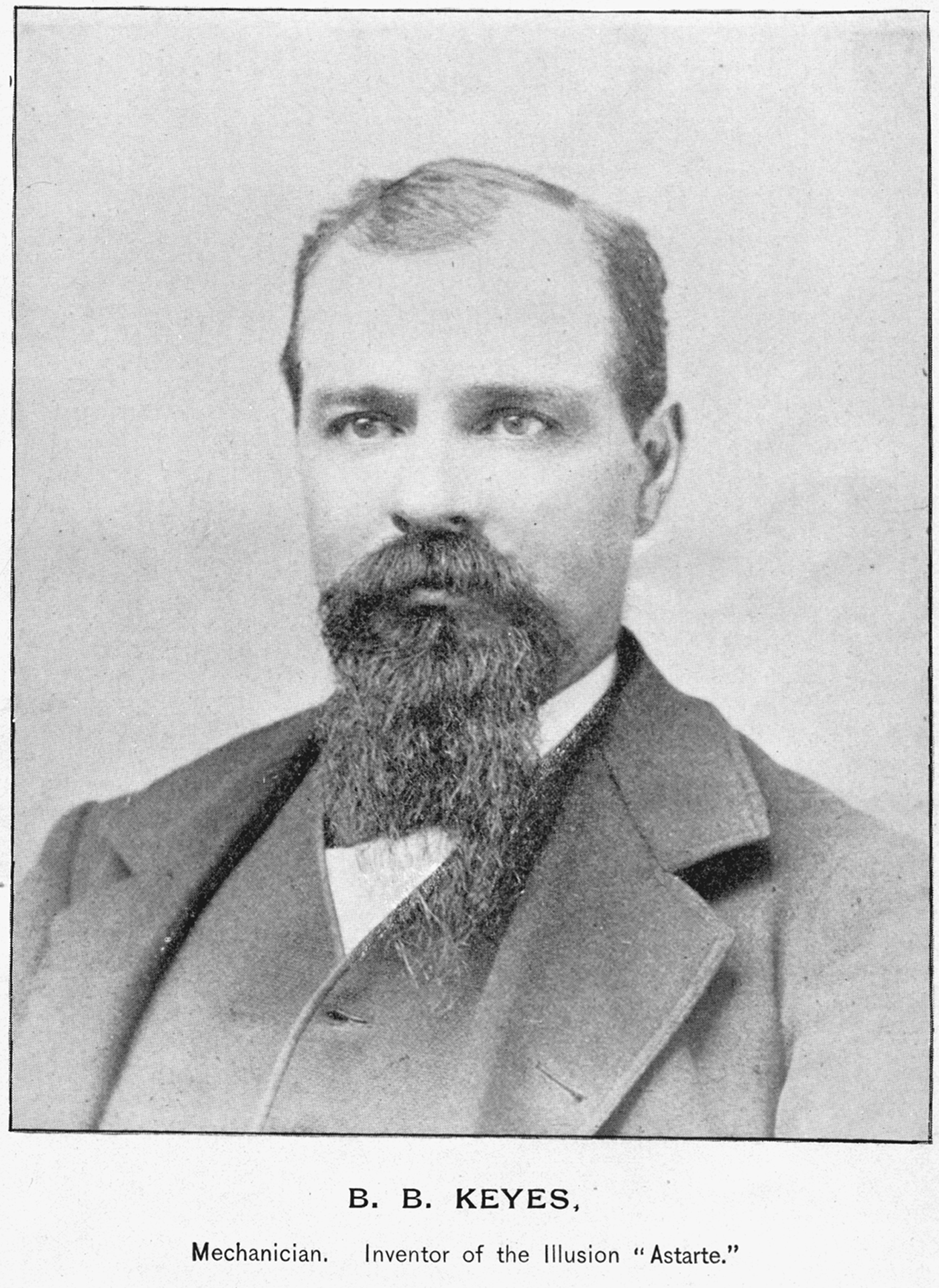
Magic catalogs also serve as a chronicle of performers who graced stages, nightclubs, and parlors throughout the twentieth century. Tricks or illusions that were known to have been invented by a particular performer often include that performer's name in the advertisement. Sometimes, in the case of large pieces that were conceived and constructed by professional illusion designers, the designer's name is included as well. For example, the levitation illusion known as Astarte and later as Maid of the Moon was created around 1898 by William Robinson (Chung Ling Soo), Benjamin B. Keyes, and Will B. Wood.Footnote 24 Keyes was a machinist who built special props for circuses and conjurers, and he is pictured and credited with the creation of Astarte in the 1908 W. D. Leroy catalog (Fig. 6).
Magic catalog printers sometimes featured illusion designers and builders in their catalogs. In this 1908 Leroy's catalog, B. B. Keyes is listed as a “Mechanician.”

Occasionally an illusion that had already been in existence for some time was presented in such an effective way that it became associated with the performer from then on, even though they had not really invented or made any changes in the actual mechanics of the trick. The association of a certain illusion with a famous performer helped boost recognition and sales, of course. For example, the Ten Ichi Troupe, headed by Tenichi Shokyokusai Hattori, came to the United States in 1901 and made a great impression on American audiences with their Water Act, in which a fountain of water seems to be under the control of a magician as it alternately spurts from a tumbler, from the end of a sword, and from the top of an assistant's head. The act is offered for sale in the catalogs as Ten-Ichi's Great Water Act. Professional magicians would have instantly known what effect they were purchasing, even without a detailed description of exactly what the illusion entails:
This sensational number which the well known Ten-Ichi Troupe have made famous in all parts, has up to the present been very little copied. We have at last resolved to place this number on the market, and thus make it accessible to the European Conjurer. We would expressly emphasise the fact that this is not an inferior copy, but the act in its entirety suitable for an illusionist. It will prove practicable, and the mechanical part is exactly similar to that of the original. Every part of this act is made in our own factory with special machinery and is guaranteed to work perfectly without fail. Every Conjurer who is looking for something New and puzzling for his programme cannot pay too much attention to this act.
We would remark that there is not at any time a great quantity of water to handle, and all is so arranged that both before and after the act, another turn can immediately come on. Time of playing this act 8 to 12 minutes as desired. Without wearisomeness owing to the number of charming variations possible.Footnote 25
A full description of Dante the Magician's Sim Sala Bim Spectacle was also offered via mail order.Footnote 26 The spectacle was a popular and well-known extravaganza of stage magic and illusion with which Dante toured the world.
Trade catalogs can also offer information about the scripts and verbal portions of effects; occasionally the entire patter for a trick would be reproduced in the catalog's pages. For example, Thayer's catalog number nine reproduces the entire script for a trick called The Three Dukes.Footnote 27
Wartime
Catalogs produced during wartime, of course, reflected the influence of war on the performing industry, both in the illusions that were advertised and in the warnings about material shortages that may affect an establishment's ability to supply certain effects. Holden's 1943 catalog, for example, contains the following notice: “This is a War-time catalog with many price changes over our previous catalog. Shortage of metal, plastics, rubber, silks and springs are going to make a shortage in many magic items and we cannot guarantee any particular effect as being available.”Footnote 28 That same year, Thayer offers the following optimistic notice: “With the attaining of complete Victory we shall again see complete stocks of all the old favorites, and wonderful new creations of steel, plastics and other compositions as yet undreamed by magicians.”Footnote 29 Wartime catalogs featured effects especially designed to play into the patriotic fervor of the time. Thayer's catalog from 1943 has several illusions containing the word “victory” in the title, for example the “Victory Girl production,” in which a woman emerges from a seemingly empty cardboard box. It was created during World War II by U. F. Grant, who invented many illusions using cardboard, since wood and metal were in short supply during the war;Footnote 30 and Holden's 1943 catalog offers an effect titled Victory 20th Century that features a “V for victory” silk that magically appears, already tied, between a British and an American flag.Footnote 31 Another patriotic effect was the Tojo Trouncer: “It's up to the minute stuff with a patriotic finish,” the copy declares. The ad features a caricature of Tojo being clobbered over the head by an American sailor wielding a large magic wand.Footnote 32 The National Magic Company's 1942 catalog contains a trick entitled The Terrible Trio that features three wooden figures representing Hitler, Tojo, and Mussolini.Footnote 33 One of the most blatant references to the anti-German sentiment that burgeoned in the United States during World War I appears in the Oaks catalog from circa 1918: “Bullet Novelty. This is one of the nicest pocket pieces that has been put on the market. It looks like a regulation U.S. bullet and it would be difficult for anyone to tell it from the real ones we are making to kill the Germans with.”Footnote 34 The 1943 Thayer catalog features a routine specifically created to entertain those in the military: “Camp Show Conjuring: A well written manuscript devoted to conjuring for the military men. If you work for the U.S.O., do camp shows or even fill an occasional canteen date, this is the work you need.”Footnote 35
Wait: There's More
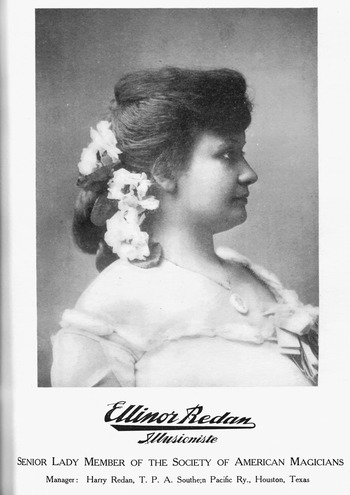
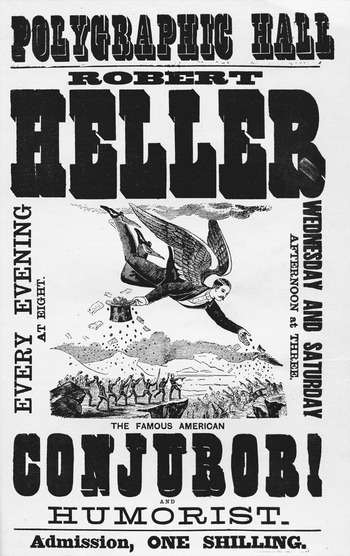
In addition to the traditional items that one would expect to find in an early twentieth-century retail catalog, such as product descriptions and drawings, many of the magic catalogs include interspersed photographs, or other informational tidbits that can be of use to theatre researchers. For instance, the trade catalogs occasionally offer a glimpse of the few women who were working in the profession. In the 1908 Leroy's catalog, for example, there is a photograph of Ellinor Redan (Fig. 7), the first female member of the Society of American Magicians. Leroy's Illustrated Catalog from circa 1908 contains photographs of all the most famous magicians of the day and a few reproductions of posters advertising magic performances (Fig. 8).
Ellinor Redan was the first female member of the Society of American Magicians. Little has been written about her, but her photograph figured prominently in the 1908 Leroy's catalog.

Reproduction of a poster advertising a magic act from the W. D. Leroy catalog, ca. 1908.

Some catalogs also include special sections that give insight into associated performance categories, such as the 1939 Kanter catalog, which includes a section featuring the Revello Petee Ventriloquial Figures. The section includes a brief biography of Petee, testimonials about the quality of his figures, construction details, and photographs of several of the figures for sale. Also on sale are ventriloquist figure effects such as “rolling eyes,” “spitting effect,” “raising eyebrows,” and “flapping ears.”Footnote 36 These details suggest the types of routine ventriloquists were using during this time.
Many of the magic supply houses included testimonials in their catalogs, a practice that was copied from the Sears, Roebuck and Co. These snippets of letters can supply additional information about the retailer's customer base and the most popular magic effects. One must always be careful, however, not to take testimonials at face value. Sellers can fabricate testimonials, and magic dealers are no exception. Some of the testimonials can be verified through the details they include, however. For example, in the 1924 catalog for Heaney Magic Company the following testimonial from “Henry” can be found:
Our season opens, in New England in about ten days or two weeks, Swarthmore Chautauqua System, so of course the summer program is already arranged, but you list a number of articles that I shall want to get during summer for next winter's show. . . . You know that all my purchases have been satisfactory from your firm and I will continue to buy what ever I need, no matter if it is a small novelty or a Large Stage Illusion.Footnote 37
The bill for the Swarthmore Chautauqua 1924 summer season confirms that “Henry and Company, an evening of Magic, Mystery and Mirth” is indeed one of the listed acts.Footnote 38
Research Challenges
It is sometimes difficult to date magic-trade catalogs; the supply houses did not always include copyright dates on their publications. If a copyright date does appear, it cannot always be counted on for accuracy because copyright dates were not always updated on new editions, even if the catalog included new material and was intended to supersede all previous versions. For example, number twenty-three of Oaks Latest Tricks has a copyright date of 1913, but judging from some of the contents and references, it is more likely that it was released in 1918.
The lack of finding aids also makes the search for information in certain types of resource particularly time consuming. Playbills, catalogs, and scrapbooks can pose a real challenge to researchers who are not blessed with patience, persistence, and loads of time. Marcus rightly notes, “Turning to a scrapbook to find material about a specific play or performer can be frustrating because the absence of adequate catalogs and indices means that most albums must be searched manually.”Footnote 39 If one is willing to put forth the effort, however, scouring resources such as these can definitely reap rewards.
Perhaps the largest challenge associated with ephemera such as playbills, scrapbooks, and catalogs is what Balme terms the “referential dilemma.” In other words, sources such as these foreground this question: “Do such pictures index a ‘theatrical reality’, an actual performance, or are they the product of iconographical codes, largely divorced from theatrical practice?”Footnote 40 Here Balme pinpoints a question with which theatrical historiographers constantly wrestle, not only in connection with these resources but with all resources, both iconographic and textual. Though there is no definitive answer to this question, grappling with it is something that we, as theatre researchers, must do.
Conclusion
Magicians' trade catalogs offer fertile ground for researchers who want to focus on this particular type of popular entertainment, but they also hold unexpected insights for those working on tangential topics such as touring shows, tent shows, vaudeville, and so forth. Perusal of these catalogs presents an opportunity for both a diachronic and a synchronic examination of the magic and conjuring industry and a glimpse into the types of performance that took place on the vaudeville circuit, in parlors, and in other local entertainment venues nationwide. They can provide information on little-known performers and performance genres and can illuminate social trends and fads that affected performers both on and off the stage. These books, originally put together for a purely practical and commercial purpose, contain a great deal of information that can support and enlighten the projects of theatre historiographers. They have had a significant effect on my own research, and I wholeheartedly recommend them as resources that might be useful to you as well. At the very least, these publications offer possibilities for discovering unique details that cannot be gleaned from other sources, and this alone makes them candidates for further exploration.