

Background
Older individuals use the internet less frequently than younger people, and although uptake of internet use is increasing, it is doing so at a slower rate among older populations (Wei Reference Wei2012), and especially the oldest old (Friemel Reference Friemel2016). Additionally, older people are more likely to have poorer IT skills, less access to relevant resources and to use the internet for fewer and more basic applications than their younger counterparts (Friemel Reference Friemel2016; Selwyn et al. Reference Selwyn, Gorard, Furlong and Madden2003; Wei Reference Wei2012). An Office for National Statistics (2014) report estimated that in 2013, of the 8.37 million adults in the United Kingdom who were ‘digitally excluded’ (unable to access the internet frequently), around 67 per cent were aged over 65, and a further 15 per cent aged between 55 and 65. Furthermore, Matthews and Nazroo (Reference Matthews and Nazroo2016) demonstrated only a third of men aged 80 and over in England use the internet, compared to around 90 per cent of men aged between 50 and 54. Percentages for women were lower, with just 14 per cent of women aged 80 and over using the internet. Although research has examined internet use and behaviour among older people, few studies have focused on the differences between the younger and oldest old (Friemel Reference Friemel2016), especially in reference to changes in internet use over time.
The concept of digital exclusion among older people is complex, with various factors contributing to individuals’ decreased likelihood of accessing and using the internet proficiently on a frequent basis. The ‘digital divide’ has been described as a two-tier phenomenon, with inequality present in terms of initial access to the internet, as well as having the skills to use the internet (Stern Reference Stern2010). On both levels, individuals may be excluded from internet use on the basis of their personal characteristics. Previous work has shown decreased levels of internet use among those with declining visual acuity and motor skills (Sayago, Sloan and Blat Reference Sayago, Sloan and Blat2011), as well as those with poorer cognitive function (Elliot et al. Reference Elliot, Mooney, Douthit and Lynch2014; Freese, Rivas and Hargittai Reference Freese, Rivas and Hargittai2006). Individuals from poorer social backgrounds are also less likely to use the internet than those from more advantaged positions, especially those who are unemployed, receiving lower incomes or living alone (Yu et al. Reference Yu, Ellison, McCammon and Langa2015; van Deursen and Helsper Reference van Deursen and Helsper2015). Higher education is linked to higher rates of internet use among older people, most probably because better education is linked to occupations in which individuals are more likely to use the internet or email, compared to occupational types in which the internet is not commonly used, which may be associated with lower educational attainment (Chang, McAllister and McCaslin Reference Chang, McAllister and McCaslin2015). Financial status has also been shown to be a significant predictor of the likelihood of investing in and using new technologies, as well as having confidence in using the internet (Zheng et al. Reference Zheng, Spears, Luptak and Wilby2015). It should be noted also that many of the social inequalities present across the lifecourse are associated with widening inequalities in both socio-economic circumstance and health in older age (Chandola et al. Reference Chandola, Ferrie, Sacker and Marmot2007), potentially exacerbating predispositions to be digitally excluded.
Another hypothesised reason for lower rates of internet use among older people is a lack of motivation (Chang, McAllister and McCaslin Reference Chang, McAllister and McCaslin2015; van Deursen and van Dijk Reference van Deursen and van Dijk2011) or the belief that the internet is irrelevant to the needs of older individuals’ lives (Selwyn et al. Reference Selwyn, Gorard, Furlong and Madden2003). Many older people do not use the internet simply because they do not wish to (Eynon and Helsper Reference Eynon and Helsper2011), or because they perceive the cost of equipment to get online to outweigh the benefits of doing so (Sayago et al. Reference Sayago, Sloan and Blat2011). Qualitative research has found some older people were deterred by fear of damaging equipment through lack of knowledge about using it properly, as well as fear associated with security and privacy of their personal data (Hill, Betts and Gardner Reference Hill, Betts and Gardner2015). Internet skill and ability, which is likely to have been learned in earlier parts of the lifecourse for younger older people and less likely to have been learned among the oldest cohorts, is also likely to influence the level at which individuals participate in internet use (Chang, McAllister and McCaslin Reference Chang, McAllister and McCaslin2015), with better skills associated with a wider range of online activities engaged in and more time spent online (Blank and Groselj Reference Blank and Groselj2014). Subsequently, it is likely to be the oldest old, who currently have not used the internet routinely, such as at work, who are most likely to be affected by such beliefs. However, evidence suggests that when the oldest old have been encouraged to use the internet, results have been promising. One study found a high proportion of older adults lacking in digital skills were eager to learn by means of taught courses, and after five months of training, three-quarters of older adults who had acquired online skills via such courses were using them on a frequent basis (White et al. Reference White, McConnell, Clipp, Branch, Sloane, Pieper and Box2002). Additionally, having easy access to help in getting online has been shown to encourage older users to become digitally engaged (Chang, McAllister and McCaslin Reference Chang, McAllister and McCaslin2015), with older internet users who had not learned internet skills in earlier life reporting younger family members or friends as the most useful resource for gaining online skills.
This study focuses not just on internet use among older people, but on internet use within specific age cohorts of older people. There are various factors which are likely to influence differing patterns of internet use among age cohorts in the older population. Health conditions and physical limitations are likely to influence differences between users, not just across the lifespan as a whole, but within older age specifically. Digital technology may become harder for older people in poorer health to use (Charness and Boot Reference Charness and Boot2009), with the ability for computer use affected by declines in visual acuity and motor control (Neves et al. Reference Neves, Franz, Munteanu, Baecker and Ngo2015; Sayago, Sloan and Blat Reference Sayago, Sloan and Blat2011) and declining cognitive ability (Freese, Rivas and Hargittai Reference Freese, Rivas and Hargittai2006), all of which are more commonly reported among the oldest old than younger cohorts. Later cohorts of older people are likely to have retired from the workforce before internet and email became commonly used tools within many occupations, therefore potentially reducing the likelihood of internet use after workforce exit (Chang, McAllister and McCaslin Reference Chang, McAllister and McCaslin2015). However, it should also be considered that older people might be encouraged into using the internet following retirement to replace lost social connections. Similarly, older people may be inclined to use the internet to increase social connectivity after becoming widowed (Cornwell, Laumann and Schumm Reference Cornwell, Laumann and Schumm2008). Another important consideration is the effect of enabling digital inclusion among older people in long-term care homes who are at high risk of social isolation, and who might benefit strongly from some of the services the internet can provide, such as email and multimedia messaging, as a means of remaining connected to friends and family, as well as with society on a wider level (Neves et al. Reference Neves, Franz, Munteanu, Baecker and Ngo2015).
Alongside the potential for internet use in older age to replace lost social connections, it should also be considered in light of its potential beneficial effects on wellbeing. Various studies have shown internet use to be linked with lower rates of depression (Cotten et al. Reference Cotten, Ford, Ford and Hale2014; White et al. Reference White, McConnell, Clipp, Branch, Sloane, Pieper and Box2002), social isolation (Cotten, Anderson and McCullough Reference Cotten, Anderson and McCullough2013; Lelkes Reference Lelkes2013; Morris et al. Reference Morris, Adair, Ozanne, Kurowski, Miller, Pearce, Santamaria, Long, Ventura and Said2014; Sum et al. Reference Sum, Mathews, Hughes and Campbell2008) and loneliness (Choi, Kong and Jung Reference Choi, Kong and Jung2012; Cotten, Anderson and McCullough Reference Cotten, Anderson and McCullough2013; Morris et al. Reference Morris, Adair, Ozanne, Kurowski, Miller, Pearce, Santamaria, Long, Ventura and Said2014), and increased feelings of empowerment (Hill, Betts and Gardner Reference Hill, Betts and Gardner2015) and independence (Neves, Amaro and Fonseca Reference Neves, Amaro and Fonseca2013). One of the key mechanisms theorised to be driving improvements in these areas of wellbeing is the potential for the internet to be used as a means of increasing social networks and access to resources, which in turn may provide both a sense of companionship and inclusion within society (Shillair et al. Reference Shillair, Rikard, Cotten and Tsai2015). Indeed, research has also demonstrated the strongest associations between internet use and decreased feelings of isolation and loneliness to be perceived among individuals whose circumstances might initiate the poorest mental wellbeing, such as those who are living alone (Cotten et al. Reference Cotten, Ford, Ford and Hale2014) and older people who were widowed or considered themselves to be ‘home-makers’, were more likely to use the internet for social networking sites (Yu et al. Reference Yu, Ellison, McCammon and Langa2015).
This study examines internet use explicitly on the basis of age cohort, while also considering period effects. A shortcoming of much previous research is the term ‘older people’ incorporating adults between 50 and 60 and over, which is problematic as the relevant characteristics of people aged over 50 are unlikely to be similar to those in much older ages. This is especially relevant when considering the rapidly growing population of people aged 80 and over, and the fact that many barriers to being online, such as declining vision and motor skills, are most likely to affect people within this age demographic. This study also furthers previous work on the topic by analysing longitudinal data with a large, nationally representative English sample. We hypothesise that the results will demonstrate internet use is a diverse behaviour on the basis of age cohort, and will furthermore identify a core group of people who may be particularly prone to digital exclusion; that is, those who are among the oldest old, in the poorest socio-economic situations and in the poorest health. Furthermore, in line with the aforementioned research demonstrating associations between declining physical functioning and both lower rates of internet use and, more specifically, increasing difficulty using technological devices, we hypothesise the onset of poorer health over the study period will be associated with a drop-off in rates of internet use among the oldest old.
Methods
Data and sample
The data used in this study are taken from Waves 1–6 of the English Longitudinal Study of Ageing (ELSA), which is a multidisciplinary, nationally representative survey of people aged 50 and over. Data are collected from the same respondents biennially, with the first wave collected in 2002–2003 and the most recent wave (Wave 6) collected in 2012–2013. The data contain a rich set of information concerning the socio-demographic characteristics and health of the older English population. The longitudinal nature of the survey makes it a powerful source of data for studies concerning changing behaviours over time.
The ELSA sample at baseline in 2002–2003 consists of 11,391 respondents. This study focuses on 10,390 of these participants who responded to the survey question providing information on internet use at Wave 1. Respondents are included in the analysis if they participated in the ELSA survey at least once within the ten-year data period. This leaves a total of 40,534 observations from 10,390 respondents. Due to attrition, the number of respondents who answered the question on internet use at Wave 1 is reduced to a total of 4,627 by Wave 6. The average number of responses for each sample member included in this study is 3.9, with a minimum of 1 and a maximum of 6.
Measures
Internet use
At all waves of ELSA, participants were asked a question regarding whether they used the internet. This allowed for an examination of changing levels of internet use for individuals over the ten-year data period, in relation to their individual characteristics. Waves 1–5 of ELSA ask respondents a binary question of whether they use the internet.
At Wave 6, respondents are instead asked how frequently they use the internet, with the possible responses ‘every day or almost every day’, ‘at least once a week’, ‘at least once a month’, ‘at least once every three months’, ‘less than every three months’ and ‘never’. Frequency tables (not reported here) of internet use at Waves 1–5 show a similar proportion of people consider themselves users of the internet as those who at Wave 6 state they use the internet once a week or more. So, when combing the Wave 6 data with the Waves 1–5 data for the purpose of longitudinal analysis, we include as ‘internet users’ those who at Wave 6 said that they used the internet once a week or more.
Demographic and socio-economic measures
Age cohort
Age is separated into five-year age groups. The longitudinal analyses examine change in internet use over the data collection period by age cohort defined as age group at Wave 1. There are seven age cohorts in total (aged 50–54, 55–59, 60–64, 65–69, 70–74, 75–79 and 80+ at the first observation).
Wealth
The wealth variable identifies net non-pension wealth quintiles measured at the household level. This includes net financial and physical wealth, and net housing wealth. Longitudinal analyses use wealth as a time-invariant variable, measured at Wave 1.
Self-reported health
Health is included in the model as a time-varying covariate. Respondents are asked to rate their general health with the options ‘excellent’, ‘very good’, ‘good’, ‘fair’ and ‘poor’. Self-reported health has been shown to correlate well with objective health measures and mortality (Bound Reference Bound1989; Mossey and Shapiro Reference Mossey and Shapiro1982).
Statistical analysis
Multi-level growth curve models are used to predict internet use at Wave 1 and changes in internet use over the six-wave data period (the ten-year period 2002–2003 to 2012–2013). The longitudinal nature of the ELSA data is well suited to such an analysis as it provides information on multiple cohorts from baseline, enabling a detailed examination of cohort-based differences in internet use over an extended period. Changes in internet use are dependent on age cohort identified at Wave 1, and show whether changes over time in internet behaviour vary according to age cohort. Similar methods have been used recently to examine cohort trajectories of frailty and depression among older populations (Marshall et al. Reference Marshall, Nazroo, Tampubolon and Vanhoutte2015; Yang Reference Yang2007). The longitudinal models account for the non-independence of individuals’ behaviour over time by measuring repeated observations of behaviour (internet use) (at level 1) nested within individuals (at level 2). This multi-level structure of the models provides the advantage of being able to handle both missing data and unequal time spaces between observations (Raudenbush and Chan Reference Raudenbush and Chan1992). Initial models are extended to show trajectories on the basis of gender and wealth.
The level 1 model (growth trajectory within individuals) is denoted as in Equation (1). For later models we add a healthti term to Equation (1) indicating the self-reported health of individual i at time t.
 $${\rm DI}_{ti} = {\rm \beta} _{0i} + {\rm \beta} _{1i} {\rm time}_{ti} + {\rm \beta} _{2i} {\rm time}_{ti}^2 + {\rm e}_{it}, $$
where DIti denotes the internet use (digital inclusion) of individual i observed at time t, where each individual has a potential maximum of six observations and a minimum of one, depending on the number of waves of data responded to. Here, internet use is modelled as a function of time, where timeti denotes the timing of observation (wave) t for individual i. In order to observe non-linear patterns of internet use change, the quadratic term  ${\rm time}_{ti}^2 $ is included in the model. β1i and β2i represent the linear and quadratic growth, respectively, over the data period for individual i. The random within-person error for person i at time t is defined by eit, and is assumed to be normally distributed.
Equations (2) and (3) denote the level 2 model (growth trajectory across individuals) which allows patterns of internet use to differ according to age cohort.
 $${\rm \beta} _{0i} = {\rm \gamma} _{00} + {\rm \gamma} _{01} {\rm cohort}_i + u_{0i} $$
 $${\rm \beta} _{1i} = {\rm \gamma} _{10} + {\rm \gamma} _{11} {\rm cohort}_i + u_{1i}. $$
Here, cohorti indicates the cohort membership of individual i. The variable is centred, with the values −3, −2, −1, 0, 1, 2 and 3. In Equation (2), γ00 is the mean internet use of cohort 0 (aged 65–69 years in 2002) at Wave 1.
The models are extended so that growth patterns of frequent internet use are allowed to vary on the basis of gender and level of wealth (both time-invariant and measured at Wave 1). Here, the models demonstrated in Equations (2) and (3) include an interaction term between cohort and gender in the first instance, and cohort and wealth in the second. Equations (4) and (5) show the model adapted to include gender (the model inclusive of wealth is the same but with the inclusion of the wealth variable and the exclusion of gender).
 $${\rm \beta }_{0i} = {\rm \gamma }_{00} + {\rm \gamma }_{01}{\rm cohor}{\rm t}_i + {\rm \gamma }_{02}{\rm femal}{\rm e}_i + {\rm \gamma }_{03}{\rm cohor}{\rm t}_i{\rm femal}{\rm e}_i + u_{0i}$$
 $${\rm \beta} _{1i} = {\rm \gamma} _{10} + {\rm \gamma} _{11} {\rm cohort}_i + {\rm \gamma} _{12} {\rm female}_i + {\rm \gamma} _{13} {\rm cohort}_i {\rm female}_i + u_{1i}. $$
All analyses are weighted using cross-sectional weights developed at Wave 1 of ELSA to account for non-response and to ensure the sample is representative of the English population aged 50 and over at the start of the study period in 2002–2003. To account for the correlation of residuals over time, models were also run with an autocorrelative structure fitted (results not reported), but the unrestricted model reported the better fit. Parameter estimates remained similar although there were small differences in standard error. All results remained significant. Analyses were carried out in Stata/SE12.1.
Results
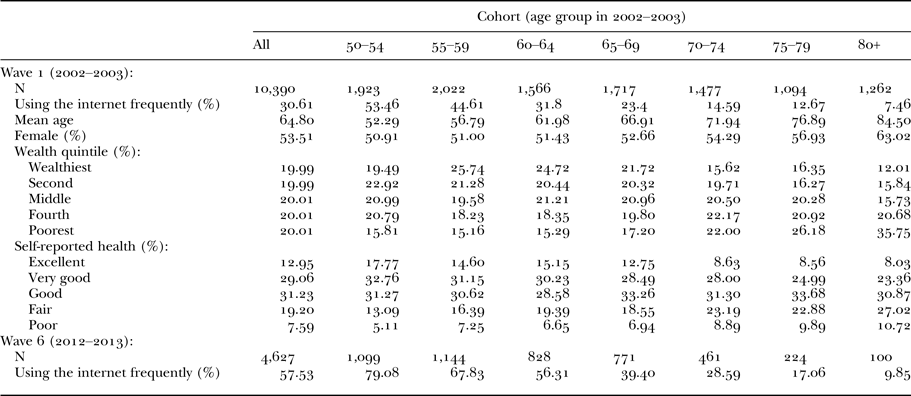
Table 1 shows sample characteristics at Wave 1 and internet use at Wave 1 and Wave 6 by age cohort (as defined at Wave 1). The percentage of people reporting internet use declines with age. The frequent use of internet increases for all age cohorts (as measured by Wave 1 age) between Waves 1 and 6. Table 1 also shows strong associations between age and wealth, with the proportion of respondents in the poorest wealth categories much higher among older cohorts. There are strong linear associations between age cohort and health, with the percentage of respondents reporting excellent or very good health declining with increasing age cohort. Twice as many respondents aged 80 and over report fair and poor health than those aged 50–54. The majority of the sample overall (60%) report their health as either very good or good.
Sample characteristics at the first and sixth wave of the English Longitudinal Study of Ageing (ELSA)

Notes: Data are weighted using Wave 1 cross-sectional weights. N are unweighted.
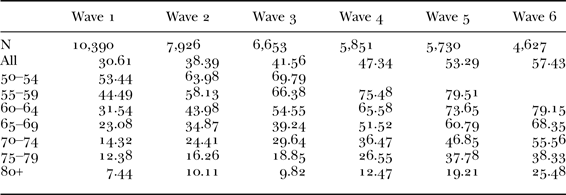
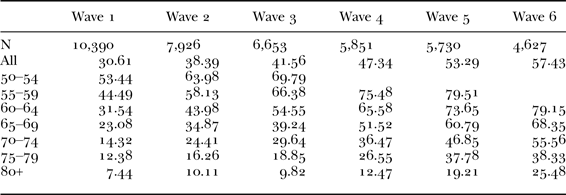
In order to examine period effects, Table 2 shows cross-sectional information concerning frequent internet use at each wave of the data period by age group at the wave (rather than following a particular cohort over time). The total percentage of people aged 50 and over using the internet increases from 30.6 per cent in 2002 to 57.4 per cent in 2012. The rate of increase occurs fastest among younger individuals. For example, 32 per cent of 60–64 year olds used the internet frequently in 2002 compared to 79 per cent in 2012, while for people aged 80 and over rates of frequent internet use increased from 7 per cent to 26 per cent over the same period.
Cross-sectional analysis of internet use across all waves of the data period
Notes: Data are weighted using Wave 1 cross-sectional weights. N are unweighted.
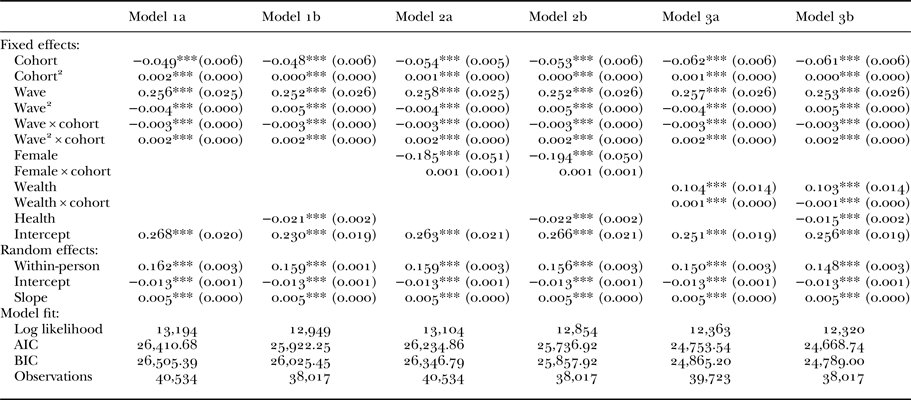
Results of the longitudinal models are presented in Table 3. Model 1a shows trajectories of internet use by cohort over the ten-year data period and Model 1b shows the results after controlling for health. Model 1a shows the coefficients for cohort are negative and significant (−0.049), suggesting older cohorts use the internet less than younger cohorts at any time. The coefficients for wave and wave-squared are significant and demonstrate a non-linear increase in internet use over the study period which varies across cohorts, with increases in internet use among older cohorts occurring at a slower rate than younger cohorts (the wave × cohort coefficient of −0.003) and one that is slowing over time. Including an interaction between cohort and wave-squared demonstrates this relationship is non-linear. Controlling for health effects demonstrates poorer health is significantly associated with a reduced likelihood of using the internet (−0.021), and although the increase of internet use over time among older cohorts remains slower than among younger cohorts, the difference in rate of increase is reduced by half (−0.001), suggesting declining health plays a large role in lower rates of internet use among the oldest old. Additionally, adjusting for health effects changes the wave-squared coefficient, which demonstrates the non-linear growth in internet use over the data period, from a negative (−0.004) to a positive value (0.005). In other words, before accounting for health, the rate of increase in the frequent use of the internet declines over time, particularly for older cohorts, but if poor health is accounted for, the rate of internet use actually increases exponentially over time for all cohorts including the oldest.
Growth curve models of frequent internet use by age cohort, gender and wealth

Notes: Health is included as a continuous variable with five categories: excellent, very good, good, fair, poor. Standard errors are given in parentheses. AIC: Akaike information criterion. BIC: Bayesian information criterion.
Significance level: *** p < 0.001.
Models 2a and 2b allow internet use to vary on the basis of gender. Females are significantly less likely to use the internet than males (−0.185). However, the positive value of the gender × cohort coefficient (0.001) demonstrates a slight reduction in this gap in the older cohorts, although this result is not significant. There was no evidence that the rate of change of internet use differed by gender (non-significant coefficient excluded from the final model in Table 3). The lower rate of internet use for women remains after controlling for health effects, and the increase in gender differences for older cohorts is of a similar magnitude to the model without the health control.
Finally, Models 3a and 3b show patterns of internet use in relation to wealth. Increasing levels of wealth are associated with higher likelihoods of internet use both in models without and with health included (0.104 and 0.103, respectively). In the model not including health, the wealth difference is greater for older cohorts (the wealth × cohort coefficient of 0.001). Again, there was no evidence that the pattern of growth over time differed on the basis of wealth (non-significant coefficient excluded from the final model in Table 3), so although those in poorer circumstances consistently report lower rates of internet use, their rate of change occurs in the same pattern as those in wealthier circumstances. However, after controlling for health, this coefficient becomes negative, suggesting the wealth differences decrease for older cohorts. In other words, the increase in the wealth and internet use across age cohorts is strongly mediated by the simultaneous effects of older cohorts’ greater risk of poor health.
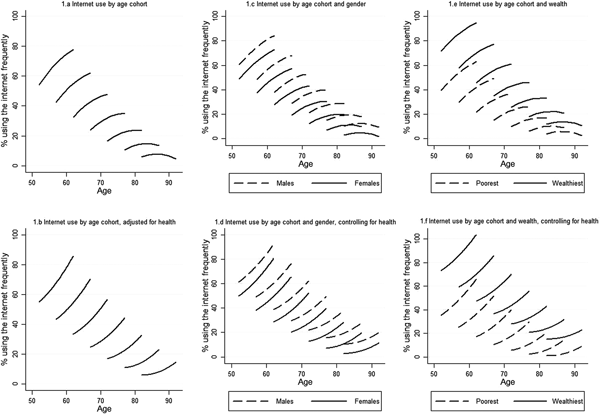
Figure 1 shows vector graphs of the models presented in Table 3. The start point of each line represents the percentage of people within each individual cohort using the internet at Wave 1 (2002–2003) and the end-point of each line represents internet use for the same cohort at Wave 6 (2012–2013). Each line on the graphs represents the pattern of internet use for each cohort individually between the period 2002–2003 to 2012–2013. All graphs show higher rates of internet use among younger cohorts across the entire data period and the greater rate of increase among younger cohorts. The importance of adjusting for health effects becomes apparent when comparing Figure 1a and b: the decline in internet use towards the end of the study period observed in the three oldest cohorts becomes a continuous increase once health is accounted for, reflecting the change in the wave-squared coefficient direction in Table 3, and this finding persists in the analyses by gender and wealth. However, the rate of growth remains slower among these later cohorts. These results may reflect period effects, in terms of increasing internet accessibility over the data period, as well as cohort and ageing effects.
Growth curve models of frequent internet use by age cohort, gender and wealth.
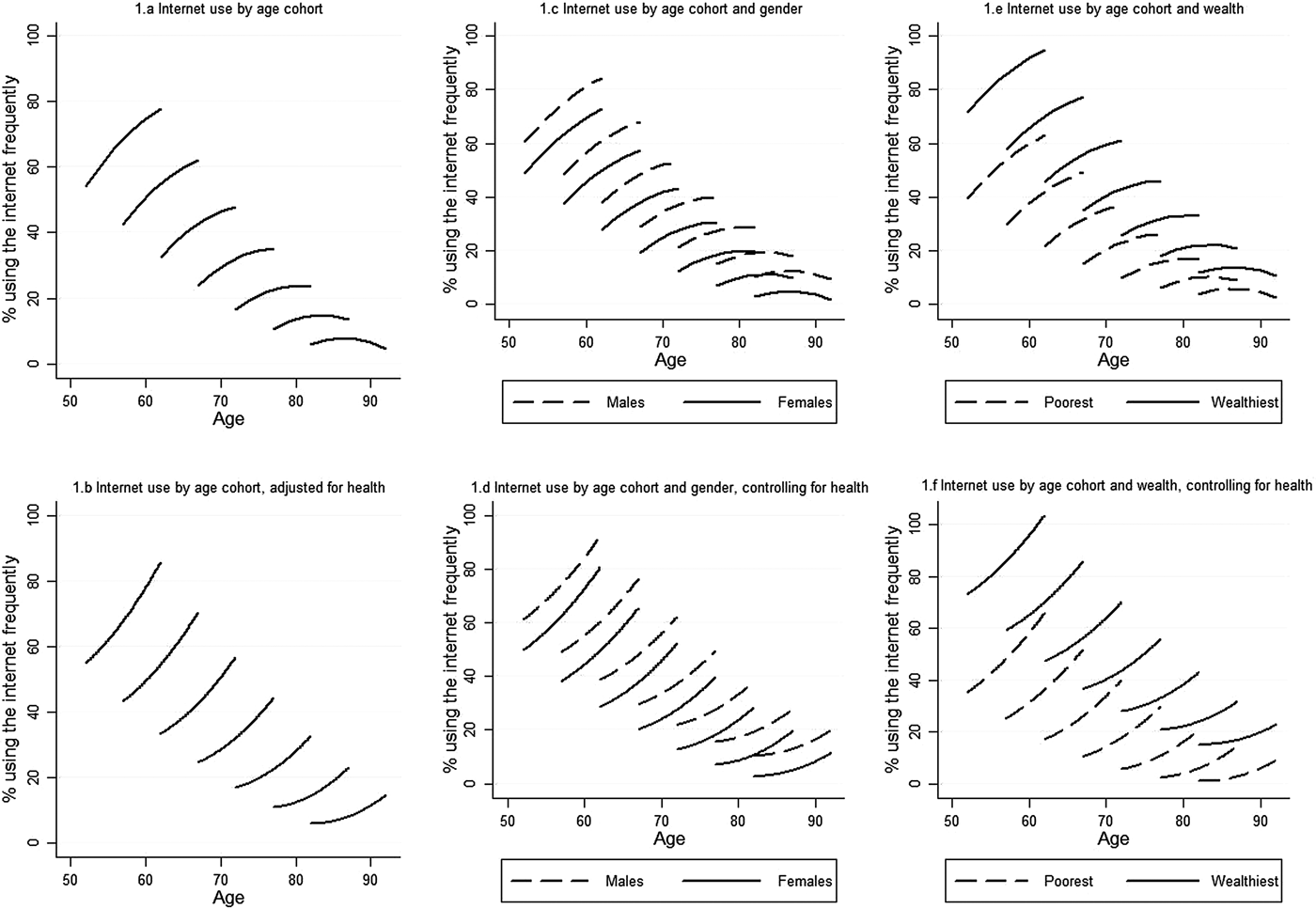
Figure 1c and d show the higher rate of internet use for men compared with women across cohorts. Women in the cohort aged 50–54 at Wave 1 display similar levels of internet use to men in the cohort aged 55–59 at Wave 1, and this pattern continues until we observe women aged 75–79 displaying similar internet use to men aged 80 and over. However, as reflected by the non-significant coefficients for rate of change, the growth of frequent internet use, as well as the rate of decline among the oldest cohorts, occurs equally for men and women.
Figure 1e and f plot the richest and poorest quintiles and demonstrate the large gap in internet use on this basis across all cohorts and time-points. For example, the poorest wealth quintile within the 50–54-year-old (at Wave 1) cohort displays similar average levels of frequent internet use to the richest wealth quintile within the cohort aged 60–64 (at Wave 1).
Discussion
This study highlights the differences in rates of frequent internet use among older people in relation to specific age cohorts. As expected, the results find internet use is reported increasingly less among increasingly older age cohorts, and across all age cohorts rates of internet use are lower among women than men and among poorer compared to wealthier individuals. While internet use increases for most age cohorts over time, for the very oldest cohorts the overall trajectory of internet use is flat and starts to decline in much older age. Longitudinal growth models show a non-linear relationship between ageing and internet use, with the fastest increase in internet use occurring among younger cohorts and at the start of the study period when all participants are younger. Poor health plays a large role in lower rates of internet use, especially among the oldest old, and crucially shapes the development of internet use over time within cohorts.
Gender and wealth appear to be related to trajectories of internet use similarly for all cohorts, with women consistently using the internet less than men, and wealthier individuals using the internet more than those in poorer circumstances. This complements the findings of earlier studies (Dutton, Helsper and Gerber Reference Dutton, Helsper and Gerber2009; Green and Rossal Reference Green and Rossall2013; Hill, Beynon-Davies and Williams Reference Hill, Beynon-Davies and Williams2008; Morris, Goodman and Brading Reference Morris, Goodman and Brading2007; Office for National Statistics 2014). The cohort analyses prove useful in highlighting how digital exclusion might affect core groups of individuals, such as the oldest old who are also in the poorest socio-economic settings. In line with this, it should be considered that, although the oldest cohorts of the future will be comprised of higher numbers of individuals who have used the internet throughout the lifecourse, and in particular through working life, socio-economic inequalities will still factor into lesser likelihoods of digital engagement for some, especially those in lower-grade occupations where internet use is not commonplace (Chang, McAllister and McCaslin Reference Chang, McAllister and McCaslin2015).
The longitudinal nature of this work adds an interesting dimension to previous research on the topic by not only demonstrating that poorer health is associated with lower internet use, but that the onset of poorer health is associated with stopping internet use. This complements earlier work which has shown declining visual acuity, motor skills and cognitive ability to be associated with lower rates of internet use (Freese, Rivas and Hargittai Reference Freese, Rivas and Hargittai2006; Sayago, Sloan and Blat Reference Sayago, Sloan and Blat2011), especially from around age 75 and onwards. The results are in line with recent cross-sectional work by Friemel (Reference Friemel2016) which shows large disparities between internet use on the basis of age groups within an older population, and a steep decline in the probability of using the internet with each additional year of age among people aged 65 and over. Furthermore, the inclusion of self-reported health in the models enables some explanation of this decline.
Although longitudinal cohort studies enable a reliable analysis of change in behaviour over time, there has been some criticism concerning the possibility that observed patterns may instead be due to period effects, as the effects of age, period and cohort are difficult to separate (Bell and Jones Reference Bell and Jones2014). Indeed, although the study period is reasonably short, digital technology has changed greatly within this time. Whereas the differences in overall rates of internet use are likely to be reflecting cohort effects, it is likely that the higher rate of growth over time for earlier cohorts is reflecting these period effects and the slower growth over time for later cohorts is reflecting ageing effects. This can be demonstrated by the changes in trajectories of use once the effects of poorer health are included in the models, and the decline in internet use among the oldest old is no longer observed. This suggests that people at much older age are still encouraged to become active online, and may echo findings which suggest digital engagement might be an important means of regaining social ties after life events such as workforce exit and the loss of a spouse (Cornwell, Laumann and Schumm Reference Cornwell, Laumann and Schumm2008; Hill, Betts and Gardner Reference Hill, Betts and Gardner2015; Shillair et al. Reference Shillair, Rikard, Cotten and Tsai2015). Similarly, the ability to use the internet may benefit older people in care home settings who are again at greater risk of social exclusion (Neves et al. Reference Neves, Franz, Munteanu, Baecker and Ngo2015). While the much lower reporting of internet use among the oldest cohorts is likely to reflect, at least in part, the lower exposure to internet use across earlier parts of the lifecourse, leading sometimes to the hypothesis that the magnitude of digital exclusion in later life will lessen over the coming decades (Gilleard and Higgs Reference Gilleard and Higgs2008), it is important to realise that the effects of ageing, such as the onset of poorer health, will continue to impact the internet use of even experienced users in the oldest cohorts of the future.
As with all longitudinal studies, ELSA is subject to issues of attrition and it has been documented that the characteristics of those who leave the study are different to those who continue to respond (Cheshire et al. Reference Cheshire, Hussey, Phelps, Wood, Banks, Nazroo and Steptoe2012). There is some likelihood that individuals who exit the study are more likely to bear characteristics of those who have been identified by this study as potential infrequent internet users and at risk of being digitally excluded, for example, those who are older, less wealthy and in poorer health. Although non-response at the start of the study period is accounted for by means of a cross-sectional Wave 1 weight, study attrition is likely to lead to a reduction in the size of the study's key findings.
This paper uses data from England only. However, it is likely the results of this study would generally be observed in other Western countries where populations are ageing and internet use is becoming increasingly popular in later life, in relation to both health and socio-economic factors. The results of this study are in line with those conducted in other countries with similar structures of ageing and internet use, including Finland and the Nordic countries (Näsi, Räsänen and Sarpila Reference Näsi, Räsänen and Sarpila2012), Switzerland (Friemel Reference Friemel2016) and the United States of America (Elliot et al. Reference Elliot, Mooney, Douthit and Lynch2014; Yu et al. Reference Yu, Ellison, McCammon and Langa2015).
There are important policy implications which can be taken from this study. The results show that older people who are among the oldest old, female, in poorer financial circumstances and in poorer health are the most likely to be digitally excluded. It is also important to consider that these factors are likely to be correlated, so that the oldest individuals in the poorest socio-economic circumstances are also those who are more likely to be in poorer health. Crucially, it should be noted that these are individuals especially at risk of social isolation, who might benefit the most from being able to use the internet frequently and well. Older people with disabilities might benefit from the use of self-servicing technology, allowing activities which might be physically difficult, such as shopping and banking, to be replaced by online services. Similarly, using the internet as a means of social communication might be particularly beneficial to those with difficulties in physically accessing social and community networks and resources, which has been linked to better mental wellbeing (Elliot et al. Reference Elliot, Mooney, Douthit and Lynch2014). In line with previous research which showed younger family members and friends as the best resource for learning internet skills in older age (Chang, McAllister and McCaslin Reference Chang, McAllister and McCaslin2015), it should be remembered that those who are already socially isolated are also more likely to be excluded digitally, and this is likely to extend to those living in long-term care settings (Neves et al. Reference Neves, Franz, Munteanu, Baecker and Ngo2015). If we also consider that older people are keen to learn in more formal settings, and continue to use the internet frequently after acquiring such skills (White et al. Reference White, McConnell, Clipp, Branch, Sloane, Pieper and Box2002), efforts should be made to make the most socially isolated individuals aware of opportunities to access computer skills courses. Where possible, encouraging younger family members and friends, or care home staff, to be involved in older people's digital learning may offer vital sources of support beyond the training setting (Neves et al. Reference Neves, Franz, Munteanu, Baecker and Ngo2015). For those who are wary of security issues surrounding internet use (Hill, Betts and Gardner Reference Hill, Betts and Gardner2015) or believe the internet is not relevant to their lives (Selwyn et al. Reference Selwyn, Gorard, Furlong and Madden2003), accessible material outlining the potential benefits of internet use should be available, again especially for those who might benefit the most from becoming digitally included. Finally, it is important to remember that although the demographic of older internet users is changing, with growing numbers of older people now retiring from employment rich in digital technology and with good IT skills, the onset of poorer physical health can prevent even experienced users from maintaining use of technology, and factors such as the weight of devices and ease of use of buttons and screens for individuals with poorer dexterity should be considered if we are to keep older people active online (Neves et al. Reference Neves, Franz, Munteanu, Baecker and Ngo2015). There should be a focus on ensuring technological devices can be manipulated for use by those with impaired physical ability so that benefits in terms of social connectedness and wellbeing are not further damaged by digital exclusion after the onset of poor health or disability.
Acknowledgements
We thank the participants in ELSA.
This work was supported by funding from the UK Government Digital Service, Cabinet Office, and the Medical Research Council and Economic Research Council through the Lifelong Health and Wellbeing programme (grant reference: G1001375/1). ELSA was funded by the National Institute on Aging and a consortium of UK Government departments. The funding sources had no further role in conducting the research or in publication.
The ELSA datasets are publicly available from the UK Data Service at www.ukdataservice.ac.uk. ELSA documentation (including questionnaires) is available from http://www.elsa-project.ac.uk.