As the number of manuscript indices available in the internationally collaborative cantus database grows, so does the number of fields which record different types of information about each chant. To the traditional roster of chant characteristics recorded by cantus, such as the location in the source, feast name, chant genre, textual incipit and modal assignment, two new fields have been added to address the interest of scholars in the transcription and digital manipulation of chant melodies. These new fields employ the music font named ‘Volpiano’, a readily accessible, free and highly beneficial tool for chant research.Footnote 1 The inclusion of melodic information in cantus records increases the potential uses of this database, allows for more efficient processes in research involving modal comparisons, and encourages collaborative projects by chant scholars worldwide.
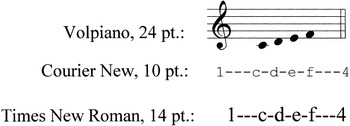
Melodies encoded for use with Volpiano exist as data-strings of letters and dashes which can be viewed as round note-heads on a five-line staff when the font is applied. The font is named after the early eleventh-century theorist William of Volpiano (Guillaume de Dijon),Footnote 2 who is credited with the letter notation used in the manuscript Montpellier H. 159.Footnote 3 Each letter in the font corresponds to a pitch in William's a–p series of alphabetic notation. For example, the application of Volpiano font to the data-string 1– – –c-d-e-f– – –4 results in the presentation of corresponding pitches on a modern staff with a treble clef, as displayed in Figure 1.
The string 1– – –c-d-e-f– – –4 shown in three different fonts.

There is widespread interest among chant scholars in the issues surrounding both the presentation of chant melodies in modern research and publications and the methods of creating chant transcriptions.Footnote 4 Some of the options scholars have previously explored include computer notation software such as Finale® and Sibelius®, the encoding of information in XML, or using chant fonts such as Meinrad.Footnote 5 Volpiano was not intended primarily to be an alternative font for preparing editions or facsimiles, but instead, a research tool adapted to the requirements of databases and word-processors. There are tremendous advantages to using Volpiano over these other notation schemes for the researcher whose time is mostly spent analysing musical data about chant.
Volpiano is not a program, but simply a font which is free to download and use. Both TrueType and PostScript versions are available. The data-entry is intuitive, straightforward and fast. One can become proficient in encoding melodies quickly; on average, a complete chant melody, including transcription of the text, can be encoded in Volpiano in less than five minutes. It is possible to convert Guido fontFootnote 6 to Volpiano and vice versa, thus minimising the re-entry of data which have been collected previously. As strings of letters and dashes, the melodic incipits of an entire manuscript can be imported into a database program and processed by computer to search for particular melodic patterns. Within such a database it is possible even to combine the melodic information about a number of manuscripts using Volpiano encoding. With very little additional manipulation, printed musical examples with textual syllables aligned beneath can easily be made in a word-processing program.
More importantly, considering the collaborative digital projects burgeoning on the Internet, data encoded for use with Volpiano effectively cross-platforms from various word-processors (from simple text editors to programs such as Microsoft Word©) to databases, and from Apple Mac to PC, with no loss of information.Footnote 7 Sharing transcriptions which can be created, edited and manipulated by anyone who has installed this font on his or her computer is a key benefit in chant research.Footnote 8 Other excursions into chant transcriptions have been designed with collaboration in mind but are not yet available for general use.Footnote 9 For the present, transcriptions in Volpiano encoding are the best option.
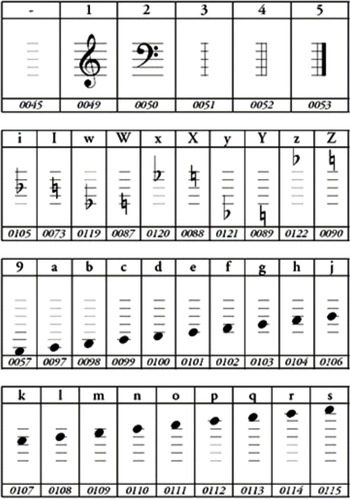
The basic character set for Volpiano font, in ASCII characters with corresponding notes on a modern five-line staff, appears in Figure 2.
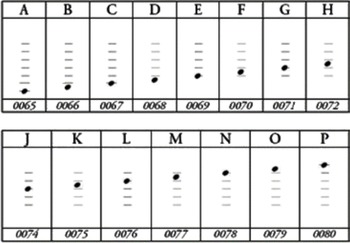
In this manner, the characters of Volpiano encoding represent pitches. Neume types, scribal nuances and so-called ‘ornamental’ neumes cannot be specified.Footnote 10 However, transcribers can make use of a second set of pitches which present with smaller note-heads, as shown in Figure 3.
Volpiano font and corresponding set of ASCII characters.

Volpiano font's secondary set of pitches.

The upper-case keystrokes correspond to the letter-notation of the lower-case set, and can be used to represent liquescents, quilismas, plicas or other types of inflected neumes. (Records submitted to cantus should specify the particular meaning of these smaller note-heads.)
In the cantus database, there are two fields available for melodic transcription in this font. One holds data for the full melody and the other for the melodic incipit, that is, the first pitches of the melody, those which correspond to the words of the ‘Textual Incipit’ field. In order to create a cantus transcription in Volpiano, begin with a clef (in this case, a non-transposing treble clef or a ‘1’), add three hyphens for some space on empty staff lines, and type lower-case ASCII letters to represent the pitches of a melody. After the last pitch of a complete melody, add three hyphens and a double bar line, that is, a ‘4’.
For cantus records, accidentals are entered as a single character (i.e., for B flat, an ‘i’, which gives a flat sign on the third line of the staff, would be given). If printing a musical example,Footnote 11 the character string should be edited by adding a note-head after the accidental (i.e., ‘ij’).
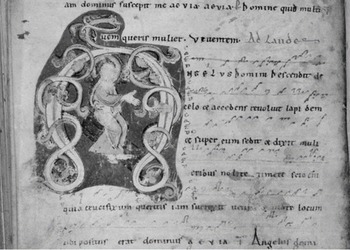
Since there is no facility in Volpiano for slur markings, ligature brackets or other metadata,Footnote 12 the spacing between the elements of alphabetic notation is an indicator of the context of the pitches in a melody. Current practice in cantus records is to enter three hyphens between words, two hyphens between syllables, and one hyphen between individual neumes which are sung on the same syllable. For example, the melodic incipit for the Easter responsory, Angelus domini descendit de (cao6093), as found in the manuscript Klosterneuburg, Augustiner-Chorherrenstiftsbibliothek, 1013 (hereafter A-KN 1013) on folio 144v, can be transcribed as: 1– – –f–fff– –dc– –df– – –fgf– –f– –df–gfe–f–fef– – –dfg– –hg–hk– –h– – –h– – –.
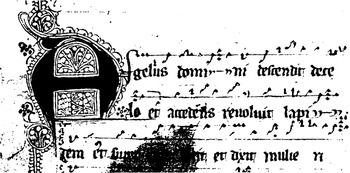
A-KN 1013, fol. 144v.

When the Volpiano font is applied to the data-string shown in Figure 5, it is transformed into musical notation, as shown in Figure 6.
Melodic string in letter notation.

Melodic string transformed into Volpiano font.

The textual incipit can be aligned under these pitches as shown in Figure 7 and Figure 8.
Pitch/text alignment in letter notation.

Pitch/text alignment in Volpiano font.

It will be useful to demonstrate here one small example of how effective the underlying encoding of Volpiano can be in research involving melodies. The melodic incipit of the same Easter responsory in the manuscript Klosterneuburg, Augustiner-Chorherrenstiftsbibliothek, 1018 (hereafter A-KN 1018), located on folio 2v, is shown in Figure 9.
Angelus domini in A-KN 1018, fol. 2v.

This contains nearly identical pitches as in A-KN 1013 in Figure 4, an antiphoner dating from two centuries earlier, yet the alignment of the syllables is either more clear in the later source or simply different from that in 1013. A-KN 1018 can be transcribed as shown in Figure 10.
Angelus domini in A-KN 1018 transcribed in Volpiano font.

When the data-strings for the two melodic incipits are aligned, the differences in the interpretation of the syllabic setting are demonstrated by the hyphens as shown in Figure 11.
Two melodic incipits for Angelus domini aligned as letter notation.

This difference may or may not be significant, and we believe it ought to be maintained in order to be true to the reading of the sources. But would this difference negatively affect research results in a melodic comparison? With a minor manipulation of the information in a secondary field, a fair treatment of this data can occur if the hyphens are removed from all character strings. In this case, the melodies are essentially an exact match, as shown in Figure 12.
Two melodic incipits in letter notation with hyphens removed.

The melodic comparison is even clearer when the repeated notes are removed (see Figure 13).Footnote 13
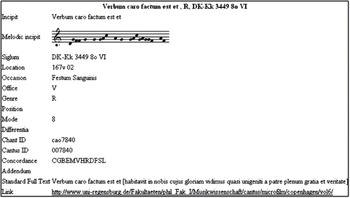
In addition to its advantages in personal research projects, the use of Volpiano is of vital importance on the cantus website to differentiate chants in cases where the modal assignment alone is insufficient for accurate identification of melodies. When a researcher searches the cantus website for a particular chant, the resulting record will be listed with a new, additional field, one which gives musical information just underneath the textual incipit as modern, round note-heads on a staff, provided Volpiano is running on the local computer. Footnote 14 Figure 14 shows the results of a cantus search for the responsory Verbum caro factum est in the late medieval antiphoner from Augsburg cathedral, now held in Copenhagen in the royal library Slotsholmen with the shelf-mark Gl. Kgl. Samling, 3449 8o, VI (hereafter DK-Kk 3449 8o).Footnote 15 Here, the melodic incipit shown is one of the most common opening phrases of responsories in mode 8.Footnote 16
Two melodic incipits in letter notation with repeated notes removed.

Verbum caro factum est in DK-Kk 3449 8o VI. in cantus.

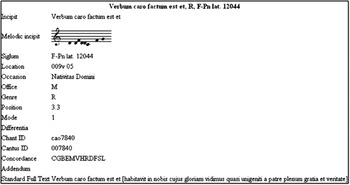
Searching for this responsory in cantus yields 284 results, each listed according to the manuscript in which it is found. While most sources assign the responsory Verbum caro to mode 8, there are some which record it in mode 1. When it is available, the Volpiano melodic incipit confirms immediately that the rare assignments to mode 1 are correct and that there are, indeed, two different melodies to which the text Verbum caro is set. Figure 15, for example, shows the record for Verbum caro as found in the twelfth-century antiphoner from the monastery of St Maur-des-Fossés, now held at the Bibliothèque nationale in Paris, shelf-mark lat. 12044 (hereafter F-Pn lat. 12044).
Verbum caro factum est in F-Pn lat. 12044 in cantus.

In this example, the assignment to mode 1 corresponds to the musical incipit and affirms that the different modal assignments in the various records are valid. Without the musical information encoded in Volpiano, the researcher might wonder if this modal assignment was a keystroke error, and would need to invest research time and effort into accessing images of the original source.Footnote 17
Along a similar vein, when considering whether the chants found with the same modal assignment were actually the same melody, a researcher using cantus alone, prior to the introduction of Volpiano incipits, had to rely on the mode number. For example, all manuscripts which set Verbum caro to a mode 8 melody might be assumed to contain the same melody, while those which set it in mode 1 might contain the same, rarer melody. No doubt, these sorts of assumptions are useful in sifting through the vast amounts of data for which chant research is infamous. Yet there are two scenarios in which the use of the numerical modal assignment alone can be misleading: first, when two different melodies for the same text are in the same mode, and, second, when the same melody for a text has been assigned to different modes.
Examples which illustrate these two possibilities will demonstrate the importance of Volpiano melodic incipits on the cantus website. In order to avoid ambiguous modal assignments in general, examples have been taken from the great responsory repertory because these chants are traditionally set to recognisable verse tones which correspond to their mode.
When combing through a long list of sources containing a specific chant, the first basic possibility for error is to assume that identical modal assignment indicates identical melody. Most scholars use the cantus website to help them answer a specific question in their own research and, because of the highly focused nature of most research, it is understandable that assumptions like this are made. However, each mode is known to contain hundreds of different melodies and so the chance does exist that a text is set to two different melodies in the same mode.
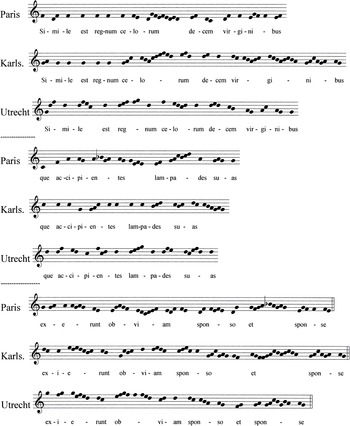
Figure 16 illustrates how misleading it may be to assume that the same modal assignment indicates the same melody. The cantus list of manuscripts where the responsory Simile est regnum caelorum appears shows that F-Pn lat. 12044 sets this text in mode 4, while Karlsruhe, Badische Landesbibliothek – Musikabteilung, Aug. LX (hereafter D-KA Aug. LX) and Utrecht, Universiteitsbibliotheek, 406 (hereafter NL-Uu 406) set it in mode 7. Without the addition of the Volpiano melodic incipit, it might be assumed that D-KA Aug. LX and NL-Uu 406 contain the same melody. The Volpiano melodic incipits are enough to signal the differences in these two mode 7 melodies.
Simile est regnum caelorum (cao7667) in F-Pn lat. 12044 in mode 4, D-KA Aug. LX and NL-Uu 406 in mode 7.

While D-KA Aug. LX initially emphasises the final, G, before its ascending melisma on ‘celorum’ which cadences on d, NL-Uu 406 makes the leap from G to d immediately, circling and repeating the reciting tone to the end of the phrase, and anticipating its high setting of ‘que accipientes lampades suas exierunt obviam’ in the next line. Compared with NL-Uu 406, D-KA Aug. LX maintains a more restricted range which could almost be interpreted as mode 8 if its melody ventured any lower than F, which it does not.
The inclusion of melodic information in cantus about this chant brings to light some interesting observations about melodic variance; without these melodic transcriptions, one would probably remain unaware of the divergent melodies if a detailed manuscript study were not undertaken. It is important to remember that computers, alone, will not be able to solve questions that people cannot, but the vagaries of modal assignments can be clarified by the kind of criteria the Volpiano encoding depends upon.
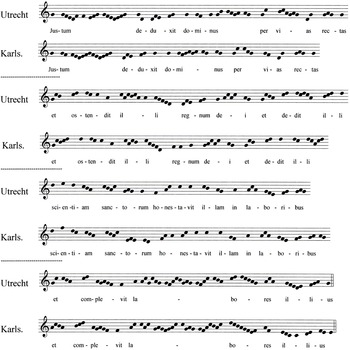
Another benefit to including Volpiano melodic incipits in cantus records is to rebuff the idea that a different modal assignment necessarily means that different melodies are used. Virtually identical responsory melodies can be found with different verse tones and, therefore, assigned to different modes. Figure 17 compares the manuscripts NL-Uu 406 and D-KA Aug. LX once more, this time comparing their melodies for the responsory Justum deduxit dominus, set to a mode 8 verse tone in NL-Uu 406 and a mode 3 verse tone in D-KA Aug. LX.
Justum deduxit dominus (cao7059) in NL-Uu 406 in mode 8 and D-KA Aug. LX in mode 3.

The version of Justum deduxit in NL-Uu 406 might be described as slightly more ornate than that of D-KA Aug. LX, especially at the concluding syllable of the word ‘dominus’, and on the words ‘vias’ and ‘dedit’ (although these last two might be described as the results of a syllabification shift). Outside these variants, however, the two melodies are very much the same. The deciding factor for their different modal assignments is found at their ends: D-KA Aug. LX cadences on E while NL-Uu 406 negotiates its way up a third, while maintaining the same melodic gesture, to cadence on G. Thus the melody in D-KA Aug. LX is categorised as mode 3 while the virtually identical melody in NL-Uu 406 is assigned to mode 8. From mode numbers alone, the researcher might interpret this to mean that these two sources contain different melodies for the same text. Reference to the Volpiano melodic incipits shows that this, obviously, is not the case.
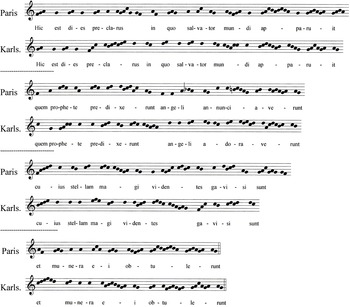
Another of the assumptions often made when comparing different modal assignments is that melodies assigned to both the authentic and the plagal version of a single modus are probably the same. This is frequently a correct assumption, but it benefits the researcher to proceed with caution when considering authentic and plagal modal assignments. Figure 18 shows the responsory Hic est dies preclarus, assigned to mode 8 in F-Pn lat. 12044 and mode 7 in D-KA Aug. LX. From the modal numbers alone, the researcher might assume that the scribes had simply assigned the authentic verse tone in D-KA Aug. LX and the plagal one in F-Pn lat. 12044 but that the melody of the respond was the same. Although the Volpiano melodic incipits contain some similar pitches, the melodies are clearly not the same. In fact, F-Pn lat. 12044 contains a very typical opening phrase for a mode 8 responsoryFootnote 18 while D-KA Aug. LX displays an equally typical mode 7 melody.Footnote 19 (One may also note that these two sources contain a different yet similar-sounding word at the end of the second line: F-Pn lat. 12044 shows the verb ‘annunciaverunt’ while D-KA Aug. LX contains ‘adoraverunt’.) F-Pn lat. 12044 and D-KA Aug. LX represent a fairly even split between the assignments of mode 7 or mode 8 in the manuscripts indexed for cantus. Admittedly, examples of this kind of melodic variance, between the plagal and the authentic versions of a modus, are rare. However, the introduction of Volpiano melodic incipits in cantus allows distinctions to be made between different melodies, regardless of modal assignment.
Hic est dies praeclarus (cao6821) in F-Pn lat. 12044 in mode 8 and in D-KA Aug. LX in mode 7.

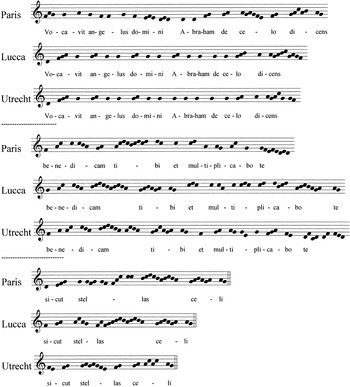
Vocavit angelus domini (cao7911) in mode 8 in F-Pn lat. 12044, I-Lc 601 and NL-Uu 406.

Perhaps this last statement is wide sweeping and in need of some qualification: Volpiano melodic incipits in cantus reflect distinctions between different melodies only when they appear in the first segment of the melody. cantus is, after all, a research tool and is no substitute for the manuscripts themselves when carrying out melodic analysis. Even when given the same Volpiano melodic incipit for a chant in the same mode, there may be melodic variants between sources which appear later in the chant. These will go unnoticed unless the original sources in question are consulted. (At some future date, complete melodies may be entered for every record in cantus, but this task is presently beyond the scope of the database's mandate.) Although a wealth of digital resources is becoming available, it is difficult to argue the fact that the most authoritative source is the original manuscript.
Figure 19 shows the mode 8 responsory Vocavit angelus domini as found in F-Pn lat. 12044, Lucca, Biblioteca capitolare Feliniana e Biblioteca arcivescovile, 601 (hereafter I-Lc 601) and NL-Uu 406. F-Pn lat. 12044 begins with a melody different from that of I-Lc 601 or NL-Uu 406, invoking the first scenario discussed earlier, where two melodies assigned to the same mode may be different. While I-Lc 601 and NL-Uu 406 have identical melodic incipits, these reveal nothing of the melodic variance which takes place between them in the last two phrases, beginning at ‘et multiplicabo te’. In addition, it is equally impossible to tell from the incipits alone that the melody in I-Lc 601 shows more similarity to that of F-Pn lat. 12044 in the final phrase than to NL-Uu 406.
While cantus staff work as time permits both to include Volpiano melodic information and to invite others to contribute such data to the website, this is an enormous task.Footnote 20 The official cantus mandate is to continue to index new sources rather than to add more detail to previously indexed records. Notwithstanding, the fields to store melodic data are now available in the event that an indexer wishes to provide this information. Those generously dedicating themselves to new indices for the site are encouraged to include melodic incipits or even full melodies in Volpiano if possible.
As the cantus database grows, its aim continues to be to provide scholars with accurate and extensive ‘tables of contents’ of medieval antiphoners and breviaries. It is hoped that this latest addition of Volpiano melodic incipits and full melodies will go some way to increasing the usefulness of the database. As a research tool, cantus is one of the first steps in a long process of exploration. Volpiano has made that step a little bigger.