Introduction
Understanding the forces shaping parasite communities has been one of the core points in parasite ecology. Amphibians exhibit great diversity in life histories and trophic relations, and inhabit a variety of environments; they can provide good models to investigate the ecological features likely to influence community structure (Aho, Reference Aho, Esch, Bush and Aho1990; Goater & Goater, Reference Goater and Goater2001). A wide range of factors may influence helminth community in amphibians, including host and parasite life history, host diet, age, gender, size and habitat (Aho, Reference Aho, Esch, Bush and Aho1990; Barton, Reference Barton1999; Muzzall et al., Reference Muzzall, Gillilland, Summer and Mehene2001; Bolek & Coggins, Reference Bolek and Coggins2003; Brooks et al., Reference Brooks, León-Regagnon, McLennan and Zelmer2006; Hamann et al., Reference Hamann, González and Kehr2006). Because of the low host specificity generally described among amphibian parasites, features of the hosts themselves are important mediators in transmission success (Aho, Reference Aho, Esch, Bush and Aho1990; Barton, Reference Barton1999). Host sex, for instance, may influence parasite communities due to morphological and behavioural constraints (McAlpine, Reference McAlpine1997; Bolek & Coggins, Reference Bolek and Coggins2001). Similarly, host size is considered an important predictor of parasite community structure, and a positive correlation between host size and parasite richness/abundance is somewhat expected (Poulin, Reference Poulin1997).
In the past decade, much attention has been devoted to understanding the impact of land use on parasite communities. Indeed, studies focusing on the influence of host habitat on helminth parasite communities have increased, especially those comparing helminth communities of disturbed and undisturbed habitats (Christin et al., Reference Christin, Ménard, Gendron, Rubys, Marcoglise, Rollins-Smith and Fournier2004; Hamann et al., Reference Hamann, González and Kehr2006; Koprivnikar et al., Reference Koprivnikar, Baker and Forbes2006; King et al., Reference King, McLaughlin, Gendron, Pauli, Giroux, Rondeau, Boily, Juneau and Marcogliese2007; McKenzie, Reference McKenzie2007). There are several biotic and abiotic habitat traits that seem to be important in the establishment of the parasite communities, such as the hydrological cycle, level of drying, landscape composition and associated organisms (Muzzall et al., Reference Muzzall, Gillilland, Summer and Mehene2001; Campião et al., Reference Campião, Delatorre, Rodrigues, Silva and Ferreira2012). Thus, host habitat also plays a critical role in parasite community structure (Aho, Reference Aho, Esch, Bush and Aho1990; Bursey et al., Reference Bursey, Goldberg and Parmelee2001; Muzzall et al., Reference Muzzall, Gillilland, Summer and Mehene2001; Zelmer et al., Reference Zelmer, Paredes-Calderón, León-Régagnon and García-Prieto2004).
Pantanal is one of the world largest continuous flood plains. It is highly productive and markedly seasonal because of its flood pulse and the influence of its surrounding areas, such as the Amazon Forest, the Atlantic Forest and savanna-like vegetation such as Chaco and Cerrado (Prance & Schaller, Reference Prance and Schaller1982). Aspects related to flood, relief, soil and vegetation resulted in a division of 11 subregions which may have distinct ecological traits (Silva & Abdon, Reference Silva and Abdon1998). The pointedbelly frog Leptodactylus podicipinus (Cope, 1862) is very abundant in Pantanal wetlands and can be found in forests and on the margins of permanent and temporary ponds. The wide geographical range of this species in the region provides an incentive for the investigation of the processes regulating community structure in different localities within a region.
The aim of this study was to describe and compare the helminth communities of three allopatric populations of L. podicipinus and to elucidate whether host sex and size are structuring these helminth communities. Specifically, we aimed to: (1) determine the richness and diversity of the helminth parasite infracommunities; (2) analyse the possible association between helminth abundance and species richness with frog size and sex; and (3) determine the richness and diversity of the helminth parasites of L. podicipinus at the component community level, evaluating the similarities among three distinct host populations.
Materials and methods
Study sites
Large wetlands, such as the Pantanal, are composed of many different subsystems. These subsystems are subjected to different environmental conditions, harbour different plant and animal communities, which interact with each other in many ways. This study was carried out with species collected in three subregions of south-eastern Pantanal, in the municipality of Corumbá, state of Mato Grosso do Sul, Brasil. The Abobral subregion is a low plain area of maximum flooding, fields may be submerged most of the year or even the entire year. Semi-deciduous forests that occur in higher areas are the only areas that do not flood. Within this region, frogs were collected in the surroundings of the Abobral River (19°30′14″S; 57°00′99″W). The Miranda subregion is characterized by open formations such as savannas and grasslands. Vegetation types also include riparian forests and patches of monotypical formations, as those composed of the silver trumpet tree Tabebuia aurea (Bignoniaceae) and palm trees (Copernicia australis, Arecaceae).The area is flooded from January to April (Silva & Abdon, Reference Silva and Abdon1998). Frogs were collected near the Miranda River (19°34′37″S; 57°00′42″W). The subregion Nhecolândia is one of the largest subregions of Pantanal in extent; within this region, our study site (18°59′0″S, 56°39′0″W) is predominantly influenced by the Cerrado (Brazilian savanna). The vegetation types that compose the landscape are distributed according to topographical variations and levels of flooding. Semi-deciduous forest occurs in higher areas, while flooded and non-flooded fields, savannas and permanent or temporary ponds (where the frogs were collected) occur in lower areas (Silva & Abdon, Reference Silva and Abdon1998). This area has little or no connection to rivers, the altitude varies from 100 to 120 m of sedimentary sandy soils.
Host and parasite collections
Anurans were hand captured between April 2008 and January 2009, as follows: 40 frogs from the margins of the Abobral River in January 2009, 44 collected at the Base de Estudos do Pantanal, located at margins of the Miranda River (24 in April and 20 in August 2008), and 39 from ponds in the Nhumirim farm, located in the subregion Nhecolândia (18 in April and 21 in August 2008).
Frogs were always transported alive to the laboratory, and the necropsies were performed at most 48 h after collection. Hosts had their snout–vent length (svl) recorded and were killed with sodium thiopental solution. Body cavity, digestive tract, accessory organs and musculature were examined for helminth parasites. All host specimens were deposited in the Coleção Zoológica de Referência do Campus de Corumbá, Seção Herpetologia (CEUCH) of the Universidade Federal de Mato Grosso do Sul, Brazil, currently allocated in the Departmento de Biologia in the city of Campo Grande State of Mato Grosso do Sul, Brazil.
Nematodes were fixed in hot alcohol–formaldehyde–acetic acid (AFA) solution; cestodes and trematodes were fixed under cover-slip pressure using cold AFA; and acanthocephalans were first maintained in cold water and then fixed in cold AFA. All helminths were preserved in 70% ethyl alcohol. For identification, acanthocephalans, cestodes and trematodes were stained with carmine and cleared with eugenol, while nematodes were cleared with lactophenol. Voucher parasite specimens were deposited in the Helminthological Collection of the Departamento de Parasitologia of the Instituto de Biociências (CHIBB), Universidade Estadual Paulista (UNESP), municipality of Botucatu, state of São Paulo, Brazil (voucher specimens — CHIBB 5090–5275, 5542–5562).
Data analysis
The term infracommunity refers to the helminth community in a single host, and component community is the helminth community in a host population (Bush et al., Reference Bush, Lafferty, Lotz and Shostak1997). Prevalence, mean intensity of infection and mean abundance were analysed as suggested by Bush et al. (Reference Bush, Lafferty, Lotz and Shostak1997). Differences in the mean abundances of parasite populations among component communities of the three localities were analysed statistically by the Kruskal–Wallis test (Hc), with the Bonferroni procedure. Differences in the svl of frogs from the three study sites were tested with an analysis of variance (ANOVA). The relation of the helminth community with host sex was calculated with a Wilcoxon rank sum test, and a Spearman Rank test (r) was used to test any correlation between host size and helminth species richness and abundance. The diversity and evenness of parasite infracommunities were calculated by the Brillouin diversity index (H) and the diversity and evenness of the component communities were calculated with the Shannon–Wiener diversity index, at a given locality (Magurran, Reference Magurran2004). Numerical dominance was calculated using the Berger–Parker dominance index, which we used to express the proportional importance of the most abundant species in each infracommunity (Magurran, Reference Magurran2004). Decreasing values in this index imply reduction in dominance of one species and thus, increasing diversity. Mean values are given with standard deviation. Differences in infracommunity species richness, diversity and dominance indexes among the three study sites were tested with a variance analysis (ANOVA) with Tukey pairwise comparisions.The Jaccard index was used to calculate qualitative similarity, based on the presence/absence matrix, and the Sorensen index was used to calculate quantitative similarity, based on the species abundance matrix. Statistical analyses were performed with the software Past 1.93 (Hammer et al., Reference Hammer, Harper and Ryan2001).
Results
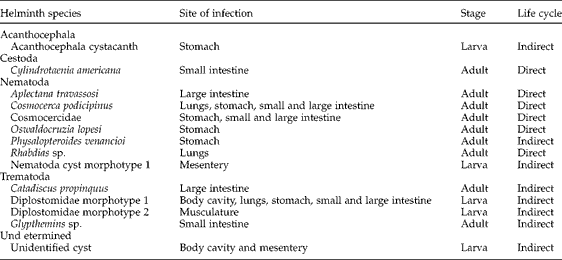
A total of 123 adult anurans were collected and we found 14 helminth taxa: 7 nematodes, 4 trematodes, 1 cestode, 1 acanthocephalan and an unidentified cyst (table 1). Leptodactylus podicipinus is a new host record for the Acanthocephala cystacanth, Cylindrotaenia americana Jewell, 1916, Diplostomidae spp. and Glypthelmins sp.
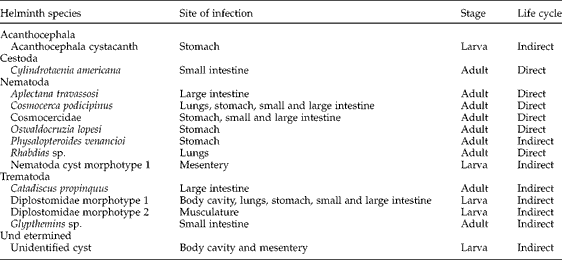
Site of infection, stage and life cycle of the helminth parasites of Leptodactylus podicipinus from south-eastern Pantanal, Brazil.
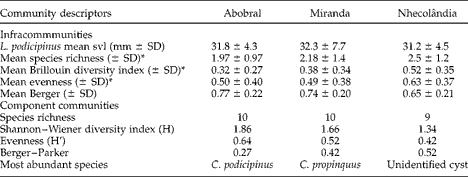
There was no difference in body size among frogs from the three study sites (F= 0.27; df = 2; P= 0.76). Infracommunity species richness varied from one to six helminth species per host (table 2). Both infracommunity species richness (F= 2.12; df = 2; P= 0.007) and diversity (F= 5.66; df = 2; P= 0.005) differed among locations; frogs from Nhecolândia had the highest mean values. Hence, infracommunities from this same region showed the highest values of evenness and the lowest dominance index (table 2). Host sex did not cause significant differences in helminth abundance (females = 62; males = 56, W= 1336.5; P= 0.07) or richness (W= 1403.5, P= 0.14). Also, there was no significant relation between frog body length (svl = 31.32 ± 0.45; 19.6–44.8 mm) and helminth abundance (r= 0.366) or richness (r= 0.301). Likewise, frog weight (3.0 ± 0.13; 0.8–8.6 g) was not related to helminth abundance (r= 0.43) or richness (r= 0.348).
Characteristics of the helminth infracommunities and component communities of Leptodactylus podicipinus from different locations of south-eastern Pantanal, Brazil.
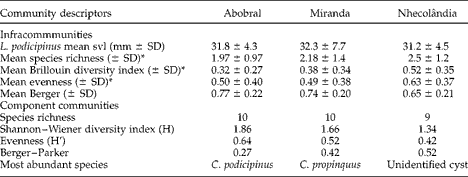
* Represents differences (P < 0.05) among localities.
At the component community level, the study site Abobral was composed of 10 species: 1 cestode, 6 nematodes, 2 trematodes and an undetermined cyst. The diversity and evenness of helminths in this study site were the highest of the three study sites, while the Berger–Parker dominance was the lowest (see table 2). The component community of Miranda was also composed of 10 species: 1 acanthocephala cystacanth, 7 nematodes, 1 trematode species and the undetermined cyst. In the locality Nhecolândia, 9 species were found: 1 acanthocephala cystacanth, 4 nematodes, 3 trematode species and the undetermined cyst. Only three species (the undetermined cyst, Catadiscus propinquus Freitas and Dobbin, 1956 and Cosmocerca podicipinus Baker and Vaucher, 1984) accounted together for 90% of all individuals composing the component community of this study site. Thus, the Berger–Parker dominance index was high and the diversity and evenness the lowest, compared to the other two study sites (table 2).
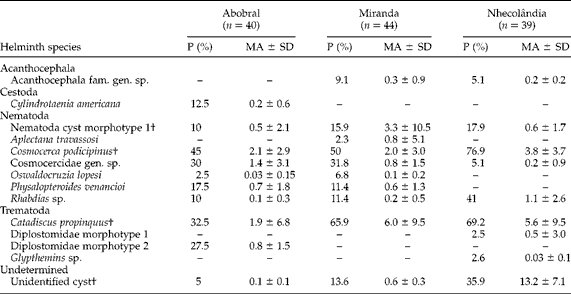
Out of 14 helminth taxa, the nematodes C. podicipinus, Cosmocercidae gen. sp., Rhabdias sp., an unidentified encysted nematode larvae, the trematode C. propinquus, and the undetermined cyst were found in the three localities (table 3). Cosmocerca podicipinus and C. propinquus were the most prevalent species in the three study sites, and along with Rhabdias sp. and the cyst showed significant differences in the mean abundance among the study sites (C. podicipinus Hc = 9.86; C. propinquus Hc = 14.98; Rhabdias sp. Hc = 16.8; P< 0.05; unidentified cyst Hc = 15.11; P< 0.05). The most similar component communities were those from Abobral and Miranda, both qualitatively and quantitatively (Jaccard index = 0.66 and Sorensen index = 0.80), while those from Abobral and Nhecolândia were the most different (Jaccard index = 0.46 and Sorensen index = 0.63). The component community from Miranda was more similar to the Nhecolândia in species abundance (Sorensen index = 0.73) than in species composition (Jaccard index = 0.58).
Prevalence (P), mean intensity (MI) and mean abundance (MA) of the helminth parasites of Leptodactylus podicipinus from three different localities of south-eastern Pantanal, Brazil.

† Represents differences (P < 0.05) in mean abundances.
Discussion
The structure of parasite communities varied among different study sites. At the infracommunity level, frogs from Nhecolândia showed the highest helminth diversity and evenness. Analysis on component communities had different results: the component community of the region Abobral had the highest diversity index and evenness and did not have a dominant species. On the other hand, Nhecolândia had the lowest values of diversity and evenness, with few species dominating the community. Both Abobral and Miranda are interspersed by lotic ecosystems and this might lead helminth component communities to higher diversity and evenness, when compared to Nhecolândia.
Although we observed differences in the distribution and abundance of parasites in the study sites, the separation of the parasite communities into the three different groups was not particularly strong, considering the similarity indexes that were often close to or higher than 50%. Nevertheless, we suggest that the differences found among the three component communities are driven by locally operating biotic and abiotic factors. These differences stress the importance of local conditions, such as hydrological characteristics and landscape composition, on helminth community structure. In fact, both host and parasite abundances are often related to landscape features (Hudson et al., Reference Hudson, Dobson and Lafferty2006).
As in some studies (Bolek & Coggins, Reference Bolek and Coggins2001; Hamann et al., Reference Hamann, González and Kehr2006), we did not find differences between parasite communities of males and females. Furthermore, host size (body length and weight) has been accepted as an important factor determining parasite richness and abundance in infracommunities (Poulin, Reference Poulin1997), but no correlation was detectable here for L. podicipinus. However, adult frogs of this species have a helminth fauna significantly more diverse than young frogs that did not reach sexual maturity (Campião et al., Reference Campião, Silva and Ferreira2009). So, we can assume that, for L. podicipinus populations, the diversity of the helminth community is favoured in adult and sexually mature frogs. But among the adult hosts, larger frogs do not necessarily harbour a richer or more abundant helminth community. Indeed, ontogeny is considered a key factor influencing helminth community structure; it causes changes in the organization of the community through the influence of changes in diet, immunocompetence and behaviour of the host, and time of exposure to infective parasite stages (Esch et al., Reference Esch, Shostak, Marcogliese, Goater, Esch, Bush and Aho1990).
The acanthocephalan cystacanths were found in frogs from Miranda and Nhecolândia. Acanthocephala species are rarely reported in amphibians from South America (Smales, Reference Smales2007). At least two hosts are required in the life cycle of this group, an invertebrate intermediate host and a vertebrate final host. The cystacanth stage found in this study indicates that L. podicipinus is acting as a paratenic host (Kennedy, Reference Kennedy2006). The absence of this parasite in the Abobral region might be due to the lack of a suitable intermediate host. In contrast, C. americana was only found in frogs from Abobral. This cestode infects terrestrial, aquatic and arboreal amphibian species widespread in Nearctic and tropical regions (Goldberg et al., Reference Goldberg, Bursey, Gergus, Sullivan and Truong1996; Bursey et al., Reference Bursey, Goldberg and Parmelee2001; Cabrera-Guzmán et al., Reference Cabrera-Guzmán, León-Régagnon and Garcia-Prieto2007). Cylindrotaenia americana has a direct life cycle and the infection occurs through ingestion of eggs (Stumpf, Reference Stumpf1982).
The Cosmocercidae Aplectana travassosi Vicente & Santos, 1970 infects the host through ingestion of the larvae (Anderson, Reference Anderson2000). The very low prevalence, only one frog infected, might indicate that the feeding behaviour of L. podicipinus does not favour infection by A. travassosi and/or the low availability of infective stages in the environment. On the other hand, C. podicipinus was the most prevalent species in all study sites. This species has been reported at high prevalence for many amphibian hosts, especially terrestrial and semi-terrestrial anurans, in the neotropics (Bursey et al., Reference Bursey, Goldberg and Parmelee2001; Goldberg & Bursey, Reference Goldberg and Bursey2003, Reference Goldberg and Bursey2008; Hamann et al., Reference Hamann, González and Kehr2006). The high prevalence of C. podicipinus in terrestrial anurans may be explained by the transmission dynamics of this parasite; the infective larva penetrates the host skin and then migrates to the intestine where it releases its eggs with faeces of the host. Amphibian sedentary behaviour (Zug et al., Reference Zug, Vitt and Caldwell2001) may enhance the recruitment rate of direct life cycle parasites with a skin-penetrating transmission dynamic (Aho, Reference Aho, Esch, Bush and Aho1990; Cabrera-Guzmán et al., Reference Cabrera-Guzmán, León-Régagnon and Garcia-Prieto2007). The same can be stated about infection by the nematodes Oswaldocruzia lopesi Freitas & Lent, 1938 and Rhabdias sp. However, these nematodes were less frequent, probably due to the low availability of infective stages.
Physalopteroides venancioi Lent, Freitas & Proença, Reference Lent, Freitas and Proença1946 has been found in several species of frogs and lizards from Peru (Bursey et al., Reference Bursey, Goldberg and Parmelee2001, Reference Bursey, Goldberg and Parmelee2005) and Brazil (Lent et al., Reference Lent, Freitas and Proença1946, Ávila & Silva, Reference Ávila and Silva2009), including L. podicipinus (Campião et al., Reference Campião, Silva and Ferreira2009). The infection of this species is likely to require an intermediate host (Anderson, Reference Anderson2000). The absence of P. venancioi in one of the study sites (Nhecolândia) might be due to the lack or rarity of an appropriate intermediate host in that locality.
Catadiscus propinquus was the second most prevalent species in the three regions and was a dominant species (>50%) in frogs collected from Miranda and Nhecolândia. The distribution of C. propinquus seems to be restricted to South America and its infection may occur with ingestion of the infective metacercariae. An immature individual of Glypthelmins sp. was collected in one frog from Nhecolândia, this could not be identified to species level, although this specimen is likely to be Glypthelmins palmipedis (Lutz, 1928) Travassos, 1930, which infects the paradoxal frog Pseudis platensis Gallardo, 1961 (Campião et al., Reference Campião, Silva and Ferreira2010). Pseudis platensis has an aquatic lifestyle, but is sympatric with L. podicipinus, and was collected in the same study site. Thus, we can infer that L. podicipinus is not a preferred host for Glypthelmins spp., and/or the semi-terrestrial habit of L. podicipinus does not favour infection by these parasites.
The Diplostomidae morphotype 1 was found at a relatively high intensity, infecting most of the organs of a single host specimen from Nhecolândia. On the other hand, a different species of Diplostomidae was found in the limb musculature of some frogs from the study site Abobral. The occurrence of this trematode may be related to the high abundance of bivalves observed in that area, as digenetic trematodes require molluscs as intermediate hosts to complete their life cycle. An undetermined cyst was collected from the body cavity and leg musculature of frogs from the three localities. These cysts were very undifferentiated and could not be identified, although they seemed to be important components of the helminth communities in the three localities and presented significantly higher mean abundance and intensity in the study site Nhecolândia.
Overall, parasite community structure varied according to host collection site. Thus, we suggest habitat structure to be an important factor influencing the structure of helminth parasite communities of L. podicipinus. Because habitat is a broad term and covers all the biotic and abiotic variables in each collection site, the differences in the composition and abundance among helminth component communities may be caused by a single environmental variable or by a set of them. Indeed, we believe it might be especially due to the flood pulse and hydrological dynamics within the Pantanal sub-regions, which also dictate the structure of vegetation and associated animals. Moreover, understanding whether the absence of some parasite species in certain locations is due to their geographic distribution or to local ecological factors may be quite challenging. Still, the findings of the present study and the data reported by Campião et al. (Reference Campião, Silva and Ferreira2009, Reference Campião, Delatorre, Rodrigues, Silva and Ferreira2012) suggest that local ecological conditions and host age are the factors most likely to influence the structure of helminth component communities of L. podicipinus from south-eastern Brazil.
Acknowledgements
We thank all our colleagues who helped in the collections of frogs. We are grateful to anonymous reviewers for helpful comments. We also thank Embrapa-CPAP for logistical support. This study was partially supported by: Fundação de Apoio ao Desenvolvimento do Ensino, Ciência e Tecnologia do Estado de Mato Grosso do Sul (41/100.169/2006; 23/200.010/2008), Conselho Nacional de Desenvolvimento Científico e Tecnológico (486039/2006-4), Fundação de Amparo à Pesquisa do Estado de São Paulo (04/03628-1) and Centro de Pesquisas do Pantanal. K.M.C. was supported by a fellowship of the Coordenação de Aperfeiçoamento de Pessoal de Nível Superior (CAPES).