Pneumonia is the second most common healthcare-associated infection worldwide,Reference Vincent, Rello and Marshall 1 – Reference Liapikou, Polverino and Cilloniz 3 occurring at a rate between 5 and 20 cases per 1,000 hospital admissions.Reference Chawla 2 , 4 Pneumonia occurs in long-term care residents at a high rate, ranging from 0.27 to 2.5 per 1,000 patient days.Reference Liapikou, Polverino and Cilloniz 3 , Reference Muder 5 Healthcare-associated pneumonia substantially increases cost of careReference Kollef, Shorr, Tabak, Gupta, Liu and Johannes 6 and mortality.Reference Muder 5 Thus, preventing pneumonia is a cost-reducing and lifesaving healthcare practice, both in acute and chronic care facilities.
Individuals in healthcare facilities frequently acquire pneumonia by aspirating oral bacteria that has been colonized in the oral flora into the lower airway.Reference Johanson, Pierce and Sanford 7 Patients often have difficulties performing their own oral hygiene due to illness, old age, dementia, or functional disabilities. Consequently, respiratory pathogens are prone to colonization in dental plaque and the oral mucosa of such populations. Reduction of oral microorganisms through oral care has been postulated to be an effective preventative measure of healthcare-associated pneumonia.Reference El-Solh 8 – Reference van der Maarel-Wierink, Vanobbergen, Bronkhorst, Schols and de Baat 11
Oral care can include chemical oral disinfection with topical application of antiseptic agents such as chlorhexidine, or with broad-spectrum antibiotics. Another approach is mechanical cleaning, including tooth brushing and supplemental oral care provided by dental professionals.Reference Pace and McCullough 12 , Reference Tada and Miura 13 The effect of oral care has been intensively studied in critically ill patients who are at high risk for ventilator-associated pneumonia (VAP). Several meta-analyses have reported significant effects of oral decontamination with antisepticReference Labeau, Van de Vyver, Brusselaers, Vogelaers and Blot 14 – Reference Chlebicki and Safdar 17 and antibiotic agents.Reference Labeau, Van de Vyver, Brusselaers, Vogelaers and Blot 14 , Reference Price, MacLennan and Glen 18 One recent randomized controlled trial (RCT) also showed an effect of tooth brushing on VAP prevention.Reference Yao, Chang, Maa, Wang and Chen 19
Unlike VAP, the effect of oral care for preventing pneumonia has not been well established in individuals without ventilatory support. Sjogren et alReference Sjogren, Nilsson, Forsell, Johansson and Hoogstraate 20 conducted a systematic review to examine the effect of oral hygiene for non–ventilator-associated pneumonia, or non-VAP, including 4 RCTs. All 3 studies demonstrated that their oral care interventions significantly reduced incidence of pneumonia. However, meta-analyses were not carried out because of clinical heterogeneity among the 3 studies. Thus, the magnitude of effect of oral hygiene in nonventilated patients is unknown. Further, the search was performed using only 2 databases, possibly omitting unpublished ‘grey’ literature and studies in other languages. To address this limitation, using broader search strategies and including other languages, we conducted an updated and more inclusive systematic review with a meta-analysis of RCTs to estimate the effectiveness of oral care in preventing pneumonia in nonventilated patients.
METHODS
This study was reported in accord with the Preferred Reporting Items for Systematic Reviews and Meta-Analyses statement. Reference Liberati, Altman and Tetzlaff 21 Methods for this study were predefined and registered in a protocol at the Centre for Reviews and Dissemination (no. CRD42014010435).
Literature Search
A comprehensive search of the literature through June 30, 2014 was performed by 2 investigators. The electronic databases used for the search were PubMed (MEDLINE), Embase, Web of Science, the Cumulative Index to Nursing and Allied Health Literature (CINAHL), the Cochrane Clinical Trial Registry of Controlled Trials (CENTRAL), Latin American and Caribbean Health Sciences Literature (LILACS), Igaku Chuo Zasshi (ICHUSHI; Japanese), and Scholarly and Academic Information Navigator (CiNii; Japanese). Combinations of the following terms were used for the search: health facilities, hospital, geriatric nursing, inpatients, intensive care unit, pneumonia, aspiration pneumonia, respiratory tract infection, oral hygiene, oral decontamination, oral health, mouthwashes, and tooth brushing. We translated the keywords into Spanish to search LILACS and into Japanese to search ICHUSHI and CiNii. Further searches were performed in 2 trial registries to identify unpublished studies: ClinicalTrials.gov and International Clinical Trial Registry Platform. We also scanned reference lists and previously published review articles for additional studies.
Study Selection
We included studies that met the following criteria: (1) published or unpublished RCTs; (2) were primary studies (not duplicate studies or reviews); (3) examined the incidence of pneumonia or mortality; (4) studied adults (18 years or older) in hospitals or long-term care facilities; (5) examined chemical oral disinfection and/or mechanical oral cleaning; and (6) reported sufficient data to calculate the relative risk (RR) for pneumonia or mortality. Exclusion criteria were set for studies that examined patients with mechanical ventilation. No language or publication date restrictions were imposed. Any objective criteria for diagnosing were accepted, including fever, leukopenia or leukocytosis, and/or analysis of x-ray film images.Reference Horan, Andrus and Dudeck 22
Independently, 2 of the authors screened titles and abstracts of the retrieved citations for potentially relevant publications. All eligible studies were read in full by 2 of the authors. Disagreements between reviewers were resolved by consensus. Publications written in languages other than English, Spanish, or Japanese, were reviewed by healthcare professionals native to that language.
Data Extraction and Risk of Bias Assessment
The following information was extracted from each included trial: (1) study characteristics: country, duration of follow up; (2) participants: sample size, inclusion/exclusion criteria, methods of diagnosis of pneumonia; (3) intervention: type, dose, and frequency of oral care, (4) control: type, dose, and frequency of placebo or other oral care, (5) outcome measure: incidence of pneumonia or number of deaths due to pneumonia. The data were extracted by one author from included studies, and the second review author verified the extracted data. Disagreements were discussed and resolved by the reviewers. Two reviewers independently assessed the risk of bias of the included trials using the Cochrane Collaboration’s tool for assessing risk of bias on 6 domains: sequence generation, allocation concealment, blinding, selective outcome reporting, completeness of outcome data, and other potential sources of bias.Reference Higgins, Altman and Gotzsche 23
Statistical Analyses
The primary outcome measure of treatment effect was the relative risk for pneumonia; the secondary outcome was the mortality rate of pneumonia. The pooled RR and its 95% confidence interval were obtained using the Mantel-Haenszel fixed effects model when the studies were statistically homogeneous. Statistical heterogeneity was assessed using the I2 measure. Heterogeneity levels were prespecified as follows: I2≤25% for low, 25%<I2<50% for moderate, and I2≥50% for high. A priori hypotheses to explain the reasons for heterogeneity were patient population (hospitalized patients vs nursing home residents) and intervention type (chemical decontamination vs mechanical cleaning). P<.05 was considered statistically significant. Statistical analyses were performed with Review Manager 4.2 (Cochrane Collaboration, Oxford).
RESULTS
Study Selection
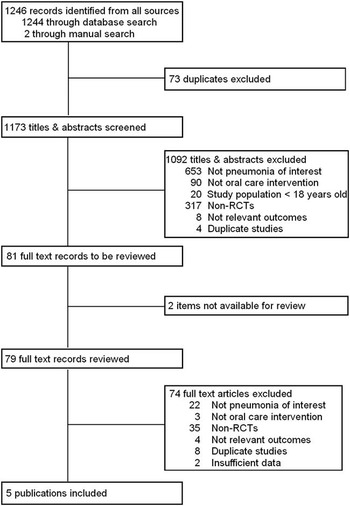
A total of 1,246 records were identified from all sources (Figure 1). After excluding duplicates, 1,173 titles and abstracts were screened for eligibility; 79 studies (58 studies written in English, 17 in Japanese, 2 in Dutch, 1 in Spanish, and one in German) were read in full for eligibility. Finally, 5 studies consisting of 1,009 subjects met all inclusion criteria and were included in the final systematic review. We contacted all 5 authors and 2 of them provided missing information on study design and outcome data.
Summary of literature search and study selection.

Characteristics of Included Studies
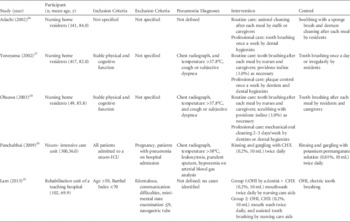
Characteristics of the reviewed RCTs are presented in Table 1. All 5 trials were published in English. Two studies examined oral chlorhexidine in hospital settings,Reference Panchabhai, Dangayach, Krishnan, Kothari and Karnad 24 , Reference Lam, McMillan, Samaranayake, Li and McGrath 25 and 3 trials assessed the effectiveness of mechanical oral care in nursing homes.Reference Adachi, Ishihara, Abe and Okuda 26 – Reference Ohsawa, Yoneyama, Hashimoto, Kubota, Ito and Yoshida 28
Characteristics of Randomized Controlled Trials Included in the Systematic Review

NOTE. CHX, chlorhexidine; ICU, intensive care unit; OHI, oral hygiene instruction.
Of the 2 hospital trials, 1 study compared 0.2% chlorhexidine to a placebo solution (0.01% potassium permanganate).Reference Panchabhai, Dangayach, Krishnan, Kothari and Karnad 24 This study included patients in an intensive care unit both with and without mechanical ventilation support. For the purpose of the present systematic review, we extracted the information of the nonventilated patients from the study population. The other trial compared oral hygiene instruction alone to 0.12% chlorhexidine gargle in combination with assisted and unassisted toothbrushing.Reference Lam, McMillan, Samaranayake, Li and McGrath 25
In the 3 nursing home trials,Reference Adachi, Ishihara, Abe and Okuda 26 – Reference Ohsawa, Yoneyama, Hashimoto, Kubota, Ito and Yoshida 28 residents assigned to the experimental groups received tooth brushing after each meal performed by nursing home staff, caregivers, or nurses. Additional professional care was provided by dental professionals onceReference Adachi, Ishihara, Abe and Okuda 26 , Reference Yoneyama, Yoshida and Ohrui 27 or 2–3 times per week.Reference Ohsawa, Yoneyama, Hashimoto, Kubota, Ito and Yoshida 28 Residents in the control groups brushed their teeth themselves once a day or irregularly,Reference Yoneyama, Yoshida and Ohrui 27 or after each mealReference Adachi, Ishihara, Abe and Okuda 26 , Reference Ohsawa, Yoneyama, Hashimoto, Kubota, Ito and Yoshida 28 with assistance by caregivers or nursing home staff as needed. Although professional mechanical cleaning was the primary experimental intervention in the 3 nursing home trials, 2 trials also utilized a minimum amount of povidone iodine (1%) for scrubbing the oral cavity in the experimental groups only when the tooth brushing was not adequate.Reference Yoneyama, Yoshida and Ohrui 27 , Reference Ohsawa, Yoneyama, Hashimoto, Kubota, Ito and Yoshida 28 The number of patients who received povidone iodine was not specified in either study.
As outcome measures, 4 studies reported the incidence of pneumonia,Reference Panchabhai, Dangayach, Krishnan, Kothari and Karnad 24 , Reference Lam, McMillan, Samaranayake, Li and McGrath 25 , Reference Yoneyama, Yoshida and Ohrui 27 , Reference Ohsawa, Yoneyama, Hashimoto, Kubota, Ito and Yoshida 28 and 2 studies noted the incidence of fatal pneumonia.Reference Adachi, Ishihara, Abe and Okuda 26 , Reference Yoneyama, Yoshida and Ohrui 27 Of those studies, Adachi et alReference Adachi, Ishihara, Abe and Okuda 26 reported only the number of fatal pneumonia cases.Reference Adachi, Ishihara, Abe and Okuda 26 We considered the study population and methods of intervention in the study by Adachi et al to be similar enough to the study by Yoneyama et alReference Furukawa, Barbui, Cipriani, Brambilla and Watanabe 29 to estimate the missing pneumonia incidence. Therefore, we imputed the number of patients who would have developed pneumonia in Adachi’s study based on the ratio of pneumonia and fatal pneumonia reported by Yoneyama et al.Reference Yoneyama, Yoshida and Ohrui 27 This analysis required computing the ratio of number of pneumonias to the number of fatal pneumonias per arm in the Yoneyama study and multiplied that by the number of fatal pneumonias per arm in the Adachi study to obtain the number of pneumonias per arm in the Adachi study. The study by Ohsawa et alReference Ohsawa, Yoneyama, Hashimoto, Kubota, Ito and Yoshida 28 only reported the mean frequency of pneumonia per patient, so we computed the approximate estimate of the number of subjects who would have developed pneumonia by multiplying the reported mean frequency of pneumonia by number of participants in each group. No pneumonia occurred in 1 hospital trial;Reference Lam, McMillan, Samaranayake, Li and McGrath 25 thus the effect of the interventions could not be tested and this study was not included in the meta-analysis.
Meta-analysis on Preventing Pneumonia
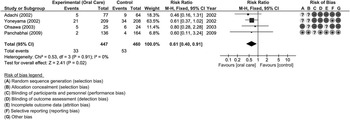
We employed an intention-to-treat analysis when the data were availableReference Adachi, Ishihara, Abe and Okuda 26 – Reference Ohsawa, Yoneyama, Hashimoto, Kubota, Ito and Yoshida 28 to minimize bias from treatment-related attrition. None of the 4 individual RCTs showed significant risk reduction in preventing pneumonia in nonventilated patients through oral care (Figure 2). We then performed a meta-analysis of 4 RCTs to assess the pooled effect of oral care with topical chlorhexidine or mechanical oral cleaning on the occurrence of non-VAP.Reference Panchabhai, Dangayach, Krishnan, Kothari and Karnad 24 , Reference Adachi, Ishihara, Abe and Okuda 26 – Reference Ohsawa, Yoneyama, Hashimoto, Kubota, Ito and Yoshida 28 The Cochran-Mantel-Haenszel fixed effect analysis showed a significant overall effect of oral care interventions in reducing the risk for developing pneumonia as compared with a control condition (RR, 0.61; 95% CI, 0.40–0.91; P=.02), with no statistical heterogeneity (χ2=0.53; df=3; P=.91; I2=0%). This significant effect was altered slightly when the imputed studyReference Adachi, Ishihara, Abe and Okuda 26 was excluded from the meta-analysis (RR, 0.64; 95% CI, 0.41–1.00; P=.05). Of the 4 trials, 3 demonstrated high risk of bias for 1 or more key domains (Figure 2), suggesting the potential for inflated estimates of treatment effect.Reference Higgins and Green 30
Effects of oral care on preventing non–ventilator-associated pneumonia (non-VAP).

Due to the limited number of eligible studies, subgroup analysis was only possible on the effect of mechanical oral cleaning in elderly nursing home residents.Reference Adachi, Ishihara, Abe and Okuda 26 – Reference Ohsawa, Yoneyama, Hashimoto, Kubota, Ito and Yoshida 28 The combined effect of mechanical oral care in combination with professional care significantly reduced the risk for nursing home–acquired pneumonia (RR, 0.61; 95% CI, 0.40–0.92; P=.02), with no statistical heterogeneity (χ2=0.53; df=2; P=.77; I2=0%; Fig. 3).
The effect of mechanical oral care on non–ventilator-associated pneumonia (non-VAP).

Meta-analysis on Preventing Fatal Pneumonia
Pooled RR for fatal pneumonia was significant (RR,0.41; 95% CI, 0.23–0.71; P=.002) with no statistical heterogeneity (χ2=0.94; df=1; P=.33; I2=0%), suggesting that mechanical oral care significantly reduced the risk for fatal pneumonia in elderly nursing home residents (Fig. 4).
The effect of mechanical oral care on fatal pneumonia in nursing home residents.

DISCUSSION
To summarize the current best evidence, we conducted a systematic review and meta-analysis on the effect of oral care in preventing non-VAP. Overall, oral care interventions showed a significant risk reduction for developing pneumonia in nonventilated patients. This effect remained significant when the effects of mechanical oral care in combination with professional care were pooled across studies. The analysis also revealed that mechanical oral cleaning was associated with a significant risk reduction of fatal pneumonia in the elderly in nursing homes.
Our finding supports the benefit of oral care in pneumonia prevention in the nonventilated patient population. This finding is consistent with a previous finding of a systematic review by Sjogren et alReference Sjogren, Nilsson, Forsell, Johansson and Hoogstraate 20 that summarized the positive effect of oral care in preventing healthcare-associated pneumonia based on the results of 3 RCTs, reporting that absolute risk reductions ranged from 6.6% to 11.7%. However, this overall effect in our review should be interpreted with caution. The majority of the primary RCTs presented selection bias in that they did not include participants with high-risk factors for pneumonia, such as patients with nasogastric tubes or severe dementia.Reference Langmore, Skarupski, Park and Fries 31 Consequently, the incidence of pneumonia in the RCTs may have been underestimated. We accepted any objective criteria for diagnosing pneumonia because we believe that the investigators of each study would use the best possible diagnostics available for their setting. The variable diagnostic criteria of pneumonia across the RCTs may also have contributed to inconsistent sensitivity in detecting pneumonia incidence. For example, 2 RCTs did not provide the definition of pneumonia. Only 1 of the included studies stated that pneumonia that was present on admission would be excluded despite it being one of the criteria for healthcare-associated pneumonia as defined by the Centers for Disease Control and Prevention.Reference Horan, Andrus and Dudeck 22 It is possible that these studies misclassified pneumonia present on admission as a hospital-acquired pneumonia. Pneumonia and pneumonitis may also have been misclassified.Reference Mylotte, Goodnough and Naughton 32 Even though this lack of uniformity adds bias to the analysis, we performed the meta-analyses because it is unlikely that researchers across the world use a consistent definition of healthcare-associated pneumonia.
The 3 mechanical oral cleaning studies conducted in nursing homes were considered to be clinically and statistically homogeneous, most likely because they utilized similar intervention protocols on participants with similar demographics. This homogeneity across the included RCTs led to a conclusion that routine mechanical oral care in conjunction with professional care is effective in preventing pneumonia in nursing home residents. It is possible that the risk reduction through mechanical oral cleaning may have been overestimated with the potential effect of povidone iodine provided in 2 of 3 RCTs, although the reported effect of povidone iodine in preventing healthcare-associated pneumonia is unclear.Reference Labeau, Van de Vyver, Brusselaers, Vogelaers and Blot 14
In 2 RCTs on fatal pneumonia, mechanical oral care was suggested to reduce the risk of death due to pneumonia in nursing home residents. Fatal pneumonia accounts for 57% of pneumonia cases in nursing home residents.Reference El-Solh, Aquilina, Dhillon, Ramadan, Nowak and Davies 33 Older age and multiple comorbidities, commonly found in this population, are considered significant contributors.Reference Polverino and Torres 34 Our pooled estimate of studies indicates mechanical oral care may potentially provide lifesaving care for such a fragile population.
To our knowledge, this paper is the first systematic review that includes a meta-analysis to assess the effectiveness of oral care in nonventilated patients. The strengths of this review include the preregistered protocol, duplicate screening, data extraction, and risk of bias assessment. We attempted to minimize selection bias by systematically searching 8 databases and allowing any language to be eligible for review. Using imputation helped retain the incidence of pneumonia in one RCT. Intention to treat analysis was possible from 3 of the 4 included trials, avoiding the effect of bias from treatment-related attrition on the results. The subgroup analysis was performed on clinically and statistically homogeneous studies, allowing for an estimate of effect of mechanical oral care in nursing home residents.
Our review has some limitations. The limited number of studies reduced the statistical power of the meta-analysis and prevented reliable visual inspection for publication bias using a funnel plot. The imputed incidence of pneumonia may have slightly altered the effect of oral care in our meta-analysis. The majority of studies included were at high risk of various biases, making the results of our analyses less conclusive. There may be eligible RCTs archived in databases that we did not use for literature search and thus were not identified. Finally, optimal frequency of both chemical disinfection and mechanical cleaning remains unclear. Our review could not verify whether mechanical or chemical oral care is more effective in preventing pneumonia.
We identified 2 additional unpublished studies (ie, NCT00975780, NCT00841074) that could have fulfilled our criteria. Both studies, recently completed, examined the effect of chlorhexidine oral rinse decontamination in large numbers of nursing home residents. These trials were not included in our current review because the outcome data were not available at the time of our analysis.
Our systematic review and meta-analyses of RCTs showed oral care potentially reduced the risk of pneumonia in nonventilated patients. Mechanical oral cleaning in combination with professional care decreased the incidence of nursing home–acquired pneumonia and death from pneumonia. Oral care is not listed in existing published guidelines for preventing non-VAP, likely due to insufficient current knowledge to support its significance. 4 Further studies are needed to establish the evidence of the best type of preventive oral care in individuals in long-term care facilities and to determine whether the same positive effects can be achieved in hospitalized patients.
Acknowledgments
We are grateful to Lisa Philpotts and Helena Vonville for sharing their expertise in systematic searching. We thank Brittany Peterson and Katey Felling for their assistance in checking our data presentation. We also thank Troy Thiel for reviewing a German article and Cherie Mars for reviewing Dutch articles.
Financial support: No funding was received for this study.
Potential conflicts of interest: All authors report no conflicts of interest relevant to this article.