Developmental programming has emerged as a leading mechanism contributing to later physical and mental health. A key feature of the model is the hypothesis that the developing organism adapts to early exposures. This programs or sets the body's response, for example, stress response or metabolism, with changes in development, in anticipation of subsequent challenges (Gluckman, Hanson, Spencer, & Bateson, Reference Gluckman, Hanson, Spencer and Bateson2005). The programming hypothesis has been primarily studied as a fundamental biological mechanism that holds across individuals. However, it is clear that, for all outcomes so far studied, not all individual are affected (Bergman, Sarkar, O'Connor, Modi, & Glover, Reference Bergman, Sarkar, O'Connor, Modi and Glover2007); the sources of this variation among individuals have not yet received significant research attention. In the current paper, we examine the hypothesis that polymorphisms in the brain-derived neurotrophic factor (BDNF) gene in the child moderate individual differences in the programming of child/adolescent internalizing symptoms by prenatal maternal anxiety.
A starting point for this research is the prediction of internalizing symptoms in the child from prenatal maternal anxiety or stress. A robust association is suggested given the diversity of samples in which an effect has been reported, the variety of maternal prenatal measures used, the variation in child age at assessment, and the outcome measures employed (Davis & Sandman, Reference Davis and Sandman2012; O'Donnell, Glover, Barker, & O'Connor, Reference O'Donnell, Glover, Barker and O'Connor2014; Robinson et al., Reference Robinson, Mattes, Oddy, Pennell, van Eekelen and McLean2011; Van den Bergh, Van Calster, Pinna Puissant, & Van Huffel, Reference Van den Bergh, Van Calster, Pinna Puissant and Van Huffel2008). However, it is equally clear that there is wide variation in the effects on the child. Understanding the sources of this variation among individuals in response to maternal prenatal anxiety is a key research task because of the potential value for developmental science and clinical practice.
Despite the large literature linking prenatal maternal anxiety or stress to child health and behavioral outcomes, remarkably few studies have looked for evidence of vulnerability or protective factors that moderate the prenatal anxiety effect. Analyses of a large community sample found no evidence that the effects of prenatal maternal anxiety on child behavioral and emotional problems through early adolescence were moderated by child sex, postnatal stress exposure, or temperamental negative emotionality (Laceulle et al., Reference Laceulle, O'Donnell, Glover, O'Connor, Ormel and van Aken2013). One positive example reported by Bergman, Sarkarm, Glover, and O'Connor (Reference Bergman, Sarkar, Glover and O'Connor2010) was that quality of early caregiving moderated the effect of prenatal maternal stress on infant cognitive development.
The hypothesis that specific genetic vulnerabilities may moderate the effects of maternal prenatal anxiety on child emotional and behavioral development was recently suggested by results from the Generation R study (Pluess et al., Reference Pluess, Velders, Belsky, van, Bakermans-Kranenburg, Jaddoe and Hofman2011). Pluess et al. reported that maternal prenatal anxiety predicted mother-rated infant negative emotionality at 6 months, but only in infants with one or two copies of the short allele of the serotonin transporter linked polymorphic region gene (5-HTTLPR). However, analyses of the larger Avon Longitudinal Study of Parents and Children (ALSPAC) cohort failed to replicate the moderation effect of the serotonin transporter promoter gene on the association between prenatal anxiety and behavioral and emotional problems through early adolescence (Braithwaite et al., Reference Braithwaite, Ramchandani, O'Connor, van IJzendoorn, Bakermans-Kranenburg and Glover2013). Inconsistencies among studies assessing genetic moderation of postnatal risks are not uncommon (Karg, Burmeister, Shedden, & Sen, Reference Karg, Burmeister, Shedden and Sen2011; Risch et al., Reference Risch, Herrell, Lehner, Liang, Eaves and Hoh2009); thus, at this early stage of the research, it is not surprising that there are also inconsistencies in studies assessing genetic moderation of prenatal risk.
Several candidate genes may moderate the effects of prenatal maternal anxiety on child internalizing symptoms. We focus on BDNF. This is because of substantial evidence implicating BDNF in internalizing symptoms. Evidence in adult depression is particularly strong (Duman & Monteggia, Reference Duman and Monteggia2006; Karege et al., Reference Karege, Perret, Bondolfi, Schwald, Bertschy and Aubry2002), and there is a growing pediatric research base (Chen, Li, & McGue, Reference Chen, Li and McGue2012). Many reports also implicate neurotrophic factors in brain plasticity and stress response that may underlie psychopathology (Monteggia et al., Reference Monteggia, Barrot, Powell, Berton, Galanis and Gemelli2004; Suri et al., Reference Suri, Veenit, Sarkar, Thiagarajan, Kumar and Nestler2013). Furthermore, there is particular reason for focusing on BDNF for prenatal maternal anxiety given the emerging evidence of linkages between BDNF and stress exposure and glucocorticoids, for example (Calabrese, Molteni, Racagni, & Riva, Reference Calabrese, Molteni, Racagni and Riva2009; Numakawa, Adachi, Richards, Chiba, & Kunugi, Reference Numakawa, Adachi, Richards, Chiba and Kunugi2013), a strong candidate mechanism underlying the effects of prenatal maternal anxiety on child outcomes. Finally, there is an animal model of early stress–BDNF interactions (e.g., Carola & Gross, Reference Carola and Gross2010), which may be relevant to human development but requires translation and direct testing. We examine multiple polymorphisms of the BDNF gene, including the val66met polymorphism that has attracted considerable attention (e.g., Verhagen et al., Reference Verhagen, van der Meij, van Deurzen, Janzing, Arias-Vasquez and Buitelaar2010), but other polymorphisms as well.
One factor that has not attracted systematic attention is how and to what extent genotype–environment (G × E) interactions (e.g., as in the current case of prenatal maternal anxiety and child internalizing symptoms) vary across development. That is somewhat surprising given obvious developmental changes in the frequency and expression of behavioral phenotypes, particularly psychopathology, and the long-reported changes in the genetic influences on behavioral phenotypes, including psychiatric symptoms in children and adolescents (Hicks et al., Reference Hicks, Blonigen, Kramer, Krueger, Patrick and Iacono2007; Kendler, Gardner, & Lichtenstein, Reference Kendler, Gardner and Lichtenstein2008; O'Connor, Neiderhiser, Reiss, Hetherington, & Plomin, Reference O'Connor, Neiderhiser, Reiss, Hetherington and Plomin1998). Similarly, BDNF expression in neural structures such as the hippocampus is dynamic across development, peaking in adolescence, with some preclinical models demonstrating varying G × E effects over time (Casey et al., Reference Casey, Glatt, Tottenham, Soliman, Bath and Amso2009). In the current study we follow children from ages 4 to 15 years, a period of considerable social and biological change. This offers an opportunity to explore the possibility that genetic moderation of the association between prenatal maternal anxiety and child internalizing symptoms varies between individuals and across development.
Using data from the ALSPAC population cohort, we have previously described a robust association between maternal prenatal anxiety and depression and child emotional and behavioral development, with persisting effects from early childhood through early adolescence (O'Connor, Heron, Golding, Bereridge, & Glover, Reference O'Connor, Heron, Golding, Beveridge and Glover2002; O'Donnell et al., Reference O'Donnell, Glover, Barker and O'Connor2014). In the current study, we extend this program of research in two important ways. First, we extend the outcome phenotype to midadolescence by assessing adolescent symptoms from an in-person clinical interview with the adolescent. This eliminates the problem of shared method variance that plagues studies linking mother-reported prenatal symptoms and mother-reported child symptoms. The use of a formal clinical interview also provides a direct account of the clinical impact of prenatal maternal anxiety on child internalizing disorders. Second, we include BDNF genetic data to consider if the prediction from prenatal maternal anxiety, as well as the fetal programming mechanism thought to underlie the effects, varies across individuals according to genetic status. Identifying genetic moderation of the prenatal anxiety effect may hold clues for the mediating biological mechanisms that have thus far not been adequately demonstrated in human studies.
Methods
Study sample
Data for this study were obtained as part of ALSPAC, an ongoing population-based study designed to investigate the effects of a wide range of influences on the health and development of children (Golding, Pembrey, & Jones, Reference Golding, Pembrey and Jones2001); details are available at http://www.bris.ac.uk/alspac. Pregnant women residing in the Avon area of southwest England who had an estimated date of delivery between April 1, 1991, and December 31, 1992, were invited to participate in the study. It was estimated that 85%–90% of the eligible population participated. The study cohort consisted of 14,541 pregnancies and 13,971 children who were still alive at 12 months of age. The current analyses focus on mothers (n = 8,584; see inclusion criteria below) who provided questionnaire data on their child's emotional and behavioral development from 4 to 13 years of age and a subset of these who returned at age 15 years for an in-person psychiatric diagnostic assessment in the research clinic (n = 4,704). Informed consent and assent was obtained from all participants; ethical approval for all measures was obtained from the ALSPAC Ethics and Law Committee and from local research ethics committees.
Measures
Questionnaires and clinical assessments
Maternal prenatal anxiety was based on the anxiety subscale of the Crown–Crisp Experiential Index, a well-validated self-rating inventory (Alderman, Mackey, Lucas, Spry, & Bell, Reference Alderman, Mackay, Lucas, Spry and Bell1983; Birtchnell, Evans, & Kennard, Reference Birtchnell, Evans and Kennard1988). Maternal anxiety was assessed at 32 weeks gestationFootnote 1 and on multiple occasions in the postnatal period from 8 weeks to 97 months postpartum (O'Connor, Heron, Golding, & Glover, Reference O'Connor, Heron, Golding and Glover2003; O'Donnell et al., Reference O'Donnell, Glover, Jenkins, Browne, Ben-Shlomo and Golding2013). We include as a control the prenatal effect and a measure of maternal anxiety at 8 weeks postnatal (to account for particular effects in the immediate postnatal period) and at 97 months (the point closest in time to the assessment of adolescent symptoms); see the Data Analysis Section. Although our primary interest is in prediction from prenatal anxiety, we also consider maternal depressive symptoms based on maternal self-reports on the Edinburgh Postnatal Depression Scale, a 10-item questionnaire shown to be valid both in and outside of the postnatal period (Cox, Chapman, Murray, & Jones Reference Cox, Chapman, Murray and Jones1996). The Edinburgh Postnatal Depression Scale was administered at the same intervals as the Crown–Crisp measure.
Child internalizing symptoms at 4, 7, 9, 11.5, and 13 years of age were assessed using mother reports from the Strengths and Difficulties Questionnaire (SDQ), a widely used and well-validated assessment of child emotional and behavioral problems (Goodman, Meltzer, & Bailey, Reference Goodman, Meltzer and Bailey1998). Given the focus of this Special Issue on internalizing symptoms, we limit analyses to the emotional problems subscale from the SDQ. When the children were approximately 15 years of age, they were administered the Development and Well-Being Assessment (DAWBA) in the course of an in-person assessment that took place at the research clinic. The DAWBA is a structured interview with wide international use; there is considerable evidence for its clinical validity and reliability (Goodman, Ford, Richards, Gatward, & Meltzer, Reference Goodman, Ford, Richards, Gatward and Meltzer2000). The DAWBA data are presented in two forms: dichotomous (yes/no) diagnoses and probability bands that assess likelihood of disorder (range = <1% to >70%); a diagnosis is assigned when the algorithm estimates likelihood of disorder at 50% or greater (Goodman, Heiervang, Collishaw, & Goodman, Reference Goodman, Heiervang, Collishaw and Goodman2011). Given our focus on internalizing symptoms and disorders, we combine data on anxiety disorders and depression for the main study hypotheses.
BDNF polymorphisms
Genomic DNA was extracted using the salting out procedure from biological samples provided by study children. Genotyping was carried out commercially (http://www.kbioscience.co.uk) using Taqman™ for single nucleotide polymorphism (SNP) analysis. We genotyped six SNPs in the BDNF gene, including rs6265 (val66met), rs27656701 (–270 C > T), rs7124442, rs11030121, rs11030104, and rs2049046. We used MIDAS to describe linkage disequilibrium (LD) between BDNF alleles (Gaunt, Rodriguez, Zapata, & Day, Reference Gaunt, Rodriguez, Zapata and Day2006) and referenced public access data sets (http://www.hapmap.org/) to compare observed with expected allele frequencies.
Obstetric and psychosocial covariates
We considered many possible covariates in analyses given the wide range of socioeconomic, demographic, and psychosocial factors associated with internalizing symptoms. Maternal education and household crowding at time of pregnancy were used as measures of maternal socioeconomic status. Women endorsed their highest educational achievement within the UK educational system according to four categories ranging from low to high (1 = Certificate of Secondary Education/vocational training; 2 = O levels, equivalent to modern day General Certificate of Secondary Education; 3 = A levels, comparable to college entrance examinations; and 4 = university or higher degree). Household crowding was calculated by dividing the number of people in the household by the number of rooms, which yielded four categories ranging from low to high (1 = 0–0.50, 2 = 0.50–0.75, 3 = 0.75–1.00, and 4 > 1.00). At 24 months mothers completed a series of questions related to parenting behavior. The frequency of positive (e.g., playing, cuddling, eating with, or praising child) and negative (e.g., slapping and shouting) behaviors were summed to calculate a parenting score, which ranged from 18 (low) to 40 (high; see Gale, O'Callaghan, Bredow, & Martyn, Reference Gale, O'Callaghan, Bredow and Martyn2006). Data on prenatal risk factors, such as maternal age, smoking, and alcohol/substance use, were collected during pregnancy (e.g., see O'Donnell et al., Reference O'Donnell, Glover, Barker and O'Connor2014). Finally, birth weight and gestational age were recorded from medical notes.
The ALSPAC study website contains details of all the data that is available through a fully searchable data dictionary (http://www.bris.ac.uk/alspac/researchers/data-access/data-dictionary).
Data analysis
Presentation of the results follows the two different methodologies for assessing internalizing symptoms: continuous symptoms from parent report on the SDQ from 4 to 13 years and in-person diagnostic interview using the DAWBA with the adolescent at age 15 years. We first describe the stability of individual differences across this wide age range and assessment method. Second, we report analyses linking maternal prenatal anxiety to child internalizing symptoms assessed from diagnostic interview at age 15 years to examine if the prediction to internalizing symptoms in childhood and early adolescence is maintained in midadolescence and according to a clinical assessment of the adolescent. We then examine genetic main effects on child/adolescent internalizing symptoms; this is followed by analyses of genetic moderation of the prenatal maternal anxiety prediction of internalizing symptoms.
Given the consistency of measurement and our interest in assessing developmental patterns and growth, we use growth curve models to analyze hypotheses from the continuous measurement from 4 to 13 years. These analyses capitalize on the increased power from multiple outcomes and distinguish between intercept, linear growth, nonlinear growth/quadratic. The intercept parameter is constructed as initial level of child symptoms of emotional problems; the linear change parameter indexes the degree to which there is linear change or growth in the behavior problems over time; and the nonlinear or quadratic parameter indexes quadratic change in behavioral problems over time. These three parameters are simultaneously predicted from prenatal anxiety. Growth curve analyses were run in Mplus version 5.21 (Muthén & Muthén, Reference Muthén and Muthén2009). Goodness of fit for each model was determined by a comparative fit index of >0.95, a Tucker–Lewis index of >0.95, and a root mean square error of approximation of <0.06 (Hu & Bentler, Reference Hu and Bentler1999). To account for nonnormal data distribution and missing data a full information maximum likelihood estimator with robust standard errors was used. However, given the distinctly different method of assessing internalizing symptoms at age 15 years (the source is the adolescent and the method is an in-person interview), we treat analyses of the latter assessment separately using logistic regression (for categorical data) and ordinary least square regression for the probability bands.
Missing data were handled in the following manner. Participants providing at least one assessment of internalizing symptoms (to include the age 4 year time point) from SDQ data between 4 and 13 years were included (n = 8,584). For these analyses, the full information maximum likelihood provides an unbiased estimate. For analyses of the internalizing symptoms from psychiatric interview data at age 15 years, we imputed missing data on predictor variables and covariates but not symptom data at age 15 years. The estimates from analyses of raw and imputed data were substantively identical; we report findings from imputed data in the table because they are less influenced by bias. Consistent with general practice, we did not include a missing data strategy where genetic data were not available; consequently, our sample size varies as a function of genetic data availability. The ALSPAC cohort is largely composed of Caucasian (>90%) participants. Given the small number of non-Caucasian participants, and the potential influence of ethnicity on genotype frequencies, we focused our genetic analyses exclusively on the Caucasian individuals. For analyses of genetic main effects and interactions, we follow the a priori convention of combining the least common homozygote with the heterozygote to form two genotypes per SNP. Analyses of the three-level genetic variable (i.e., two homozygotes and one heterozygote) did not reveal novel or different effects from those obtained with the two-level genetic variable. We include as covariates (see above) those factors that have been linked to prenatal anxiety and child internalizing symptoms from preliminary analyses.
Results
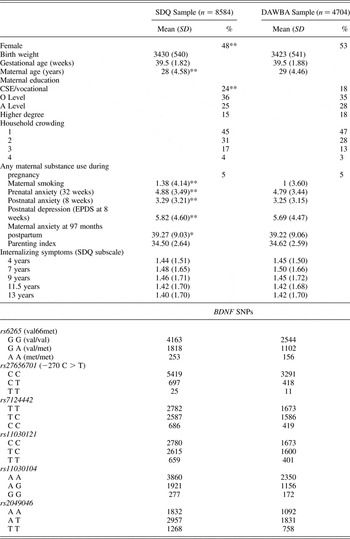
Table 1 presents the demographic information for participants included in these analyses. The bottom section includes the distribution of genotypes for each of the six BDNF SNPs investigated.
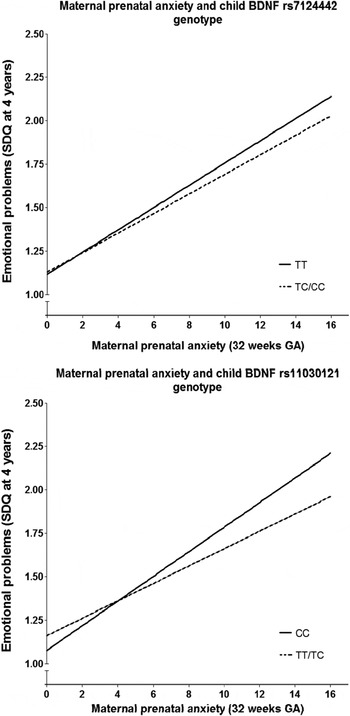
Maternal prenatal anxiety and child BDNF genotype (rs7124442 and rs11030121) interact to predict emotional symptoms at 4 years of age. Regression lines are displayed for each genotype and illustrate the association between maternal prenatal anxiety at 32 weeks gestational age and child emotional problems assessed using the Strengths and Difficulties Questionnaire at 4 years of age.

Cohort demographics and genotype frequencies

Note: SDQ, Strengths and Difficulties Questionnaire; DAWBA, Development and Well-Being Assessment. Percentages, means (standard deviations) are presented where appropriate.
*p < .01. **p < .001 for differences between cohorts.
Preliminary analyses
LD was observed between rs11030121 and rs7124442, D′ = 0.946, r 2 = .885 and between rs6265 and rs11030104, D′ = 0.995, r 2 = .889 in line with expected patterns of LD for individuals of European ancestry described by the HapMap project (rs11030121 and rs7124442, D′ = 1.0, r 2 = .932; rs6265 and rs11030104, D' = 1.0, r 2 = .817).
Attrition analyses revealed a number of significant differences between the cohort available for SDQ analyses and those returning for the age 15-year follow-up. Adolescents included in the DAWBA analyses at age 15 years were born to women who were slightly older, better educated, and generally less anxious than those included in the SDQ analyses; although the effects were significant (because of the large sample size), the effect sizes were typically quite small (Table 1).
The point prevalence rate of internalizing disorder from the age 15-year assessment using the diagnostic cutoff was 3.2% (172/5371) for an emotional disorder; point prevalence rates were somewhat lower for any anxiety disorder (2%; 107/5371) and major depression (2%; 89/5369).
Stability of individual differences on the internalizing scale of the SDQ was moderate to high across the five assessments, ranging from r = .25, p < .01 (ages 4–13 years) to r = .61, p < .01 (ages 11– 13 years). In contrast, the prediction of adolescent internalizing at age 15 years from the SDQ varied considerably, from r = .03 at age 4 years to r = .20, p < .01 at age 13 years (using the disorder probability bands on the DAWBA). The distinct methodology for the SDQ and DAWBA (e.g., source) and negligible to moderate association between the SDQ score in early childhood and DAWBA assessment at age 15 years supports the separate analyses for these two indicators of internalizing symptoms.
Maternal prenatal anxiety predicts child internalizing symptoms in early childhood
We fit separate models to our SDQ symptom data for each BDNF SNP. In addition to child BDNF genotype, these models contained multiple measures of maternal mood, psychosocial, and obstetric outcomes. These models fit the data well (χ2 = 38.523–48.86, df = 34, comparative fit index = 0.998–0.999, Tucker–Lewis index = 0.994–0.998, a root mean square error of approximation = 0.005–0.008). Prenatal maternal anxiety was significantly associated with the intercept, representing initial levels of child internalizing symptoms. No significant association was observed between maternal prenatal anxiety and the slope or quadratic terms, indicating that maternal prenatal anxiety did not influence change in child emotional symptoms across childhood. This effect on the initial level of impairment was consistent across all models (estimate = 0.10–0.11, all ps < .01) and independent of obstetric, psychosocial covariates, and the BDNF polymorphisms available for analyses.
Persisting association between prenatal maternal anxiety on adolescent internalizing symptoms at age 15 years according to diagnostic interview
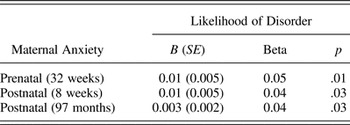
Table 2 displays the prediction from prenatal maternal anxiety to adolescent internalizing symptoms assessed from in-person interview at age 15 years. Findings indicate that prenatal anxiety continued to predict elevated internalizing symptoms at age 15 according to a structured interview of the adolescent. Effect sizes for the probability bands of disorder are small but consistent for the prenatal and the two postnatal maternal anxiety measures included in analysis. Of the other covariates included in the model and reported in the footnote to Table 2, significant independent effects were observed for females (B = 0.34, SE = 0.03; p < .001). Follow-up exploratory analyses indicated that paternal prenatal anxiety was not associated with adolescent symptoms from a structured interview at age 15 years, a pattern that was observed for mother-reported SDQ data from 4 to 13 years (O'Donnell et al., Reference O'Donnell, Glover, Barker and O'Connor2014). Additional analyses, based on diagnostic data from the structured interview and using logistic regression analysis, indicated weaker effects of prenatal maternal anxiety: prenatal maternal anxiety was associated with a 9% increased risk of internalizing disorder at age 15 years (p < .05), controlling for obstetric and psychosocial covariates; however, this effect was reduced to nonsignificance (5% increased risk, p >.05) after including maternal anxiety at 8 weeks postnatal and 97 months postnatal in the model. The weaker effects for logistic regression of dichotomous outcome may be explained by the small number of affected individuals and the weaker power associated with dichotomous compared with continuous data.
Prediction of emotional disorder from diagnostic interview at age 15 years from prenatal maternal anxiety

Note: Estimates are from imputed data for predictor variables; child sex, gestational age, birth weight, substance use in pregnancy, social class were also included in the model. Likelihood of disorder indexes probability bands; diagnosed disorder indexes presence/absence of disorder.
Genetic main effects on internalizing symptoms
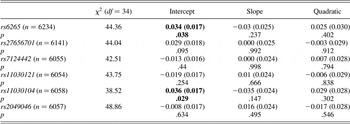
We first tested if there was a simple transmission of internalizing symptoms from mother to child as a function of child BDNF genotype. We found no association between any of the BDNF SNPs and maternal anxiety or depression in pregnancy (all ps > .47). However, some of the polymorphisms in children's BDNF genotype were associated with initial symptom level on the SDQ (Table 3). Specifically, we tested for the effects of six BDNF SNPs on three latent factors (intercept, slope, and quadratic), which described child emotional problems across childhood into adolescence. We found a significant main effect for both rs6265 (val66met) and rs11030104 on the intercept; the BDNF rs27656701 polymorphism predicted the intercept at trend level (see Table 3 and Supplementary Table S.1). These effects were specific to the intercept; there was no main effect of BDNF genotype on the slope or quadratic terms, suggesting that the effect did not change over time. The prediction was significant after accounting for covariates (see Supplementary Table S.1). Likewise, we found no evidence that any of the child BDNF SNPs tested associated with elevated maternal anxiety at any of the time points investigated (all p > .50).
BDNF single nucleotide polymorphism main effects on parent-reported child internalizing symptoms from 4 to 13 years

Note: Standardized regression coefficients (standard error estimates) are provided for six growth curve models describing the effects of BDNF genetic variation on child emotional symptoms assessed using the strengths and difficulties question. Models were run separately controlling for birth weight, gestational age, child gender, maternal age and education, maternal smoking and substance abuse during pregnancy, maternal prenatal anxiety at 32 weeks of pregnancy, maternal anxiety and depression at 8 weeks postpartum, maternal anxiety at 97 months, household crowding, and an index of parenting. See the Supplementary Material for full tables.
For genetic analyses of internalizing symptoms data from structured interview at age 15 years, we focus on analyses of probability bands. There was some evidence that BDNF polymorphisms predicted internalizing symptoms from diagnostic interview at age 15 years, although the overall patterns did not mimic what was found for the maternal-reported SDQ data. Specifically, after accounting for covariates used for DAWBA analyses (Table 2), we found a significant effect of rs7124442 (B = –0.07, SE = 0.03, p < .05) and rs11030121 (B = –0.07, SE = 0.03, p < .05; comparable effects were found for rs7124442 as would be expected given the linkage disequilibrium noted above; see also below). None of the other BDNF SNPs predicted internalizing symptoms from diagnostic interview.
BDNF genotype moderates the association between maternal prenatal anxiety and child internalizing symptoms
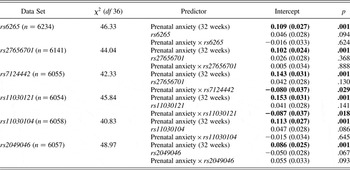
We next tested the hypothesis that the association between maternal prenatal anxiety and child internalizing symptoms was moderated by child BDNF genotype. We generated interaction terms between maternal prenatal anxiety (32 weeks) and each of the six BDNF SNPs (Table 4). We found a significant interaction between maternal prenatal anxiety and both rs7124442 and rs11030121 in predicting the internalizing symptoms intercept (Prenatal Anxiety × rs7124442: estimate = –0.080, SE = 0.037, p = .029; Prenatal Anxiety × rs11030121: estimate = –0.087, SE = 0.037, p = .018) after allowing for covariates. Figure 1 illustrates the nature of the interaction between maternal prenatal anxiety and child BDNF (rs7124442) genotype. Carriers of the TT genotype exposed to higher levels of maternal prenatal anxiety showed the highest numbers of emotional problems at age 4. Similarly at rs11030121, carriers of the CC exposed to elevated levels of maternal prenatal anxiety showed the highest SDQ scores. There was also a trend for an interaction between maternal prenatal anxiety and rs2049046 at p < .10 (estimate = 0.055, SE = 0.033, p = .093). In each case, the moderation effect was specific to the intercept; no significant interaction between maternal prenatal anxiety and BDNF genotype was observed for the slope or quadratic terms.
Effects of maternal prenatal anxiety on child internalizing symptoms are moderated by BDNF single nucleotide polymorphisms: Parent-reported child symptoms from 4 to 13 years

Note: Standardized regression coefficients (standard error estimates) are provided for six growth curve models describing the interaction between maternal prenatal anxiety at 32 weeks of pregnancy and six single nucleotide polymorphisms in BDNF. Models were run separately controlling for birth weight, gestational age, child gender, maternal age and education, maternal smoking and substance abuse during pregnancy, maternal prenatal anxiety at 32 weeks of pregnancy, maternal anxiety and depression at 8 weeks postpartum, maternal anxiety at 97 months, household crowding, and an index of parenting. See the Supplementary Materials for full tables.
There was no significant interaction among prenatal anxiety, BDNF SNPs, and child internalizing symptoms from diagnostic interview at age 15 years, whether symptoms were assessed in terms of probability bands or dichotomous diagnosis (not tabled).
Supplementary analyses
Haplotype analyses
We formed haplotypes based on the LD observed between BDNF SNPs described above. This gave rise to two haplotype groups: BDNF haplotype 1 (rs6265–rs11030104): AA-AA versus AG/GG-AG/GG and BDNF haplotype 2 (rs11030121 and rs7124442): C-TT versus CT/CC-CT/TT). We repeated the analyses described above and found comparable results to our single SNP analyses. BDNF haplotype 1 was predictive of the intercept function (estimate = 0.033 SE = 0.018, p = .059). There was no interaction between BDNF haplotype 1 and maternal anxiety to predict child emotional symptoms (see Supplementary Table S.1). Conversely, we found no main effect of BDNF haplotype 2 on child emotional symptoms; however, a significant interaction with maternal prenatal anxiety was noted, which predicted the intercept (estimate = –0.084, SE = 0.039, p = .029). The effect of maternal prenatal anxiety on the intercept was consistent across all single SNP and haplotype analyses.
Maternal prenatal depression and child emotional problems across childhood
Maternal prenatal depression predicted intercept (initial level) of parent-reported child internalizing symptoms (estimate = 0.059–0.061, all ps ≤ .01) but was not associated with the slope or quadratic terms (data available from first author). BDNF SNPs did not moderate the association between maternal prenatal depression (at 32 weeks gestation) and child emotional symptoms across childhood (data available upon request from first author). Similarly, prenatal depression predicted internalizing symptoms at age 15 from structured interview of the adolescent (B = 0.01, SE = 0.004, p < .001), independent of early postnatal depression at 8 weeks and maternal depression at 97 months, as well as psychosocial and obstetric covariates; there was no evidence of Prenatal Maternal Anxiety × Child BDNF Genotype interaction in predicting adolescent internalizing symptoms at 15 years from structured interview.
Discussion
The findings from the current longitudinal study, which covers development from the prenatal period until 15 years, show a persisting association between maternal prenatal anxiety and internalizing symptoms, after allowing for confounders. The results also suggest that the effect may, at least until age 13, be moderated by individual variations in the BDNF gene. Prenatal depression was also associated with internalizing symptoms in the child, but the association was not moderated by any of the BDNF polymorphisms.
Our study extends previous work with this cohort (O'Connor et al., Reference O'Connor, Heron, Golding and Glover2003; O'Donnell et al., Reference O'Donnell, Glover, Barker and O'Connor2014), demonstrating that the effects of maternal prenatal anxiety are evident across assessment modalities (both parent and self-report) and persist until at least midadolescence, an age at which the presence of an emotional disturbance is a strong predictor of adult mental health outcomes (Kim-Cohen et al., Reference Kim-Cohen, Caspi, Moffitt, Harrington, Milne and Poulton2003). Our findings are also consistent with a report from another long-term follow-up of approximately 1,500 adolescents, which shows a persisting effect of maternal prenatal stress on child emotion/behavioral problems, including internalizing symptoms, at age 14 years (Robinson et al., Reference Robinson, Mattes, Oddy, Pennell, van Eekelen and McLean2011). These studies collectively emphasize the importance of the prenatal period for child neurodevelopment and later mental health. One challenge then becomes to determine the biological pathways that mediate these persisting effects on child development and to understand why children are affected in different ways.
Some progress has been made in identifying the biological mechanisms that are influenced by maternal prenatal anxiety/stress in humans. Drawing on extensive evidence from animal models, studies have characterized the programming role of maternal glucocorticoids (Bergman et al., Reference Bergman, Sarkar, Glover and O'Connor2010; Buss et al., Reference Buss, Davis, Shahbaba, Pruessner, Head and Sandman2012; Glover, Bergman, Sarkar, & O'Connor, Reference Glover, Bergman, Sarkar and O'Connor2009), placental function (Blakeley, Capron, Jensen, O'Donnell, & Glover, Reference Blakeley, Capron, Jensen, O'Donnell and Glover2013; Hompes et al., Reference Hompes, Izzi, Gellens, Morreels, Fieuws and Pexsters2013; O'Donnell et al., Reference O'Donnell, Bugge Jensen, Freeman, Khalife, O'Connor and Glover2012), and regulation of the child's HPA axis (O'Connor et al., Reference O'Connor, Ben-Shlomo, Heron, Golding, Adams and Glover2005; O'Connor, Bergman, Sarkar, & Glover, Reference O'Connor, Bergman, Sarkar and Glover2013; O'Donnell et al., Reference O'Donnell, Glover, Jenkins, Browne, Ben-Shlomo and Golding2013; Van den Bergh, Van Calster, Smits, Van Huffel, & Lagae, Reference Van den Bergh, Van Calster, Smits, Van Huffel and Lagae2008). Here we provide data that highlight child genetic polymorphisms in BDNF as potential moderators of the relationship between maternal prenatal anxiety and child emotional problems. This concept draws support from rodents studies showing strain differences in the effects of maternal prenatal stress on BDNF expression and function (Neeley, Berger, Koenig, & Leonard, Reference Neeley, Berger, Koenig and Leonard2011), suggesting genotype-driven sensitivity (or resistance) to prenatal stress effects.
Human studies have associated altered BDNF expression and function with depressive-like behavior and treatment response to antidepressants (Martinowich, Manji, & Lu, Reference Martinowich, Manji and Lu2007). This association between BDNF function and mood disorders is also supported by postmortem brain studies showing a decrease in hippocampal BDNF in depressed subjects. Conversely, BDNF levels were preserved in a depressed subject undergoing antidepressant treatment (Chen, Dowlatshahi, MacQueen, Wang, & Young, Reference Chen, Dowlatshahi, MacQueen, Wang and Young2001). Genetic association studies have shown mixed results, with stronger evidence for an interactive effect of BDNF polymorphisms with stressful life events in the prediction of depression (Brown et al., Reference Brown, Craig, Harris, Herbert, Hodgson and Tansey2013; Gyekis et al., Reference Gyekis, Yu, Dong, Wang, Qian and Kota2013; Hosang, Shiles, Tansey, MacGuffin, & Uher, Reference Hosang, Shiles, Tansey, McGuffin and Uher2014). These associations are most commonly reported for the functional val66met BDNF polymorphism.
In the current study, we found a significant main effect for both rs6265 (val66met) and rs11030104 on the SDQ scores from ages 4 to 13. These effects were specific to the intercept and were not associated with the slope or quadratic terms, suggesting a stable effect over time. By midadolescence, we found modest but significant main effects of BDNF SNPs on internalizing problems, although the significant effects did not parallel what was found for the maternal-reported symptom data.
We found no interaction between maternal prenatal anxiety and the rs6265 (val66met) BDNF polymorphism in the prediction of child internalizing symptoms. However, we did see a significant interaction between maternal prenatal anxiety and two other SNPs in BDNF: rs11030121 and rs7124442 with the SDQ internalizing scores (although not at age 15 years). These SNPs were found to be in strong linkage disequilibrium, and as such, it is difficult to resolve which SNP is of functional relevance. Other SNPs in linkage disequilibrium with these candidates, not directly assessed in this study, may also be of functional relevance.
It is interesting to note the genomic context and possible biological effects of these polymorphisms. SNP rs7124442 is located in the 3′ untranslated region of the BDNF gene, a region which influences epigenetic regulation of the BDNF gene (Mellios, Huang, Grigorenko, Rogaev, & Akbarian, Reference Mellios, Huang, Grigorenko, Rogaev and Akbarian2008). Previously, SNPs within this region have been shown to influence the binding and regulation of BDNF mRNA stability by specific microRNAs (Caputo et al., Reference Caputo, Sinibaldi, Fiorentino, Parisi, Catalanotto and Pasini2011). In addition, rs7124442 occurs in the binding region of miR-22 (Chen & Rajewsky, Reference Chen and Rajewsky2006), a microRNA that has previously been shown to influence BDNF expression in vitro (Muiños-Gimeno et al., Reference Muiños-Gimeno, Espinosa-Parrilla, Guidi, Kagerbauer, Sipilä and Maron2011). In contrast, Orefice et al. (Reference Orefice, Waterhouse, Partridge, Lalchandani, Vicini and Xu2013) did not find an effect of rs7124442 on BDNF mRNA stability in rat hippocampal neurons, but they did note a significant allele-specific effect on the cellular distribution of BDNF transcripts influencing neuron morphology and function (Orefice et al., Reference Orefice, Waterhouse, Partridge, Lalchandani, Vicini and Xu2013). In addition to the functional effects described from the in vitro studies described above, there is preliminary evidence for an effect of rs7124442 genotype on treatment outcome following antidepressant treatment over 6 weeks, although these findings were not replicated in an independent sample (Domschke et al., Reference Domschke, Lawford, Laje, Berger, Young and Morris2010). Taken together, these studies indicate that rs7124442 influences BDNF regulation. The challenge then becomes to define the biological basis of the interaction between this SNP and maternal prenatal anxiety.
Less is known about the functional effects of the intronic SNP rs11030121. However, it is noteworthy that the T-C substitution caused by the C allele of rs11030121 forms a CpG unit and thus a potential site for DNA methylation. Activity-dependent transcription of BDNF is mediated at least in part by dynamic changes in DNA methylation (Martinowich et al., Reference Martinowich, Hattori, Wu, Fouse, He and Hu2003), and a recent study in rats shows increased methylation of BDNF (exon IV) in both the amygdala and the hippocampus of prenatally stressed offspring (Boersma et al., Reference Boersma, Lee, Cordner, Ewald, Purcell and Moghadam2014). It remains to be determined if rs11030121 associates with allele-specific methylation and any functional effects on BDNF regulation. It is possible that maternal prenatal anxiety may interact with child SNPs to influence the epigenetic state of BDNF. Teh et al. (Reference Teh, Pan, Chen, Ong, Dogra and Wong2014) have recently described widespread G × E effects on DNA methylation in umbilical cord at birth, and such effects were most evident proximal to the site of the SNP. Their study, which includes measures of maternal prenatal mood, illustrates how the effects of in utero environment are moderated by child genotype (Teh et al., Reference Teh, Pan, Chen, Ong, Dogra and Wong2014), and it will be interesting to determine how such G × E effects on DNA methylation change across development.
Several limitations of the study deserve mention. First, like most long-term longitudinal follow-up studies, ALSPAC has significant and nonrandom attrition. The cohort available for analyses at age 15 was born to mothers who were older, better educated, and generally less anxious than the cohort providing data for the SDQ analyses. This was addressed in the data analyses, although we did not supply missing genetic data, as is customary. Second, given the measurement differences (and the weak or minimal stability from early childhood), we conducted analyses separately on the SDQ data (mother-reported symptoms from 4 to 13 years) and the diagnostic data (from in-person interview with the adolescent at age 15 years). In addition to these methodological differences, there were other potentially important differences in these sets of analyses, including sample size, that could help to explain differences in the results. Alternatively, the discrepancy between our genetic findings across ages may have a biological basis. It has been suggested that BDNF genotype–environment interactions may be difficult to resolve at times when endogenous levels of BDNF are high, such as during adolescence (Casey et al., Reference Casey, Glatt, Tottenham, Soliman, Bath and Amso2009). In the current study, we are unable to disentangle differences in genetic main effects or moderation effects, and are unable to differentiate between methodological or developmental explanations for differences in results. It is important, nonetheless, that the prediction from maternal prenatal anxiety was significant for both sets of analyses. These limitations are balanced by several strengths, including a large community cohort and 15 + year follow-up period, detailed measures of risk and outcome extending to diagnostic assessment in adolescence, and consideration of multiple potential targets in the BDNF gene.
We have shown the following: the prediction of child internalizing symptoms from prenatal anxiety persists until age 15 and is independent of a range of confounders, rs6265 (val66met) BDNF and rs11030104 have main effects in the prediction of child internalizing symptoms until age 13, and there is an interaction between prenatal anxiety and BDNF SNPs rs11030121 and rs7124442 in the prediction of internalizing symptoms during childhood.
This study provides new evidence that the effects of prenatal anxiety may depend on the specific genetic vulnerabilities of each child. It helps to explain why different children are affected in different ways. However, the variance in outcomes explained by the BDNF gene is very small (<1%). It seems highly likely that very many genes are involved, both separately and in combination, in the interaction with prenatal anxiety or depression to cause changes in child outcome. This study is just the beginning of what will prove to be a very complex undertaking to understand the full picture.
The evidence for the importance of maternal mood in the prenatal period in the determination of child neurodevelopmental outcome is strong and emphasizes the need for better emotional care of pregnant women. However, we still have a limited knowledge of the biological mechanisms underlying these effects; we know that there is often not a good correlation between maternal mood and specific biological indices, such as maternal cortisol. More research is needed to show which prenatal interventions have the greatest effect on the outcome for the child (Glover, Reference Glover2014). We may eventually be able to develop a more personalized medicine, which takes into account the genetic vulnerabilities of both mother and child.
Supplementary Materials
The supplementary materials for this article can be found online at http://journals.cambridg.org/dpp.