Introduction
Electronic cigarettes (e-cigarettes) are battery-powered, non-combustible devices designed to produce aerosolized vapours from propylene-glycol and/or glycerine-based solutions that can then be inhaled or “vaped” by users (Bullen et al., Reference Bullen2013). Awareness, popularity and the use of e-cigarettes have increased exponentially across all populations since their introduction into US markets, particularly amongst current smokers and young adults (Haung et al., Reference Haung, Kowitt, Stufin, Patel, Ranney and Golstein2016; McMillen, Gottlieb, Shaefer, Winickoff, & Klein, Reference McMillen, Gottlieb, Shaefer, Winickoff and Klein2014).
The long-term safety and toxicity profile of e-cigarettes is currently unknown and the growing literature has raised a number of short-term health and public safety concerns (Allen et al., Reference Allen2015; Bahl et al., Reference Bahl, Lin, Xu, Davis, Wang and Talbot2012; Burstyn, Reference Burstyn2014; CBS News Staff, 2012; Farsalinos & Polosa, Reference Farsalinos and Polosa2014; Fuoco, Buonanno, Stabile, & Vigo, Reference Fuoco, Buonanno, Stabile and Vigo2014; Goniewicz et al., Reference Goniewicz2014; Grana, Benowitz, & Glantz, Reference Grana, Benowitz and Glantz2014; Hajek, Etter, Benowitz, Eissenberg, & McRobbie, Reference Hajek, Etter, Benowitz, Eissenberg and McRobbie2014; Ingebrethsen, Cole, & Alderman, Reference Ingebrethsen, Cole and Alderman2012; Konstantinos & Polosa, Reference Konstantinos and Polosa2014; Laino et al., Reference Laino, Tuma, Moor, Martin, Stolz and Curioni2012; Lerner and Sundar, Reference Lerner, Sundar, Watson, Elder, Jones and Done2015; Lerner, Sundar, & Yao, Reference Lerner, Sundar, Yao, Gerloff, Ossip and McIntosh2015; Pellegrino et al., Reference Pellegrino2012; Romagna et al., Reference Romagna, Allifranchini, Bocchietto, Todeschi, Esposito and Farsalinos2013; Schober et al., Reference Schober2014; Schripp, Markewitz, Uhde, & Salthammer, Reference Schripp, Markewitz, Uhde and Salthammer2013; Strickland, Reference Strickland2013; Vardavas et al., Reference Vardavas, Anagnostopoulos, Kougias, Evangelopoulou, Connolly and Behrakis2012; Williams, Villarreal, Bozhilov, Lin, &Talbot, Reference Williams, Villarreal, Bozhilov, Lin and Talbot2013; Zhang, Sumner, & Chen, Reference Zhang, Sumner and Chen2013). Conversely, a number of studies including a recent Cochrane review have concluded that e-cigarettes are far safer than traditional cigarettes (Hartmann-Boyce et al., Reference Hartmann-Boyce, McRobbie, Bullen, Begh, Stead and Hajek2016; Malas et al., Reference Malas2016; O'Leary, MacDonald, Stockwell, & Reist, Reference O'Leary, MacDonald, Stockwell and Reist2017; Royal College of Physicians, 2016).
There is a growing body of research with respect to various topics related to e-cigarettes including regulation, dual use, use in adolescents and young adults and association with tobacco cessation (Adkison et al., Reference Adkison2013; Corey et al., Reference Corey2013; Dockrell, Morrison, Bauld, & Mcneill, Reference Dockrell, Morrison, Bauld and Mcneill2013; Dutra and Glantz, Reference Dutra and Glantz2014; Haung et al., Reference Haung, Kowitt, Stufin, Patel, Ranney and Golstein2016; King, Alam, Promoff, Arrazola, & Dube, Reference King, Alam, Promoff, Arrazola and Dube2013; Lee, Grana, & Glantz, Reference Lee, Grana and Glantz2014; Lee, Hebert, Nonnemaker, & Kim, Reference Lee, Hebert, Nonnemaker and Kim2015; Pearson, Richardson, Niaura, Vallone, & Abrams, Reference Pearson, Richardson, Niaura, Vallone and Abrams2012; Ramo, Young-Wolff, & Prochaska, Reference Ramo, Young-Wolff and Prochaska2015; Regan, Promoff, Dube, & Arrazola, Reference Regan, Promoff, Dube and Arrazola2013; Rostron, Schroeder, & Ambrose, Reference Rostron, Schroeder and Ambrose2016; Soneji, Sargent, & Tanski, Reference Soneji, Sargent and Tanski2016). Findings from Huang et al. (Reference Haung, Kowitt, Stufin, Patel, Ranney and Golstein2016) for example revealed that among adolescent dual users of traditional and e-cigarettes, current e-cigarette use was negatively associated with intention to quit traditional cigarette smoking and with attempts to quit in the previous 12 months. That study also reported that these dual users were less likely than traditional cigarette smokers (only) to have ever had prolonged abstinence from cigarette smoking for 6 or 12 months and to have used any kinds of cessation aids.
2-year college students are a large and growing subset of the US population and make up almost half of the total undergraduate population (Snyder & Dillow, Reference Snyder and Dillow2011). Rates of substance use including tobacco are high in college populations. Compared to traditional 4-year college and university students, 2-year college students come from lower income backgrounds, are more economically disadvantaged and have increased racial and ethnic diversity (Laska, Pasch Lust, Story, & Ehlinger, Reference Laska, Pasch, Lust, Story and Ehlinger2011; Prokhorov et al., Reference Prokhorov2003). In comparison to their traditional university counterparts, smoking prevalence is higher in this population (Prokhorov et al., Reference Prokhorov2003; Ossip et al.), 2-year college students are more likely to be daily smokers, even after controlling for baseline socioeconomic variables, health status and demographics (Rosenbaum, Reference Rosenbaum2012). 2-year college students are also more likely to describe themselves as a regular user of a number of tobacco products including cigarettes, cigars and smokeless tobacco and are more likely to have used tobacco products in the past 30 days. Given their high risk for substance use and their growing population size, in combination with the relative lack of research in comparison to their more traditional counterparts, 2-year college students pose a unique population in which to study e-cigarette use and cessation (Hasman, Berryman, & McIntosh, Reference Hasman, Berryman and McIntosh2013; McIntosh et al., Reference McIntosh, Wall, Johnson, Done, Kurtzman and Ververs2016; Wall, BaileyShea, & McIntosh, Reference Wall, BaileyShea and McIntosh2012).
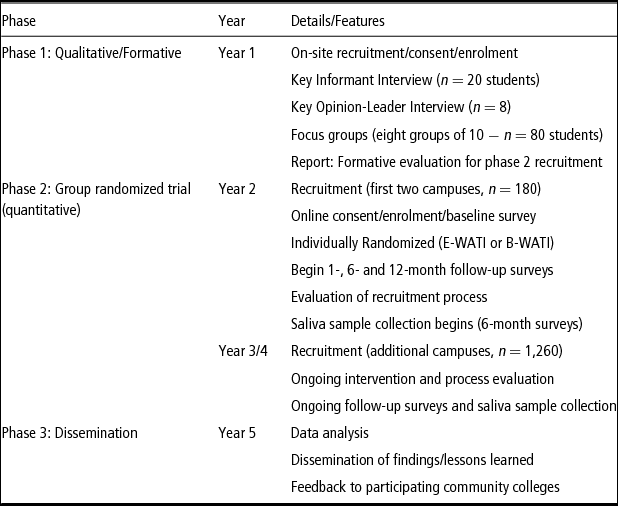
This study aimed to evaluate the impact of baseline e-cigarette use in a national sample of 2-year college student smokers enrolled in a parent study – a web-assisted tobacco intervention (WATI) trial (see Table 1). The parent study randomly assigned 2-year college students who smoked and wanted to quit within the next 30 days to one of two web-based treatment conditions (a website basic information with mostly static features, or a website with more interactive features). The primary purpose of the current report is to evaluate the associations of baseline e-cigarette use (as defined by self-reported use within the first month of intake, including baseline and 1-month follow-up surveys) with self-reported 30-day cessation of traditional tobacco products at 6-months. Secondary outcomes include both self-reported and biochemically verified 30-day cessation at 6-months of all non-medication nicotine/tobacco products.
Parent study overview

Methods
Participants
Selection and recruitment
Study participant recruitment began in upstate NY and expanded nationally during year two of the parent study. A total of 25 states were targeted, to include those whose state quitline website was not provided by the same vendor used for the WATI website, in order to avoid confounding study interventions with access to the same or similar interventions (25 states and Washington D.C. contracted with this vendor). As reported elsewhere (McIntosh et al., In Press), students were recruited through a variety of strategies including mass emails, website advertisement, poster ads and personalized follow-up via phone and/or email. At the completion of recruitment, there were a total of 1,453 study participants from 17 states and approximately 65 2-year colleges participating in the parent study. The majority of students (76%) were recruited from NY State. The number of students per 2-year college varied across individual schools with one of the early upstate NY colleges having the largest number of participants (n = 210).
Inclusion criteria
In order to be eligible for the WATI trial, at the time of recruitment participants must have attained at least 18 years of age, currently enrolled in a 2-year college and a current cigarette smoker of at least five cigarettes/week with intentions to quit within 3 months of their recruitment date. Additionally, for the current analyses, participants must have identified themselves as either an e-cigarette user or non-user on either the baseline or 1-month follow-up survey and have either filled out the 6-month follow-up survey or have exceeded the time window in which to do so. In the latter case, participants were coded as a tobacco user at 6-months (e.g., no cessation) based on intent to treat. The parent study was powered for the analysis of 6-month outcomes due to the short-term nature of matriculation at a Community College and due to the high rates of attrition common to web-based intervention trials. A total of 1,400 participants were included in the present analysis.
Procedure
Parent study summary
This study utilized data from an ongoing three-phase RCT (parent study) comparing the effectiveness of enhanced web-assisted tobacco intervention (E-WATI) to basic web-assisted tobacco intervention (B-WATI) as tools for smoking cessation in the 2-year college student population. A detailed description of each phase can be found in Table 1. In phase 1, qualitative and informative data were collected to determine the ideal study population and aid in survey development. Phase 2 involved participant recruitment, randomization into one of the two interventions arms (B-WATI vs. E-WATI) and follow-up for outcome measures. Enrolled participants completed a baseline survey and three subsequent follow-up surveys at 1, 6 and 12-month time points.
Survey development
A total of four surveys were developed for the parent study – a baseline survey and three follow-up surveys designed for 1, 6 and 12-month follow-up. Each survey was adapted from pre-existing, validated instruments with alterations and additions informed by phase 1 qualitative data. Pilot and pre-testing of all survey instruments were conducted prior to use in phase 2.
Data collection and management
Once officially enrolled in the parent study and randomized, participants had unlimited access to their assigned WATI website to use ad lib with interactivity recorded and monitored observationally by the vendor's digital data tracking capabilities and subjectively by self-report via the three follow-up surveys. All surveys were conducted and stored in REDCap, a widely used data capture application developed for large-scale research projects (REDCap). Participants accessed the study surveys through links provided via email at the three follow-up time points. If a participant reached the time point for the subsequent follow-up survey without completing the prior survey, the data were classified as missing for the previous time point. Data from REDCap were exported to Microsoft Excel and verified both visually and through Excel formulation. Any mismatched or incorrect data were identified and resolved and a final dataset was created of baseline, 1-, 6- and 12-month survey data. The present analysis used only the data from baseline, 1- and 6-month follow-up.
Measures
Demographics
Demographic characteristics included in this analysis were age, gender, race/ethnicity (White/Non-Hispanic vs. Other) and student-status (categorized as full-time at 12 or more credits vs. part-time at <12 credits).
Smoking characteristics
Smoking characteristics consisted of daily smoking status (yes/no), number of cigarettes per day on days subjects smoked (1–10 vs. >10 cigarettes per day), time of first cigarette in the morning (0–30 minutes vs. >30 minutes) and in-home smoking policy (categorized as no smoking allowed at all vs. other).
Cessation features
Cessation features for analysis included intervention arm (B-WATI vs. E-WATI), confidence in ability to quit smoking completely (scale 1–10), level of engagement on assigned WATI website (proxy by total number of logins) and use of one or more medication cessation aids at 6-months (yes/no) including any form of nicotine replacement therapy (NRT), Zyban® and/or Chantix®.
Independent variables
The key independent variable of interest was e-cigarette user status as identified on either baseline or 1-month follow-up survey. Users were identified by answering the question “In the past 30 days have you used any of the following?” and checking the box corresponding to e-cigarettes. Other independent variables of interest can be found in Tables 2 and 3.
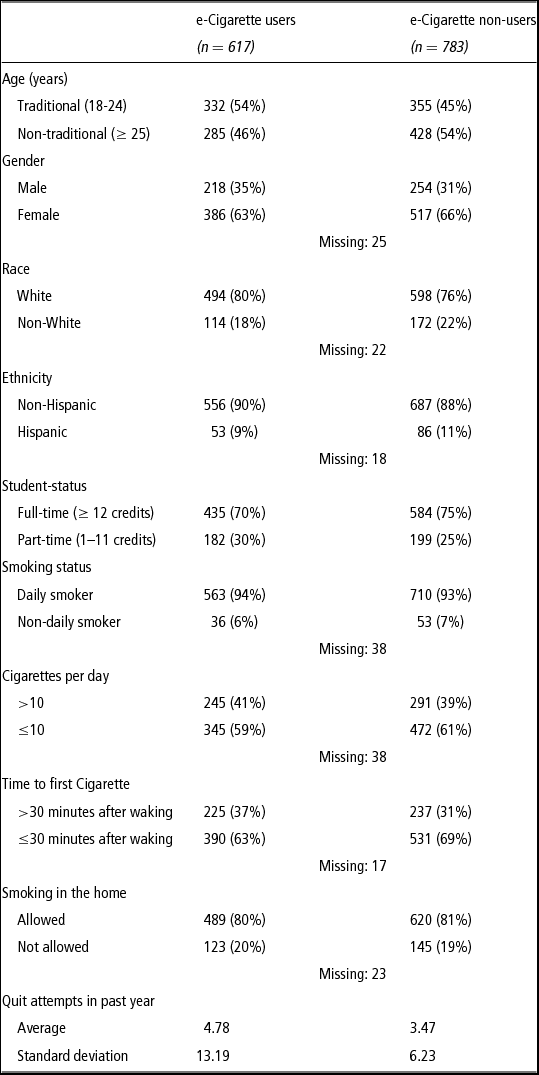
Baseline demographics (N = 1,400)

Bivariate analysis

*Indicates an a priori variable
**Indicates statistical significance (≤0.10)
***Primary cessation was defined as self-reported 30-day cessation at 6-months of all traditional tobacco products not including e-cigarettes (e.g., conventional cigarettes, cigars, cigarillos, hookahs, orbs, pipe tobacco); secondary cessation was defined as self-reported 30-day cessation at 6-months of all non-medication nicotine and tobacco products including e-cigarettes; and biochemically verified cessation was defined as biochemically verified self-reported abstinence from tobacco and nicotine products.
Outcome variables
The key outcome variables of interest included one primary and two secondary outcomes: (1) the primary outcome of interest (primary cessation) was defined as self-reported 30-day cessation at 6-months of all traditional tobacco products not including e-cigarettes (e.g., conventional cigarettes, cigars, cigarillos, hookahs, orbs, pipe tobacco); (2) a secondary outcome measure was defined as self-reported 30-day cessation at 6-months of all non-medication nicotine and tobacco products including e-cigarettes (“secondary cessation”); and (3) an additional secondary outcome measure was defined as biochemically verified (via salivary cotinine assay) self-reported abstinence from tobacco and nicotine products (biochemical cessation).
Data Analysis
All data were analysed using SAS version 9.4 for Windows. Data analysis included four major steps: Descriptive, Bivariate, Mullticolinearity and Logistic Regression.
Descriptive
Descriptive data for all eligible study subjects were compiled to determine the overall characteristics of the study population (Table 2).
Bivariate
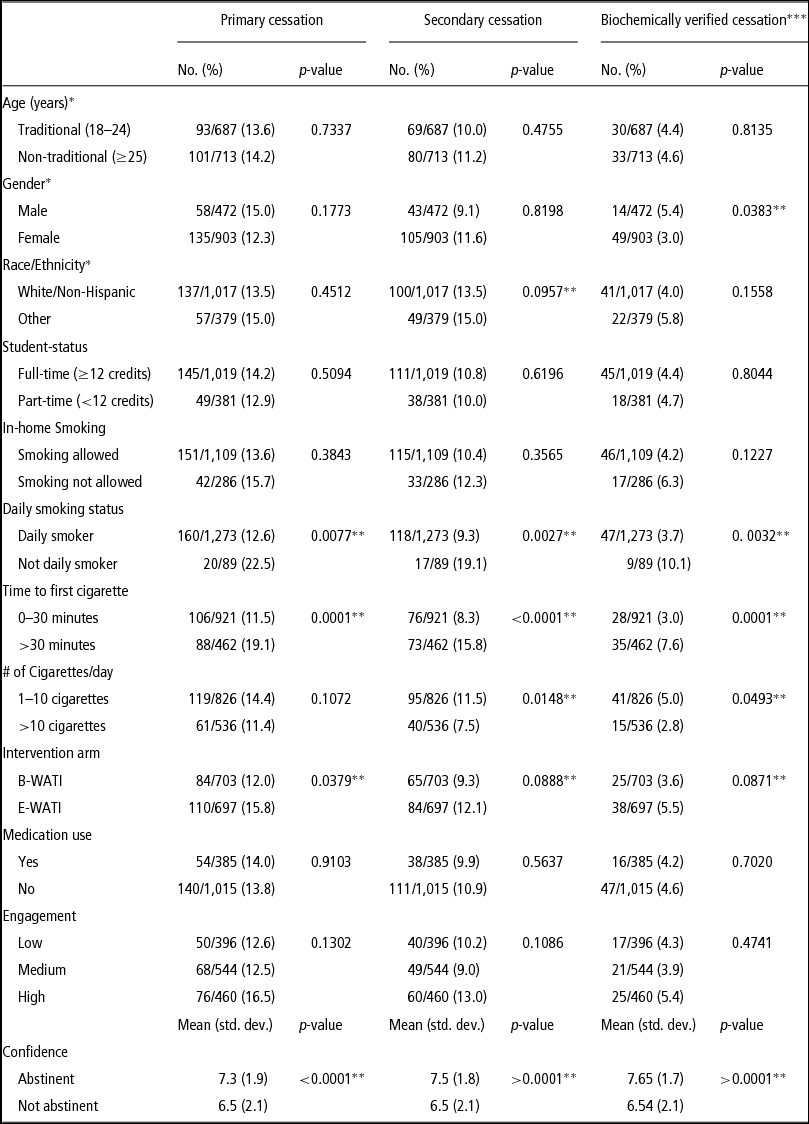
Bivariate analysis used either Pearson chi-squares or t-tests to examine the individual relationship between each variable identified in the methods section and the primary outcome of self-reported traditional tobacco cessation at 6-months. Two separate bivariate analyses were also conducted, one for each of the secondary outcomes (e.g., cessation of all non-medication nicotine and tobacco products and biochemically verified cessation). Results for all 6-month outcomes are listed in Table 3.
For all chi-square and t-test analyses, those variables found to have a p-value of ≤0.10 were considered for inclusion in the final logistic regression model. A priori variables were identified prior to bivariate analysis and were included in the final logistic regression model regardless of significance. These variables included age, gender, race/ethnicity and intervention arm.
Mullticolinearity
Prior to inclusion in the final logistic regression model, multicollinearity was assessed by examining associations between each independent variable pair using chi-square or t-test as appropriate for variable type. A cutoff of p ≥ 0.80 was used to indicate multicollinearity, consistent with the recommendations of Tabachnick and Fidell (Reference Tabachnick and Fidell1989). No multicollinearity was detected.
Logistic Regression
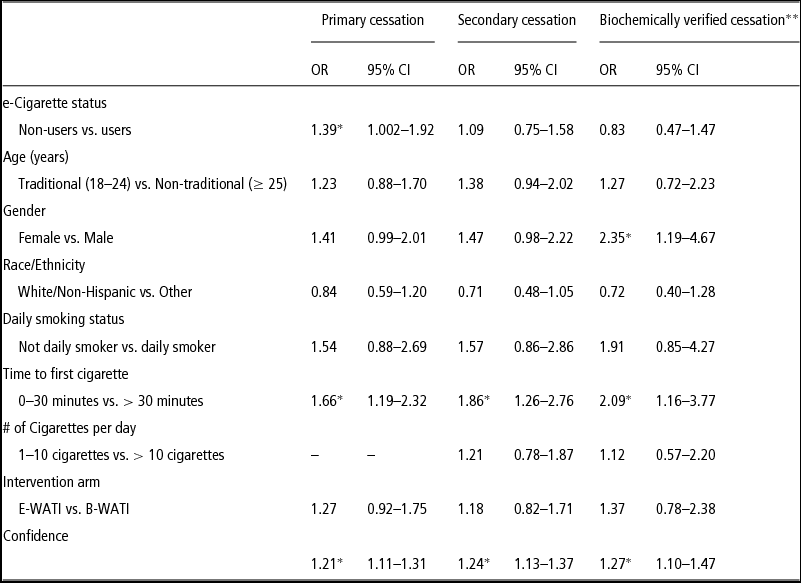
A series of multivariate logistic regression analyses were conducted entering variables identified in bivariate analyses and screened for multicollinearity. Three separate analyses were run using each of the three definitions of cessation at 6-months (see Table 4). An odds ratio using 95% confidence intervals and a statistical significance threshold of p < 0.05 was used to determine significance in the all multivariate models.
Logistic regression

*Indicates statistical significance (<0.05)
**Primary cessation was defined as self-reported 30-day cessation at 6-months of all traditional tobacco products not including e-cigarettes (e.g., conventional cigarettes, cigars, cigarillos, hookahs, orbs, pipe tobacco); secondary cessation was defined as self-reported 30-day cessation at 6-months of all non-medication nicotine and tobacco products including e-cigarettes; and biochemically verified cessation was defined as biochemically verified self-reported abstinence from tobacco and nicotine products.
Results
Of the 1,453 participants enrolled in the parent study, 1,400 met the inclusion criteria requirements for this analysis. Of these, 617 (44%) were e-cigarette users at baseline. Baseline demographic characteristics of e-cigarette users and non-users are summarized in Table 2. The two groups were similar on most variables, though e-cigarette users were somewhat more likely to be of traditional college age (18–24 years) compared to non-users (54% vs. 45%, respectively). There were no major differences in gender, race, ethnicity or student-status between the two groups.
Bivariate Analysis
Four primary outcome variables met the threshold for inclusion in the multivariable model (p ≤ 0.10) using the cessation of all traditional tobacco products as the outcome of interest (Table 3). Six secondary outcome variables met the threshold criteria (p ≤ 0.10) for inclusion in the multivariable model using the cessation of all non-medication nicotine/tobacco products as the final outcome of interest and, similarly, six secondary outcome variables met the threshold criteria when using biochemically verified cessation as the outcome of interest (Table 3).
Logistic Regression
All variables meeting the inclusion threshold of p ≤ 0.10 in bivariate analyses, along with all a priori variables were included in the final logistic regression models for the primary outcome (self-reported 30-day cessation at 6-months of all traditional tobacco products not including e-cigarettes) and two secondary outcomes (self-reported 30-day cessation at 6-months of all non-medication nicotine and tobacco products including e-cigarettes; and biochemically verified self-reported abstinence from tobacco and nicotine products).
Primary Outcome (Primary Cessation): Controlling for potential covariates, baseline e-cigarette use was associated with cessation of all traditional tobacco products (OR 1.39, 95% CI 1.002–1.92). In addition, both higher confidence (OR 1.21, 95% CI 1.11–1.31) and greater time to first cigarette (OR 1.66, CI 95% 1.19–2.32) were significantly associated with cessation. Age, gender, race/ethnicity, daily smoking status and intervention arm were not significantly associated with cessation (Table 4).
Secondary Outcomes (Secondary Cessation and Biochemically Verified Cessation): Baseline e-cigarette use was not significantly associated with the cessation of all nicotine/tobacco products (OR 1.09, 95% CI 0.75–1.58) or biochemically verified abstinence from tobacco and nicotine products (OR 0.83, 95% CI 0.47–1.47). Higher confidence and greater time to first cigarette were significantly associated with both cessation of all non-medication nicotine/tobacco products (OR 1.24, 95% CI 1.13–1.37; OR 1.86, 95% CI 1.26–2.76) and biochemically verified abstinence from tobacco and nicotine products (OR 1.27, 95% CI 1.10–1.47; OR 2.09, 95% CI 1.16–3.77). Female gender was found only to be associated with biochemically verified abstinence from tobacco and nicotine products (OR 2.35, 95% CI 1.19–4.67). No other variables were significantly associated with either secondary cessation outcome (Table 4).
Discussion
The current study explored the association between baseline e-cigarette use and various definitions of abstinence in the study sample, including abstinence from all traditional tobacco products (not including e-cigarettes), abstinence from all non-medication nicotine and tobacco products (including e-cigarettes) and biochemically verified self-reported abstinence from tobacco and nicotine products. Baseline e-cigarette users were more likely to report cessation of traditional tobacco products compared to non-users. This is consistent with the literature supporting the potential benefits of e-cigarettes in cessation of traditional cigarettes (Adkison et al., Reference Adkison2013; Corey et al., Reference Corey2013; Dockrell et al., Reference Dockrell, Morrison, Bauld and Mcneill2013; Dutra & Glantz, Reference Dutra and Glantz2014). However, baseline e-cigarette users were not more likely to be successful in terms of cessation of all tobacco products (including e-cigarettes) or biochemically verified cessation. Consistent with prior literature, higher confidence and increased time to first cigarette in the morning were significantly associated with increased odds of cessation across all outcomes (Ling & Glantz, Reference Ling and Glantz2002; Marynak et al., Reference Marynak, Holmes, King, Promoff, Bunnell and McAfee2014). Female gender was associated with increased odds of biochemically verified cessation only.
The association of e-cigarette use with cessation of traditional tobacco products is consistent with results of one small RCT (Caponnetto et al., Reference Caponnetto2014), though there has been an overall lack of strong evidence of efficacy in the few large RCTs that have evaluated e-cigarette use and cessation (Adriaens, Van Gucth, Declerck, & Baeyens, Reference Adriaens, Van Gucth, Declerck and Baeyens2014; Grana, Popova, & Ling, Reference Grana, Popova and Ling2014). It is important to note that although all participants in this study had an intention to quit smoking conventional cigarettes, the study did not focus on e-cigarette cessation, and no information was collected regarding subjects’ intentions to stop or to continue e-cigarette use as a cessation strategy. This may help explain the difference in the results given that participants in prior RCTs used e-cigarettes for the specific purpose of aiding cessation, whereas in the present analysis the specific reasons for using e-cigarettes were not prospectively or reliably assessed. In addition, given the lack of association of baseline e-cigarette use with both total and biochemically verified cessation, e-cigarette use in this population may lead to persistent e-cigarette use rather than complete cessation of nicotine. Future studies are needed to assess intention for cessation of all nicotine products vs. specific products only, and whether that goal changes during the intervention.
Long-term use of e-cigarettes creates a number of concerns both at an individual and at a population level. There is no information regarding the long-term safety of these devices and emerging evidence indicates associations between short-term e-cigarette use and exposure to a number of toxins/carcinogens as well as linking vaping to a number of concerning physiological effects (Allen et al., Reference Allen2015; Bahl et al., Reference Bahl, Lin, Xu, Davis, Wang and Talbot2012; Chen, Reference Chen2013; Goniewicz et al., Reference Goniewicz2014; Hua, Alfi, & Talbot, Reference Hua, Alfi and Talbot2013; Laino et al., Reference Laino, Tuma, Moor, Martin, Stolz and Curioni2012; Lerner, Sundar, Watson et al, Reference Lerner, Sundar, Watson, Elder, Jones and Done2015; Lerner, Sundar, Yao et al., Reference Lerner, Sundar, Yao, Gerloff, Ossip and McIntosh2015 Romagna et al., Reference Romagna, Allifranchini, Bocchietto, Todeschi, Esposito and Farsalinos2013; Schober et al., Reference Schober2014; Vardavas et al., Reference Vardavas, Anagnostopoulos, Kougias, Evangelopoulou, Connolly and Behrakis2012; Williams et al., Reference Williams, Villarreal, Bozhilov, Lin and Talbot2013). Additionally, it is unknown how continued use of e-cigarettes may impact relapse rates amongst those who are able to achieve smoking cessation. Unlike other cessation aids, in addition to providing nicotine to counter cravings and withdrawal symptoms, e-cigarettes mimic the sensorimotor behaviour of conventional cigarette smoking (Adriaens et al., Reference Adriaens, Van Gucth, Declerck and Baeyens2014; Tseng et al., Reference Tseng2016). As the participants in this study were all current traditional cigarette smokers, the fact that e-cigarette use at baseline was associated with smoking cessation at 6-month follow-up was a positive finding. However, it was observed that a substantial number of people who switched to e-cigarettes were still using them at 6 months. Whether to expect that such alternative sources of nicotine will be protective from relapse to traditional cigarettes (because the need for nicotine has been met), or will lead to a later relapse to traditional cigarettes (because the ability to live nicotine-free for a substantial period of time has not been met), should be explored via studies with longer follow-up periods.
Even if e-cigarettes are ultimately found to be beneficial for cessation at the individual level, it is important to also consider their effect at the larger population scale. The degree to which e-cigarettes may act as gateway for nicotine addiction and to more dangerous tobacco products in non-tobacco users is of significant concern, particularly in vulnerable populations such as adolescents and young adults (Foulds, Veldheer, & Berg, Reference Foulds, Veldheer and Berg2011; Villanti, Rath, & Williams, Reference Villanti, Rath and Williams2015; Yamin, Bitton, & Bates, Reference Yamin, Bitton and Bates2010). A small but growing portion of e-cigarette users in these populations do not smoke conventional cigarettes, supporting the hypothesis that e-cigarette use may be creating a new population of persons addicted to nicotine (Chapman & Wu, Reference Chapman and Wu2014; Kadowaki, Vuolo, & Kelly, Reference Kadowaki, Vuolo and Kelly2015; Loukas, Batanova, Fernandez, & Agarwal, Reference Loukas, Batanova, Fernandez and Agarwal2015; Saddleson et al., Reference Saddleson2016). On the other hand, it is noted that recent data from the UK suggest this phenomenon is negligible or not occurring, at least in Great Britain (Action on Smoking and Health, 2016; Fidler et al., Reference Fidler2011). Future studies are needed to assess whether there are indeed cross-cultural differences in how young people are using nicotine.
Limitations
This study has a number of limitations. Although this was a national study, a significant portion of study participants were based in upstate New York and therefore the results may not be generalizable to a broader population. Additionally, despite the fact that 2-year college students are a diverse population, the majority of the study population was white and non-Hispanic and therefore the findings may not be generalizable across different races and ethnicities.
Due to the nature of the survey questions in the parent study, the purpose of e-cigarette use could not be ascertained and consequently the associations found may vary depending on the intention of e-cigarette use. For these analyses, subjects were defined as e-cigarette users at baseline if they self-identified as using e-cigarettes at the time of enrolment (baseline) and/or at the 1-month time point, because self-reported e-cigarette users at 1-month, irrespective of their use at intake, were still in the early stages of their quit attempts (the parent study's inclusion criteria allowed persons to enrol as long as they indicated intention of quitting “in the next 3 months”, and because the present analyses aimed to assess associations of our available measurable e-cigarette use with the parent study's primary 6-month outcomes. In total, 164 subjects indicated e-cigarette use at 1 month despite not having indicated e-cigarette use at baseline, and it cannot be assumed (nor was it measured) why some subjects began using e-cigarettes after enrolment (e.g., as a nicotine substitute, a cessation aid, or for any other reason). Future studies should prospectively account for and measure such uptake and self-reported intentions.
Another limitation is that self-reported tobacco cessation separate from e-cigarette use could not be biochemically verified. The assay used in this study to confirm abstinence measures cotinine, the primary metabolite of nicotine and the gold standard for biochemical verification of self-reported abstinence. Current e-cigarette use in self-reported tobacco quitters may cause false positives and underestimate biochemically verified cessation rates and therefore biochemical verification of traditional tobacco product cessation could not be reliably measured.
Lastly, as this was an exploratory observational analysis within a trial of cessation of traditional cigarettes, results can only indicate associations with abstinence (which may actually be underestimations) and not causation; e-cigarette use at any time-point may be confounded by smoker intention to quit tobacco and/or nicotine. The parent study's original research design did not aim to fully assess e-cigarette use in as reliably measurable a manner as would have been possible with a more prospective approach with this emerging product.
The findings from this study highlight the complexities of evaluating the impact of e-cigarette use on cessation. In addition, it is clear that a well-defined description of the term cessation in regard to the use of e-cigarettes needs to be established in both research and clinical settings. More prospective randomized controlled trials with large sample sizes, proper controls and reliable biochemical verification methods are needed in order to appropriately investigate the role of e-cigarettes as a cessation aid.
Acknowledgements
The authors would like to thank all 2-year college participants who shared their time, opinions and research participation, and the following for their assistance with data analyses: Chad Lerner, Janice Gerloff, Isaac Sundar and Vanessa Assibey-Mensah. Portions of this work were presented at Society for Research on Nicotine and Tobacco 2016 International Meeting, Chicago, IL, USA, March 3–5, 2016.
Financial Support
This work was supported by the National Cancer Institute (R01CA152093-01). Its contents are solely the responsibility of the authors and do not necessarily represent the official views of the National Cancer Institute or the National Institutes of Health.
Conflicts of Interest
The authors have no conflicts of interest and have nothing to declare.
Institutional Review
The study was reviewed and approved by the IRB of the corresponding author's institution. All authors had full access to all the data in the study and take responsibility for the integrity of the data and the accuracy of the data analysis. The corresponding author had final responsibility to submit the report for publication.