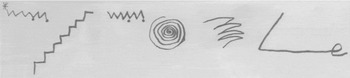
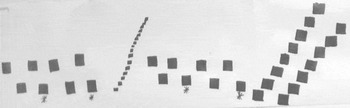
On a blustery March morning, fifth-grade music students are seated in groups around the classroom facing the board. Some are in chairs arranged in a semi-circle, but most are seated on the floor at the front of the room where they have a better vantage point. The students watch with eagerness and intrigue as each group of peers shares its ‘musical map’, a graphic score representing the musical ideas and images that these students heard and felt while listening to Mussourgsky's Ballet of the Unhatched Chicks, from Pictures at an Exhibition. Now while listening to the music once again, the students trace the map they have created, with gestures that intuitively reveal duration, phrasing, dynamics or articulation. When the music ends, they turn and face the class, with looks of satisfaction and pride.
Spontaneous applause ensues, both for delight in the shared musical experience and in congratulations for the map creators. Hands fly into the air as the students who have just watched the tracing of the map seek to participate in a discussion with the creators of the map about newly shared musical ideas.
This vignette captured a final episode in the story of these students’ experiences with musical mapping and the use of this process to formulate and express musical understanding during listening. Earlier, these students had engaged in a wide range of musical listening activities that provided a foundation that enabled them to collaboratively create graphic representationsFootnote 1 of a piece of music. While all musical engagement includes listening, a ‘listening lesson’ here is one in which the primary engagement with music is through listening, rather than those that also include performing or creating music. Studying the work and interactions of these students during previous lessons,Footnote 3 I had become acutely aware of the strategies they valued and readily used to interact with musical sound, including visual representation, vocalising and moving (Bruner's modes of representation, Reference BRUNER1966) and spontaneous peer interaction (Rogoff & Wertsch, Reference ROGOFF and WERTSCH1984; Rogoff, Reference ROGOFF1990). Since successful creation of the maps seemed to require the use of these strategies, I anticipated that the same strategies would come into play and support students through the process of musical mapping, and, if so, might enable the students to more fully interact with the music and with each other. As students later shared their maps with the class, they continued their use of these strategies. It became clearly evident that the mapping process provided a unique frame for students to develop, express and share their musical understanding while listening to music.Footnote 4
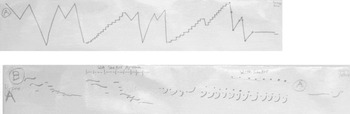
A student-created musical map (The “A” section, 00:0–0:15)Footnote 2

This article develops the notion of learner agency in the context of a fifth-grade (learners ages 10–11) general music classroom. The data shared here, drawn from a larger study (Blair, Reference BLAIR2006), were collected during regularly scheduled sessions of my own fifth-grade general music classes over a period of 3 years. Emergent themes from this study discussed in other publications include: (a) the nature of kinaesthetic or ‘felt pathways’ of learning when engaged with music (Blair, Reference BLAIR2008) and (b) the metaphorical relationship of narrative and musical mapping as a form of narrative musical expression (Blair, Reference BLAIR2007).
Students engaged in activities that were part of the regular music programme – activities that I designed in my role as their teacher; no alterations were made for the purposes of the study. The classes, which averaged 25 students each, were part of a public elementary school that served about 450 students from middle- to low-income families. The school was officially considered ‘at-risk’ with more than 60% of the students receiving free or reduced price lunch.Footnote 5 I worked as a teacher-researcher, collecting data through personal observation, video- and audio-taping, student interviews, field notes, reflective journals and artifacts. Data were transcribed and analysed for emergent themes (Lincoln & Guba, Reference LINCOLN and GUBA1985). While data were collected during all class sessions as the study progressed, my attention became increasingly focused on student work during listening lessons, particularly those that culminated in the musical map project.
The students, whose work is represented here, engaged in a musical mapping unit that began with students figuring out how to interpret a map that I had created (Fig. 2).
When the students enter the classroom, the Love for Two Cats (Ravel's L'Enfant et les sortileges) map is already on the board. As the music begins, they instantly become quiet, eyes fixed on the map. There are grins as students hear the sounds of cats represented musically. Keith and Abby immediately begin pointing, tracing in the air the contour of the shapes on map. Lauren and Jessica watch intently. As soon as the music stops, Lauren claps her hands with glee and with a big smile says, ‘I got it’. Instantly, there is chatter all around the room, with ‘I got it!’ called out from several directions.
We listen again and this time several students are tracing the map in the air from their seats, some are making meowing noises. Hands are raised and students are eager to be selected. Several suggest that it sounds like cats and we discuss the title. I let them know that we will listen one more time and then I will be asking for a volunteer to trace the map for us. Jessica is carefully and gracefully tracing the contour. Where there is a ‘pffft’ sound, she touches her fingers together and releases them appropriately with the music.
I invite Jessica to trace the map for the class, which she does with amazing precision as her peers watch and listen intently. When the music stops, she returns to her seat with a confident gait and a smile on her face. Over the course of the class period, several more students come up to point to the map; the others continue to point from their seats, their gestures becoming clearer and more expressive with each repetition of the experience.
Map for Ravel's L'Enfant et les sortilèges (excerpt: 0:00–0:40)

The students seemed to revel in the experience as they figured out the relationship between graphic and sound, took many turns tracing it while the music played, and had a lively debate about what the symbols might mean. They then interacted with a different map, a skeletal representation of the music (excerpt of Haydn's ‘Surprise’ Symphony), where they were invited to add important musical features that were missing from the map. Both maps used a variety of graphics to represent musical ideas, providing the students with examples from which to draw upon when designing their own maps. Last, students listened to the music that would be used for their own mapping experience, Mussourgsky's Ballet of the Unhatched Chicks. The students quickly determined its AABA form and were then invited to listen several more times and draw the music in the air. Students voluntarily began singing or humming along with the music as they ‘drew’ and preferred gestures began to emerge. When students seemed confident in their singing and gestures, they took paper and pencil and began rough drafts of their maps, working in small groups to explore, discuss and negotiate musical ideas and creative ways to visually represent them.
Lauren and Jessica work together. Lauren has the pencil and Jessica watches carefully as Lauren draws and then points along to what she has drawn. They finish the first phrase before the others and are frustrated because they want to hear the next phrase, the ascending line. I suggest that they go ahead and just sing the music. Lauren begins to draw, but cannot remember the music precisely. Jessica joins her in singing and they continue. I play the recording for them this time and they sit up and count the number of steps on their fingers.
At this point, Lauren turns the pencil over to Jessica indicating that drawing the rest of the map will be her responsibility, sharing the work fairly. They are at the point of the two shorter ascending lines and are once again working out the steps on their fingers. They get to the penultimate phrase, listen to it without drawing, and as soon as it stops, look at each other, sing it accurately in unison, and both bend over the map to draw it, this time singing it slowly together as Jessica draws the shapes that represent these difficult intervals, with Lauren frequently pointing to where the next pitch should be placed. They anticipate the long sustained note, sing it and draw a long horizontal line, placing it closer to the top of their paper (Fig. 3).
Jessica and Lauren's map (The “A” section, 00:0–0:15)

Working nearby, Danny, Abby and Roger listen to the ascending phrase. Abby asks, ‘How many times does that go up?’ In reply, Danny sings it, making a rolling motion with his hand indicating pulse more than pitch. Abby begins to draw, and Danny sings it very slowly, counting the pitches on his fingers.
Abby is doing most of the drawing and points to the map with her pencil as the music is playing. Danny sings and gestures constantly and gives Abby immediate feedback to help her with the map. When the music arrives at the place where the long ascending line is split into two sections, Danny actually points to the paper, drawing imaginary lines with his hand to express his idea. ‘It's not the same’, he tells her, referring to the first ascending pattern. The music is playing and he sings along when the split phrase is heard. ‘It goes up twice. The second one starts down.’ He is still singing and counting the steps on his fingers. ‘Eight for the first one’, he tells her. He listens again. ‘Eight the first time, seven the second time’ (Fig. 4).
“Eight the first time, seven the second time.” (The “A” section, 00:0–0:15)

The music plays again from the beginning and Danny continually sings along, while Abby once again points to the map with her pencil. The class has not yet worked on the last phrase, but Danny sings it during the moments between listening and working on the map. ‘Here's the next one’, he says as he ‘draws’ it with his hand on the paper, accurately indicating the melodic contour of the phrase, then draws the long sustained pitch in the air, as he runs out of paper. Abby draws the first pitch and cannot remember where to draw the next one, so he again, more slowly, draws the imaginary marks for her. He is quite specific about the pitch relationships: ‘And then it goes one lower’, singing it slowly.
All around the room, students are asking, ‘Can we hear that again?’ Like Danny, they are quite determined to get their maps just the way they want them and repeated listenings have become a necessity. Danny is not the only student singing; various phrases are sung simultaneously around the room as students continue to work on their maps.
During the creation of the rough drafts, the music was played in short sections or phrases, repeated as often as requested by the students. When the students returned to class the following week and began to make their final copies, the music was once again played in its entirety. Finally, each group presented its map to the class, tracing it as the music played and allowing others a glimpse into the ways they made meaning while listening to this particular work.
Cindy, Madison, and Bethany have represented two layers of music at the end of the B section, which Bethany manoeuvres with two hands pointing simultaneously (Fig. 5).
Cindy, Madison, and Bethany's map (complete work)

Tina: We couldn't read it at the end . . . of B (place where they have two layers).
Mrs B: Oh . . . that's a pretty interesting spot. We might have Bethany point to that this time, ‘cause she's figured out how to trace that two-handed. There are two things going on at one time. (The music is played and Bethany successfully points to both layers.)
Tina: I liked the way it was pointed to at the same time.
Mrs B: Did that help to have them do that?
Tina: Yes, like totally.
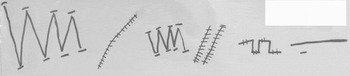
Alex and Jerry had used only angular lines on their map (Fig. 6).
Alex and Jerry's map (The “A” section, 00:0–0:15)

Dillon: Were you going to use circles? ‘Cause you practically made everything in like, sharp lines.
Mrs B (sounding intrigued): They did, didn't they? Did you notice that?
Dillon (with a hint of criticism): You guys made everything in sharp lines.
Mrs B: The thing I like about this project is that everybody's is different. Everybody draws it the way they hear it – it's just your own thing. It doesn't have to be a certain way at all – it doesn't have to be curvy, it doesn't have to be circles, it doesn't have to be sharp lines – it can be whatever you think.
Bethany (thoughtfully): It's like map stuff . . . cause you put your personality into it and the people around you and stuff.
Mrs B (smiling): That happens a lot when we listen to music – what you are and what you hear makes a whole new thing.
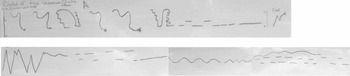
Oliver has drawn a particularly clear and detailed map (Fig. 7). His classmates are duly impressed with his ability to both hear and graphically articulate what he understood about the music.
Oliver's map (complete work)

Shelly (referring to Oliver's map): I thought it was neat how he really listened to the music and saw that the – I don't know what you would call it – the weirder part of the music kept going. You know, I thought it was hard. (She is referring to the extra layers he has drawn in two places.)
I asked Oliver to point to the extra layers this time as we listened to it again. When it was over, I asked the class, ‘Did you hear it?’ ‘Yeah!’ they answered emphatically.
Kelly: I thought . . . I thought their map was neat because it showed all the different little things, little things that were added. Nobody . . . I don't think that anybody else really heard those things until they saw it on the map (emphasis added).
Learner agency
This mapping experience provided a glimpse into these students’ musical thinking and gave me a sense of their agency as learner-musicians in this classroom setting. The high level of engagement displayed by these students, their free use of strategies to propel their understanding and enable their own success, their desire to make a map that expressed their musical understanding and to get it ‘just right’, their urgency to share their maps with their peers and to discuss them with others in a way that validated themselves as musicians and as contributing members of this learning community, are all representative of the central role of learner agency in these experiences. In discussing learner agency, some researchers have focused their attention on the arts as a vehicle for social inclusion (Kinder & Harland, Reference KINDER and HARLAND2004), others as a means of engaging the under-engaged (Kim, Reference KIM2006; Morrison, Burton, & O'Toole, Reference MORRISON, BURTON, O'TOOLE, Burnard and Hennessy2006), or the ways the arts function as a source and expression of identity among students (Akuno, Reference AKUNO2006; Davis, Reference DAVIS2005; Evelein, Reference EVELEIN2006; Green, Reference GREEN2002, Reference GREEN2006; Seifried, Reference SEIFRIED2006). What emerged from the present study was the development of understanding of the connections between learner agency and music learning process.
Agency refers to the ways people act and interact within sociocultural settings. Dewey (Reference DEWEY1916) describes the agent or participant (as opposed to spectator) as one who is ‘bound up with what is going on: its outcome makes a difference to him or her’ (p. 124). Agency implies interest and ownership of the outcomes; people who act with personal agency act with concern, interest, aims, purpose, intent and motivation (p. 125).
Bruner (Reference BRUNER1996) identifies four crucial areas concerning the way teachers teach and learners learn: agency, reflection, collaboration and culture, defining agency as ‘taking more control of your own mental activity’ (p. 87). The ability and opportunity to make decisions, to use strategies, and to create frames that enable understanding are ‘key notions of the agentive approach to mind’ (p. 93). Swanwick (Reference SWANWICK1999, pp. 53–4) elaborates on Bruner's ideas, describing agency as ‘the natural energies that sustain spontaneous learning: curiosity; a desire to be competent; wanting to emulate others; [and] a need for social interaction’.
The desire to fulfil basic human needs fuels the impetus for human agency. Among these needs are competence, autonomy and relatedness (Deci & Ryan, Reference DECI and RYAN2000), love and belonging, power and freedom (Glasser, Reference GLASSER1998), esteem and self-actualisation (Maslow, Reference MASLOW1943). Kohn (Reference KOHN1999) suggests that intrinsic motivation results when students are engaged in authentic and relevant content, decision-making is collaborative (all voices heard and considered), community members are caring, and autonomy (choice) is a valued characteristic of the learning environment.
For Bruner (Reference BRUNER1996) agency (self-esteem and its connection to identity) is connected to and rooted in a sense of self. ‘Selfhood . . . derives from the sense that one can initiate and carry out activities on one's own’ (p. 35). Beyond the recognition of experiential activity, ‘what characterizes human selfhood is the construction of a conceptual system that organizes . . . a ‘record’ of agentive encounters with the world, a record that is related to the past . . . but that is also extrapolated into the future – self with history and with possibility’ (p. 36). It is, then, evaluation that instils a sense of possibility – not simply ‘this is who I am’, but a sense of becoming.
The notion of agency includes, then, developing this sense of who we are, the agentive need to be valued for who we are, and the desire to fulfil imagined possibilities (Greene, Reference GREENE1995). Agency implies learners moving from powerlessness to a sense of control and a hope for the future, their own future. The realisation of self and one's potential for growth is a transformative experience. When learners realise that they have voices, use their voices, listen to the voices of others, value the process and seek to expand it, they become people able to feel ‘themselves part of the dance of life’ (p. 72).
Agency and music education practice
Can these broader notions of agency inform practice in the music classroom? Is there a sense of agency among music students to develop a ‘musician voice’, to imagine their own possibilities? Studying student interactions in my own classroom, it became evident that agency was students’ internal motivation to have their needs met. It is what propelled them to learn, to be engaged in thoughtful problem solving and reflection, to care about the content under consideration, and to function democratically with others in a particular learning environment.
Two fundamental, interdependent qualities of student agency emerged from this study, confirmed for me by my teaching experience as well. One was students’ desire to enable and further their own understanding, or more simply, to grow as learners and to accomplish that learning by discovering things for themselves. This ‘own understanding’ implies ownership or control within the learning process. In the music classroom, this was manifested in the students’ desire to function as musicians – to participate with others as composers, listeners and performers. Through these kinds of experiences, they are able to (a) apply conceptual understanding to new musical contexts and (b) relate to others in musical ways. The authentic nature of participating in such roles is critical, for it is in solving problems in real-life contexts that learning has meaning (Dewey, Reference DEWEY1938/1998; Reimer, Reference REIMER2003).
The second fundamental area of student agency that emerged was the students’ desire to be respected and valued as members of the learning community. Students sought to have their musicianship honoured, to have their musical ideas known, valued, even celebrated. It is as if they were saying, ‘Listen to me! I have something to say! Hear me, respect me, know me.’ Upitis (Reference UPITIS1992) shares a similar observation, sharing that when students ask her,
‘Can I play you my song?’ the question signifies much more than a request for a minute or two of [her] attention. It means, ‘Listen to what I made up, look at how I wrote it down, see what I can do, and – most important of all – listen to who I am’ (p. 151, emphasis added).
Valuing students and respecting their agency about what they are learning, doing and living are key attributes of a successful learning community. These ideals will shape the classroom environment but must also inform the curriculum. Dewey (Reference DEWEY1902) emphasises that education must be about the child and the curriculum, rather than the child versus the curriculum, with ‘the child [as] the starting-point, the center, and the end’ (p. 9). Vygotsky, as explained by Moll (Reference MOLL1990), ‘highlighted the importance of everyday activities and content in providing meaning, the ‘conceptual fabric’ for the development of schooled concepts’ (p. 10). Everyday concepts must be the starting point and as they are ‘transformed by interacting with schooled concepts [become] part of a system of knowledge, acquiring conscious awareness and control’ (p. 10). It is not that curriculum is generated solely from student interests (although it might be); it is that teachers actively and creatively develop a continuum of experience that flows through students’ lives in and out of school.
Student agency, learning and the zone of proximal development
These two areas of agency, the students’ desire (a) to grow in musicianship and (b) to be valued for their musical ideas, are directly connected to Vygotsky's (Reference VYGOTSKY1978) zone of proximal development (ZPD), which he describes as ‘the distance between the actual developmental level as determined by independent problem solving and the level of potential development as determined through problem solving under adult guidance or in collaboration with more capable peers’ (p. 86). Learning within the ZPD means entering an arena in which the learner is not fully competent to operate independently. Within the ZPD, with effective, appropriate scaffolding, a learner is often able to operate at a higher level than he or she would have been able to operate independently. However, for this to happen, the learner must be willing to enter that arena. Willingness to engage in experiences that are outside a learner's comfort level requires (a) a desire and willingness to learn and (b) feelings of confidence, security and trust.
Mahn & John-Steiner (Reference MAHN and JOHN-STEINER2000, Reference MAHN, JOHN-STEINER, Wells and Claxton2002; Mahn, Reference MAHN, Kozulin, Gindis, Ageyev and Miller2003) have extended Vygotsky's work to include what they have called perezhivanie, suggesting that affect is central to the notion of the ZPD. ‘Perezhivanie describes the ways in which the participants perceive, experience and process the emotional aspects of social interaction’ (p. 49). They suggest that Vygotsky included affective variables as an important interwoven layer in the ZPD and that interpersonal scaffolding within human discourse may promote risk-taking, enabling a ‘gift of confidence’ (Mahn & John-Steiner, Reference MAHN, JOHN-STEINER, Wells and Claxton2002) that supports learner success. These variables may include ‘a common understanding of the task at hand, an appreciation of one another's cognitive, social and emotional development, and potential contribution’ (p. 49).
Without a desire to learn or capacity and willingness to take risks, students may hesitate to venture into the ZPD. The teacher cannot do this for them; the impetus must be present in the student. Willingness to engage requires internal motivation to learn, to grow, to function as musicians (competence). Deturk (Reference DETURK and Boardman1989) describes ‘creative thinkers as risk takers in pursuit of their objective’ (p. 27). Entering the ZPD places the student in a position of potentially being revealed as unintelligent or unskilled. Rogoff (Reference ROGOFF1990) links the ZPD to a place of risk taking because of the revealing of ones’ own vulnerabilities and the need for safe learning environments: ‘Learning requires risk taking, since learning involves functioning at the edge of one's competence on the border of incompetence: If the teacher is not trustworthy, the student cannot count on effective assistance from the teacher; there is a high risk of being revealed (to self and others) as incompetent’ (p. 202). It is only in establishing a learning environment where trust is the norm – between teacher and student and among peers – that students can set aside fears and risk stepping into the unknown.
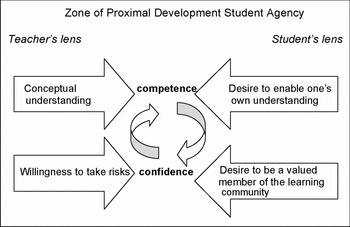
Here then, within the ZPD, are two interdependent layers: competence and confidence (Bandura, Reference BANDURA1977; Csikszentmihalyi, Reference CSIKSZENTMIHALYI1990). An emerging sense of self-efficacy rooted in a growing balance between confidence and competence (for Cskikszentmihalyi, skill and challenge) enables student growth. In a music classroom, as students successfully move through once-uncertain zones of proximal development, they grow in their conceptual understanding and grow in competence, in their ability to function as musicians. As students are honoured and celebrated for their musical ideas, they grow in confidence and their sense of agency to be considered valued members of the learning community is met. Each then propels the other as students grow in both areas of the ZPD, conceptual understanding and confidence (Cameron et al., Reference CAMERON, WIGGINS, WIGGINS and BARTEL2002; Wiggins et al., Reference WIGGINS, BLAIR, RUTHMANN and SHIVELY2006), which is reciprocal with their own sense of agency as their desire to learn and their desire to be valued for who they are and what they can contribute is met (see Fig. 8).
Interdependent layers of learning and student agency

Valuing of process and product
In this study, there was an underlying sense of valuing that permeated everything occurring in the classroom. Students were intrigued with solving melodic contour puzzle cards and intrigued with following and adding to the teacher-created maps, freely employing personal strategies to ensure their success. Students were highly engaged in creating their own maps and insistent upon sharing their ideas with peers and teacher, enjoying the discussion that ensued with the opportunity to further describe or explain their work. This type of informal assessment may further the students’ sense of musical identity because ‘if identity is concerned with persuading others and oneself about who one is, and what one is able to do, the judgment of others is crucial’ (Gipps, Reference GIPPS, Wells and Claxton2002. p. 80). Gipps also suggests that ‘involving the pupils in evaluation of their work through a constructive process of feedback is one way in which teachers can show pupils that they are valued and respected rather than objects of classification and grading’ (p. 81).
As I reflected upon the students’ use of the various strategies to solve the mapping problems, I realised that while these were strategies commonly used in this music classroom, in these data, it was evident that the students were the initiators of the strategies and were using them in ways that served their own purposes, with their own intentions and through their own design. It was evident that they were intently listening, thinking, conferring, moving and singing – working out musical ideas in their minds and bodies. Even when they had finished solving the problems, students would continue to trace or gesture to the musical map, never seeming to tire of retracing the map and reflecting on their ideas.
Among the students, there was also a high level of urgency to share what they had come to know; they were both insistent and persistent to express their ideas. While creating their maps, students continued to repeat their ideas until the group ‘scribe’ had written them down. Their sense of agency was also evident on a private, individual level, for example, in their continual tracing and confirming of their decisions about placement of puzzle cards by continuing to trace them even after pronouncing that the puzzle was complete. It was as though students continued to share the experience for themselves, a personal interaction with music, self and musical map.
Student agency was evident on a more public level in their insistence that they be heard by peers and teacher when they had an idea to share. Hands were raised spontaneously and urgently, with standing and flailing about a common occurrence. Students changed their positions in the room to see better, to interact more closely with the musical problem and with others. They called out, ‘Do it again!’ requesting yet another listening. Students used personal strategies to solve the problem, because finding a solution was important to them. They seemed unhappy with me if I moved on before all their ideas were heard. When sharing their maps with their peers, they wanted an opportunity to show or explain every nuance.
It seemed to me that underlying the students’ sense of agency was a feeling of self-empowerment for enabling their own musical understanding. It was the development of a ‘musician voice’, a sense of self as a person with personhood validated by others when expressed musically. ‘Voice is related to students’ capacity to formulate and air their thoughts, believing they have something worthwhile to say and feeling heard’ (Stanton, Reference STANTON, Goldberger, Tarule, Clinchy and Belenky1996, p. 41). It is the furthering of one's own understanding that fuels student agency. As they became more successful, understanding new or more complex musical ideas, their sense of efficacy as musicians rose. This fuelled their agency to continually grow and the growth further fuelled their agency by building their confidence and self-worth. It was a never-ending cycle, a synergistic energy that seemed to internally propel them forward.
Agency, collaboration and knowing the other
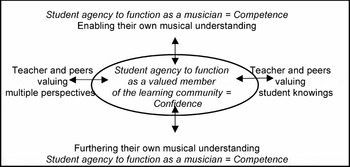
Bruner (Reference BRUNER1996) describes the link between agency and collaboration, noting that it is impossible to determine where one stops and another begins. This supports the notion that competence and confidence are interdependent components within student agency (see Fig. 9). The collaborative nature of learning not only furthers thinking, but empowers learners as their ideas are validated, as they witness their contributions being affirmed and furthering the learning of others, not just themselves. It is this discourse that allows us to know ourselves while and because we come to know others.
Agency: Self-empowerment to grow in competence and confidence

[T]he agentive mind is not only active in nature, but it seeks out dialogue and discourse with other active minds. And it is through this dialogic, discursive process that we come to know the Other and his points of view, his stories. We learn an enormous amount not only about the world but about ourselves by discourse with Others. Agency and collaborations are rather like yin and yang (Bruner, Reference BRUNER1996, p. 93).
To understand and to be understood
As was evident in the high level of engagement, student valuing of the process of mapping was a dynamic force underlying the students’ experiences. The students’ agency to further their own musical understanding – to grow in musical competence – was evident in their valued use of enactive and visual expressions of musical understanding and in their intense collaboration with others to find and share meaning. Likewise, the students’ agency to be valued as members of their learning community – to grow in musical confidence – was evident in their urgency to share their ideas, particularly their maps, and to receive approval from their peers and teacher when doing so. Everyone wanted to share their maps; none were reluctant or ambivalent.
The discussion of the maps, with the scaffolding of watching the maps while the creators traced them, provided a forum for discovering both the common and the unique. Musical representations were varied, yet because of the shared listening experience, each could enter into the listening experience of another, to find his or her way along the map, recognising familiar musical paths and landmarks. Each map also provided new perspectives, nuances now noticed because familiarity provided the groundwork for discerning the unique among the shared musical expressions.
The musical maps provided the opportunity to enter into another's musical experience whilst listening. This in itself is incredibly important as we seek ways for students to interact with music and with others. However, the noticing of the common and unique is not just about the musical ideas or about how they are represented by similar lines and shapes; it is about noticing the common and unique in one another. By noticing the various and similar ways we each respond to music, we become aware that we, as people, have commonalities we share, yet each with our own unique perspective. This is the valuing that students so desire – that others in their learning communities recognise in each one of them that they know something about this thing called music and that what they know is very special – they understand. It is in knowing this about each other that we come to be understood.