Introduction
Trematode infections are economically important helminth diseases hampering the productivity of domesticated ruminants worldwide (Vercruysse & Claerebout, Reference Vercruysse and Claerebout2001). Fasciola gigantica, Schistosoma mattheei and Amphistomum spp. are the most common trematodes in Zambia (De Bont et al., Reference De Bont, Vercruysse, Southgate, Rollinson and Kaukas1994; Phiri et al., Reference Phiri, Phiri and Monrad2006a). Mixed infections with different trematode species are common since they share the same intermediate snail host and/or similar transmission sites (Pfukenyi et al., 2005; Keyyu et al., Reference Keyyu, Kassuku, Msaliwa, Monrad and Kyvsgaard2006; Phiri et al., Reference Phiri, Phiri and Monrad2006a).
Heterologous resistance between Schistosoma and Fasciola species in concurrent infections has been observed in several experimental and farm animals (Hillyer, Reference Hillyer2005). Previous reports have demonstrated that F. hepatica and Schistosoma mansoni cross-protect against each other in mice, causing a reduction in worm burden and/or egg-producing capacity (Hillyer, Reference Hillyer1984). Likewise, cattle infected with Schistosoma bovis were shown to acquire an enhanced resistance to challenge Fasciola spp. infection and vice versa (Haroun & Hillyer, Reference Haroun and Hillyer1986; Yagi et al., Reference Yagi, Younis, Haroun, Gameel, Bushara and Taylor1986). An enhanced resistance against F. hepatica and F. gigantica after primary infection with S. bovis has been described in cattle (Sirag et al., Reference Sirag, Christensen, Nansen, Monrad and Frandsen1981; Yagi et al., Reference Yagi, Younis, Haroun, Gameel, Bushara and Taylor1986) and sheep (Monrad et al., Reference Monrad, Christensen, Nansen and Frandsen1981). Similarly, a primary infection of F. gigantica in calves resulted in enhanced resistance to challenge S. bovis, with a 94.2% reduction in worm count (Yagi et al., Reference Yagi, Younis, Haroun, Gameel, Bushara and Taylor1986). These findings imply that these two trematodes may be susceptible to the same or similar immune responses (Spithill et al., Reference Spithill, Smooker, Bruce and Dalton1999) and may have common antigens (Rodriguez-Osorio et al., Reference Rodriguez-Osorio, Gomez-Garcia, Rojas-Gonzalez, Romajo-Martin, Manga-Gonzalez and Gonzalez-Lanza1993).
Studies on concurrent naturally acquired infections of Fasciola, Schistosoma and Amphistomum in cattle are lacking. Since concurrent trematode infections may influence the epidemiology of individual fluke populations, it was desirable to study the dynamics of these trematode infections and their relationships in cattle in endemic areas. Therefore, objectives of this study were to determine the occurrence and extent of concurrent F. gigantica, Schistosoma spp. and Amphistomum spp. infections in free-ranging cattle in Zambia, and to investigate their interactions.
Materials and methods
Study area
This study was carried out at Turn Pike abattoir, located 60 km south of Lusaka. The local cattle came from areas where worm control is not routinely practised. A total of 315 cattle presented for slaughter were examined from June 2005 to July 2006 for worms of F. gigantica in the liver, Schistosoma spp. in mesenteric blood veins, and Amphistomum spp. in the rumen. Worm and faecal egg counts were determined from 50 randomly selected trematode- infected cattle.
Parasitological examinations
Fasciola and Amphistomum eggs were detected and quantified by the sieving and sedimentation technique as described by Taira et al. (Reference Taira, Suzuki and Boray1983). Schistosoma faecal egg counts were determined using a modification of the concentration technique by Lawrence (Reference Lawrence1970). Each Schistosoma egg counted represented 10 eggs per gram (De Bont et al., Reference De Bont, Vercruysse, Sabbe, Southgate and Rollinson1995).
Worm counts
The intestine was isolated and mesenteries were spread out for thorough examination of mesenteric veins for schistosomes. The rumen was opened and washed lightly with tap water to expose amphistomes. Schistosomes were counted in situ in the abattoir, while amphistomes were picked from the mucosa of the whole rumen using tissue forceps, and counted. Sharp incisions were made on the liver surface, through major bile ducts and into the parenchyma to expose liver flukes. To determine liver fluke burden, liver dissections were done as described by Phiri et al. (Reference Phiri, Phiri, Sikasunge, Chembensofu and Monrad2006b).
Statistical analysis
Data of faecal egg counts (EPG) and worm counts from sampled animals were log transformed (count +1) to stabilize variances. Trematode frequencies were calculated using SPSS version 11.0 for Windows (SPSS Institute, Chicago, Illinois, USA). Chi-square was used to determine differences in worm burdens and faecal egg counts among the three trematodes. Pearson's correlation coefficient and linear regression were used to determine and describe relationships among the three trematodes. A significant relationship was denoted by a P value of less than 0.05.
Results
Of 315 cattle presented for slaughter, 133 were positive for at least one trematode infection. From these, 50 animals were randomly selected for further studies.
Coproscopy (n=50)
On coproscopic examination, 58% were positive for fascioliasis, 76% for amphistomiasis, 22% for schistosomiasis and 20% were positive for Schistosoma miracidia. Faecal egg counts varied throughout the study period, but ranged from 0 to 95 with a mean ( ± SEM) of 8.02 ± 2.23 for F. gigantica, 0–90 with a mean ( ± SEM) of 7.0 ± 2.42 for Schistosoma species and 0–183 with a mean ( ± SEM) of 17.7 ± 4.49 for Amphistomum species. A positive correlation (r = 0.560, P < 0.001) was obtained between F. gigantica and Amphistomum EPG.
Worm burdens
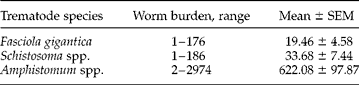
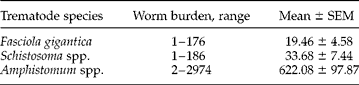
At meat inspection, 68% of the 50 randomly selected trematode-infected cattle were positive for fascioliasis, 56% for schistosomiasis and 92% were positive for amphistomiasis. The range of individual worm burdens was wide and there were variations in worm burdens among the three trematodes (table 1). Heavy worm burdens characterized Amphistomum infections, of which 48% of the Amphistomum infected cattle (n = 46) harboured more than 500 amphistomes. Low worm burdens characterized Schistosoma infections, of which 68% of the Schistosoma infected cattle (n = 28) harboured fewer than 100 worms in the mesenteric blood vessels.
Fasciola gigantica, Schistosoma spp. and Amphistomum spp. worm burdens in 50 randomly selected trematode-infected cattle from the Kafue and Zambezi river basins of Zambia.
Mixed trematode infections were common, of which 32% of the 50 randomly selected trematode-infected cattle harboured all three trematodes. Fasciola gigantica and Amphistomum dual infections were the highest (34%) while F. gigantica and Schistosoma dual infections were the lowest (0%). Schistosoma and Amphistomum dual infections were represented by 20%. Only 6% of sampled animals had Amphistomum, 2% F. gigantica and 4% Schistosoma single infections.
Interactions among trematodes
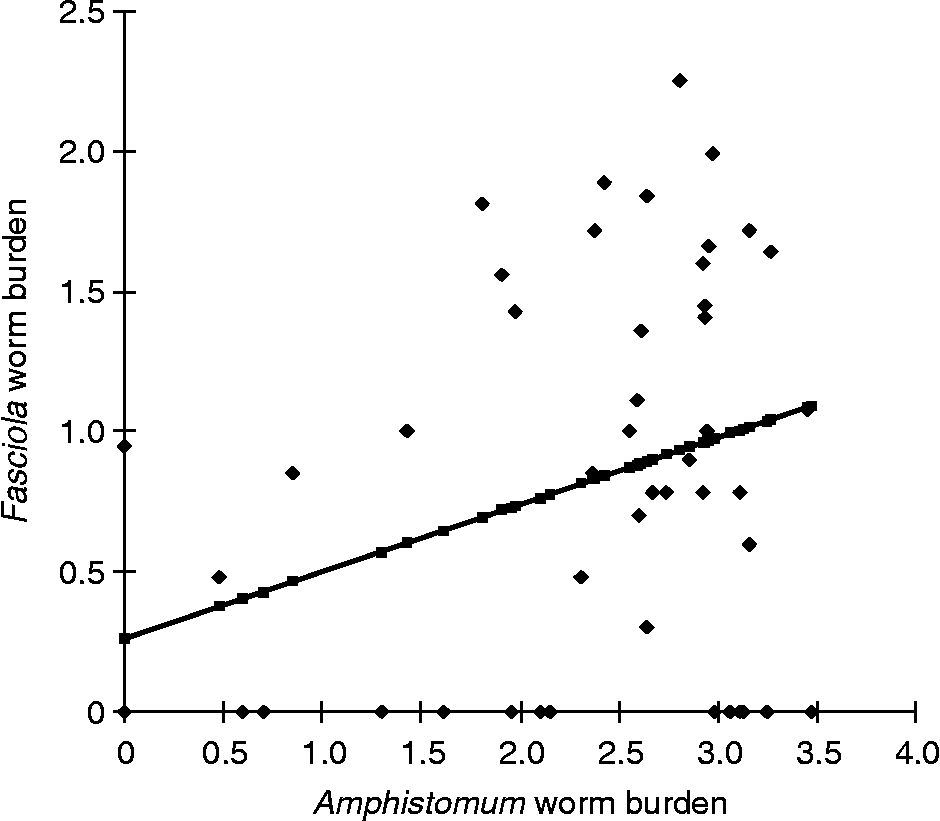
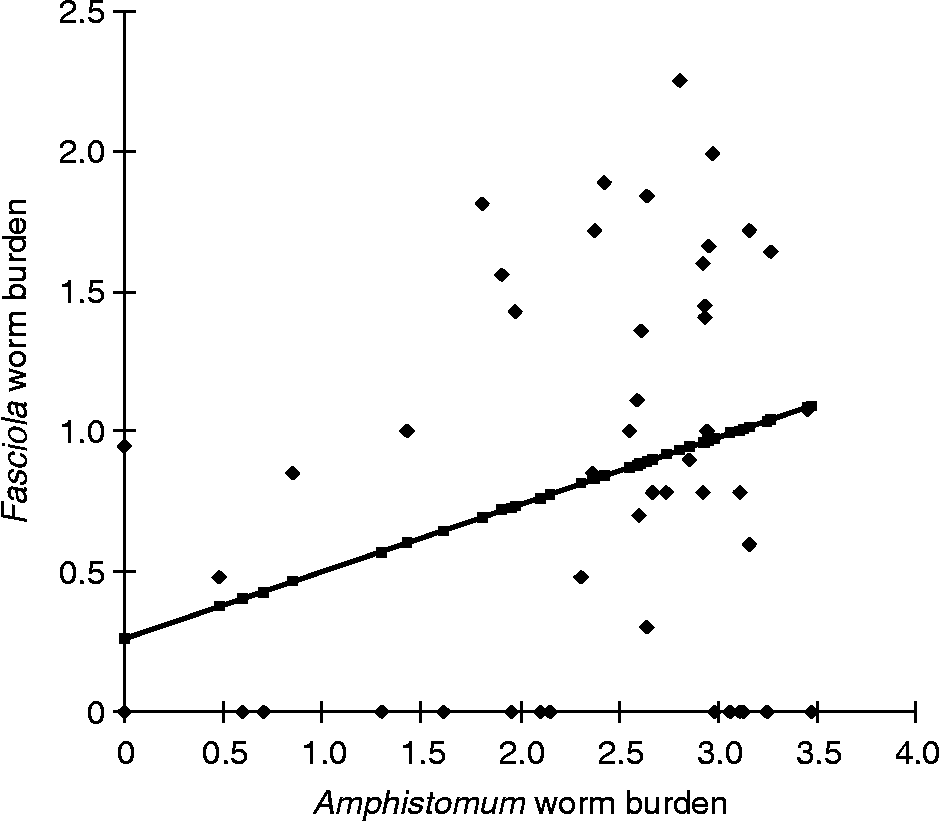
A positive correlation (r 2 = 0.12, P = 0.014) was obtained between F. gigantica and Amphistomum worm counts (fig. 1), and also between F. gigantica worm burden and Amphistomum faecal egg counts (r 2 = 0.338, P < 0.001).
Positive correlation (r 2 = 0.12) between Fasciola gigantica and Amphistomum worm burdens in cattle from Kafue and Zambezi river basins of Zambia.
There were no correlations (r 2 = 0.022, P = 0.302) between Amphistomum and Schistosoma worm burdens and between F. gigantica and Schistosoma worm burdens (r 2 = 0.015, P = 0.390).
Discussion
This study has revealed, for the first time, the presence and extent of fascioliasis, schistosomiasis and amphistomiasis concurrent infections in cattle in Zambia, based on both egg and worm counts. Our observation of concurrent F. gigantica and Amphistomum species infections is in agreement with earlier reports in Zambia (Phiri et al., Reference Phiri, Phiri and Monrad2006a) and elsewhere (Szmidt-Adjide et al., Reference Szmidt-Adjide, Abrous, Adjide and Dreyfuss2000; Pfukenyi et al., 2005; Keyyu et al., Reference Keyyu, Kassuku, Msaliwa, Monrad and Kyvsgaard2006). This finding demonstrates that interactive infections between these two trematodes are mutually inclusive. Phiri et al. (Reference Phiri, Phiri and Monrad2006a) recorded a positive correlation (r 2 = 0.043) between F. gigantica and Amphistomum species using faecal egg counts. Our study, however, recorded a stronger correlation (r 2 = 0.120) between these two trematodes using worm burdens. Worm burden may therefore be a better parameter for determining the relationship between these two trematodes than EPG, as pathophysiological changes in the host may result in fluctuations in faecal egg outputs (Boray, Reference Boray1969). Faecal egg counts may also be influenced by the amount of faeces produced per day, time of day of faecal sampling, low sensitivity of coproscopic techniques and other factors. Moreover, acquisition of immunity by cattle in chronic infections may depress egg output (Bitakaramire, Reference Bitakaramire and Dalton1973).
Although an increase in F. gigantica worm burden was associated with an increase in Amphistomum worm burden, differences in their worm burdens could be due to the density and uptake of the specific metacercariae by the host and/or the specific development of metacercariae in the definitive host (Szmidt-Adjide et al., Reference Szmidt-Adjide, Abrous, Adjide and Dreyfuss2000). Despite scarcity of reports on economic effects of amphistomiasis in cattle, the heterologous interaction of Amphistomum and F. gigantica may compound the economical effects of liver flukes to the livestock industry. These effects could be induced by the combined pathology caused by individual trematode populations, especially by immature flukes in young animals.
Although Schistosoma and Amphistomum spp. co-joint infections were common, there was no significant relationship between these trematodes. This may be attributed to possible simultaneous exposure of cattle to both trematodes in endemic areas and other unknown factors. Knowles & Jones (Reference Knowles and Jones1989) observed that concurrent Calicophoron microbothrium and Schistosoma bovis infection might occur in the snail Bulinus tropicus, given that B. tropicus is an intermediate host for both trematodes. As a result of the above, it may be difficult to observe the relationship between these trematodes in cattle in endemic areas where both parasites may become established in the definitive host at the same time.
In this study, few animals harboured both F. gigantica and Schistosoma worms. Since both trematodes cause significant liver pathology (Ferreras et al., Reference Ferreras, Garcia-Iglesias, Manga-Gonzalez, Perez-Martinez, Mizinska, Romajo, Gonzalez-Lanza, Escudero and Garcia-Marin2000; Phiri et al., Reference Phiri, Phiri, Sikasunge, Chembensofu and Monrad2006b), when one infection is established, it may exclude the other from establishing. Almeida et al. (Reference Almeida, Torloni, Lee-Ho, Villar, Taumaturgo, Simpson and Tendler2003) demonstrated that sheep vaccinated against rSm14 were significantly protected against challenge infections with F. hepatica metacercariae, and were completely free of histopathological hepatic damage related to liver fluke infections. Although the correlation coefficient between the two trematodes in our study was negative, the relationship was not significant (P = 0.390). In experimental studies, primary infection with Schistosoma or Fasciola species in ruminants has been reported to result in enhanced resistance to heterologous challenge (Bushara et al., Reference Bushara, Hussein, Saad, Taylor, Dargie, Marshall and Nelson1978; Sirag et al., Reference Sirag, Christensen, Nansen, Monrad and Frandsen1981; Yagi et al., Reference Yagi, Younis, Haroun, Gameel, Bushara and Taylor1986; Ferreras et al., Reference Ferreras, Garcia-Iglesias, Manga-Gonzalez, Perez-Martinez, Mizinska, Romajo, Gonzalez-Lanza, Escudero and Garcia-Marin2000; Almeida et al., Reference Almeida, Torloni, Lee-Ho, Villar, Taumaturgo, Simpson and Tendler2003). Our findings however, were not conclusive, since this study was done in naturally infected cattle from endemic areas with no known duration of infections. It was not possible to determine which trematode infected the host first, or the sequence of subsequent infections. Possible simultaneous exposure of cattle to both trematodes in endemic areas could have contributed to our failure to assess the effects of co-joint infections on their worm burdens and egg production.
In conclusion, for control programmes of trematodes to be effective in endemic areas, their design must consider the existence of concurrent infections. It is difficult to conclude on the relationship among and between those trematodes in natural infections. The number of cattle in this study is relatively low, especially considering the high trematode prevalence ratio in the study area. Experimental studies on concurrent Fasciola and Amphistomum, and Schistosoma and Amphistomum infections may also give a clear explanation on interactions of these trematodes in cattle.
Acknowledgements
We thank the VLIR-UNZA IUC Program for funding this study and Professor S. Siziya for his assistance with statistics and data analysis. Technical assistance by Mr M. Masuku and Mr D.S. Banda is acknowledged. We also thank the University of Zambia School of Veterinary Medicine for facilitating this study and Turn Pike abattoir management for their cooperation.