Introduction
Estimates of the odds against life emerging from non-life are highly uncertain, but must surely range from being superastronomical to hugely astronomical (Hoyle & Wickramasinghe Reference Hoyle and Wickramasinghe1999). The recognition that life has an information content too vast to be assembled by random processes has led to many discussions of possible evolutionary routes, starting from a simpler self-replicating organic system and ultimately leading to the present-day protein-DNA-based life. The currently popular RNA-world hypothesis is based on the evidence that short stretches of RNA molecules act in the capacity of enzymes, catalysing their continuing replication (Woese Reference Woese1968; Gilbert Reference Gilbert1986). The clay model (Cairns-Smith Reference Cairns-Smith1966; Cairns-Smith & Hartman Reference Cairns-Smith and Hartman1986) uses the repeating lattice structures of clay particles and their catalytic properties of converting simple organic molecules in aqueous solution into complex biopolymers. The clay lattice structure serves as the first template in the progression to life. RNA molecules are known to persist and replicate on clay surfaces, thus combining aspects of the RNA-world theory with the clay model.
Cometary interiors as incubators of early life
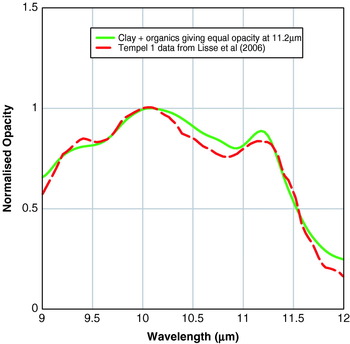
In the context of recent studies of comets, the clay hypothesis merits serious reconsideration. The Deep Impact mission to Comet Tempel 1 (4 July 2005) revealed spectroscopic evidence for a mixture of organics and clay particles carried away in the post-impact plume (A'Hearn et al. Reference A'Hearn2005; Lisse et al. Reference Lisse2006). Figure 1 shows the normalized emissivity curve of dust from Tempel 1 (Lisse et al. Reference Lisse2006) compared with mixtures of clay and biological aromatic molecules, the latter contributing to the emission peak at 11.2 μm. The case that matches the data best requires an estimated 30% by mass in the form of clay particles. Analysis of dust recovered from Comet Wild 2 in the Stardust Mission showed the presence of a range of complex hydrocarbon molecules that might be considered appropriate monomers for prebiotic chemistry when they are introduced into an aqueous environment (Sandford et al. Reference Sandford2006). Thus, the required aqueous environment for this model, containing high concentrations of organics and clay particles, is now established to occur in comets.
Normalized opacities over the 9–12 μm range owing to mixtures of clays and biological aromatic molecules. Comparable contributions at 11.2 μm from clays and aromatic molecules fit most of the long-wave opacity requirements.

It is curious that modern biology displays a residual affinity to silica and highly ordered silica structures. Biogenic silica often displays ring structures and ultra-microcrystalline order. Diatoms use silica in the form of complex siliceous polymers overlain with protein templates in their cell walls (Hecky et al. Reference Hecky1973). The formation of solid silica structures with precisely controlled morphologies appear to be directed by DNA coded proteins (Cha et al. Reference Cha2000), and one might conjecture that a reversal of logic could lead from highly ordered silica morphologies (a primitive genome) to a DNA-based informational system.
The liquid-water condition in cometary interiors may be maintained by radiogenic heat sources 26Al and 50Fe over timescales of around 106 years (Lisse et al. Reference Lisse2006; Wickramasinghe Reference Wickramasinghe2007). For large comets (say >100 km in diameter) the liquid phase may be an order of magnitude longer. The surfaces of clay particles with a total volume of 103 km3 in a typical comet may thus provide an ideal platform for prebiotic evolution to commence.
Cataldo (Reference Cataldo2007) has pointed out that life cannot be conceived without chirality, and that the prolonged action of cosmic rays on prebiotic molecules in the interstellar medium or the action of sunlight on the Earth would act against the preservation of chirality of asymmetric molecules. However, in cometary interiors, the only photons present are γ photons arising from the decay of radiogenic nuclides. Cataldo (Reference Cataldo2007) found that, in the presence of the expected radioactive decay in cometary interiors, a significant fraction of chiral molecules would survive over several billion years. In one specific case studied, the optical activity was enhanced by the gamma radiation, yielding a polymer that could act as a template for prebiotic chemistry. Thus, cometary interiors seem to favour the chirality selection of amino acids and sugars found in present-day biology.
The recent discovery of a diverse microbial ecosystem at a depth of 2.8 km in the Archean crust, evidently sustained by the energy of radioactive decays over millions of years, gives additional credence to the idea that life could originate under similar conditions (Lin et al. Reference Lin2006). The a priori case for a clay-based model for an origin of life in a clay–organic–water comet somewhere in the Galaxy, as against an origin in a diminutive setting on the Earth, is manifestly strong.
Comparison with an early Earth origin
A link between the origin of life and comets has been minimally conceded to the extent that raw materials (water, prebiotic organic molecules and essential minerals) were delivered to Earth by comets. There can be little doubt that a fraction at least of the Earth's water came from comets (Morbidelli et al. Reference Morbidelli2000; Raymond et al. Reference Raymond, Quinn and Lunine2004) and possibly a component of primordial cometary clays as well. On the present-day Earth aqueous suspensions of clay particles in conjunction with organics persist mostly in hydrothermal vents, the total volume of which could hardly be in excess of 103 km3. Clay present elsewhere in the crust, formed through weathering of rocks and accumulating in shallow pools, would have an erratic short-term persistence, drying up seasonally, or with colloidal particles sedimenting under gravity on shorter timescales. Soon after the end of the Late Heavy Bombardment, the deposition rate of indigenous clay in the Earth's crust would have been minimal, as is indicated by the thin layers of clay found at the top of the oldest Pre-Cambrian sediments (Ziegler & Longstaffer Reference Ziegler and Longstaffer2000).
At the presumed time of life's origin on Earth we consider an effective depth of 2 m of clay covering 1% of the Earth to be an optimistic upper limit for the total clay volume (~104 km3) that is transiently available for catalytic chemistry.
The volume of clay on the Earth is vastly surpassed by that in comets. A single comet of radius 10 km and 30% volume fraction of clay (Wickramasinghe et al. Reference Wickramasinghe, Wickramasinghe and Wallis2008) contains as much clay, to within a factor of around 10, as that of the early Earth. However, our Solar System is surrounded by about 1011 comets forming the Oort cloud (Bailey et al. Reference Bailey, Clube and Napier1990), giving a factor of 1011 in favour of comets on the basis of relative clay volume alone. Whereas the average persistence of shallow clay pools and hydrothermal vent concentrations of clay on the Earth can range from 1 to around 100 years, a cometary interior provides a stable, aqueous, organic-rich environment for around 106 years. Thus, there is another factor of at least 106/100=104 in favour of Solar System comets over the Earth, raising their relative chances to say 1015 to within two powers of ten. However, mechanisms for interstellar panspermia have recently been identified (Napier Reference Napier2004, Reference Napier2007; Wallis & Wickramasinghe Reference Wallis and Wickramasinghe2004), and we may have to multiply this number by the number of Oort cloud analogues in the Galaxy. Direct detection of such clouds is not yet possible (Jura Reference Jura2005), although their existence has been inferred by indirect arguments for several star systems (Grady et al. Reference Grady1997; Melnick et al. Reference Melnick2001; Beichman et al. Reference Beichman2005). Indeed our current understanding of planetary system formation suggests that such clones are the rule rather than the exception. If 10% of G-dwarf stars are endowed with planetary systems and Oort clouds of comets, the final number for the Galaxy is at least 1024. Thus, the mass and stability of suitable cometary environments overwhelms any which may have existed on the early Earth: if life was first assembled in clay, the odds against the clay being terrestrial are at least 1024:1. Similar considerations apply to other proposed prebiotic pathways, such as those of the PAH (Hazen Reference Hazen2005), lipid (Szostak et al. Reference Szostak, Bartel and Luisi2001) or peptide (Carny & Gazit Reference Carny and Gazit2005) worlds.
Conclusion
It is widely considered that prebiotic molecules were brought by comets to the early Earth, there to be assembled as soon as the harsh conditions of the Late Heavy Bombardment eased. Liquid water, organic nutrients and surface rather than volume reactions are likely prerequisites for whatever prebiotic pathway was involved in the creation of life. However, there seems to be no compelling reason why prebiotic molecules need to be brought to Earth before they can be assembled. Mechanisms discussed in the literature (such as the clay world of Cairns-Smith) work as well or better in liquid cometary interiors as they do in the harsh conditions of the early Earth, while in terms of total mass and surface area available, stability of environment, nutrient concentration, and the generation and protection of chirality, comets are overwhelmingly favoured.