Fermentation of local dairy products in most developing countries relies on undefined microorganisms. In Africa, most of these dairy products such as Lait caillé, Nunu and Kivuguto are spontaneously fermented milks which represent a source of nutrients especially for children of rural areas, and a source of income for many women of urban and rural areas (Duteurtre, Reference Duteurtre2007; Akabanda et al., Reference Akabanda, Owusu-Kwarteng, Tano-Debrah, Parkouda and Jespersen2014; Karenzi et al., Reference Karenzi, Fauconnier, Destain, Laurent and Thonart2015; Jans et al., Reference Jans, Meile, Kaindi, Kogi-Makau, Lamuka, Renault, Kreikemeyer, Lacroix, Hattendorf, Zinsstag, Schelling, Fokou and Bonfoh2017). Previous studies on the quality of these products have revealed a poor hygienic quality with high level of enterobacteria, enterococci and other presumptive pathogens (Koussou et al., Reference Koussou, Grimaud and Mopate2007; Tankoano et al., Reference Tankoano, Kabore, Savadogo, Soma, Fanou-Fogny, Compaore-Sereme, Hounhouigan and Sawadogo-Lingani2016). The challenge of introducing quality into African spontaneous fermented milk includes a need to upgrade the process for the use of indigenous microbial strains as starter cultures. Additionally, this will contribute to preserving microbial biodiversity. Lactococcus lactis, Streptococcus spp., Lactobacillus spp., Leuconostoc mesenteroides/pseudomesenteroides and Enterococcus spp. have been shown to be the most reported LAB involved in the fermentation of milk in Africa (Jans et al., Reference Jans, Meile, Kaindi, Kogi-Makau, Lamuka, Renault, Kreikemeyer, Lacroix, Hattendorf, Zinsstag, Schelling, Fokou and Bonfoh2017). In a recent investigation, indigenous LAB and yeasts involved in fermentation of Lait caillé samples from bovine milk in the south west area of Burkina Faso were identified, for the first time, by both genotypic and phenotypic methods (Bayili et al., Reference Bayili, Johansen, Nielsen, Sawadogo-Lingani, Ouedraogo, Diawara and Jespersen2019). The study revealed a high dominance of L. lactis as potential LAB species for starter culture development. Thus, there was a need to evaluate the technological performance of the strains of L. lactis (Bintsis and Athanasoulas, Reference Bintsis, Athanasoulas and Papademas2015). Among these technological features, the acidification performance is of interest since the coagulation of the milk is a major role expected from a LAB starter culture. Additionally, the fast lowering of pH by the selected starters reduces the risk of growth of pathogens. Besides this, the rheological properties and the exopolysaccharide (EPS) production are also important as they give an indication of the sensorial perception of the product (Bintsis and Athanasoulas, Reference Bintsis, Athanasoulas and Papademas2015) and may confer health benefits (Lynch et al., Reference Lynch, Zannini, Coffey and Arendt2018).
The aim of this study was to determine important technological features of indigenous L. lactis strains previously isolated from a traditional spontaneously fermented milk, Lait caillé. The rates of acidification of the strains were evaluated as well as some physiological features. Moreover, the rheological properties, specifically the flow and viscoelasticity behaviours of selected fermented milk samples and the impact of cold storage on flow behaviour and CFU counts were determined. This study constitutes a step towards starter culture development for production and preservation of African traditional dairy food products.
Materials and methods
Bacterial strains and reagents
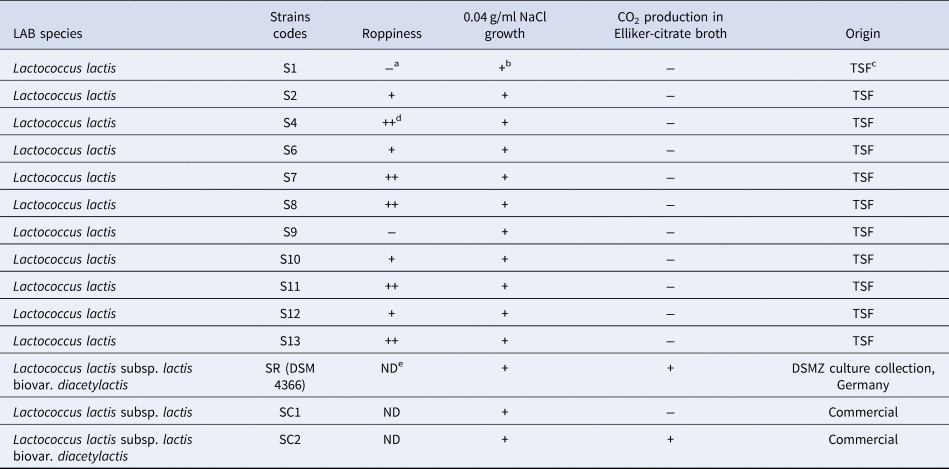
Eleven (11) indigenous strains of L. lactis codified S1, S2, S4, S6, S7, S8, S9, S10, S11, S12, and S13 (Table 1) previously isolated from Lait caillé and identified by (GTG)5 based rep-PCR followed by 16S rRNA gene sequencing were used for the tests. GenBank accession numbers: MH431819 to MH431829. A type strain (SR DSM 4366) of L. lactis subsp. lactis biovar. diacetylactis (DSMZ collection, Germany) and 2 commercial strains of L. lacis subsp. lactis (SC1), L. lactis subsp. lactis biovar. diacetylactis (SC2) were also used as reference strains. Reagents for the experiments were purchased from Sigma A/S (Brøndby, Denmark) or Becton, Dickinson and Co. (Albertslund, Denmark) unless otherwise stated. The strains of L. lactis were stored in M17 broth (Oxoid A/S, Denmark) at −80°C with 19% (v/v) glycerol.
Origin, codes, roppiness, NaCl growth and citrate metabolism tests of Lactococci strains used in this study

a −, negative test.
b +, positive test.
c TSF, traditional spontaneous fermentation of Lait caillé from Burkina Faso.
d ++, positive test, stronger sign of ropiness.
e ND, not analysed.
Ropy character and biochemical tests
The ropy character of the indigenous strains of L. lactis from Lait caillé was determined by visual observation after plating the strains on M17 agar (Oxoid A/S, Denmark) supplemented with 0.02 g/ml lactose (Tidona et al., Reference Tidona, Zago, Corredig, Locci, Contarini, Giraffa and Carminati2016). All L. lactis strains were observed for growth in MRS broth (Becton, Dickinson and Co. Albertslund, Denmark) in presence of 0.04 g/ml NaCl (Kim, Reference Kim, Holzapfel and Wood2014). Their ability to ferment citrate in modified Elliker broth with lactose (0.01 g/ml), sodium citrate (0.02 g/ml), bromothymol blue (0.0002 g/ml) was also determined (Reddy et al., Reference Reddy, Vedamuthu and Reinbold1971).
Preparation of starter cultures and fermentation conditions
The strains used as inocula (Table 1) were prepared basically as described by Akabanda et al. (Reference Akabanda, Owusu-Kwarteng, Tano-Debrah, Parkouda and Jespersen2014). The strains were successively cultured on M17 agar and MRS broth at 30°C, then the cells were washed three times and suspended in 10 ml sterile diluent (pH 7.0 ± 0.2). Fermentations were performed in 500 ml of full-fat (3.5%) UHT milk of a sole brand, purchased from supermarkets in Copenhagen, Denmark. Inoculation was done at 106 cells/ml. Cell numbers were determined by microscope counting (400×) with image acquisition system. All fermentations trials were performed in duplicates at 30°C. Changes in pH were monitored as described by Larsen et al. (Reference Larsen, Werner, Vogensen and Jespersen2015). The electrodes (Hamilton Easyferm Plus VP 120) signals were converted by a pH converter (PH450G, Yokogawa, Tokyo, Japan) and recorded by DataLogger FX112-4-2 (Yokogawa). For short fermentation time (less than 24 h), the pH values were recorded until a pH of 4.5 ± 0.1 was reached. For longer fermentation time, the pH was recorded for 69–72 h maximum time, afterwards the samples were analysed for rheological properties. Derivatives of pH changes were calculated with Excel 2013. The lag phase (T L) and the global rate of acidification were estimated with DMFit3_5, an Excel add-in program (Baranyi and Roberts, Reference Baranyi and Roberts1994). The maximum rate of acidification (V m), the time of maximum rate of acidification (T m), the lag phase (T L) and the global rate of acidification were used to describe the acidification for fermentation times less than 24 h, while the V m only was calculated for longer fermentation time.
Rheological properties of the fermented milk samples
General conditions
The flow and viscoelastic properties were determined for all fermented milk samples obtained from the strains inducing short fermentation time. A rotational rheometer, TA Instrument, Model AR-G2 (New Castle, USA) was used with a geometry of 40 mm 2° standard steel cone. All the measurements on flow and viscoelastic behaviours were done in triplicate for 2 different samples. The determination of the models fitting the flows curves, and the calculation of rheological parameters were done by using the software Rheology Advantage Data Analysis v5.7.0 TA instruments (New Castle, USA) and Excel (Microsoft office 2013). As recommended by the Rheology Advantage Data Analysis operating instructions, only the fits giving standard errors of less than 20 were later used for rheological parameters determination, making a total of 6 measurements if all the fits satisfied the limit or 5 measurements if one fit did not satisfy.
Flow behaviour
The flow curves were obtained at 30°C by recording shear stress at shear rates from 0.001 to 300 s−1 (forward) in 100 s and from 300 to 0.001 s−1 (backward) in 100 s. Data from the backward (descending) segment of the shear cycle were used to describe the flow behaviour. Different models were tested for the best fit, then the Herschel–Bulkley (Eq. 1) model was selected to describe the flow behaviour of the data from the descending segment of the shear cycle.
 $${\rm \tau }\,= \,{\rm \tau }_y\,+ \,k\dot{{\rm \gamma }}^n$$
where τ (Pa) is the shear stress, τy (Pa) is the yield stress, K (Pa sn) is the consistency index,  $\dot{\gamma }$ (s−1) is the shear rate and n is the flow behaviour index.
The relative thixotropic was also calculated using Eq. 2
 $$A_t\,= \,\displaystyle{{A_{up}-A_{down}} \over {A_{down}}}$$
where Aup and Adown are the areas under ascending and descending flow curves, respectively.
Viscoelastic behaviour
Strain sweep tests were conducted (strain: from 0.01 to 1% and frequency: 1 Hz) for all samples at 30°C in order to determine the linear viscoelastic region.
Frequency sweep tests were conducted for all samples at 30°C (frequency: from 0.1 to 100 Hz; strain: 0.05%). The parameters elastic modulus (G′), and viscous modulus (G′′) were determined.
Effect of cold storage
The indigenous strains of L. lactis inducing short fermentation time and for which the fermented milks were presenting the highest values of consistency index were selected to assess the impact of cold storage (1 to 3°C). The fermentations trials were performed as described above with the initial and final loads of microorganisms in the milk determined by CFU counts on agar plates. The rheological properties and the pH were measured at the end of fermentation (day 0), then after 8 d (day 8) and 12 d (day 12) of cold storage. The rates of survival of the strains were also determined by CFU counts on M17 agar plates.
Statistical analysis
One way analysis of variance (ANOVA) from Minitab 18 (Minitab Inc., State College, PA) statistical software was applied to determine differences between the strains. Tukey (HSD) pairwise comparisons test was used at a confidence interval of 95%.
Results
Acidification ability
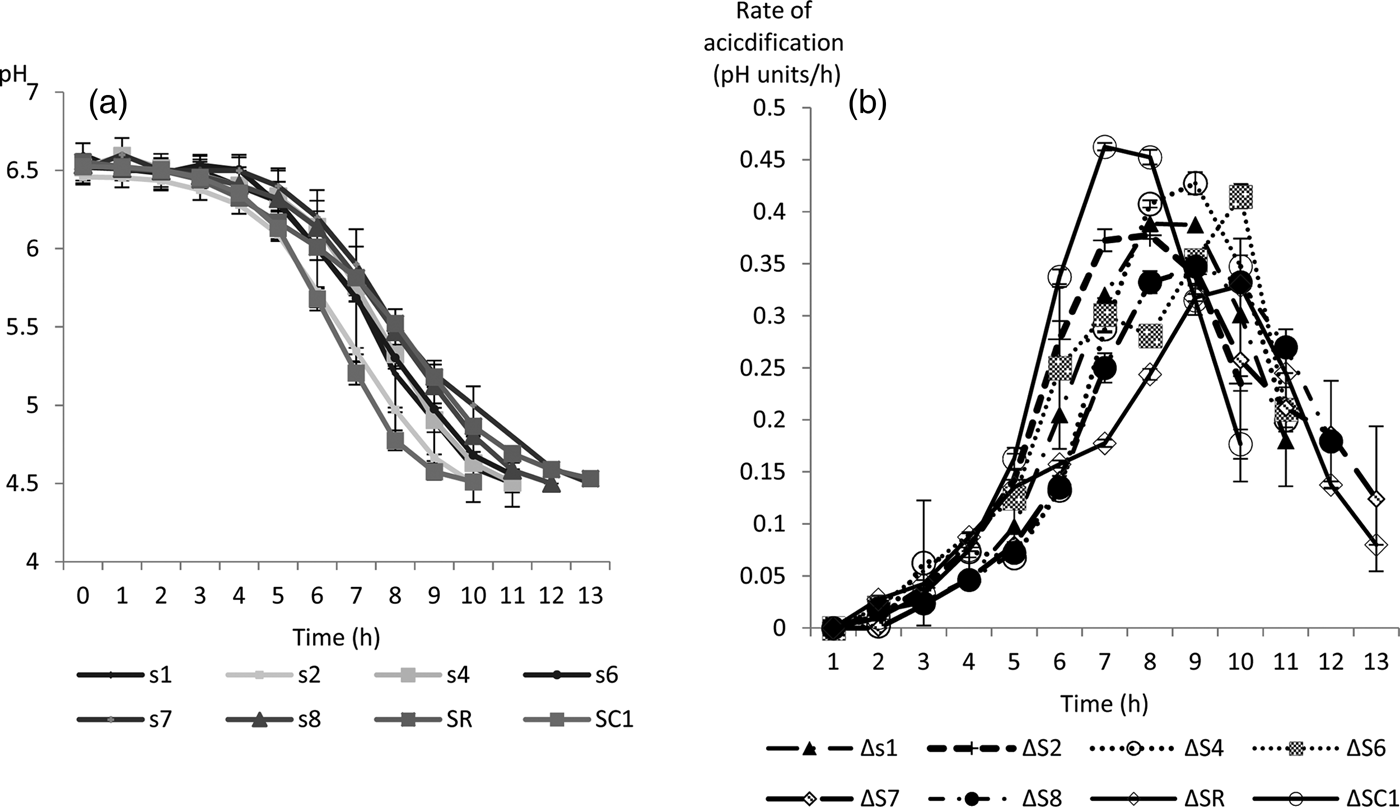
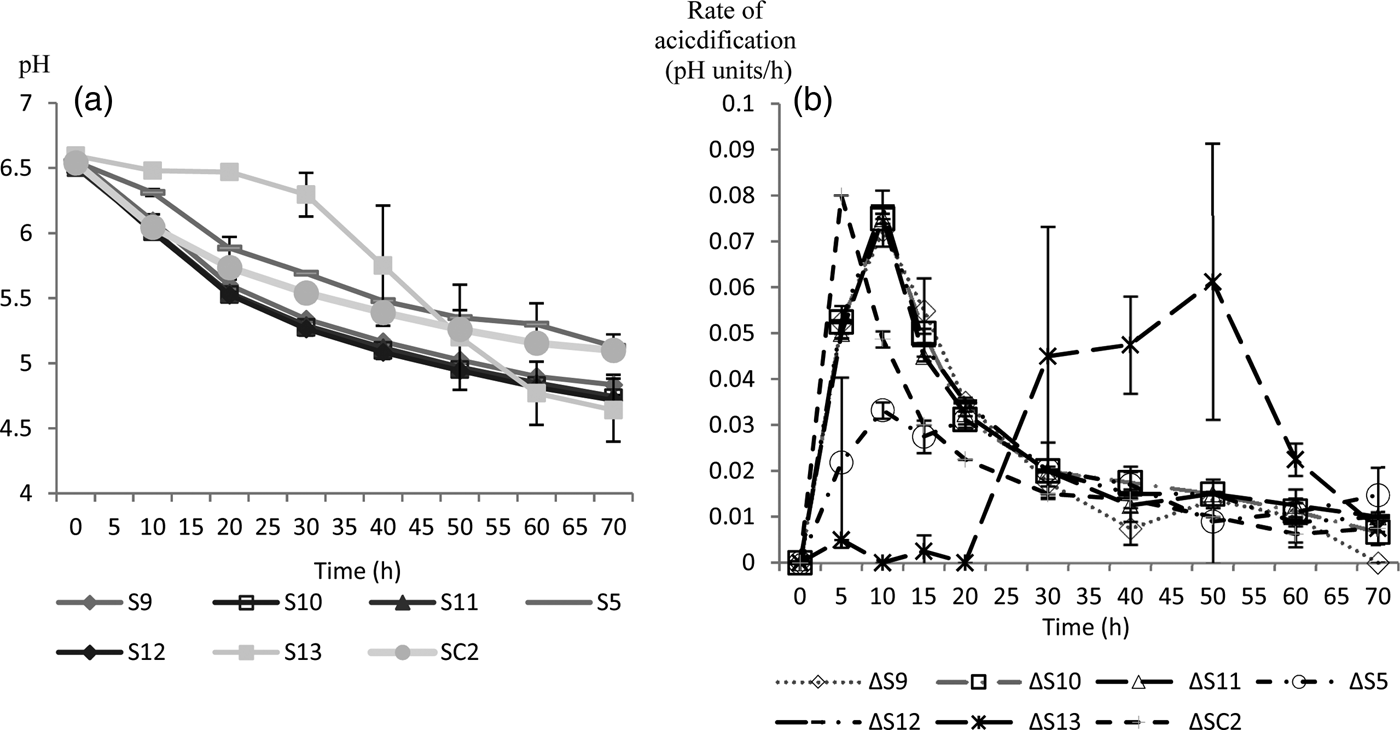
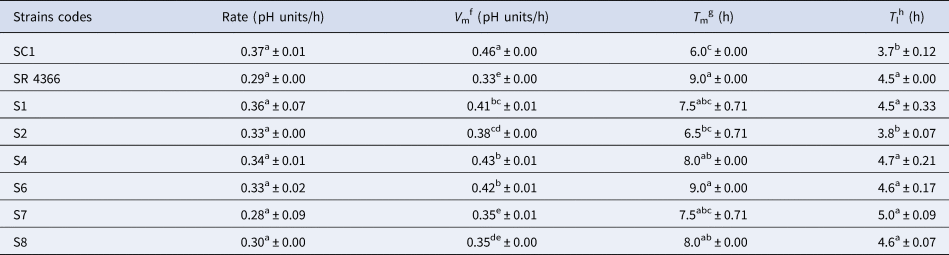
Monitoring of changes in pH revealed 2 groups of bacteria. A first group composed of L. lactis (S1, S2, S4, S6, S7, S8, SR-DSM 4366 and SC1) strains, with a short fermentation time between 9 and 13 h, for a final pH o × f 4.5 ± 0.10 (Fig. 1a, b). Then a second group, composed of L. lactis (S9, S10, S11, S12, S13 and SC2) strains, with up to 3 d of pH monitoring and a final pH ranging from 4.8 ± 0.08 to 4.6 ± 0.24 (Fig. 2a, b). The first group was characterized by sigmoid curves of pH decrease (Online Supplementary File Fig. S1a), with a maximum rate of pH decrease (V m) ranging from 0.33 ± 0.00 to 0.46 ± 0.00 pH units/h and a lag time (T L) varying between 3.7 ± 0.12 and 5.0 ± 0.09 h (Table 2). The commercial strain SC1, closely followed by strain S2 expressed the best characteristics of a high V m at earlier stage of fermentation (6–7 h) and a shorter lag phase, T L (3.8 ± 0.07 h). In the second group of bacteria, the pH decrease was not reflected by sigmoid curves and the DMFit program could not be used for successful fitting (Online Supplementary File Fig. S1b). Due to the low overall acidification rate of the strains of this group, a lag phase could not be perceived from the curves. The V m varied between 0.08 ± 0.00 and 0.11 ± 0.10 pH units/h (Online Supplementary File Table S1), and L. lactis subsp. lactis biovar. diacetylactis (SC2) expressed the lowest acidification rate with a pH of 5.1 ± 0.09 after 70 h of fermentation.
Kinetic curves of milk acidification by fast acidifier Lactococcus lactis strains (fermentation time between 9 and 13 h; final pH of 4.5 ± 0.10). (a): pH changes; (b): acidification rate (pH units/h). Si/ΔSi (i ∈ N): indigenous bacterial strain of Lait caillé; SR/ΔSR: type strain DSM 4366; SC1/ΔSC1: commercial strain. Values are means of 2 different samples; error bars represent standard deviation.

Kinetic curves of milk acidification by slow acidifier Lactococcus lactis strains (up to 3 d of pH monitoring; final pH ranging from 4.8 ± 0.08 to 4.6 ± 0.24). (a): solid curves of pH changes; (b): dashed curves of acidification rate (pH units/h). Si/ΔSi (i ∈ N): indigenous bacterial strain of Lait caillé; SC2/ΔSC2: commercial strain. Values are means of 2 different samples; error bars represent standard deviation.

Kinetic parameters of milk acidification by the fast acidifier Lactococcus lactis strains

Results are mean values ± standard deviation from 2 different biological samples. Different superscript lowercase letters within same column indicate significant (P < 0.05) differences between the samples.
f V m, maximum rate of acidification
g T m, time of maximum acidification rate.
h T l, lag phase.
Ropy character, growth in 0.04 g/ml NaCl and fermentation of citrate
The ropy phenotype was expressed by most of the strains, only 18% (2/11) of the indigenous L. lactis strains of Lait caillé did not show the ropy character (Table 1). Moreover, growth in presence of 0.04 g/ml NaCl was observed for all the eleven strains. However, fermentation of citrate was negative, since CO2 production in Elliker-citrate broth was not observed.
Rheological properties
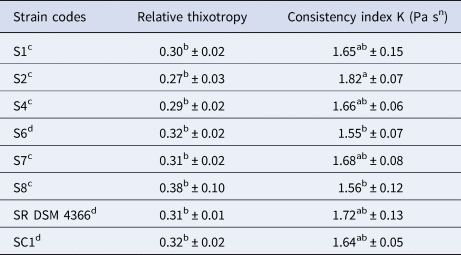
All of the fermented milks tested expressed a shear thinning non-Newtonian behaviour (flow behaviour index n < 1). A thixotropic behaviour (Table 3) was also observed under shear flow conditions (Online Supplementary File Fig. S2). The relative thixotropic values were not significantly different and were ranging between 0.27 ± 0.03 and 0.38 ± 0.10. The consistency indices were ranging from 1.55 ± 0.07 to 1.82 ± 0.07 Pa sn (Table 3).
Relative thixotropy and consistency index of fermented milk samples from the fast acidifier Lactococcus lactis strains

Results are mean values ± standard deviation from measurements on 2 different samples.
Different superscript lowercase letters within same column of values indicate significant (P < 0.05) differences between the samples.
c n = 6 measurements.
d n = 5 measurements.
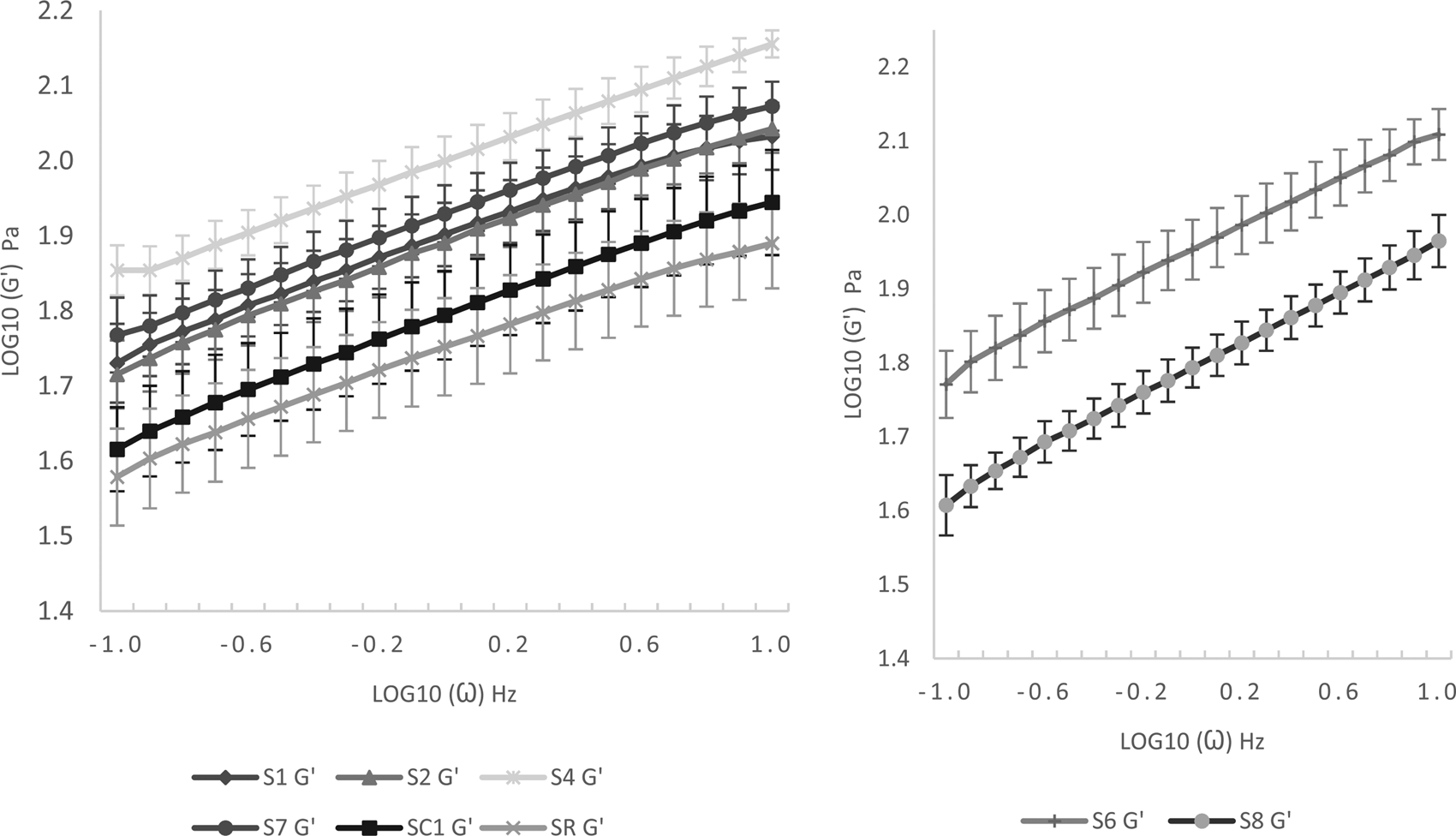
Frequency sweeps on the fermented milk samples were performed within the linear viscoelastic region and the results are presented as Log10 (G′) vs. Log10 (w) is in Figure 3. All the curves had the same profile. In addition, in the linear viscoelastic regime, G′ was always superior to G″ at any frequency (Online Supplementary File Fig. S3). Both moduli showed a small frequency dependence; positive and parallel slopes of G′ and G″ vs. angular frequency could also be observed.
G′ values of fermented milks produced with fast acidifier Lactococcus lactis strains: (a) strains [S1, S2, S4, S7, SC1, and SR (DSM 4366)] with the highest consistency index expression; (b): strains (S6, S8,) with lower consistency index expression. Values are means of 3 measurements on 2 different samples. Error bars represent standard deviation (G′ always superior to G″).

Impact of cold storage
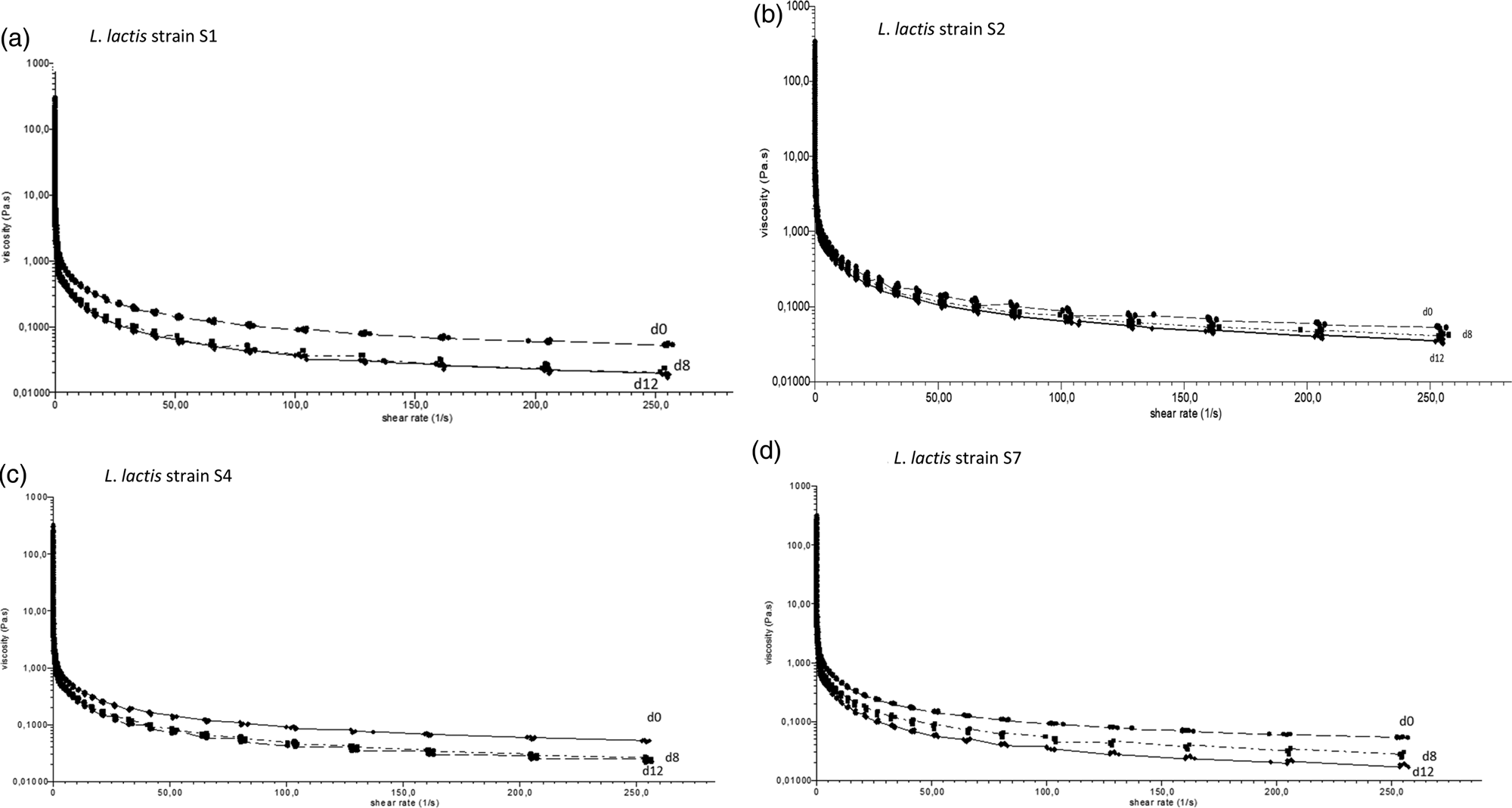
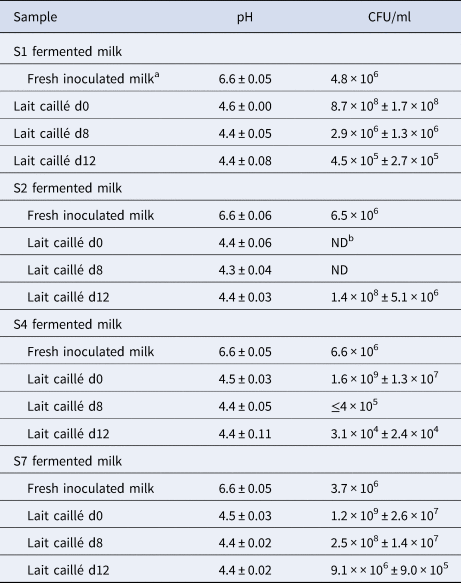
Based on the measured consistency index values, the indigenous L. lactis strains (S1, S2, S4, and S7) were investigated for changes in pH, CFU count (Table 4) and changes in viscosity of the fermented milks (Fig. 4) during the cold storage (1 to 3°C). After fermentation (day 0), no flow model could be used at day 8 and day 12 of cold storage to successfully fit the flow behaviour of the samples inoculated by L. lactis strains S1, S2, S4, and S7. Thus, in these cases, the parameters were not calculated, but the viscosity vs. shear rate curves are presented (Fig. 4).
Viscosity – shear rate flow curves at varying storage times (d0, d8 and d12) of fermented milk samples made with the indigenous Lactococcus lactis strains (a = S1, b = S2, c = S4, d = S7) of Lait caillé.

pH and CFU changes in fermented milk samples from indigenous Lactococcus lactis strains with the highest consistency index expression during cold storage.

Results are mean values ± standard deviation from 2 different biological samples.
a For fresh inoculated milk only 1 sample was used to check the CFU count.
b ND: not analysed. S1, S2, S4, S7: indigenous strains. d0: 0 d of storage; d8: 8 d of cold storage; d12: 12 d of storage.
A decrease in pH of less than 0.15 unit was observed during the cold storage. Meanwhile, the CFU count and the viscosity declined for the samples inoculated by S1, S4, and S7, from day 0 (8.7 × 10⁸ ± 1.7 × 10⁸ to 1.6 × 10⁹ ± 1.3 × 10⁷ CFU/ml) to day 12 (3.1 × 10⁴ ± 2.4 × 10⁴ to 1.4 × 10⁸ ± 5.1 × 10⁶ CFU/ml). For the sample inoculated by S2, the CFU count recorded at day 12 was 1.4 × 10⁸ ± 5.1 × 10⁶ CFU/ml.
Discussion
Rate of acidification
The monitoring of changes in pH showed that the indigenous L. lactis of the first group (fast acidifier) can compete with the commercial strains in terms of acidification rate. Akabanda et al. (Reference Akabanda, Owusu-Kwarteng, Tano-Debrah, Parkouda and Jespersen2014) measured acidification performance for LAB isolated from Nunu, a fermented milk from Ghana, and showed less diversity in terms of fermentation duration (up to 24 h) compared to the current study. Considering the 1 to 3 d duration of the traditional process, the fast acidifier strains may be considered for starter culture development for a safer product and a gain of processing time. Lactococci strains with a low acidification rate may still be used, as adjunct cultures, after complementary studies proving their beneficial effects, which may relate to improved texture and aroma (Ustunol, Reference Ustunol, Özer and Akdemir-Evrendilek2014).
Ropy character and biochemical tests
In the present study, most of the tested strains expressed at different degrees a positive result to the presumptive detection test of EPS (Table 1), similarly to the conclusions drawn by Akabanda et al. (Reference Akabanda, Owusu-Kwarteng, Tano-Debrah, Parkouda and Jespersen2014) when investigating the LAB strains from Nunu. However, the presence of a string in the test is not noticeable for all EPS producing colonies (Lynch et al., Reference Lynch, Zannini, Coffey and Arendt2018) and investigations on the presence of capsule, and/or the ruthenium red stain were also used by some previous reports for presumptive detection of EPS producing strains (Ruas-Madiedo and de los Reyes-Gavilan, Reference Ruas-Madiedo and de los Reyes-Gavilan2005). The ropy character was not directly linked to the acidification rate, since both fast and slow acidifier strains exhibited it or not, independently of their acidification capacity.
The biochemical tests revealed that none of the indigenous L. lactis were able to ferment citrate, which means they will not produce acetaldehyde derived compounds during fermentation. Moreover, growth was observed in presence of 0.04 g/ml NaCl, which indicates they are most probably L. lactis subsp. lactis (Kim, Reference Kim, Holzapfel and Wood2014). The main role of a starter culture is the acidification of the milk. In addition to be good acidifiers, L. lactis subsp. lactis were reported to convert milk fat and protein into flavour compounds (Bintsis and Athanasoulas, Reference Bintsis, Athanasoulas and Papademas2015). Sensorial features can also be achieved by combining the main starter with adjunct cultures, for in spontaneous fermented milks, the overall desirable characteristics are due to complex interactions between different types of microorganisms (Ustunol, Reference Ustunol, Özer and Akdemir-Evrendilek2014).
Rheological properties
A thixotropic and shear thinning non-Newtonian behaviour was observed for all the L. lactis fermented samples from the fast acidifier strains. The shear thinning behaviour is due to a deformation of the gels structure involving a breaking of aggregates, which leads to a decreased flow resistance corresponding to the viscosity. All the samples were also subject to a minimum value of stress, the yield stress, before starting flowing. The thixotropic behaviour specified that the thinning property of the samples was time dependent, characterized by processes of breaking-down of the gel structure during the application of the force and recovering of the initial structure after some rest time (Douglas, Reference Douglas2018).
The fact that G′ was always superior to G″ in the frequency range, characterizes a predominantly solid behaviour of the fermented milk samples. G′ values of the samples inoculated by strains S2, S4 and S6 were clearly higher than those of the samples inoculated by strains SR and SC1, suggesting the former were more elastic in their behaviour than the latter. The positive and parallel slopes of all the curves and the thixotropic time-dependent property indicate that the gels of the samples fermented by the indigenous strains of Lait caillé could be considered structurally as weak gels (Eroglu et al., Reference Eroglu, Bayrambas, Eroglu, Toker, Mustafa, Karaman and Dogan2014; Douglas, Reference Douglas2018). Weak gels will display homogeneous flow conditions when submitted to high shear stresses, while strong gels will display breaking on a non-homogenous surface (Douglas, Reference Douglas2018).The ‘softness’ of the gels of food products such as Lait caillé, easily susceptible to deformation, and their thixotropic behaviour are important criteria in their acceptance by both consumers and traditional manufacturers.
Impact of cold storage
The cold storage (1 to 3°C) revealed the harmful impact of these low temperatures on most of the tested strains. However, the lack of nutrients and the harmful effect of the lactic acid accumulated may also explain the L. lactis decrease during storage (Russel and Diez-Gonzalez, Reference Russel and Diez-Gonzalez1997). Another factor that we previously reported in a study on milk acidification, is the redox potential (Larsen et al., Reference Larsen, Werner, Vogensen and Jespersen2015) and it could have influenced the LAB growth as well. The impact of these additional factors is supported by the analysis of the kinetic curves of milk acidification (Fig. 1a); indeed, the tendency to a stabilization of the pH at a low value (4.5 ± 0.10) at the end of the fermentation trials, suggests a lack of nutrients, particularly lactose, and an accumulation of lactic acid.
The decline of the starter population of L. lactis S1, S4, and S7 over time together with the buffering capacity of lactic acid (Li et al., Reference Li, Liu, Kang and Zheng2015) may also explain why the pH remained quite constant during cold storage.
The impact of cold storage on viscosity shows a decreasing effect on fermented milk consistency occurring concomitantly with the decrease in CFU counts for S1, S4, and S7. Similar results were found for kefir fermented milk by Irigoyen et al. (Reference Irigoyen, Arana, Castiella, Torre and Ibanez2005) who reported a stable pH, a decrease of apparent viscosity as well as a decrease of about 2 log for Lactobacillus spp. and Lactococcus spp., followed by a stabilization of the counts after 14 d of storage of cold storage.
Regarding the samples inoculated by L. lactis S2, the high CFU counts of 1.4 × 10⁸ ± 5.1 × 10⁶ at the end of storage and the slight decrease of the viscosity curves from day 0 to the end of storage, suggests that this strain might have contributed to the low variation of the consistency of the gel structure. However, as part of the starter culture development process, additional studies are needed to determine the viability of the starter and non-starter LAB for a longer period of time, the suitable initial inoculum size, as well as the possible interaction effects between the indigenous LAB on their technological profiles
In conclusion, the evaluation of technological properties of indigenous strains of L. lactis isolated from a spontaneous fermented milk revealed that they could be subdivided into slow and fast acidifier strains. In order to reduce the long fermentation time of the traditional process, the latter could be used as starter, in combination with adjunct starter which may be any indigenous strains procuring either desired health or sensorial benefits. The determination of the rheological properties showed a shear thinning, thixotropic behaviour of the fermented milk samples characterized by a weak gel network. The cold storage (1–3°C) was harmful for most of the strains in the fermented milks probably due to the combination with additional factors such as lack of lactose and other nutrients, accumulation of lactic acid and redox potential state. The microbiota of spontaneous fermented milks is complex. Thus, the definition of starter cultures should take into account the specificity of each species and the complexity of the interactions, to have a product with the desired technological features. Therefore, the present study is important as it gave information for further investigations on the technological performances of strains of L. lactis, for use as starter cultures for Lait caillé and similar products.
Supplementary material
The supplementary material for this article can be found at https://doi.org/10.1017/S0022029919000888.
Acknowledgements
The authors would like to acknowledge the Ministry of Foreign Affairs of Denmark (Danida) for funding through the project ‘Preserving African food microorganisms for Green Growth’ (project number DFC No. 13-04KU).