Introduction
Until relatively recently, stroke has been the ‘poor relation’ of cancer and ischaemic heart disease in terms of political, professional and social priorities. That attitude, however, has begun to change and patients can now expect to be treated in a radically different manner compared with previous decades. This paper will review: (i) the role of carotid artery disease in the aetiology of stroke, (ii) symptoms suggestive of a transient ischaemic attack (TIA) or stroke, (iii) how patients (and sometimes professionals) remain unaware of the need to seek urgent medical attention following onset of symptoms, (iv) the evidence supporting rapid initiation of treatment (best medical therapy, carotid endarterectomy (CEA)) in the hyperacute period after onset of symptoms, (v) how modern cerebrovascular services should function, (vi) the evidence supporting intervening in patients with asymptomatic carotid disease, and (vii) whether randomized trials have established whether CEA or carotid artery stenting (CAS) is safer in the short term and also effective in preventing stroke in the long term.
Carotid artery disease and stroke
Out of the next 100 strokes destined to occur in your community, about 20% will be haemorrhagic (intracranial, subarachnoid) and 80% will be ischaemic. Of the 80 ischaemic strokes, approximately 20 will affect the vertebrobasilar territory and 60 will involve the carotid territory. About half of the 60 carotid territory, ischaemic strokes will follow either carotid artery thrombosis or embolism of atherothrombotic debris into the anterior or middle cerebral artery territories. Of these 30 strokes, however, only about 10 will have significant carotid artery disease (i.e. an ipsilateral stenosis >50%) meriting consideration for surgery. The other 20 patients will have lesser degrees of stenosis that do not require surgical intervention. The remaining 30 ischaemic carotid territory strokes will be attributable to a number of other causes. These include: small vessel intracranial disease (n = 15), cardiac embolism (n = 9), haematological causes (n = 3) and miscellaneous causes (n = 3).
Symptoms that professionals and patients should look out for
While it is true that patients suffering a TIA or stroke can present with a wide spectrum of symptoms, the vast majority will report a relatively small number of consistent symptoms that form the basis of public awareness campaigns. ‘Classical’ carotid territory symptoms include: (i) hemimotor/sensory signs, (ii) transient monocular blindness (amaurosis fugax) and (iii) evidence of higher cortical dysfunction (dysphasia, visuospatial neglect).
‘Classical’ vertebrobasilar territory symptoms include: bilateral blindness, problems with gait and stance, unilateral/bilateral motor or sensory impairment (NB 10% of patients with vertebrobasilar events will report hemisensory/motor signs due to the carotid arteries supplying part of the posterior circulation), dysarthria, homonymous hemianopia, nystagmus, dizziness, diplopia and vertigo. If, however, any of the latter three symptom groups are described in isolation, they should not be considered to be TIAs.
Public and professional awareness
As will be seen, one of the most important changes in contemporary practice has been the recognition that patients should be treated as soon as possible after onset of symptoms. However, this requires patients and professionals to understand that TIAs represent medical emergencies and that they should be treated on a par with heart attacks and unstable angina.
In a recent systematic review,Reference Sprigg, Machili, Otter, Wilson and Robinson1 it was observed that (in the UK) the majority of patients still tended to present first to their family doctor (incurring a greater time delay to being seen by a stroke specialist than if they went to Accident and Emergency), that 50% of patients presented within 24 hours of onset of symptoms, while 25% delayed their presentation to the medical services by >48 hours.Reference Giles, Flossman and Rothwell2 Delays were more likely to occur if the patient suffered their symptoms ‘out of hours’ during weekdays or at the weekends. Overall, 25–50% of TIA patients did not know that their symptoms were associated with stroke-related syndromes and quite a proportion of those who did recognize that their symptoms might be a stroke or TIA still failed to seek emergency medical assessment.Reference Sprigg, Machili, Otter, Wilson and Robinson1 This lack of public awareness is also exemplified by the observation that while three times as many women will die of stroke as from breast cancer, 40% more women will mention breast cancer (rather than stroke) when asked the main causes of death in females.3
There are also problems with regard to professional medical attitudes. Only 22% of primary care physicians in the United StatesReference Nguyen-Huynh, Fayad, Gorelick and Claiborne-Johnstone4 were able to identify both the typical symptoms of a TIA and that its duration should be <24 hours, while in the 2005 National Audit Office Report,3 the most common complaint from UK family doctors was that there seemed to be little point in expediting referral to the secondary sector as they did not seem to have any processes in place to treat patients as emergencies.
These attitudes and practices must change. This will obviously involve greater emphasis on changing patient awareness and how patients should respond should they suffer symptoms suggestive of a stroke or TIA, but the primary and secondary healthcare sectors also have important responsibilities as well.
Why should TIAs and minor strokes be treated as emergencies?
(i) The risk of early recurrent stroke is higher than you think
Most doctors who trained through the 1970s–1990s will have been taught that the risk of recurrent stroke after a TIA/minor stroke was only about 1–2% at 7 days and 2–4% at 4 weeks; i.e. hardly an impetus for radically changing practice. However, the last 5 years has witnessed a major change in this perception. One of the first ‘red flag’ studies to warn that the risk of recurrent stroke had been seriously underestimated came from a review of stroke patients participating in international trials and registries who had reported a prior TIA. Overall, almost one-fifth of strokes (17%) occurred on the same day as the index TIA, 9% of strokes occurred on the day after the TIA, while 43% of strokes occurred in the 7 days following the index TIA.Reference Rothwell and Warlow5
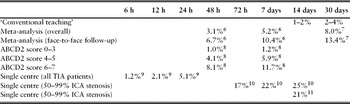
There have also been a number of better quality natural history studies that have highlighted the fact that the early risk of stroke (after a TIA/minor stroke) is very much higher than had been previously thought. These data are summarized in Table 1. Meta-analyses of all published natural history studies suggest that the 48-hour risk of stroke was about 3.1%, increasing to 5.2% at 7 days and 8% at 30 days.Reference Giles and Rothwell6, Reference Wu, McLaughlin, Lorenzetti, Hill, Manns and Ghali7 However, if one only considered community-based studies that had ‘face to face’ follow up, the 48-hour risk of stroke increased to 6.7%, the 7-day risk of stroke increased to 10.4%, while the 30-day risk of stroke was 13.4%.Reference Giles and Rothwell6, Reference Wu, McLaughlin, Lorenzetti, Hill, Manns and Ghali7 Clearly, these risks are very much higher than was previously taught. Interestingly, there is also emerging evidence that up to 50% of strokes destined to occur within the first 7 days after onset of symptoms did so within the first 24 hours.Reference Chandratheva, Mehta, Geraghty, Marquardt and Rothwell9
What is the early risk of stroke after presenting with a TIA/minor stroke (reproduced with permission from NaylorReference Naylor12)

Most of the studies summarized in Table 1 refer to all TIA/minor stroke patients. Two studies have, however, reported that the early risk of stroke in TIA patients with an ipsilateral 50–99% stenosis is even higher, ranging from about 17% at 72 hours, to 22% at 7 days, and 25% at 14 days.Reference Ois, Cuadrado-Godia, Rodriguez-Campello, Jimenez-Conde and Roquer10, Reference Fairhead, Mehta and Rothwell11 These data are now driving the move towards expedited investigation and treatment.
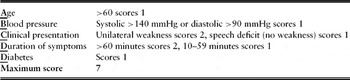
Awareness that the risk of stroke may be higher than was previously thought has led to the development of predictive scoring systems, so as to enable Rapid Access TIA Clinics to triage referrals. One such system is the ABCD2 score,Reference Johnston, Rothwell, Nguyen-Huynh, Giles, Elkins, Bernstein and Sidney8 which is based on a series of very simple bed-side questions (Table 2). Patients scoring 0–3 (out of a maximum of 7) face a 1% risk of stroke at 48 hours, increasing to 1.2% at 7 days. Patients scoring 4–5 have a 4.1% risk of stroke at 48 hours, increasing to 5.9% at 7 days, while patients scoring 6–7 have the highest risks of early stroke (8.1% at 48 hours and 11.7% at 7 days). Accordingly, TIA clinics can now triage referrals and arrange for patients whose ABCD2 score is 4–7 to be seen either the same day or on the following morning after onset of symptoms. Those scoring 0–3 can be seen less urgently, usually within 7 days.
The ABCD2 scoring system for predicting stroke after TIA/minor stroke (data adapted from JohnstonReference Johnston, Rothwell, Nguyen-Huynh, Giles, Elkins, Bernstein and Sidney8)

(ii) Rapid institution of medical therapy reduces stroke risk
The EXPRESS studyReference Rothwell, Giles, Chandratheva, Marquardt, Geraghty, Redgrave, Lovelock, Binney, Bull, Cuthbertson, Welch, Bosch, Alexander, Silver, Gutnikov and Mehta13, Reference Luengo-Fernandez, Gray and Rothwell14 has shown that reconfigured TIA clinics can radically reduce the risk of stroke through the introduction of relatively simple changes in practice. In phase 1 of the project (April 2002–September 2004), patients were booked by their family doctors into a dedicated TIA clinic that ran Monday to Friday. Investigations were either undertaken or booked within the clinic, a treatment plan was then faxed to the referring doctor within 24 hours, and the patient then made an appointment with their family doctor to receive their prescription. At the time (and perhaps even now) some would consider this to be quite reasonable practice.
In phase 2 of the EXPRESS project (October 2004–March 2007), the clinics changed to operating every day of the week. There was now no need for anyone to book an appointment and patients with a suspected TIA simply attended the daily ‘walk in’ clinic. Risk factor control was initiated in the clinic and patients physically started their ‘best medical therapy’ (anti-platelet agents, statins, anti-hypertensive therapy, etc.) in the clinic. As before, a treatment plan was then faxed to the family doctor within 24 hours.
The two key changes in practice during phase 2 were: (i) the change to a ‘walk in’ service, which instantly reduced the delay to being seen, and (ii) the fact that ‘best medical therapy’ was physically started within the clinic. The latter change in practice was vitally important as the mean time between attending the clinic and the patient seeing their GP in order to get their prescription was 19 days in phase I;Reference Rothwell, Giles, Chandratheva, Marquardt, Geraghty, Redgrave, Lovelock, Binney, Bull, Cuthbertson, Welch, Bosch, Alexander, Silver, Gutnikov and Mehta13 i.e. very few patients had a realistic chance of starting best medical therapy during the hyperacute high-risk period.
The most important clinical outcomes following introduction of the phase 2 clinics were that: (i) the 90-day risk of stroke fell by 80% from 10.3% to 2.1%, without increasing the risk of haemorrhagic complications; (ii) there was a significant reduction in recurrent fatal stroke (1%, down from 3%, P = 0.027), (iii) there was a significant reduction in admissions with disabling strokes (0%, down from 3%, P = 0.007); overall, 15% of patients in phase 1 either died or became disabled, compared with only 9% in phase 2 (P = 0.022); (iv) hospital admissions for recurrent stroke were significantly reduced (2%, down from 8% (P = 0.001), leading to a significant reduction in the overall number of hospital bed days utilized (average reduction was 4 bed days per patient referred to the clinic (P = 0.02)) and an average reduction in hospital costs of £624 per patient referred to the service (P = 0.03).
EXPRESS predicted that for a population of 1 million, implementation of a TIA clinic along the lines of the phase 2 service would prevent about 165 strokes each year, it would save the NHS in that region about 4790 hospital bed days and provide a saving of £1.12 million per year.Reference Rothwell and Warlow5 If this type of service were rolled out across the whole of the UK, the authors predicted that it might prevent about 10,000 strokes each year, reduce hospital bed usage by 290,000 days and generate monetary savings of £68 million in acute care costs.Reference Rothwell, Giles, Chandratheva, Marquardt, Geraghty, Redgrave, Lovelock, Binney, Bull, Cuthbertson, Welch, Bosch, Alexander, Silver, Gutnikov and Mehta13, Reference Luengo-Fernandez, Gray and Rothwell14
(iii) Rapid access to carotid endarterectomy reduces late stroke risk
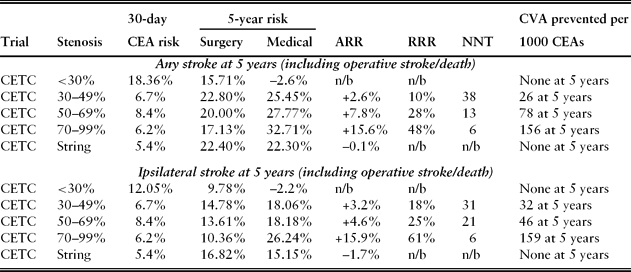
The Carotid Endarterectomy Trialists Collaboration (CETC)Reference Rothwell, Eliasziw, Gutnikov, Fox, Taylor, Mayberg, Warlow and Barnett15–Reference Rothwell, Eliasziw, Gutnikov, Warlow and Barnett17 combined data from over 6000 recently symptomatic patients who were randomized to immediate CEA plus best medical therapy versus best medical therapy alone in the European Carotid Surgery Trial (ECST),18 the North American Symptomatic Carotid Endarterectomy Trial (NASCET)19 and the Veterans Affairs (VA) TrialReference Mayberg, Wilson, Yatsu, Weiss, Messina, Hershey, Colling, Eskridge, Deykin and Winn20 having remeasured all of the pre-randomization angiograms using the NASCET measurement method. Table 3 summarizes the 5-year risks of ‘any’ and ‘ipsilateral’ stroke in medically and surgically treated patients, along with the absolute (ARR) and relative (RRR) risk reductions conferred by surgery, the number needed to treat to prevent one stroke at 5 years (NNT) and the number of strokes prevented at 5 years per 1000 CEAs.
Combined Endarterectomy Trialists Collaboration (CETC) overview of data from the ECST, NASCET and the VA studies (adapted from CETC, Combined Endarterectomy Trialists CollaborationReference Rothwell, Eliasziw, Gutnikov, Fox, Taylor, Mayberg, Warlow and Barnett15–Reference Rothwell, Eliasziw, Gutnikov, Warlow and Barnett17)
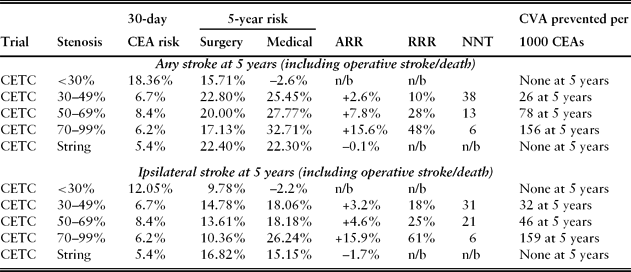
n/b, no benefit demonstrated; ARR, absolute risk reduction; RRR, relative risk reduction; NNT, number needed to treat to prevent one stroke; CVA prevented per 1000 CEAs, number of strokes prevented at 5 years by performing 1000 CEAs.
As can be seen, surgery conferred no benefit in recently symptomatic patients with a NASCET stenosis <50% (equivalent to <70% using the ECST measurement method). However, virtually every national and international guideline now recommends that patients reporting carotid territory symptoms within the preceding 6 months and who have a 50–99% stenosis (excluding the string sign) should be considered for CEA.
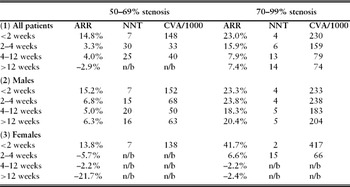
The ‘six month’ threshold for intervention has reigned supreme for almost 20 years and few have questioned its enduring validity. However, one consequence of the very large CETC database, is that it was able to show that the faster the operation was performed, the greater the number of strokes that were prevented in the long term. Table 4 details the ARR, NNT and number of ipsilateral strokes prevented at 5 years by performing 1000 CEAs in patients with a 50–69% or 70–99% stenosis, stratified for gender and delay to surgery. For clarification purposes, delays in Table 4 refer to the delay between randomization and undergoing surgery. On average, the median delay from symptom to randomization was another 7 days. Note that the quicker the operation was performed, the greater becomes the long-term benefit. For example, 238 strokes will be prevented at 5 years if patients with 70–99% stenoses undergo surgery within 2 weeks. This falls to 74 strokes if the delay exceeded 12 weeks.Reference Rothwell, Eliasziw, Gutnikov, Fox, Taylor, Mayberg, Warlow and Barnett15–Reference Rothwell, Eliasziw, Gutnikov, Warlow and Barnett17
Absolute risk reduction conferred by CEA in the 5-year risk of ipsilateral stroke (including the peri-operative risk) in patients with a NASCET 50–69% and 70–99% stenosis, stratified for delay from index event to randomization and gender (data derived from the CETCReference Rothwell, Eliasziw, Gutnikov, Fox, Taylor, Mayberg, Warlow and Barnett15–Reference Rothwell, Eliasziw, Gutnikov, Warlow and Barnett17 with all pre-randomization angiograms remeasured using NASCET method. Table reproduced with permission from NaylorReference Naylor21)

ARR, absolute risk reduction (%) conferred by surgery over best medical therapy; NNT, number of CEAs needed to be performed to prevent one stroke at 5 years; CVA/1000, number of ipsilateral strokes prevented at 5 years by performing 1000 CEAs; n/b, no benefit conferred by CEA.
Table 4 also shows that any significant delay to surgery has a very important impact in women. In males, benefit gradually diminished across both stenosis subgroups with time, but some benefit was still conferred to the patient if delays exceeded 12 weeks. By contrast, the CETC found that females with 50–69% stenoses appeared to gain little benefit from surgery after 2 weeks had elapsed, while all benefit seemed to disappear after 4 weeks in female patients with 70–99% stenoses. To date, no international guideline has proposed differential recommendations for males and females (regarding the appropriateness of CEA should excessive delay occur), and the basic recommendation has been that clinicians and surgeons should aim to offer surgery as soon as possible after the index event. In Leicester, for example, we do not now offer CEA to female patients with 50–69% stenoses if more than 1 month has elapsed since their last symptom.
How should modern cerebrovascular services function?
As a consequence of three key factors: (i) awareness that the natural history risk of stroke is much higher than previously thought, (ii) that rapid introduction of ‘best medical therapy’ reduces early recurrent stroke and (iii) that rapid access to CEA prevents more strokes, NICE now recommends that CEA should be performed within 14 days of onset of symptoms.22 This is a challenge to existing stroke services, but not insurmountable. Even more challenging, however, will be the goal of offering CEA within 48 hours by 2017 (to the majority of patients) as is advocated in the UK Department of Health's ‘Strategy for Stroke’.23
In order to meet NICE's 14-day target, it is essential to increase patient (and professional) awareness of the need to treat TIA patients as emergencies. To assist this, there have been calls to avoid the term ‘TIA’ and refer to ‘brain attacks’ or ‘acute brain syndromes’ so as to drive awareness and action. Secondly, stroke physicians, vascular surgeons, health providers and senior hospital management must work together and develop new services that optimize management. Effective changes in practice cannot be achieved by only one or two of the four parties in isolation. In Leicester, for example, all four professional groups met and then radically reconfigured services leading to the development of a totally new and patient-focused service in October 2008.Reference Salem, Sayers, Bown, Eveson, Robinson and Naylor24 Changes in practice included: (i) introduction of a daily, single-visit TIA clinic (including bank holidays and weekends) that was run by the on-call stroke physician, (ii) all referrals were triaged using the ABCD2 scoring system; those scoring 0–3 were seen within 7 days, while the remainder were either seen later the same day or on the following morning, (iii) risk factor control and medications were started within the clinic, (iv) Duplex ultrasound + CT/MR imaging were performed in the single-visit clinic, (v) any patient with a 50–99% stenosis was then transferred directly to the Vascular Surgery Unit (under the care of the on-call consultant vascular surgeon) where a second Duplex scan was performed (in accordance with HTA recommendationsReference Wardlaw, Chappell, Stevenson, De Nigris, Thomas, Gillard, Berry, Young, Rothwell, Roditi, Gough, Brennan, Bamford and Best25 to ensure the presence of a surgically significant stenosis, (vi) we removed consultant surgeon ‘ownership’ of patients; i.e. the admitting consultant surgeon may not be the surgeon ultimately doing the operation, and (vii) provision of access to ‘ring fenced’ vascular theatre lists twice a week in order to ensure that the patient had rapid access to his/her operation.
During the first 18 months following reconfiguration of services, 78% of patients underwent CEA within 14 days of onset of symptoms (compared with a previous average of only 15–20%Reference Brown and Naylor26), whilst 45% underwent their operation within 7 days without any significant increase in the operative risks.Reference Salem, Sayers, Bown, Eveson, Robinson and Naylor24
Evidence for intervening in patients with asymptomatic carotid disease?
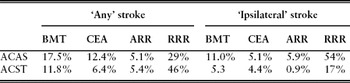
Two very large randomized trials (the Asymptomatic Carotid Atherosclerosis Study (ACAS) and the Asymptomatic Carotid Surgery Trial (ACST)) compared immediate versus deferred CEA in patients with asymptomatic carotid artery disease.27, 28 The principle results from these trials are detailed in Table 5. It has since become customary to report that both trials reported similar results (i.e. that immediate CEA reduced the 5-year risk of stroke from approximately 12% down to about 6%). However, this interpretation is actually a little misleading.

Confusion arose because the ‘12%/6%’ data in ACAS refers to the 5-year risk of ‘ipsilateral’ stroke, while the ‘12%/6%’ stroke risk in ACST refers to ‘any’ stroke (i.e. two totally different end-points). Table 5 summarizes the principle findings from both trials relative to the type of end-point being analysed. One interesting (and often ignored) observation (highlighted in Table 5) is the fact that in the 9 years between ACAS reporting in 1995 and when ACST reported in 2004, there was evidence of a considerable decline in the overall risk of ‘ipsilateral’ and ‘any’ stroke in patients randomized to medical therapy. For example, the 5-year risk of ‘any’ stroke in medically treated patients in ACAS was 17.5%, falling to 11.8% in ACST. Similarly, the 5-year risk of ‘ipsilateral’ stroke in ACAS was 11.0%, which fell to 5.3% when ACST reported in 2004.27, 28
Several important subgroup analyses have emerged from the two randomized trials. Firstly, ACST showed that immediate surgery significantly reduced the risk of fatal or disabling stroke from 6.1 to 3.5%. Secondly, neither ACAS nor ACST found compelling evidence that asymptomatic females benefited significantly from CEA. Thirdly, ACAS did not randomize patients aged >80 years, while ACST had no upper age limit. Accordingly, one of the more important findings from ACST was that patients with an asymptomatic carotid stenosis who were aged >75 years did not gain significant benefit from surgery.27, 28 As a consequence, the 2009 European Society for Vascular Surgery CEA Guidelines now recommend that CEA should only be considered in otherwise fit males under 75 and only in younger, medically fit females (although they did not define what ‘younger’ meant).Reference Liapis, Bell, Mikhailidis, Sivenius, Nicolaides, Fernandes and Fernandes29
It would, however, be reasonable to concede that the management of asymptomatic carotid disease remains enduringly controversial and polarized opinions exist as to what now constitutes optimal management.Reference Naylor30 There are a number of reasons for this, but the most important is growing evidence that improvements in the modern concept of ‘best medical therapy’ have significantly reduced the annual risk of stroke from about 2% per year in 1995, to between 0.5 and 1.0% in 2010.Reference Naylor30 If that is, indeed, true (and the decline was already apparent as early as 2004; see Table 5), this would render many of the risk:benefit analyses from ACAS and ACST null and void.
When ACAS started to recruit its patients, medical therapy consisted largely of smoking cessation advice, mono-agent antiplatelet therapy and rudimentary blood pressure control. By 2010, however, the ‘modern concept’ of medical therapy had expanded to include: low dose ACE inhibition, aggressive blood pressure control in type II diabetics, multi-agent antihypertensive therapy, smoking cessation advice, more aggressive lifestyle modification, dual antiplatelet therapy (Aspirin & Dipyridamole), higher dose statin therapy and discontinuation of hormone replacement therapy in females.
In the author's practice, CEA is currently offered to otherwise fit males under the age of 75 years and otherwise fit females under the age of 70 years. Patients aged >75 years are not considered for surgery.
Is CEA or CAS the preferred intervention?
Carotid endarterectomy has remained the ‘gold standard’ for over 50 years. However, in the early 1990s, angioplasty emerged as a potential alternative. By the late 1990s, angioplasty had been replaced by angioplasty with stenting (CAS) and, more recently, the technique has benefited from the use of dual anti-platelet therapy and the evolution of cerebral protection devices.
As the theme of this review is the management of carotid disease in the older patient (i.e. >75 years), I will start by concluding that there is currently no Level I evidence that CAS (or CEA) is proven to be of benefit in asymptomatic patients aged >75 years. Accordingly, the role of CEA/CAS in asymptomatic patients will not be discussed further. But what about the recently symptomatic patient?
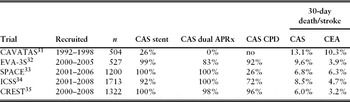
There have now been at least 10 randomized trials comparing CEA and CAS in symptomatic patients. Some are too historical to influence contemporary practice, but five large multicentre studies (CAVATAS, EVA-3S, SPACE, ICSS and CREST) have informed the ongoing debateReference Ederle, Dobson, Featherstone, Gaines, Beard and Venables31–Reference Schnaudigel, Groschel, Pilgram and Kastrup37 and enabled some practical conclusions to be made. First, carotid artery stenting is preferable to angioplasty alone. Second, all CAS patients should be pre-treated with dual anti-platelet therapy (usually Aspirin and Clopidogrel). Third, patients undergoing CAS should continue to receive dual anti-platelet therapy for up to 3 months after the procedure. Fourth, most centres would now recommend that some form of cerebral protection device should be used during CAS. Fifth, once the first 30 days have elapsed, the long-term rates of ipsilateral stroke seem to be similar after both CEA and CAS (i.e. CAS appears to be durable after the initial peri-procedural period). Sixth, CAS does appear to be associated with an increased risk of recurrent stenosis, but this is not associated with a significant increase in procedural stroke. Seventh (and most important), whilst CAS is associated with a significant reduction in the risk of cranial nerve injury, most of the recently published randomized trials have shown that there is still an almost 2-fold excess risk of procedural stroke following CAS compared with CEA (see below). Eighth, there is still confusion over whether CAS is associated with a significant reduction in peri-procedural myocardial infarction (MI); in ICSS there was no difference,Reference Ederle, Dobson, Featherstone, Bonati, van der Worp, de Borst, Lo, Gaines, Dorman, Macdonald, Lyrer, Hendriks, McCollum, Nederkoorn and Brown34 while CREST observed a 2-fold excess risk of subclinical MI.Reference Brott, Hobson, Howard, Roubin, Clark, Brooks, Mackey, Hill, Leimgruber, Sheffet, Howard, Moore, Voeks, Hopkins, Cutlip, Cohen, Popma, Ferguson, Cohen, Blackshear, Silver, Mohr, Lal and Meschia35 Ninth, ICSSReference Bonati, Jongen, Haller, Flach, Dobson, Nederkoorn, Macdonald, Gaines, Waaijer, Stierli, Jäger, Lyrer, Kappelle, Wetzel, van der Lugt, Mali, Brown, van der Worp and Engelter36 and a large systematic reviewReference Schnaudigel, Groschel, Pilgram and Kastrup37 have both observed that CAS is associated with a 5-fold increase in new ischaemic lesions on DW-MRI (compared with CEA) and that these lesions still persist at 6 weeks. It remains to be seen whether these lesions are associated with a decrease in cognitive function during follow-up.
Table 6 summarizes the 30-day rates of death/stroke in symptomatic patients in five large, multicentre randomized trials. Overall, CAS is associated with a near 2-fold excess risk of stroke/death and that, unlike CEA, the procedural risks after CAS have not decreased significantly with time. In addition (and very relevant in the context of this review), SPACE and CREST found that elderly patients incurred a much higher risk of stroke following CAS. In SPACE the risk of stroke was significantly higher in patients aged >68 years,33 while in CREST the risk of procedural stroke appeared to increase in patients aged >70 years.Reference Brott, Hobson, Howard, Roubin, Clark, Brooks, Mackey, Hill, Leimgruber, Sheffet, Howard, Moore, Voeks, Hopkins, Cutlip, Cohen, Popma, Ferguson, Cohen, Blackshear, Silver, Mohr, Lal and Meschia35
30-day risk of death/stroke after CEA or CAS in the five largest multicentre randomized trials involving symptomatic patients

CAS stent, proportion of CAS patients who were stented; CAS dual APRx, proportion of CAS patients receiving dual anti-platelet therapy prior to CAS; CAS CPD, proportion of CAS procedures that used a cerebral protection device.
Accordingly, and given that this review is specifically themed with how to manage elderly patients, the available evidence would suggest that patients with recent onset symptoms who are aged >70 years should probably undergo expedited CEA (rather than CAS) unless co-morbidities mitigate otherwise. Elderly patients face the highest natural history risk of stroke if left on medical therapy and their intervention should not be delayed in order to try and achieve lower procedural risks. Delay may make the surgeon/interventionist look good, but this is at the cost of an increased risk of stroke in the early time period after onset of symptoms.Reference Naylor21
Conclusions
The ‘take home’ messages for managing elderly patients with symptomatic carotid disease are that they need to be investigated as soon as possible after onset of the index event and that someone has to take active responsibility for ensuring that risk factor control and best medical therapy is started as soon as possible. In this modern era, patients suffering a TIA/minor stroke should be seen in dedicated, rapidly accessible single-visit clinics and those found to have significant carotid disease should generally be admitted and undergo expedited CEA unless contra-indicated. Every centre should now aim to be performing carotid surgery within 14 days of onset of symptoms, with this threshold likely to become even shorter in the future. The current culture of allowing delays to treatment should be considered unacceptable. Evidence suggests that the risk of procedural stroke is lower in higher volume centres and this should be considered when planning referrals.
Recently symptomatic elderly patients deemed unfit for CEA should be considered for carotid stenting, but with the caveat that this may be associated with an increased risk of procedural stroke. In this situation, every patient should be considered on an individual basis and no symptomatic patient should be denied access to surgery simply on the grounds of age. Meta-analyses of data from the international trials have clearly shown that patients aged >75 years gain considerably more benefit from CEA than any other age group. By contrast, there is no compelling evidence that patients aged >75 years with asymptomatic carotid artery disease benefit from CEA or CAS. For this category of patients, risk factor control and best medical therapy should remain the first line of management.
Conflict of interest
The author has no conflict of interest to declare.