1 Introduction
The concept of frames, first introduced by Duffin et al. [Reference Duffin and Schaeffer13], gained widespread attention when Daubechies et al. [Reference Daubechies, Grossmann and Meyer12] underscored its importance in signal processing. This renewed interest led to frame theory becoming a crucial tool in various fields, including Mathematics, Physics, and Engineering. Its versatility has since made frames indispensable in different areas, such as wavelet analysis, quantum mechanics, and communication systems.
We first discuss the basics of frames to establish the foundational concepts required for our results.
Definition 1.1 A sequence
 $\{ f_n \}_{n=1}^\infty $
in a Hilbert space
 $\mathcal {H}$
is called a frame for
 $\mathcal H$
if there exist constants
 $A,B>0$
so that
 $$ \begin{align} A\|f\|^2~ \leq ~\sum\limits_{n=1}^\infty |\langle f,f_n\rangle|^2 ~\leq ~B\|f\|^2, \end{align} $$
for all
 $f \in \mathcal {H}$
. The numbers
 $A, B$
are called frame bounds. For a given frame
 $\{f_n\}_{n=1}^\infty $
for
 $\mathcal {H}$
, the pre-frame operator or synthesis operator is a bounded linear operator
 $T: \ell ^2(\mathbb N)\rightarrow \mathcal {H}$
and is defined as
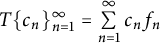 $T\{c_n\}_{n=1}^\infty = \sum \limits _{n=1}^\infty c_n f_n$
. The adjoint of T,
 $T^*: \mathcal {H} \rightarrow \ell ^2(\mathbb N)$
is given by
 $T^*f = \{\langle f, f_n\rangle \}_{n=1}^\infty $
, is called the analysis operator. The frame operator,
 $S=TT^*: \mathcal {H}\rightarrow \mathcal {H}$
, is defined as
 $$ \begin{align} Sf=TT^*f = \sum\limits_{n=1}^\infty \langle f, f_n\rangle f_n, ~~{for~all~} f\in {\mathcal H}. \end{align} $$
We notice that depending upon the nature of frame bounds, we get special kinds of frames, e.g., in the inequality (1.1) if
 $A=B$
, then the given frame is called a tight frame, in addition to the same if
 $A=B=1,$
it is called a Parseval frame. It is well-known that the frame operator is bounded, positive, self adjoint, and invertible.
Using the invertibility property, every element in the Hilbert space can be reconstructed as
 $$ \begin{align} f=\sum\limits_{n=1}^\infty \langle f, S^{-1}f_n \rangle f_n = \sum\limits_{n=1}^\infty \langle f, f_n \rangle S^{-1}f_n. \end{align} $$
Here, we present the definition of weaving frames, as it is the primary objective of our study. The focus of this article is to explore the properties and structure of weaving frames in Krein spaces.
Definition 1.2 [Reference Bemrose, Casazza, Gröchenig, Lammers and Lynch4] Let
 $\{f_n\}_{n=1}^\infty $
and
 $\{g_n\}_{n=1}^\infty $
be two frames for a Hilbert space
 $\mathcal {H}$
. Then, they are said to be weaving frames for
 $\mathcal H$
if for every
 $\sigma \subset \mathbb N$
,
 $\{f_n\}_{n \in \sigma } \cup \{g_n\}_{n \in \sigma ^c}$
is a frame for
 $\mathcal H$
. Thus, for every
 $h \in \mathcal H$
and every
 $\sigma \subset \mathbb N$
, there exist positive constants
 $\alpha \leq \beta $
for which we have
 $$ \begin{align} \alpha \|h\|^2 \leq \sum\limits_{n \in \sigma} |\langle h, f_n\rangle|^2 + \sum\limits_{n \in \sigma^c}|\langle h, g_n\rangle|^2 \leq \beta \|h\|^2. \end{align} $$
For detailed discussion regarding frames, their generalization and applications, we refer [Reference Balan, Okoudjou and Poria2–Reference Bemrose, Casazza, Gröchenig, Lammers and Lynch4, Reference Bolcskei, Hlawatsch and Feichtinger6–Reference Jyoti, Vashisht and Verma22, Reference Poria24].
In this article, we begin by discussing the fundamental concepts of Krein space frames to establish the necessary groundwork. Our primary objective is to investigate weaving frames and J-weaving frames within the Krein space. While frames in Krein spaces have been studied extensively, the notions of weaving and J-weaving frames remain unexplored. These properties play a crucial role in understanding the stability and redundancy of frames in indefinite inner product spaces. By introducing and analyzing these concepts, we aim to bridge this gap in the literature. Our study focuses on the analytical and structural aspects of weaving and J-weaving frames. We explore conditions under which these frames exhibit desirable properties and their implications in Krein space settings. Furthermore, we establish results characterizing these frames through associated operators. The findings of this study provide a deeper insight into the frame stability and reconstruction in Krein spaces.
Let
 $\mathcal K$
be a complex vector space equipped with a Hermitian sesquilinear form
 $[. , .]$
. An element
 $ k \in \mathcal {K} $
is said to be neutral if
 $ [k , k] = 0$
, positive if
 $ [k , k]> 0$
, and negative if
 $ [k , k] < 0$
.
The space containing both positive and negative elements is called an indefinite inner product space and the corresponding inner product is known as an indefinite inner product.
For an indefinite inner product space (
 $\mathcal {K}, [. , .]$
), it is said to be decomposable if it has the following representation:
 $$ \begin{align} \mathcal{K} = \mathcal K_{\delta^0} \oplus \mathcal K_{\delta^+} \oplus \mathcal K_{\delta^-}, \end{align} $$
where (
 $\mathcal K_{\delta ^0} $
) is neutral subspace, (
 $\mathcal K_{\delta ^+} $
) is positive-definite subspace, and (
 $\mathcal K_{\delta ^-} $
) is negative-definite subspace of
 $\mathcal {K}$
, respectively. Moreover, equation (1.5) is said to be a fundamental decomposition of an indefinite inner product space (
 $\mathcal {K}$
, [., .]).
An indefinite inner product space (
 $\mathcal {K}$
, [., .]) is said to be a Krein space if it can be represented as othogonal direct sum of the spaces (
 $\mathcal K_{\delta ^+} $
) and (
 $\mathcal K_{\delta ^-} $
) such that (
 $\mathcal {K}_{\delta ^+}, +[.,.]$
) is a Hilbert space and (
 $\mathcal {K}_{\delta ^-}, -[.,.]$
) is known as anti Hilbert space.
A fundamental decomposition of a Krein space (
 $\mathcal {K}$
, [., .]) is defined as
 $$ \begin{align} \mathcal{K} = \mathcal K_{\delta^+} \oplus \mathcal K_{\delta^-.} \end{align} $$
In this context, let us define,
 $P_{\delta ^{\pm }} : \mathcal {K} \longrightarrow \mathcal {K}_{\delta ^{\pm ,}}$
where
 $P_{\delta ^+}$
and
 $P_{\delta ^-}$
are the othogonal projection onto the subspace
 $ \mathcal {K}_{\delta ^+}$
and
 $\mathcal {K}_{\delta ^-} $
, respectively.
The linear transformation
 $J = P_{\delta ^+} - P_{\delta ^-}$
is called fundamental symmetry related to the decomposition (1.6). Thus, for every
 $k = k_{\delta ^+}+ k_{\delta ^-}\in \mathcal K_{\delta ^+} \oplus \mathcal K_{\delta ^-}$
, we have
 $J(k) = J(k_{\delta ^+}+ k_{\delta ^-}) = k_{\delta ^+} - k_{\delta ^-}$
. Moreover, it is to be noted that
 $J^2 = I$
.
The expression
 $[k, k']_J = [k, Jk']$
defines a positive-definite inner product on (
 $\mathcal {K}, [. , .])$
. This inner product is said to be J-inner product associated with the fundamental decomposition (1.6). Furthermore, for every
 $ k = k_{\delta ^+}+ k_{\delta ^-,}$
where
 ${k_{\delta ^\pm }\in \mathcal {K}_{\delta ^\pm }}$
, we have the following representation:
 $$ \begin{align*} [k, k]_J & =[k,J(k)]\\ & =[k, (P_{\delta^+} - P_{\delta^-})(k)]\\ & =[(k_{\delta^+}+ k_{\delta^-}), P_{\delta^+} (k_{\delta^+}+ k_{\delta^-})] - [(k_{\delta^+}+ k_{\delta^-}), P_{\delta^-} (k_{\delta^+}+ k_{\delta^-})] \\ & = [k_{\delta^+}, k_{\delta^+}] - [k_{\delta^-}, k_{\delta^-}], \end{align*} $$
the corresponding norm is said to be J-norm and it is defined as
 $\|k\|_{J}^2 = [k, k]_J = [k, Jk] .$
For detailed discussion regarding indefinite inner products and Krein spaces, we refer to [Reference Bognár5].
A J-orthonormalized system is a family of vectors
 $\{e_n\}_{n=1}^\infty $
satisfying condition
 $[e_m, e_n]=\delta _{mn}$
for every
 $m, n \in \mathbb N$
. A J-orthonormal basis is a J-orthonormalized system that also serves as a Schauder basis, providing unique and stable expansions for vectors. If
 $\{e_n\}_{n=1}^\infty $
is a J-orthonormal basis in
 $\mathcal K$
, then any element
 $k \in \mathcal K$
can be represented as
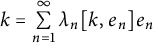 $k=\sum \limits _{n=1}^\infty \lambda _n [k, e_n] e_n$
, where
 $\lambda _n=[e_n, e_n]=\pm 1$
.
A sequence
 $\{z_n\}_{n=1}^\infty $
in a Krein space
 $(\mathcal K, [.,.])$
is said to be a frame for
 $\mathcal K$
, if for every
 $k \in \mathcal K,$
there exist positive constants
 $\alpha , \beta $
so that
 $$ \begin{align} \alpha \|k\|_{J}^2 \leq \sum\limits_{n=1}^\infty |[k, z_n]|^2 \leq \beta \|k\|_{J}^2, \end{align} $$
where
 $\|\|_{J}$
is the standard norm in
 $(\mathcal K, \langle .,. \rangle )$
. It is to be noted that a sequence
 $\{z_n\}_{n=1}^\infty $
is a frame for a Krein space
 $(\mathcal K, [.,.])$
if and only if it is a frame for
 $(\mathcal K, \langle .,. \rangle )$
(see [Reference Esmeral, Ferrer and Wagner14]). The key difference between J-frames and classical frames for Hilbert spaces is that some frames in Hilbert space
 $(\mathcal K, \langle .,. \rangle )$
are not necessarily J-frames in Krein spaces
 $(\mathcal K, [.,.])$
. For detailed discussion regarding the same, we refer [Reference Giribet, Maestripieri, Martínez Pería and Massey17, Example 3.3].
2 Main results
In this section, we explore various properties and characterizations of weaving frames within the structure of Krein spaces. We begin by introducing the concept of Krein space weaving frames, which extends the classical frame theory into indefinite inner product spaces. Our discussion focuses on the interplay between the positive and negative components of Krein spaces.
Definition 2.1 Let
 $\{z_n\}_{n=1}^\infty $
and
 $\{z^{\prime }_n\}_{n=1}^\infty $
be two frames for the Krein space
 $(\mathcal K, [.,.])$
. Then, they are said to be weaving frames for
 $\mathcal K$
if for every
 $\sigma \subset \mathbb N$
,
 $\{z_n\}_{n \in \sigma } \cup \{z^{\prime }_n\}_{n \in \sigma ^c}$
is a frame for
 $\mathcal K$
. Thus, for every
 $k \in \mathcal K$
and every
 $\sigma \subset \mathbb N$
, there exist positive constants
 $\alpha \leq \beta $
for which we have
 $$ \begin{align} \alpha \|k\|_{J}^2 \leq \sum\limits_{n \in \sigma} |[k, z_n]|^2 + \sum\limits_{n \in \sigma^c} |[k, z^{\prime}_n]|^2 \leq \beta \|k\|_{J}^2. \end{align} $$
We now define the corresponding frame operator for the associated weaving frames, establishing its roles in the framework.
The weaving frame operator
 $S:\mathcal K \rightarrow \mathcal K$
is defined as
 $$ \begin{align*}S_{\sigma}(k)=TJT^*=\sum\limits_{n \in \sigma} [k, z_n] z_n + \sum\limits_{n \in \sigma^c} [k, z^{\prime}_n] z^{\prime}_n,\end{align*} $$
where
 $T, T^*$
, and J are associated synthesis, analysis operators, and fundamental symmetry on
 $(\mathcal K, [.,.])$
.
Example 2.1 Let us assume a Krein space
 $\mathcal K = (\mathbb C^2, [.,.])$
with the associated indefinite inner product defined as
 $[(k_1 , k_2), (l_1, l_2)] = k_1\overline l_1 - k_2\overline l_2$
, where
 $\ (k_1, k_2) \in {\mathcal K}$
,
 $\ (l_1, l_2) \in {\mathcal K}$
. Consider two frames
 $$ \begin{align*}\{z^{\prime}_n\}_{n=1}^3\ = \{(1, 1), (0, 1), (1, 0) \}\end{align*} $$
and
 $$ \begin{align*}\{z^{\prime\prime}_n\}_{n= 1}^3\ = \{(-1, -1), (0, -1), (1, 0) \}. \end{align*} $$
Then, it is easy to verify that for every
 $\sigma \subset \{1, 2, 3\}$
, equation (2.1) is satisfied. Therefore,
 $\{z^{\prime }_n\}_{n = 1}^3$
and
 $\{z^{\prime \prime }_n\}_{n = 1}^3$
are weaving frames for
 $\mathcal K = (\mathbb C^2, [.,.])$
.
On the other hand, if we consider a Krein space
 $\mathcal K = (\mathbb C^3, [.,.])$
with the associated indefinite inner product
 $[. , .]$
defined as
 $$ \begin{align*}[ (k_1, k_2, k_3 ), (l_1, l_2, l_3 )] = k_1\overline l_1 + k_2\overline l_2 - k_3\overline l_3, \end{align*} $$
where
 $\ (k_1, k_2, k_3) \in {\mathcal K}$
,
 $\ (l_1, l_2, l_3) \in {\mathcal K}$
. Let us consider two frames
 $$ \begin{align*}\{z^{\prime}_n\}_{n=1}^3\ = \{(1, 2, 0), (0, \sqrt{2}, 0), (0, 0, 1) \} \end{align*} $$
and
 $$ \begin{align*}\{z^{\prime\prime}_n\}_{n= 1}^3\ = \{(0, -\sqrt{2}, 0), (-2, 0, 0), (0, 0, 2) \}. \end{align*} $$
It is easy to verify that these frames are not weaving frames if we consider
 $\sigma $
=
 $\{2\}$
, since for
 $k =(k_1, 0, 0)$
with
 $k_1 \neq 0,$
we have
 $\|k\|_{J}^2 = \|(k_1, 0,0)\|_{J}^2 = |k_1|^2$
, whereas
 $$ \begin{align*} &\sum\limits_{n \in \sigma} |[k, z^{\prime}_n]|^2 + \sum\limits_{n \in \sigma^c} |[k, z^{\prime\prime}_n]|^2 \\&\quad = |[(k_1, 0, 0), (0, \sqrt{2}, 0)]|^2 +|[(k_1, 0, 0), (0, -\sqrt{2}, 0)]|^2 + |[(k_1, 0, 0), (0, 0, 2)]|^2\\&\quad = 0. \end{align*} $$
Thus, the left-hand inequality of equation (2.1) is not satisfied. Therefore, the given frames are not weaving frames.
We present both an example and a non-example of Krein space weaving frames to illustrate their defining characteristics and limitations.
Our first result provides a characterization of weaving frames in Krein spaces through the use of the associated fundamental symmetry.
Theorem 2.1 Let
 $\{z_n\}_{n=1}^\infty $
and
 $\{z^{\prime }_n\}_{n=1}^\infty $
be two frames for the Krein space
 $(\mathcal K, [.,.])$
, then the following are equivalent:
-
(1)
 $\{z_n\}_{n=1}^\infty $
and
$\{z^{\prime }_n\}_{n=1}^\infty $
are weaving frames for
$\mathcal (K, [., .])$
.
-
(2)
$\{Jz_n\}_{n=1}^\infty $
and
$\{Jz^{\prime }_n\}_{n=1}^\infty $
are weaving frames for
$\mathcal (K, [., .])$
. -
(3)
$\{z_n\}_{n=1}^\infty $
and
$\{z^{\prime }_n\}_{n=1}^\infty $
are weaving frames for
$(\mathcal K, [.,.]_J)$
. -
(4)
$\{Jz_n\}_{n=1}^\infty $
and
$\{Jz^{\prime }_n\}_{n=1}^\infty $
are weaving frames for
$(\mathcal K, [.,.]_J)$
.


The validity of the above theorem is demonstrated through the following example.
Example 2.2 Consider
 $\mathcal K = \ell ^2$
and the indefinite inner product on
 $\ell ^2$
is defined as
 $$ \begin{align*}[k,k']=\sum\limits_{n=1}^\infty (-1)^n z_n \overline{z^{\prime}_n}, \end{align*} $$
where
 $k{\kern-1pt}={\kern-1pt}\{z_n\}_{n=1}^\infty , k'{\kern-1pt}={\kern-1pt}\{z^{\prime }_n\}_{n=1}^\infty \in \ell ^2$
. Suppose that
 $K_{\delta ^+} {\kern-1pt}={\kern-1pt} \{\{z_n\}_{n=1}^\infty : z_n=0 \text { if n is odd}\}$
and
 $K_{\delta ^-} = \{\{z^{\prime }_n\}_{n=1}^\infty : z_n=0 \text {~if ~n ~is~ even}\}$
. Then,
 $\mathcal K = K_{\delta ^+} \oplus K_{\delta ^-}$
, where
 $K_{\delta ^+}$
and
 $K_{\delta ^-}$
are complete and hence
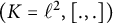 $\mathcal (K = \ell ^2, [.,.])$
is a Krein space.
Consider the frames
 $$ \begin{align*}\{z_n\}_{n=1}^\infty=\{e_1, 0, e_2, e_2, e_3, e_3, \ldots\} \end{align*} $$
and
 $$ \begin{align*}\{z^{\prime}_n\}_{n=1}^\infty=\{e_1, e_1, e_2, e_2, e_3, e_3, \ldots\} \end{align*} $$
for
 $\ell ^2$
, where
 $\{e_n\}$
is the standard orthonormal basis in
 $\ell ^2$
. Then, it is easy to see that they are weaving frames for
 $\ell ^2$
. If
 $$ \begin{align*}J=\begin{pmatrix} -1 & 0 & 0 & 0 & 0 & \cdots\\ 0 & 1 & 0 & 0 & 0 & \cdots\\ 0 & 0 & -1 & 0 & 0 & \cdots\\ 0 & 0 & 0 & 1 & 0 & \cdots\\ \vdots & \vdots & \vdots & \vdots & \vdots & \ddots \end{pmatrix}, \end{align*} $$
then
 $\{Jz_n\}_{n=1}^\infty = \{-e_1, 0, e_2, e_2, -e_3, -e_3, \ldots \}$
and
 $\{Jz^{\prime }_n\}_{n=1}^\infty = \{-e_1, -e_1, e_2, e_2, -e_3, -e_3, \ldots \}$
, and therefore, it is easy to verify that the remaining conditions of the theorem are satisfied.
Proof of Theorem 2.1:
(
 $\underline{1 \Longleftrightarrow 4}$
) Let
 $\{z_n\}_{n=1}^\infty $
and
 $\{z^{\prime }_n\}_{n=1}^\infty $
be weaving frames for
 $\mathcal K$
with the universal bounds
 $\alpha , \beta $
. Then, for every
 $k \in \mathcal K$
and every
 $\sigma \subset \mathbb N,$
we have
 $$ \begin{align} \alpha \|k\|_{J}^2 \leq \sum\limits_{n \in \sigma} |[k, z_n]|^2 + \sum\limits_{n \in \sigma^c} |[k, z^{\prime}_n]|^2 \leq \beta \|k\|_{J}^2. \end{align} $$
Now, we prove
 $J^2=\mathcal I$
and
 $J=J^*$
, where
 $\mathcal I$
is the identity operator and J is the fundamental symmetry on
 $\mathcal K$
.
Since
 $\mathcal K = K_{\delta ^+} \oplus K_{\delta ^-}$
, then for every
 $k \in \mathcal K$
can be written as
 $k=k_{\delta ^+} + k_{\delta ^-}$
and
 $J = \pi ^+ - \pi ^-$
, where
 $ \pi ^+$
is the orthogonal projection onto
 $K_{\delta ^+}$
and
 $ \pi ^-$
is the orthogonal projection onto
 $K_{\delta ^-}$
.
Thus, for every
 $k \in \mathcal K,$
we have
 $$ \begin{align*} J^2(k)=J(Jk)=J(J(k_{\delta^+} + k_{\delta^-}))&=J( (\pi^+ - \pi^-)(k_{\delta^+} + k_{\delta^-}))\\ &=J(k_{\delta^+} - k_{\delta^-})\\ &= (\pi^+ - \pi^-)(k_{\delta^+} - k_{\delta^-})\\ &= (k_{\delta^+} + k_{\delta^-})\\ &= k. \end{align*} $$
Furthermore, for every
 $k \in \mathcal K,$
we have
 $$ \begin{align*} [J^*(k), k] = [k, J(k)]=[k, (\pi^+ - \pi^-)(k)] &= [(\pi^+ - \pi^-)^*(k), k]\\ &= [(\pi^+ - \pi^-)(k), k]\\ &= [J(k), k]. \end{align*} $$
Therefore, applying equation (2.2), for every
 $k \in \mathcal K$
and every
 $\sigma \subset N,$
we have
 $$ \begin{align*} \alpha \|k\|_{J}^2 \leq \sum\limits_{n \in \sigma} |[Jk, Jz_n]|^2 + \sum\limits_{n \in \sigma^c} |[Jk, Jz^{\prime}_n]|^2 \leq \beta \|k\|_{J}^2 \end{align*} $$
and hence, we obtain
 $$ \begin{align*} \alpha \|k\|_{J}^2 \leq \sum\limits_{n \in \sigma} |[k, Jz_n]_{J}|^2 + \sum\limits_{n \in \sigma^c} |[k, Jz^{\prime}_n]_{J}|^2 \leq \beta \|k\|_{J}^2. \end{align*} $$
(
 $ \underline{2 \Longleftrightarrow 3} $
) Let
 $\{J z_n\}_{n=1}^\infty $
and
 $\{J z^{\prime }_n\}_{n=1}^\infty $
be weaving frames for
 $\mathcal K$
with the universal bounds
 $\alpha , \beta $
. Then, for every
 $k \in \mathcal K$
and every
 $\sigma \subset \mathbb N,$
we have
 $$ \begin{align*} & \alpha \|k\|_{J}^2 \leq \sum\limits_{n \in \sigma} |[k, J z_n]|^2 + \sum\limits_{n \in \sigma^c} |[k, J z^{\prime}_n]|^2 \leq \beta \|k\|_{J}^2\\ & \Leftrightarrow \alpha \|k\|_{J}^2 \leq \sum\limits_{n \in \sigma} |[k, z_n]_{J}|^2 + \sum\limits_{n \in \sigma^c} |[k, z^{\prime}_n]_{J}|^2 \leq \beta \|k\|_{J}^2. \end{align*} $$
Thus,
 $\{z_n\}_{n=1}^\infty $
and
 $\{z^{\prime }_n\}_{n=1}^\infty $
are weaving frames for
 $(\mathcal K, [.,.]_J)$
and conversely.
(
 $ \underline{3 \Longleftrightarrow 4} $
) Let
 $\{z_n\}_{n=1}^\infty $
and
 $\{z^{\prime }_n\}_{n=1}^\infty $
be weaving frames for
 $(\mathcal K, [.,.]_J)$
with the universal bounds
 $\alpha , \beta $
.
Then, for every
 $k \in \mathcal K$
and every
 $\sigma \subset \mathbb N,$
we have
 $$ \begin{align} \alpha \|k\|_{J}^2 \leq \sum\limits_{n \in \sigma} |[k, z_n]_{J}|^2 + \sum\limits_{n \in \sigma^c} |[k, z^{\prime}_n]_{J}|^2 \leq \beta \|k\|_{J}^2. \end{align} $$
For every
 $k \in \mathcal K$
, we prove
 $\|J(k)\|_{J}=\|k\|_{J}$
. Since
 $\|J\|_{J}=1$
, then
 $\|J(k)\|_{J} \leq \|k\|_{J}$
.
Furthermore, for every
 $k \in \mathcal K$
,
 $\|k\|_{J} \leq \|J^{-1}\|_{J} \|J(k)\|_{J}$
, and hence, we have
 ${\|k\|_{J} \leq \|J(k)\|_{J}}$
. Thus, for every
 $k \in \mathcal K$
,
 $\|J(k)\|_{J}=\|k\|_{J}$
.
Therefore, using equation (2.3) and replacing k by
 $J(k)$
, for every
 $\sigma \subset \mathbb N,$
we obtain
 $$ \begin{align*} & \alpha \|J(k)\|_{J}^2 \leq \sum\limits_{n \in \sigma} |[J(k), z_n]_{J}|^2 + \sum\limits_{n \in \sigma^c} |[J(k), z^{\prime}_n]_{J}|^2 \leq \beta \|J(k)\|_{J}^2\\ & \Leftrightarrow \alpha \|k\|_{J}^2 \leq \sum\limits_{n \in \sigma} |[k, J z_n]_{J}|^2 + \sum\limits_{n \in \sigma^c} |[k, Jz^{\prime}_n]_{J}|^2 \leq \beta \|k\|_{J}^2. \end{align*} $$
This completes the proof.
In the following result, we present necessary and sufficient conditions for the existence of Krein space weaving frames.
Proposition 2.1 Let
 $\{z_n\}_{n=1}^\infty $
and
 $\{z^{\prime }_n\}_{n=1}^\infty $
be frames for the Krein space
 $(\mathcal K, [.,.])$
with the bounds
 $\alpha _1 \leq \beta _1$
and
 $\alpha _2 \leq \beta _2$
, respectively, then the following are equivalent:
-
(1)
$\{z_n\}_{n=1}^\infty $
and
$\{z^{\prime }_n\}_{n=1}^\infty $
are weaving frames for
$\mathcal K$
. -
(2) For every
$\sigma \subset \mathbb N$
, if
$S_{\sigma }$
is the corresponding weaving frame operator, then for every
$k \in \mathcal K,$
there exists
$\alpha>0$
so that we have
$$ \begin{align*}\|S_{\sigma}(k)\|_{J} \geq \alpha \|k\|_{J}.\end{align*} $$


Proof 1 (
 $ \underline{1 \implies 2} $
)
Let
 $\{z_n\}_{n=1}^\infty $
and
 $\{z^{\prime }_n\}_{n=1}^\infty $
be weaving frames for
 $(\mathcal K, [.,.])$
with the universal bounds
 $\alpha , \beta $
. Then, for every
 $k \in \mathcal K$
and every
 $\sigma \subset \mathbb N,$
we have
 $$ \begin{align*} \alpha \|k\|_{J}^2 \leq \sum\limits_{n \in \sigma} |[k, z_n]|^2 + \sum\limits_{n \in \sigma^c} |[k, z^{\prime}_n]|^2 \leq \beta \|k\|_{J}^2 \end{align*} $$
and hence applying Theorem 2.1, we obtain
 $$ \begin{align} \alpha \|k\|_{J}^2 \leq \sum\limits_{n \in \sigma} |[k, z_n]_{J}|^2 + \sum\limits_{n \in \sigma^c} |[k, z^{\prime}_n]_{J}|^2 \leq \beta \|k\|_{J}^2. \end{align} $$
Thus, using equation (2.4), for every
 $k \in \mathcal K$
and
 $\sigma \subset \mathbb N,$
we obtain
 $$ \begin{align*} \|S_{\sigma}k\|_{J} = \sup\limits_{\|l\|=1} |[S_{\sigma}k, l]_{J}| & \geq \left [ S_{\sigma}k, \frac{k}{\|k\|_{J}}\right ]_{J}\\ & = \frac{1} {\|k\|_{J}} [S_{\sigma}k, k]_{J}\\ & \geq \alpha \|k\|_{J}. \end{align*} $$
(
 $ \underline{2 \implies 1 }$
) For every
 $k \in \mathcal K$
and every
 $\sigma \subset \mathbb N$
, the corresponding weaving frame operator is given by,
 $S_{\sigma } k = TJT^* k$
, where
 $T, T^*$
, and J are associated synthesis, analysis operators, and fundamental symmetry on
 $(\mathcal K, [.,.])$
.
Since
 $\|J\| = 1$
and
 $\|S_{\sigma }(k)\|_{J} \geq \alpha \|k\|_{J}$
, and
 $\{z_n\}_{n=1}^\infty $
and
 $\{z^{\prime }_n\}_{n=1}^\infty $
are frames for the Krein space
 $(\mathcal K, [.,.])$
with the bounds
 $\alpha _1 \leq \beta _1$
and
 $\alpha _2 \leq \beta _2$
, respectively, then we have
 $$ \begin{align} \alpha^2 \|k\|_{J}^2 \leq \|T\|_{J}^2 \|T^*k\|_{J}^2 \leq \|T\|_{J}^2 (\beta_1 + \beta_2) \|k\|_{J}^2. \end{align} $$
Again, we have
 $$ \begin{align} \|T\|_{J}^2 = \|T^*\|_{J}^2 = \sup\limits_{k \neq 0} \frac{\|T^*k\|_{J}^2} {\|k\|_{J}^2} \leq \frac { (\beta_1 + \beta_2) \|k\|_{J}^2}{\|k\|_{J}^2} = (\beta_1 + \beta_2). \end{align} $$
Thus, using equations (2.5) and (2.6), for every
 $k \in \mathcal K$
and
 $\sigma \subset \mathbb N,$
we obtain
 $$ \begin{align} \frac{\alpha^2}{(\beta_1 + \beta_2)} \|k\|_{J}^2 \leq \sum\limits_{n \in \sigma} |[k, z_n]_{J}|^2 + \sum\limits_{n \in \sigma^c} |[k, z^{\prime}_n]_{J}|^2. \end{align} $$
The upper weaving frame bound will be achieved automatically under the given assumption. Therefore, applying Theorem 2.1,
 $\{z_n\}_{n=1}^\infty $
and
 $\{z^{\prime }_n\}_{n=1}^\infty $
are weaving frames for
 $\mathcal K$
.
The validity of the above result is illustrated through the following example.
Example 2.3 Let us consider the frames
 $$ \begin{align*}\{z_n\}_{n=1}^\infty=\{e_1, e_2, e_1, e_2, e_3, e_3, \ldots\} \end{align*} $$
and
 $$ \begin{align*}\{z^{\prime}_n\}_{n=1}^\infty=\{e_1, e_1, e_2, e_2, e_3, e_3, \ldots\} \end{align*} $$
for
 $\ell ^2=\mathcal K$
. Then, for every
 $\sigma \subset \mathbb {N}$
, it is straightforward to verify that the necessary and sufficient conditions of the theorem are satisfied.
The following result establishes the wovenness of a Krein space frame and its image under a bounded linear operator, subject to certain conditions.
Proposition 2.2 Let us consider a frame
 $\{z_n\}_{n=1}^\infty $
for Krein space
 $(\mathcal K, [.,.])$
with bounds
 $\alpha $
,
 $\beta ,$
and U be a bounded operator. If
 $\|I - U\|_{J}^2 < \frac {\alpha }{\beta }$
, then
 $\{z_n\}_{n=1}^\infty $
and
 $\{Uz_n\}_{n=1}^\infty $
are weaving frames.
Proof 2 Clearly, U is invertible and
 $\{Uz_n\}_{n=1}^\infty $
is a frame for
 $\mathcal K$
. For every
 $k \in \mathcal K,$
we have
 $$ \begin{align*} & \left(\sum\limits_{n \in \sigma} |[k, z_n]|^2 + \sum\limits_{n \in \sigma^c} |[k, Uz_n]|^2 \right)^{\frac{1}{2}} \\ & \qquad\quad = \left(\sum\limits_{n\in\sigma} |[k, z_n]|^2 + \sum\limits_{n \in \sigma^c} |[k, z_n] - [(I - U^*)k, z_n]|^2 \right)^{\frac{1}{2}}\\ & \qquad\quad \geq \left(\sum\limits_{n \in \mathbb{N}} |[k, z_n] - \chi_{\sigma^c}(n)[(I - U^*)k, z_n]|^2 \right)^{\frac{1}{2}}\\ & \qquad\quad \geq \left (\sum\limits_{n \in \mathbb{N}} |[k, z_n]|^2\right)^{\frac{1}{2}} - \left(\sum\limits_{n \in \mathbb{N}}|\chi_{\sigma^c}(n)[(I - U^*)k, z_n]|^2 \right)^{\frac{1}{2}}\\ & \qquad\quad = \left (\sum\limits_{n \in \mathbb{N}} |[k, z_n]|^2\right)^{\frac{1}{2}} - \left(\sum\limits_{n \in \sigma^c}(|[(I - U^*)k, z_n]|^2 \right)^{\frac{1}{2}}\\ & \qquad\quad \geq \sqrt{\alpha} \|k\|_{J} - \sqrt{\beta} \|(I - U^*)k\|_{J}\\ & \qquad\quad \geq (\sqrt{\alpha} - \sqrt{\beta} \|(I - U^*)\|_{J})\|k\|_{J}. \end{align*} $$
Again, for every
 $k \in \mathcal K,$
we have
 $$ \begin{align*} \sum\limits_{n \in \sigma} |[k, z_n]|^2 + \sum\limits_{n \in \sigma^c} |[k, Uz^{\prime}_n]|^2 &\leq \sum\limits_{n \in \mathbb{N} } |[k, z_n]|^2 + \sum\limits_{n \in \mathbb{N}} |[k, Uz^{\prime}_n]|^2\\ & \leq ( \beta + \|U\|^2) \|k\|^2. \end{align*} $$
Thus,
 $\{z_n\}_{n=1}^\infty $
and
 $\{Uz_n\}_{n=1}^\infty $
are weaving frames.
Example 2.4 Let
 $k_1 = (1,0)$
and
 $k_2 = (0, 2) $
be two elements in the Krein space
 ${\mathcal {K}=(\mathbb {R}^{2}, [.,. ])}$
. Let us define the indefinite inner product as
 $[x, y] = [(x_1, x_2), (y_1, y_2)] = x_1y_1 - x_2y_2$
. The set
 $\{k_i\}^2_{i = 1}$
forms a frame in the Krein space with bounds (
 $\alpha $
= 1) and (
 $\beta $
= 2).
Suppose U is a bounded linear operator given by
 $U(x_1, x_2) = (x_1, 0.8x_2)$
and compute
 $\|I - U\|_{J} = 0.2$
. Since
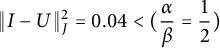 $\|I - U\|^2_{J} = 0.04 < (\dfrac {\alpha }{\beta } = \dfrac {1}{2})$
, then Proposition 2.2 ensures that
 $\{k_i\}^2_{i = 1}$
and
 $\{Uk_i\}^2_{i =1}$
are weaving frames.
Example 2.5 Here, we discuss a counter example of Proposition 2.2. Let us consider two elements
 $k_1 = (1,0)$
and
 $k_2 = (0, 3) $
in the Krein space
 $\mathcal {K}=(\mathbb {R}^{2}, [.,. ])$
and the corresponding indefinite inner product is defined by
 $[x, y] = [(x_1, x_2), (y_1, y_2)] = x_1y_1 - x_2y_2$
. Then, the set
 $\{k_1, k_2\}$
forms a frame for the rein space with bounds (
 $\alpha = 1$
)and (
 $\beta $
= 3).
Let U be a bounded linear operator given by
 $U(x_1, x_2) = (-x_1, x_2)$
. Clearly,
 $\{Uk_i\}^2_{i =1}$
is a frame. It is easy to verify that
 $\{k_i\}^2_{i = 1}$
and
 $\{Uk_i\}^2_{i =1}$
are weaving frames. However,
 $\|I - U\|^2_{J} = 4> (\dfrac {\alpha }{\beta } = \dfrac {1}{3})$
.
The following result establishes a condition for weaving frames through their respective frame operators.
Proposition 2.3 Let K =
 $\{z_n\}^\infty _{n =1}$
and
 $K'$
=
 $\{z^{\prime }_n\}^\infty _{n= 1}$
be weaving frames with universal frame bounds
 $\alpha $
,
 $\beta $
and the corresponding frame operators
 $S_K$
and
 $S'_{K'}$
, respectively. If
 $\|S_K\|_J \|S_K^{-1} - S^{-1}_{K'}\|_J < \dfrac {\alpha }{\beta }$
(or
 $\|S_K'\|_J \|S_K^{-1} - S^{-1}_{K'}\|_J < \dfrac {\alpha }{\beta }$
), then
 $S^{-1}_K = {\{S^{-1}_kz_n}\}^\infty _{n= 1}$
and
 $S^{-1}_{K'} = {\{S^{-1}_{k'}z^{\prime }_n}\}^\infty _{n= 1}$
are weaving frames.
Proof 3 Without loss of generality, let us consider
 $\|S_K\|_J \|S_K^{-1} - S^{-1}_{K'}\|_J < \dfrac {\alpha }{\beta }$
. For every
 $\sigma \subset \mathbb {N}$
and
 $k \in (\mathcal {K}, [., .]$
), we have
 $$ \begin{align*} & \left (\sum\limits_{n \in \sigma} |[k, S^{-1}_Kz_n]|^2 + \sum\limits_{n \in \sigma^c} |[k, S^{-1}_{K'}z^{\prime}_n]|^2 \right)^{\frac{1}{2}} \\&\quad = \left(\sum\limits_{n\in\sigma}|[S^{-1}_Kk, z_n]|^2 + \sum\limits_{n \in \sigma^c} |[S^{-1}_{K'}k, z^{\prime}_n]|^2\right)^{\frac{1}{2}}\\&\quad \geq \left(\sum\limits_{n\in\sigma}|[S^{-1}_Kk, z_n]|^2 + \sum\limits_{n \in \sigma^c} |[S^{-1}_{K}k +(S^{-1}_{K'} - S^{-1}_K)k, z^{\prime}_n]|^2\right)^{\frac{1}{2}}\\&\quad \geq \sqrt{\alpha} \|S^{-1}_Kk\|_J - \sqrt{\beta} \|(S^{-1}_{K'} - S^{-1}_K)k\|_J. \end{align*} $$
On the other hand, we have
 $$ \begin{align*} &\sum\limits_{n \in \sigma} |[k, S^{-1}_Kz_n]|^2 + \sum\limits_{n \in \sigma^c} |[k, S^{-1}_{K'}z^{\prime}_n]|^2 \\ &\leq \sum\limits_{n \in \mathbb{N}} |[S^{-1}_Kk, z_n]|^2 + \sum\limits_{n \in \mathbb{N}} |[S^{-1}_{K'}k, z^{\prime}_n]|^2 \\ &\leq {\beta}(\|S^{-1}_K\|_J^2 + \|S^{-1}_{K'}\|_J^2)\|k\|_J^2. \end{align*} $$
This completes the proof.
In the following theorem, we characterize weaving frames in Krein space using the projection operator.
Theorem 2.2 Let
 $\{z_n\}_{n=1}^\infty $
and
 $\{z^{\prime }_n\}_{n=1}^\infty $
be two frames for Krein space
 $\mathcal ({K},[., .])$
, then the following are equivalent:
-
(1) The frames
$\{z_n\}_{n=1}^\infty $
and
$\{z^{\prime }_n\}_{n=1}^\infty $
are weaving frames for
$\mathcal {K}$
. -
(2) For every
$\sigma \subset \mathbb {N}$
, let
$Z_\sigma = \overline {span}\{z_n\}_{n \in \sigma }$
,
$Z_{\sigma ^{c}}= \overline {span}\{z^{\prime }_n\}_{n \in \sigma ^{c}}$
and let P be the orthogonal projection of
$\mathcal {K}$
onto
$Z^\perp _{\sigma }$
. Then,
$P|Z_{\sigma ^{c}}$
is the orthogonal projection onto
$Z^\perp _\sigma $
and
$\{Pz^{\prime }_n\}_ {n \in \sigma ^c}$
is a frame for
$Z^\perp _{\sigma }$
.


Proof 4 (
 $ \underline{ 1\implies 2}$
)
First, we prove that for every
 $\sigma \subset \mathbb N$
,
 $P|Z_{\sigma ^c}$
be the orthogonal projection onto
 $Z^\perp _{\sigma ^c}$
.
Let us define
 $ Z_{\sigma } = \overline {span} \{z_n\}_{n \in \sigma }$
,
 $ Z_{\sigma ^c} = \overline {span} \{z^{\prime }_n\}_{n \in \sigma ^c}$
and P be the orthogonal projection of
 $\mathcal {K}$
onto
 $Z_{\sigma }^\perp $
. Assumed condition implies that for every
 $\sigma \subset \mathbb N$
,
 $(\{z_n\}_{n \in \sigma } \cup \{z^{\prime }_n\}_{n \in \sigma ^c})$
is a frame for
 $\mathcal {K}$
. Since
 $\{z^{\prime }_n\}_{n \in \sigma ^c}$
spans
 $Z_{\sigma }^\perp $
, every
 $k \in Z_{\sigma }^\perp $
can be written as linear combination of
 $\{z^{\prime }_n\}_{n \in \sigma ^c}$
. Therefore,
 $P|Z_{\sigma ^c}$
be the orthogonal projection onto
 $Z^\perp _{\sigma }$
.
Since
 $(\{z_n\}_{n \in \sigma } \cup \{z^{\prime }_n\}_{n \in \sigma ^c})$
is a frame for
 $\mathcal {K}$
, then for every
 $k \in \mathcal {K}$
, there are universal constants
 $\alpha \leq \beta ,$
we have
 $$ \begin{align*}\alpha \|k\|_{J}^2 \leq \sum\limits_{n \in \sigma} |[k, z_n]|^2 + \sum\limits_{n \in \sigma^c} |[k, z^{\prime}_n]|^2 \leq \beta \|k\|_{J}^2.\end{align*} $$
Hence, for every
 $k \in Z_{\sigma }^\perp $
, we have
 $$ \begin{align*}\alpha \|k\|_{J}^2 \leq \sum\limits_{n \in \sigma^c} |[k, z^{\prime}_n]|^2 \leq \beta \|k\|_{J}^2.\end{align*} $$
Since
 $P(z^{\prime }_n) = z^{\prime }_n$
, then
 $\{Pz^{\prime }_n\}_{n \in \sigma ^c}$
is a frame for
 $Z_{\sigma }^\perp .$
(
 $ \underline{2 \implies 1}$
)
Since
 $\{z_n\}_{n=1}^\infty $
is a frame for
 $\mathcal {K}$
and
 $ Z_\sigma = \overline {span}(\{z_n\}_{n\in \sigma })$
), then for every
 $\sigma \subset \mathbb {N}$
,
 $\{z_n\}_{n\in \sigma }$
is frame for
 $Z_\sigma .$
Therefore, for every
 $\sigma \subset \mathbb {N}$
and
 $k_\sigma \in Z_\sigma $
, there exist
 $0<\alpha _1\leq \beta _1< \infty $
so that
 $$ \begin{align} \alpha_1 \|k_\sigma\|_{J}^2 \leq \sum\limits_{n \in \sigma} |[k_\sigma, z_n]|^2 \leq \beta_1 \|k_\sigma\|_{J}^2. \end{align} $$
Moreover,
 $\{Pz_n\}_{n \in \sigma ^c}$
is a frame for
 $Z^\perp _{\sigma }.$
Therefore, for every
 $\sigma \subset \mathbb {N}$
and
 $k^\perp _{\sigma } \in Z^\perp _\sigma $
, there exist
 $0<\alpha _2\leq \beta _2< \infty $
so that
 $$ \begin{align} \alpha_2\|k_\sigma^\perp\|_{J}^2 \leq \sum\limits_{n \in \sigma^c} |[k_\sigma^\perp, Pz^{\prime}_n]|^2 \leq \beta_2 \|k_\sigma^\perp\|_{J}^2. \end{align} $$
Furthermore, since
 $P|Z_{\sigma ^c}$
is the orthogonal projection onto
 $Z^\perp _{\sigma }$
, then from equation (2.9), we have
 $$ \begin{align} \alpha_2\|k_\sigma^\perp\|_{J}^2 \leq \sum\limits_{n \in \sigma^c} |[k_\sigma^\perp, z^{\prime}_n]|^2 \leq \beta_2 \|k_\sigma^\perp\|_{J}^2. \end{align} $$
Again, for every
 $k \in \mathcal {K,}$
we have
 $k = k_\sigma + k^\perp _\sigma $
. Thus, applying equations (2.8) and (2.10), for every
 $\sigma \subset \mathbb {N,}$
we obtain
 $$ \begin{align*}\alpha^*(\|k_\sigma^\perp\|_{J}^2 +\|k_\sigma^\perp\|_{J}^2 )\leq \sum\limits_{n \in \sigma} |[k_\sigma, z^{\prime}_n]|^2 +\sum\limits_{n \in \sigma^c} |[k_\sigma^\perp, z^{\prime}_n]|^2 \leq \beta^* (\|k_\sigma^\perp\|_{J}^2 +\|k_\sigma^\perp\|_{J}^2),\end{align*} $$
where
 $\alpha ^* = \min (\alpha _1, \alpha _2)$
and
 $\beta ^* = \beta _1 + \beta _2$
. Consequently, for every
 $\sigma \subset \mathbb {N}$
and for every
 $k \in \mathcal {K,}$
we obtain
 $$ \begin{align*}\alpha^*\|k\|_{J}^2 \leq \sum\limits_{n \in \sigma} |[k_\sigma, z^{\prime}_n]|^2 +\sum\limits_{n \in \sigma^c} |[k_\sigma^\perp, z^{\prime}_n]|^2 \leq \beta^* \|k\|_{J}^2.\end{align*} $$
This completes the proof.
Definition 2.2 [Reference Bognár5] A vector
 $ k \in ( \mathcal {K}, [. , .])$
with the property
 $ [. , .]> 0$
is said to be J-positive. Thus, subspace
 $ L\subset \mathcal {K}$
is said to be J-positive if for every non-zero
 $k \in L$
is J-positive. Furthermore, the subspace L is called uniformly J-positive if for every
 $ k \in L$
, there exists
 $\lambda>0$
so that
 $ [k , k] \geq \lambda \|k||^2$
. Analogously, we can define J-negative, J-non-positive, J-neutral, and uniformly J-negative subspaces.
Definition 2.3 [Reference Giribet, Maestripieri, Martínez Pería and Massey17] A Bessel sequence
 $\{z_n\}^\infty _{n = 1}$
is said to be a J-frame for (
 $\mathcal {K}, [., .]$
) if
 $R(T_{\sigma }P^+)$
is maximal uniformly J-positive subspace of
 $\mathcal {K}$
and
 $R(T_{\sigma }P^-)$
is maximal uniformly J-negative subspace of
 $\mathcal {K}$
.
Remark 2.1 Let (
 $\mathcal {K}, [., .]$
) be a Krein space with fundamental symmetry J. Consider
 $\{z_n\}^\infty _{n = 1}$
be a Bessel sequence in
 $\mathcal {K}$
. Let
 $$ \begin{align*}T_{\sigma}: \ell^2(\mathbb N)\rightarrow \mathcal{K}\end{align*} $$
be the associated synthesis operator. Define the index sets by
 $$ \begin{align*}\sigma_+ =\{n \in\mathbb{N} : [z_n, z_n]\geq0\}\quad and\quad \sigma_- =\{n \in\mathbb{N} : [z_n, z_n]< 0\}.\end{align*} $$
Then, the Hilbert space
 $\ell ^2(\mathbb N)$
can be orthogonally decomposed as
 $$ \begin{align*}\ell^2(\mathbb N) = \ell^2(\sigma_+) \oplus \ell^2(\sigma_-).\end{align*} $$
Let
 $P^+$
and
 $P^-$
be the orthogonal projections from
 $\ell ^2(\mathbb N)$
onto the subspaces
 $\ell ^2(\sigma _+)$
and
 $\ell ^2(\sigma _-)$
, respectively. If
 $M_{\sigma _+} = \overline {span} \{z_n\}_{n \in \sigma _+}$
and
 $M_{\sigma _-} = \overline {span} \{z_n\}_{n \in \sigma _-},$
then it is easy to check that
 $\overline {span} \{z_n\}_{n \in \sigma _+} \subset R(T_{\sigma }P^+) \subset M_{\sigma _+},$
 $\overline {span} \{z_n\}_{n \in \sigma _-} \subset R(T_{\sigma }P^-) \subset M_{\sigma _-} .$
Thus, we have
 $$ \begin{align*}R(T_\sigma )= R(T_{\sigma}P^+) +R(T_{\sigma}P^-).\end{align*} $$
We discuss J-weaving frames in Krein spaces examining their structural properties and implications.
Definition 2.4 Let
 $\{z_n\}^\infty _{n= 1}$
and
 $\{z^{\prime }_n\}^\infty _{n= 1}$
be two J-frames for Krein space
 $\mathcal ({K}, [., .])$
, then they are said to be J-weaving frames, if for every subset
 $\sigma \subset {\mathbb {N}}$
,
 $\{z_n\}_{n \in \sigma } \cup \{z^{\prime }_n\}_{n \in \sigma ^c}$
is a J-frame for
 $\mathcal {K}$
.
In this context, it is evident that for every
 $\sigma ^+$
,
 $$ \begin{align*}R(T_{\sigma}P^+) = M_{\sigma_+} = \overline{span} (\{z_n\}_{n \in \sigma_+} \cup \{z^{\prime}_n\}_{n \in \sigma^c_+})\end{align*} $$
is a maximal uniformly J-positive subspace and for every
 $\sigma ^-,$
 $$ \begin{align*}R(T_{\sigma}P^-) = M_{\sigma_-} = \overline{span} (\{z_n\}_{n \in \sigma_-} \cup \{z^{\prime}_n\}_{n \in \sigma^c_-})\end{align*} $$
is a maximal uniformly J-negative subspace of
 $\mathcal {K},$
respectively.
If
 $\{z_n\}^\infty _{n= 1}$
and
 $\{z^{\prime }_n\}^\infty _{n= 1}$
are J-weaving frames then for every subset
 $\sigma \subset \mathbb {N}, \{z_n\}_{n \in \sigma } \cup \{z^{\prime }_n\}_{n \in \sigma ^c}$
is a J-frame and due to its maximality, the range is closed. Thus, applying [Reference Ando1, Corollary 1.5.2] we have
 $$ \begin{align*}R(T_{\sigma}P^+) = M_{\sigma_+} \quad and \quad R(T_{\sigma}P^-) = M_{\sigma_-} ,\end{align*} $$
and hence
 $$ \begin{align*}R(T_{\sigma}P^+) +R(T_{\sigma}P^-) = M_{\sigma_+} + M_{\sigma_-} = \mathcal{K}.\end{align*} $$
It is to be noted that
 $M_{\sigma _+} = \overline {span} (\{z_n\}_{n \in \sigma _+} \cup \{z^{\prime }_n\}_{n \in \sigma ^c_+})$
and
 $M_{\sigma _-} = \overline {span} (\{z_n\}_{n \in \sigma _-} \cup \{z^{\prime }_n\}_{n \in \sigma ^c_-})$
.
Example 2.6 If we consider
 $$ \begin{align*}\{z_n\}_{n =1}^3 = \left\{ \left(\dfrac{1}{2.16}, 0, 0 \right), \left(0, 0, \dfrac{2}{2.17} \right), \left(0, \dfrac{1}{2.18}, 0 \right)\right\} \end{align*} $$
and
 $$ \begin{align*}\{z^{\prime}_n\}_{n =1}^3 = \left\{ \left(\dfrac{100}{\sqrt{2}}, 0, \dfrac{101}{\sqrt{2}}\right), \left(\dfrac{102}{\sqrt{3}}, 0, \dfrac{103}{\sqrt{2}}\right), \left(0, \dfrac{1}{2.19}, 0\right)\right\}, \end{align*} $$
then it is easy to verify that
 $\{z_n\}_{n =1}^3$
and
 $\{z^{\prime }_n\}_{n =1}^3$
are J-weaving frames for Krein space
 $\mathcal {K} = (\mathbb {R}^3, [., .]),$
where
 $$ \begin{align*}[(x_1, x_2, x_3), (y_1, y_2, y_3)] = x_1y_1 - x_2 y_2 + x_3 y_3.\end{align*} $$
Using the associated index sets in Remark 2.1, we have the following cases:
Case 1:
 $\sigma _+ = \{1\}$
,
 $ M_{\sigma _+} = \overline {span} (\{z_1\} \cup \{z^{\prime }_2\})$
is a maximal uniformly J-positive subspace of
 $\mathcal {K}.$
Case 2:
 $\sigma _+ = \{2\}$
,
 $ M_{\sigma _+} = \overline {span} (\{z_2\} \cup \{z^{\prime }_1\})$
is a maximal uniformly J-positive subspace of
 $\mathcal {K}.$
Case 3:
 $\sigma _+ = \{1, 2\}$
,
 $ M_{\sigma _+} = \overline {span} \{z_n\}_{n = 1}^2 $
is a maximal uniformly J-positive subspace of
 $\mathcal {K}.$
Case 4: Otherwise,
 $ M_{\sigma _+} = \overline {span} \{z^{\prime }_n\}_{n = 1}^2 $
is a maximal uniformly J-positive subspace of
 $\mathcal {K}.$
It is to be noted that for every subset
 $\sigma _+, M_{\sigma _+} = \overline {span} (\{z_n\}_{n \in \sigma _+} \cup \{z^{\prime }_n\}_{n \in \sigma ^c_+}),$
is a maximal uniformly J-positive subspace of
 $\mathcal {K}.$
Analogously, for every subset
 $\sigma _-, M_{\sigma _-} = \overline {span} (\{z_n\}_{n \in \sigma _-} \cup \{z^{\prime }_n\}_{n \in \sigma ^c_-})$
is a maximal uniformly J-negative subspace of
 $\mathcal {K}.$
The following is a non-example of Definition 2.4, illustrating that not every weaving frame in Krein space necessarily qualifies as J-weaving frames.
Example 2.7 Let
 $\mathcal {K} = (\mathbb {C}^3, [., .])$
be a Krein space and define the associated indefinite inner product as
 $$ \begin{align*}[(x_1, x_2, x_3), (y_1, y_2, y_3)] = x_1\overline y_1 + x_2\overline y_2 - x_3\overline y_3.\end{align*} $$
Let us consider two frames
 $$ \begin{align*}\{z_n\}_{n =1}^3 = \left\{ \left(3, 0, \dfrac{3}{\sqrt{2}}\right), \left(0, \dfrac{2}{\sqrt{3}}, 0\right), \left(0, 0, \dfrac{1}{\sqrt{3}}\right)\right\} \end{align*} $$
and
 $$ \begin{align*}\{z^{\prime}_n\}_{n =1}^3 = \left\{ \left(1, 0, 0\right), \left(0, 3, \dfrac{3}{\sqrt{2}}\right), \left(0, 0,1\right )\right\} \end{align*} $$
in
 $\mathbb C^3$
. Then, it is easy to verify that they are weaving frames, however, they are not J-weaving frames.
Here,
 $M_{\sigma _+} = \overline {span} (\{z_n\}_{n \in \sigma _+} \cup \{z^{\prime }_n\}_{n \in \sigma ^c_+})$
,
 $M_{\sigma _-} = \overline {span} (\{z_n\}_{n \in \sigma _-} \cup \{z^{\prime }_n\}_{n \in \sigma ^c_-})$
, where
 $\sigma _+ =\{n \in \mathbb {N} : [z_n, z_n]\geq 0\}$
,
 $\sigma _- =\{n\in \mathbb {N} : [z_n, z_n]< 0\}$
,
 $\sigma ^c_+ =\{n\in \mathbb {N} : [z^{\prime }_n, z^{\prime }_n]\geq 0\}$
and
 $\sigma ^c_- = \{n \in \mathbb {N} : [ z^{\prime }_n, z^{\prime }_n]< 0\}$
. Thus,
 $M_{\sigma _+}$
is not uniformly J-positive, whenever we consider
 $\sigma _+ = \{1\}$
. Therefore,
 $\{z_n\}_{n = 1}^3$
and
 $\{z^{\prime }_n\}_{n = 1}^3$
are not J-weaving frames.
Proposition 2.4 If
 $\{z_n\}^\infty _{n= 1}$
and
 $\{z^{\prime }_n\}^\infty _{n= 1}$
are J-weaving frames on Krein space
 $(\mathcal {K}, [., .])$
, then
 $ \sigma _{\pm } \subset {\mathbb {N}}$
and for every
 $k \in M_{\sigma _\pm }$
, there exist constants
 $ \beta _{-} \leq \alpha _- < 0 < \alpha _+ \leq \beta _{+}$
such that
 $$ \begin{align} \alpha_{\pm} [k, k] \leq \sum\limits_{n \in \sigma_{\pm}} |[k, z_n]|^2 + \sum\limits_{n \in \sigma_{\pm}^c} |[k, z^{\prime}_n]|^2 \leq \beta_{\pm} [k, k]. \end{align} $$
Proof 5 Given
 $\{z_n\}^\infty _{n= 1}$
and
 $\{z^{\prime }_n\}^\infty _{n= 1}$
are J-weaving frames, which imply that for every
 $ \sigma \subset {\mathbb {N}}$
,
 $\{z_n\}_{n \in \sigma } \cup \{z^{\prime }_n\}_{n \in \sigma ^c}$
is a J-frame for
 $\mathcal {K}$
. Thus,
 $R(T_{\sigma }P^+) = M_{\sigma _+}$
is a maximal uniformly J-positive subspace for
 $\mathcal {K}$
. Therefore,
 $T_{\sigma }P^+: \ell ^2(\mathbb N)\rightarrow (M_{\sigma _+}, [., .])$
is an onto map. Hence, for every subset
 $\sigma _+ \subset \mathbb {N}, \{z_n\}_{n \in \sigma _+} \cup \{z^{\prime }_n\}_{n \in \sigma _+^c}$
is a frame for (
 $M_{\sigma _+}, [., .]$
). In particular, there exist constants
 $0<\alpha _+ \leq \beta _{+}$
such that equation (2.11) holds for
 $M_{\sigma _+}$
. A similar assertion applies for every
 $\sigma _- \subset \mathbb {N}.$
The following result establishes a characterization theorem for J-weaving frames. This characterization provides deeper insights into their structural properties within Krein spaces.
Theorem 2.3 Let
 $\{z_n\}^\infty _{n= 1}$
and
 $\{z^{\prime }_n\}^\infty _{n= 1}$
be weaving frames for
 $(\mathcal {K}, [., .])$
. Define the index sets
 $\sigma _+ =\{n \in \mathbb {N} : [z_n, z_n]\geq 0\}\quad and\quad \sigma _- =\{n \in \mathbb {N} : [z_n, z_n]< 0\}$
. Suppose
 $M_{\sigma _+} = \overline {span} (\{z_n\}_{n \in \sigma _+} \cup \{z^{\prime }_n\}_{n \in \sigma ^c_+})$
and
 $M_{\sigma _-} = \overline {span} (\{z_n\}_{n \in \sigma _-} \cup \{z^{\prime }_n\}_{n \in \sigma ^c_-})$
. Then, the following are equivalent:
-
(1)
$\{z_n\}^\infty _{n= 1}$
and
$\{z^{\prime }_n\}^\infty _{n= 1}$
are J-weaving frames for
$(\mathcal {K}, [., .])$
. -
(2) If
$M_{\sigma _+} \cap M^\perp _{\sigma _+} = \{0\}\quad and\quad M_{\sigma _-} \cap M^\perp _{\sigma _-} = \{0\} $
, then for every
$ \sigma _{\pm } \subset \mathbb {N}$
and
$k \in M_{\sigma _{\pm }}$
, there exist constants
$ \beta _{-} \leq \alpha _- < 0 < \alpha _+ \leq \beta _{+}$
, we have (2.12)
$$ \begin{align} \alpha_{\pm} [k, k] \leq \sum\limits_{n \in \sigma_{\pm}} |[k, z_n]|^2 + \sum\limits_{n \in \sigma_{\pm}^c} |[k, z^{\prime}_n]|^2 \leq \beta_{\pm} [k, k].\end{align} $$


Proof 6
 $ \underline{ 1 \implies 2} $
)
Suppose
 $\{z_n\}^\infty _{n= 1}$
and
 $\{z^{\prime }_n\}^\infty _{n= 1}$
are J-weaving frames for
 $\mathcal ({K}, [., .]$
), then using the definition of J-weaving frames and applying Proposition 2.4, we achieve our desired result.
(
 $ \underline{2 \implies 1} $
)
If
 $M_{\sigma _+} \cap M^\perp _{\sigma _+} = \{0\}$
and
 $M_{\sigma _-} \cap M^\perp _{\sigma _-} = \{0\}$
, then both
 $M_{\sigma _+}$
and
 $M_{\sigma _-}$
are J-non-degenerated. Then, applying [Reference Giribet, Maestripieri, Martínez Pería and Massey17, Proposition 3.8], for every
 $ \sigma _{\pm } \subset \mathbb {N}$
and
 $k \in M_{\sigma _{\pm }}$
, there exist constants
 $ \beta _{-} \leq \alpha _- < 0 < \alpha _+ \leq \beta _{+}$
so that
 $$ \begin{align*}\alpha_{\pm} [k, k] \leq \sum\limits_{n \in \sigma_{\pm}} |[k, z_n]|^2 + \sum\limits_{n \in \sigma_{\pm}^c} |[k, z^{\prime}_n]|^2 \leq \beta_{\pm} [k, k].\end{align*} $$
Furthermore, applying [Reference Giribet, Maestripieri, Martínez Pería and Massey17, Theorem 3.9],
 $M_{\sigma _+}$
is a maximal uniformly J-positive subspace of
 $\mathcal {K}$
and
 $M_{\sigma _-}$
is a maximal uniformly J-negative subspace of
 $\mathcal {K}.$
Therefore,
 $\{z_n\}^\infty _{n= 1}$
and
 $\{z^{\prime }_n\}^\infty _{n= 1}$
are J-weaving frames for
 $(\mathcal {K}, [., .])$
.
3 Application to probabilistic erasure
In this section, we explore the applications of Krein space weaving frames in the context of probabilistic erasure, focusing on their stability in data recovery scenarios. Our discussion begins by introducing the fundamental concepts of the tensor product of elements in Krein spaces, which plays a crucial role in understanding the interaction of frame elements. This foundational discussion sets the stage for analyzing how weaving frames can be applied to mitigate the effects of erasure in probabilistic settings.
Let
 $\{z_n\}_{n=1}^\infty $
and
 $\{z^{\prime }_n\}_{n=1}^\infty $
be weaving frames for
 $\mathcal K$
with the corresponding frame operators
 $S_1, S_2$
, then for every
 $\sigma \subset \mathbb N$
, the associated error operator is given by
 $$ \begin{align*} E=\sum\limits_{n \in \sigma} \delta_n z_n \otimes S_1^{-1} z_n + \sum\limits_{n \in \sigma^c} \delta_n z^{\prime}_n \otimes S_2^{-1} z^{\prime}_n, \end{align*} $$
where
 $\delta _n$
is the standard Dirac delta function.
This error operator enables rapid representation while significantly minimizing computational cost. Its effectiveness is largely dependent on the selection of Krein space frames utilized in the encoding and decoding process. By optimizing these frame choices, the overall efficiency of the technique can be further enhanced.
In the following result, we demonstrate how weaving frames can effectively mitigate data loss in erasure scenarios.
Theorem 3.1 Let
 $\{z_n\}_{n=1}^m$
and
 $\{z^{\prime }_n\}_{n=1}^m$
be uniform tight weaving frames for the Krein space
 $\mathbb R^n$
with
 $\|z_n\|_{J} = \sqrt n = \|z^{\prime }_n\|_{J}$
. Suppose
 $\epsilon>0$
is very small number for which
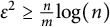 ${\epsilon ^2 \geq \frac {n}{m} \text {log} (n)}$
. Then, for every
 $k \in \mathbb R^n$
, there is an absolute constant
 $M>0$
for which we have
 $$ \begin{align*}E\|\hat k-k\|_{J} \leq M \epsilon \|k\|_{J}.\end{align*} $$
Proof 7 For every
 $k \in \mathbb R^n$
and every
 $\sigma \subset \{1, 2, \ldots , m\},$
we have
 $$ \begin{align*} \tilde{E} k = \hat k-k = \frac{1}{m} \left [\sum\limits_{n \in \sigma} \epsilon_n [k, z_n]z_n + \sum\limits_{n \in \sigma^c} \epsilon_n [k, z^{\prime}_n]z^{\prime}_n \right], \end{align*} $$
where
 $$ \begin{align*} \hat k & = \frac{2}{m} \left [\sum\limits_{n \in \sigma} [k, z_n]z_n + \sum\limits_{n \in \sigma^c} [k, z^{\prime}_n]z^{\prime}_n \right]\\ & =\frac{2}{m} \left [\sum\limits_{n \in \sigma} \tilde{\delta_n}^{p_n} [k, z_n]z_n + \sum\limits_{n \in \sigma^c} \tilde{\delta_n}^{p_n} [k, z^{\prime}_n]z^{\prime}_n \right], \end{align*} $$
with
 $$ \begin{align*}\tilde{E}=\sum\limits_{n \in \sigma} \tilde{\delta_n}^{p_n} z_n \otimes z_n + \sum\limits_{n \in \sigma^c} \tilde{\delta_n}^{p_n} z^{\prime}_n \otimes z^{\prime}_n ~\mbox{ and }~ \epsilon_n = 2\tilde{\delta_n}^{p_n} - 1 \end{align*} $$
is an independent Bernoulli variable that takes values
 $1$
and
 $-1$
, each with probability of
 $\frac {1}{2}$
(see [Reference Parzen23]).
Thus, it is sufficient to prove that, for every
 $\sigma \subset \{1, 2, \ldots , m\}$
,
 $$ \begin{align*} E\left \| \frac{1}{m} \left [\sum\limits_{n \in \sigma} \epsilon_n z_n \otimes z_n + \sum\limits_{n \in \sigma^c} \epsilon_n z^{\prime}_n \otimes z^{\prime}_n \right] \right \|_{J} \leq M \epsilon. \end{align*} $$
Applying [Reference Rudelson25, Lemma], for every
 $\sigma \subset \{1, 2, \ldots , m\}$
, there is a positive constant M, we have
 $$ \begin{align} E\left \| \left [\sum\limits_{n \in \sigma} \epsilon_n z_n \otimes z_n + \sum\limits_{n \in \sigma^c} \epsilon_n z^{\prime}_n \otimes z^{\prime}_n \right] \right \|_{J} & \leq M \sqrt{n \text{log}(n)}\\ \nonumber & \hspace{0.3cm} \left \| \left [\sum\limits_{n \in \sigma} z_n \otimes z_n + \sum\limits_{n \in \sigma^c} z^{\prime}_n \otimes z^{\prime}_n \right] \right \|^{\frac{1}{2}}_{J}. \end{align} $$
Furthermore, since
 $\{z_n\}_{n=1}^m$
and
 $\{z^{\prime }_n\}_{n=1}^m$
are uniform tight weaving frames for
 $\mathbb R^n$
with
 $\|z_n\|_{J} = \sqrt n = \|z^{\prime }_n\|_{J}$
, then for every
 $\sigma \subset \{1, 2, \ldots , m\},$
we have
 $$ \begin{align*} \mathcal I_{\mathbb R^n} = \frac{1}{m} \left [\sum\limits_{n \in \sigma} z_n \otimes z_n + \sum\limits_{n \in \sigma^c} z^{\prime}_n \otimes z^{\prime}_n \right], \end{align*} $$
where
 $\mathcal I_{\mathbb R^n}$
is the identity operator on
 $\mathbb R^n$
.
Hence, we obtain
 $$ \begin{align} \left \| \left [\sum\limits_{n \in \sigma} z_n \otimes z_n + \sum\limits_{n \in \sigma^c} z^{\prime}_n \otimes z^{\prime}_n \right] \right \|_{J} =m. \end{align} $$
Thus, using equations (3.1) and (3.2), we obtain
 $$ \begin{align*} E\left \| \frac{1}{m} \left [\sum\limits_{n \in \sigma} \epsilon_n z_n \otimes z_n + \sum\limits_{n \in \sigma^c} \epsilon_n z^{\prime}_n \otimes z^{\prime}_n \right] \right \|_{J} \leq M \sqrt{\frac{n}{m}} ~\sqrt {\text{log}(n)}. \end{align*} $$
Therefore, we achieved our result due to the fact
 $\epsilon ^2 \geq \frac {n}{m} \text {log} (n)$
.