Introduction
Wild rabbit Oryctolagus cuniculus L. populations have been declining over the past decades in the Iberian Peninsula (e.g. Villafuerte et al., Reference Villafuerte, Calvete, Blanco and Lucientes1995), with extreme implications for the conservation of threatened predators, such as the Iberian lynx Lynx pardinus and the imperial eagle Aquila adalberti (Iborra et al., Reference Iborra, Arthur and Bayle1990; Palomares, Reference Palomares2001). Its importance as a key species in the Iberian Peninsula and also its importance as a game species (Rogers et al., Reference Rogers, Arthur, Soriguer, Thompson and King1994) has led researchers to focus on several parameters influencing wild rabbit populations, such as rabbit viral haemorrhagic (RVH) disease (e.g. Villafuerte et al., Reference Villafuerte, Calvete, Gortázar and Moreno1994), predation (Jaksic & Soriguer, Reference Jaksic and Soriguer1981; Palomares & Delibes, Reference Palomares and Delibes1997), habitat type (Lombardi et al., Reference Lombardi, Fernandez, Moreno and Villafuerte2003; Carvalho & Gomes, Reference Carvalho and Gomes2004) and diet (Martins et al., Reference Martins, Milne and Rego2002; Alves et al., Reference Alves, Vingada and Rodrigues2007).
With respect to the helminth parasites of the wild rabbit and their ecological correlates, the available studies mainly refer to the UK (e.g. Boag & Kolb, Reference Boag and Kolb1989; Allan et al., Reference Allan, Craig, Sherington, Rogan, Storey, Heath and Iball1999), Ireland (Butler, Reference Butler1994) and Australia (Dunsmore, Reference Dunsmore1966; Dunsmore & Dudzinski, Reference Dunsmore and Dudzinski1968). In the Iberian Peninsula, the interpretation of wild rabbit helmithfaunal data in view of ecological and host parameters has been attempted in studies referring to several Spanish regions (e.g. Blasco et al., Reference Blasco, Torres, Feliu, Casanova, Miquel and Moreno1996; Molina et al., Reference Molina, Casanova and Feliu1999), whereas the scarce studies on the helminth parasites of Portuguese wild rabbits are merely descriptive (Carvalho-Varela, Reference Carvalho Varela1967; Maia et al., Reference Maia, Viçosa, Simões and Caeiro1994).
This paper aims to evaluate the effect of parasites on rabbits so that future management regimes can be developed to conserve rabbits in the Iberian Peninsula.
Materials and methods
Study area
Dunas de Mira is included in the Natura 2000 site PTCON0055. The study area is located in the Coimbra District, littoral centre of Portugal, comprising an area of 6000 ha (40°26′N, 8°47′W). According to the Habitat Directive (92/43/EEC), the area is located in the Mediterranean Biogeographic Region and includes important habitats such as Mediterranean salt meadows, forested dunes with Pinus pinaster and P. pinea, and European dry heaths. The average rainfall ranges from 5.4 mm in June to 105.4 mm in January and average temperatures range from 10.3°C in December/January to 19.1°C in July/August.
Host and parasite sampling
Wild rabbits (n = 163) were shot by hunters between 2000 and 2004. All animals were collected from October to December, thus complying with the legal hunting period (DL 201/2005, 4 November, Agriculture Ministry), while limiting the range of factors in the analysis and avoiding a possible seasonal effect in helminth community composition. Animals were sexed and weighed and the digestive tract and liver were frozen for later analysis. Immediately upon thawing, organs collected from all specimens were separated in different Petri dishes with saline solution, and subjected to helminthological analysis using a stereoscopic microscope. All of the helminths found were counted, preserved in tagged glass vials in 70% alcohol and processed following general helminthological methods. In the case of nematodes, extemporaneous preparations with lactofenol of Amann were used. Platyhelminthes were refixed using a mixture of ethanol (85%), glacial acetic acid (10%) and formalin (5%), stained using different carmine-based staining agents and dehydrated in ethanol solutions (80 and 90%), isopropyl alcohol and xylol, each step lasting 5–10 min, approximately. Once dehydration was complete, Platyhelminthes were permanently mounted in Canada balsam. Helminth species were identified according to previous descriptions (Baylis, Reference Baylis1925; Simón Vicente, Reference Simón Vicente1969; Beveridge, Reference Beveridge1978; Durette-Desset & Denke, Reference Durette-Desset and Denke1978; Tenora & Murai, Reference Tenora and Murai1978; Durette-Desset, Reference Durette-Desset1979; Tenora et al., 1981–Reference Tenora, Murai, Valero and Cutillas1982; Afonso-Roque & Barata, Reference Afonso-Roque and Barata1984; Genov et al., Reference Genov, Murai, Georgiev and Harris1990).
Wild rabbit kidney mass (kidney with surrounding fat and kidney trimmed of all external fat) was recorded in order to calculate the kidney fat index (KFI) (Harder & Kirkpatrick, Reference Harder, Kirkpatrick and Bookout1996) as a suitable measure of the condition of lagomorphs (Flux, Reference Flux1971).
Data analysis
The use of descriptive ecological terms follows Bush et al. (Reference Bush, Lafferty, Lotz and Shostak1997). Differences in helminth prevalence according to year and sex were tested by chi-square analysis followed by Fisher's exact test (two-sided) for pairwise comparisons. A bootstrap two-sample t-test was used for pairwise comparison of annual helminth mean intensities and mean intensities according to host sex (QP 3.0 software; Rozsa et al., Reference Rózsa, Reiczigel and Majoros2000). The year 2000 subsample was excluded from analysis, considering the reduced number of females obtained during this period. A two-way ANOVA with Bonferroni post-tests (Prism 4.0a, GraphPad Software Inc., San Diego, California, USA) was used in order to assess the overall variation of helminth intensities according to the effect of year and host sex, and according to the interaction of factors. Data included in these analyses refer to ranked intensities of the five most common species as defined in the results section. A two-way ANOVA was also used to assess the effect of year and sex on KFI values. Afterwards, in order to assess the effect of helminths and host weight on host condition (log transformed KFI values), a MANOVA was used entering the five most important helminth species intensities and host weight as main effects, and year as a co-variable (JMP 5.1, SAS Institute Inc., Cary, North Carolina, USA).
Results
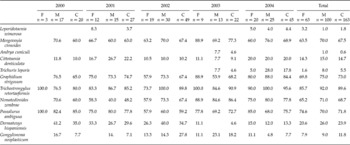
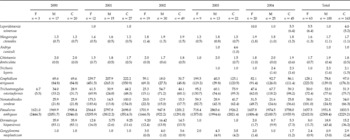
The 163 wild rabbits examined carried an estimated 238,256 helminths belonging to 11 species. Individual hosts harboured a mean of 4.3 species (SD = 1.4, range = 1–7) and a mean of 1480 individuals (range = 1–12,799). Data on prevalence and mean intensity of all the species detected in this study are presented in tables 1 and 2, respectively.
Prevalences of helminth species in wild rabbits according to host sex and year. F, females; M, males; C, sexes combined.

Mean intensities (±SD) of helminth species in wild rabbits according to host sex and year. F, females; M, males; C, sexes combined.

In the present dataset it is possible to define a group of abundant and frequent species including a cestode (Mosgovoyia ctenoides) and four nematodes (Graphidium strigosum, Trichostrongylus retortaeformis, Nematodiroides zembrae and Passalurus ambiguus) accounting for 99.7% of all worms. However, considering their prevalences (table 1), Cittotaenia denticulata, Dermatoxys hispaniensis and Gongylonema neoplasticum also present some importance within the helminth community. Leporidotaenia wimerosa, Andrya cuniculi and Trichuris leporis are considered to be rare species (prevalence < 10%; Lotz & Font, Reference Lotz and Font1994), and were thus removed from further analysis.
No differences were found among annual prevalences. However, significantly higher annual mean intensities of G. strigosum were detected in 2003 and 2004 in comparison to values registered in 2002 (t-test: t = 2.875, P = 0.015 and t = 2.891, P = 0.008). Notice that a higher G. strigosum value was detected in 2001 (table 2), although the extremely large standard deviation value precludes any reliable inference concerning the mean intensity of G. strigosum in that year. Statistically significant differences were detected in G. strigosum populations due to both sex and year (two-way ANOVA, F = 4.15, P = 0.04 and F = 3.38, P = 0.02, respectively) but there was no significant interaction (two-way ANOVA, F = 4.36, P>0.05). Indeed, the mean intensity of G. strigosum in males during 2002 was lower than that recorded in 2001 and 2004 (Bonferroni's test, t = 2.62, P < 0.05 and t = 2.53, P < 0.05, respectively) whereas a higher mean intensity in females was registered in 2003 when comparing to 2002 and 2004 (Bonferroni's test, t = 3.34, P < 0.01 and t = 2.35, P < 0.05, respectively).
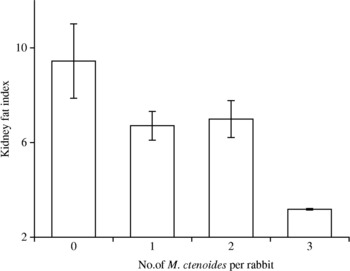
Wild rabbit weight and respective KFI values are presented in table 3. Notice that a relatively higher body weight was registered in 2003, coinciding with the lowest KFI values. There was a significant effect of year of host capture on host condition (two-way ANOVA, F = 6.98, P < 0.001) whereas host sex and the interaction of factors were not significant; therefore host sex was set aside from further analysis. When testing for both helminth and host weight effects on annual KFI values, M. ctenoides (MANOVA, F = 7.69, P = 0.015) was found to produce a significantly negative effect on host condition in the year 2003. Indeed, higher KFI values were obtained in rabbits uninfected by M. ctenoides while the lowest KFI values were obtained in rabbits presenting the higher M. ctenoides intensity (fig. 1).
Body condition (kidney fat index. KFI) and weight (g) of wild rabbits in relation to host sex and year. F, females; M, males; C, sexes combined.

Kidney fat index (mean values ± SD) in relation to the number of Mosgovoyia ctenoides in wild rabbits collected in 2003.

Discussion
The available data on the helminth parasites of wild rabbits in Portugal are scarce (Carvalho-Varela, Reference Carvalho Varela1967). Other available papers referring to Portugal focused on particular species (Mendonça & Varela, Reference Mendonça and Varela1971; Afonso Roque & Barata, Reference Afonso-Roque and Barata1984; Maia et al., Reference Maia, Viçosa, Simões and Caeiro1994) or included data on Portuguese archipelagos (Foronda et al., Reference Foronda, Valladares, Lorenzo-Morales, Ribas, Feliu and Casanova2003). Apart from recording L. wimerosa, T. leporis and N. zembrae in the wild rabbit for the first time in continental Portugal (see Cordero del Campillo et al., Reference Cordero del Campillo, Castañón-Ordoñez and Reguera-Feo1994), the present data provided the first record of wild rabbits naturally infected by G. neoplasticum in Europe (Eira et al., Reference Eira, Miquel, Vingada and Torres2006). The record of L. wimerosa also enlarges its distribution within the Iberian Peninsula, considering that previous reports suggested its confinement to southern areas of Spain (Blasco et al., Reference Blasco, Torres, Feliu, Casanova, Miquel and Moreno1996). In general, the helminthfauna of the wild rabbit in Dunas de Mira was, to some extent, similar to those obtained in the helminthfaunal studies of the wild rabbit in continental Spain (Blasco et al., Reference Blasco, Torres, Feliu, Casanova, Miquel and Moreno1996; Molina et al., Reference Molina, Casanova, Feliu and Castién1998). However, one must emphasize the higher prevalence found for M. ctenoides (65%) in Dunas de Mira, in comparison to those found in several regions of Spain, ranging from 33% in Catalonia (Blasco et al., Reference Blasco, Torres, Feliu, Casanova, Miquel and Moreno1996) to 48% in Navarra (Molina et al., Reference Molina, Casanova, Feliu and Castién1998).
In order to elucidate the higher mean intensities of G. strigosum in 2003 and 2004 in comparison with 2002, one must take into account the higher rabbit density registered in the same period, particularly in 2004 (Alves, Reference Alves2005). Indeed, rabbit density was found to influence the numbers of G. strigosum (Dunsmore, Reference Dunsmore1972). Furthermore, assuming rabbit weight as an indication of age (Cowan, Reference Cowan1983), the heavier, and therefore older, rabbits were obtained in 2003. The higher mean intensity of G. strigosum in 2003 is in accordance with the concept of parasite load increasing with age (see Wilson et al., Reference Wilson, Bjørnstad, Dobson, Merler, Poglayen, Randolph, Read, Skorping, Hudson, Rizzoli, Grenfell, Heesterbeek and Dobson2001), as also verified for this nematode by Boag & Kolb (Reference Boag and Kolb1989) in Scotland, and Dunsmore (Reference Dunsmore1966) in Australia. It is thereby suggested that either the wild rabbit does not acquire resistance to infection with increasing age, as also suggested by Molina et al. (Reference Molina, Casanova and Feliu1999), or that G. strigosum does not respond to host immunity (Lello et al., Reference Lello, Boag, Fento, Stevenson and Hudson2004). Apart from host density and age, according to Dunsmore (Reference Dunsmore1966) and Allan et al. (Reference Allan, Craig, Sherington, Rogan, Storey, Heath and Iball1999), suitable conditions of humidity and temperature could favour these higher values of G. strigosum. Although several other studies related higher G. strigosum values with wetter areas (Boag, Reference Boag1985; Butler, Reference Butler1994), regrettably in the present study such relationship could not be assessed because annual rainfall data referring to the study period were unavailable.
Passalurus ambiguus presented the highest intensity values, which may be a result of its transmission process. In fact, infection occurs following ingestion (during grooming or coprophagy) of the infective stage resulting from larval development within the eggs laid by adult P. ambiguus females on the peri-anal skin of the rabbit (Anderson, Reference Anderson2000).
As to the effect of parasites upon lagomorphs, Hobbs et al. (Reference Hobbs, Twigg, Elliot and Wheeler1999) reported that nematode infection was not an important cause of wild rabbit mortality, although Lello et al. (Reference Lello, Boag and Hudson2005) supports the hypothesis that rabbit parasites may have substantial negative effects upon host condition.
In the present study, the year of capture was found to play a role in the variation of host body condition. When annual data sets were considered, the intensities of M. ctenoides were found to be of importance in the modulation of host body condition as expressed by KFI values. With respect to the assessment of wild rabbit body condition, Boos et al. (Reference Boos, Thouzeau, Delacour, Artois, Marchandeau, Jean-Claude and Tobin2005) reported that wild rabbit body mass (averaging between 1491 and 1618 g) and KFI equally explained the same amount of variation of body lipid mass. However, in the present study the patterns of rabbit weight and KFI values did not concur. Furthermore, it is unreasonable to assume that rabbits from Dunas de Mira present lower body condition values, based on the much lower body weights presented by the rabbits analysed in the present study (922–1036 g). In this case, as mentioned above, the M. ctenoides burden significantly affected the wild rabbit body condition in 2003. In fact, wild rabbits presenting lower condition values were infected by more cestodes, whereas rabbits without cestodes presented higher body condition values.
The underlying mechanisms by which a high M. ctenoides burden leads to a decrease in body condition are, as yet, unknown, since these cestodes probably do not feed directly on the host but on the food passing through the gut lumen (Neilson et al., Reference Neilson, Boag and Hartley2005). However, apart from the increase in the use of host resources and in the energy allocated to an immune response, one must emphasize that these relatively large tapeworms occupy a considerable amount of the host's small intestine, thus causing congestion of the digestive tract, eventually increasing the host's need to mobilize its fat reserves while reducing its capacity for new fat storage. Ultimately, although several other factors are bound to influence wild rabbit condition, the present results suggest that the cost of heavier infections of M. ctenoides in rabbits from Dunas de Mira is a reduction in their body condition.
Acknowledgements
This study was partially supported by the ‘DURSI, Generalitat de Catalunya’ project 2005-SGR-00 576 and the fellowship SFRH/BD/6802/2001 provided by the ‘Fundação para a Ciência e a Tecnologia’ of the Portuguese ‘Ministério da Ciência, Tecnologia e Ensino Superior’. Authors are grateful to Paulo Calisto and to the directive board and hunters from ‘Zona de Caça Associativa de Mira’ for allowing the collection of wild rabbit samples. The method by which the animals were obtained complies with current Portuguese laws (DL 201/2005, 4 November, Agriculture Ministry).