INTRODUCTION
As members of the indigenous Upper Xingu society in Brazil, Wauja and Yawalapiti people participate in ritual exchange meetings with each other. In March 2006 scores of Wauja people traveled overland for many hours to visit the Yawalapiti community. They had come for three days of trading, music, and dance in intergroup exchange called huluki. On the first night three Wauja men played sacred flutes owned by the Yawalapiti in the village's large central patio. At this moment a tapirFootnote 1 emerged from the forest, ran around the patio, and in a completely unexpected attack, mauled the senior Wauja flautist before the animal was shot and killed. The Wauja man was seriously injured, and the attack precipitated an intergroup crisis. In part because tapirs are normally docile, participants immediately began to question whether the animal was not actually the manifestation of a spirit-monster, possibly manipulated by human sorcery. The two ethnolinguistic groups had come together to reinforce positive social bonds through exchange, but the act of violence against a guest in the village of his hosts put this in doubt. Talk among participants in the event turned to the disposition of valuable possessions: the Wauja had broken the Yawalapiti's kawoka flute fending off the attack; the Wauja victim's soul may have been taken from him; the material fact of the tapir's dead body suggested that it was just a wild animal; but a shaman's dream revealed that the tapir was a spirit.
In this article I analyze how inalienable possessions such as flutes, souls, bodies, and dreams contribute to the social identities of their possessors in the cultural context of the Brazilian Upper Xingu. Wauja grammar encodes a distinction between alienable and inalienable possession that imperfectly overlaps with the cultural category. I argue that the use of grammatically inalienable possessive constructions in discourse plays an important role in the linguistic construction of social relationships. I present an ethnographic account of the tapir attack and the events that followed to show that the integrity of individual persons and the proper boundaries between social groups may be compromised in situations where inalienable possessions are at risk of alienation. I then show that discursive negotiation over who may possess what, along with performative speech (Austin Reference Austin1962) that returns inalienable possessions to persons and groups, ultimately accomplishes the assignation of recognizable emblems of identity to restore social order. I analyze the role that inalienability in Wauja grammar and discourse has in the disruption and repair of social relationships in the cultural context of Upper Xinguan ritual.Footnote 2
I approach the nexus between grammatical and cultural regimes of possession by looking at social principles of rights and circulation and by asking how these are enacted in exchange and in the discourse that frames exchange. I suggest that this approach adds nuance to our understanding of the grammar of inalienability and to grammatical categories generally. My analysis follows Kockelman (2007a) in taking up the emblematic semiotic function of inalienable possessions; the alignment or resonance between inalienable possessions in grammar, discourse, and culture; the powerful role of inalienable possessions in the expansion and contraction of personhood that is at the base of ritual baptism and illness cures; and the way that sharing in inalienable possessions is a key site for negotiating social belonging and differentiation. I focus on how the form and function of inalienable possession in Wauja grammar and discourse structure relations between social role positions, and how this contributes to ethnolinguistic identity in the regional exchange economy. I connect formal possession marking in Wauja grammar to the notional domain of inalienable possession in Upper Xingu culture by considering how such possessions, including body parts, kin, and selected artifacts, serve as emblems (Singer Reference Singer1984) of corporate persons and groups.
I appeal to recent developments in the linguistics and anthropology of inalienable possession that suggest that (frequency of) reference to inalienables in discourse reinforces the grammatical categorical distinction (Haspelmath Reference Haspelmath2006), and that the practice of referring utilizes the distinction for the purposes of characterizing relations between people and their possessions in terms of cultural expectations about who may possess what (Kockelman Reference Kockelman2009). In particular, I follow Kockelman's (2009) suggestion that repeated reference to inalienables as possessed in discourse, in combination with the discourse function that inalienables fulfill in characterizing referents, are mechanisms that work to reinforce and even grammaticize inalienable morphosyntactic coding. In turn, inalienability as a grammatical category of a given language influences, but does not predetermine nor necessarily perfectly map onto, cultural notions of inalienable possession among its speakers. I have not counted how often reference to inalienables occurs in my data, but the idea that discourse is a key site of the sociolinguistic life of inalienability and a pivot between grammatical coding and cultural categorization is at the heart of my approach. I use ethnographic methodology to focus deeply on one representative event rather than superficially on many decontextualized events.Footnote 3
The Wauja language is spoken by roughly 350 people who mostly reside in a single circular village in the Xingu Indigenous Park in Brazil. I draw on over a year of fieldwork on the Wauja language during which time I resided in the Wauja community and periodically accompanied Wauja people out of their village in sojourns to other Xinguan locales and beyond. First I discuss grammatical and cultural aspects of inalienability in the Wauja context. Next I describe the first night of the ritual encounter when the tapir attack took place. I continue with ethnography of the ritual, looking at how intergroup discord grew through contention over various inalienables, including souls, images, and songs. I conclude by showing how the final act of the intergroup encounter, a ritual baptism that itself centered on the deployment of and sharing in an important inalienable possession—names—worked to repair the relationship between the two groups. Throughout I hope to show how a local linguistic ideology of social relationality positions inalienables as emblematic signs of connections between persons, groups, and their possessions. Through the cultural framing of acts of inalienable reference speakers reflect, contest, and transform those relationships in discourse (Silverstein Reference Silverstein2003).
INALIENABILITY IN WAUJA GRAMMAR AND CULTURE
Wauja belongs to the Arawk linguistic stock. It shares many typological features with other Arawak languages (Aikhenvald Reference Aikhenvald, Dixon and Aikhenvald1999, Payne Reference Payne, Desmond and Geoffry1981), including a lexical distinction between inalienable and alienable nouns expressed in overt differences in morphological marking in possessive constructions (Facundes Reference Facundes2000, Granadillo Reference Granadillo2004). (In)alienability is a categorical distinction that divides possessed nouns in a language into one set that is marked when possessed (alienables) and another set that is marked when unpossessed (inalienables). Inalienable possessions in Wauja include kin terms, body parts, and a set of objects, ideas, and relations such as bows, dreams, language, names, and rituals. The goal of this section is to describe the grammatical, categorical, and coding properties of inalienability in Wauja, and to suggest ways in which we might think about the interrelatedness of linguistic and cultural categoriality. First I explore the grammatical category of inalienability in Wauja.
The set of inalienable nouns in Wauja is marked. Inalienable nouns form a closed set, in contrast to the unmarked open set of alienable nouns. All possessable nouns in Wauja are marked with a pronominal proclitic when possessed.
In addition, a class of nouns including terms such as kamo ‘sun’ and kejo ‘moon’ is defined as semantically unpossessable. The unpossessable nouns never occur in possessed constructions, and so never take pronominal proclitics. Alienable nouns are defined as those that are unmarked when unpossessed and that take morphological marking when possessed. The canonical marker used is the suffix -la possessed.Footnote 4
(1)
a. uku
‘arrow’
b. n-uku-la
1s-arrow-possessed
‘my arrow’
(2)
a. kawoka
‘sacred flute’ or ‘guardian spirit’
b. o-kawoka-la
3-flute/guardian spirit-possessed
‘his flute’ or ‘his guardian spirit’
(3)
a. hoka
‘tobacco’
b. po-hoka-la
2s-tobacco-possessed
‘your tobacco’
Inalienable nouns are ungrammatical when suffixed with the possessed-la, as in (4a) through (4c) and (5a) through (5c).
(4)
a. õta-í
bow-unpossessed
‘bow’
b. n-õta
1s-bow
‘my bow’
c. *n-õta-la
1s-bow-possessed
‘my bow’
(5)
a. naaka-i
custom-unpossessed
‘custom’
b. a-naaka
1p-custom
‘our custom’
c. *a-naaka -la
1p-custom-POSSESSED
‘our custom’
Wauja pronominal proclitics.

Absolutive inalienable nouns are defined as those that are unmarked when possessed and that bear a mark when unpossessed—this mark being the suffix -i, unpossessed.Footnote 5 The use of inalienable nouns in their unpossessed form in speech accomplishes generic reference.Footnote 6 The absolutive inalienable roots in Wauja are bound forms—they may never appear without either -i, unpossessed, or a pronominal clitic cross-referencing a possessor. The exception to this is the set of kin terms, which may never appear outside of possessive constructions; thus they never appear with the unpossessed suffix. This makes them members of the class of inabsolutive inalienables (Kockleman 2009). I list examples of inalienable Wauja nouns in the appendix.Footnote 7
Corbera summarized data on possession from the three extant Xingu Arawak languages (Corbera Reference Corbera Mori2005). He describes Mehinaku and Wauja as displaying an alienable/inalienable pattern, but he says that Yawalapiti lacks the distinction (see also Mujica Reference Mujica1992). Gregor recognizes that Mehinaku words for “body parts and other basic objects have a very close association with the individual,” without going so far as to claim that they form a grammatical set of inalienables distinct from the alienable nouns he cites along with them (Reference Gregor1977:120). Richards (Reference Richards1973) discusses morphophonological difficulties in the analysis of nominal possession in Wauja without explicitly labeling the category of inalienability.
Most linguistic descriptions of inalienabilty in different languages feature kin terms and/or spatial-relational terms and body parts, and often include a set of culturally specific items that are taken to be, like kin terms and body parts, intimately related to their possessor's identity or self. However, while there is agreement that the types of objects included in the closed class of inalienables is culturally determined, there is no consensus on the semantics that unifies the class of inalienables cross linguistically. Nichols puts this position very well:
A description of the semantics of possession is therefore very possibly not even a part of the grammar of a language; it is part of the linguist's personal understanding of particular grammatical features, or the native speaker's personal and conscious reflection on language. “Alienability”, then, is basically not a semantic matter. (Nichols Reference Nichols and Shipley1988:575–56).
Still, when a conceptual core for the category of inalienable possession is discussed in the linguistic literature, accounts tend to focus on relations of inherency between possessor and possessed. Take the following definition: “Inalienable possessions comprise then either inextricable, essential, or unchangeable relations between ‘possessor’ and ‘possessed’ ” (Chappell & McGregor Reference Chappell, McGregor, Chappell and McGregor1996). Such a definition figures the identity between possessor and inalienable possessions on the model of essential qualities such as color, size, and shape. A more nuanced understanding of inalienable possession is informed by economic anthropological approaches to the reproduction of subjectivity in exchange relations (Mauss Reference Mauss1925/1990).Footnote 8 Inalienable possessions serve as emblems of persons or groups grounded in and transformed through who they are associated with in specific contexts and through by-degrees separation from possessors in circulation (Weiner Reference Weiner1992). Inalienables may appear to be essential to their possessor's self, but risk of their alienation generates much of the value deriving from the very intimacy of that association.
Grammatical inalieability and cultural notions of inalienable possession do not always match up in Wauja or other sociolinguistic cases. Consider the Wauja construction o-hoka-la-naku 3-tobacco-poss-loc.inside, referring to a shaman's tobacco pouch. Both the terms for tobacco and the distinctive woven containers restricted to use by shamans are grammatically alienable. As a prime mediator of casual discourse between men, tobacco is seen as something best shared. Tobacco in general, then, is an eminently alienable material possession. However, the shaman grows, dries, and rolls his own tobacco into distinctively long cigars, and his smoking practices distinguish him from the common man. He uses tobacco as medicine, in the mediation of social relations of another order—those between humans and apapatai ‘spirit-monsters.’ The pouch that the shaman uses to store his tobacco is emblematic of his shamanic training and exclusive position.
The pouch itself is considered exchangeable, but it can only be freely given if empty. Wauja shamans insist that great care should be taken to remove all of the small bits of tobacco clinging to the inside before transfer, for if any pieces remained they could be used by a witch in the manufacture of a charm against the owner. In this way a shaman's tobacco is like the quintessential charm ingredients hair and fingernails, grammatically inalienable body parts whose association with their possessors is so close that they may bridge a link between witch and victim.Footnote 9 The interpretation of such objects as hair, nails, and tobacco from a shaman's pouch as so representative of their owners that they may be used as witchcraft charms contradicts the grammatical marking of the latter as alienable, yet this interpretation is totally unproblematic to Wauja speakers. The closeness of fit of grammar to cultural category and of cultural category to context is malleable.
It is worth noting that even in terms of everyday casual use, tobacco is often referred to in such a way as to suggest inalienablity. So, rather than to ask someone for tobacco by referring to po-hoka-la ‘your tobacco-poss’ it is common to substitute an inalienable noun and ask japai usixu-i? ‘Is there any drink-unposs (inalienable)?’ or more directly, simply p-usixu ‘your drink (inalienable).’ Substitution of the inalienable term for drink for the alienable term for tobacco is further motivated by the fact that in Wauja these two nouns form a paradigm as grammatical objects of the same verb of consumption, tuuka ‘drink/inhale,’ viz. tuuka hoka ‘smoke tobacco,’ tuuka usixu-i ‘drink a drink-unposs.’ The metaphorical use of the inalienable term for drink is interpretable as downplaying alienation on the part of the requester when the “drink” (tobacco) is referred to in the marked unpossessed form, or as alternatively deferentially recognizing the imposition placed upon the giver by being asked to part with such an intimate valuable when asking for the unmarked possessed inalienable form p-usixu ‘your drink.’
Wauja cultural notions of possession that converge around inalienability combine aspects of intimate association with the risks of alienation, even of certain body parts, rather than focusing only on inseparability. A key semiotic function of Wauja cultural and grammatical inalienable possession is emblematicity, the degree to which certain possessions may stand for their possessors. This is highlighted in situations of separation or threat of separation. In the following ethnographic description I show how Wauja grammatical and cultural categories of inalienable possession come to be related through interaction and exchange, as inalienable morphosyntactic constructions are mobilized in discursive acts of reference to culturally inalienable emblematic possessions, the potential circulation of which becomes an object of social negotiation, a site for engaging in and foreclosing exchange.
TAPIR ATTACK
The Upper Xingu social system is composed of ten ethnolinguistic groups speaking languages from three linguistic stocks (Carib, Tupi, Arawak) and one language isolate (Trumai). Each group is typically endogamous and monolingual. However, they share artistic, religious, mythical, dietary, and other cultural patterns, and they identify as members of a single society in opposition to indigenous peoples outside their territory. They use language and other emblems to differentiate themselves from one another, and they participate in periodic ritual exchange events, such as those called huluki in Wauja, to reinforce idealized Upper Xinguan relations of peaceful competition between groups.Footnote 10 Upper Xinguan multi-group ceremonies stress partnerships between chiefs and emphasize friendly relationships between groups, making them “a medium of intervillage factional alliances” (Basso Reference Basso1973:147). Importantly, huluki includes a competitive aspect in its capacity as a “tournament of value” (Appadurai Reference Appadurai1988). In addition, ritual exchange celebrates apapatai ‘spirit-monsters’ through dance. This has the goal of regulating relations between humans and spirit-monsters, where the desired situation is also one of peace and separation. The very same spirit-monsters that are celebrated also make people sick, and exchange with these beings is the fulcrum of relations at times pacific, at times pathogenic. In interlocal huluki, risks of sickness and death, alliance and war, and profit and loss are all in play. Like the Northern Canadian Cree eat-all feast, Upper Xinguan huluki is a “Maussian ‘totality’” involving economic, political, social, aesthetic, and religious factors (Brightman Reference Brightman1993:219).
The two groups involved in this huluki, the Wauja and the Yawalapiti, traditionally speak languages from the Arawak family. Their identification with a common linguistic heritage makes them closer to one another in the Upper Xinguan economy of ethnolinguistic identity than either is to other groups in Upper Xingu society who speak Carib, Tupí (-Guarani) or Trumai languages. But there are differences between the groups that complicate this easy friendship. The Wauja are regarded within the Upper Xingu as relatively traditional in terms of ritual and material culture and the Wauja language is vital and spoken by all members of the community. In contrast, Yawalapiti leaders are recognized as mediators with Whites and as less culturally conservative. In addition, most of the people who identify as Yawalapiti today, though they used to speak an Arawak language like the Wauja, now speak other indigenous languages in addition to Portuguese. Upper Xinguans often depict the loss of this Yawalapiti inalienable possession as a stigma (Barcelos Neto Reference Barcelos Neto2002:55). Furthermore, many see this loss as a result of the historical decision of some Yawalapiti to depart from the regional norm of ethnolinguistic endogamy to intermarry with speakers of the Carib language Kuikuru and the Tupí language Kamayurá, now the dominant languages in the Yawalapiti community. On this view the Yawalapiti traded their language for kin, one inalienable possession for another, and in so doing they have transformed their ethnolinguistic identity.
The Wauja hosted the Yawalapiti in huluki some months before, and now it was the Yawapiti's turn to reciprocate as hosts. On the first night of the huluki, a large tapir entered the patio of the village, ran more or less in a circle and then directly at the principal Wauja flautist, Wapi. He turned around while playing with his companions and the tapir attacked him. The tapir jumped up onto the man, injuring him slightly by scraping its hoof against the man's left leg, and injuring him much more gravely with a deep bite to the trunk on his right side. Wapi was left bleeding and traumatized. The animal was shot with a rifle and killed. Attention focused on the victim and on discursive reconstruction of what had just happened, as men and women excitedly gathered in front of the village's central men's house. A composite narrative of the series of events emerged from the busy exchanges. Two Wauja men, Alawa and Ajapu, narrated what had transpired in (6).Footnote 11
(6)

This version of events that I was told immediately afterwards emphasized the severity of the attack. Alawa imitates the cries of the injured man Wapi and describes the reaction of his colleagues. Ajapu, one of the trio of flautists, seeing the tapir on top of Wapi, began hitting the animal with the flute he was playing. The kawoka flutes are roughly a meter and a half long. Made of heavy Amazonian hardwood, the flute was used as a weapon in this instance with enough force to crack upon the head of the tapir. The animal separated from its victim and continued to the center of the patio where it was shot and killed. The flutes are the property of the Yawalapiti hosts, and through his actions, Ajapu had broken one of the most valuable possessions loaned to the Wauja by their neighbors for use in the huluki ritual. Reference to the flute with the alienable noun kawoka in lines 6 and 8 of example 6 is in the unmarked unpossessed form. Both speakers fail to use the marked construction o-kawoka-la, 3-flute-poss, ‘the Yawalapiti's flute.’ They exploit the possibility of denoting a member of the alienable noun class without having to overtly signal if it is possessed or not, even if it is culturally important property. This phrasing downplays the fact that a Wauja man broke a nearly irreplaceable Yawalapiti possession, one that happens not to be coded with an inalienable noun.
The gathered men continued to comment that this was aitsa awojopai ‘not good,’ aitsa yajo ‘truly not (good).’ They said kuhai, aitsa auutapai ‘we don't know’ when I asked why a tapir would attack. They stressed that the animal was shot again and again— uku, uku, uku, uku ‘arrow, arrow, arrow, arrow’—but used the frustrative (-)tuwa to indicate that the bullets (arrows) had little effect. Why had it been so aggressive and difficult to kill? The situation involves Upper Xinguan notions of injury versus illness. If the attack is by a mere animal, then its result is physical injury, but if the attack is by a spirit-monster in the form of an animal, then the situation is more serious. First, a spirit-monster attack brings not only injury but potentially lethal illness, as it causes the victim's inalienable papits-í ‘soul-unposs’ to become separated from his person. Further, an animal attack causing mere injury can be explained as random, but a spirit-monster attack suggests a plot, specifically by a witch who has called the spirit to assassinate the victim. The Wauja began to suspect the second possibility, specifically a Yawalapiti attack on their Wauja guests.
The victim was transported to a nearby infirmary by truck for Western medical treatment. This came after the senior Wauja shaman, named Paho, was called to pray and blow tobacco smoke over his wounds. Also, before the victim was taken out of the village, a group of women rushed to the center and wailed over him, his wife making an especially emotional display. At this point the attention of some of the men turned to the corpse of the tapir. Ewejo called me and his young son to inspect the material remains. He addresses his child first in example (7).
(7)

In line 1 Ewejo calls the dead tapir apapatai, which is here ambiguous between animal and spirit-monster. When suffixed with -yajo ‘true,’ apapatai-yajo means spirit-monster. When suffixed with -mona ‘(mere) token,’ apapatai-mona means animal. When used alone, apapatai refers to either the higher-order category of nonhuman entities including animals and spirit-monsters, or to spirit-monsters alone. Wauja claim that spirits hide themselves by wearing (inalienable) animal na-í ‘clothing-unposs’ (Barcelos Neto Reference Barcelos Neto2004). Without specification, Ewejo leaves open the possibility that this could be either animal or spirit.
The men linger over the body, inspecting and commenting upon its body parts using grammatically inalienable terms such as i-tsewe ‘its teeth’ (cf. tsewe-i ‘teeth-unposs’) and o-gane-wẽi ‘its old designs/marks (on the hide)’ (cf. yana-i ‘design/mark- unposs’). They remark that this beast ‘is with child’ katãipai. Ewejo called out maniu yunupa temiu ‘You all, come see the tapir.’ Next he turned to address me in (8) below.
(8)

The section of talk in (8) initially focuses on the edibility of the animal. For Upper Xinguans, the foods that one eats, ideally fish and manioc, are emblematic of the kind of person one is. This involves both commensality (Fausto Reference Fausto2007), who one eats with, that is, one's kin, but also the taboos one observes against certain foods. There is an Upper Xinguan taboo against the consumption of four-legged land animals like tapirs. Joking about whether or not the people present, all upper Xinguans, will transgress the taboo by eating the animal's flesh in lines 1–3 indexes membership in a community defined by putative adherence to such taboos (Basso Reference Basso1973, Urban Reference Urban1981). Ewejo's question to me in line 5 if this dead animal could be my food allows me to associate myself with this emblem of Upper Xinguan identity by not eating nasty tapir heads. Even though the grammatically inalienable Wauja noun ulekẽ-i ‘food-unposs’ is not used in this section of talk, Ewejo focuses on the carcass as not properly human (read Upper Xinguan) food, invoking this as an inalienable cultural emblem.
The second part of the tapir inspection in (8) focuses on o-towo ‘its head (inalienable)’ in lines 5–6, and o-to ‘its genitalia (inalienable)’ in lines 11–12. This mention seems to highlight its status as an animal rather than a spirit in inalienable animal na-í ‘clothing-unposs.’ Ewejo and the other men's previous comments on the animal's possible pregnancy are interesting because, in the context of trying to figure out if this is an animal or spirit, the “hysterical” motivation of a mother defending her young may be the best explanation of an attack by an otherwise docile animal.
As I was looking at the tapir's carcass, Ewejo had a brief exchange with another man about dreaming. I overheard only the mention of inalienable dreams, but I knew that shamans diagnose the identities and agencies of malevolent spirits and sorcerers through dreams, so I asked Ewejo what they had discussed as we walked back to the men's house in the center of the village. As I suspected, Ewejo told me that the discussion had been about the dreams of the senior Wauja shaman Paho, as shown in (9).
(9)

Shamans have the ability to diagnose causes of illness by identifying pathogenic spirit-monsters and witches though inalienable sẽẽpũ-i ‘dream-unposs.’ As I understand it the dream allows a shaman to access a space shared by spirits and by witches, who are basically malevolent shamans. So a shaman, by virtue of his dreams, sees the dreams of powerful others. Ewejo reports here in lines 1–6 that Paho the shaman did not (fore)see the cause of this attack in his dreams. Ewejo explicitly mentions that he did not see whether a human did this attack in line 5. I want to emphasize that in the discussion of the tapir's inalienable body and the shaman's inalienable dreams, Ewejo lays out both the possibility of animal agency and human witchcraft agency. To argue for animality he presents a direct confrontation with the material fact of the corpse. To argue for supernaturality and an ultimately human agency he appeals to dreams. Although one is corporal and the other ethereal, both are inalienable and therefore privileged sites for the diagnosis of the identity of possessors. The teeth, the marks on the hide, and the genitals point towards an animal possessor. But if a dreaming shaman sees indications of witchcraft, then it is because he is glimpsing the inalienable dreams of another possessor, which serve to identify the responsible party. Wauja shamans would make it a priority to smoke tobacco and dream that night in order to decide the issue, and by the morning answers were starting to come. If a supernatural tapir had been called by a human witch, then the ethnolinguistic identity of that witch was a key piece of information. For if it was a Yawalapiti person, as one of the shamans later said was a distinct possibility, then “the Wauja would have to attack the Yawalapiti” in return.
The Yawalapiti chief Kukisi was aware of the potential conflict brewing, and he spoke to me in Portuguese about the attack. He said that at first he thought he saw a dog, but then he realized how large the animal was. The tapir chased him a little bit too, and then he called for someone to bring a gun and dispatch it. As Kukisi summarizes his account in example (10) he interprets the attack as unexpected.
(10)
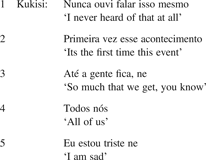
Kukisi emphasizes contingency and the unexpected nature of the attack in lines 1–3. He argues that the Yawalapiti are not responsible; they were not even aware of this possibility. He situates himself in the role of victim as he asserts that he too was chased and that he too is sad in line 5. As spokesman for the Yawalapiti he places any possible agency for this attack, animal or witch, outside of the Yawalapiti sphere.
I had elected along with several other men to spend the first night in the Yawalapiti men's house in the center of the village. Not all of the men slept through the entire night and I moved in and out of sleep as flutes were periodically played. Early in the morning of the second day of the huluki, Paho arrived after dawn while the village was still quiet. He sought out one of the elder Wauja men, Iyula, and sat down to speak to him. Although Paho appeared to be attempting hushed tones, he had to loudly repeat much of what he said due to Iyula's poor hearing. Paho said that he had smoked tobacco and seen the cause of the attack. He may or may not have slept, yet he had dreamt.
Paho named the proximate cause of the attack as the tapir's inalienable o-potalapitsi ‘its image.’ He had seen in his dreams the material manifestation of witchcraft in the form or image of a tapir. This was a charm, an object manufactured by a witch and left hidden on the ground in the bush in order to attract the spirit-monster. Paho remarked Kamayurá pitsana uputawo ‘perhaps a Kamayurá put/placed it.’ He cautioned Iyula amiya puma ipitsihã ‘don't tell them (the Yawalapiti).’ I remained unclear on the identity of the witch, and when I asked another shaman about this a little later he declined to give a name, but did say that it was now known who he was. Since the Yawalapiti have intermarried extensively with the Tupí-speaking Upper Xinguan Kamayurá, it was possible that the culprit was a resident of the Yawalapiti community. The identification of a Kamayurá as witch fits with a general Xinguan stereotype, or at least a Wauja one, that the Kamayurá are especially powerful in both positive and negative cosmological machinations. Their shamans are renowned for their healing ability (Paho himself trained for years in residence in the Kamayurá village), yet they are suspected for their elaboration of the moral converse of this, attack sorcery. Further, this ethnolinguistic identification allowed for some flexibility in aligning the source and goal of this attack along a Yawalapiti-to-Wauja course. It was possible that a Kamayurá-speaking Yawalapiti village resident had attacked the Wauja on purpose, or that a Kamayurá from outside had placed the charm in anticipation of a Yawalapiti victim and had missed his target. The latter explanation turns out to have been favored at the end of accounts, perhaps because in retrospect it was the most conducive to minimizing conflict between hosts and guests. It was explained to me in the following weeks that the charm had been made with the same type of resin used in the manufacture of kawoka flutes, and that this fact accounted for the triggering of the attack as soon as the flutes were brought out and played. It was chance that the players were Wauja.
At this point, however, on the second morning of the huluki, the shamanically ratified explanation for the attack that had been put forward was ambiguous and still open for interpretation. The information was new, and restrictions on its circulation were attempted. This counted as secret, perhaps as gossip. Looking backward we see the tapir's disruptive attack and explanations of it centering on inalienable notions of body parts (e.g. wounds, markings, genitalia, teeth, etc.), food taboos, dreams, and ethnolinguistic identity. Looking forward, the trade, song, and dance that filled the next two days' schedule had yet to be performed.
As the Wauja exchange relationship with the Yawalapiti turns on suspicions of sorcery, the identities of witch and victim are emblematized in their inalienable possessions, and these are in turn emblematic of the corporate subjectivities of the two ethnolinguistic groups. The relationship between the groups has come to pivot on inalienability and they negotiate this relationship through exchange. The second morning saw the Upper Xingu's most obvious ritual enactment of exchange in the form of a huluki trading session. As I turn to examine what happened next, I consider how Wauja and Yawalapiti actors were or were not able to identify as alike through the continued practice of exchange, and the negotiation over rights of foreign and Yawalapiti spectators to images and audio recordings of Wauja performance.
ALIENATING RITUAL
Most Upper Xinguan groups manufacture a uniquely identifying emblematic trade item, for example, Kalapalo river-snail shell necklaces, Kamayurá bows, and the like. Women have a central role in making the Wauja emblematic trade product—pottery—and in controlling its circulation in the village and in intervillage huluki. Terms for ceramic products in Wauja are not grammatically inalienable, but pottery may be considered a culturally inalienable ethnic emblem. Wauja women seem to have been highly desired by other Xinguan groups for their knowledge of ceramic production. Thus some Wauja claim that during the time of open conflict with the Txicão (Ikpeng), a non-Upper-Xinguan Carib-speaking group, raids on Wauja villages targeted the abduction of women. The idea here is that non-Upper-Xinguans sought to acquire access to the inalienable naaka-i ‘custom-unposs’ of pottery making by turning the possessors of that knowledge into Txicão inalienable possessions, into wives and eventually mothers of female kin.
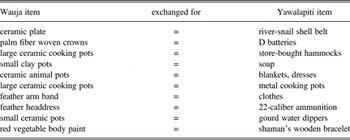
Early on the morning of the second day of huluki Kukisi called for Yawalapiti people to come to the center of the village to join the Wauja in a formal trading session. Three young female amuluneju, daughters of Wauja chiefs, sat in front of the Wauja group. They passed Wauja items to the Yawalapiti. On the Yawalapiti side, three men served as intermediaries. One of the men, Kapulu, was referred to as truly Yawalapiti, and the Wauja women said that he spoke Arawak and was able to communicate with the amuluneju. The other two younger Yawalapiti intermediaries did not speak any Arawak variety. The Wauja offered the goods they had brought as the Yawalapiti asked what they wanted in trade for particular items, periodically running to their houses to find goods to be given in payment. The first trend that becomes apparent is that the Wauja offered entirely handmade traditional products, especially ceramics, while the Yawalapiti offered almost exclusively store-bought manufactures in return. The Yawalapiti are widely reported to be one of the only Upper Xinguan groups without their own emblematic trade item; perhaps it is accurate to say now that the store-bought manufacture is the Yawalapiti emblem. Examples of exchanges I witnessed are listed in Table 2.
Wauja items exchanged for Yawalapiti items.

The first and the last trades, with a reciprocation of indigenous manufactures, were both commented upon by Wauja as particularly awojopai ‘good.’ The first exchange was marked with a resounding hoot as it was completed. Following the other trade of red body paint from Paho in exchange for a shaman's bracelet offered by Kukisi, Paho made sure to point out his new acquisition, inviting me to smell the aromatic wood and praising Kukisi for giving up such a kakaiyapai ‘valuable’ object. Yet the majority of transactions were for manufactured objects, and Wauja commented that these days emblematic exchange items tuma-kona-yajo-pai, 3s.make-pass-truly-impf, ‘are truly made’ by Wauja alone. Alawa describes this dissimilarity in terms of inalienability in (11).
(11) Alawa: Yawalapoho upuuta kajaopa o-naaka-tai
Yawalapiti 3s.give Whiteman 3s-custom-RESTR
‘The Yawalapiti give only the Whiteman's customs (inalienable)’
The inalienable term naaka-i, which I translated above as ‘custom/ritual-unposs,’ seems to be used in the sense that one would say that ceramics is a Wauja custom. The material artifacts are objectified indices of the process of production, from collecting clay at river bottoms, through to molding, firing, painting, and so on. In the Wauja genre of political “chief's speech,” depiction of the loss of technique and expertise in working clay serves as a eulogy of a more general loss of Wauja o-naaka ‘the Wauja's custom (inalienable)’ (Ball Reference Ball2007). So, as the Wauja present material manifestations of their inalienable tradition to the Yawalapiti, the Yawalapiti (merely) present material manifestations of the Whiteman's tradition. This does not mean the Wauja do not appreciate manufactured goods. Many Western manufactures have an aura of desirability to them, and Wauja traders request items such as coffee, sugar, batteries, fishhooks, and the like during huluki with the Yawalapiti. But it does show how the Yawalapiti and other Upper Xinguans have, from the Wauja perspective, lost something constitutive of their identity. This is further highlighted when the exchanged items on each side are seen as emblematic of complementary differences between transacting groups, as indices of Wauja tradition versus Yawalapiti cosmopolitanism. In terms of reproducing intergroup solidarity the huluki session appeared to be successful. Some of the same people that described all but the two exchanges discussed above as mundane or unfortunate insisted that both sides came out of the session kotepemonapai ‘happy.’
On the second day of the huluki, the Wauja prepared to dance for the spirit-monster named kagapa. Just as the Wauja men had played the Yawalapiti's kaowka flutes, they now danced exclusively with Yawalapiti women. This is a metaphorical circulation of sisters and daughters, though some of the young Wauja men saw it as a potential opportunity to court young women. Teenage Wauja boys coyly joked with me that it would be nice to win new young Yawalapiti wives, entertaining the hope at least of alienating Yawalapiti possession in their kin. But another group of women was also present that day, and they received a different kind of attention from some of the Wauja men. Three French women in their twenties had traveled by boat to the village during the night, accompanied by Kukisi's brother. On this morning they hung around the perimeter of the trading, snapping pictures. The Wauja, and presumably the Yawalapiti too, had noticed this, but did not remark upon it right away. By the time that the Wauja men were set to begin a dance, some of them had discussed the situation and approached me with a problem. They told me that these guests were clearly going to take pictures, potalapits-í ‘image-unposs (inalienable),’ of the Wauja men's performance and that this could not be allowed without permission.
The women informed me that they were traveling on a small grant from the French government to photograph and record video in various indigenous communities in Brazil. The results were to be displayed in a nonprofit exhibition in France, the purpose of which was to educate the French people about culture and social problems in indigenous Brazil. I relayed this to the Wauja men, who now insisted on payment, suggesting a sum equivalent to one thousand US dollars. These young travelers did not have the desire, nor probably the means, to pay this and decided to forgo taking pictures. I should point out that the women were reluctant to agree to this, remarking that these Indians, in comparison to other groups they had visited, were sophisticated in “controlling the commercialization of their culture.” The Wauja, for their part, seemed slightly disappointed that their tactic of eliciting a gift had failed, but stood fast that even if the women were poor students, no pictures could be allowed.
This decision is interestingly situated within the overall exchange relationship between the Yawalapiti and Wauja. One Wauja man explained that the Yawalapiti chiefs, including Kukisi's brother who convinced the women to travel with him from the city, used the temporary presence of Wauja dancers in ritual as a selling point for their visit. The Yawalapiti, he said, told these tourists that they should come to the village to see the traditional huluki ritual. Of course the women paid the Yawalapiti to come (with at least three hundred liters of gasoline according to what one of the women told me), yet the Wauja perceived that, as usual, they were cut out of the loop. The message was clear: The Yawalapiti are not authorized by the Wauja to sell the inalienable Wauja image. What appears to be at stake here is at least a reckoning of alienability of image in terms of the rights of indigenous actors to speak on behalf of others, a local politics of who can alienate what from whom.
The Yawalapiti have a history since contact with Whites in the privileged role of mediators. Wauja people thus enter into exchange with the Yawalapiti in a double sense. The Yawalapiti may trade with the Wauja, but as mediators with Whites the Yawalapiti may also trade signs of the Wauja themselves: Wauja images, Wauja songs, Wauja names, and so on. Yawalapiti political attempts to create exchange relations with the wider world, where one of their most marketable assets is Upper Xinguan indigenous identity, are often seen by other Upper Xinguan groups as Yawalapiti trade in the inalienables of their closest others. This is apparent in a recent polemic surrounding Kukisi in which he signed a contract with an energy company granting permission for the construction of a hydroelectric dam in Xingu headwaters. In this document Kukisi signed not only as chief of the Yawalapiti, but he also signed on behalf of several other Xinguan groups, including the Wauja, and was widely perceived to have done so illegitimately and for great personal profit.Footnote 12
Many Wauja feel particularly vulnerable on the turf of their exchange partners, the Yawalapiti. They are vulnerable to attack by witches and to exploitation by chiefs who deal with Whites. Both threaten to alienate inalienables: Wauja souls and Wauja images. Further, the possibility of foreign tourist snapshots of kagapa dancing moving unchecked beyond ritual circuits of performance without compensation threatens the efficacy of the ritual itself, where a series of payments from kagapa victims to performers and to the kagapa spirits mediates relations between human and cosmological realms.
Later in the afternoon, as the kagapa dancing continued, I sat on the log bench in front of the men's house watching and listening. The sun had come out and the Wauja had erected a tree in the center of the dancing space. This provided shade to the singer and drummer who stayed in one spot for the duration of their performance, before being replaced by others who would continue in the song cycle. Iyula, an elder Wauja man, came and sat next to me. He pointed to the center of the activity and said that the Yawalapiti were stealing the Wauja's songs. He was referring to a teen-aged Yawalapiti boy who stood next to the singer casually holding a Walkman-sized cassette tape recorder. Iyula's rendering of the situation to me is presented in (12).
(12)

Here we clearly see song and dance figured as Wauja inalienable property. In Iyula's statement in lines 1 and 3, the inalienable noun for song or music, apa-i ‘music-unpossessed,’ is inflected with the 3rd person proclitic o-, which is coreferential with the possessor NP, Wauja. He uses the verbal form of the inalienable noun tuluka-i ‘dance- unpossessed’ in the construction tuluka-wé, 3s.dance- fut, ‘He will dance’ in line 3. Iyula portrays the recording in line 2, using a-kurafa-ta-pai, 3.vblz-record-caus-impf, from the Portuguese gravar ‘to record’ as an act of alienation. He depicts this with the verb iya, which when intransitive means ‘to go,’ and when used transitively means ‘to take’ in lines 1 and 3.
One of the Wauja present at the huluki, Paho's son Kapi, had been video recording the proceedings as part of a project of audiovisual documentation of Wauja ritual. When I asked Kapi for his opinion of the Yawalapiti's audio recording, he dismissed its importance, saying that the youth would most likely re-record over the tape or lose the tape before long. When I asked if there is danger of the Yawalapiti taking or stealing songs in such a way, he replied that a mere tape recording cannot serve as a legitimate base of study. In order to effectively or correctly learn the songs, one must apprentice with a singer specialist. This is paid for with expensive gifts. Each song has a story, its origins, and without knowledge of origins and of the ritual procedures of performance in a series, merely reproducing the song is meaningless, valueless. Kapi added in Portuguese, não temos como controlar toda gravacão de som e imagem das nossas danças ‘We have no way to control all of the sound and image recordings of our dances.’ This may in part have been a comment on the alienation of images raised in the encounter with the French women. When inalienable possessions are taken far away, spatially removed from circulation, the risks of alienation are palpable. In the case of the Yawalapiti recordings, however, Kapi deemphasizes the likelihood of circulation by saying that the tape will not materially survive, and recognizes that an exercise of control by the Wauja here would equal an imposition on their hosts. Asking the French women to pay up or put away their cameras, while perhaps a tactically sophisticated jibe at the Yawalapiti leadership, is not directed at them, whereas a Wauja request for Yawalapiti youth to stop recording might be offensive to the hosts, especially given the still charged atmosphere following the tapir attack.
RITUAL REPAIR THROUGH BAPTISM AND CURING
The final day of the huluki culminated in a final act, one that I analyze here in terms of repair and a characterization of appropriate and unique relations between the Wauja and the Yawalapiti as groups. This act was a ritual baptism, the bestowal of new names on the Yawalapiti chief Kukisi and his younger brother. Upper Xinguans inherit names from same-sex grandparents at several points in the life cycle. It is not uncommon for young adults to have a store of several names, and elder men and women accumulate more. Both men stated that they both now had many grandchildren and so must liberate their names for them. This amounts to making inalienable names alienable.
At sunset on the final evening of the visit, one of the three Wauja visionary shamans present at the huluki took Kukisi by the hand and led him to the village's central space in front of the men's house where Ajapu stood waiting. Ajapu asked Kukisi what his new name would be. Kukisi replied “Ulako.” Wauja say they do not choose the new name for the person to be named, they merely give it. Ajapu asked what name was being lost, to which the answer was “Kukisi.” Ajapu repeated the new name to himself and then called out loudly:
(13)

Ajapu stops to double check on the pronunciation of the new name, repeating it quietly to himself, and continues. At this point he begins to move his arms up and down as he stands holding an inalienable hardwood bow horizontally behind Kukisi. He shouts the new name Ulako loudly, followed by a nonreferential sung vocalization in lines 1 and 2 of (14) below in the continuation of the baptism.
(14)

The single speech act in (13) and (14) can be characterized as an act of performative nomination (Lyons Reference Lyons1977:217). As Austin exemplifies such acts: “When I say I name this ship the Queen Elizabeth I do not describe the christening ceremony, I actually perform the ceremony” (Austin Reference Austin1961). This performative nomination, or baptism, is a counterpart to an immediately previous and logically prior speech event that we may term a performative de-nomination. Ajapu's naming of Kukisi-cum-Ulako seems to focus on dispelling the old name and its associated deeds. Kukisi himself offers that he was in cahoots with Brazilians and that he facilitated an unpopular and potentially destructive dam project. This admission is given as a basis for this name's undesirable associations, its descriptive backing (Searle Reference Searle1969:171). The name is intimately associated with the negative deeds attributed to the person who owns it, and shedding the name is a means of shedding the persona.
Ajapu's references to the patient in this baptism divide into three parts. First he utters “Kukisi” four times in (13), lines 3, 4 and 9. Next he follows with “Ulako” twice in lines 1 and 2 of (14). He closes by sending away the prior name with two more references to “Kukisi” in lines 5 and 6 of (14). The first instance is an appellative utterance serving to pick out the referent and to direct the audience's focus to that person. Note that Ajapu refers to Kukisi here as his older brother in (13), lines 1 and 2, invoking an inalienable relation of kinship between them, a move that suggests a parallel relation between the Wauja and the Yawalapiti as groups. The second instance, where the new name is bestowed, is explicitly creative of a novel union of linguistic item and referent. The authority to perform this properly performative function is key here; it is licensed in part by Ajapu's nobility (he is from a chiefly line and so can name chiefs), and partly in his identity as Wauja (he can name Arawak speakers). The third instance, where “Kukisi” is dismissed as a name, is immediately preceded in the discourse by the second occurrence of the inalienable lexical root kupona- ‘name’ in (14), line 3. This noun also appears in its unmarked possessed form in (13), line 1. More interesting though is its use in the marked unpossessed form kuponan-i ‘name-unposs’ as subject of the clause “The name (inalienable) is leaving for good” in line 3 of (14). The speaker does not say o-kupona ‘his name’ in this case. Why is this significant?
Mithun (Reference Mithun, Chappell and McGregor1996) reports that in Mohawk the distinction between inalienable and alienable possession is in part marked by agent pronominal prefixes in inalienable possessive constructions such as “his (agent) head” versus patient pronominal prefixes for alienable possession as in “my (patient) onion.” She suggests that this difference can be used figuratively such that “in a legend about a headless horseman, the noun referring to the horseman's head contained a patient possessor after decapitation” (Mithun Reference Mithun, Chappell and McGregor1996:640). Wauja has no formal way of alternatively marking a noun such as “head” in a possessive construction as alienable or inalienable depending upon its perceived connectedness or disconnectedness from its body. However, reference to a typical inalienable possession such as a name with a pragmatically marked unpossessed construction does similar work to the Mohawk patient possessor prefix. In this stage of the baptism ceremony, the unpossessed form of the inalienable noun “name” signals its dissociation from its possessor. It has been severed from its owner so that it may be dispatched. When Ajapu says, “the name (unposs) goes away” the referent is de-christened.
The three Upper Xinguan Arawak groups—the Yawalapiti, Mehinaku, and Wauja—share the right to name one another. Wauja insist that Arawak speakers can only be named by other Arawak speakers. The Yawalapiti and the Wauja, in addition to the Mehinaku, use names from a common store, and the name-giver announces the name in an elaborate style described as o-wojikuwapa õta-i ‘with a bow-unposs (inalienable) in his hands (inalienable).’ These features are noted as distinctive of Arawak naming practices in the Xingu.
I want to suggest that in this instance there is a resolution to the witchcraft crisis in the naming ceremony. The exclusive potential participation of Arawak groups in this ritual reminds the participants of their common bonds. Names exist as a stock of Arawak property that these groups may share. Further, names are inalienable possessions that are passed between generations as indexical heirlooms. We see a definition of the Yawalapiti and Wauja ethnolinguistic units as alike on the principle that co-possessing persons are treated as a single social individual (Kockelman Reference Kockelman2007:352). Both identity formation and the solidification of alliance between exchange partners in this ritual moment turn on the category of inalienability and its indexically creative potential. Ritual moves are here coordinated to transform a situation of conflict to one of alliance between groups.
The three day huluki saw various attempts to alienate different possessions. Despite this fact, or rather because of it, these signs successfully stand for the integrity of groups on a model of the integrity of persons. Yet after the huluki was over and participants had returned home, one person's subjective integrity was still in serious danger due to the alienation of an inalienable possession. Wapi, the victim of the tapir attack, remained separated from his soul.
Wapi was transported on the night of his injury to the Xingu Indigenous Park's Leonardo Villas-Bôas Post for medical treatment. The Brazilian doctor stitched up his large abdominal wound and gave him antibiotics. Wapi was well enough to travel home three days later with the remaining huluki participants in a cart pulled through the forest by the Wauja's 1980s-era Ford tractor.Footnote 13 After a few days of rest back in his hammock, Wapi was not getting better. One of my housemates said that Wapi had been having dreams about the tractor and the road that links the Wauja village to the park's post and the Yawalapiti village, the road we had taken together in that lurching tractor. Wapi's i-sẽẽpũ ‘his dreams (inalienable)’ a shaman explained, showed the perspective of u-paapitsi ‘his soul (inalienable).’ He was seeing in sleep the point of view of his wandering and detached soul, that part of himself that had been separated through his contact with, and separation from, the tapir spirit-monster. The tapir, as spirit-monsters inevitably do when they come into contact with humans, had peeled away something of his life, and it was still out there, roaming the road out of the Wauja community. If it was not returned, Wapi would die.
Special cases presenting particular curative challenges call for a group effort. Wauja practice pukai in such instances, a collective shamanic ritual involving as many of the community's ritual specialists as can attend, upwards of ten individuals. Pukai is highly secretive. Villagers are not supposed to see pukai, and when a session is scheduled, children are rounded up and brought inside their longhouses as mothers urge them to shut the doors. Some of the more curious youth peer through the thatch to glimpse the procession of shamans cross the village patio toward the house of their patient, but most experience this event through listening to its distinctive song. The goal of pukai is to recapture the patient's soul, to locate and retrieve the soul from the vicinity of its original separation (Barcelos Neto Reference Barcelos Neto2004). This requires the group of practitioners to consult the patient at his bedside, after which they strike out single-file to find the soul. The usual pukai can take the shamans a good distance out of the village, at least out of earshot, lasting for an hour or more. All the while, people remain locked in their houses, following the cues to the comings and goings of the group provided by their singing.
Pukai was performed for Wapi a few days after the Yawalapiti huluki. The shamans smoked tobacco and saw a tapir. The leading visionary shaman Paho saw that Wapi's soul was indeed outside of the village, in the direction of the post and the Yawalapiti. I was told later that in the forest near the road, the group of shamans encountered the soul. As Paho held his lit tobacco cigar, a small, spotted blue butterfly appeared. The butterfly is the spirit master of tobacco. One of the participants in the pukai explains below in (15).
(15)

The butterfly perched on Paho's hand and rested there. The man who was telling me the story showed how Paho circled his other arm around and over the butterfly, cupping his hand as he brought it in close to his chest in a slow sweeping motion. This butterfly, like the tapir before him, was a spirit-monster in animal o-nai ‘its clothing (inalienable).’ The shaman's cigar smoke called this master of tobacco and it did not fly away until after Paho had collected the soul and guarded it. The shamans subsequently returned to the village and walked to Wapi's house. Paho brought Wapi's inalienable o-paapitsi ‘his soul’ back to its owner. The circuit of another inalienable possession was closed, and, with the proper relationship of possession restored, Wapi fully recovered.
CONCLUSION
I have used this ethnographic example to examine how inalienable possessions contribute to individual and group subjectivity. I have shown specifically that dispute over inalienable possessions can produce conflict and that negotiations over who possesses what can help to repair relationships. Wauja and Yawalapiti corporate groups are in a relation of “potential affinity” (Viveiros de Castro Reference Viveiros de Castro, Rival and Whitehead2001), where concentrated attention on the uncertainty of the tie that unites them is matched by mutual working to exchange with one another in order to bring outside energies in. Gell remarks on the ameliorative function of commodity exchange in potentially dangerous relationships carried out at the “fringes” of social groups.
In exchange, objects are focalized, quantified, valued, and so on; and there is recognition of debt, credit and reciprocity. It is the transaction of these objects, now commodities, which sustains the partnership, and, because the partnership relation is valued as an end in itself, the objects involved carry a symbolic charge stemming from this source; they are over valued because their presence evokes a valued relationship and a privileged kind of social interaction. Where there could be enmity and danger, lo! – there is this shell, the axe… (Gell Reference Gell1999)
This echoes Sahlins's (Reference Sahlins and Banton1965, see also Polanyi Reference Polanyi and Dalton1968) discussion of the ways in which different forms of reciprocity correlate with social distance. Sahlins analyzes a cline of altruism in exchange from generalized to balanced to negative reciprocity that correlates with a cline from close kin to relatively distant outsiders. While no one transactional ideology defines Wauja and Yawalapiti exchange and its concomitant negotiation of rights to inalienable possessions in huluki, balanced reciprocity seems to be a goal. But the threat of negative reciprocity, what Sahlins calls the unsociable extreme and which takes the form of sorcery here, remains a palpable presence.
With this in mind, possessions that are emblematic of Upper Xinguan persons and groups, including trade manufactures and also names, souls, songs, images, and so on should be seen not only as identity indices of each possessing collective; they also fundamentally index difference and opposition between transacting groups. This is not merely the flip side of the indexical identity function of these signs, for the mobilization of these items in transaction, the potential alienation of inalienables, indexes a potential relation of enmity that, lo! – is repaired and again made possible in exchange. We see that inalienables serve as points around which political action may revolve.
Relations with ontologically other beings such as spirit-monsters are likewise characterized by ritual exchange practices that involve inalienable possessions. These typically focus on reestablishing proper ownership of souls in order to cure bodies. In fact relations between humans and between humans and spirits are bound up together and are mediated by the same inalienable possessions. In the Wauja case, any person who has been made ill by contact with a particular spirit-monster becomes an owner of that spirit. With ownership comes the obligation to sponsor ritual, to pay individuals who helped in curing the illness through acting the role of the spirit to next become performers—singers and dancers—of the spirit's songs (Barcelos Neto Reference Barcelos Neto and Granero2009, Ball Reference Ball2011). My discussion of inalienability in an Upper Xinguan ritual that bridges human and other cosmological domains contributes to knowledge of the central role of ownership and possession in Amazonian societies (Fausto Reference Fausto2008; see also Seeger Reference Seeger1981). It also shows how renewed interest in the subjectification of material objects in Amazonia can benefit from attention to the grammar of possession in Amazonian languages (Santos-Granero Reference Santos-Granero2009).
Inalienable possessions are associated with individuals through perceived intimacy or proximity, yet they are often still separable from possessors. In the Upper Xinguan multilingual system in which the Wauja participate, individual languages, songs, traditions and other ethnic emblems play a central role in group identitification and intergroup differentiation.Footnote 14 As objects or signs of them circulate, identities of multiple possessors may become attached to them. Multiple possessors have a similar relation to one inalienable object such that shared possession indexically links subjects. Also, when inalienable possessions are transferred, something of the identity of the possessor is transferred along with them. This is the mana that attaches to the gift (Mauss 1925/1990). If inalienable possessions are intimately identified with their possessors, then when people exchange inalienables, they identify as alike. Inalienability as a category emphasizes identification of possessor and possessed, yet it also emphasizes transferability between possessors. In fact, circulation is not merely possible, it is motivated in a way, as positive intersubjective associations such as “fame” may grow through exchange (Munn Reference Munn1986). We should recognize the extent to which identity can be dependent upon possession—being upon having (Tarde Reference Tarde1999 in Latour Reference Latour and Joyce2001). One lesson of this study is that attention to language and possession, in addition to language and identity, is important for cross-culturally comparative sociolinguistic analysis.
Inalienable reference in Wauja language and emblematic inalienable possession in Wauja culture are both highly presupposed in Wauja discourse. In turn, inalienables and the exchange relations that they mediate become a focus of Wauja practice.Footnote 15 My ethnography of the construction of ethnolinguistic identity through discourse and the interactional negotiation of exchange relations shows how language and society contribute in a mutually reinforcing way to defining, contesting, and producing relations between persons and groups. This supports continued investigation of the place of grammatical categories in social life with an emphasis on the subtle ways in which interaction and grammar are mutually interpenetrating.
APPENDIX: WAUJA INALIENABLE NOUNS