Introduction
Suicide in later life needs to be considered as an important health concern, given the high rates of late-life suicide in industrialized countries. Suicide rates in Flanders, Belgium are comparable to other countries and are at least as high as in other age groups. Between 2005 and 2009, mean yearly suicide rates of 23.65 (age group: 60–74 years) and 28.16 (age group: 75+ years) per 10,000 people have been reported (http://www.zorg-en-gezondheid.be/Cijfers/Sterftecijfers/Cijfers-oorzaken-van-sterfte/Zelfdoding-per-leeftijd).
Death ideation, death wish, suicide ideation, and suicide attempts are risk factors for completed suicide in later life (Rowe et al., Reference Rowe, Bruce and Conwell2006), but it remains difficult to determine how the different components of the suicidal spectrum are related to each other (Pompili et al., Reference Pompili2014). Additionally, the presence of a death wish is different in an older person in comparison to an adult person: the awareness of the inevitability of death and the realization of moving inexorably closer to death become more prominent through the process of ageing (Maxfield et al., Reference Maxfield2007). Thoughts of death and death wishes are not uncommon in older persons and there is growing evidence that thoughts of death in some cases might be part of a non-pathological ageing process, whereas in other cases, these might reflect the presence of underlying psychopathology (Szanto et al., Reference Szanto2013). To date, several risk factors of a death wish in older persons have been identified: female gender (Raue et al., 2010; Rurup et al., Reference Rurup, Deeg, Poppelaars, Kerkhof and Onwuteaka-Philipsen2011), the presence of a mental disorder (mostly depression – (Rurup et al., Reference Rurup, Deeg, Poppelaars, Kerkhof and Onwuteaka-Philipsen2011)), a somatic disorder (Yip et al., Reference Yip2003, Kim et al., Reference Kim, Bogner, Brown and Gallo2006, Lapierre et al., Reference Lapierre2012), the report of pain (Lapierre et al., Reference Lapierre2012), or a small social network (Rurup et al., Reference Rurup, Deeg, Poppelaars, Kerkhof and Onwuteaka-Philipsen2011). Research examining the role of living arrangements and civil status revealed mixed results (Lapierre et al., Reference Lapierre2012). However, the presence of these risk factors is insufficient to fully understand why some older people, exposed to these risk factors, develop a wish to die and why others do not. Including skills and coping styles specifically relevant to the process of ageing might be required as the particular challenge for older adults is the large number of changes and transitions that start to occur by ageing: in later life, life stress and challenges rapidly accumulate (Ryff et al., Reference Ryff, Singer, Love, Essex and Lomranz1998). From a theoretical perspective on successful ageing, the importance of meaning in life has been identified as a significant predictor of well-being in later life (e.g. Baltes and Carstensen, Reference Baltes and Carstensen1996). The following definition of meaning in life is often referred to: “the cognizance of order, coherence, and purpose in one's existence, the pursuit and attainment of worthwhile goals, and an accompanying sense of fulfillment” (Reker and Wong, Reference Reker, Wong, Birren and Begston1988). Indeed, the experience of meaning in life has been identified as a significant predictor of well-being in later life in empirical studies. Higher levels of meaning in life were associated with both psychological well-being (Kaji et al., Reference Kaji2010) and life satisfaction (Steger et al., Reference Steger, Oishi and Kashdan2009, Ju et al., Reference Ju, Shin, Kim, Hyun and Park2013). In contrast, loss of meaning in life was associated with late-life depression (Kaji et al., Reference Kaji2010), with symptoms of distress (at least, in older patients with cancer (Vehling et al., 2011)), with increased fatigue and with overall symptom experience (in patients with cancer and cancer survivors (Thompson, 2007)). Purpose in life, as a subcomponent of global meaning in life, was correlated with fewer functional limitations and higher levels of perceived health (Krause, Reference Krause2009).
Theories on successful ageing and research on the associations between well-being and meaning in later life both justify that meaning in life and broader life attitudes contribute to the presence of a death wish in later life. Since previous findings indicate that gender is associated with a wish to die (Raue et al., 2010) as well as with different dimensions of life attitudes (Pinquart, Reference Pinquart2002), it is relevant to explore whether gender interacts with different dimensions of life attitudes on the presence of the wish to die in older adults. Therefore, the first aim of the current study was to explore whether meaning in life as well as other life attitudes are associated with a wish to die in older adults, independently from the presence of sociodemographic and clinical factors. Second, we explored a gender effect in the association between life attitudes and the wish to die.
Material and methods
Subjects
Since both somatic disorders and psychiatric symptoms were found to be robust risk factors for suicidality in later life, all patients admitted in the medical wards of Internal Medicine (May 2011–January 2012), of Old age Psychiatry of the University Hospital Leuven (UPC KU Leuven) and of Psychiatrische Kliniek Broeders Alexianen Tienen, and of M.C. St. – Jozef Munsterbilzen, Old Age Psychiatry, AZ Vesalius Tongeren (May 2011–May 2013) were consecutively recruited to participate in this cross-sectional study. 164 patients were invited to participate in the study, 51 individuals refused to take part. Cognitively impaired (a score of 24 or below on Mini-Mental State Examination (MMSE)) and psychotic inpatients were excluded from participating in the study. A total of 113 patients (72 psychiatric inpatients, 41 somatic inpatients) provided their informed consent, which was approved by the University Hospital's review board, and completed all study questionnaires.
Measures
Dependent variable
The wish to die was assessed with the BSS (Beck Scale for Suicide Ideation – Beck et al., Reference Beck1988). The BSS is a 21-items measure of which only the first 19 are scored. The final two items are used to record previous suicide attempts. All items consist of three response options, ranging from 0 to 2. The time frame is the week preceding the interview. The first five items serve as an initial screening of suicide ideation. The focus of the present study was limited to the answer of the screening item: “I have no wish to die” (score 0), “I have a weak to moderate wish to die” (score 1), and “I have a strong wish to die” (score 2). This item was converted to a binary score, where “I have no wish to die” equaled 0 and where “I have a weak to moderate, or a strong wish to die” equaled 1.
Independent variables
Mental disorders
Mental disorders were assessed by means of the SCID, the Structured Clinical Interview for the Diagnostic and Statistical Manual of Mental Disorders, 4th Edition (DSM-IV; SCID v2.0; First, Spitzer, Gibbon & Williams); a semi-structured clinical interview designed to assess Axis I disorders based on DSM-IV criteria. Major depressive episode (12 months) and anxiety disorder (12 months) (including social phobia, generalized anxiety disorder, panic disorder, agoraphobia, and specific phobia) were assessed.
Life attitudes
The Life Attitude Profile-Revised (LAP-R) is a multidimensional measure of global meaning, i.e. the degree of existential meaning and purpose in life and the strength of motivation to find meaning and purpose (Reker, 1992). It consists of 48 items, all scored on a 7-point Likert scale ranging from “strongly disagree” to “strongly agree.” The LAP-R is scored and profiled on six dimensions: Purpose (e.g. “In thinking of my life, I see a reason for my being here” or “My past achievements have given my life purpose and meaning”), Coherence (e.g. “I have the sense that parts of my life fit together into a unified pattern”), Goal Seeking (e.g. “I am eager to get more out of life than I have so far”), Existential Vacuum (e.g. “I find myself withdrawing from life with an ‘I don't care’ attitude”), Life Control (e.g. “When it comes to important life matters, I make my own decisions”), Death Acceptance (e.g. “Even though death awaits me, I am not concerned about it”). For the purpose of this research, the Death Acceptance dimension, referring to the acceptance of death as a natural aspect of life was not administered. The LAP-R has good psychometric qualities in terms of factor structure and reliability and shows good concurrent and discriminant validity (Reker, 1992).
Covariates
The included sociodemographic factors are: age, gender, and civil status (married, widowed, divorced, or single).
Somatic symptoms were assessed by the SCL-90 (Symptom Checklist) (Derogatis et al., Reference Derogatis, Lipman and Covi1973) – Somatization subscale. Psychometric evaluations have reported good internal consistency (α coefficients = 0.77 to 0.90), good test–retest reliability, and good concurrent, construct, and discriminant validity (Derogatis, Reference Derogatis1983).
Other variables
Mini-Mental State Examination (MMSE)
Cognitive functioning was assessed by means of the MMSE (Folstein et al., Reference Folstein, Folstein and McHugh1975). A score of 24 or below was used to exclude cognitively impaired subjects from participating in the study (Lezak et al., Reference Lezak, Howieson and Loring2004).
Statistical analyses
The Pearson correlation test was used to determine the strength of the relationships between the independent variables. Due to the high association between the subscales of the LAP-R, separate logistic regression analyses for each subscale of the LAP-R were performed to assess the association of the presence of a wish to die with gender and the different LAP-R domains and the interactions between those.
A logistic regression analysis was completed to identify the contribution of the interaction between life attitudes and gender to the wish to die, independently from sociodemographic variables and from the presence of a depressive disorder or somatic symptoms. The “explained variance” of the logistic regression models was calculated by means of Nagelkerke's R 2 and the goodness of fit by means of the Hosmer and Lemeshow goodness-of-fit test (Hosmer and Lemeshow, Reference Hosmer and Lemeshow2000).
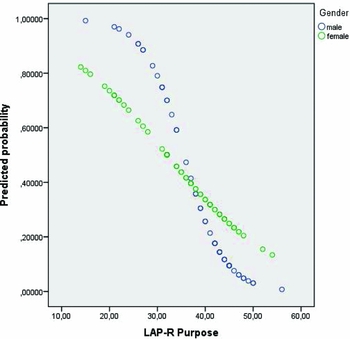
Predicted probabilities of a wish to die in low and high purpose in life and gender (using parameters from the fully interacted model) were estimated.
Analyses were performed with SPSS version 21.0. Two-tailed p values were reported. Because the study was of an explanatory nature, the level of significance was set to α = 0.05.
Results
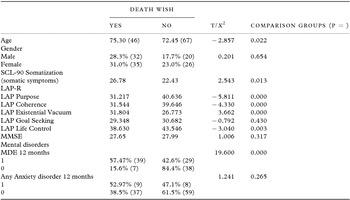
As shown in Table 1, 52 male and 61 female persons were included in the study. The mean age of the sample was 73.61 years (range: 62–89 years). The mean age in the persons with a wish to die was 3 years higher than that of the persons without a wish to die. The overall mean score on MMSE was 27.85, without differences in mean scores between both groups. Half of the included persons (49.6%) were married.
Descriptives for the group with a death wish and the group without death wish (Equal variances not assumed)

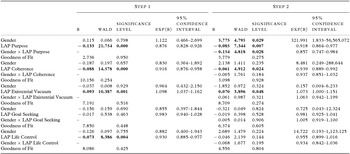
Table 2 provides a summary of the logistic regression models. Gender and life attitudes were entered in Step 1 and the interaction between these independent variables was added in Step 2. We found a main effect of the subscales Purpose (p = 0.000), Coherence (p = 0.000), Existential Vacuum (p = 0.001), and Life Control (p = 0.004). Higher scores on Purpose, Coherence, and Life Control are associated with a lower risk of the presence of the wish to die, while a higher score on Existential Vacuum was associated with a higher risk.
Multivariate logistic regression models with death wish as dependent variable and life attitudes, gender, and life attitude × gender as independent variables. Step 1 is a logistic regression with gender and life attitudes as independent variables. In Step 2, the interaction term of life attitude × gender is included as well (LAP = Life Attitude Profile)

Note: The significance level of the bold face values is p < 0.05.
After adding the interaction variable Life Attitude*Gender, the main effects of Purpose (p = 0.007), Coherence (p = 0.024), and Existential Vacuum (p = 0.048) remained significant; only the interaction variable Purpose*Gender explained significant variance (p = 0.028), independently from Gender and Purpose. The interaction of Gender by other Life Attitudes was not significant.
In the regression model including Gender, Purpose, and the interaction term Purpose*Gender, main effects of Purpose or Gender were present. Lower Purpose is associated with a higher probability of the wish to die and males are less likely to have a wish to die. The interaction effect of Purpose*Gender is reflected in a significant effect of Purpose on the wish to die in women (with every unit increase in Purpose, the log(odds) of wish to die decreases with 0.085 units) and in men (with every unit increase in Purpose, the log(odds) of wish to die decreases with 0.239 units).
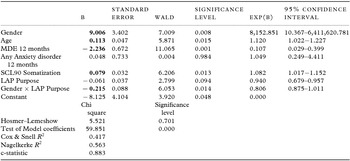
In Table 3, we show results of the logistic regression models with Gender, MDE (major depressive episode), Anxiety, somatic complaints on the one hand and Life Attitude and Life Attitude*Gender on the other hand. Overall, this model had a Hosmer and Lemeshow goodness-of-fit χ 2 value of 5.521 (p = 0.701). The model explained 56% of the pseudo variance (Nagelkerke R 2) in the wish to die as dependent variable. While Gender, MDE, and the interaction Gender*Purpose were the most important predictors of the wish to die, the presence of somatic symptoms was significant as well.
Logistic regression with death wish as dependent variable and sociodemographic, clinical variables, and LAP purpose as independent variables (MDE = Major Depressive Episode; LAP = Life Attitude Profile)

Note: The significance level of the bold face values is p < 0.05.
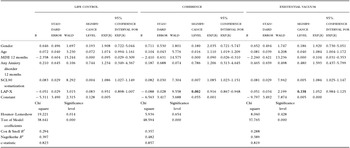
In Table 4, the fully adjusted models for Existential Vacuum, Life Control, and Coherence are presented. The interaction term with Gender was not included since this term did not have an additional significant contribution in the association with a wish to die, besides gender and the life attitudes, Existential Vacuum, Life Control, and Coherence. The Hosmer–Lemeshow goodness-of-fit test indicated that the multivariate model including clinical factors and Life Control was not valid. Existential Vacuum had no added value on top of sociodemographic and clinical factors in the association with the presence of a wish to die. The independent variable Coherence on the other hand had an additional significant contribution to the association with a wish to die (p = 0.002).
Logistic regression with death wish as dependent variable and sociodemographic, clinical variables, and LAP-subdimensions as independent variables (MDE = Major Depressive Episode; LAP-X = Different dimensions of the Life Attitude Profile)

Note: The significance level of the bold face values is p < 0.05.
Figure 1 shows the predicted probability of the wish to die as a function of Gender and Purpose of life. The plot lines show that when Purpose in Life increases, the predicted probability of the wish to die decreases. The slope of the line is significantly steeper in men compared to women, illustrating the interaction effect of purpose and gender on the wish to die: for men with a low score on LAP-R Purpose, the probability of the occurrence of a wish to die is highest.
Predicted probabilities of wish to die of interactions between gender and purpose in life.

Discussion
A first finding of the study was that life attitudes were associated with the wish to die in older adults: lower scores on Purpose, Coherence, and Life Control were related to an increased probability on the presence of a wish to die. Second, the Purpose in Life*Gender interaction explained additional variance in the occurrence of the wish to die in older adults, independent from sociodemographic (such as age and gender) and clinical factors (such as depression and the presence of a somatic symptoms).
The current study found that concerns related to the meaning in life contributed significantly to the presence of the wish to die, independently from known risk factors (such as depression or physical symptoms). This suggests that the aforementioned life attitudes play a significant role in the development of a wish to die in later life. Previous research has described the meaning-making process as a coping strategy to stressful life events (Park and Folkman, Reference Park and Folkman1997). Growing older is often a stage in life where stress accumulates. When confronted with stressful events and when becoming aware of the finiteness of life, existential concerns have a particular importance in the experience of psychological well-being and in the development of the wish to die in older adults. Similar results were found by Heisel and colleagues (Heisel and Flett, Reference Heisel and Flett2008), indicating that meaning in life, though assessed with a single item (“I feel that my life is meaningful”), was predictive for the scores on a multidimensional measure of suicide ideation. This explains the significant added variance when controlling for depression and for perceived health.
Two subcomponents of the experience of global meaning, such as Purpose in life or Coherence, were found to be associated factors of the wish to die. The observed association between a lower level of purpose in life and the wish to die are in line with previous findings. Meaninglessness (feeling like life has no meaning or purpose) evolved as a main theme in suicidal older adults (Moore, Reference Moore1997), and an association between meaninglessness and suicidality was found in adults as well (Edwards and Holden, Reference Edwards and Holden2001). Since meaninglessness is also associated with depression, the question may be asked to what extent purpose in life is merely an indicator for depression rather than a distinct construct. In this sense, it is relevant that in our study Purpose in Life explains additional variance in the prediction of the wish to die. A study with very old persons revealed an inverse association between the degree of purpose in life and depression but also determined that a high purpose in life did not serve as protection against the risk of developing depression (Hedberg et al., Reference Hedberg, Gustafson, Alex and Brulin2010). Thus, depression and purpose in life seem associated, although the latter seems to be a distinct construct (Boyle et al., Reference Boyle, Barnes, Buchman and Bennett2009), explaining additional variance in the occurrence of a wish to die. It would be interesting to explore in the future research whether the association between purposelessness and the presence of a wish to die is found both in older people with and without depression, which was not possible in the present study due to the limited sample size. The inverse association between the presence of a wish to die and a sense of Coherence after adjusting for depression such as found in our study with older adults has been reported in several studies on adult populations (e.g. Sjostrom et al., Reference Sjostrom, Hetta and Waern2012). However, this association did not remain significant after a 3-year follow-up. Since ageing increases the likelihood of being confronted with an experience of loss, older persons may feel as if previous assumptions related to life, such as meaning in life, are disrupted. Consequently, idiosyncratic beliefs about the purpose and coherence of life might be challenged by ageing, reflected by the evidence that purpose in life decreases by increasing age (e.g. Pinquart, Reference Pinquart2002). Age itself might not be the cause of change in purpose in later life, but age can be considered as a proxy of age-associated losses and declines, such as loss of health, retirement or a decrease of social relationships (Pinquart, Reference Pinquart2002). However, failing to maintain a sense of purpose and coherence in life in later life is not solely determined by the losses themselves. One's personality (Pinquart, Reference Pinquart2002) and the meaning of the loss (Bonnewyn et al., Reference Bonnewyn2014) might be relevant factors as well in the meaning-making process and will influence whether an emerging wish to die presents itself or not.
High levels of purpose in life reduce the predicted probability of the wish to die in both men and women, but lower levels of purpose in life increase the predicted probabilities of the wish to die in men more than in women. Previous findings indicate that older men maintain a higher level of purpose in life in general (e.g. Boyle et al., Reference Boyle, Barnes, Buchman and Bennett2009). Women are likely to be more vulnerable to lose purpose in life because they are more exposed to risk factors such as widowhood, chronic health problems, and lower socioeconomic status (Pinquart and Sorensen, Reference Pinquart and Sorensen2001). However, men of the present cohort may experience a discontinuation of purpose in later life as well due to the consequences of their retirement. The fact that that men maintain a higher level of purpose in later life and that they report a wish to die less often compared to older women (Rurup et al., Reference Rurup, Deeg, Poppelaars, Kerkhof and Onwuteaka-Philipsen2011) stresses the implication of the found interaction effect of purpose and gender on the wish to die. For men in particular, a minimal level of purpose in life is relevant to maintain a wish to live. Consequently, when a male loses purpose in life, a critical situation might arise, especially when other risk factors of suicidality (e.g. depression, the presence of a somatic disorder, ) also occur. Since losing purpose in life is associated with increased mortality (Krause, Reference Krause2009), the interaction effect between gender and purpose in life on the wish to die in older adults might partially explain this association, mediated by self-destructive behaviors such as suicide and by self-neglected behaviors with severe health consequences (Dyer et al., Reference Dyer, Pickens and Burnett2007), but this explanation is speculative. Further research is needed to confirm this hypothesis and to elaborate on the effect of gender in this regard. However, the experience of purpose in life might be modifiable and especially in older men, it would be worthwhile to examine whether and how purpose in life can be enhanced. It would be of particular relevance to explore how men can be helped to successfully cope with the loss of sources of purpose in life.
Several limitations of the study should be noted. First, participants were able-bodied, which sets them apart from the subgroup of frail older adults who are often exposed to somatic multimorbidity. Second, meaning in life is hard to define and is multidimensional (Reker, Reference Reker, Reker and Chamberlain2000). The use of highly intercorrelated subscales to measure meaning in life hampered the overall testing of several sources of meaning in one model. Third, the choice to limit the data to older inpatients implies that results might not be generalized to home-dwelling older adults who do not express help-seeking behavior (for mental or somatic problems). A fourth limitation was the exploratory character of the study, which implies that the findings are partly data-driven. Hypothesis-testing studies are needed to replicate these findings in similar samples. A last limitation concerns the cross-sectional nature of the study, implying that conclusions regarding causality cannot be drawn. The observed associations between purpose in life and the wish to die may be bidirectional and therefore the issue of directionality or temporality of effects cannot be answered.
To summarize, this study has added to our understanding of the wish to die in older adults by incorporating variables in analyses that also address the life attitudes of older adults. Purposelessness is an important correlate of a wish to die in older men, on top of sociodemographic and clinical risk factors (such as depression and somatic symptoms). Finding or maintaining a purpose in later life might therefore be an important feature that eventually could prevent the development of a death wish, especially in male persons.
Conflict of interest
None.
Description of authors’ roles
A. Bonnewyn, R. Bruffaerts, K. Demyttenaere, and A. Shah designed the study. A. Bonnewyn collected the data, K. Demyttenaere supervised the data collection. A. Bonnewyn and R. Bruffaerts were responsible for the statistical design and statistical analyses. A. Bonnewyn wrote the paper with assistance of R. Bruffaerts, A. Shah, and K. Demyttenaere.
Acknowledgments
The authors thank the UPC KU Leuven, Campus Kortenberg, St Goedele; Psychiatrische Kliniek Broeders Alexianen Tienen (Ter Linden), and M.C. St. – Jozef Munsterbilzen, Old Age Psychiatry, AZ Vesalius Tongeren.
This study was funded by an unrestricted educational grant by Eli Lilly Belgium. The funding source had no role in the study design, collection, analysis, and interpretation of results, in the writing of the report, or in the decision to submit the paper for publication.