Introduction
How a firm allocates its resources is crucial because these allocations affect firm performance (Aguilera, Crespí-Cladera, Infantes, & Pascual-Fuster, Reference Aguilera, Crespí-Cladera, Infantes and Pascual-Fuster2020; Chen, Lin, Wang, & Guo, Reference Chen, Lin, Wang and Guo2022). Previous scholars have cited the benefits of business concentration on performance (Chen & Chu, Reference Chen and Chu2012; Kwak & Kim, Reference Kwak and Kim2020; Lee, Jiraporn, & Song, Reference Lee, Jiraporn and Song2020) and the costs of business concentration on performance (Lee et al., Reference Lee, Jiraporn and Song2020; Lin, Chen, Ahlstrom, & Wang, Reference Lin, Chen, Ahlstrom and Wang2021; Mahmood, Chung, & Mitchell, Reference Mahmood, Chung and Mitchell2013; Srikanth, Anand, & Stan, Reference Srikanth, Anand and Stan2021; Zhang, Priem, Wang, & Li, Reference Zhang, Priem, Wang and Li2023). This study concurs with these findings. At different levels of business concentration, resources have both advantages and disadvantages. For example, when resource concentration is low, diversification can benefit from group affiliations with different industries; however, low resource concentration also has drawbacks in terms of communication and management costs (Chen & Chu, Reference Chen and Chu2012; Chen et al., Reference Chen, Lin, Wang and Guo2022; Lee et al., Reference Lee, Jiraporn and Song2020).
According to resource-based theory, business groups can create synergies from different resource portfolios by establishing subgroups to acquire new resources and knowledge around the world, thereby cultivating their core competitiveness capabilities (Chen et al., Reference Chen, Lin, Wang and Guo2022; Kwak & Kim, Reference Kwak and Kim2020; Wang, Chen, Guo, & Lin, Reference Wang, Chen, Guo and Lin2020). When they enter a new country or industry, multinational enterprises can also absorb external business knowledge and learn vicariously from their competitors (Chen & Chu, Reference Chen and Chu2012; Cuervo-Cazurra & Li, Reference Cuervo-Cazurra and Li2021; Srikanth et al., Reference Srikanth, Anand and Stan2021). However, the level of business concentration is a strategic choice that implies business groups’ incentives to pursue competitive advantages through separate value-added and cost-reduction activities (Kwak & Kim, Reference Kwak and Kim2020; Wang et al., Reference Wang, Chen, Guo and Lin2020). The following question arises: Are the costs higher or lower than the advantages under low/high business concentration? Although long-term business concentration is known to have advantages, understanding the costs and sources of those advantages, as well as their impact on performance, can assist business groups in setting future strategic directions and allocating organizational resources and capabilities (Srikanth et al., Reference Srikanth, Anand and Stan2021; Zhang et al., Reference Zhang, Priem, Wang and Li2023).
In addition, previous studies have suggested that different ownership structures represent operators’ beliefs, motivations, and desires (Aguilera et al., Reference Aguilera, Crespí-Cladera, Infantes and Pascual-Fuster2020; Cuervo-Cazurra & Li, Reference Cuervo-Cazurra and Li2021), affecting their willingness to share resources and knowledge and their motivation for supervision (Chung, Dahms, & Kao, Reference Chung, Dahms and Kao2021; Kwak & Kim, Reference Kwak and Kim2020; Purkayastha, Kumar, & Lu, Reference Purkayastha, Kumar and Lu2017). According to agency theory, groups controlled by managers are more vulnerable to principal–agent conflicts (Chung et al., Reference Chung, Dahms and Kao2021). However, groups controlled by families are more likely to face family and minority shareholders (Chung et al., Reference Chung, Dahms and Kao2021; Holmes, Hoskisson, Kim, Wan, & Holcomb, Reference Holmes, Hoskisson, Kim, Wan and Holcomb2018) because family-controlled groups insist on maintaining their control rights and safeguarding their family interests (Holmes et al., Reference Holmes, Hoskisson, Kim, Wan and Holcomb2018). This illustrates that both family and managerial control are crucial in a group’s investment decisions. Moreover, outside directors include domestic governments, foreign governments, and legal entities. In contrast to general business groups, groups with many outside directors can obtain more government resources, regulatory protection, and information on the development of the industry. However, few studies have explored the impact of different shareholding styles on a business group’s resource strategy and performance. Different ownership structures can affect a business group’s political assets (Li, Zhang, & Shi, Reference Li, Zhang and Shi2020; Thomsen & Pedersen, Reference Thomsen and Pedersen2000), specialized knowledge, resource restructuring advantages, and performance (Li et al., Reference Li, Zhang and Shi2020; Purkayastha et al., Reference Purkayastha, Kumar and Lu2017). It is worth exploring why and how different ownership structures affect the nonlinear relationship between business concentration and performance. This study presents a theoretical framework (Fig. 1) based on resource-based theory and agency theory to explain the impact of resource strategies on business group resource reorganization and performance. The purpose of this study is (1) to explore the impact of a business group’s resource strategy on its financial performance; (2) to explore the advantages and costs of business concentration and explain why it has a nonlinear S-shaped relationship with business group performance; and (3) to explore how the group’s shareholding pattern (family business group, outside director, and manager ownership) results in different moderating effects between business concentration and performance.
Research framework of this study.

Background and theoretical framework
Benefits of business concentration
Business concentration (especially resource concentration) is defined here as the degree of dispersion of a business group’s business units and group assets (Chen & Chu, Reference Chen and Chu2012; Kwak & Kim, Reference Kwak and Kim2020). A business group concentrating its resources on related industries can integrate information and knowledge into its subgroup and generate specific advantages. Because they have similar industry knowledge backgrounds, technical languages, and management structures, their specificity advantages can increase their operational efficiency and effectiveness (Chen & Chu, Reference Chen and Chu2012; Chen et al., Reference Chen, Lin, Wang and Guo2022; Kwak & Kim, Reference Kwak and Kim2020). The benefits of a business concentration strategy, such as a position on the learning curve, enable business groups to lower the cost structure and improve product quality by using their capabilities and customer–supplier relationships (Lee et al., Reference Lee, Jiraporn and Song2020; Mahmood et al., Reference Mahmood, Chung and Mitchell2013; Wang et al., Reference Wang, Chen, Guo and Lin2020). In addition, business concentration can bring market power, such as the power to bargain for lower prices, delay or transfer payments, and arrange for extensive presales support, which can be regarded as a business group’s intangible assets (Kwak & Kim, Reference Kwak and Kim2020). Moreover, this study proposes a third advantage: resource restructuring. When business concentration is high, the restructuring effects of the business group will be more effective. The main reason is that unrelated diversification requires more investment, greater uncertainty, and greater external financial needs. Business groups restructure their foreign affiliates and prefer to adopt high-resource-concentration strategies to reduce financial risk and maintain socioemotional wealth, such as retaining control of the business, family member wealth, and relationships (Bennedsen, Lu & Mehrotra, Reference Bennedsen, Lu and Mehrotra2022; Chung et al., Reference Chung, Dahms and Kao2021). Business groups eradicate unprofitable subgroups through asset reorganization and then invest resources in potential subgroups (Bergh & Lim, Reference Bergh and Lim2008).
Cost of business concentration
Despite its advantages, some costs are incurred when business concentration is high (Lin et al., Reference Lin, Chen, Ahlstrom and Wang2021; Srikanth et al., Reference Srikanth, Anand and Stan2021). When a business group invests its assets in highly similar industries or markets to obtain business concentration advantages, portfolio risks and bottleneck costs may arise. Business groups with a relatively high level of business concentration have a high probability of suffering financial distress, such as unstable cash flow, delayed payments, and difficulty switching assets to a different supplier (Lee et al., Reference Lee, Jiraporn and Song2020), making it more difficult to respond to dynamic market environments (Lee et al., Reference Lee, Jiraporn and Song2020).
In addition, when business concentration is high, there will be bottleneck costs in the operating process. Here, we define bottleneck costs as a phenomenon in which the background knowledge of business groups fails to reveal blind spots, making it difficult to be innovative and improve operational processes. There are three causes of bottleneck costs: resource redundancy, resource depletion, and organizational saturation. Overinvestment in the same industry can lead to resource redundancy (Mahmood et al., Reference Mahmood, Chung and Mitchell2013). When the original operation of the business group is inefficient, business groups with overconcentrated internal resources cannot innovate and become resource depleted (Mahmood et al., Reference Mahmood, Chung and Mitchell2013). Moreover, organizational saturation occurs when resources are highly concentrated and organizational capacity has reached its limit, as with the Penrose effect, which arises from limited and incomplete information about the subsidiaries’ operational environment (Lin et al., Reference Lin, Chen, Ahlstrom and Wang2021; Srikanth et al., Reference Srikanth, Anand and Stan2021). Therefore, business groups cannot translate knowledge and experiences into meaningful learning processes under the fast and irregular rhythm of internationalization (Lin et al., Reference Lin, Chen, Ahlstrom and Wang2021; Zhang et al., Reference Zhang, Priem, Wang and Li2023). Organizational saturation prevents a business group from managing its organization efficiently and responding agilely to a dynamic environment; because changing a group’s mindset is difficult, it is unable to absorb new knowledge and experiences from external networks (Chung et al., Reference Chung, Dahms and Kao2021; Srikanth et al., Reference Srikanth, Anand and Stan2021).
Business concentration and business group performance
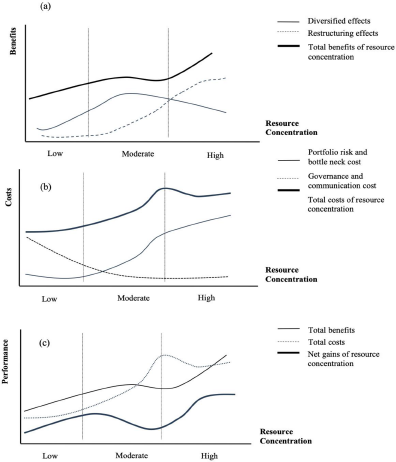
At a low level of business concentration, business groups that set up group affiliates in foreign markets can enjoy diversified resources, knowledge, and management experience to enhance innovation, thereby enhancing their adaptability to enter different markets and improve performance (Chatterjee & Eyigungor, Reference Chatterjee and Eyigungor2023; Hou & Robinson, Reference Hou and Robinson2006). However, business groups desiring to enter different industry backgrounds face a conundrum. These business groups can create resource synergy only when they have well-designed communication and sharing channels with subgroups in a range of industries (Chatterjee & Eyigungor, Reference Chatterjee and Eyigungor2023; Chen et al., Reference Chen, Lin, Wang and Guo2022); hence, initial governance and communication costs are high. In addition, not all business groups can use differentiated resources and capabilities to produce resource synergies when international processes accelerate; because of the Penrose effect, business groups have bounded rationality and an upper limit to its ability to decode, assimilate, and absorb reverse knowledge from their group affiliates in a short and quickly international period (Lin et al., Reference Lin, Chen, Ahlstrom and Wang2021; Srikanth et al., Reference Srikanth, Anand and Stan2021). Accordingly, owing to rising benefits and stagnating costs, there is a positive relationship between business concentration and performance at a low level of business concentration.
At a moderate level of business concentration, the business group has more opportunities to integrate its limited knowledge about production processes and management systems with subgroups in related industries. This indicates that the business group needs fewer collaboration requirements, so the communication and government costs are low when the concentration increases (Purkayastha et al., Reference Purkayastha, Kumar and Lu2017; Srikanth et al., Reference Srikanth, Anand and Stan2021). Therefore, the cost of portfolio risk and bottleneck costs quickly increases, whereas the cost associated with governance and communication decreases, and the total cost steadily increases. At a moderate level of business concentration, restructuring will exert its influence since business groups will consider the commitment of their resources in potential profit industries through restructuring (Bergh & Lim, Reference Bergh and Lim2008). Thus, the benefits of restructuring increase significantly, but the benefits of diversification increase and then decrease after a specific point at a moderate concentration level. Accordingly, the slightly increasing benefits and rapidly increasing costs would result in negative net gains for business groups with moderate business concentration.
At a high level of business concentration, the benefits of diversification result from investing in different industries and countries, and the costs of governance and commutations decrease (Chen et al., Reference Chen, Lin, Wang and Guo2022; Lin et al., Reference Lin, Chen, Ahlstrom and Wang2021). This study argues that business groups desiring to enter a similar industry background may find themselves in a dilemma. A high level of trade within business groups may reduce the probability of diversified knowledge sharing, absorption, transmission, and creation during knowledge-sharing processes (Bennedsen et al., Reference Bennedsen, Lu and Mehrotra2022; Chung et al., Reference Chung, Dahms and Kao2021). Similar backgrounds are more likely to contribute to duplicative thinking among affiliates, thereby increasing portfolio risk and bottleneck costs in terms of resource redundancy, resource depletion, and organizational saturation. Investment in highly similar industries inevitably involves investment risk, low-cost elasticity and a diminished ability to respond to dynamic markets (Chatterjee & Eyigungor, Reference Chatterjee and Eyigungor2023; Lee et al., Reference Lee, Jiraporn and Song2020). In summary, the costs associated with portfolio risk and bottleneck costs decrease, whereas the costs associated with governance and communication decrease more slowly. This leads to a sharp increase in the total cost. At a high level of business concentration, business groups set up group affiliates in foreign markets with similar industry knowledge backgrounds and management structures, and the specificity advantages can increase operational efficiency and improve product quality through learning curves (Chen & Chu, Reference Chen and Chu2012; Chen et al., Reference Chen, Lin, Wang and Guo2022). However, the advantages of diversification decrease at a high level of business concentration (Choi & Cowing, Reference Choi and Cowing2002), when the benefits of restructuring are more pronounced. Most family groups in Taiwan expand their market territory through internationalization into related diversification to avoid greater uncertainty and external financial needs. Business groups restructure their foreign affiliates and prefer to adopt high-resource-concentration strategies to reduce financial risk and maintain higher control rights and socioemotional wealth (Chung et al., Reference Chung, Dahms and Kao2021). Business groups eradicate unprofitable subgroups through asset reorganization and then invest resources in potential subgroups (Bergh & Lim, Reference Bergh and Lim2008). Thus, the benefits of restructuring continue to increase, but the benefits of diversification also decrease at high levels of concentration. Taken together, the benefit and cost performance experience a net increase when concentration is high.
Figure 3 in the Appendix shows how these positive and negative effects are integrated to establish the S-shaped relationship between business concentration and performance. Figure 3(a) depicts how the benefits from diversification and restructuring determine the total benefits of business concentration. Figure 3(b) depicts how governance and communication costs, portfolio risk, and bottleneck costs affect the total cost of business concentration. Figure 3(c) presents the net gains in performance (bold line), total benefits (solid line), and total costs (dotted line). The lines of the net gains in performance become an S-shaped curve. We propose the following hypothesis:
Hypothesis 1: There is an S-shaped relationship between business concentration and performance.
Moderating the role of the family business group
Ownership structure is defined as the distribution of the management and control rights of all stakeholders in a business group (Chung et al., Reference Chung, Dahms and Kao2021; Kwak & Kim, Reference Kwak and Kim2020). On the basis of resource-based and agency theories, this study proposes three ownership structures – family business groups, outside director ownership, and manager ownership – related to resource strategy and performance.
Family business groups enjoy a close relationship between the founder and the group they control (Bennedsen et al., Reference Bennedsen, Lu and Mehrotra2022). Family businesses instill strong values, ethics, and cultural norms in their members from childhood. This common set of beliefs and values among family members, employees, and other stakeholders fosters a strong sense of identity and commitment (Bennedsen et al., Reference Bennedsen, Lu and Mehrotra2022). Therefore, at lower levels of business concentration, a family business may strengthen network connections and trust relationships and weaken the negative effects of governance and communication costs (Chung et al., Reference Chung, Dahms and Kao2021; Kwak & Kim, Reference Kwak and Kim2020). The family group can also enhance diversified knowledge sharing and assist with internal and external cross-domain cooperation (Bennedsen et al., Reference Bennedsen, Lu and Mehrotra2022). This allows the group to accumulate internal and external cross-domain cooperation and establish trust relationships and cooperative networks that other enterprises cannot easily replicate in the long term.
As internationalization increases, business groups adopt a low-level business concentration strategy, and managers encounter unfamiliar cultures, policies, and partners. Thus, bounded rationality and the Penrose effect arise from limited and incomplete information (Lin et al., Reference Lin, Chen, Ahlstrom and Wang2021). Family businesses can buffer themselves from the Penrose effect and portfolio risk across diverse group affiliates since kinship provides family groups a unique way to access a stable human resource and profit network that fosters social capital and long-term family reputation (Bennedsen et al., Reference Bennedsen, Lu and Mehrotra2022; Chung et al., Reference Chung, Dahms and Kao2021). In addition, when a business group has a moderate concentration of resources, the subgroups invest in a variety of fields. Family groups are accustomed to appointing their children and relatives to important positions in subgroups of the same or different industries, thereby holding the management and control of the subgroup. When the subgroups span industries, the trust relationship between family members can be monitored across industries, thereby reducing the cost of governance and communication and increasing the speed of decision-making, particularly concerning resource allocations (Bennedsen et al., Reference Bennedsen, Lu and Mehrotra2022; Purkayastha et al., Reference Purkayastha, Kumar and Lu2017). As a result, operating costs are lower, and financial performance improves.
However, when business concentration is high, a family-owned group weakens the positive side (resource restructuring) and strengthens the negative side (bottleneck cost) of nonlinear relationships. Taiwan engaged in large-scale restructuring from 19,941,996, when few resources were invested in restructuring family-owned business groups. Taiwan’s system of inheritance is from father to son. For all children to inherit a company, the founders may invest in unfamiliar industries and are less likely to engage in restructuring (Chen & Chu, Reference Chen and Chu2012). Moreover, family groups emphasize long-term cooperative relations, so they may have established such relations with certain manufacturers from the father’s generation. Therefore, family groups may be based on humane considerations; even if some partners may not be able to increase efficiency, family business groups may not conduct resource restructuring, nor increase the advantages of resource restructuring (weaken the positive side). In addition, family members’ beliefs and thinking models are similar since they grew up in the same environment (Chung et al., Reference Chung, Dahms and Kao2021; Srikanth et al., Reference Srikanth, Anand and Stan2021). Once a group is faced with management incidents, leaders are vulnerable to limited thinking when making decisions (Chung et al., Reference Chung, Dahms and Kao2021). This will result in resource redundancy, resource constraints, and organizational saturation problems, all of which increase the error-free rate and the need for resource flexibility and reduce the group’s ability to handle bottlenecks, resulting in continuously increasing costs (Srikanth et al., Reference Srikanth, Anand and Stan2021). In summary, when resources are concentrated, a family group may strengthen the positive side (establishing resource networks) and weaken the negative side (resource restructuring advantages and costs of bottleneck) of the nonlinear relationship between business concentration and performance. On the basis of these inferences, this research proposes the following hypothesis:
Hypothesis 2: Family business groups positively moderate the relationship between business concentration and performance.
Moderating role of outside director ownership
According to the Taiwan Economic Journal database, outside director ownership includes domestic governments, foreign governments, and legal entities. According to resource-based theory, business groups with more government shares outperform general business groups because they have good relationships with the government and legal entities (Cuervo-Cazurra & Li, Reference Cuervo-Cazurra and Li2021; Holmes et al., Reference Holmes, Hoskisson, Kim, Wan and Holcomb2018). The ownership advantage can also take the form of support in firms’ dealings with foreign governments, with the home country government facilitating relationships and easing restrictions in foreign markets through commercial diplomacy (Cuervo-Cazurra & Li, Reference Cuervo-Cazurra and Li2021). This study argues that outside directors can strengthen the positive side (political assets) and benefit performance at any level of business concentration. Therefore, compared with general business groups, groups with many outside directors can obtain more government resources, regulatory protection, and information on industry developments, improving the business group’s ‘political assets’ (Li et al., Reference Li, Zhang and Shi2020; Thomsen & Pedersen, Reference Thomsen and Pedersen2000).
In addition to domestic governments and legal entities, outside directors’ ownership may come from overseas governments and legal entities. Overseas legal entities have more advanced R&D technology, and when they have more commitments to business groups, they will be more willing to pass on this specialized knowledge and resources to the business group (Li et al., Reference Li, Zhang and Shi2020; Purkayastha et al., Reference Purkayastha, Kumar and Lu2017). In addition, outside directors are not family members and cannot inherit family property. They must show good financial performance, so they are more motivated to reorganize and reallocate resources with an appropriate resource application strategy (Chen & Chu, Reference Chen and Chu2012; Thomsen & Pedersen, Reference Thomsen and Pedersen2000). Therefore, when there is a moderate or high level of business concentration, outside directors can strengthen their resource restructuring advantage by adopting restructuring in the face of nonprofitable subgroups.
Moreover, at a low-to-moderate level of business concentration, a business group with many shares held by external shareholders indicates that external entities have more power to place managers in important positions (Chen et al., Reference Chen, Lin, Wang and Guo2022). This will lead to better performance in cross-industry or cross-country operations since each industry or country has its own operating environment and requires its own management experience; hence, a group with many external directors can obtain implicit knowledge and operating experience (Purkayastha et al., Reference Purkayastha, Kumar and Lu2017). Due to overseas relations, outsider direct relationships can strengthen the group’s local management and operation capabilities through local managers or operating channels, thereby increasing the amount of resources and experience shared with the business group (Purkayastha et al., Reference Purkayastha, Kumar and Lu2017). When resources are concentrated, groups with more outside director ownership can strengthen the positive side (management knowledge and capabilities) of the nonlinear relationship. This leads to the following assumption:
Hypothesis 3: The outsider direct ownership positively moderates the relationship between business concentration and performance.
Moderating role of manager ownership
Manager ownership is defined as managers holding greater management rights but who are not family members of the business group (Windy & Lukman, Reference Windy and Lukman2023). Windy and Lukman (Reference Windy and Lukman2023) argued that managerial ownership can positively moderate the impact of a company’s profitability on its debt policy. However, this study argues that manager ownership has a negative moderating effect on the relationship between business concentration and performance. Previous scholars have noted that the shareholding structure of a business group is more complicated than that of other firms (Holmes et al., Reference Holmes, Hoskisson, Kim, Wan and Holcomb2018; Mukherjee, Makarius, & Stevens, Reference Mukherjee, Makarius and Stevens2018). More specifically, business groups in Asia use pyramids and cross-shareholding to replace alternative shareholdings, thereby controlling the entire group (Holmes et al., Reference Holmes, Hoskisson, Kim, Wan and Holcomb2018; La Porta, Lopez‐de‐silanes, & Shleifer, Reference La Porta, Lopez‐de‐silanes and Shleifer2002). According to agency theory, a business group with high manager ownership is more likely to experience principal–agent conflicts between managers and shareholders (Chung et al., Reference Chung, Dahms and Kao2021; La Porta et al., Reference La Porta, Lopez‐de‐silanes and Shleifer2002). Owing to the principal–agent problem, manager ownership may strengthen the negative side (agency and governance costs) of nonlinear relationships, given the divergent interests between shareholders and managers (La Porta et al., Reference La Porta, Lopez‐de‐silanes and Shleifer2002). In addition, it is difficult for managers who are not family members to obtain the detailed and latest information to assess the group’s problems and make the right resource allocations (Bennedsen et al., Reference Bennedsen, Lu and Mehrotra2022; Chung et al., Reference Chung, Dahms and Kao2021). Manager ownership may weaken the positive side, since asymmetric information makes the manager’s job more difficult and reduces the advantages of business concentration (Bennedsen et al., Reference Bennedsen, Lu and Mehrotra2022). This study argues that the ownership of a business group with many managers can weaken the negative aspect, bottleneck costs, caused by resource redundancy, resource limitations, and organizational saturation. However, the cost of agency problems and resource misallocations will be greater than the benefits resulting from reducing bottlenecks and operating costs. Thus, this study proposes the following:
Hypothesis 4: Manager ownership negatively moderates the relationship between business concentration and performance.
Methodology
Sample and methodology
This study used Taiwan’s top 100 business groups as the research sample (ranked according to sales) from the China Credit Information Service. In addition to the China Credit Information Service database, this study uses the Taiwan Economic Journal database, which has more subgroup-related information. Taiwan’s top 100 business groups account for more than 70% of Taiwan’s gross domestic product and occupy a central position in Taiwan’s economy. Since the 1990s, many international needs and issues have been related to the management of complex foreign subsidiaries (Chung et al., Reference Chung, Dahms and Kao2021). This study collects data from the top 100 business groups for 15 years from 2004 to 2018. To increase the credibility of causal inference among variables, this study extends the independent, moderating, and control variables to 1 year after the dependent variable (Chen et al., Reference Chen, Lin, Wang and Guo2022). This study tests this hypothesis through generalized least squares regression analysis (Jiang, Tao, & Santoro, Reference Jiang, Tao and Santoro2010), which can correct problems such as heteroscedasticity and autocorrelation. In addition, prior scholars have noted that in the sample testing process, if the Hausman test does not differ between random-effects and fixed-effects generalized least squares, then it is recommended to use generalized least squares with random effects to obtain a more efficient and appropriate regression model (Jiang et al., Reference Jiang, Tao and Santoro2010).
Measures
Dependent variable. Return on assets (ROA) was selected as an indicator of the performance of a business group’s foreign operations. ROA was measured as a percentage of sales in a given year. ROA reflects a business group’s financial outcome and demonstrates operational effectiveness (Chen et al., Reference Chen, Lin, Wang and Guo2022). The sales data of the business group are group-level measurements collected by Taiwan Economic Journal.
Independent variables and moderating variables
The Herfindahl‒Hirschman Index of business concentration is a popular measure of the intensity of competition (Djolov, Reference Djolov2013). This study uses the Herfindahl‒Hirschman Index to calculate the degree of asset diversification of business groups in each affiliated group (Chen & Chu, Reference Chen and Chu2012; Djolov, Reference Djolov2013). In the formula  $the\,1 - {(\mathop \sum \nolimits T\, A_i/\mathop \sum \nolimits T \,A_i)^2}$, TA i represents the total assets of the i-th group affiliated. Second, to measure business concentration (BC), this study divides M by
 $1 - {(\mathop \sum \nolimits T\,A_i/\mathop \sum \nolimits T\,A_i)^2}$. M represents how many group-affiliated the group company has in a specific industry. This study uses two Standard Industrial Classification (SIC)codes to distinguish industries and then calculates the group-affiliate resources in these industries to determine asset dispersion. When the assets of the business group are more concentrated in a few related industries, BC has a high value. In contrast, if the assets of business groups span different industries, the value of BC is less.
This study contains three moderating variables: family business group, outside director ownership, and manager ownership. For family businesses, dummy variables are used for coding. This study set 1 to indicate that the group is a family business group and 0 to indicate a nonbusiness group (Bennedsen et al., Reference Bennedsen, Lu and Mehrotra2022; Chung et al., Reference Chung, Dahms and Kao2021). The proportion of shares held by outside directors is based on the recommendations of scholars (Khanna & Yafeh, Reference Khanna and Yafeh2007) and is measured by the proportion of shares held by outside directors in the business group. A high ratio means that the business group has a greater chance of being controlled by outside directors. The manager’s shareholding calculates how many managers hold shares of the business group, not including the group’s family members (Khanna & Yafeh, Reference Khanna and Yafeh2007).
Control variables
To avoid industrial effects, this study considers the industrial asset return rate (industry ROA) and industry dummy variables as control variables. Industry ROA was measured as the proportion of industry income in a specific industry and took the 3-year arithmetic average. The industry is divided into 25 categories on the basis of the Taiwan industry classification code and the two-code SIC industry code (Chen et al., Reference Chen, Lin, Wang and Guo2022). Prior studies have shown that previous performance may affect financial performance; therefore, this study uses the average financial performance of the past 3 years and takes a log as a measurement (Chen et al., Reference Chen, Lin, Wang and Guo2022; Lin et al., Reference Lin, Chen, Ahlstrom and Wang2021). The leverage ratio is measured by the proportion of short- and long-term debt to the group’s net assets, which can be used temporarily to build the company’s capacity structure. Available slack was measured as the current ratio, which reflects short-term improvements in operating efficiency (Chen et al., Reference Chen, Lin, Wang and Guo2022). Prior studies also show that group size may directly affect performance; large business groups have a greater ability to enter new markets and offer new products than small business groups do. This study takes the log of group assets as the group size (Chen et al., Reference Chen, Lin, Wang and Guo2022). Finally, a previous study revealed that internationalization experience affects a group’s resource arrangement. When a business group has better internationalization experience, it will have a more complete blueprint to layout its resources (Lin et al., Reference Lin, Chen, Ahlstrom and Wang2021). International experience is calculated as the difference between the first export or overseas direct investment to the data collection year.
Results and contributions
Analyses and results
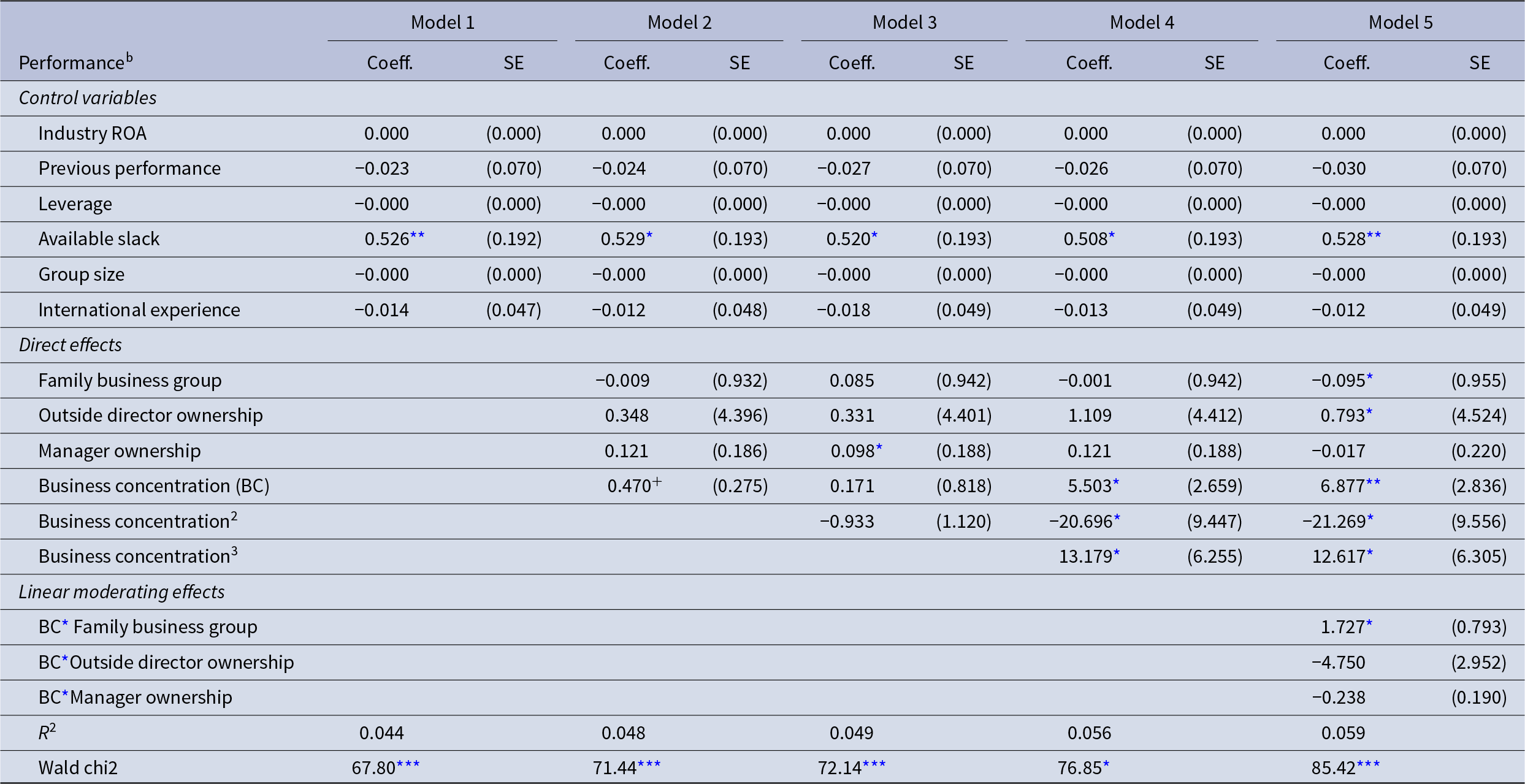
This study explored the effects of business concentration and its interaction with ownership structure on business group performance using group-year as an analysis unit. Fractional polynomial regression was used to test all the hypotheses. This study shows the means, standard deviations, correlations, and variance inflation factors for all the variables in Table 1. The variance inflation factors range from 1.01 to 1.34, within acceptable limits (Chen et al., Reference Chen, Lin, Wang and Guo2022), suggesting that there is no multicollinearity problem. To avoid the multicollinearity problem, this study used the standard-centered value of business concentration squared and business concentration cubed. Table 2 shows the results of the polynomial regression analyses. Model 1 is the base model that considers only the control variables. Models 2 to 4 add direct, quadratic, and cubic terms to capture the S-shaped relationship between business concentration and business group performance. Model 2 considers the direct effect of business concentration and shows a positive and linear relationship with performance (B = 0.470, p < .1). In Model 3, the coefficient for the linear term was positive (B = 0.171, p > .05), and the squared term was negative (B = − 0.933, p > .05). Model 4 tested the joint effects of the linear, squared, and cubic terms of business concentration; the coefficient for the linear term was positive (B = 5.503, p < .05); the squared term was negative (B = − 20.696, p < .05); and the cubic term was positive (B = 13.179, p < .05). These results support Hypothesis 1. The study tested the interaction effects of ownership structure, adding three linear interaction terms in Model 5. The interaction effect between business concentration and family group was positive and significant (B = 1.727, p < .05). Hypothesis 2 is supported. The interaction effect between business concentration and outsider direct ownership was negative and not statistically significant (B = − 4.75, p > .05). Hypothesis 3 is therefore not supported. The interaction effect between business concentration and manager ownership was negative and not statistically significant (B = − 0.238, p > .05). Thus, Hypothesis 4 is not supported.
Correlations and descriptive statistics

* Note: p < .05; **p < .01 (two-tailed test).
Results of regression analyses (ROA)

Note: N = 1012 (two-tailed test), +p < .1;
* p < .05;
** p < .01;
*** p < .001 b: year and industry dummy are controlled in all model.
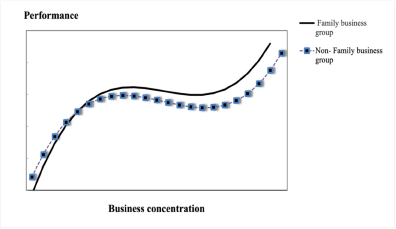
For the robustness test, this study adopted a three-step process by using a UTEST: STATA module (Chen et al., Reference Chen, Lin, Wang and Guo2022). An inverted U-shaped test is supported by the use of the UTEST: STATA module (t = 2.17, p < .01). The findings indicate that business concentration has an inverted U-shaped relationship with performance at the low–moderate level. The U test is also supported (t = 1.66, p < .05). The findings indicate that business concentration first decreases and then increases (a U shape) with performance at the moderate–high level. When business concentration increases, performance increases, decreases, and then increases again, supporting Hypothesis 1. Moreover, drawing on the moderating effect in Model 5 for Hypothesis 2, this study constructs three-dimensional diagrams (Fig. 2) of the S-shaped relationship between business concentration and performance.
Business concentration and performance: The moderating role of a family business group.

The business concentration-performance

Discussion and conclusions
Discussion
Hypothesis 1 showed an S-shaped relationship between business concentration and performance. These findings echo those of Chen and Chu (Reference Chen and Chu2012), who identified a positive relationship between resource concentration and performance, and Kwak and Kim (Reference Kwak and Kim2020), who reported a U-shaped relationship between business (customer) concentration and performance. However, this study argues that business concentration has different benefits and cost interactions, leading to an S-shaped relationship with performance. This study indicated that, when there is little business concentration, business group performance growth increases with diversified effects. As business concentration increases slowly, diversified effects are still the main effects on business group performance. At moderate levels of business concentration, the relationship between business concentration and performance becomes negative, where the sum of governance and communication costs, portfolio risk, the Penrose effect, and bottleneck costs all surpass the increase in diversified effects and restructuring effects. Finally, when resources are heavily concentrated, business group performance improves again because of the advantages of the restructuring effect, while the costs of governance and communication decrease. Therefore, this study highlights business concentration’s nonlinear and complex effects on performance.
Regarding the moderating role of ownership structure, the family group positively moderates the relationship between business concentration and performance. These findings echo previous studies (Bennedsen et al., Reference Bennedsen, Lu and Mehrotra2022; Chung et al., Reference Chung, Dahms and Kao2021; Kwak & Kim, Reference Kwak and Kim2020; Mukherjee et al., Reference Mukherjee, Makarius and Stevens2018; Purkayastha et al., Reference Purkayastha, Kumar and Lu2017) showing that family business groups improve performance. At lower levels of business concentration, family business groups may weaken the negative side (governance and communication costs) and strengthen the positive side (cross-domain knowledge and experience) of nonlinear relationships due to their strong network connections and trust relationships (Bennedsen et al., Reference Bennedsen, Lu and Mehrotra2022). In other words, family relationships allow the group to align interests and internal and external cross-field collaborative relationships for a long period, establishing networks built on trust relationships that other firms cannot imitate (Bennedsen et al., Reference Bennedsen, Lu and Mehrotra2022; Kwak & Kim, Reference Kwak and Kim2020; Purkayastha et al., Reference Purkayastha, Kumar and Lu2017). This study also argues that the kinship relationship gives family business groups a unique way to overcome the cost of the Penrose effect and portfolio risk across diversified group affiliates in a short period (Bennedsen et al., Reference Bennedsen, Lu and Mehrotra2022; Chung et al., Reference Chung, Dahms and Kao2021). At a moderate level of concentration, family groups strengthen the positive side (cross-field cooperation and speed of decision-making) by placing their children and relatives in important positions in subgroups, maintaining the management and control of the subgroup. Family groups also weaken the negative side (communication and coordination costs) of nonlinear relationships via the cross-holding structure (Bennedsen et al., Reference Bennedsen, Lu and Mehrotra2022; Purkayastha et al., Reference Purkayastha, Kumar and Lu2017). At a high level of concentration, family groups allow business groups to strengthen the positive side (resource network and trust relationship) and weaken the negative side (bottleneck and Penrose effect) of the nonlinear relationship. This study argues that the cost of bottlenecks will increase, but the benefits of restructuring may decrease when business concentration is high (Srikanth et al., Reference Srikanth, Anand and Stan2021). Due to family members’ similar beliefs and thinking, the costs of bottleneck and Penrose effects increase dramatically when they face quick and irregular internationalization (Chung et al., Reference Chung, Dahms and Kao2021; Srikanth et al., Reference Srikanth, Anand and Stan2021). This will cause resource redundancy, resource constraints, and organizational saturation problems, increasing the error-free rate and the need for resource flexibility (Srikanth et al., Reference Srikanth, Anand and Stan2021). Moreover, long-term trust and cooperative relationships with a partner can be a double-edged sword, as many companies have worked together since their predecessors. Therefore, when family businesses choose partners, the selection may be based on personal relationships and networking considerations; they may not necessarily choose the most efficient or beneficial companies with which to collaborate (Chen & Chu, Reference Chen and Chu2012; Chen et al., Reference Chen, Lin, Wang and Guo2022; Lin et al., Reference Lin, Chen, Ahlstrom and Wang2021). Therefore, family groups may be based on humane considerations and may not engage in resource restructuring. In summary, the benefits of the resource network and trust relationships established by the family group can compensate for the lack of resource restructuring advantages and the cost of bottlenecks and the Penrose effect during internationalization. Hence, the family group has a positive moderating effect.
This study proposed that outside director ownership positively moderates the relationship between business concentration and performance. However, this study has no empirical evidence to support Hypothesis 3. This study does not align with previous studies that found business groups with more external director ownership have more opportunities to acquire the management knowledge and capabilities of different industries or countries, thereby improving performance (Li et al., Reference Li, Zhang and Shi2020; Purkayastha et al., Reference Purkayastha, Kumar and Lu2017). This study explains the potential reason that outside directors are defined as those nonfamily members serving as board members in business groups, including domestic governments, foreign governments, and legal entities. For regulatory reasons, the proportion of foreign governments and institutions in Taiwan is low, meaning their potential influence is less significant than that of family businesses. This could be one explanation for their limited impact. Even if the percentage of the domestic government’s ownership is greater in Taiwan, government-related institutions tend to interfere with business groups only in exceptional cases, such as when there is a risk of major group collapse (e.g., the 2008 financial crisis and the COVID-19 pandemic). Generally, domestic government intervention in business groups is minimal or nonexistent. This may be one of the reasons for the lack of support for Hypothesis 3.
Hypothesis 4 proposes that manager ownership negatively moderates the relationship between business concentration and performance. The empirical findings of this study cannot support Hypothesis 4 and confirm those of previous studies that claim that a business group with high manager ownership is more likely to result in principal–agent conflicts between managers and shareholders and increase agency and governance costs (Chung et al., Reference Chung, Dahms and Kao2021; Kwak & Kim, Reference Kwak and Kim2020; La Porta et al., Reference La Porta, Lopez‐de‐silanes and Shleifer2002). This study also cannot provide empirical evidence to support that argument that managers do not make the wisest decisions since the asymmetric information within the business group makes the manager’s job harder and reduces the advantages of business concentration (Bennedsen et al., Reference Bennedsen, Lu and Mehrotra2022; Chung et al., Reference Chung, Dahms and Kao2021; Kwak & Kim, Reference Kwak and Kim2020; Purkayastha et al., Reference Purkayastha, Kumar and Lu2017). This study explains that managers’ ownership may not have a significant effect on business groups, possibly because the organizational structure of business groups is more complex than that of typical corporations. When business groups are under the control of a strong board of directors or when corporate culture or the influence of family members assumes a more substantial role in resource allocation, the extent of managerial ownership may appear to have a less significant influence.
Theoretical contributions
This research makes several contributions to academic research and practice. The academic contributions of this study are as follows. In the past, many studies have investigated the impact of resource allocation, diversification, and ownership structure on performance, demonstrating how allocating resources through internationalization is a crucial concern for business groups (Aguilera et al., Reference Aguilera, Crespí-Cladera, Infantes and Pascual-Fuster2020; Chen et al., Reference Chen, Lin, Wang and Guo2022). The primary contribution of this study lies in the use of resource-based and agency theories to explain why business concentration has a nonlinear relationship with business group performance. Previous scholars have reported a positive effect of business concentration (Chen & Chu, Reference Chen and Chu2012; Kwak & Kim, Reference Kwak and Kim2020; Lee et al., Reference Lee, Jiraporn and Song2020) on performance and a negative effect of business concentration (Lee et al., Reference Lee, Jiraporn and Song2020; Lin et al., Reference Lin, Chen, Ahlstrom and Wang2021; Mahmood et al., Reference Mahmood, Chung and Mitchell2013; Srikanth et al., Reference Srikanth, Anand and Stan2021; Zhang et al., Reference Zhang, Priem, Wang and Li2023) on performance. This study provides evidence of both the costs and advantages of business concentration, with fluctuations between them. Additionally, it is not a consistently positive relationship. Furthermore, this study contends that at different levels of business concentration, if the advantages generated surpass the costs associated with business concentration, the result positively affects performance. Conversely, when the costs of business concentration still outweigh the related advantages, the results are the opposite results. This study also proposes that business concentration not only entails advantages such as specificity, experience learning, and market power but also includes restructuring advantages. In addition to governance and communication, portfolio investment risk, the Penrose effect, and bottleneck costs are also considered. This study suggests that these advantages and costs result from the effects of resource concentration on performance. The results of this study offer distinct academic findings for the areas of resource allocation strategy, ownership structure, and business groups. Finally, this study revealed that family businesses have a significant positive moderating effect. However, outside director ownership and manager ownership are not as expected. This finding shows that in Asian countries, at different levels of resource allocation, a business group owned by outside directors may not necessarily improve performance. Having managers as shareholders does not lead to significant principal–agent conflicts between managers and shareholders and results in significantly poor performance. Due to the unique culture of Asian countries, family business groups have a significantly greater influence on resource allocation and performance than do outside ownership and managerial ownership since hereditary culture, trust, and network relationships are prevalent in family-owned businesses. The findings of this study also offer practical evidence and theoretical contributions relevant to the organization and managerial issues in Asian business groups.
Managerial contributions and implications
This study makes several practical contributions. It identified an S-shaped relationship between business concentration and performance. The study suggests that business groups should consider not only the advantages of business concentration but also the different costs at various levels, such as governance and communication costs, portfolio risk, and bottleneck costs. Furthermore, business groups should evaluate whether the advantages at the current stage are sustainable. It is essential to assess the reasons behind the costs incurred at the current and next levels. Business groups should furthermore consider whether they can be altered through organizational restructuring and the potential impacts of such changes. In addition, this study suggests that business groups should consider whether restructuring actions should be taken to generate advantages if performance is poor in the current stage.
Additionally, if the resource concentration increases, there may be bottleneck costs. This study also suggests that business groups should consider three factors leading to bottleneck costs – resource redundancy, resource depletion, and organizational saturation – and should try to avoid potential negative effects through organizational management methods. Finally, the results reveal that family-owned businesses have a positive moderating effect, whereas outside director ownership and managerial ownership do not have statistically significant effects. The findings provide a reference for business groups and other foreign institutions in determining their equity structure in new industrial economies, such as Taiwan. Furthermore, this study suggests that family-owned businesses should continue to maintain the cooperation model driven by family heredity. This is because the inherent trust and resource connections within the family network can help resolve many challenges associated with overseas investments. Avoiding disruptions in the trust network is crucial when transitioning to the second generation. Additionally, in terms of business concentration, family-owned businesses may face a stronger Penrose effect than nonfamily-controlled business groups. Therefore, they must think about how to prevent the Penrose effect from reducing cooperation benefits and leading to incorrect decisions in overseas resource allocation in the long term.
Limitations and further research
This study used archival data, which has the following limitations. The empirical findings were limited to business groups in Taiwan; thus, the findings cannot be generalized to business groups outside of Taiwan. Future studies could compare the resource allocation strategies of business group globalization in different countries. In addition, the database is missing data on subsidiaries’ performance, which could affect the performance of the entire business group. Future studies should consider the effect of subsidiaries’ performance. Finally, this study explored ownership structure as a moderator in the relationship between business concentration and business group performance. Other moderators, such as different industries and international business variables, may also affect this relationship. Future studies could extend our framework and explore why and how these contingent factors affect the relationship between business concentration and performance in the future.
Acknowledgements
This work was supported by Ministry of Science and Technology Taiwan, the under Grant MOST 109-2410-H-029-022.
Competing interests
The author(s) declare none.
Shan-Huei Wang (Corresponding author) is an associate professor in the Department of Business Administration at Tunghai University in Taiwan. She received her PhD at National Taiwan University, Taiwan. Her research interests focus on international business, strategy, and internet marketing research. Her articles have appeared or have been accepted for publication in Asia Pacific Journal of Management, Journal of Business Research, Management decision, Telematics & Informatics, Journal of International Management, Internet Research and other refereed conference proceedings.
Jung-Hua Chang (Corresponding author) is an associate professor in the Institute of Marketing Communication at National Sun Yat-sen University, Taiwan. He received his PhD in marketing at National Taiwan University, Taiwan. His research interests focus on marketing, consumer behavior, service marketing and hospitality management. His articles have been published or accepted for publication in Journal of Business Research, Psychology & Marketing, Marketing Letters, European Journal of Marketing, Telematics & Informatics, International Journal of Hospitality Management and other refereed journals and conference proceedings.