Introduction
Increasing life expectancy and the growing number of people aged 80 years and above in the population have led to a higher number of elderly caregivers who are caring for other aged persons for longer periods than in the past. Over several years they will experience the effects of physiological aging and the consequences of caregiving itself. Low resistance to stressors, lowering of the immune system, fatigue, anorexia, non-intentional weight loss and physical inactivity, all of which are frequently associated with caregiving, are also manifestations that are inherent to frailty (Vitaliano et al., Reference Vitaliano, Echeverria, Shelkey, Zhang and Scanlan2007; Oswald, Reference Oswald2009). The prevalence of frailty is highest among the oldest old, women, the poorest and the least educated old people (Vitaliano et al., Reference Vitaliano, Echeverria, Shelkey, Zhang and Scanlan2007). These are also the groups with particular susceptibility to the adverse effects of family caregiving (Pinquart and Sörensen, Reference Pinquart and Sörensen2003a; Reference Pinquart and Sörensen2003b; Vitaliano et al., Reference Vitaliano, Zhang and Scanlan2003; Borg and Hallberg, Reference Borg and Hallberg2006; Mackenzie et al., Reference Mackenzie, Wiprzycza, Hasher and Goldstein2009).
Caring for family members is widely acknowledged to be a source of physical, psychological and social burden. These burdens have negative effects on several aspects of caregivers’ well-being, such as their physical and mental health (Oswald, Reference Oswald2009), functional capacity (Fried et al., Reference Fried2001), cognition (Pinquart and Sörensen, Reference Pinquart and Sörensen2007), and life satisfaction, with negative repercussions over professional, family and marital roles and daily activities (Pinquart and Sörensen, Reference Pinquart and Sörensen2006). Meta-analyses have shown that the physical health of caregivers is worse than the health of non-caregivers, as indicated by subjective measures of health (Giacomin et al., Reference Giacomin, Uchoa, Firmo and Lima-Costa2005) and by objective measures such as stress hormones, antibodies and medication use (Robinson et al., Reference Robinson, Fortinsky, Kleppinger, Shigue and Porter2009).
Pinquart and Sörensen (Reference Pinquart and Sörensen2003a) have observed stronger associations of health problems with depressive symptoms than with the objective stressors that are inherent in care. Stronger associations of caregiving stress and health variables have been observed among older caregivers, caregivers of elderly dementia patients and male caregivers. However, when the effects of gender on stressors and social resources were statistically controlled for, the effects of gender on depression and caregivers’ physical health were nearly the same as those observed in non-caregivers (Pinquart and Sörensen, Reference Pinquart and Sörensen2003b; Vitaliano et al., Reference Vitaliano, Zhang and Scanlan2003).
The lack of instrumental support through having a limited number of potential caregivers in the family may exacerbate the tension associated with care. Likewise, overcrowding and competition for resources that characterize very poor multigenerational families may worsen the conditions of care. Brazilian caregivers, especially those who are poor, have few options for supervision and for obtaining informational, instrumental and emotional support from healthcare professionals (Giacomin et al., Reference Giacomin, Uchoa, Firmo and Lima-Costa2005). The lack of formal support results in greater demands on family resources and especially on women, and is likely to be detrimental to their physical and psychological health. According to Robinson et al. (Reference Robinson, Fortinsky, Kleppinger, Shigue and Porter2009), caring per se does not lead to depressive symptoms, health problems and social isolation unless it is accompanied by cohabitation, insufficient income to meet basic needs and a lack of formal support services.
In a large number of studies, emotional support provided by the informal support network has been evaluated quite positively by caregivers (Pinquart and Sörensen, Reference Pinquart and Sörensen2006; Huang et al., Reference Huang, Souza, Perng, Hwang, Tsai, Huang and Yao2008; Kaufman et al., Reference Kaufman, Kosberg, Leeper and Tang2010; Koerner et al., Reference Koerner, Shirai and Kenyon2010). This support is associated with life satisfaction and better health and has moderating effects on personal reactivity to care-related chronic stressors (McNeill et al., Reference McNeill, Kosberg, Durkin, Dooley, Coster and Williamson2009). In the study by Huang et al. (Reference Huang, Souza, Perng, Hwang, Tsai, Huang and Yao2008), low-income caregivers who cared for elderly people with behavioral problems were more likely to suffer from depression. However, within this group of caregivers, those who relied on emotional support were better protected against depressive symptoms.
In addition to increased risks to physical and mental health, caregiving can create barriers to a satisfactory social life for caregivers. Commonly they complain of lack of privacy, impediments to the right to maintain personal interests, conflicts between the demands of caregiving and the performance of other social activities and roles, and disengagement from social activities performed outside home. The exercise of social activities and roles is important to self-esteem and the perception of one's self, as their frequency, variety and end results allow individuals to be evaluated as more or less productive, socially engaged and active (Pinquart and Sörensen, Reference Pinquart and Sörensen2003b; Borg and Hallberg, Reference Borg and Hallberg2006; Elliot and Pezent, Reference Elliot and Pezent2008). Under the influence of complex cultural variables, performing social activities and roles outside the home may be more important to the well-being of men than women. Therefore, the deprivation of opportunities to take part in such activities and roles may be more stressful to men. Limits to social involvement and roles tend to enhance the effects of stress, especially when associated with a scarcity of instrumental support, information, and caregiving skills. Because of cultural variables, men may be less likely to develop caregiving skills and to obtain help.
Given an increasing number of elderly caregivers, and given that caregiving can place an additional burden on frail bodies and limited resources, it is relevant to investigate the variables involved in the relationship between caring and the well-being of elderly caregivers. Knowledge about the interactions between gender and age of caregivers, caregiving conditions (family income, living arrangements and perceived social support), caregivers’ physical and mental health (indicated by the number of reported chronic illnesses, depressive symptoms and frailty indicators), and social isolation (indicated by the number of social activities and roles they no longer perform) may contribute to the understanding of the mechanisms related to the well-being of female and male elderly caregivers. Such knowledge may also yield suggestions for physical and mental health interventions that might promote better quality of life for the caregivers and to the elderly individuals who receive that care.
The current study involved a sample of elderly caregivers aged 65 years and older who had cared for a spouse or parents within a period of five years preceding data collection. The first aim of the study was to describe the sample in terms of sociodemographic characteristics, health and care conditions. The second objective was to investigate relationships between gender, age and circumstances of family life, as independent variables, and health conditions and social isolation as dependent variables. The hypothesis to be tested was that being older, male, and having challenging living arrangements and limited support would be associated with adverse health and social outcomes. These issues have been little explored in studies of Latin American elderly populations where the familial organization may differ from that of Anglo-Saxon elderly people, who are represented much more strongly in the international gerontological literature.
Methods
This study involved elderly caregivers who were selected from a population-based study of elderly people residing in Campinas (N = 900), a city located in the southeast region of Brazil, which has an estimated population of 1,024,862 residents (2010 census). Eighty-eight of the 835 urban primary sampling units (PSU) were randomly drawn and their households were visited by a team of trained recruiters. The elderly people who fulfilled the inclusion criteria of the study (being 65 years of age and older, permanently residing in the home and living within the census area, and able to understand the instructions) were invited to participate in a study that aimed to gather information on frailty and associated variables, such as sociodemographic characteristics, health, cognition, functional capacity and psychosocial variables. In this phase, the exclusion criteria, adapted from Ferrucci et al. (Reference Ferrucci, Guralnik, Studenski, Fried, Cutler and Walston2004), were the following: (1) severe cognitive deficit suggestive of dementia; (2) use of a wheelchair or being bedridden; (3) sequelae of stroke with localized loss of strength and aphasia; (4) advanced or unstable Parkinson's disease; (5) severe hearing or vision impairment, with severe consequences for communication; and/or (6) being terminally ill.
Participants
In the initial phase of data collection, the participants’ scores on the Mini-Mental State Examination (MMSE) were used to exclude 211 elderly people. The cut-off scores were education adjusted and represented the means reported for each education level minus the standard deviation reported for the group: 17 points for the illiterate, 22 for those with 1 to 4 years of schooling, 24 for those with 5 to 8 years of schooling, and 26 for those with 9 or more years (Brucki et al., Reference Brucki, Nitrini, Caramelli, Bertolucci and Okamoto2003).
Of the 689 elderly individuals who completed the protocol, 176 (123 women) were selected to participate in this study on the basis of replying affirmatively to one of two questions that denoted being a caregiver: “In the past five years, have you had to care for a sick parent? In the last five years, have you had to care for a sick spouse?”. As participants were 65 and older, some of them might have reported caregiving experiences which occurred when they were 60 to 65 years old.
Data collection
Data collection took between 40 to 120 minutes, and was carried out in community centers, by a team composed of students and professionals in the field of gerontology. These team members collected data on sociodemographic variables, cognitive status, general and oral health status, frailty criteria (physical activity, fatigue, unintentional weight loss, grip strength, walking speed), anthropometric characteristics (weight, height, and waist, abdomen and hip circumference), systolic and diastolic pressure, use of health services, functional status, expectations of care, perceived social support, depressive symptoms, stressful experiences, and overall life satisfaction referenced to specific domains (health, cognition, social relationships and environment).
Instruments and measurements
The variables of interest were investigated using the following measurements:
1) Age, gender and family income. The questions included birth date, gender and monthly family income in gross values. Participants were classified into four age groups (65–69; 70–74, 75–79, and 80 years and above), two gender groups and five income groups according the number of minimum wages earned monthly by the members of the participants’ family (≤1; 1.1–3; 3.1–5; 5.1–10; >10 minimum wages).
2) Caregiver stress. This was evaluated by an item of the Elders Life Stress Inventory (ELSI) (Fortes-Burgos et al., Reference Fortes-Burgos, Neri and Cupertino2008) that asked: “In the last 5 years have you cared for your spouse or your parents?” If answered positively, they were asked to classify the intensity of the stress generated by this experience on a scale from 1 to 5, in which 5 was the highest value.
3) Living arrangements. This variable was assessed by a self-report question with six dichotomous items. The question asked whether the elderly participant lived alone; only with a spouse; with a spouse and child (or children); with a spouse, children, grandchildren and/or great-grandchildren; with the family of one of the children; with other relatives; with people who were not part of the family, or in mixed arrangements.
4) Perceived social support. The evaluation included five items that were semantically adapted to Portuguese from the Interpersonal Support Evaluation List (ISEL) (Cohen et al., Reference Cohen, Mermelstein, Kamarck, Hoberman, Sarason and Sarason1985), each with four intensities. Cronbach's α obtained for this scale in the sample was 0.70. The items represent four functions of perceived support and assess the perception of the elderly in terms of the availability of people to meet their needs for tangible support (material assistance or instrumental support), sense of belonging or emotional support (affinity for someone from the support network), fostering self-esteem (positive comparisons with others) and informational support (offers of information, suggestions and advice). The scores ranged from 1 to 20. The tertiles were calculated for the scores of the sample. Those who scored ≤16 points were considered to have low perceived social support, those who scored between 17 and 19 points had moderate perceived social support, and those who scored 20 points were considered to have high perceived social support.
5) Number of chronic diseases. Participants were asked whether a physician had told them that they had the following chronic diseases: heart disease; hypertension; diabetes mellitus; CVA / stroke / ischemia; arthritis/rheumatism; osteoporosis; depression; and cancer. The interviewer asked about each of these diseases individually. Affirmative responses were counted and three categories were created: zero, 1 or 2, and 3 or more diseases.
6) Depressive symptoms. These symptoms were evaluated by the Geriatric Depression Scale (GDS) (Almeida and Almeida, Reference Almeida and Almeida1999), with 15 items and a cutoff point of ≥6 (Cronbach's α = 0.725).
7) Frailty. The frailty criteria were those obtained by Fried et al. (Reference Fried2001) from the data of the Cardiovascular Health Study, a prospective population-based study of community-dwelling elderly. According to these authors, participants who met three or more of these criteria were classified as frail, those who met one or two as pre-frail, and those who did not meet any criteria were classified as non-frail. The criteria are:
a) Unintentional loss of weight in the last year of more than 4.5 kg or than 5% of body weight, adjusted for gender and body mass index (BMI).
b) Fatigue, indicated by responses of always or almost always on any one of two items (7 and 20) from the Center for Epidemiological Studies-Depression (CES-D) Scale (Batistoni et al., Reference Batistoni, Neri and Cupertino2007).
c) Low grip strength, indicated by values below the first quintile of the sample, adjusted for gender and BMI. For each elderly participant, the average was calculated for three measurements taken with a Jamar portable hydraulic dynamometer using the dominant hand, following the standard protocols. The cut-off scores for men were: < BMI ≤ 23: grip strength ≤ 27,00 kg; 23 < BMI < 28: grip strength ≤ 28.67 kg; 28 ≤ BMI <30: grip strength ≤ 29.50 kg; BMI = 30: grip strength ≤ 28.67 kg. For women the cut-off scores were: 0 < BMI ≤ 23: grip strength ≤ 16.33 kg; 23 <MBI < 28: grip strength ≤ 16.67kg; 28 ≤ BMI <30: grip strength ≤ 17.33 kg; BMI ≥ 30: grip strength ≤16.67 kg.
d) Low walking speed, indicated by values above the 80th percentile of time required to travel a distance of 4.6 m, adjusted for height and gender. The average of three measurements was calculated. The cut-off scores for men were: 0<height ≤168 cm: time ≥5.49 seconds; height ≥168 cm: time ≥5.54 seconds. For women the cut-off scores were: 0 < height ≤155 cm: time ≥ 6.61 seconds; height > 155 cm: time ≥ 5.92 seconds.
e) Low calorie expenditure was assessed based on the self-reported frequency and duration of physical exercise and housework performed the previous week (Taylor et al., Reference Taylor, Jacobs, Schucker, Knudsen, Leon and Debacker1978). It was indicated by the values below the first quintile of the distribution of metabolic rate in kilocalories, adjusted for gender. The cut-off score for men was < 1253.65 kcal/week; for women it was < 2290.48 kcal/week.
8) Social isolation. This was indicated by a discontinuity of advanced activities of daily living (AADL) performance. The assessment was done using a questionnaire with 13 roles and activities that require physical independence, autonomy, investment of time and motivation. This assessment is based on Reuben et al. (Reference Reuben, Laliberte, Hiris and Mor1990). The items included: visit and entertain visitors, go to church, go to parties and cultural events, do ballroom dancing, go on short and long trips, drive a vehicle, perform paid and volunteer work, participate in the University of the Third Age and in the community center, and participate in community boards or councils. For each item, there were three response alternatives: never have done, still do and stopped doing. For each elderly participant, the activities in which they had never participated were disregarded, and the frequency of the activities in which they participated and those they stopped performing were counted. The score for each participant was based on the relationship between the two measures.
Ethical procedures
The investigation followed the ethical principles established by the last Declaration of Helsinki and was approved by the Ethics Committee of Research of the Faculty of Medical Sciences of the State University of Campinas (Unicamp), under process 208/2007. At the beginning of the data collection session, the participants were informed of the nature of the study, the procedures, their rights to refuse to participate at any time, the non-invasive character of the measurements, the absence of risks to their physical and mental integrity, and the guaranteed confidentiality of individual data. All who were willing to participate signed an informed consent form. At the end of the data collection session, the participants were given general guidance on health and how to maintain a healthy lifestyle.
Data analysis procedures
The χ2 and Fisher's exact tests were used to compare data for the categorical variables, and the Mann-Whitney, Kruskall-Wallis and Dunn tests were used to compare the means for ordinal variables. Univariate and multivariate logistic analyses of regression were conducted in order to investigate relationships between the variables. The significance level was set at p ≤ 0.05. The statistical software SAS System for Windows, version 8.02 was used for analyses.
Results
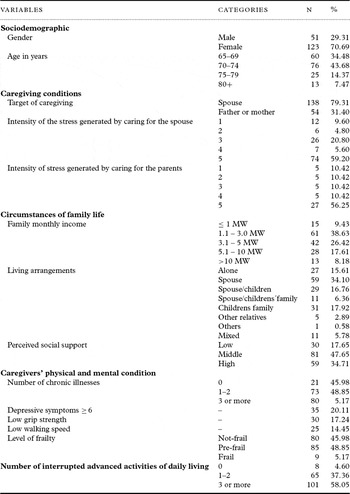
The majority of the 176 elderly caregiver participants was female, aged 65 to 74 years, and reported having cared for a spouse. Sixty-nine percent of those who cared for parents and an equal proportion of those who cared for a spouse scored at the highest levels (4 and 5) on the scales of perceived stress. The great majority had a family monthly income varying between 0 and 5 minimum wages (MW). The majority reported living arrangements that included the spouse and/or one or more members of the family. The frequency of those who judged their social support as low was small. Almost half of the caregivers reported not having chronic illnesses, 20% reported depressive symptoms suggestive of depression (GDS ≥ 6), 17% had low grip strength, and 14% had low walking speed. Almost half were pre-frail and 58% had interrupted more than three AADLs (Table 1).
Distribution of the caregivers’ characteristics (n = 176)

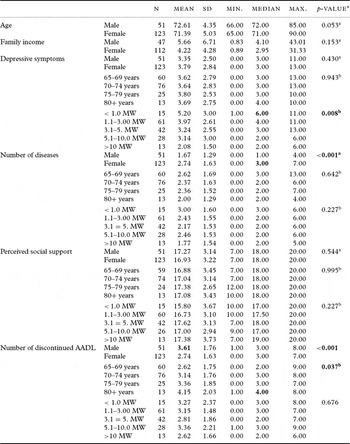
Their ages ranged between 68 and 90 years, with an average of 71.8 ± 4.86 years. The mean family monthly income was 4.64 (R$1990.00) ± 4.98 MW (R$2279.00). There were no statistically significant gender differences for age and income. There were more octogenarians among those with an income that varied from ≤ 1 to 3 MW and more elderly people aged 70–74 years among those with an income over 10 MW.
There were significantly more men living only with a spouse, or living with a spouse and children, and only women lived with their children's family. The highest proportion of elderly people living alone was observed among the poorest participants and the highest frequency of elderly participants living only with a spouse was seen among those who earned more than 10 MW monthly. Only a small part of the sample, regardless of gender, age or income, lived with extended family, consisting of the couple and children, grandchildren and great-grandchildren. Mixed arrangements included a spouse, direct descendants, other relatives and, more rarely, domestic workers. Few participants reported living in such kinds of family arrangements.
The highest frequency of those with depressive symptoms was found among the poorest participants. Only 5.17% of the elderly caregivers were classified as frail, whereas 48.85% were classified as pre-frail and 45.98% were non-frail. The elderly aged over 80 years and those aged 75–79 years were the most affected in terms of low grip strength.
There were no statistically significant differences between the frequency of participants that evaluated their perceived social support as low, medium or high, according to gender, age and income criteria. More than 50% of participants had abandoned three or more AADLs and 37.36% had discontinued one or two AADLs. Men reported having stopped a significantly higher number of AADLs than women. The octogenarians reported having stopped more AADLs than younger elderly participants (Table 2).
Descriptive statistics for age, gender, family income, depressive symptoms, number of chronic diseases, social support and number of discontinued AADL

*sign. if ≤ 0.05; a Mann-Withney; b Kruskall-Wallis and post hoc of Dunn.
MW = minimum wage; AADL = advanced activities of daily living
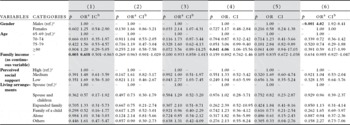
Univariate and multivariate logistic regression analyses were conducted to investigate relationships among gender, age, family income, living arrangements and perceived social support as independent variables, and depressive symptoms, comorbidities, low grip strength, low walking speed and discontinuity of AADLs as the dependent variables.
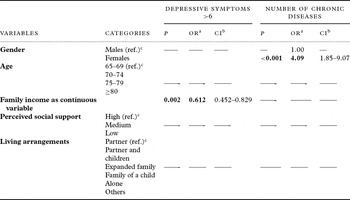
As a result of these analyses it was observed that every monthly minimum wage earned by the elderly participants corresponded to a decrease of 34.2% in the risk of having depressive symptoms (GDS ≥ 6); being female represented a two-fold greater risk of having three or more comorbidities; perceiving social support as low increased the risk of having three or more chronic illnesses almost three-fold, in comparison with high perceived social support; being older than 80 years of age represented a four-fold increase in the risk of having low grip strength, in comparison with being younger; and being male represented a four-fold higher risk of social isolation than being female (Tables 3 and 4).
Univariate logistic regression analyses for depressive symptoms (1), frailty (2), number of chronic diseases (3), low grip strength (4), low walking speed (5), and discontinuity of three or more AADL (6) (n = 174)

*Sig, if ≤ 0.05; aOR = Odds ratio; bCI = confidence interval (95%); cref = level of reference.
Multivariatelogistic regression analyses over depressive symptoms ≥ 6 and number of chronic diseases (n = 174).

*Sig, if ≤ 0.05; aOR = odds ratio; bCI = confidence interval (95%); cref = level of reference.
Discussion
The aim of the current study was to describe the profile of a sample of elderly caregivers in terms of their sociodemographic, health and caregiving conditions. An additional aim was to investigate the impact of sociodemographic and caregiving conditions on physical and mental health parameters and social isolation. Results indicated that gender, age, income and low perceived social support were associated with adverse health and social outcomes.
The percentage of caregivers in the sample was comparable to that reported by Giacomin et al. (Reference Giacomin, Uchoa, Firmo and Lima-Costa2005) in the study of Bambuí, a previous Brazilian population-based study of community-dwelling elderly people. The distribution of the sample by gender, age, and type of living arrangement was comparable to that of the population of Campinas (IBGE, 2009). The predominant living arrangements for both genders were conjugal family and husband, wife and children living in the same household, which may be due to the fact that there was a predominance of elderly people younger than 75 years of age in the sample. Twenty-five percent of women were living with the family of one of their children, but men were not found in this type of living situation at all. This reflects greater female longevity and the existing practices in Brazil in this generation of women who tend to marry older men and, and when widowed in old age, do not remarry. A limited number of elderly people were living with their extended family. This may reflect the influence of urbanization and the decline in fertility and birth rates in Brazil in recent decades.
In the current study, depressive symptoms were strongly associated with poverty among elderly caregivers. It is worth noting the high frequency of elderly people living alone, which is far greater than in the general population. However, living alone may not linearly explain the physical and mental health problems of caregivers as caring does not necessarily lead to depression, chronic diseases and social isolation (Pinquart and Sörensen, Reference Pinquart and Sörensen2006). It is possible that a substantial number of elderly lived alone due to the death of the spouse for whom they had provided care. The fact that most of the elderly people with a high number of depressive symptoms were poor indicates the lower levels of protection and worse emotional and physical health conditions within this income level.
As in other studies, the sample scored highly on perceived social support (Robinson et al., Reference Robinson, Fortinsky, Kleppinger, Shigue and Porter2009; Koerner et al., Reference Koerner, Shirai and Kenyon2010). This is possibly due to the predominance of women in the sample. Women are better able to call on social support and receive greater benefits from the protective effects of this type of support against the chronic stress associated with care as compared to men (Robinson et al., Reference Robinson, Fortinsky, Kleppinger, Shigue and Porter2009). Consistent with these data, the perception of low social support was associated with a greater probability of AADL discontinuity.
The higher rates of comorbidities found among women in comparison to men were expected given the available accounts in the gerontological and caregiving literature (Pinquart and Sörensen, Reference Pinquart and Sörensen2006; Reference Pinquart and Sörensen2007; Huang et al., Reference Huang, Souza, Perng, Hwang, Tsai, Huang and Yao2008; Koerner et al., Reference Koerner, Shirai and Kenyon2010). The lower grip strength in older caregivers was expected because of the impact of the physiological aging process, which determines that older people have less muscle strength due to sarcopenia and that the physical functions that depend on strength decline proportionally to the losses in structure (Oswald, Reference Oswald2009). This fact may explain the greater frequency of older people who abandon AADLs. It is possible that AADL discontinuity is a form of selection used by the very elderly to allow physical investment in caregiving tasks, which, in the context of their lives, are more necessary and urgent. It is also possible that a selection process of social activities occurs, which may favor the activities with lower requirement for involvement with social partners and with varied activities. In both cases, discontinuity would be an adaptation strategy and not a form of withdrawal determined by the decline of functionality.
However, in this research, men stopped practicing AADL more often than women; this finding was unexpected as they generally have better health and functional conditions and higher social status and participation than women. As the majority of men had fewer chronic diseases, less frailty and higher muscle strength than women, the reasons for discontinuing AADLs were not due to functional incapacity. Therefore, it may be inferred that caring implies a greater deprivation of contacts and complex social activities outside of the home for men than for women. It is possible that a lack of caring abilities, which are more associated with female than male roles, leads men to require more time to perform these tasks than women. It is also possible that women are able to integrate the housework and the instrumental support tasks in such a way that they are able to perform one as if it were a natural extension of the other and both as part of their obligations and feminine identity. Men may suffer more from the lack of social support than women, or may be less competent in promoting such support. Furthermore, perhaps the schedule of care activities, which frequently includes housework, rivals the schedule of complex male social activities in terms of type, time and organization adopted by non-caregiver male social partners. These data replicate those found in the meta-analysis developed by Pinquart and Sörensen (Reference Pinquart and Sörensen2007) on studies on the health of caregivers. Male elderly caregivers, whose number tends to increase with age (IBGE, 2009), deserve more attention as a risk group while they care for a family member, and when they find themselves left alone due to the death, institutionalization or transfer of their spouse to another residence.
The logistic regression analyses showed family income as robustly associated with depressive symptoms, and female gender associated with having three or more diseases. These results are compatible with those of Huang et al. (Reference Huang, Souza, Perng, Hwang, Tsai, Huang and Yao2008) and Pinquart and Sörensen (Reference Pinquart and Sörensen2007). However, the effects of low income are not restricted to old age. Poor elderly people were likely to have been socially disadvantaged throughout their lives. Their development would have been affected by exposure to chronic and recurrent stressors generated by the lack of economic resources (Kahn and Pearlin, Reference Kahn and Pearlin2006). Poverty may be associated with many adverse variables that weaken the resistance to health risk factors.
In the context of the Aging, Stress and Health Study, Kahn and Pearlin (Reference Kahn and Pearlin2006) examined the relationships between persistent financial disadvantages occurring throughout life and health status in old age. The study revealed a strong impact of economic disadvantage that occurred early and throughout life on the conditions of health that manifested in the number and severity of symptoms, incapacity, depression and negative self-evaluations of health, even when controlling for the effects of income levels on old age. Thus, economic disadvantages experienced before the age of 35 years caused impairments to health and these impairment were present after the age of 35. Financial problems that began in middle age did not have deleterious effects on health in old age. It was further shown that the persistence of difficulties was more relevant than episodic events. The adverse effects of social inequality on late-onset depression are more robust than the effects of individual income or mean income of the population (Lorant et al., Reference Lorant, Deliège, Eaton, Robert, Philippot and Ansseau2003; Ladin et al., Reference Ladin, Daniels and Kawachi2009).
For the elderly who were very poor and who have lived under severe conditions of social inequality throughout their entire lives, old age only exacerbates the physiological, social and psychological disadvantages that are likely to occur at this stage. These disadvantages interacted with chronic deprivation of opportunities to care for their health and to have their loved ones equally well cared for and educated. In agreement with these findings, a higher prevalence of chronic diseases, frailty, incapacities, depression and cognitive deficit was observed among the elderly who experienced greater poverty, particularly the women and the less educated.
In caregiving situations, these adverse conditions co-vary with the lack of information about the changes that patients are going through and about what the caregivers must do in relation to the person for whom they provide care (Elliot and Pezent, Reference Elliot and Pezent2008). These conditions are associated with a lack of instrumental help from the formal support network, difficulties in coping with crisis situations and insufficient money to meet the family and care needs. At the same time, the caregivers must subsist with reduced opportunities to access health services and to participate in activities, social interactions and the fulfillment of significant roles for the maintenance of the self.
The nature of the data does not allow for determination of cause and effect relationships between caring and the other variables considered because this was not a longitudinal or experimental study. Because of the inherent difficulty in separately controlling for the effects of each examined variable, the results could not be independently attributed to aging or care. Limitations due to the design, among them the size of the sample, the absence of equal numbers of men and women, the family relations and the lack of information on the circumstances of care (for instance, its duration and continuity at the time of the interview, as well as the long period of five years comprehended by the question about caregiving, which can give rise to memory distortions) do not allow for broad generalization. New longitudinal studies with larger sample sizes that compare caregivers and non-caregivers could indicate other relationships and clarify the relationships found in the current study.
Despite these limitations, this study offers indicators for understanding the multiple variables involved in family care that is provided to the elderly by other elderly people, especially men. Caregiving is an increasingly common event that affects women, men, the family and other social institutions. Its characterization as a process rooted in the life history of individuals and families, including cultural and macro-structural factors, aids the understanding of these relationships.
Conflict of interest
None.
Description of authors' roles
Anita Liberalesso Neri was the coordinator of the main project, planned this study and had the main responsibility for writing the paper; Mônica Sanches Yassuda was co-coordinator of the main project and participated in the preparation of the paper; Andrea Cristina Garofe Fortes-Burgos, Efigênia Passarelli Mantovani, Flávia Silva Arbex Borim and Stella Vital de Souza Torres were responsible for the recruitment of participants and for the data collection; Mônica Rodrigues Perracini and Maria Elena Guariento reviewed the paper.
Acknowledgments
We thank the Conselho Nacional de Pesquisa e Desenvolvimento (CNPq) for supporting the project of which this study forms a part (Process N. 555.082/2006-7).