INTRODUCTION
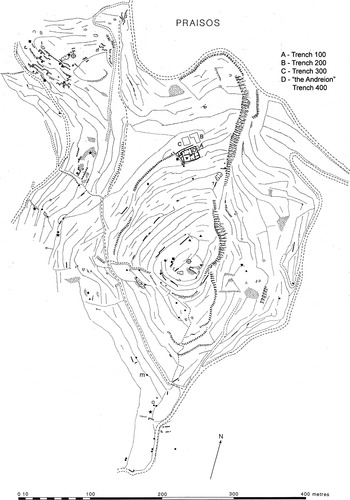
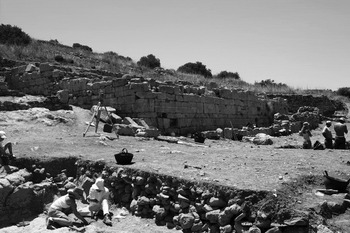
In 2007, the British School at Athens returned to the ancient city of Praisos in eastern Crete (Fig. 1), a site which the School had last excavated in 1901.Footnote 1 Excavation was concentrated in locations within the fenced alpha zoni on the north west slopes of the First Acropolis of Praisos, immediately to the west and north of the so-called Andreion or Almond Tree House, previously investigated by R.C. Bosanquet (Bosanquet Reference Bosanquet1901–2, 259–70) (Figs. 2 and 3). A plot of land, owned most recently by Georgios Christodoulakis and his family, was purchased by the British School at Athens especially for the purpose of excavation.Footnote 2 Excavation was followed by two seasons of study, conducted in the Ayios Antonios apotheke at Palaikastro.Footnote 3 Though not all the finds have been closely scrutinised (and some have yet to be cleaned), study has proceeded to the point where we have some results, which are of sufficient interest to be worth publishing in this preliminary form. It should be emphasised however that, this being a preliminary report, some of the results and interpretations are provisional – in other words, they may turn out to be wrong.
Location map of Praisos.

Position of trenches (in relation to 1992 plan of the First and Second Acropolises of Praisos).

View showing trenches in relation to the Andreion.

BACKGROUND AND PROJECT GOALS
Praisos was famous in antiquity as the city of the Eteocretans (‘True Cretans’), one of the five peoples of ancient Crete mentioned in the Odyssey (ix. 175–7). Praisian ethnic exceptionalism is noted by Herodotus (vii. 170–1), though it is only Strabo (x. 4.6; x. 4.12) who identifies Homer's Eteocretans with Herodotus' Praisians. The Cambridge scholar Pashley was the first to identify the site in modern times, settling a longstanding confusion with another Cretan city, Priansos.Footnote 4 In the 1880s the ‘Eteocretan’ character of the site was dramatically confirmed by the discovery of Archaic and Classical inscriptions, written in Greek letters but not in the Greek language, in various locations around Praisos.Footnote 5 Systematic excavations were undertaken first by the great Italian scholar Federico Halbherr in the 1890s (Halbherr Reference Halbherr1894; Reference Halbherr1901), and then by R.C. Bosanquet for the British School at Athens in 1901 (Bosanquet Reference Bosanquet1901–2). It was Halbherr and Bosanquet who devised the terminology we still use to describe the topography of the ancient city, where the principal settlement lies on the First and Second Acropolises, with the principal sanctuary (the Third Acropolis or Altar Hill) to the south. Between 1901 and 1992 the Greek Archaeological Service undertook a variety of rescue excavations and other investigations in the environs of Praisos, but (until recently) there has been no systematic investigation of the city itself.Footnote 6 More recently the site and its environs have been the focus of a survey project (the Praisos project). An EDM (Electronic Distance Meter) topographical survey of the site in 1992 was followed by three seasons of fieldwalking survey, in 1993, 1994 and 1998, whose purpose was to determine the broad settlement history of the area.Footnote 7
Excavation of the city is the logical next step. The 2007 excavations were conceived as the first season of a larger project, whose principal aim is to investigate domestic space, urban structure and the material expression of ethnicity in this ‘Eteocretan’ city. A subsidiary objective is to explore what, if anything, Praisian identity may have to do with the Bronze Age (‘Minoan’) past, and to determine if any manifestation of linguistic difference (such as more ‘Eteocretan’ inscriptions) was maintained into Hellenistic times. The 2007 season also had more limited, if also more specific, goals. The first of these was to understand the use of space in and around the Almond Tree House (the so-called Andreion); the second was to investigate the plausibility of Bosanquet's interpretation of this building (not simply an andreion, but a koimeterion), whose monumental façade provides a prima facie case for its being at least some kind of civic structure (Bosanquet Reference Bosanquet1901–2, 260 quoting Dosiadas [Jacoby, Fragmente der griechischen Historiker 458 F2]). A third aim was to try to define the last phase of settlement on this site, before its destruction by Hierapytna at some point between 146 and 140 bc; a fourth was simply to provide a stratigraphic sequence which could form a firm basis for a ceramic sequence of the historical period.
METHODS AND PROCEDURE
In order to understand domestic space and urban structure one has to adopt the principle of an open-area excavation, with trenches of variable size, if always of broadly rectilinear shape. The recording method adopted was a modification of the single-context excavation method now standard in Britain (also known as the Barker/Harris method), incorporating features of the American locus system (as used at Azoria; see Haggis et al. Reference Haggis, Mook, Scarry, Snyder and West2004, 347–9) for the numbering of trenches and the traditional British School at Athens ‘zembil’ system (as originally devised by Sinclair Hood, and refined by A.H.S. Megaw and others). Contexts were first defined by trench, but then by natural layers or features. Contexts were further subdivided by zembil (or pail) at the decision of the trench master, to define particular assemblages or to differentiate between finds from different days. The aim here was to provide comparability of results with the excavations at Itanos and Azoria. Small finds, pottery and bone were all defined by zembil (pail) and numbered accordingly. Soil samples were taken from possible floor areas, from the insides of pithoi, from pits and from other well-defined contexts. Layers of particular interest, in particular those close to floors, were dry sieved using a quarter-inch mesh. All soil samples were wet sieved, using a froth flotation device built by Evi Margaritis. All small finds (objects other than pot or bone) were recorded three-dimensionally using the School's Total Station (a Leica TCR407). Ten soil micromorphology samples were taken from ancient surfaces in trenches A-200, A-100 and A-400 (the ‘Andreion’).
These methods are reflected in the numbering system we have adopted. So, for example, the object in Fig. 13 (A-202.6 object 5) is from one of the top layers in trench 200 (context 202), pail/zembil number 6, object number 5. Pottery and tile were not given individual numbers, but simply grouped by zembil.
After clearing of the vegetation covering the area, and in particular of the plants, stone blocks and other debris obscuring the north and west faces of the Andreion, three trenches were opened up (Figs. 2 and 3). The smallest (A-100), immediately to the north of the Andreion, was defined by two of the surviving walls which Bosanquet had called ‘earlier’. Two larger trenches were opened to the west of the Andreion, A-200 to the north, and A-300 to the south. For recording purposes, the Andreion was itself considered a trench (numbered A-400).
All bone, all small finds and much of the pottery was washed. Finds processing during 2007 was followed by two study seasons at the Ayios Antonios apotheke, Palaikastro in 2008 and 2009. Study involved washing, strewing, weighing and counting sherds from trenches A-100 and A-200. In 2009 acid was applied to selected sherds which had been very badly affected by limescale, under the supervision of a trained conservator, Stephanie White. All washed pottery was weighed and counted by pail before sherds were selected for cataloguing. In all, 10,473 sherds from 54 separate zembils, weighing 196.977 kg, were processed in the 2008 and 2009 study seasons. Of these, 2141 were thrown as being of no further interest. Small finds were cleaned and studied in all seasons, the metal finds being cleaned and conserved in 2009. The animal bone, flotation samples and micromorphology samples have been stored in specially constructed boxes, to await permits for their transport and subsequent study. The two walls in A-100 and the top of wall A-310 were conserved with a mix of white mortar, grey mortar and quarried sand. Finds are stored in the Siteia museum for the time being.
RESULTS BY TRENCH
Trench A-100
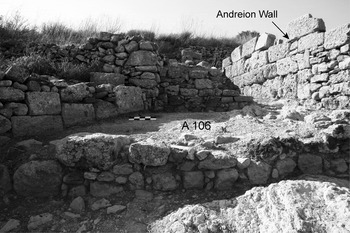
This area (Fig. 4), defined by two of Bosanquet's ‘earlier walls’ to the north of the Andreion (though which two proved difficult to determine), was not completely investigated. The first clear result from clearing the vegetation was that these two walls, though of inferior workmanship, clearly abut and are therefore later than the north west outer face of the Andreion. The walls do not underlie this monumental structure, as Bosanquet thought.Footnote 8 To the west, cleaning the face of the outermost and lower wall revealed a layer of clay mixed with some organic material. This was interpreted as possible roofing debris underlying the wall, which was not excavated in 2007. After cleaning and removal of topsoil, two micromorphology samples were taken in the north east corner of the area between the walls, and layers of probable hillwash then removed. A more compact surface was reached just above bedrock. Though this is probably not a floor in the proper sense, it is clearly an ancient surface.
View of trench A-100 and walls.

Finds from the layer of compacted hillwash comprised numerous (1353) sherds of broadly late Classical or early Hellenistic date, all very worn and fragmentary, with some residual earlier finds (including two possible Middle Minoan examples), two metal objects (including a possible weight) and a spindle whorl. Subsequent cleaning revealed three very worn terracotta figurines (including an almost unrecognisable daedalic head), which cannot represent primary deposits. None of these objects can be considered as being in situ, and so none is very useful for dating purposes.
Catalogue of small finds (objects) from trench A-100
1. A-106.4 object 3. Copper alloy shaft, c.3 cm long, possibly from a pin.
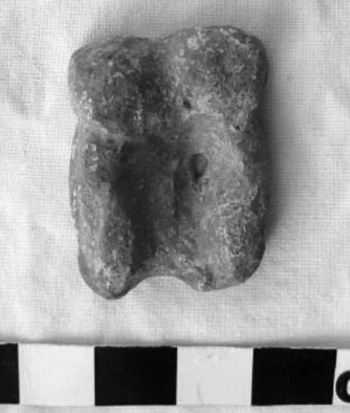
2. A-106.4 object 2. Lead weight? 3.5 cm long (Fig. 5).
Fig. 5.Lead object from trench A-100, A-106.4 object 2.


Trench A-200
As with its neighbour to the south (A-300), the most prominent feature in the upper levels of this trench was the medieval-to-modern terrace wall (A-203), which we hoped might give us some indication of the line of an underlying ancient wall. The upper layers below topsoil (contexts A-201 to A-211) consisted of a fill of loose stones (or tumble) – relatively large blocks (0.3 m × 0.3 m), some worked, most not – full of loose earth and scorpions, and rich in cultural material (Fig. 6). These layers were, in some places, about 1 m thick. The cultural material comprised large quantities of animal bone, tile, and pottery of various dates from the Bronze Age until the present. Small finds from these layers comprised terracotta plaques and numerous terracotta loomweights of all types. The cultural material is described below.
View over trench A-200 from NE, early phase of excavation, after removal of the upper tumble layers.

Upper layers: Pottery
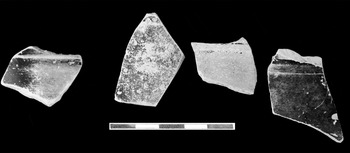
Though these upper layers were all mixed, the bulk of the material was Classical and Hellenistic in date. The working hypothesis is that these represent the material thrown out during Bosanquet's 1901 excavation. The deposits appear to be more mixed (with more early material) closer to the top – which may be evidence of ‘reverse stratigraphy’. The deposits comprised fineware cups, hydrias and jugs, and tile (most in a distinctive tile fabric), mostly of late Classical or Hellenistic date. Datable pottery includes large jugs or hydrias with dropped floors, and bowls with incurving rims. The most recognisable fineware shape is the Cretan necked cup (Fig. 7), in both its high- and low-necked varieties (Callaghan Reference Callaghan1978, 6–8; Erickson Reference Erickson2000; Reference Erickson2002, 58–65). Such cups are rarely decorated with anything more elaborate than black or red paint, though they seem to have been quite large (with rim diameters of between 0.09 and 0.13 m). The proportion of such cups in these deposits varies from 1% (closer to the surface) to 20% (further down). So far, no deposit composed primarily or exclusively of such cups has been found. However, it is clear that these (probably Classical) necked cups were produced by three distinct workshops.
Neck–shoulder joins of Classical–Hellenistic necked cups from trench A-200 (deposit A-204.8), upper layers.

One workshop produced a very fine, hard grey fabric, where the black paint has bonded completely with the body. The walls of these vessels are extraordinarily thin (0.004 m on average), and the fabric very hard fired. A second series is characterised by a softer, orange fabric, where the black paint is poorly bonded to the surface of the vase (and often comes off when washing). The latter fabric is almost certainly local; the origin of the first fabric is unclear, but must be Cretan. A third, and much rarer, fabric has been fired a pale green colour, and has a wall thickness of 0.002–0.003 m – almost as thin as ‘eggshell’ Kamares ware; a fourth (rarer still) is in a pale fabric, with thicker walls. Since the shape is clearly the necked cup, a Cretan origin must also be supposed for all these fabrics. Other indications that drinking took place in the vicinity are a considerable number of pedestal bases, three examples having the characteristic ‘rilling’ (Fig. 8) that may be characteristic of Praisian wares in the fourth century bc (see Whitley Reference Whitley, Deger-Jalkotzy and Lemos2006, 610 fig. 31.7), and numerous bases of jugs and oinochoai.
Cup bases with ‘rilling’ from upper levels of trench A-200 (deposit A-204.13), probably 4th century bc.

Upper layers: Coarsewares
The vast majority of the coarse fabrics on the other hand must be local, with phyllite or quartzite inclusions conforming to the general impression of the ‘phyllite-quartzite series’. There is one major exception, however, and that is a coarse yellow fabric with clearly micaceous inclusions (Fig. 9 and Fig. 10). This material represents (by number or weight) about 1%, or at most 2%, of the finds in the upper levels of trench A-200. Sherds in this fabric seem to come from open vessels (such as mortaria) as well as closed ones (such as pithoi). Macroscopic examination suggests that the mica is silver, rather than gold or black. Silver mica is generally taken to indicate either a Cycladic (Naxian?) or a West Anatolian origin for Aegean fabrics (though this is by no means certain), and raises the so-far unexplored question of trade in specialist coarsewares in Classical and Hellenistic times.
Imported coarse fabric, fragments from Hellenistic pithoi (upper sherd from deposit A-211.03).

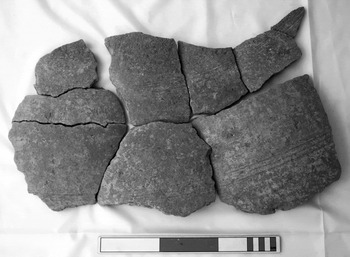
Close-up of rim of sherd from pithos in imported coarse fabric from deposit A-205.5. See page 375 for colour version.

Imports
There are at least 15 sherds of what look like Attic imports of black-glazed ware, probably dating to the fourth century bc (Fig. 11). These however represent no more than 0.5% of the assemblage in A-204.9, the zembil in which they are most frequent. Other possible imports include a Hellenistic cup from Ephesus, and a possible late Classical cup from Afrati (see Erickson Reference Erickson2002).
‘Attic’ imports from trench A-200 (deposit A-204.9).

Tile
This is found in virtually all contexts in trench A-200, in some cases (deposits A-202.13 and A-202.14) forming about 10% of the context by both weight and number. These tiles are (with one or two exceptions) of a uniform fabric with grog and purple phyllite inclusions, and therefore probably produced locally. Both pan tiles and ridge tiles in the so-called ‘Corinthian’ technique are found. Halbherr found an inscribed ridge tile on the First Acropolis, and Bosanquet recorded finding Corinthian-style ridge tiles from his excavation of the Almond Tree House, so their discovery is no surprise.Footnote 9 Presumably the tile was painted to provide extra waterproofing, but no paint has survived on the highly eroded tile we found in these upper deposits.
Tile is nonetheless rare in Crete in all periods, apart from the Roman. It was not used in the Bronze Age, and was not in general use in the neighbouring site of Azoria in late Archaic and early Classical times. Azoria was destroyed and abandoned around 475 bc; the roofs of the houses at Azoria were uniformly of the traditional Cretan roofing technique. This technique, using timbers, brush and packed clay, was employed in Crete both in ancient and in modern times, and is memorably described by Pendlebury in his report from Karphi.Footnote 10 Tiled roofs were introduced some time after this. But when?
The sequence at Knossos is the most complete in all of Crete. Here, tile seems to be fairly common in Hellenistic deposits of the second century bc, such as pit 1 (deposit H28) in the Unexplored Mansion (Sackett Reference Sackett1992, 117–20 and 407) and the Little Palace Well (Callaghan Reference Callaghan1981, 36). There are reports of earlier finds from Classical levels at Knossos, but none has as yet been published. Most Knossian tile, and indeed most tile reported from other Hellenistic deposits in central Crete (e.g. at Lyktos: Lebessi Reference Lebessi1971, 495), is ‘Laconian’ rather than ‘Corinthian’. A better analogy to the situation at Praisos is Kommos, in south-central Crete. Here, the third temple (temple C), constructed sometime in the middle of the fourth century bc, had a tiled roof. A considerable quantity of both pan and cover tiles employing the ‘Corinthian’ technique of roofing were recovered from this and several other late Classical and early Hellenistic buildings at this sanctuary (Shaw and Shaw Reference Shaw and Shaw2000, 76–8).
Tile from Praisos resembles tile from Kommos quite closely. The bulk of the tile from our upper layers is of a fabric which demonstrates a fairly sophisticated knowledge of tile technology. Made in a light fabric that is very much fit for purpose, our tile represents a developed and probably imported roofing technology. And the numbers of tile fragments suggest that this established technology had been around for some time before Praisos' abandonment in 145 bc. For all these reasons, a date for the introduction of tile technology in Praisos sometime in the late Classical period may be proposed with some degree of confidence.
Lamps
Several parts of simple, single-nozzle lamps, usually spouts, were recovered from the upper layers (Fig. 12). The lamps were all very simple in form – corresponding largely to Howland type 21 or 21b (Howland Reference Howland1958, 44–7 pls. 6 and 34). In Crete the typology should not be pressed too much, as these types vary little in the Classical and early Hellenistic periods.Footnote 11 The distribution of lamp fragments is given in Table 1.
Lamp fragments from trench A-200 (deposit A-204.8).

Distribution of lamp fragments, by trench.

Terracottas
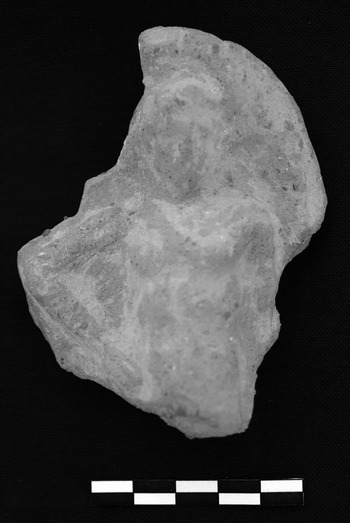
Two terracotta plaques were uncovered during the excavation of the upper layers: one, of a young man (Fig. 13), was found during excavation; another, of a plumed warrior, was revealed by subsequent cleaning (Fig. 14).
1. A-202.6 object 5 (Fig. 13). Height 0.093 m, width 0.76 m, wall thickness 0.011 m. Fabric includes phyllite inclusions. This terracotta plaque, made from a single mould, corresponds to Forster type 25 or 26 (Forster Reference Forster1904–5, 252–3; Halbherr Reference Halbherr1901, 392 fig. 24). Forster described type 25 as the most common of those that were revealed in excavations in and around Praisos (in various locations) in 1901. The figure depicts a young man, and the modelling of the torso and the contrapposto pose of this type make a date before 430 bc (Polykleitos) unlikely and one after 350 bc (Praxiteles) implausible. The size of our figure makes it more likely that it belongs to Forster type 26 than to type 25. The iconography of both types continues that of the ‘belted man’, that is Forster type 12 (Forster Reference Forster1904–5, 248–9; for examples see Higgins Reference Higgins1954, 162 nos. 596 and 597; Mollard-Besques Reference Mollard-Besques1954, 30 B172 = Dohan Reference Dohan1931, 211 fig. 5). It also indicates a plaque earlier rather than later in the series (see Nicholls Reference Nicholls1952).
2. A-205.7 object 6 (Fig. 14). Height 0.09 m, width 0.063 m, wall thickness 0.008 m. Terracotta plaque of a warrior advancing to the left, with a plumed helmet and a shield in the form of a ram's head (very indistinct). Though the iconography corresponds to Forster's description of his type 11 (Forster Reference Forster1904–5, 248; see also Halbherr Reference Halbherr1901, pl. XII no. 3; Dohan Reference Dohan1931, 211 figs. 4, 6 and 7), our example is clearly neither from the same type nor from the same series. I have found no exact parallel for this piece. The image of a plumed warrior (though without the ram's head), however, nonetheless has a long history at Praisos. A clear antecedent can be found in Forster's type 10 (Forster Reference Forster1904–5, 248), which dates from the Geometric period (see Higgins Reference Higgins1954, 157–8 nos. 575–8; Dohan Reference Dohan1931, 210, figs. 1 and 2). Halbherr (Reference Halbherr1901, 392 fig. 25) illustrates a warrior plaque of Classical date, but without the ram's head on the shield. As to the date, the iconographic parallels for a ram's head used as a part of a suit of armour (on helmets rather than shields) are more easily found in the late Archaic period and the early fifth century than later. Cheek pieces in the form of a ram's head are found in several Chalcidian and Corinthian helmets from Olympia and south Italy,Footnote 12 and on the helmet of the marble head and torso of a warrior from the Acropolis at Sparta, dating from the early fifth century.Footnote 13 They are also depicted on some helmets on some Athenian black figure vases.Footnote 14 But the poor modelling of the figures, and the small size (0.09 m), might suggest that this plaque comes from late in its series (again, see Nicholls Reference Nicholls1952). Its date is therefore probably close to that of the other terracotta, or perhaps a little earlier, i.e. c.430–350 bc.
Late Classical/Hellenistic terracotta plaque from the upper levels, trench A-200 (A-202.6 object 5).

Late Classical terracotta plaque depicting a warrior holding a ram's head shield, A-205.7 object 6.

Our terracottas are not found here in sufficient quantities to suggest that there was a sanctuary nearby. Terracottas such as these are not unknown in Cretan domestic deposits of Classical or Hellenistic date; but they are highly unusual.Footnote 15 Two points should be noted. First, the images on these terracottas, though distinct from one another, are clearly and markedly masculine; and second, both continue a masculine iconography that can be traced back to the earliest appearance of terracotta plaques in the locality (c.700–675 bc).
Loomweights and spindle whorls
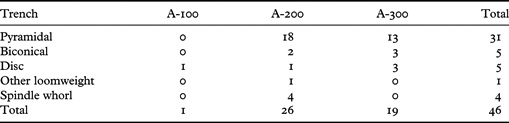
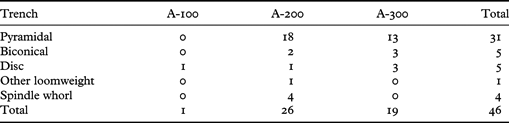
Loomweights and spindle whorls (especially the former) are quite numerous from the upper layers (A-201–211). All the common types of loomweights are to be found (pyramidal, disc and biconical), for which good parallels can be found in Knossos and Azoria.Footnote 16 These date from all times from the late Archaic until the Roman. Few, apart from the stamped loomweight from trench A-300 (A-306.12 object 4; Figs. 34 and 35), or the large loomweight from the floor A-216 (A-216.2 object 1; Fig. 24), require particular comment. Their distribution in the upper levels is however slightly skewed, as Table 2 shows.
Distribution (by trench) of loomweights and spindle whorls.
Inscriptions
Two sherds were found with simple inscriptions, one painted, the other incised.
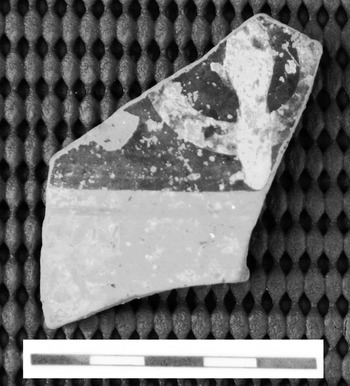
1. A-204.9 unnumbered. Hellenistic body sherd, from a closed vessel (jug or hydria), with Φ (phi) painted in white paint on a dark ground (Fig. 15).
2. A-207.13 object 2. Height 0.02 m, width 0.027 m, wall thickness 0.003 m. Inscribed sherd from a Hellenistic closed vessel (Fig. 16). The sherd is painted inside and out, with the letters Α Λ (alpha and lambda) incised. Black paint is found in the incision, so the letters were incised before firing (it is not a graffito).
Hellenistic sherd painted ‘Phi’ in white (A-204.9).

Incised sherd (A-207.13 object 2).

Together with the stamped loomweight from trench A-300 (A-306.12 object 4; see below and Figs. 34 and 35), these represent a small addition of three inscriptions to the thirty-one or so already known from Praisos.Footnote 17
Below these upper, tumble layers were levels which, if not closed, were relatively undisturbed. To the east, a rock-cutting formed the eastern extent of an ancient surface (almost certainly not a floor), below which were a number of small rock-cut pits and natural hollows, one of which contained a mass of animal bone, and another a high-necked cup. This surface – which was probably an open-air space, or αυλή, was squared off to the south west by a stone setting and marked to the south by a rock-cutting (which was not excavated). Four soil micromorphology samples were taken from this surface.
A-200: The floor levels
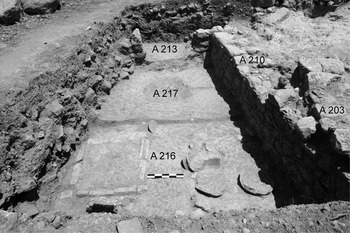
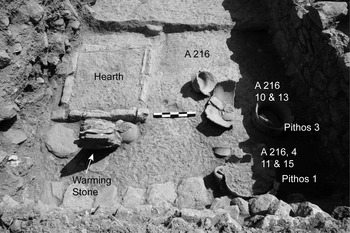
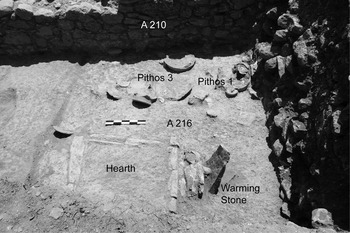
To the west, the terrace wall overlay, at a slightly different angle, a substantial ancient wall (A-210), at least 0.7 m wide (see Fig. 17), set almost against the vertical face of the bedrock (the filling between was not excavated in 2007). To the north west of this wall was a cross-wall (A-215) with a threshold in the north west corner and a rock-cut floor. The area behind this to the north west (A-213) contained numerous small finds – an iron and a bronze nail, an iron knife and a lead weight, a kernos, and some pithos fragments (Fig. 18, at back of photo). These seem to be associated with other terracotta weights which had fallen into the adjacent room (A-216), finds associated with further pithos fragments and our only (bronze) coin (Figs. 19, 20 and 21). Excavation of this adjoining room proved particularly productive. While the north west part of the room had been disturbed by a later pit (A-217), a layer of fragments of at least four pithoi which had fallen in situ were found in the south east corner. In the centre of the room was a stone column base (probably used to support the roof), and to the south west a rectangular stone-built hearth with a setting of stones and a small amphora to the south (Figs. 20 and 21). The stone setting is interpreted as a ‘warming stone’, and around this were masses of carbonised material. The hearth was not excavated in 2007, but left for excavation and analysis in a subsequent season.
General view of floor A-216, trench A-200 after excavation, from WNW, showing collapsed pithoi.

More detailed view of same, showing floor A-216 from SW.

View of trench A-200, close-up from SW, showing area of hearth with warming stone with collapsed pithoi.

View of trench A-200 from WNW, showing hearth in foreground.

Close-up of hearth (A-218) with ‘warming stone’ before excavation.

Parallels for this kind of room can be found in many parts of Crete in Classical and Hellenistic times. Very similar Hellenistic houses, examples of the so-called ‘linear house with hearth rooms’, are to be found at nearby Trypetos – house B1-3 being the best example (Westgate Reference Westgate2007, 432–4 and 438–9 figs. 12–13). Parallels for the hearth arrangement can be found in the B700-B1500 complex at Azoria (Haggis et al. Reference Haggis, Mook, Scarry, Snyder, West and Fitzsimmons2007, 274–94), dating from a much earlier period (c.500 bc).
A-213: Small finds
All loomweights are terracotta, unless otherwise stated.
1. A-213.2 object 1. Pyramidal loomweight.
2. A-213.2 object 2. Five joining fragments, 15 cm long, of a long curved iron tool held together with rivets (Fig. 22). Probably a reaping hook (that is, a small sickle), though it is just possible that it might be a strigil (Boardman Reference Boardman1971).
3. A-213.4 object 5. Disc loomweight.
4. A-213.4 object 6. Pyramidal loomweight.
5. A-213.4 object 7. Three joining fragments of another iron object – sheet iron?
6. A-213.4 object 4. A rectangular lead object, with flanges, weighing 0.995 kg. Probably a weight (Fig. 23).
A-213.2 object 2. Iron reaping hook (or strigil?).

A-213.4 object 4. Lead weight.

These finds seem to indicate some kind of work area, in contrast to the more obviously domestic character of the adjoining room (A-216 – see below).
A-214: Small finds
This is the level immediately above the floor deposit. These finds consisted entirely of loomweights.
1. A-214.1 object 3. Pyramidal loomweight.
2. A-214.1 object 4. Biconical loomweight.
3 and 4. A-214.2 objects 5 and 6. Biconical loomweights.
5 and 6. A-214.2 objects 7 and 8. Pyramidal loomweights.
7. A-214.5 object 11. Disc loomweight.
A-216
This floor deposit contained a number of small finds, substantial amounts of pottery and some large ceramic vessels. To deal with the small finds first:
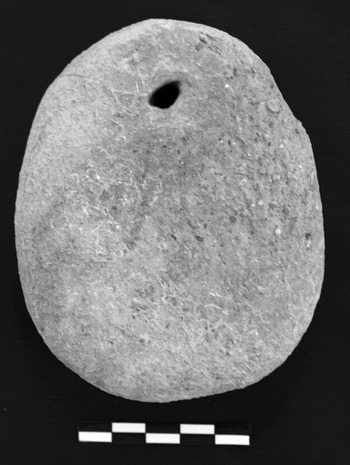
1. A-216.2 objects 1 and 2. Disc loomweights (no. 1 Fig. 24).
2. A-216.2 object 3. Stone weight.
3. A-216.2 objects 4 and 5. Disc loomweight.
4. A-216.2 object 6. Pyramidal loomweight.
5. A-216.2 object 7. Bronze coin, weight 3 g, diameter 0.012 m. Very corroded (Fig. 25). Only the reverse preserves an image of a winged thunderbolt. The obverse ought to be a head of Apollo, crowned with a laurel, but nothing here can be discerned. Almost certainly a coin of Praisos (Svoronos Reference Svoronos1890, 292 either 49 or 50; see also Wroth Reference Wroth1886, 72 no. 16 pl. XVIII, 5), datable to the third to second centuries bc.Footnote 18
6. 216.2 object 8. Pyramidal loomweight.
7. 216.4 object 10. Bronze stud (rather than nail), shaft 3 cm long. The ‘mushroom’ head is redundant from a purely functional perspective, and indicates that it was primarily decorative (Fig. 26).
8. 216.9 object 11. Pyramidal loomweight.
Disc loomweight (A-216.2 object 1) from floor level A-216.2.

Coin of Praisos.

Bronze decorative stud (or nail) with ‘mushroom’ head (A-216.4 object 10), 3 cm long.

The associated pottery from immediately above the floor (A-216.2, 216.4, 216.5, 216.6) comprised large numbers of fragmented pottery, including pithoi and cups. Cup fragments numbered at least 342 from these contexts. These levels also contained the remains of at least two storage vessels (pithoi; see below, under 5 and 6).
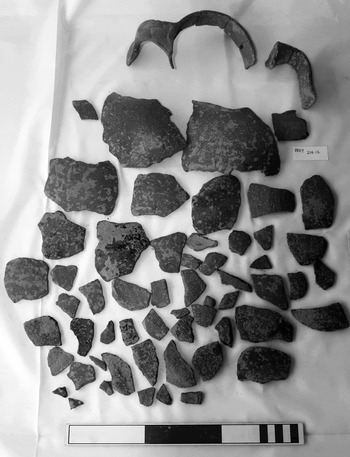
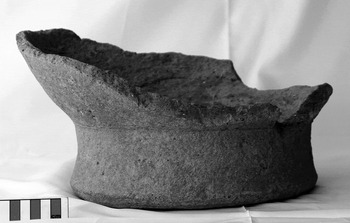
On the floor itself, several smashed and broken storage vessels (pithoi) were noted at the time of excavation, and put in separate bags (numbered as zembils). Subsequent cleaning has identified one near-complete cooking vesselFootnote 19 (A-216.12; see Fig. 27) and at least four pithoi of various dates, found on the floor.
Cooking vessel (A-216.12) from floor level.

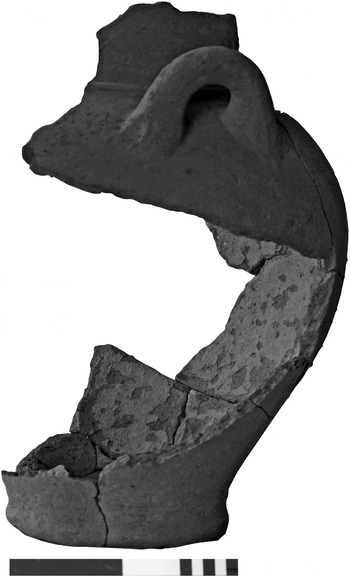
1. ‘Pithos 1’. A-216.15, 216.4 and 216.11 (Figs. 28 and 29). This comprises over 14 joining fragments of an Archaic pithos, height approx 0.6 m, base diameter 0.24 cm, wall thickness 0.015 m (0.03 m at base). The fabric fits into the Cretan phyllite-quartzite series, though it has not been studied petrologically.
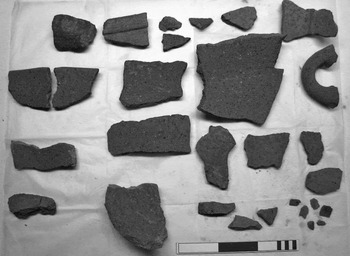
2. ‘Pithos 2’. A-216.11. About 16 pieces of another, very similar Archaic pithos, which could not be reconstructed (Fig. 30).
3. ‘Pithos 3’. This comprises three joining pieces of the neck, rim and shoulder (A-216.10) together with the base (A-216.13) of another Archaic pithos (Figs. 31 and 32). Estimated height approx 0.7–0.8 m (no joining pieces survive); base diameter 0.268 m, rim diameter 0.04 m, wall thickness 0.032 m. The fabric (with quartzite and calcite) is distinctly different from pithoi 1 and 2. The pendent tongue around the rim, and the unusual fabric, are features of the Afrati pithos workshop (Brisart Reference Brisart2007), which flourished around 600 bc, and was responsible for most of the (much larger) Cretan relief pithoi of Archaic times.Footnote 20
4. ‘Pithos 4’. At least 11 fragments (A-216.14) of the body of a large semi-coarse Classical or Hellenistic pithos.
‘Pithos 1’: A-216.15, 216.4 and 216.11. Archaic pithos: front view.

‘Pithos 1’: A-216.15, 216.4 and 216.11. Archaic pithos: side view.

‘Pithos 2’: A-216.11. Fragments of another Archaic pithos.

‘Pithos 3’: A-216.10. Rim of pithos of Afrati workshop.

‘Pithos 3’: A-216.13. Base of pithos of Afrati workshop.

Not from the floor, but immediately above it:
5. ‘Pithos 5’. At least 30 fragments (A-216.2) from a large Classical or Hellenistic pithos in a phyllite fabric.
6. ‘Pithos 6’. Nine joining fragments (A216.6) of a large Classical or Hellenistic semi-coarse pithos with incised bands (Fig. 33).
‘Pithos 6’: A-216.6. Classical/Hellenistic pithos with incised bands.

The discovery of large numbers of pithoi in domestic contexts at Praisos should come as no surprise. Bosanquet noted numerous examples in his excavation of the Almond Tree House, one inscribed ΠΑΝΣΩΝΟΣ (PANSONOS – ‘of Panson’) and one (set into the ground) in one of the houses below.Footnote 21 That three out of the four pithoi in this Hellenistic house were Archaic surely requires comment. The reason usually given for this habit of retaining storage vessels over the generations is that pithoi were expensive to produce, and so were repaired when necessary – Bosanquet (Reference Bosanquet1901–2, 270) notes a lead rivet from the Almond Tree House used for such a purpose. But, while repairs of pithoi using such devices can be paralleled in mainland Greece and the Cyclades in Classical and Hellenistic times, the extent to which Cretans clearly liked to hold on to their pithoi is remarkable. At Azoria, a Bronze Age (‘Minoan’) pithos has been found in a late Archaic/early Classical horizon (Haggis et al. Reference Haggis, Mook, Scarry, Snyder and West2004, 354 fig. 8 and n. 47). Moreover, the retention of Archaic pithoi into the Hellenistic period is not that unusual on the island – parallels can be found in the nearby town of TrypetosFootnote 22, in Knossos (in the Little Palace Well; see Callaghan Reference Callaghan1981, 36–7), in LyttosFootnote 23 and in PhaistosFootnote 24. These pithoi, like ours, are all associated with deposits of the second century bc, and (with the exception of the Little Palace Well) are generally found in destruction/abandonment horizons.
Clearly there is a social dimension to this retention of pithoi. In Archaic times, pithoi are closely linked, in both a practical and a symbolic sense, to households in both Crete and the Cyclades (Ebbinghaus Reference Ebbinghaus2005). Natalia Vogeikoff informs me that, at the nearby town of Trypetos near Siteia, which was established in early Hellenistic times and destroyed or abandoned (like Praisos) around the middle of the second century bc, each house had at least one pithos, and that pithos was, more often than not, Archaic in date (Vogeikoff-Brogan forthcoming). The most economical explanation for this is that the household pithos had been brought in when the family itself moved from one settlement to another. In Crete therefore pithoi are heirlooms in the full sense of that term – that is, objects passed down between several generations of the same family (or household). Pithoi therefore have a distinct kind of agency (sensu Gell Reference Gell1998), which is perhaps one of the reasons why pithoi are some of the few Cretan artefacts of Archaic through to Hellenistic date that come to be inscribed with their owner's name (Erpetidamos, Panson).
Trench A-300
In this trench we came down upon evidence of substantial Hellenistic walls very soon after we began to excavate. Fig. 34 shows the excavation at a relatively early stage. The upper layers in this trench, opened up around the probable Venetian/modern terrace wall, contained material which was, in most respects, very similar to that found in the upper layers of A-200: animal bone, loomweights, pottery of all dates from the Bronze Age to the early twentieth century ad, with Hellenistic material predominating. There were some slight differences between trenches A-200 and A-300, however. There were far fewer examples of Archaic cup bases in trench A-300, and two vessel types absent from A-200 – these being some possibly Roman ridged ware (about five sherds) and a few sherds of a dark fabric completely unfamiliar from anything found on the survey. At the time of writing, however, the pottery (and tile?) from these contexts has not been fully processed. Only the metal finds have been studied and cleaned.
Trench A-300: early stages of excavation, view from SE, from the Almond Tree House.

Small finds from this trench (for loomweights, see Table 2) from the upper layers comprise:
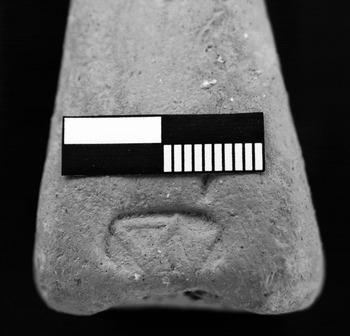
1. A-306.12 object 4. A pyramidal loomweight stamped ΑΔ in letters of the fourth century (Fig. 35). Fig. 36 shows detail of stamp.
2. A-305.2 object 4. An iron piece.
3. A-312.4 object 2. Nine fragments of an iron object.
A-306.12 object 4. A pyramidal loomweight stamped ΑΔ.

Detail of the pyramidal loomweight, showing the letters.

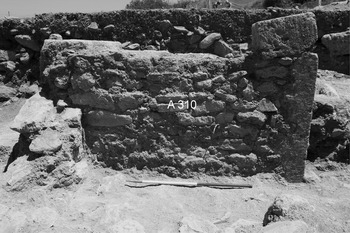
After the upper tumble was removed, at a depth of about 0.7 m we came down onto a complex of walls, some standing quite high. To the south of the trench, walls A-309 and A-307 formed two sides of a probable building whose insides were filled with tumble. The tops of these walls were defined, but not excavated further in 2007 (Fig. 37). Excavation concentrated on the north and north east corners of the trench, on either side of the extraordinarily well-preserved wall A-310, which ran broadly east–west. This wall, with its well-defined stone door jambs, survives to a height of about 1.8 m above the original ground surface (Figs. 38 and 39). Wall A-310 overlies partially another wall at right angles to it, wall A-314, which in turn clearly abuts (and is therefore later than) wall A-309. In the angle between walls A-310 and A-314 is a partially rock-cut bench next to a possible window in wall A-314 (Fig. 37). These walls appear to form part of the same building. To the west is another wall, A-315, whose exact relationship to this complex could not be determined (though this wall might continue and join up with a spur of wall A-314). Though the threshold was defined, the area north of wall A-310 was not completely excavated this year, and the floor was not reached. Excavation instead concentrated on the area immediately to the south of wall A-310, where a very large pithos (Fig. 40) seems to have been set into a ground or floor surface, a situation paralleled further to the south in a building excavated by Bosanquet (Reference Bosanquet1901–2, pl. XII). This surface was in turn directly overlaid with largish blocks (tumble, about 0.3 m × 0.15 m). A copper alloy rod (A-316.6 object 2; see below) was found immediately adjacent to this pithos.
Trench A-300 after further excavation, showing outlines of walls A-309, 307 and 310.

View of wall A-310 from S.

View of wall A-310 from S and above, showing door jambs.

Large pithos set into floor A-316 in trench A-300.

The small finds associated with these layers are:
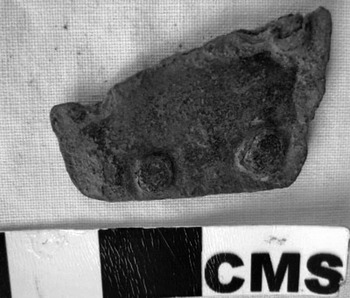
4. A-312.6 object 3. Two sheets of riveted bronze (Fig. 41).
5. A-316.5 object 1. Iron nail.
6. A-316.6 object 2. Copper alloy rod with possible signs of dark patination, and ‘Corinthian’ bronze (Fig. 42).
7. A-319.2 unnumbered object. Lead object.
Two sheets of riveted bronze (A-312.6 object 3).

Copper alloy rod (A-316.6 object 2), possibly ‘Corinthian’ bronze. See page 375 for colour version.

In sum, then, we have a complex of several walls in several phases, broadly datable to the Hellenistic period. Excavation would have to be extended to determine what buildings each wall belonged to, and indeed which spaces are ‘exterior’ and ‘interior’. The working hypothesis must be that these represent several phases of houses.
A-400
This is the number given to the ‘Andreion’, which was not excavated. Its west face was cleaned and photographed, fully revealing its monumental façade in a clearly mainland style broadly characteristic of the fourth century bc. The only excavation that took place in the interior of the structure were four soil micromorphology samples taken in the north west room, where some paving survives (Bosanquet seems to have dug through the original floor level in the room to the south).
Other areas
Though no other areas were excavated, several worked blocks from a large monumental structure were recovered which do not seem to fit the so-called Andreion. This may be an indication of there being another large civic building in the vicinity.
SUMMARY OF RESULTS AND PRELIMINARY INTERPRETATION
Inscriptions
These excavations uncovered three more short inscriptions, bringing the total known from Praisos to thirty-four.Footnote 25 Our inscriptions are too short for anyone to determine whether they were in Greek or Eteocretan, but the likelihood must be that they were in Greek. This is the language of the bulk of the known inscriptions, and Greek tends to predominate in public inscriptions in Praisos as we approach the second century bc. Three inscriptions (none public, none monumental) may not seem very much. Considering however that no more than 40 cubic metres of deposit were excavated, a higher proportion of inscriptions per cubic metre was revealed for Hellenistic Praisos than was found for late Archaic Azoria, where only 20 inscriptions were found over a much larger area (amounting to about 400 cubic metres at least).Footnote 26 It seems then that there might have been a slight increase in the use of writing for informal purposes in eastern Crete between the Archaic and the late Hellenistic periods.Footnote 27
The upper layers in trenches A-200 and A-300
Though these mixed deposits do not come from anything like a closed context, they are telling us something. First, the presence of residual Bronze Age, Early Iron Age, Geometric and Orientalising sherds confirms the results of the survey – they indicate early habitation on other parts of the First Acropolis further upslope. Second, the description of our upper deposits corresponds quite closely with Bosanquet's description of the finds he recovered from the Almond Tree House.Footnote 28 Third, it is clear from Bosanquet's report that he used some of the dump from his excavation of the Andreion to form terrace walls for the local (Muslim) farmers.Footnote 29 Part of the upper layers therefore probably represent Bosanquet's dump partly mixed with hillwash. That this dump comprised, in part, Archaic and later drinking vessels and animal bone is consistent with his hypothesis that the monumental building he also called ‘the Almond Tree House’ might, at some stage, have been an andreion, i.e. a public building or area for communal dining and drinking.
Is the ‘Andreion’ an andreion?
Bosanquet (Reference Bosanquet1901–2, 259–70) clearly was wrong about many of the details of his description of this building and the adjacent structures which he excavated – he failed to notice that all the surrounding walls butt onto, and thereby partially obscure, this structure. But he was probably right in thinking that its original purpose was not for processing olive oil – the olive presses must relate to a second phase of use, and perhaps to a complete re-interpretation of this structure (which may have taken place after 140 bc; see below). With the possible exception of the large structure at Ayia Pelagia (Apollonia)Footnote 30 just west of Heraklion, there are moreover no parallels for such a monumental building on Crete in late Classical or early Hellenistic times. It is much larger, and architecturally more complex, than most of the Cretan houses that Westgate (Reference Westgate2007) has studied (including those at nearby Trypetos). These considerations provide a prima facie case for its being some kind of civic building, rather than a private house. But does this make the Almond Tree House an andreion, or more specifically a koimeterion as Bosanquet (Reference Bosanquet1901–2, 260) thought?
The search for an architectural form – a type of building – to accommodate the ceremonies associated with that Cretan institution which ancient authors (and Cretan inscriptions) called the andreion has proved extraordinarily difficult. Claims have been made for a large Archaic structure at nearby Itanos (to the north east), and (to the west) a complex of buildings at Azoria.Footnote 31 But these two structures are, in architectural terms, as dissimilar as possible within the limited architectural repertoire of Archaic Crete. Such considerations have led a number of scholars (principally Prent Reference Prent2005, 441–76) to conclude that, while the institution clearly existed in Crete, its architectural expression varied greatly between regions and periods. Nonetheless, a reasonably good architectural parallel might be provided by the so-called ‘monumental civic building’ at Azoria (Haggis et al. Reference Haggis, Mook, Scarry, Snyder, West and Fitzsimmons2007, 295–301). Close to this large structure, which could seat tens if not hundreds, is the ‘service building’ (Haggis et al. Reference Haggis, Mook, Scarry, Snyder, West and Fitzsimmons2007, 274–94), which contains numerous pithoi for storing grain, and drinking vessels that could be used in syssitia. But if so, this is the only plausible such parallel, and it is not one that the excavators themselves wish to call an ‘andreion’. Not much then can be inferred from architectural parallels.
Interpretation therefore has to be based on what we found, on the assumption that the finds in our upper layers represent Bosanquet's dump. Three considerations support the interpretation of the ‘Almond Tree House’ as an andreion:
1) The considerable quantity of drinking vessels (together with the animal bones) found in the upper layers (dump) suggests some kind of communal drinking (and perhaps ‘feasting’). ‘Feasting’ in a particular location other than a sanctuary may be taken as a prima facie case for its being some kind of ‘diacritical’ feasting, in Dietler's sense,Footnote 32i.e. one that serves to define a relatively exclusive group within the larger community.
2) The presence and iconography of the two terracotta plaques. Terracotta figurines are rare outside of sanctuary contexts in eastern Crete (see for example Erickson Reference Erickson2009). The iconography of our figurines is emphatically masculine (andriko) – they depict a young man and a warrior. While such iconography is not uncommon in eastern Crete, it usually occurs within a range of iconographic types, including ‘Astarte’ figurines in other votive deposits, e.g. the deposit at Roussa Ekklesia (Erickson Reference Erickson2009), or the ‘spring shrines’ around Praisos (Whitley Reference Whitley, Cavanagh, Curtis, Coldstream and Johnston1998, 17; 2006, 606–9).
3) The architectural sophistication of the building suggests that it is a civic structure, and not merely a house (Westgate Reference Westgate2007, 434–5 and n. 125, 440–1 figs. 14 and 15 and 452–3).
There is one further consideration that might support Bosanquet's interpretation of the building as a koimeterion. The façade of the building, with its cleanly dressed ashlar masonry, would have been clearly visible to travellers approaching the city from the north, especially if they had taken a route similar to that of the Venetian/Turkish kaldirim that winds its way up from Maroneia by the Skalais cave. To any traveller coming from one of Praisos' ports (such as Trypetos) the building would have signalled its particular function by its outward form.Footnote 33
The Hierapytnan destruction and the final phase of occupation
Strabo (x. 4.12) is unequivocal in his statement that the Hierapytnans destroyed Praisos. This destruction, which we can date with some confidence as taking place between the death of Ptolemy Philometor (146/145 bc; see Guarducci Reference Guarducci1942, 4.9 lines 41–4) in Egypt and the consulship of C. Laelius (140 bc; see Guarducci Reference Guarducci1942, 4.10 lines 22-3) in Rome, is about the only secure event in Praisos' history. Bosanquet however does not mention this destruction in relation to his interpretation of the Almond Tree House. He only invokes it in his account of the sanctuary on the Altar Hill.Footnote 34
No signs of a destruction by fire were noted either in trench A-200 or in trench A-300. Wall A-310 seems to be the latest of our walls, and ought therefore to date to the last building phase of the city, that is some time in the decades before 146 bc. But there is no clear destruction horizon, nor is there any layer of tile collapse or roofing debris, of a kind easily recognisable from Azoria, where at least two of our team members have worked. Tile was only found in the upper levels (and is probably to be associated with the Almond Tree House/Andreion), and the small quantities of carbon found close to the floor level (A-216) in trench A-200 are close to the hearth and probably represent the sweepings of a fire rather than the destruction by fire that a casual reading of Strabo (x. 4.12) would lead us to believe. The absence of either a tile horizon or a layer of roofing debris can only be explained if we assume that the building of which A-310 formed a part was a tiled structure, and that the tiles were robbed before the building was allowed to collapse. In the case of the floor level A-216 there are two further considerations. One is the coin, which provides a terminus post quem of 290 bc.Footnote 35 The second is the fact that the pithoi were smashed, and not moved. As is argued above, pithoi are associated with households in eastern Crete. If households (families) remain intact, the pithoi move with them. The fact that these pithoi were smashed and then simply left suggests that the social unit with which they were associated was no more.
We are dealing therefore with abandonment (probably forced) followed by the partial demolition of the remaining structures in the area we have excavated. This rather raises the question of what Strabo meant by κατέσκαψαν, and what we mean when we say a city was destroyed. Destruction need not imply the wholesale burning of the inhabited area of a city. It was enough to destroy the community's identity by targeting its sanctuaries. None of the votives from the sanctuaries in and around Praisos seems to date from a period after 140 bc. The same may not, however, be true of the houses in the city. Though we would like to date wall A-310 to the early second or late third century bc, we cannot rule out some kind of ‘Hierapytnan re-occupation’ in the latest Hellenistic period. Indeed, the secondary use of the Almond Tree House (‘Andreion’) as an olive press may betoken such partial re-occupation of parts of the city. The absence of any quantity of Roman pottery, however, rules out the notion that there was any serious Roman re-occupation of this area of the settlement.
Finally, Praisos' destruction must be seen as part of a wider pattern. Lyttos was destroyed by Knossos around 220 bc (Polybius iv. 53–4);Footnote 36 Apellonia/Apollonia (modern Ayia Pelagia) by Kydonia in 171/170 bc – the manner of its destruction shocked Polybius (xxviii. 14).Footnote 37 The destruction of Phaistos by Gortyn (κατέσκαψαν Γορτύνιοι; Strabo x. 4.14), datable on archaeological grounds to around 150 bc, soon followed.Footnote 38 Praisos' takeover by Hierapytna was the last event in this second-century phase of violent political consolidation on Crete, undertaken while the Romans were engaged with the Endlösung of their Corinthian and Carthaginian problems. Soon these same Romans would arrive to police the behaviour, and bring an end to the quarrels, of these Cretan cities, and in so doing bring to an end the independent Greek polis.