


1. INTRODUCTION
Case variation in Icelandic has been a fruitful topic of investigation for the past ten years or so (see Barðdal Reference Barðdal2001, Reference Barðdal2008, Reference Barðdal2011a, Reference Barðdalb; Eythórsson Reference Eythórsson and Lightfoot2002; Jónsson Reference Jónsson, Brandner and Zinsmeister2003, Reference Jónsson2012; Jónsson & Eythórsson Reference Jónsson and Eythórsson2003, Reference Jónsson and Eythórsson2005, Reference Jónsson and Strahan2011; Thráinsson Reference Thráinsson2007, Reference Thráinsson2012; Friðriksson Reference Friðriksson2009; Ingason Reference Ingason2010; and Árnadóttir & Sigurðsson Reference Árnadóttir and Sigurðsson2012, among others). While studies of case variation in Icelandic have unearthed a wealth of new and interesting data, the focus has typically been on a fairly restricted set of facts. As a result, some general issues concerning case variation have not been adequately addressed in my view, for example the way that case variation reflects the case system as a whole.
The main goal of this paper is to take some steps to rectify this situation. In doing so, I will argue that there are two kinds of case variation in Icelandic, formal variation and semantic variation. Moreover, both types correlate with the nature of the case variants. Formal variation is variation in form without any semantic difference. It involves one variant with lexical case and another variant with an innovative case that is more regular, that is, structural or (more rarely) inherent case. Formal variation can be relatively stable diachronically but if the lexical case is clearly losing ground to the innovative case, the weakening of the former will manifest itself in two ways: (i) it can only appear in the presence of certain person and number features of the case-marked DP (see Section 3.3 below), and (ii) it may fail to control case agreement on a dependent element (see Section 3.4 below).
The term variation is usually reserved for situations where formally similar ways are employed to express the same meaning. Using the term semantic variation in this paper is justified by the fact that there are often differences between speakers with respect to how they evaluate each variant.Footnote 1 Semantic variation is between case forms that contrast semantically but in fairly subtle ways that are linked to particular uses of individual verbs. Unlike formal variation, this kind of variation has been relatively unexplored in the literature on Icelandic case marking (but see Jónsson Reference Jónsson2012 for some discussion). Semantic variation always involves inherent case vs. structural case. Moreover, variation between inherent and structural case is inevitably semantic because inherent case imposes semantic requirements that are otherwise absent.Footnote 2
Although the claims advanced here are primarily made on the basis of data from Icelandic, with some comparative evidence from Faroese, they are formulated in such a way that they should be applicable to other languages. Generally speaking, formal variation is expected in any language that has lexical and structural case, and semantic variation is likely to be found in all languages that have inherent and structural case. It remains to be seen to what extent these predictions are borne out.
The paper is organized as follows. Section 2 discusses the three types of case (lexical, inherent and structural) that must be assumed in a language like Icelandic and how they can be distinguished from one another. Building on this three-way distinction, various issues relating to formal variation are addressed in Section 3, with the main emphasis on Dative Substitution in Icelandic and similar data from Faroese. Semantic variation is discussed and illustrated by four verbs in Old and Modern Icelandic in Section 4. Section 5 concludes the paper.
2. CASE TYPES
My claim that formal and semantic variation correlate with case types is based on the assumption that Icelandic has three kinds of case: lexical case, inherent case and structural case. This three-way division is the product of two binary oppositions, that is, structural vs. oblique case, and lexical vs. inherent case, the two subclasses of oblique case. Each of these oppositions requires some discussion as outlined below.
2.1 Structural vs. oblique case
I take the division between structural case and oblique case to be well founded despite the criticism of Barðdal (Reference Barðdal2011a).Footnote 3 As is well known, structural case alternates between nominative and accusative in actives vs. passives and finite clauses vs. ECM clauses in Icelandic whereas oblique case is unaffected (Zaenen, Maling & Thráinsson Reference Zaenen, Maling and Thráinsson1985).Footnote 4 Another difference between structural and oblique case is that only structural case can be assigned to unselected objects in resultatives. This is exemplified in (1) and (2):
(1)

(2)


The verb hella ‘pour’ assigns dative case to an object it theta-marks, as in (1a), but the case shifts to accusative when the verb forms a resultative with an unselected object, as in (1b). The examples in (2) feature two unergative verbs, hlæja ‘laugh’ and öskra ‘scream’. These verbs do not theta-mark the reflexive DPs in (2), the so-called ‘fake reflexives’. As a result, only accusative case can be assigned to the DPs.
These facts follow from the traditional view that oblique case is dependent on theta-role assignment whereas structural case is not (Chomsky Reference Chomsky1981). Under current theoretical assumptions, structural case is licensed by functional heads that do not assign a theta-role to the DPs they case-mark, namely T (nominative) and ν (accusative) (see Chomsky Reference Chomsky and Belletti2004 and much subsequent work). Thus, structural case is structural in the sense that there is no semantic relation between the case assigner and the case-marked DP.
Oblique case is associated with theta-role assignment as shown by the familiar case preservation effect in passives and ECM clauses. Oblique case is preserved in these constructions precisely because theta-role assignment of the relevant argument is unaffected. A head X can only assign oblique case to an argument Y if X also theta-marks Y, either on its own or in conjunction with another head. The second scenario arises when inherent dative is licensed by a functional head that does not introduce any argument (see Section 4 below).
2.2 Lexical vs. inherent case
Dividing oblique case into lexical and inherent case is based on the view that lexical case is associated with specific lexical items whereas inherent case is determined by lexical semantics. This means that lexical case is licensed by particular lexical heads but inherent case is licensed by functional heads (see also Woolford Reference Woolford2006).
The distinction between lexical and inherent case is well motivated for Icelandic, where dative indirect objects represent the clearest example of inherent case and genitive objects may be the best example of lexical case (see Yip, Maling & Jackendoff Reference Yip, Maling and Jackendoff1987, and Jónsson Reference Jónsson, Nelson and Foulkes2000, Reference Jónsson, Brandner and Zinsmeister2003). As in many other languages, inherent case in Icelandic is always dative. A particular case associated with a verb is inherent if the verb falls within a semantically coherent class of verbs selecting the same case. Thus, I will assume that any oblique case that is fairly predictable on semantic grounds is inherent but otherwise it is lexical. This means for example that lexical case is exemplified by genitive subjects and objects, accusative subjects, and dative theme/patient subjects.Footnote 5 By contrast, dative is inherent with indirect objects, experiencer subjects, and many direct objects.
An overview of lexical and inherent case in Icelandic is shown in (3) below. The theta-role labels should not be taken too literally, although they are useful in understanding the semantics of the Icelandic case system.
(3)

Dative direct objects (of monotransitive and ditransitive verbs) are omitted here because they introduce some complications for the lexical/inherent distinction that are not directly relevant for our concerns here.
3. FORMAL VARIATION
3.1 The basic facts
Formal variation in case marking affects a wide range of verbs selecting lexical case in Icelandic. This is shown by the overview in (4), where the case variants are boldfaced. I am not aware of any systematic gaps in formal variation in Icelandic as all the verb classes illustrated here have some members showing variation between lexical case and structural or inherent case.Footnote 6
(4)

The best known patterns here are Nominative Substitution, as in (4a–b), and Dative Substitution, as in (4c), but these patterns also differ from one another in how widely the innovative case is used. In that respect, Dative Substitution is set apart from other cases of formal variation because it is already attested in Old Icelandic (Halldórsson Reference Halldórsson1982, Viðarsson Reference Viðarsson2009) and the innovative dative has become dominant for many speakers of Modern Icelandic.Footnote 7 For me, both variants are acceptable in Dative and Nominative Substitution but I only use the standard lexical case in examples like (4d–g).
The introduction of a new case variant can be an adult innovation or the result of an overgeneralization in language acquisition due to impoverished input during the critical period for acquisition. The second scenario is more likely for formal variation. To see this more clearly, let us examine variation between an accusative and a nominative theme/patient subject:
(5)
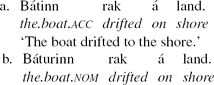
Since accusative subjects have to be learned item by item, there must be enough positive evidence in the input that the child is exposed to for accusative subjects to be successfully acquired. In the case at hand, the child will need to hear many unambiguous examples of an accusative subject with reka ‘drift’. In the absence of such evidence, the child will fail to learn that reka selects an accusative subject and the subject will be assigned nominative case by T, as there will be no other case assigner in the clause. For evidence that Icelandic children acquire structural and inherent case long before lexical case, see Sigurðardóttir (Reference Sigurðardóttir2002), Björgvinsdóttir (Reference Björgvinsdóttir2003), and Erlingsdóttir (Reference Erlingsdóttir2010).
Some of the other variation patterns shown in (4) are illustrated in (6) below. In these examples, as in all other examples from Modern Icelandic in this paper, the standard case is shown before the innovative case.
(6)

The assignment of lexical case with these verbs is optional for those speakers that allow variation here but there is no structural distinction between the two variants in (6). As a result, the variation in (6) has no semantic import. The only difference here is which head assigns case to the relevant DP. Either the verb assigns lexical case or a higher functional head assigns structural case, T in (6a) and ν in (6b–d). The latter option is an automatic consequence of the verb not assigning lexical case to the DP.
3.2 Dative Substitution
As can be seen from the overview of formal variation in (4), it is only with Dative Substitution (DS) that the innovative case is inherent. As illustrated in (7), DS involves variation between accusative and dative experiencer subjects:
(7)

Despite the dative being inherent, there is no semantic difference between the accusative and the dative in examples like (7). Moreover, different senses of oblique experiencer verbs do not seem to affect the possibility of using dative for the standard accusative. For instance, the verb vanta means either ‘lack’ or ‘need’ but DS is equally good in both cases:
(8)
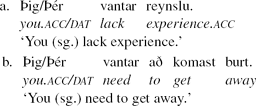
The verb dreyma behaves the same way, whether it means ‘dream (while sleeping)’ or ‘have a strong desire to do in the future’:Footnote 8
(9)

It is often assumed that dative goals and experiencers across languages are licensed by an applicative ν-head that introduces the dative argument (see Cuervo Reference Cuervo2003, and McFadden Reference McFadden2004, Reference McFadden, Abraham, Hole and Meinunger2006 among others). This may be true for Icelandic as well, although there is an important difference in that oblique experiencer subjects in Icelandic are usually obligatory, unlike dative goals of typical ditransitive verbs. What is important for our purposes here is that there should be no structural difference between examples with accusative and dative experiencer subjects as DS instantiates formal variation. Hence, if the presence of an applicative ν-head is assumed, this must hold for oblique experiencer subjects generally, not just the dative ones. This is, in fact, quite plausible since verbs with accusative and dative experiencer subjects form a semantically coherent class in Icelandic that separates them from verbs with nominative experiencer subjects (Jónsson Reference Jónsson, Brandner and Zinsmeister2003). Thus, the only difference between the accusative and the dative variants in examples like (7)–(9) is which head assigns case to the experiencer subject, the verb or the applicative ν-head. As in (5), we can analyse this as optional assignment of lexical case.
Unlike other cases of formal variation in Icelandic, DS is clearly unstable variation. As discussed by Jónsson & Eythórsson (Reference Jónsson and Eythórsson2005), using dative for accusative with experiencer subjects is on the rise in contemporary Icelandic. In the next two subsections, we will discuss two interesting phenomena that signal the weakening of accusative experiencer subjects in Icelandic. We will also examine similar data from Faroese.
3.3 The person/number effect
Studies of DS have shown that the innovative dative is least common with first-person singular subjects (Svavarsdóttir Reference Svavarsdóttir1982, Jónsson & Eythórsson Reference Jónsson and Eythórsson2005, Friðriksson Reference Friðriksson2009). Thus, native speakers of Icelandic are much more likely to use accusative than dative in (10) whereas dative is probably more common than accusative in examples like (11):
(10)
(11)
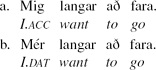
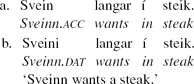
I will refer to this sensitivity to the person and number features of the subject as the person/number effect (PNE). Interestingly, the PNE is also found in Faroese, where the standard dative subject with the verb dáma ‘like’ is three times more common than the innovative nominative with first-person singular subjects.Footnote 9 The preferences are reversed with third-person plural subjects, where nominative is approximately six times more common than dative (Jónsson Reference Jónsson2009a). This is exemplified in (12) and (13):
(12)
(13)
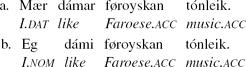

Since dative experiencer subjects are only possible with a handful of verbs in Faroese, and they are gradually disappearing (Jónsson & Eythórsson Reference Jónsson and Eythórsson2005), it is clear that dative with experiencer subjects has become lexical case in Faroese. Hence, the PNE in both Icelandic and Faroese stems from unstable variation between lexical case and a more regular case, inherent dative (Icelandic) or structural nominative (Faroese).
For some speakers of Icelandic, the PNE is probably only a matter of language use, such that the relative frequency of accusative vs. dative depends on the person and number features of the subject. For other speakers, however, the PNE is presumably part of their grammar, in that they disallow an accusative experiencer subject if certain features for person and number are present. I take the grammatical PNE in Icelandic to be asymmetric in that the lexical accusative is subject to selectional restrictions imposed by the verb with respect to the person and number of the subject. The inherent dative is not restricted in this way, although it may be dispreferred in certain cases, for example if the subject is first-person singular. This asymmetry is quite evident in Faroese, where many speakers do not seem to have dative subjects in third-person plural as part of their grammar.
One may wonder how the PNE emerged in Icelandic. In my view, this must stem from language acquisition, as it is easier for children to successfully learn the irregular accusative with experiencer subjects in first-person singular because verbs with experiencer subjects are more often used in that person than any other person (Jónsson & Eythórsson Reference Jónsson and Eythórsson2005, Friðriksson Reference Friðriksson2009, Nowenstein Reference Nowenstein2012).Footnote 10 The result is that children may fail to learn the accusative for subjects that are less common than first-person singular subjects. The same kind of explanation applies to Faroese, where dative with experiencer subjects should be most easily acquired with first-person singular subjects.
3.4 Mixed case marking
In this section, I will discuss an interesting phenomenon that has only recently caught the attention of linguists working on syntactic variation in Icelandic. This phenomenon will be referred to as mixed case marking (MCM) because it involves the use of two cases where case agreement is expected to be obligatory.Footnote 11 This is shown in (14):
(14)

These examples have the verb langa ‘want’ but MCM can be illustrated by other verbs displaying variation between accusative and dative experiencer subjects.Footnote 12
In the examples in (14), a dative XP is predicated of an accusative subject.Footnote 13 This is surprising as the accusative subject is expected to control agreement on the dependent XP. Such an agreement is clearly possible, as shown in (15):
(15)

Strikingly, the MCM is asymmetric in that examples with a dative subject and an accusative XP are fairly marginal, as in (16). A dative subject with verbs like langa must control agreement on the dependent XP, as illustrated in (17).
(16)
(17)


Note that the contrast between (14) and (16) has nothing to do with the relative order of the accusative and dative. Thus, neither (16a) nor (16c) can be salvaged by moving the accusative XP in front of the dative subject:
(18)

The asymmetry displayed by MCM suggests that there is a crucial difference between accusative and dative experiencer subjects. It appears that the former bear two cases, accusative and dative, although the dative is not overtly realized.Footnote 14 As shown by (14) and (15) above, both cases can control agreement on a dependent element. By contrast, dative experiencer subjects have only dative case and therefore they cannot agree with an accusative XP, as in (16).
Coordinated DPs also display MCM in Icelandic. Interestingly, there is also an asymmetry in this case in that examples with accusative before dative are better than examples with dative before accusatives:Footnote 15
(19)

In view of the contrast between (14) and (16), the contrast between (19a) and (19b) suggests that the first DP in these examples behaves like the agreement controller and the second DP as the target of agreement. On the view of coordination where the first conjunct asymmetrically c-commands the second one, there may be a way of deriving this contrast, but I will leave this as a topic for further investigation.
Mixed case marking is also found with verbs that display (formal) variation between dative and nominative experiencer subjects in Faroese, such as dáma ‘like’. This is shown by the following examples (from Jónsson Reference Jónsson2009a:159):
(20)

The case mismatch in (20a) involves a dative subject co-occurring with the nominative emphatic pronoun sjálvur ‘self’. In fact, it appears that native speakers of Faroese prefer MCM to morphological agreement between the emphatic pronoun and the dative subject, as in (20b). As in Icelandic, the case mismatch only works in one direction in Faroese. Thus, if dáma ‘like’ takes a nominative subject, the emphatic pronoun must also be nominative:
(21)

The status of MCM with respect to coordination is somewhat unclear in contemporary Faroese but Henriksen (Reference Henriksen1988–1989) provides examples from a 19th-century text of conjoined genitives and accusatives as objects of the preposition ímillum ‘in between’, which used to assign genitive case only. One of these examples is (22). In this example, as in seven out of nine examples supplied by Henriksen (Reference Henriksen1988–1989), the genitive DP precedes the accusative DP.
(22)

The Faroese genitive was clearly losing ground in the 19th century (Weyhe Reference Weyhe1996); by now it is virtually lost as a syntactic case and accusative has taken its place in most cases (Thráinsson et al. Reference Thráinsson, Petersen, Jacobsen and Hansen2004:433–434). Thus, (22) is comparable to (19a) in that a disappearing variant is coordinated with the competing variant.
The Faroese examples in (20)–(21) are also comparable to the Icelandic examples in (14)–(17). The common denominator is that a DP with lexical case behaves syntactically as if it also possesses the case that is taking its place, whether it is inherent case (Icelandic) or structural case (Faroese). This, in turn, suggests that the lexical case which is under threat does not fulfill the case requirements of a DP argument, even though this case may trigger agreement, as in (15) and (20b).
4 SEMANTIC VARIATION
A major claim of this paper is that two case variants differ semantically if they have inherent vs. structural case. The semantic import stems from the fact that inherent dative is only possible in the presence of certain semantic components and these may cut across different uses of the same verb. We can formalize this intuition by postulating a functional head that licenses the inherent datives to be discussed below and selects a verb root with the appropriate semantics. This is sketched in (23) below where the functional head licensing the dative is labelled ν-dat and the functional head licensing accusative case is labelled ν-acc.Footnote 16
(23)

The ν-dat semantically selects a certain kind of verb root and these two heads jointly assign a theta-role to the direct object. When ν-dat is present, it assigns case to the direct object, as in (23b). In the absence of ν-dat, as in (23a), ν-acc is the closest case assigner for the object. This means that semantic variation, in contrast to formal variation, correlates with a structural difference between the two variants.Footnote 17
With semantic variation, it is only the dative that needs to be explained semantically, accusative being the default case for direct objects in Icelandic. In the discussion of individual verbs in Sections 4.2–4.5 below, I will nevertheless point out verb classes that systematically take accusative objects as this will serve to illustrate the limits of inherent datives. As we will see, some fairly fine-grained semantic components must be invoked to capture the subtle differences that are associated with different case variants and also to explain the absence of variation in certain uses of the verbs in question.
4.1 Case alternations
Before proceeding, it is important to discuss the difference between semantic variation and case alternations such as the alternation between accusative and dative object with verbs like skjóta ‘shoot’ (but see Barðdal Reference Barðdal1993, and Svenonius Reference Svenonius2002 for more examples and discussion):
(24)
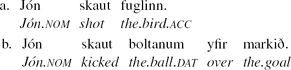
There are two basic properties that distinguish case alternations from semantic variation. First, there is a very strong semantic contrast between alternating cases, which can usually be described in terms of theta-roles. Thus, the accusative object in (24a) above is clearly a patient whereas the dative object in (24b) is a theme, as it denotes something that undergoes motion. Second, speakers seem to have uniform judgments about case alternations. To the best of my knowledge, all native speakers of Icelandic accept accusative in (24a) and dative in (24b), and the same holds for other examples of case alternation. Semantic variation is different in that the contrast between the two cases is always quite subtle and speakers often prefer one variant over the other.
In Sections 4.2–4.5 below, examples will be discussed of four different verbs displaying semantic variation, two from Old Icelandic and two from Modern Icelandic (but see Jónsson Reference Jónsson2012 for further examples from Modern Icelandic). The Old Icelandic examples add an interesting diachronic dimension to our discussion of semantic variation but they are also potentially problematic since it is hard to establish semantic variation in a language with no living speakers to provide judgments about the relevant examples. Still, I think that a reasonably good case can be made for semantic variation in Old Icelandic, at least with respect to the potential semantic differences between the variants (but see further in Sections 4.2 and 4.3 below).
4.2 The verb slíta
The basic meaning of the verb slíta is ‘tear off, break in two pieces’ but it also has the derived meaning ‘end, cut off’. In Old Icelandic, the direct object of this verb varied between accusative and dative in the derived meaning, but in the basic meaning only accusative was possible. This is exemplified in (25) below:Footnote 18
(25)

In its basic sense, slíta denotes the disruption of the material integrity of the object and all verbs in this semantic class take accusative objects in Old and Modern Icelandic (e.g., brjóta ‘break’, búta niður ‘chop down’, hluta niður ‘cut up’, höggva ‘chop’, kljúfa ‘split’, rjúfa ‘disrupt’, skera ‘cut’, etc.).
It seems likely that there was a subtle semantic difference between (25b) and (25c) in Old Icelandic in that the accusative in (25b), but not the dative in (25c), indicated a close semantic connection to the original sense of slíta. This connection has been lost in Modern Icelandic, where examples like (25b) are no longer possible. The accusative is only preserved in the fixed expression slíta samvistir ‘end a marriage/relationship’.Footnote 19
To make sense of the dative in (25c), it should be noted that the verbs that are semantically closest to slíta in the sense ‘end, cut off’ take dative objects in Icelandic, that is hætta ‘quit, stop’ and ljúka ‘finish’. In addition to these verbs, many verbs describing the ending or closing of something take dative objects in Icelandic, for example aflétta ‘end, abolish’, aflýsa ‘cancel, call off’, hnekkja ‘refute’, létta ‘relieve, stop’, linna ‘stop’, loka ‘close’, læsa ‘lock’, rifta ‘annul (a contract)’, and rumpa af ‘finish quickly’. More generally, there is a sizable class of telic verbs denoting change-of-state (COS) in Icelandic that take dative objects (Jónsson Reference Jónsson, Barðdal and Chelliah2009b) but how this class can be semantically distinguished from telic COS verbs taking accusative objects (e.g. laga ‘fix’, drepa ‘kill’, and skemma ‘damage’) is not entirely clear and requires further investigation.Footnote 20
4.3 The verb eyða
Another example from Old Icelandic is the verb eyða ‘annihilate, delete’ which is historically related to the adjective auður ‘empty, deserted’. The basic sense of this verb is presumably ‘clear a place of something’, where the object denotes the place and what is being removed may be expressed in a PP. This can be seen in the following example:
(26)

The verb eyða is no longer used in this sense in Modern Icelandic, but the accusative is expected since eyða in (26) denotes the removal of something from a location and all verbs with similar meaning in Icelandic take accusative objects (e.g., fjarlægja ‘remove’, hreinsa ‘clean’, skafa ‘scrape’, skúra ‘scrub’, taka burt ‘take away’, tæma ‘empty’, þrífa ‘clean’).
The verb eyða had another sense in Old Icelandic, which has also become obsolete but where both accusative and dative were possible, as shown in (27):
(27)

It is plausible to assume that the variation in (27) is semantic as (27a) means something like ‘clear the case of any merit or underpinnings’, treating the accusative object as a location, as in (26), but in an extended sense. By contrast, the dative object in (27b) is associated with the meaning ‘annull, wreck (a case)’. This is very close to the meaning ‘exterminate, kill, spend’ which is also found with eyða, but only with a dative object:
(28)

The dative in examples like (28) is unsurprising since Icelandic has a number of dative-taking verbs that denote killing, wasting or losing something (see Maling Reference Maling2002):
(29) Verbs of killing, wasting or losing
bana ‘kill’, drekkja ‘drown’, eyða ‘delete, spend, annihilate’, farga ‘kill, throw away’, glata ‘lose’, glutra niður ‘lose’, granda ‘destroy’, kála ‘kill’, lóga ‘put down (an animal)’, sálga ‘kill’, slátra ‘slaughter’, sóa ‘waste’, sólunda ‘waste, squander’, stúta ‘kill, use up’, tapa ‘lose’, tortíma ‘annihilate’, týna ‘lose, misplace’, útrýma ‘exterminate’
All of these verbs belong to the class of telic COS verbs taking dative objects, but this class also includes verbs denoting less drastic changes in the state of the direct object, for example the verbs mentioned in the discussion of (25c) above.
4.4 The verb brenna
The third verb discussed here is brenna ‘burn’ (see also Maling Reference Maling2002). This verb has fairly complex semantics, which we will not discuss in any detail here. The important point to note is that case variation with brenna is restricted to two senses, namely ‘use as a source of energy’ and ‘dispose of by burning’. In the first case, dative is strongly preferred to accusative but in the latter case, accusative is probably more common than dative:
(30)

Presumably, the strong preference for dative in (30a) is due to the fact that brenna in this sense qualifies as a member of the class listed in (29).
Apart from examples like (30), only accusative objects are possible with brenna. This is illustrated in (31):
(31)

Accounting for the accusative in (31c–e) is fairly straightforward. The verb brenna describes bodily injury in (31c) and it appears that all such verbs in Icelandic take accusative objects (Jónsson Reference Jónsson and Strahan2011). The use of brenna in (31d) can be subsumed under the generalization that verbs of creation take accusative objects in Icelandic (Jónsson Reference Jónsson2012). The accusative in (31e) is also predictable because verbs of copying (such as afrita ‘copy’, kópera ‘copy’, ljósmynda ‘photograph’, ljósrita ‘photocopy’, taka upp ‘record (sounds)’, vélrita ‘type’, etc.), which are semantically very close to creation verbs, only take accusative objects in Icelandic.
It is less clear why accusative is obligatory in examples like (31a–b) since they are not clearly distinct from examples like (30b). The crucial difference may be that the purpose of burning in (30b) is to dispose of the object like a trash, whereas the aim in (31a) and (31b) is to cause death or destruction. Still, the fact that many verbs of killing take dative objects suggests that something more specific is required to explain why accusative is the only possible object case in examples like (31a).
4.5 The verb blasta
The verb blasta ‘blast’ is a recent borrowing from English. In its basic and most common meaning, blasta describes the playing of loud music, in which case both accusative and dative are possible:
(32)

Most of the native speakers that I have consulted prefer dative to accusative with this verb. I am not sure about my own preferences but I have a clear intuition that dative and accusative with blasta are semantically different and this intuition is congruent with known semantic determinants of object case in Icelandic. When occurring with a dative object, blasta is a verb of sound emission and means something like ‘play (music) so loudly that it is heard everywhere’. The dative is expected in this case since all verbs of emission take dative objects in Icelandic (Maling Reference Maling2002, Jónsson Reference Jónsson2102). By contrast, blasta with an accusative object means simply ‘play (music) loudly’. Thus, (32a) can be felicitously uttered even if the music is played in a sound-proof room so that it cannot be heard from the outside. In this sense, blasta is a verb of performing and all such verbs take accusative objects in Icelandic (e.g., flytja ‘recite’, leika ‘perform (a play)’, spila ‘play (a song)’, syngja ‘sing’, etc.).
The verb blasta can also mean ‘play loud music at somebody’ or ‘play loud music in (loudspeakers)’. In both cases, only an accusative object is possible since there would be no semantic basis for a dative object:Footnote 21
(33)

Note that blasta is different from the other verbs discussed here displaying semantic variation in that it is a novel verb. These verbs have a long history in Icelandic and it seems that dative is the innovative case with all of them when it varies with accusative. With blasta, however, neither accusative nor dative can be claimed to be innovative. This shows that semantic variation does not necessarily involve diahronic change as formal variation seems to do.
5. CONCLUSIONS
In this paper, I have argued for two kinds of case variation, formal variation and semantic variation. The data have mostly been drawn from Icelandic but supporting evidence concerning formal variation in Faroese has also been discussed. As we have seen, the only difference between variants in formal variation is whether the relevant DP is assigned case by the verb (lexical case) or some higher functional head (inherent or structural case). However, syntactic assignment of both cases with overt realization of the lexical case seems to occur when lexical case is losing ground to the competing case. This is shown by facts about agreement with experiencer subjects displaying lexical case.
Semantic variation stems from the fact that inherent datives bring certain semantic requirements which are absent when accusative is assigned to the direct object. This can be formalized as a structural difference between the two variants, as inherent datives involved in semantic variation are licensed by a special functional head. Semantic variation is clearly distinguised from case alternations as the semantic components that play a role in the former are quite subtle and native speakers often prefer one variant over the other.
ACKNOWLEDGEMENTS
I wish to thank three anonymous reviewers for constructive comments on the first version of this paper. I am also indebted to Jeffrey Parrott for encouragement and patience. The research reported here was supported by a grant from The Icelandic Science Foundation (Rannsóknamiðstöð Íslands).


