On August 14th 2012, GOP presidential hopeful Mitt Romney visited an Ohio coal mine to give a speech attacking the energy policies of opponent Barack Obama. A campaign stop such as this one might not seem that unusual in the midst of a heated presidential election. But this event was different, as the owners of the coal mine had told their workers that attendance at the rally would be both mandatory and unpaid. Footnote 1 Although an executive with the mining company later explained that “nobody was ordered to attend,” workers still told reporters that they showed up to the rally out of fear of losing their jobs or being disciplined in some other way. Footnote 2 The wife of one miner explained that her husband “felt like [his managers] were pushing the Republican choice on him and he felt a little intimidated.” Footnote 3
The Ohio rally was not the only example of employers trying to recruit their workers into politics during the 2012 election. In an article written just a few weeks later titled “Here’s a Memo From the Boss: Vote This Way,” the New York Times described how a number of employers had been contacting their workers about the upcoming election. Footnote 4 The major paper product manufacturer Georgia Pacific, for instance, had distributed packets to its workers that included warnings that employees “may suffer the consequences” if the slate of candidates provided by the firm was not elected. Footnote 5 Mitt Romney had himself encouraged managers to inform their workers about managers’ preferences for candidates in the run-up to the election. Footnote 6
How many other employers are trying to engage their workers in politics and how many workers report receiving such messages? How do workers perceive—and respond to—political communications from their managers? And how should we think about the political and normative implications of these messages as a form of mobilization and corporate lobbying? Given the degree to which political scientists have studied citizen mobilization in other contexts, like churches, unions, or civic associations, we know surprisingly little about recruitment that happens between employers and their workers. Footnote 7
I offer initial reflections on these questions, and in the process highlight broader implications for American politics of how employers are recruiting their workers into politics—what I term “employer mobilization.” Using new national surveys of workers and top corporate managers, I show that a significant proportion of firms—nearly half of the firms in a survey reported here—reported attempting to recruit their workers into politics and about one in four employees recalled ever being contacted by their employer about politics in some way. These findings suggest that employer mobilization may be an important source of political information and recruitment for Americans. Just as scholars of political participation focus on unions or political parties as sources of mobilization, this essay argues that so too should those scholars consider the top management at companies as political recruiters. Footnote 8
Aside from offering workers a source of information and motivation to participate in politics, employer mobilization could also be seen as a mechanism through which companies seek to change public policy. The evidence I present suggests that mobilization can be a conscious political strategy that corporate managers deploy to shape government, akin to other better-studied practices such as hiring lobbyists, making contributions to political campaigns, participating in business associations, and buying political ads. Indeed, I find that surveyed corporate managers ranked employee mobilization as being as effective at changing public policy as hiring a lobbyist, and even more effective than PAC contributions. To understand how businesses shape the decisions that are made—and not made—by government, this essay argues that scholars, politicians, political activists, and citizens would do well to focus more attention on employee political engagement by managers.
Lastly, the practice of employer mobilization raises potentially troubling normative issues, echoing concerns originally voiced by Robert Dahl about the peculiarly undemocratic nature of the workplace. Footnote 9 As I describe in the final section of the essay, employer political recruitment offers the promise of engaging more citizens into politics, as workers are exposed to a new source of political information and requests. Yet political recruitment in the workplace is unlike recruitment elsewhere, given the degree of economic control that managers have over their workers. The fact that managers directly control most workers’ wages, working conditions, and employment means that workers may feel pressure to comply with their managers’ political requests—even if workers disagree with those messages. What is more, the fact that employer mobilization affords companies—but not other actors—a new tool for influencing policy and politics may well exacerbate the outsized representation businesses already enjoy in the policymaking process. I describe these trade-offs, concluding that we need more research and public discussion about the role of employers in the civic lives of their workers.
The Changing Context of Employer Mobilization
I define employer mobilization as including any effort by senior corporate managers to alter the political behavior or attitudes of their workers as company policy. This definition is agnostic about the intended and actual outcomes of that mobilization. It could mean that employers want their workers to support a specific candidate or issue, or that managers simply want their workers to vote and participate in the political process in general, regardless of the candidates or issues workers choose to support. Equally important, this definition does not delimit the specific means by which employers pursue mobilization. It could merely include neutral information on both sides of an issue or about all candidates in a race. On the other hand, mobilization could encompass explicitly partisan activities, as in the Georgia Pacific example. Thus, any activity where the top managers and supervisors at a company convey political information to their workers with the intent of changing workers’ behaviors would count as a mobilization effort. While I adopt this expansive definition of mobilization as a conceptual tool, I separated employer efforts to give neutral information about voting from partisan endorsements and legislative advocacy in the surveys I conducted.
Historically speaking, it is clear that early American elections were sometimes characterized by mobilization of workers by their employers (in addition to party bosses and other brokers). Footnote 10 Richard Bensel, for instance, has described how: “A landowner or factory owner could use his power over employees or tenants to influence their voting decisions. This was most commonly and notoriously the case with freedmen in the South following the Civil War. But northern employers could also intimidate their men by threatening to discharge them from their employment. For intimidation to be effective, it was not necessary that this threat be explicit; when a man was sufficiently sensitive to the prospect of unemployment, all that was required was a public announcement by his employer of a party preference.” Footnote 11
Certainly the sort of company towns documented by scholars such as John Gaventa would provide another set of examples of employers encouraging the support of particular values, candidates, and policies among their workers. Footnote 12 Historians have also documented how large industrial employers in the early twentieth century, like DuPont and General Electric, engaged in similar practices, promoting the virtues of capitalism and the free market through extensive promotional material distributed to workers. Footnote 13
Later, two mid-century federal bills had important implications for the ability of employers to shape the political behavior of their workers. In 1965, the Voting Rights Act made it illegal for individuals—including managers—to intimidate or threaten others in the voting process. Footnote 14 In 1971, the Federal Election Campaign Act (FECA) and its subsequent amendments restricted partisan communication between a company’s top managers and their rank-and-file workers. Footnote 15 Communication between a firm’s managers and ordinary workers, or the public, generally could not include explicit political advocacy or endorsements of candidates. In addition, corporate PACs were prohibited from using economic threats or rewards—like dismissals or promotions—to solicit contributions from workers. Footnote 16
These federal protections still left considerable ambiguity for employers and workers. For instance, since private-sector workers in the United States enjoy no constitutional right to free speech in the workplace, employees can conceivably be fired for engaging in political activities, or even for their political affiliation. Footnote 17 While some states have passed laws barring the firing of workers for political actions or views, not all states have equally vigorous protections in place. Footnote 18 Moreover, while the FECA generally prohibited explicitly partisan messages from firm managers to their rank-and-file, it left open the possibility that companies could use workplace resources to educate workers on political issues (rather than candidates), using what labor law scholars refer to as mandatory “captive audience” meetings. Footnote 19 There is considerable evidence to suggest that firms have used such meetings extensively. Footnote 20
Another major legal shift occurred with the Supreme Court’s 2010 decision in Citizens United v. Federal Election Commission. Most of the attention to that case has focused on how it lifts previous restrictions on the ability of corporations to spend directly on political ads from their treasuries, so long as that spending is uncoordinated with campaigns, inviting fears of a flood of corporate-backed attack ads. Footnote 21 But Citizens United also has important implications for the legality of employer mobilization. In allowing the use of corporate funds for electoral ends, Citizens United also permits managers to use their employees’ time and effort—a corporate resource—in elections. Footnote 22 Combined with the fact that private-sector employees enjoy minimal legal protections against political coercion, Footnote 23 many employers can now require that their workers participate in partisan electoral politics, and can even discipline or even dismiss workers who refuse to engage in those activities.
Aside from a more favorable legal environment, firms also have access to a range of new technologies that permit them to easily communicate with their workforce, facilitating political mobilization in ways that would have been previously unfeasible. In the 1950s, General Electric would have had to print tens of thousands of free-market leaflets to disseminate its messages to employees. Footnote 24 The same sort of political campaigns are now much easier and less expensive to implement. At the click of a mouse button, a government affairs officer can send an email message encouraging all employees to support an issue or candidate. This message could link to a website dedicated to providing political information to workers, with opportunities for employees to contact their lawmakers about legislation, register to vote or find their polling station, or to contribute to a corporate PAC. Moreover, the information that companies send to workers can be easily (and automatically) customized to particular workers based on characteristics like employees’ geographic locations and rank within the firm. In addition to facilitating contact between employers and workers, this technology also permits managers to monitor the success rate of their efforts, tracking, for instance, whether workers submitted correspondence to lawmakers, downloaded voter registration forms, or turned out to vote. So while employers may no longer be able to follow workers into the polling place to verify that workers cast the “right” ballot as they once did, employers could monitor a range of other responses to their political requests.
Many business associations have begun to sell services to firms to do precisely this sort of targeted political recruitment of employees, helping to lower the costs of mobilization for managers. Footnote 25 Most prominently, the Business-Industry Political Action Committee (or BIPAC) began to license firms access to the Prosperity Project in 2000, an electronic platform it had designed to help managers to recruit their workers into politics. Many other large associations, including the U.S. Chamber of Commerce and the National Association of Manufacturers soon followed suit with similar platforms that their members could use. Footnote 26
A final trend that may have facilitated recent employer mobilization efforts is the decline of worker bargaining power. Evidence for this change in bargaining power is manifest in a variety of indicators, including the stagnation of workers’ wages relative to gains in economic productivity. From 1948 to 2013 productivity of the overall economy grew by 243 percent—yet wages and benefits for rank-and-file production workers rose only by 109 percent. We see a similar story with poor and declining working conditions in many parts of the economy, including record levels of wage theft, the misclassification of workers by managers to evade tax and regulatory responsibilities, and the rise of on-call arrangements where employees must be ready to go into work at a moment’s notice. Footnote 27
These economic trends have emerged from a variety of causal factors, including increasing low-wage competition from within and outside the United States, automation, greater financial pressure on firms to return value to their shareholders, and the decline of the labor movement in the private sector. Footnote 28 But, taken together, these changes in the American labor force have meant that employers are better positioned to make demands of their workers, including participating in politics in certain ways. Just as employers face the logistical costs of producing and disseminating political material for workers, so too can they face the economic costs of having their workers protest or resist mobilization efforts. If workers are now less likely to protest employer requests given their reduced bargaining power, the potential costs of mobilization for managers are effectively lower. These costs of worker resistance are most likely to be relevant for employers that engage in more partisan forms of recruitment, like the Ohio coal mine that endorsed Romney, rather than for employers who merely encourage workers to register or turn out to vote, or who convey neutral information about issues of shared interest to both firms and workers.
Given the direction of changes in campaign finance and labor law, technology, and worker bargaining power, employer mobilization should have become more common in recent years. While we lack rigorous over-time survey data on employer political recruitment, there is suggestive evidence that mobilization may indeed be more common now than in mid-century. For instance, the Business Roundtable—an association of about 150 of the largest and most prominent firms in the country—estimates that the share of its members contacting workers about politics has increased from 18 percent in 2002 to 66 percent in 2004. Footnote 29 And using its own polling, BIPAC estimates that the share of employees hearing from their bosses about politics has risen over time as well. Footnote 30
Although we cannot be sure of the exact trend of employer mobilization over time, we are in a far better position to assess the contemporary landscape of employer mobilization—how frequently it occurs, what information is included, why firms decide to engage in this practice, and how workers respond to mobilization efforts. The following section describes my initial efforts to answer these questions.
Characterizing The Landscape of Employer Mobilization
To characterize the contemporary prevalence and content of employer mobilization, I commissioned two surveys. I used SSRS Inc.’s weekly omnibus, dual-frame telephone survey to poll 1,032 non-self-employed American workers. Footnote 31 On that survey, I asked workers a variety of questions about their experience with employer political recruitment. To distinguish between efforts at mobilization from individuals’ (immediate) supervisors and a company’s top leadership, I asked if workers had received political messages or contact from the “top managers and supervisors” at their main job. In pre-testing of the survey, respondents indicated that they believed that phrasing was inquiring about messages from the main leaders of a company, rather than from immediate managers and supervisors. The full survey instrument appears in an online appendix.
To understand workplace mobilization from the perspective of firms, I also commissioned a series of national online surveys of top corporate managers from YouGov. The first sample consisted of 513 executives recruited from YouGov’s online panel during December 2014 and January 2015, and was intended to provide a balanced sample across different firm sizes and sectors. Footnote 32 In September 2015, I commissioned a follow-up survey from YouGov, which successfully re-contacted 391 of the 513 managers originally surveyed in the first wave. Footnote 33
One important issue to consider on the firm survey is whether managers responded accurately and truthfully to the question about employer mobilization. Managers might not feel comfortable disclosing their mobilization activities. For this reason, I included a prompt on the survey to increase the social desirability of an affirmative response. Footnote 34 Another concern is that certain types of managers may not be aware of mobilization that is occurring in their companies. However, as an empirical matter, the reporting of mobilization did not differ by the job rank of survey respondents. In other words, more highly ranked employees were not more or less likely to report mobilization than their lower-ranked counterparts.
Employers As Important Political Recruiters
The worker survey indicates that about one in four American workers reported ever having some form of political contact with the top managers at their main jobs. Footnote 35 This estimate compares favorably to an estimate produced in a 2014 poll by Allstate and the National Journal, which found that 30 percent of workers agreed with the statement that “My employer is vocal about their opinions on politics and legislation,” which taps into a similar concept. Footnote 36
We can also contrast employer political contact with union mobilization. Unions provide information to workers about policies and candidates, and help get workers to the polls for elections. Footnote 37 On the worker survey, I asked respondents if they had received any messages about politics from a labor union at their main job. In all, about 12 percent of employees indicated that they had received such messages—about the same proportion of all wage and salary workers in the United States who are covered by a union at their job. Footnote 38 Thus, looking across workers who have ever received messages from employers or unions, employer voices far outnumber labor voices in the workplace.
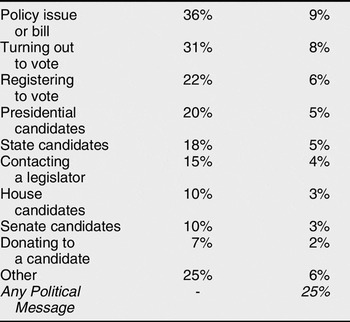
What did employers discuss with workers in their political messages? Table 1 answers this question, showing the share of American employees receiving political messages about a particular topic. Note that these shares do not sum to 100 percent since workers could indicate that they received multiple types of messages from their employers. The most common types of messages dealt with policy issues or legislation and with turning out to vote for elections. The least reported messages included requests for donations, as well as discussions about House and Senate candidates.
Employer political messages reported by workers

2015 Worker Survey. Shares do not sum to 100 percent because workers could select more than one option.
Another way of considering this variation in employer political messages is to categorize messages into three types: messages that only deal with registering or turning out to vote; messages that discuss policy and legislation, but not political candidates; and lastly, messages that discuss specific candidates and parties. Dividing employer communications in this way, I find that about 11 percent of all workers reported receiving messages about voter registration and turnout, 6 percent of workers reported receiving messages about policy issues and legislation, but not candidates, and 7 percent of workers reported messages about candidates and the political parties. Thus in all, messages about policy debates and electoral contests outweighed messages that were solely about getting out the vote.
Workers were divided over whether they reported agreeing with their employers’ political stances and messages. Footnote 39 About half (47 percent) of contacted workers reported that they agreed with their employer’s messages (or 12 percent of all workers). The remaining workers were split between those without an opinion (28 percent of contacted workers, or 7 percent of all workers) and those who opposed their employers’ messages (25 percent of contacted workers; or 6 percent of all workers).
A fourth source of variation across employer messages involves the policy issues that managers mentioned to their workers. Footnote 40 About 10 percent of workers reported receiving employer messages involving health care or health reform, the most frequently cited policy topic. Education and training was the next most frequently cited topic in managerial messages, at 8 percent of workers, which was closely followed by taxes and regulation (both at 7 percent of workers). The least cited issues involved trade (3 percent of workers) and unions (4 percent of workers). Aside from the topics that were discussed, workers reported that messages also differed in their political orientation. Footnote 41 The most frequently reported ideological orientation of employer messages was conservative (11 percent of all workers and 43 percent of contacted workers reported such messages), followed by moderate messages (8 percent of all workers and 30 percent of contacted workers), and then lastly, liberal messages (7 percent of all workers and 27 percent of contacted workers). Well over half of contacted workers reported that they received messages from their employers that ran contrary to their own political beliefs, for instance, liberal workers who were contacted by conservative employers.
I next asked if workers had received warnings of job loss, plant closure, or changes in wages and hours alongside their employers’ political messages. 20 percent of workers contacted by their bosses reported that their employer included at least one such warning, or 5 percent of all workers. Footnote 42 To be sure, these warnings could represent a wide range of practices, encompassing very specific threats about the election of particular political candidates or more general information about the consequences of state and federal regulations. But these cases both share the underlying feature that employers are tying the economic fate of employees to political activities. These warnings capture what is unique about employers as political recruiters: While other actors can speculate about the effect of elections and legislation on wages and jobs, only corporate executives are in a position to actually follow through on those warnings. Footnote 43 A politician can claim that the economy will suffer if her opponent gains power, but only employers have the power to ultimately lay off workers or cut wages.
Interestingly, more partisan forms of mobilization were also more likely to include threats of economic losses. Workers who reported receiving messages endorsing political candidates were three times more likely to report receiving a warning of economic loss compared to workers who had not received endorsements. Workers were also more likely to indicate they were uncomfortable with messages that included threats of economic losses. Workers who received at least one threat were about three times more likely to say they were uncomfortable with their employer’s outreach compared to workers who did not receive warnings.
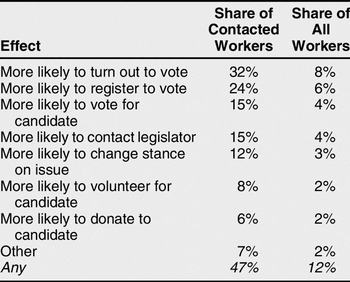
A final aspect of employer mobilization we can consider is how workers responded to messages they received from their managers. The survey asked contacted employees whether employer messages had any effect on a range of their behaviors and attitudes. Footnote 44 Table 2 summarizes these possible responses. In all, nearly half of contacted workers (47 percent) reported that employer messages changed at least one of their political practices or beliefs. Workers were most likely to report that employer political messages made them more likely to turn out to vote or to register to vote (32 percent and 24 percent of contacted workers reported these effects, respectively). Fifteen percent of contacted workers reported that their company’s political message made them more likely to vote for an employer’s favored candidate, and another 15 percent of contacted workers reported that the message made them more likely to write to, or call, a legislator about a policy issue on behalf of an employer. Although these self-reports do not provide definitive evidence of a causal effect of employer messages, they do indicate that a number of contacted workers perceived that employers were shaping the ways that they thought about politics.
Worker-reported effects of employer mobilization
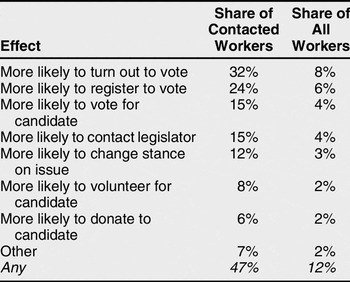
2015 Worker Survey. Shares do not sum to 100 percent because workers could select more than one option.
Employer Mobilization As Corporate Political Strategy
Moving from the worker to the firm survey, I find that 46 percent of the 513 top managers surveyed at the beginning of 2015 reported that their firm had engaged in at least one form of worker mobilization. Footnote 45 As with the worker survey, the most common modes of mobilization reported by firms were not limited to registering and turning out to vote. Of the firms that reported mobilizing their workers, only 29 percent reported providing exclusively information about registering or turning out to vote. The remaining 71 percent gave their workers more explicitly political information about candidates or policy issues.
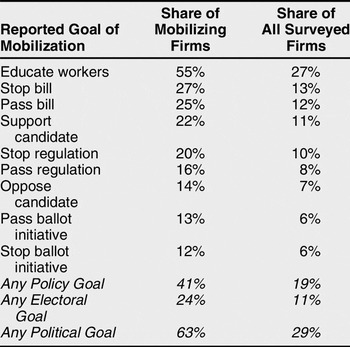
Managers responding to the firm survey also had an opportunity to indicate what they were hoping to achieve with mobilization, offering a window into how managers conceive of employee political recruitment as a political strategy. Footnote 46 Are managers mobilizing in order to provide more information to their workers in a neutral manner, or are managers trying to use their employees as a political resource to change politics and policy? Table 3 answers this question, showing the share of firms reporting different goals for mobilization.
Employer goals for mobilization of workers

2015 Firm Survey. Shares do not sum to 100 percent because managers could select more than one option.
By far, the most cited goal was to educate workers about politics. Over half of mobilizing firms, and over a fourth of all surveyed firms, reported this objective. The next cluster of goals involved stopping and passing bills, which were listed by a little over a quarter of managers at mobilizing firms. Supporting political candidates and stopping regulation were the next most commonly cited goals, at slightly over a fifth of all mobilizing firms. Interestingly, firms were less likely to report opposing politicians than to report supporting them. Perhaps more intuitively, firms were less likely to cite passing regulation as a goal as compared to stopping regulation. Addressing ballot initiatives—whether by supporting or opposing them—was the least cited goal of mobilizing firms.
What is striking about these objectives is the fact that in all, a large proportion of firms listed either electoral or policy objectives that went beyond worker education. A full 41 percent of mobilizing firms gave changing policy as an objective, and nearly a quarter of mobilizing firms gave changing elections as a goal. In all, nearly two-thirds of mobilizing firms reported goals that went beyond educating workers and referred to changing elections or policies. Importantly, these shares may not reflect the full set of firms mobilizing in order to change elections or policy, as some firms might be educating their workers with the intent of ultimately effecting later political change. Many business associations use the language of turning workers into “employee voters”—that is, employees who take their firms’ interests into account when participating in politics. For instance, the Business-Industry Political Action Committee justifies its employee mobilization activities on the grounds that “[b]etter educated employees…become motivated participants in political process [sic] and better advocates for prosperity-based public policy.” Footnote 47 In the model pursued by BIPAC and the firms that license BIPAC software, employer mobilization proceeds in three steps: communication, or making the initial contact with workers, education, which is a continuous process of helping workers to understand the stakes of policy and politics for a company, and then activation, which involves making specific asks of workers related to politics and policy. In this setting, a firm could be engaging only in education—but doing so with the clear intention of making more explicitly political requests of their workers (“activation”) at some point in the future.
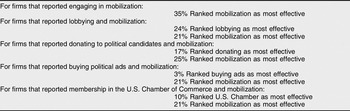
Another way of considering the importance of mobilization as a mechanism for companies to change politics and policy is to assess how managers rank mobilization against other corporate political activities more frequently studied by political scientists. To this end, the survey asked managers to rank the relative effectiveness of the political strategies in which they engaged (managers did not rank options that their firm did not report using). The options included mobilizing workers, buying political advertisements, donating to campaigns, hiring lobbyists, and participating in various business associations. Footnote 48 In all, 35 percent of firms that reported mobilizing their workers ranked mobilization as their most effective tool for influencing policy.
Table 4 explores managers’ perceptions of the effectiveness of mobilization in greater detail. Managers ranked mobilization as being roughly as effective as lobbying, more effective than donations to political candidates, and substantially more effective than either purchasing political advertisements or participating in the U.S. Chamber of Commerce. The evidence from the firm survey, then, strongly suggests that managers consider worker mobilization to be an important means of influencing public policy.
Managers’ rankings of most effective options for influencing policy

2014 Firm Survey. Denominator is all firms that reported mobilization and other political activities.
A Research Agenda for Employer Mobilization
The survey results I have presented in this essay underscore several important descriptive findings about employer political mobilization, which in turn have implications for a variety of literatures in political science. A sizeable proportion of workers are reporting that they have received political messages from their employers, and a number of firms reported that they have attempted to communicate with their workers about politics. Some of these contacts involve relatively neutral information about how to register or turn out to vote. But a majority of surveyed firms reporting mobilization said that their messages went beyond these efforts to advocate for the passage of particular policies or the election of specific candidates. This suggests that political scientists need to think about the workplace as a site of political mobilization not just between coworkers, or between workers and unions, but also between top management and rank-and-file workers. Footnote 49 As the worker-reported responses to employer messages indicate, employer mobilization may be encouraging workers to change their voting habits, their stances on political issues, and their support of parties and candidates.
This conclusion, in turn, invites the question of how effective employer messages are at changing employee political behavior—especially in comparison to other recruiters, like unions or political parties. Are there types of firms or workplaces that are more conducive to employer mobilization efforts than others? Are workers more likely to be persuaded by certain types of requests their employers make? One place to start answering these questions might be to focus on the nature of the relationship between workers and employers and how it differs from other organizations. Unlike, say, when a voluntary association or political party tries to mobilize citizens, an employer already has a great deal of information about each of its potential recruits—including their salaries, work routines, contact information, and residences. Similarly important is the fact that employer mobilization requests are coming from an actor that citizens depend on for their economic livelihood, and with whom they interact on a daily basis, potentially making workers more attuned to political messages they receive from their managers, as opposed to say, other voluntary associations or even the political parties. Footnote 50
The implications of employer mobilization go beyond the study of individual political behavior. The survey of firms revealed that many managers consider mobilization of their workers to be a highly effective means of changing politics and policy. That fits with what Kay Schlozman, Sidney Verba, and Henry Brady have described as interest groups’ “time-honored tactic” of “communicating with the public or with organization members and supporters in order to highlight issues, to shape opinions, or to generate communications to public officials in support of favored political positions.” Footnote 51 Further work ought to examine how companies have used employer mobilization to change specific policies and to alter the course of elections. That work could identify the types of policy debates or elections where employer mobilization might matter the most, and also how the effectiveness of employer mobilization compares to other corporate lobbying strategies, like participating in business associations or giving campaign contributions to electoral campaigns. Viewing employer mobilization as a form of corporate political engagement would also invite comparisons between the historical development of mobilization and the marked rise in other types of corporate political involvement in recent decades. Footnote 52
Lastly, comparative political scientists could focus on the extent to which employer mobilization in the United States resembles corporate political strategies documented in other countries. How similar or different are the strategies I have outlined in this essay to the sort of employer political recruitment documented by scholars in imperial Germany or contemporary Eastern Europe or Russia? Footnote 53 Do employers in other advanced democracies mobilize their workers into politics in similar ways? And do national political institutions, like labor associations, corporatist bargaining arrangements, and electoral and party systems determine whether employers deploy mobilization as a strategy? These are all questions that could produce fruitful lines of further research.
Employer Mobilization and American Democracy
Apart from the implications they carry for political science, the findings in this essay raise normative questions that merit further discussion, even if straightforward answers are not readily available. Employer mobilization certainly has appealing civic benefits if employers are encouraging greater interest in, and knowledge of, elections and policy debates. Indeed, employer mobilization could be seen as one potential remedy to declining civic engagement in the mass public. Footnote 54 Employer-initiated political recruitment might even help to foster greater political tolerance. After all, workers tend to be contacted by employers with a very different ideology or opinions to their own. Footnote 55
Cutting against these arguments in favor of employer mobilization, however, are concerns related to political coercion and the fundamentally undemocratic nature of most workplaces—the fact that workers often encounter spaces of “hierarchical and often despotic” control, in Robert Dahl’s formulation. Footnote 56 If employers make a political request of their workers while also incorporating an explicit or implicit warning about job losses or wage cuts, workers might feel pressured to follow through on their employer’s request—even if workers might not agree with their employer’s position. This economic pressure might well violate workers’ political liberty, as workers are forced to behave in ways that they would not otherwise in order to appease their employers. These concerns are likely to be magnified as economic pressures on workers—such as the decline of the labor movement and low-wage labor competition—continue to mount in the coming years.
Indeed, perhaps ironically it is for precisely this reason that the federal government prevents employers from threatening employees with the loss of jobs, wages, or benefits in the union organization process. Footnote 57 In past jurisprudence related to labor organizing, the Supreme Court has recognized that the right of employers to free speech in the workplace must be balanced against the economic control employers possess over workers. In NLRB v. Gissel (1969), for instance, the Supreme Court argued that “Any assessment of the precise scope of employer expression…must take into account the economic dependence of the employees on their employers, and the necessary tendency of the former, because of that relationship, to pick up intended implications of the latter that might be more readily dismissed by a more disinterested ear.”
The federal government has expressed a similar concern in campaign finance legislation. When crafting restrictions on corporate PACs as part of the Federal Election Campaign Act, lawmakers never envisioned that companies would be able to engage all employees in politics. Members of Congress worried that permitting companies to solicit contributions from rank-and-file workers, as opposed to managers and shareholders, would create “extraordinary pressure and undue potential for coercion” for ordinary workers. Footnote 58 Yet in spite of the fact that the federal government has recognized the potential for political coercion of workers by employers in other policy domains, and despite the fact that large majorities of Americans believe that there should be limits on how employers can mobilize their workers into politics, there remains little consistent national law regulating employer mobilization. Footnote 59
Employer mobilization may pose additional concerns for democratic representation. Even before the Supreme Court’s ruling in Citizens United, many ordinary Americans and political elites bemoaned the disproportionate influence that businesses carried in the policymaking process—for instance, nearly half of all Democrats and well over half of all Republicans believed that big business had “too much influence” over the decisions made by the newly elected Obama administration in 2009. Footnote 60 By any measure—number of groups, political activities, or financial resources—organizations representing business interests do indeed vastly outweigh groups representing labor or public interest issues in Washington, DC. Footnote 61 Pioneering work by Martin Gilens and Benjamin Page, moreover, suggests that all this corporate mobilization has had consequences for policy representation, ensuring that business interests are substantially more likely to be represented in government decisions compared to mass-based interest groups and average Americans. Footnote 62 By providing a lobbying tool that is only available to managers, employer mobilization may further exacerbate these inequalities of political representation, helping employers to entrench their “pervasive” presence in the halls of power in Washington and across the states. Footnote 63 Employer mobilization, in short, has the potential to produce serious concerns for both workers’ rights and the equal representation of interests in government.
Ultimately, regardless of the normative stance one adopts towards employer mobilization, it is clear that it represents a widespread and important practice that merits far greater attention from scholars of American politics, as well as from citizens, political reformers, the media, and politicians. Much more remains to be learned and discussed about how this practice has shaped politics and policy—and what it means for American democracy.
Supplementary Materials
• Worker and firm survey methodologies and descriptive statistics.