Implications
Physiological changes during the transition period can have a great impact on health and performance. In our study, prepartum injection of somatotropin reduced negative energy balance (NEB) intensity as indicated by several metabolic markers evaluated in the postpartum period. A more intense NEB is usually associated with a delay in resumption of normal ovarian function. In this way, we observed a higher proportion of somatotropin-treated heifers ovulating earlier. Moreover, cows treated with somatotropin prepartum increased milk production. Along with earlier resumption of estrous cycles, this strategy can have an important impact on farm profitability.
Introduction
During the early postpartum period, high-producing cows experience a period of negative energy balance (NEB) that occurs as the requirements for milk production exceed the energy obtained through feeding (Butler, Reference Butler2003). In early postpartum dairy cows, the duration and intensity of NEB, the level of body condition score (BCS) loss and the milk yield are strongly associated with the timing of the first ovulation (Butler, Reference Butler2003; Wathes et al., Reference Wathes, Fenwick, Cheng, Bourne, Llewellyn, Morris, Kenny, Murphy and Fitzpatrick2007). Moreover, cows that ovulated earlier and had more estrous cycles before the first artificial insemination (AI) had a higher conception rate (Thatcher and Wilcox, Reference Thatcher and Wilcox1973). As a consequence, strategies that minimize NEB and BCS loss in the early postpartum period could have a positive impact on the timing of the first ovulation and conception rate.
Supplementing cows with low doses of somatotropin during the periparturient period has been associated with beneficial effects on the physiological adaptations and liver function (Gulay et al., Reference Gulay, Hayen, Teixeira, Wilcox and Head2003 and Reference Gulay, Hayen, Liboni, Belloso, Wilcox and Head2004). Somatotropin has direct effects on the partitioning of nutrients to target tissues (Bauman and Vernon, Reference Bauman and Vernon1993), as well as indirect effects expressed in the mammary gland and other tissues that are mediated by IGF-I (Jones and Clemmons, Reference Jones and Clemmons1995). In this regard, somatotropin injection during the peripartum period is able to increase serum IGF-I concentration and milk production (Putnam et al., Reference Putnam, Varga and Dann1999; Gulay et al., Reference Gulay, Hayen, Liboni, Belloso, Wilcox and Head2004; Carriquiry et al., Reference Carriquiry, Weber, Dahlen, Lamb, Baumgard and Crooker2009b). In addition, injection of somatotropin exclusively in the prepartum period can also lead to increased dry matter intake (DMI) in the early postpartum period (Putnam et al., Reference Putnam, Varga and Dann1999). These studies indicate that prepartum injection of somatotropin is a potential tool to improve metabolic adaptation of transition dairy cows, and thus can have a positive impact on early postpartum ovulation.
Somatotropin plays a pivotal role in stimulating liver production of IGF-I (Jones and Clemmons, Reference Jones and Clemmons1995). Circulating IGF-I is highly related to the extent of NEB (Lucy et al., Reference Lucy, Jiang and Kobayashi2001; Wathes et al., Reference Wathes, Fenwick, Cheng, Bourne, Llewellyn, Morris, Kenny, Murphy and Fitzpatrick2007), and concentrations start to decline in the third trimester of lactation, reaching a nadir at calving (Knight, Reference Knight2001). Elevated plasma concentration of IGF-I is beneficial because it acts as a modulator of gonadotropin action in the ovary, stimulating granulosa and theca cell proliferation and differentiation (Armstrong and Webb, Reference Armstrong and Webb1997) and preventing follicular atresia (el-Roeiy et al., Reference el-Roeiy, Chen, Roberts, Shimasakai, Ling, LeRoith, Roberts and Yen1994). Dairy cows that ovulated the first postpartum dominant follicle had higher serum IGF-I concentration in the prepartum and postpartum periods (Butler et al., Reference Butler, Pelton and Butler2006; Kawashima et al., Reference Kawashima, Fukihara, Maeda, Kaneko, Montoya, Matsui, Shimizu, Matsunaga, Kida, Miyake, Schams and Miyamoto2007). However, somatotropin injection starting at 10 days post partum had no effect on the interval from calving to first ovulation (Carriquiry et al., Reference Carriquiry, Dahlen, Weber, Lamb and Crooker2009a). Nevertheless, the number of recruited follicles is increased in dry cows or heifers injected with somatotropin (Gong et al., Reference Gong, Bramley and Webb1991 and Reference Gong, Bramley, Wilmut and Webb1993; Kirby et al., Reference Kirby, Smith, Keisler and Lucy1997). This effect persisted for at least 21 days after termination of treatment (Kirby et al., Reference Kirby, Smith, Keisler and Lucy1997). These lines of evidence indicate that prepartum somatotropin injection can have beneficial effects on follicular development in the early postpartum period.
On the basis of previous research, the hypothesis of this study is that the better adaptation provided by prepartum somatotropin injection in late-pregnant Holstein heifers would lead to earlier postpartum resumption of ovarian activity and increased milk production.
Material and methods
All procedures carried out in this experiment were approved by the Committee for Ethics in Animal Experimentation from the Universidade Federal de Pelotas (Pelotas, RS, Brazil).
Experimental design
For this study, 31 late-pregnant Holstein heifers in a commercial dairy herd in southern Brazil (32° 16’ S, 52° 32’ E) were used. The heifers had a mean BW of 568.8 ± 47.8 kg and BCS of 3.4 ± 0.4 (ranging from 2.5 to 4.0) at the beginning of the experiment. All calvings occurred in a 30-day interval during the winter season.
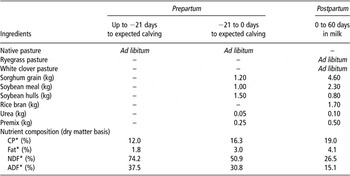
At −35 days from expected calving, the heifers were assigned randomly into two groups: (1) 500 mg somatotropin (500 mg/2 ml; Boostin®, LG Life Sciences, Seoul, Korea) by sc injections (somatotropin-treated group, n = 15) at −35 and −21 days, and, if pertinent, at −7 days (eight heifers that did not anticipate calving) from expected calving date; and (2) no treatment (control group, n = 16). All heifers were managed under the same conditions and nutritional regimen (Table 1).
Ingredient and nutrient composition of prepartum and postpartum diets

*Estimated based on diet analyses in National Research Council (NRC) software (2001).
Sample collection, measurement and analyses
Blood samples were collected weekly from −5 to 7 weeks after calving via venipuncture of the jugular vein into two tubes: one containing EDTA and potassium fluoride and the other without an anticoagulant. Samples were collected in the interval after milking and before feeding. In the postpartum period, heifers were milked twice on a daily basis at 0330 and 1530 h and production was recorded daily (Alpro®, DeLaval, Kansas City, MO, USA) and combined for weekly averages. BW was estimated weekly using a chest tape and BCS was evaluated weekly by one technician.
Concentrations of glucose and non-esterified fatty acids (NEFA) were measured colorimetrically using commercial kits, Glucose PAP Liquiform (Labtest Diagnostica, Lagoa Santa, SP, Brazil; Tabeleão et al., Reference Tabeleão, Goulart, Schwegler, Weiser, Moura, Silva, Pereira, Del Pino and Corrêa2008) and NEFA-HR (Wako USA, Richmond, VA, USA) using the micro-method described by Ballou et al. (Reference Ballou, Gomes, Juchem and DePeters2009). The intra- and inter-assay coefficients of variation (CV) for glucose and NEFA were <10%.
The procedures for IGF-I, insulin and progesterone analysis followed those specified by the manufacturer. Plasma IGF-I and insulin concentrations were measured using sandwich-type immunoassay commercial kits, DSL-10-2800 ACTIVE Non-extraction IGF-I ELISA (Obese et al., Reference Obese, Humphrys, Macmillan and Egan2008) and DSL-10-1600 ACTIVE Insulin (Diagnostics Systems Laboratories Inc., Webster, TX, USA; Lee et al., Reference Lee, Engle and Hossner2002), respectively. The intra-assay CV was 4.2% and 4.0% and the inter-assay CV 8.5% and 13.0% for IGF-I and insulin, respectively.
Progesterone concentrations in plasma were measured using a solid-phase ELISA that is based on the principle of competitive binding using a commercial kit, Progesterone IB79105 (Immuno-Biological Laboratories Inc., Minneapolis, MN, USA; Colazo et al., Reference Colazo, Ambrose, Kastelic and Small2008). The intra-assay CV was 9.9% and the inter-assay CV was 5.5%. Only the plasma samples collected from weeks 2 to 7 were analyzed. Heifers with progesterone concentrations in plasma above 1 ng/ml in two consecutive samples were considered as having resumed ovarian activity (Stevenson and Britt, Reference Stevenson and Britt1979).
Composite milk samples were collected weekly at the afternoon milking. Milk protein, fat and lactose assays were carried out using IR spectrophotometry (Bentley 20000, Bentley Instruments Inc., Chaska, MN, USA). The somatic cell count (SCC) assay was carried out using flow cytometry (Somacount 300, Bentley Instruments Inc.).
Reproductive management
After 50 days in milk (DIM), estrus was detected by visual observation and cows presenting visual signs of estrous behavior (standing when mounted) were artificially inseminated (AI). Visual observation of estrous behavior and AI were carried out by the same technician. Pregnancy diagnosis was carried out using ultrasound 30 days after AI and rechecked 60 days later.
Statistical analyses
The results are presented as means ± standard error of the mean (s.e.m.). All statistical analyses were carried out using SAS (SAS Institute Inc., Cary, NC, USA). Analyses involving repeated measures over time (e.g. BCS, BW, glucose, NEFA, insulin, IGF-I, milk production and composition) were compared between treatments using ANOVA for repeated measures using the MIXED procedure to evaluate the main effects of time, treatment and their interactions (Littell et al., Reference Littell, Henry and Ammerman1998). SCC values were log transformed before analysis. The statistical models and data analyses were designed and carried out separately for the prepartum and postpartum periods. When the interaction between treatment and time was significant (P < 0.05), pair-wise comparison of individual means was conducted. Percentage of cows ovulating before 3 and 7 weeks was analyzed using χ 2-test. Pregnancy rate was evaluated using the CAT MOD procedure for repeated measures at 60, 100, 120 and 150 DIM. A value of P < 0.05 was considered significant and a value of between 0.05 and ⩽0.1 was considered as a tendency.
Results
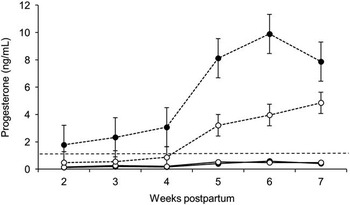
A higher proportion (P = 0.04) of heifers treated with somatotropin resumed ovarian activity in the first 7 weeks post partum (73.3%; 11/15) compared with the control group (37.5%; 6/16). A higher number of heifers in the somatotropin treatment group also ovulated (P = 0.02) the first postpartum dominant follicle (53.3%; 8/15) compared with the control group (12.5%; 2/16), as indicated by the number of heifers ovulating in the first 3 weeks post partum. Concentrations of progesterone for ovulatory and non-ovulatory heifers are represented in Figure 1. For non-ovulatory heifers, progesterone concentrations were never higher than 1 ng/ml. Pregnancy rate was not different (P = 0.30) between somatotropin-treated (40.0%; 6/15) heifers and control heifers (25.0%; 4/16) when evaluated up to 150 DIM.
Plasma progesterone concentrations from 2 to 7 weeks after calving for somatrotopin-treated (●) or control heifers (○) that ovulated (- - - -) or not (——). The dashed line (- - - -) indicates the 1 ng/ml limit used to divide cows that were considered as ovulatory or non-ovulatory. Heifers were treated with 500 mg of recombinant bovine somatotropin at weeks −5 and −3 from calving.

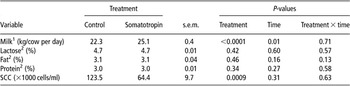
Data for milk production and composition are summarized in Table 2. Somatotropin treatment increased the average daily milk production (P < 0.0001) and reduced the SCC (P = 0.009).
Milk production and composition in control and somatotropin-treated groups

SSC = somatic cell count.
1Weekly average from daily measurements taken from 8 to 45 days post partum.
2Average of samples collected weekly from 8 to 45 days post partum.
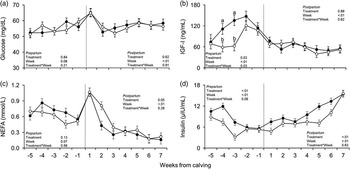
Data for plasma variables are summarized in Figure 2. Briefly, we did not detect an effect of week of study, treatment or treatment × week interaction on prepartum plasma glucose concentrations. For postpartum glucose, there was only an effect of time (P = 0.0004) with plasma glucose being higher (P < 0.02) at week 1. For plasma IGF-I concentration, there was a week (P = 0.002), treatment (P = 0.03) and week × treatment (P = 0.03) effect. Plasma IGF-I was higher for somatotropin-treated heifers at weeks −4 and −3. There was only an effect of week (P = 0.002) for postpartum IGF-I concentrations, being higher (P < 0.05) at weeks 5, 6 and 7 than at weeks 1 and 3. For prepartum insulin, there was an effect of week (P < 0.0001) and treatment (P = 0.002). Insulin concentrations were higher (P < 0.05) at weeks −5 and −4 and were higher (P < 0.05) for somatotropin-treated heifers. Postpartum insulin concentrations were higher (P = 0.01) for somatotropin-treated heifers and were higher (P < 0.05) at weeks 6 and 7.
Plasma concentrations of glucose (mg/dl) (a), IGF-I (ng/ml) (b), non-esterified fatty acids (NEFA; mmol/l) (c) and insulin (μIU/ml) (d) from −5 to 7 weeks from calving for somatrotopin-treated (●) or control heifers (○). Heifers were treated with 500 mg of recombinant bovine somatotropin at weeks −5 and −3 from calving.

We detected an effect of the week for prepartum (P = 0.0006) and postpartum (P = 0.0006) BCS. For the prepartum period, BCS was higher (P < 0.05) at week −5 and there was no effect of treatment (P = 0.93). For the postpartum period, BCS was lower (P < 0.05) at weeks 6 and 7. Postpartum BCS was higher for somatotropin-treated heifers (2.7 ± 0.02) than in control heifers (2.6 ± 0.02; P = 0.02). Effects for the treatment, week or treatment × week interaction for prepartum (560.3 ± 9.2 kg) or postpartum (530.3 ± 5.7 kg) BW were not significant.
Discussion
As hypothesized, prepartum somatotropin treatment reduced intensity of NEB as observed by increased insulin and reduced NEFA concentrations and BCS loss in the postpartum period. Consequently, prepartum somatotropin increased milk production and the proportion of heifers ovulating in the first 7 weeks post partum. Despite the positive effects in the resumption of ovarian activity, we did not find any significant increase in the pregnancy rate for treated heifers, probably because of low statistical power and number of heifers enrolled in this study.
Somatotropin treatment increased the number of heifers resuming ovarian activity in the first 7 weeks post partum. In addition, more heifers in this treatment ovulated the first postpartum dominant follicle, as indicated by the rise in progesterone concentration before 21 DIM (Kawashima et al., Reference Kawashima, Kaneko, Amaya Montoya, Matsui, Yamagishi, Matsunaga, Ishii, Kida, Miyake and Miyamoto2006). It is well-established that cows ovulating during the first postpartum follicular wave have higher serum IGF-I concentration in the prepartum and postpartum periods (Butler et al., Reference Butler, Pelton and Butler2006; Kawashima et al., Reference Kawashima, Fukihara, Maeda, Kaneko, Montoya, Matsui, Shimizu, Matsunaga, Kida, Miyake, Schams and Miyamoto2007). In this study, heifers treated with somatotropin had higher IGF-I concentration in the prepartum period, but not in the postpartum period. Britt (Reference Britt1992) hypothesized that the developmental competence of the oocyte and the steroidogenic capacity of the follicle, in high yielding dairy cows, is determined by their biochemical environment during the long period (up to 80 days) of follicular growth before ovulation. Thus, primary follicles exposed to adverse conditions associated with the metabolically challenging period of NEB during the early postpartum period may be less capable of producing adequate amounts of estrogens. Furthermore, such follicles would be doomed to contain an inferior oocyte, which will then be ovulated approximately 60 to 80 days post partum (Leroy et al., Reference Leroy, Opsomer, Van Soom, Goovaerts and Bols2008). Although this hypothesis was never tested with regard to the NEB challenge, it was found to be true for cows undergoing a short period of heat stress (Roth et al., Reference Roth, Meidan, Shaham-Albalancy, Braw-Tal and Wolfenson2001a and Reference Roth, Arav, Bor, Zeron, Braw-Tal and Wolfenson2001b) and can explain the effects of prepartum IGF-I on postpartum follicle development observed in this study.
Another interesting point is that somatotropin-treated heifers had higher insulin concentrations in the postpartum period. Circulating insulin concentration is proposed as a key factor in mediating the effect of dietary intake on ovarian function (Armstrong et al., Reference Armstrong, Gong, Gardner, Baxter, Hogg and Webb2002). In this manner, dairy cows fed diets designed to increase circulating insulin concentrations demonstrated increased ovarian function (Armstrong et al., Reference Armstrong, McEvoy, Baxter, Robinson, Hogg, Woad, Webb and Sinclair2001) and earlier onset of estrous cycles (Gong et al., Reference Gong, Lee, Garnsworthy and Webb2002). In addition, cows that ovulated the first postpartum dominant follicle had higher circulating insulin concentrations than anovulatory cows (Butler et al., Reference Butler, Pelton and Butler2006). The increased ovulation rate is probably due to positive effects of insulin on steroidogenesis (Butler et al., Reference Butler, Pelton and Butler2004) via amplification of gonadotropin action (Spicer and Echternkamp, Reference Spicer and Echternkamp1995).
Milk production was increased by prepartum somatotropin treatment, in agreement with a previous observation (Putnam et al., Reference Putnam, Varga and Dann1999). In the same way, prepartum injection of somatotropin in ewes led to higher milk production and mammary cell proliferation (Stelwagen et al., Reference Stelwagen, Grieve, Walton, Ball and Mcbride1993), probably mediated by IGF-I (Baumrucker and Stemberger, Reference Baumrucker and Stemberger1989). Furthermore, according to the SCC data, the health of the mammary gland was also improved in heifers injected with somatotropin. The decreased SCC in dairy cows receiving somatotropin has already been shown elsewhere (Putnam et al., Reference Putnam, Varga and Dann1999; Gulay et al., Reference Gulay, Hayen, Liboni, Belloso, Wilcox and Head2004), and can also have contributed to increased milk production (Hortet et al., Reference Hortet, Beaudeau, Seegers and Fourichon1999).
Previous studies have shown that cows treated with a low dose of somatotropin in the peripartum period had a better recovery of BCS during early lactation, even though they produced more milk (Putnam et al., Reference Putnam, Varga and Dann1999; Gulay et al., Reference Gulay, Hayen, Teixeira, Wilcox and Head2003). Studies indicate that the extra energy to support increased milk yield in somatotropin-treated cows arose from greater DMI rather than from greater mobilization of body reserves (Putnam et al., Reference Putnam, Varga and Dann1999; Gulay et al., Reference Gulay, Hayen, Liboni, Belloso, Wilcox and Head2004). In agreement with these observations, in this study, somatotropin-treated heifers had lower BCS loss and better energy balance related parameters, such as higher insulin and lower NEFA concentrations in the early postpartum period, even though they produced more milk. Vallimont et al. (Reference Vallimont, Varga, Arieli, Cassidy and Cummins2001) also found a reduction in postpartum NEFA concentration after injecting cows with somatotropin exclusively in the prepartum period, in concert with our current findings.
In conclusion, somatotropin injection during the prepartum period in late-pregnant Holstein heifers increased proportion of heifers resuming ovarian activity during the first 7 weeks post partum, inspite of higher milk production. In addition, prepartum somatotropin also improved parameters that indicate that these heifers had a less severe NEB during the early postpartum period.
Acknowledgments
The authors thank the Coordenadoria de Aperfeiçoamento de Pessoal de Nível Superior (CAPES) and Conselho de Desenvolvimento Científico e Tecnológico (CNPq) for the financial support. The authors thank Granja 4 Irmãos S/A that provided cows and farm facilities.