Implications
Animal fats constitute about half of human lipid intake in developed countries. Therefore, there is an interest to modify the composition of meat by dietary means to improve its nutritional value. Increasing the dietary supply of polyunsaturated fatty acids (PUFAs) is one of the most important strategies to increase their content in beef. However, following rumen degradation, these dietary FAs could be altered in various tissues/organs such as the liver and adipose tissues (ATs), thus affecting their subsequent deposition in muscles. This study showed that a large proportion of α-linolenic acid (ALA; n-3 PUFA) reaching the liver was oxidised to produce energy. Moreover, bovine liver and ATs were inefficient at converting ALA into longer chain n-3 PUFA known for their health properties.
Introduction
Scientific evidence and nutritional guidelines recommend a reduction in total fat intake, particularly of saturated FAs (SFAs), which are associated with an increased risk of obesity, hypercholesterolaemia and some cancers (Smit et al., Reference Smit, Mozaffarian and Willett2009), leading nutrition advisers to recommend a higher intake of PUFA, especially n-3 PUFA. Consequently, in rich industrialised societies consumers attach increasing importance to diet as a major factor contributing to health.
Meat, and more particularly beef, often has a negative health image because of its relatively high SFA content and its low concentration in PUFA (Demeyer and Doreau, Reference Demeyer and Doreau1999). Therefore, there is an interest to modify the composition of beef by dietary means to improve its nutritional value. Several energy sources, such as whole cottonseed, rapeseeds, linseeds and soyabeans, soyabean oil, maize oil and sunflower oil could form part of the diet of ruminants, with the objective of raising the levels of monounsaturated and PUFA in muscles (Wood et al., Reference Wood, Enser, Fisher, Nute, Sheard, Richardson, Hughes and Whittington2008). Dietary effects are relatively well recognised and in general the composition of beef lipids reflects the FA composition of the diet. However, the response is relatively small and complex as the result of FA synthesis by rumen microorganisms as well as lipolysis followed by hydrogenation of dietary PUFA in the rumen (Doreau and Chilliard, Reference Doreau and Chilliard1997). Moreover, in addition to rumen biohydrogenation, PUFA could still be metabolised (oxidation, elongation, desaturation, esterification, etc.) in various tissues/organs involved in FA metabolism such as the liver (Bauchart et al., Reference Bauchart, Gruffat and Durand1996) and adipose tissues (ATs; Hanson and Ballard, Reference Hanson and Ballard1967). For example, if we consider a minor group of FAs that are characteristic of ruminant fat and have a number of potent beneficial health effects, that is, conjugated linolenic acid (CLA), recent studies have shown that bovine ATs are especially involved in endogenous synthesis of CLA from vaccenic acid and in its desaturation into conjugated derivatives (Gruffat et al., Reference Gruffat, Rémond, Durand, Loreau and Bauchart2008). In contrast, bovine liver is not involved in conversion of vaccenic acid to CLA (Gruffat et al., Reference Gruffat, De La Torre, Chardigny, Durand, Loreau and Bauchart2005), although CLA is highly metabolised by bovine hepatocytes, especially by the oxidation pathway and by conversion into conjugated derivatives (De La Torre et al., Reference De La Torre, Gruffat, Chardigny, Sébédio, Durand, Loreau and Bauchart2005). The intensity of all these metabolic pathways can consequently have a considerable effect on the deposition of these FAs in muscles.
In this context, the aim of this study was to compare the metabolism of linoleic (LA; 18:2n-6) and linolenic (ALA; 18:3n-3) acids in the liver and in two ATs (subcutaneous (SC) and inter-muscular (IM)) of animals fed a concentrate/straw-based diet or the same diet supplemented with a mixture of extruded linseed (rich in n-3 PUFA) and rapeseed (rich in n-3 and n-6 PUFA and in 18:1n-9), using the in vitro method of incubated tissue slices.
Material and methods
Chemicals and materials
The medium for incubation of liver slices (RPMI-1640), bovine serum albumin (BSA) free of FA, glutamine (300 mg/l), FA and antibiotic–antimycotic cocktail (penicillin, 100 U/ml; streptomycin, 0.1 mg/ml; and amphoterine B, 0.25 μg/ml) were purchased from Sigma Chemical (St Louis, MO, USA). The medium for incubation of AT slices (M-199) and Hank's buffer were purchased from Invitrogen (Cergy Pontoise, France). [1-14C] LA (3.7 MBq/ml), tri-[9,10 3H]olein (185 MBq/ml) and 1,2 dipalmitoyl L-3-phosphatidyl[N-methyl-3H]choline (37 MBq/ml) were purchased from GE Healthcare (Orsay, France). [1-14C] ALA (3.7 MBq/ml) was purchased from PerkinElmer (Courtaboeuf, France). Hyamine hydroxide was purchased from ICN Biochemicals (Irvine, CA, USA). Perchloric acid and organic solvents (chloroform, methanol, propanol, diethyl ether and acetic acid) were purchased from VWR International (Fontenay sous Bois, France). Ready Safe® scintillation cocktail was purchased from Beckman Instruments (Fullerton, CA, USA). Plastic organ culture Petri dishes were purchased from Beckton Dickinson (Cockeysville, MD, USA). Plastic centre wells were purchased from Kontes (Vineland, NJ, USA) and aminopropyl-activated silica Sep-Pak® cartridges were purchased from Waters (Milford, MA, USA).
Animals and diets
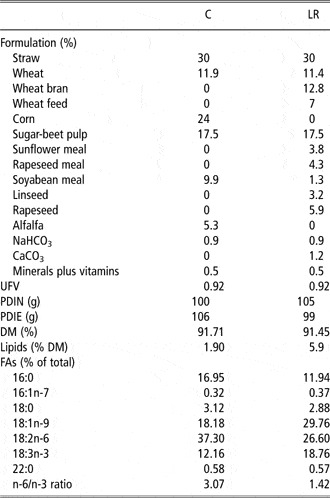
All experiments were conducted in a manner compatible with national legislation on animal care (Certificate of Authorisation to Experiment on Living Animal no. 7740, Ministry of Agriculture and Fish Products). A total of 12 Normande cull cows (48 to 60 months old, mean live weight 642 kg) were divided into two groups and were given one of the two isoenergetic and isonitrogenous diets consisting either in a concentrate/straw-based diet (70/30; C group) or the same basal diet supplemented with a mixture of extruded linseed and rapeseed (LR group, 66/33; 40 g lipid/kg dry matter diet) during their 100-day-finishing period (Table 1).
Chemical composition and nutritive value of diets fed to cows

C = concentrate/straw-based diet; LR = linseed and rapeseed; DM = dry matter; FAs = fatty acids; UFV = meat feed unit; PDIN = protein digestible in the intestine limited by nitrogen supply; PDIE = protein digestible in the intestine limited by energy supply.
Liver slice preparation and incubation
Liver tissue samples were collected from cows within 15 min after slaughtering. They were quickly rinsed in an ice-cold saline solution (NaCl, 9 g/l), trimmed of blood and connective tissue and cut into 0.5 mm slices. Approximately, 200 mg of fresh liver was placed on stainless steel grids positioned either on a plastic organ culture Petri dish (for quantification of FA bioconversion, esterification and secretion) or in a 25-ml flask equipped with suspended plastic wells (to measure specific CO2 production) in the presence of RPMI-1640 medium (0.9 ml per dish and 1.4 ml per flask) supplemented with the antibiotic–antimycotic cocktail and an FA mixture (Chilliard et al., Reference Chilliard, Bauchart and Barnouin1984) representative in composition and concentration of bovine plasma non-esterified FA (0.2 mM final concentration, which consisted of caprylic acid (4.2 μM), capric acid (4.2 μM), myristic acid (15.3 μM), palmitic acid (52.8 μM), stearic acid (57.9 μM), oleic acid (56.1 μM), LA (7 μM) and ALA (0.9 μM)) complexed with BSA (FA : albumin molar ratio, 4 : 1). The liver slices were placed under a water-saturated atmosphere (95% O2 and 5% CO2) for 3 h at 37°C to ensure cell recovery. The medium was then replaced with similar fresh medium containing the same mixture of FA as previously described, except for certain FAs that were omitted from the mixture and were added as radioactive substances: [1-14C]-18:2n-6 (2.04 GBq/mmol, 96.2 KBq/ml) or [1-14C]-18:3n-3 (1.91 GBq/mmol, 96.2 KBq/ml). Previous kinetic experiments (Graulet et al., Reference Graulet, Gruffat-Mouty, Durand and Bauchart2000) had been carried out to verify correct viability of liver slices for 24 h. Consequently, liver slice incubations were stopped after 17 h of labelling. Briefly, media (2.5 ml) were collected and liver slices were washed with 2.0 ml of buffered solution (KCl, 0.4 g/l; NaHPO4, 0.8 g/l; pH 7.4; and D-glucose 2.0 g/l) before homogenisation with a dounce homogeniser (VWR International, Fontenay sous Bois, France) in 2.0 ml of Tris-HCl, 0.25 mM (pH 8.0) and NaCl, 50 mM (pH 8.0).
AT slice preparation and incubation
Within 20 min after slaughtering, SC AT samples (∼200 g) were taken in the region of the 6th rib, the IM AT sample being taken between the thoracic portion of the Trapezii muscle and the Rhomboideus thoracis muscle. The samples were immediately placed in an incubator vessel containing sterile Hank's buffer pH 7.4 at 37°C. SC and IM ATs were finely cut freehand into 20- to 25-mg pieces of uniform shape and placed (∼10 slices) on stainless steel grids positioned on a plastic organ culture Petri dish in the presence of M-199 medium (0.9 ml per dish, two dishes per experimental condition and per animal) supplemented with insulin (2 U/l), acetate (5 mM) and in the presence of the antibiotic–antimycotic cocktail and of an FA mixture representative in composition and concentration of bovine plasma non-esterified FA as described above for liver slice incubation. AT samples were placed under a water-saturated atmosphere (95% O2 and 5% CO2) for 3 h at 37°C in order to ensure cell recovery. As for liver slices, the medium was then replaced with similar fresh medium containing the same mixture of FA as previously described, except for certain FAs, which were omitted from the mixture and were added as radioactive substances: [1-14C]-18:2n-6 (2.04 GBq/mmol, 96.2 KBq/ml) or [1-14C]-18:3n-3 (1.91 GBq/mmol, 96.2 KBq/ml). The viability of AT slices were verified by measuring glucose-6-phosphate dehydrogenase activity (Chilliard et al., Reference Chilliard, Gagliostro, Flechet, Lefaivre and Sebastian1991). AT slice incubations were stopped after 17 h of labelling. Briefly, media (1.8 ml) were collected and AT slices were washed with 1.0 ml of Hank's buffer. The washing solutions were grouped with the corresponding incubation media.
Determination of FA oxidation in liver slices
CO2 excreted into the atmosphere by liver cells was complexed with hyamine hydroxide (500 μl) placed in suspended plastic centre wells inside flasks at the beginning of incubation as described earlier (Graulet et al., Reference Graulet, Gruffat, Durand and Bauchart1998). After 17 h of incubation, wells were introduced into scintillation vials containing 4 ml of Ready Safe® scintillation cocktail for radioactivity quantification. The production of ketone bodies was estimated according to the method of Graulet et al. (Reference Graulet, Gruffat, Durand and Bauchart1998). Briefly, cell homogenates (250 μl) and media (500 μl) were treated for 20 min at 4°C with ice-cold perchloric acid (0.2 mM final). After centrifugation for 20 min at 4°C at 1850 g, an aliquot of supernatant containing the acid soluble products (ASPs, composed mainly of ketone bodies (63%), acetate (16%) and, a minor proportion represented by intermediates of the Krebs cycle (Graulet et al., Reference Graulet, Gruffat, Durand and Bauchart1998)) was introduced into a scintillation vial and the radioactivity was counted.
Determination of FA bioconversion in liver and AT slices
Total liver and AT lipids were extracted according to the method of Folch et al. (Reference Folch, Lees and Sloane-Stanley1957), and their corresponding FA were liberated and methylated by transmethylation at room temperature according to the method of Christie et al. (Reference Christie, Sébédio and Juanéda2001). FA methyl esters (FAME) containing [14C] FAME were analysed by GLC using a Peri 2100 chromatograph (Périchrom, Saulx-les-Chartreux, France), equipped with a split/splitless injector and a fused Stabilwax wide-bore silica column (60 m × 0.53 mm i.d.; film thickness, 0.50 μm; Restek, Evry, France). The outflow from the column was split between a flame-ionisation detector (15%) and a copper oxide oven heated at 700°C in order to transform the [14C] FA into 14CO2 (85%). Radioactivity was quantified with a radiodetector (GC-RAM) (Lablogic, Sheffield, UK) by counting 14CO2 after mixing it with a 9 : 1 ratio of argon/methane, as previously described by Bretillon et al. (Reference Bretillon, Chardigny, Grégoire, Berdeaux and Sébédio1999). Data were computed using Laura software (Lablogic). The proportion of LA or ALA converted into 20:4n-6 or 20:5n-3, respectively, according to the similarity of their retention time with that of their corresponding standard, was calculated as the ratio between the radioactivity corresponding to 20:4n-6 or 20:5n-3 and the sum of the radioactivity present in peaks of LA or ALA and 20:4n-6 or 20:5n-3. Values were expressed as percentage of converted FA.
Determination of FA esterification into neutral and polar lipids in liver and AT slices
Total lipids of liver and ATs were extracted according to the method of Folch et al. (Reference Folch, Lees and Sloane-Stanley1957) after addition of [3H] trioleylglycerol (67 Bq) and [3H] phosphatidylcholine (100 Bq) as internal triacylglycerol (TG) and phospholipid (PL) standards (Graulet et al., Reference Graulet, Gruffat, Durand and Bauchart1998) and, in the case of hepatic lipid extraction, after addition of a standard (non-radioactive) liver tissue homogenate (∼10 mg of lipids) as a lipid carrier. Neutral and polar lipids were separated by affinity-liquid chromatography with an aminopropyl-activated silica Sep-Pak® cartridge according to Kaluzny et al. (Reference Kaluzny, Rode, Meritt and Epps1985). They were directly collected into scintillation vials, evaporated to dryness under an air stream, and counted for radioactivity.
Hepatic secretion of very-low-density lipoproteins (VLDL) by liver slices
Newly secreted [14C] VLDL were purified by ultracentrifugation according to Graulet et al. (Reference Graulet, Gruffat, Durand and Bauchart1998). Hence, the medium (3 ml) previously supplemented with purified plasma bovine VLDL (0.3 mg of VLDL-TG per 12 ml tube) as a carrier for VLDL during ultracentrifugation, was adjusted to the density of 1.063 g/l with potassium bromide and overlaid with 9 ml of saline solution. VLDL particles were isolated by ultracentrifugal flotation at 100 000 g for 16 h at 15°C in a Kontron Centrikon T-2060 ultracentrifuge equipped with a TST 41-14 rotor (Kontron, Zürick, Switzerland). About 2 ml were collected at the top of each tube and recentrifuged in the same conditions, except that pure albumin (50 mg/tube) was added to remove traces of free [14C] FA adsorbed onto VLDL particles. Finally, purified VLDL (2.5 ml) were counted for radioactivity in scintillation vials.
Calculation of results
For each analysis, except for CO2 determination, an aliquot of medium and/or liver/AT homogenate from the same incubation dish was taken. As the specific activity of each [1-14C] FA was known and the weight of liver/AT in each dish was determined, results were expressed in nanomole of FA per gram of liver or as percentage of FA added to the medium.
Statistical analysis
Values are expressed as means ± s.e.m. of six animals per group. For liver slice data, comparison of means between diets (C v. LR) and FA (LA v. ALA) were tested by analysis of variance using the GLM procedure of statistical analysis software (SAS Institute Inc., Cary, NC, USA). The interaction diet × FA was also tested without any significant differences being found. Consequently, the effects of interaction are not presented in tables. Data of ATs were analysed according to a split-splot design using the MIXED procedure of SAS (Cary, NC, USA) in which diets, FA and ATs were accepted as constant factors and animals as a random factor. The interactions diet × FA, diet × AT, FA × AT and diet × FA × AT were also tested without any significant differences being found. Consequently the effects of interaction are not presented in tables.
Results
Hepatic metabolism of LA and ALA
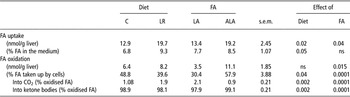
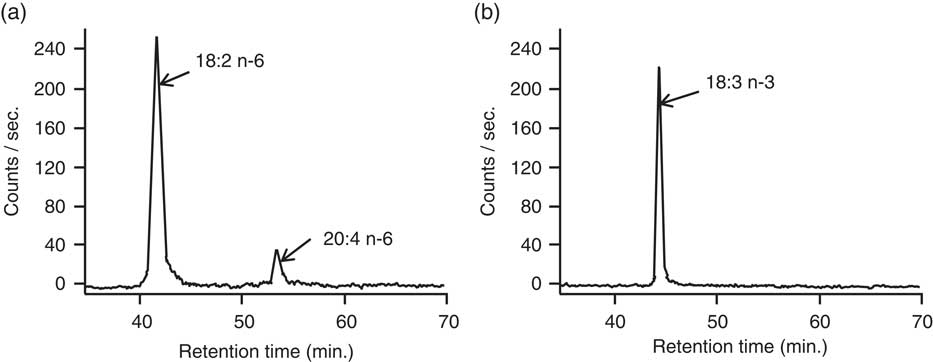
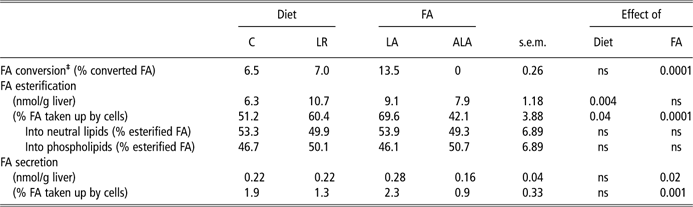
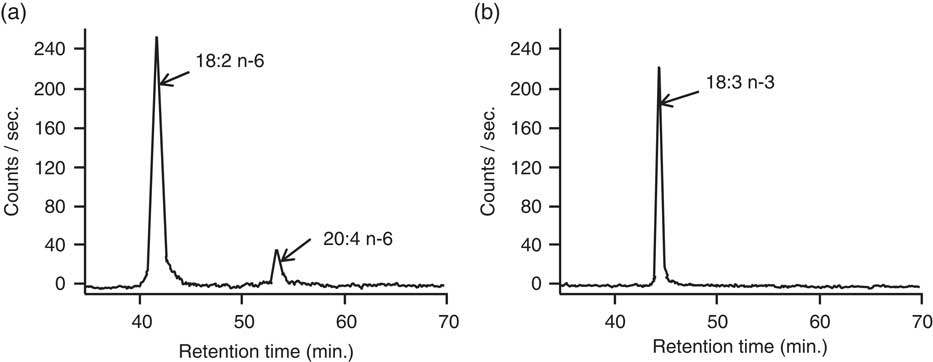
Hepatic uptake of the two FAs present in the medium was 1.53-fold higher with the LR than with the C diet (P = 0.02) corresponding to around 6.8% and 9.3% of FA present in the medium for C and LR diets, respectively (Table 2). Moreover, for the two diets, the uptake of ALA was 1.43-fold higher (P = 0.04) than that of LA when expressed as nanomole of FA taken up by the liver. Mitochondrial β-oxidation of ALA (mainly in the form of ketone bodies, >99% of oxidised ALA) was 3.17-fold higher than that of LA (P = 0.015; Table 2). Indeed, the extent of ALA oxidation corresponded to >57% of ALA taken up by hepatocytes, whereas the corresponding figure for LA oxidation did not exceed 31%. Whatever the diet studied, ALA was not bio-converted into longer (by elongation) and/or more unsaturated (by desaturation) FA, although about 13.5% of LA was converted into 20:4n-6 (arachidonic acid; Figure 1, Table 3). The esterification pathway was 1.7-fold higher (P = 0.004) with the LR than with the C diet for both FA tested. When expressed as percentage of FA taken up by cells, the intensity of LA esterification could reach 69%, whereas that of ALA did not exceed 42% (Table 3). Finally, hepatic secretion of ALA as part of VLDL, which represents the fraction of 18:3n-3 that could reach the target tissues such as muscles, was 1.75-fold lower than that of LA (P = 0.02; Table 3). This secretion rate corresponded to around 0.9% of ALA taken up by cells, whereas for LA the rate was about 2.3%.
Least squares means for uptake and oxidation of 18:2n-6 (LA) and 18:3n-3 (ALA) after 17 h of incubation of liver slices of Normande cull cows (n = 6 per diet) fed a C diet (C group) or the same basal diet supplemented with a mixture of extruded LR (LR group)

LA = linoleic acid; ALA = α-linolenic acid; C = concentrate/straw-based diet; LR = linseed and rapeseed; FA = fatty acid.
Representative radiochromatograms of [1-14C]-linoleic acid (a) and [1-14C]-α-linolenic acid (b) bioconversion in bovine liver slices. Liver slices from Normande cull cows were incubated for 17 h in a medium containing a fatty acid (FA) mixture (0.2 mM) and [1-14C]-18:2n-6 or [1-14C]-18:3n-3. At the end of incubation, cellular lipids were extracted, transformed into methyl esters and analysed by GLC. The outflow from the column was split between a flame-ionisation detector (15%) and a copper oxide oven in order to transform the labelled FA into [1-14C] CO2 (85%). The radioactivity was determined with a radiodetector by counting [1-14C] CO2.
Least squares means for conversion, esterification and secretion of 18:2n-6 (LA) and 18:3n-3 (ALA) after 17 h of incubation of liver slices of Normande cull cows (n = 6 per diet) fed a C diet (C group) or the same basal diet supplemented with a mixture of extruded LR (LR group)
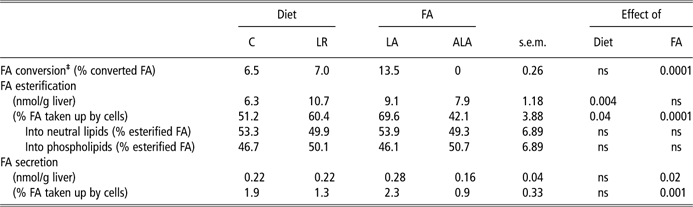
LA = linoleic acid; ALA = α-linolenic acid; C = concentrate/straw-based diet; LR = linseed and rapeseed; FA = fatty acid.
‡Ratio between the radioactivity corresponding to the product of desaturation and the sum of the radioactivity present in peak of precursor (LA, ALA) plus its corresponding desaturation product. LA was converted into arachidonic acid (20:4n-6).
AT metabolism of LA and ALA
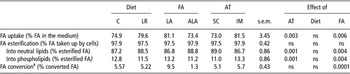
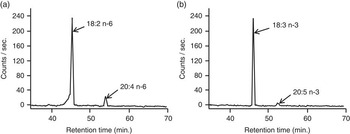
In the case of ATs, there was no significant effect of diets (C v. LR) on the different parameters representative of the metabolism of the two FAs tested (Table 4). FAs were strongly incorporated by ATs (>70% of FA present in the incubation medium; Table 4). This uptake was 1.11-fold higher for IM AT than for SC AT (P = 0.003). Moreover, AT uptake of LA was 1.1-fold higher than that of ALA (P = 0.006; Table 4). The two FAs were essentially directed towards the esterification pathway as this metabolic pathway involved >97% of FA present in adipocytes (Table 4). All FAs in both types of AT were preferentially esterified into neutral lipids (>86% of esterified FA), although the proportion of FA esterified as neutral lipids was higher in SC than in IM AT (P = 0.001). Moreover, ALA was more esterified into neutral lipids than LA (P = 0.004). Around 9.5% of LA present in ATs were converted into arachidonic acid (20:4n-6), whereas only around 1.3% of ALA were converted into eicosapentaenoic acid (20:5n-3, EPA; Figure 2, Table 4).
Least squares means for uptake, esterification and conversion of 18:2n-6 (LA) and 18:3n-3 (ALA) after 17 h of incubation of SC and IM AT slices of Normande cull cows (n = 6 per diet) fed a C diet (C group) or the same basal diet supplemented with a mixture of extruded LR (LR group)

LA = linoleic acid; ALA = α-linolenic acid; SC = subcutaneous; IM = inter-muscular; AT = adipose tissue; C = concentrate/straw-based diet; LR = linseed and rapeseed; FA = fatty acid.
‡Ratio between the radioactivity corresponding to the product of desaturation and the sum of the radioactivity present in peak of precursor (LA, ALA) plus its corresponding desaturation product. LA and ALA were respectively converted into arachidonic acid (20:4n-6) and ecosapentaenoic acid (20:5n-3).
Representative radiochromatograms of [1-14C]-linoleic acid (a) and [1-14C]-α-linolenic acid (b) bioconversion in bovine inter-muscular (IM) adipose tissue (AT) slices. IM AT slices from Normande cull cows were incubated for 17 h in a medium containing a fatty acid (FA) mixture (0.2 mM) and [1-14C]-18:2n-6 or [1-14C]-18:3n-3. At the end of incubation, cellular lipids were extracted, transformed into methyl esters and analysed by GLC. The outflow from the column was split between a flame-ionisation detector (15%) and a copper oxide oven in order to transform the labelled FA into [1-14C] CO2 (85%). The radioactivity was determined with a radiodetector by counting [1-14C] CO2.

Discussion
Feeding strategies based on the addition of plant lipids rich in PUFA in diets of bovines during the finishing period are common to enhance the nutritional value of meat. However, besides rumen biohydrogenation, dietary PUFA could still be largely metabolised in the various tissues/organs involved in FA metabolism. Indeed, the liver plays an important role in ruminant lipid metabolism, especially during periods of fat mobilisation that occur in several nutritional and physiological situations such as restricted feed intake or the periparturient period (Bauchart et al., Reference Bauchart, Gruffat and Durand1996). ATs also play an important role in ruminant lipid metabolism as they are the major sites of de novo synthesis of FA (Hanson and Ballard, Reference Hanson and Ballard1967). The regulation of these metabolic pathways could affect FA deposition into lipids of ruminant products. In this context, the aim of this study was to investigate the metabolic behaviour of LA and ALA in the liver and SC and IM ATs of animals fed a concentrate/straw-based diet or the same diet supplemented with a mixture of extruded linseed and rapeseed. For this purpose, the in vitro method of incubated liver and AT slices was chosen in order to retain normal cellular architecture and intact connective tissue (Olinga et al., Reference Olinga, Meijer, Slooff and Groothuis1997; Novakofski, Reference Novakofski2004).
Metabolism of LA and ALA in ruminant liver
The ruminant liver extracts between 7% and 25% of plasma non-esterified FA each pass through the liver under in vivo conditions (Emery et al., Reference Emery, Liesman and Herdt1992), whereas it removes little or no TG from blood lipoproteins because of its low lipoprotein lipase and TG lipase contents (Hocquette et al., Reference Hocquette, Graulet and Olivecrona1998). Therefore, uptake of non-esterified FA is the predominant route by which FAs are supplied to the liver (Emery et al., Reference Emery, Liesman and Herdt1992). However, few studies have measured hepatic uptake of individual long-chain FA in ruminants. In our experiment, the liver slice model showed a hepatic uptake of both LA and ALA reaching around 7.5% and 8.5% of FA present in the medium respectively, that is, levels comparable to those previously observed in vivo (Emery et al., Reference Emery, Liesman and Herdt1992). Nevertheless, the liver slice model showed a significant difference in LA and ALA uptake by hepatocytes, as for the two diets, the uptake of ALA was 42.6% higher than that of LA. Transport of long-chain FA into cells is thought to involve both facilitative and passive processes (Abumrad et al., Reference Abumrad, Harmon and Ibrahimin1998). In either process, the amount of FA dissociated from albumin is thought to be a determinant for uptake into the cell (Stremmel et al., Reference Stremmel, Pohl, Ring and Herrmann2001). Therefore, the binding affinity of FA to albumin may be an important factor regulating their uptake. Transport through the cell membrane is also thought to be a rate-limiting process in FA uptake (Schwenk et al., Reference Schwenk, Holloway, Luiken, Bonen and Glatz2010). The rate of desorption of FA from PL bilayers decreased with increasing chain length and increased with addition of each double bond (Zhang et al., Reference Zhang, Kamp and Hamilton1996). Thus, it could be speculated that a low rate of removal from the cell membrane into the cytosol may impede LA uptake, whereas uptake of ALA is less hindered. Finally, the higher ALA uptake by bovine liver slices compared with that of LA might be attributable to a higher rate of intracellular FA utilisation (oxidation, esterification, etc.) increasing cellular needs (Zakim, Reference Zakim1996). The intensity of the hepatic uptake of FA was higher in animals fed LR compared with C diet. This dietary effect may be related to a change in the FA composition of liver membranes, which is strongly influenced by the relative abundance of PUFA in the diet (Hulbert et al., Reference Hulbert, Turner, Storlien and Else2005). Such changes could alter membrane fluidity, which is involved in the mechanisms of FA transport across membranes (Bojesen and Bojesen, Reference Bojesen and Bojesen1999).
Once in the hepatocytes, catabolism of FA is mostly directed towards synthesis of ketone bodies for energy utilisation by tissues (Reid and Husbands, Reference Reid and Husbands1985) as observed in our study in which products of LA and ALA oxidation were dominated by ASPs (>97% of total oxidation products). The higher rate of oxidation of ALA compared with that of LA is in agreement with previous data on rats (Clouet et al., Reference Clouet, Niot and Bezard1989; Emmison et al., Reference Emmison, Gallagher and Coleman1995) that showed that the rate of hepatic mitochondrial oxidation of 18:3n-3 was higher than that of 18:2n-6 mainly due to higher mitochondrial activity of carnitine palmitoyltransferase (Ide et al., Reference Ide, Murata and Sugano1996). As ALA is an essential FA, the extent of its partitioning towards β-oxidation is somewhat counterintuitive. One hypothesis proposed is that carbon on acetyl CoA generated by ALA β-oxidation may be recycled and used in FA de novo synthesis (Burdge and Calder, Reference Burdge and Calder2005). However, in our experimental conditions using GC-RAM detection, no products from ALA β-oxidation corresponding to FA shortened by two carbon atoms per cycle were observed.
FA that escaped from the β-oxidation pathway could be converted into longer and/or more unsaturated FA by the elongation–desaturation pathway, LA and ALA being in theory metabolised into arachidonic acid (20:4n-6) and docosahexaenoic acid (DHA, 22:6n-3) as end-products, respectively (Sprecher, Reference Sprecher2000; Burdge and Calder, Reference Burdge and Calder2005). In this study, the conversion of ALA into DHA was undetectable, whereas LA conversion into 20:4n-6 reached 13.5%. These results agree with the general observation of a very low biosynthesis of DHA (<1%) in mammalian liver (Igarashi et al., Reference Igarashi, Ma, Chang, Bell, Rapopport and DeMar2006). It is well known that members of the n-6 and n-3 families compete for the elongation–desaturation pathway (Sprecher, Reference Sprecher1981), the conversion of LA and ALA into their longer chain homologues being significantly influenced by the composition of dietary fats (Christiansen et al., Reference Christiansen, Lund, Rortveit and Rustan1991). In this context, bioconversion of n-3 FA into higher homologues depends on the ratio of ingested n-6/n-3 FA, a ratio of 1/1 being proposed to lead to the highest formation of long-chain n-3 PUFA (Harnack et al., Reference Harnack, Andersen and Somoza2009). In our study, the n-6/n-3 ratio of the liver explant incubation medium was close to 7, a context, which might favour LA conversion into 20:4n-6 to the detriment of ALA conversion.
LA, ALA and their derivatives that escaped the β-oxidation pathway were esterified. The lower level of esterification of ALA compared with LA was certainly the consequence of its preferential β-oxidation leading to less FA available for esterification (Emmison et al., Reference Emmison, Gallagher and Coleman1995). The intensity of the hepatic esterification pathway was higher in animals fed LR compared with C diet. Among the possible explanations, this dietary effect could be a direct consequence of the higher uptake of FA with the LR compared with C diet. Another hypothesis could be based on the results of Emmison et al. (Reference Emmison, Gallagher and Coleman1995) who showed for rat hepatocytes that the presence of 18:1n-9 (the major FA present in the LR diet) in the incubation medium increased the esterification of both LA and ALA. In our experimental conditions, the concentration of 18:1n-9 in the LR diet was 1.6-fold higher than that of C diet. However, the concentration of 18:1n-9 in the liver slice incubation medium was the same for both diets. The difference in FA esterification between the two diets would reveal a long-term adaptative mechanism activated by the LR diet. Emmison et al. (Reference Emmison, Gallagher and Coleman1995) suggested that 18:1n-9 may mediate n-3 and n-6 FA sparing, channelling these FAs preferentially into the secretion pathway. However, in our experimental conditions, the intensity of secretion of FA as part of VLDL was not changed by the composition of the diet. In terms of intensity, this secretion was rather low in our experimental conditions (from 0.9% to 2.3% of FA incorporated into cells); this result is in agreement with the fact that newly synthesised TG represented only a small part (4% to 13%) of lipids secreted by the liver as parts of VLDL (Gibbons and Wiggins, Reference Gibbons and Wiggins1995). Neosynthesised TG are stored primarily in cytosolic droplets from which they enter into a hydrolysis/esterification cycle to return to the endoplasmic reticulum for VLDL assembly (Gibbons et al., Reference Gibbons, Bartlett, Sparks and Sparks1992). Therefore, it is not excluded that in our experimental conditions, the time of incubation for liver slices would be too short to allow the return of a significant amount of TG to the secretion pool. However, ALA secretion as part of VLDL was considerably lower than that of LA. Previous experiments with isolated liver perfusion showed that the low hepatic VLDL secretion was not caused by defects in synthesis, assembly or secretion, but rather by lack of available FA substrate owing to activation of the FA oxidation sequence, indicating that the rate of FA oxidation is a decisive regulatory factor for TG synthesis and secretion as VLDL in the liver (Ide and Ontko, Reference Ide and Ontko1981). This mechanism might partly explain the beneficial hypolipaemic effects of dietary ALA (Simopoulos, Reference Simopoulos1999).
Metabolism of LA and ALA in ruminant ATs
To our knowledge, only two studies described the uptake of FA by SC AT explants of the ruminant (Jacobi and Miner, Reference Jacobi and Miner2002; Gruffat et al., Reference Gruffat, Rémond, Durand, Loreau and Bauchart2008). Jacobi and Miner (Reference Jacobi and Miner2002) showed a five-fold higher uptake of FA than that observed in our study when results were expressed as nanomole of FA taken up per hour per gram tissue. However, discrepancies between their results and ours would probably be explained by differences in the FA incubation conditions. Indeed, Jacobi and Miner (Reference Jacobi and Miner2002) determined the intensity of 14C-palmitate and 14C-oleate uptakes by AT explants by adding these FAs as a tracer dose to the medium, whereas in our experiment, in order to simulate the in vivo physiological conditions, 14C-LA and 14C-ALA were mixed with long-chain FAs, the composition and concentration of which are similar to that of bovine plasma non-esterified FA. Under these conditions, competition between labelled FA and other non-labelled FA uptake decreased the intensity of cell uptake of the labelled FA compared with the results obtained by Jacobi and Miner (Reference Jacobi and Miner2002) in which only the labelled FA could be taken up by cells. In contrast, Gruffat et al. (Reference Gruffat, Rémond, Durand, Loreau and Bauchart2008) showed in the same experimental conditions as in this study that hepatic uptake of 14C-18:0, 14C-vaccenic acid and 14C-9cis,11trans CLA did not exceed 45% of FA present in incubation medium. In our study, the AT uptake of FA exceeded 68%, with the uptake of LA being higher than that of ALA. These discrepancies in uptake intensity between FA might be explained by the number and/or the conformation of double bonds and/or, as described above in the liver section, by the different facilitative processes of transport of long-chain FAs into cells. Besides the differences in the uptake between FAs, we also showed a difference in the uptake of FA between ATs, the uptake of FA by IM being greater than that by SC AT. Tissue site differences in lipid metabolism are not uncommon, and likely reflect differences in the metabolic role of these tissues, leading to different needs for these ATs in terms of quality of FA (Bouyekhf et al., Reference Bouyekhf, Rule and Hu1992). Indeed, SC AT plays an FA storage role for the whole organism, whereas IM AT would preferably store important FA for muscular metabolism (Bonnet et al., Reference Bonnet, Faulconnier, Leroux, Jurie, Cassar-Malek, Bauchart, Boulesteix, Pethick, Hocquette and Chilliard2007).
Once in ATs, FA tested in our experiment were preferentially esterified into TG in agreement with the fundamental role of adipocytes, that is, to store energy in the form of TG in dietary situations of energy excess (Gavino and Gavino, Reference Gavino and Gavino1991; Chilliard, Reference Chilliard1993).
As observed above in the liver, the conversion of ALA into DHA in ATs was undetectable, only around 1.3% of ALA being converted into eicosapentaenoic acid (20:5n-3, EPA), unlike LA conversion into 20:4n-6, which reached 9.5%. ATs being the major sites of de novo synthesis of FA in ruminants (Hanson and Ballard, Reference Hanson and Ballard1967), we could expect that this was a preferential site of desaturation–elongation of n-3 PUFA. Several stable isotope tracer studies, both on humans and rodents indicated that conversion of ALA to EPA occurs but is limited and that further transformation to DHA is very low (Burdge and Calder, Reference Burdge and Calder2005; Brenna et al., Reference Brenna, Salem, Sinclair and Cunnane2009). In our experimental conditions, two hypotheses might explain the low level of EPA synthesised from ALA in ATs: (i) the time of incubation for AT slices might be too short to allow a significant synthesis of EPA. But, as in humans and rodents, the limiting step for de novo synthesis of DHA in ruminants takes place probably during the last steps of DHA synthesis, mainly elongation of EPA to docosapentaenoic acid (DPA, 22:5n-3), elongation–desaturation of DPA into 24:6n-3 and peroxisomal β-oxidation of 24:6n-3 to form DHA (Burdge and Calder, Reference Burdge and Calder2005) and (ii) the synthesis of EPA from ALA in ATs is very low in bovine suggesting that limiting steps for DHA de novo synthesis take place upstream in the enzymatic reactions.
In conclusion, in our experimental in vitro conditions, our results suggest that the liver is highly active in ALA catabolism, a metabolic pathway, which would limit its deposition in muscles. However, bovine liver and ATs were not efficient in the conversion of ALA by elongation and desaturation for the synthesis of long-chain n-3 PUFA, whereas de novo synthesis of arachidonic acid from LA actively takes place in both liver and ATs.
Acknowledgements
This study was carried out with the financial support of the ‘ANR- Agence Nationale de la Recherche – The French National Research Agency’ under the ‘Programme National de Recherche en Alimentation et Nutrition Humaine’, project ‘ANR-06-PNRA-018-01’. We thank the experimental installations and the abattoir of INRA (Clermont-Ferrand/Theix) for animal rearing and slaughtering. We also wish to address specific thanks to Françoise Duboisset for her excellent technical assistance.