Introduction
The current pace of digital applications and transformation is continuously accelerating, bringing about a transformation in the ways society and organizations operate. The World Economic Forum’s 2022–2023 annual report indicates that employers estimate that 42% of the skills required for an average job will undergo significant changes in the next 5 years, and 54% of all employees will need significant skills retraining and upskilling. Organizations need to have an agile workforce capable of continuously adjusting and quickly adapting to this ever-changing environment to maintain a competitive edge. The benefits of employee agility lie in ensuring that organizations can develop and adapt to changes to meet future demands. To cultivate employee agility, organizations must fully integrate the concept of ‘agility’ with human resource (HR) practices. For example, focusing on continuous learning and development for employees in performance management. These initiatives can emphasize igniting employees’ work vitality and assisting them in acquiring new knowledge and skills, enabling them to flexibly address evolving job requirements.
Employee agility refers to the dynamic ability of employees to adapt to unpredictable and continuously changing job demands to ensure the success of the organization (Alavi, Abd. Wahab, Muhamad, & Arbab Shirani, Reference Alavi, Abd. Wahab, Muhamad and Arbab Shirani2014; Cai, Huang, Liu, & Wang, Reference Cai, Huang, Liu and Wang2018; Salmen & Festing, Reference Salmen and Festing2022). This capability helps employees cope with internal and external environmental turbulence triggered by new technologies, digitization, and artificial intelligence (Baran & Woznyj, Reference Baran and Woznyj2020), ultimately enhancing the overall agility and competitiveness of the organization (Harsch & Festing, Reference Harsch and Festing2020). Extant research has placed increasing emphasis on employee agility, primarily focusing on exploring its antecedents (Salmen & Festing, Reference Salmen and Festing2022). These factors include enterprise social media (Rasheed, Pitafi, Mishra, & Chotia, Reference Rasheed, Pitafi, Mishra and Chotia2023), knowledge transfer (Pitafi, Rasheed, Islam, & Dhir, Reference Pitafi, Rasheed, Islam and Dhir2023), organizational trust (Doeze Jager, Born, & van der Molen, Reference Doeze Jager, Born and van der Molen2022), task characteristics (Zhu, Sun, Jeyaraj, & Hao, Reference Zhu, Sun, Jeyaraj and Hao2021), and more.
HR practices play a crucial role in maintaining employee agility (Roper, Prouska, & Chatrakul Na Ayudhya, Reference Roper, Prouska and Chatrakul Na Ayudhya2022). Past research has indicated that HR practices have a positive impact on strategic agility (Baran & Woznyj, Reference Baran and Woznyj2020; Doeze Jager et al., Reference Doeze Jager, Born and van der Molen2022). Sustainable HR practice strategies can cultivate flexibility in employee behaviors and skills, enabling them to adapt dynamically to their environment (Sharma, Luthra, Joshi, & Kumar, Reference Sharma, Luthra, Joshi and Kumar2022). HR practices oriented toward the mutual development of the organization and its employees can create a favorable developmental environment for employees (Doz, Reference Doz2020), helping them adapt to change and grow in a constantly evolving work environment, thereby nurturing employee agility (Harsch & Festing, Reference Harsch and Festing2020).
To address the highly variable internal and external environments, many organizations have begun to build developmental HR practices. Kuvaas (Reference Kuvaas2008) defined developmental HR practices as the degree to which employees perceive that their development needs are supported by the organization’s HR practices, and he examined three broad categories of HR practice strategies or functions: career development, training opportunities, and performance appraisal (Kuvaas, Reference Kuvaas2008). These HR practices are designed to enhance employees’ skills, commitment, empowerment, motivation, and productivity (Jung & Takeuchi, Reference Jung and Takeuchi2018), focusing on employees’ potential and future career development.
Previous research has shown that developmental HR practices have a positive impact on employee growth (Pitafi, Liu, & Cai, Reference Pitafi, Liu and Cai2018; Vrontis et al., Reference Vrontis, Christofi, Pereira, Tarba, Makrides and Trichina2022), fostering a growth mindset, encouraging an open-minded approach, providing career advancement opportunities, and inspiring employees to be proactive, adaptive, and resilient in responding to environmental changes (Ahmed, Kura, Umrani, & Pahi, Reference Ahmed, Kura, Umrani and Pahi2020). However, there is currently no research exploring the important relationship between developmental HR practices and employee agility. Based on this, the main purpose of this study is to investigate the significant role of developmental HR practices in employee agility and the underlying mechanisms thereof.
Self-determination theory posits that individuals have three basic psychological needs: autonomy, competence, and relatedness (Ryan & Deci, Reference Ryan and Deci2000). When these needs are satisfied through supportive conditions, individuals’ intrinsic motivation is ignited, enhancing their external performance (Kanat-Maymon, Elimelech, & Roth, Reference Kanat-Maymon, Elimelech and Roth2020). Therefore, as an important internal psychological state experienced by employees in the workplace (Spreitzer, Sutcliffe, Dutton, Sonenshein, & Grant, Reference Spreitzer, Sutcliffe, Dutton, Sonenshein and Grant2005), thriving at work may play a crucial mediating role in the relationship between developmental HR practices and employee agility. Thriving at work is defined as the simultaneous experience of a state of learning and vitality by individuals (Porath, Spreitzer, Gibson, & Garnett, Reference Porath, Spreitzer, Gibson and Garnett2012), a state influenced by HR practices within the organization and contributing to the enhancement of an individual’s career capabilities (Alikaj, Ning, & Wu, Reference Alikaj, Ning and Wu2021; Jiang, Reference Jiang2017). According to self-determination theory (Gagné & Deci, Reference Gagné and Deci2005), the training opportunities, performance appraisals, and career development within developmental HR practices contribute to the fulfillment of employees’ basic psychological needs (Dello Russo et al., Reference Dello Russo, Parry, Bosak, Andresen, Apospori, Bagdadli and Reichel2020). This enhances their proactive learning and work vitality, thereby strengthening their experience of thriving at work, ultimately increasing employee agility (Rego et al., Reference Rego, Cavazotte, Cunha, Valverde, Meyer and Giustiniano2021).
Additionally, we will explore the moderating role of workplace spirituality in the relationship between developmental HR practices and employee agility. Workplace spirituality is defined as the recognition that employees have an inner life that nourishes and is nourished by meaningful work that takes place in the context of community (Ashmos & Duchon, Reference Ashmos and Duchon2000), primarily encompassing three dimensions: meaningful work, community, and alignment with organizational values (Milliman, Czaplewski, & Ferguson, Reference Milliman, Czaplewski and Ferguson2003). According to self-determination theory (Deci & Ryan, Reference Deci and Ryan2008), an individual’s intrinsic motivation influences the impact of environmental support on individual behavior and capabilities (Sun, Mengyi, & Jeyaraj, Reference Sun, Mengyi and Jeyaraj2023). Therefore, employees’ workplace spirituality may enhance the relationship between developmental HR practices and thriving at work and employee agility, as employees with a high level of workplace spirituality are more capable of comprehending and embracing developmental HR practices. This, in turn, allows them to access more learning opportunities and unleash greater work vitality, ultimately transforming the intrinsic state of thriving at work into the outward manifestation of employee agility.
This study makes contributions to the existing literature in three main ways. First, it centers on employee agility and examines the crucial role of developmental HR practices as key antecedents. This responds to the prior suggestion for further exploration of specific HR practices and their relationship with employee agility (Salmen & Festing, Reference Salmen and Festing2022). Second, grounded in self-determination theory, our research investigates and validates the mediating role of thriving at work in the relationship between developmental HR practices and employee agility. Our findings expand the application of self-determination theory to the HR practices and employee dynamic capabilities relationship (Lin et al., Reference Lin, Shipton, Teng, Kitt, Do and Chadwick2022), providing valuable insights into the potential mechanisms influencing these aspects. Furthermore, we uncover the boundary effects of workplace spirituality in the relationship between developmental HR practices and employee agility, as well as thriving at work, enriching the existing literature on workplace spirituality.
Theoretical background and hypotheses development
Developmental HR practices and employee agility
Based on ‘best practice’ HRM (Bal, Kooij, & De Jong, Reference Bal, Kooij and De Jong2013; Edgar & Geare, Reference Edgar and Geare2005), Kuvaas (Reference Kuvaas2008) defined the perception of developmental HR practices as the degree to which employees perceive their developmental needs to be supported by organizational HR practices. Given the significant managerial applicability of these HR practices, existing research has increasingly focused on them (Ahmed et al., Reference Ahmed, Kura, Umrani and Pahi2020; Marescaux, De Winne, & Forrier, Reference Marescaux, De Winne and Forrier2019). These studies primarily investigate the impact of developmental HR practices on employee satisfaction, work engagement, turnover intention, job performance, and in-role behaviors (Chien & Lin, Reference Chien and Lin2013; Jung & Takeuchi, Reference Jung and Takeuchi2018; Kuvaas, Reference Kuvaas2008), the mediating mechanisms of psychological contracts and emotional exhaustion (Bal et al., Reference Bal, Kooij and De Jong2013; Marescaux et al., Reference Marescaux, De Winne and Forrier2019), as well as the boundary conditions of developmental leadership, perceived organizational support, service climate, and affective commitment (Ahmed et al., Reference Ahmed, Kura, Umrani and Pahi2020; Liu, Sha, & Yu, Reference Liu, Sha and Yu2022; Marescaux et al., Reference Marescaux, De Winne and Forrier2019). Additionally, researchers have also recognized the significant impact of developmental HR practices on employee career capabilities (Pak, Kooij, De Lange, & Van Veldhoven, Reference Pak, Kooij, De Lange and Van Veldhoven2019).
Employee agility is an essential career competency demonstrated by employees when addressing organizational and environmental changes (Alavi et al., Reference Alavi, Abd. Wahab, Muhamad and Arbab Shirani2014). This ability helps them adapt to unpredictable and ever-changing job demands (Cai et al., Reference Cai, Huang, Liu and Wang2018), thus enhancing the overall agility and competitiveness of the organization (Salmen & Festing, Reference Salmen and Festing2022). Employee agility primarily consists of three dimensions: proactivity, adaptability, and resilience (Alavi et al., Reference Alavi, Abd. Wahab, Muhamad and Arbab Shirani2014; Saeed et al., Reference Saeed, Khan, Zada, Ullah, Vega-Muñoz and Contreras-Barraza2022; Sherehiy, Karwowski, & Layer, Reference Sherehiy, Karwowski and Layer2007). Specifically, proactivity refers to the ability of employees to identify changes and opportunities and take action to achieve their career goals (Doeze Jager et al., Reference Doeze Jager, Born and van der Molen2022). Adaptability involves changing or adjusting behaviors to better fit new environments (Paul, Jena, & Sahoo, Reference Paul, Jena and Sahoo2020). Resilience emphasizes the capacity to act effectively under pressure (Näswall, Malinen, Kuntz, & Hodliffe, Reference Näswall, Malinen, Kuntz and Hodliffe2019).
Self-determination theory posits that individuals possess self-determining tendencies that guide their self-development and inner growth, and the successful development of these positive tendencies can be influenced by the external environment (Ryan & Deci, Reference Ryan and Deci2020). When the external environment meets an individual’s psychological needs, growth can be achieved (Blechman, Tóth-Király, Nadon, Fernet, & Morin, Reference Blechman, Tóth-Király, Nadon, Fernet and Morin2022). Based on this, we posit that developmental HR practices positively impact employee agility. Specifically, developmental HR practices are beneficial in satisfying employees’ autonomy, competence, and relatedness needs (Liu et al., Reference Liu, Sha and Yu2022). The fulfillment of these three needs fosters a sense of self-determination in employees, motivating their intrinsic drive, making them more proactive, adaptive, and resilient in the face of turbulent external environments (Sherehiy & Karwowski, Reference Sherehiy and Karwowski2014). By providing employees with diverse skill training (Munteanu, Bibu, Nastase, Cristache, & Matis, Reference Munteanu, Bibu, Nastase, Cristache and Matis2020), implementing efficient and timely performance appraisal mechanisms (Baran & Woznyj, Reference Baran and Woznyj2020), and flexibly broadening employees’ career advancement channels (Franco & Landini, Reference Franco and Landini2022), organizations can nurture employee autonomy and competence, helping employees maintain harmonious and stable collaborative relationships with colleagues and enabling them to respond more agilely to turbulent external environments. Therefore, we hypothesize as follows:
Hypothesis 1: Developmental HR practices are positively related to employee agility.
Mediating role of thriving at work
Thriving at work is a positive psychological state characterized by individuals simultaneously experiencing a sense of vitality and learning at work (Spreitzer et al., Reference Spreitzer, Sutcliffe, Dutton, Sonenshein and Grant2005). Vitality encompasses energy and enthusiasm in the workplace (Alikaj et al., Reference Alikaj, Ning and Wu2021), while learning signifies individuals experiencing personal growth through continuous acquisition of domain-related knowledge and skills (Goh et al., Reference Goh, Eva, Kiazad, Jack, De Cieri and Spreitzer2022; Spreitzer, Porath, & Gibson, Reference Spreitzer, Porath and Gibson2012). Existing research has extensively explored the antecedents of thriving at work (Kleine, Rudolph, & Zacher, Reference Kleine, Rudolph and Zacher2019), including agentic work behavior, proactive personality, psychological capital, time pressure, workplace civility, ethical leadership, and perceived organizational support (Jiang, Reference Jiang2017; Paterson, Luthans, & Jeung, Reference Paterson, Luthans and Jeung2014; Prem, Ohly, Kubicek, & Korunka, Reference Prem, Ohly, Kubicek and Korunka2017; Rahaman, Stouten, Decoster, & Camps, Reference Rahaman, Stouten, Decoster and Camps2022; Sia & Duari, Reference Sia and Duari2018), along with significant employee outcomes such as task performance, subjective well-being, turnover intention, job satisfaction, organizational citizenship behavior, and career adaptability (Babalola et al., Reference Babalola, Ren, Ogbonnaya, Riisla, Soetan and Gok2022; da Silva Oliveira, Reference da Silva Oliveira2021; Jiang, Reference Jiang2017; Kleine, Rudolph, Schmitt, & Zacher, Reference Kleine, Rudolph, Schmitt and Zacher2023; Li, Liu, Han, & Zhang, Reference Li, Liu, Han and Zhang2016; Okros & Virga, Reference Okros and Virga2023; Walumbwa, Muchiri, Misati, Wu, & Meiliani, Reference Walumbwa, Muchiri, Misati, Wu and Meiliani2018). Moreover, research also suggests that thriving at work can serve as a mediator in the relationship between workplace support and life satisfaction (Zhai, Wang, & Weadon, Reference Zhai, Wang and Weadon2020).
According to the self-determination theory, social contextual factors enhance employees’ intrinsic motivation and improve their vocational capabilities because they provide support to meet employees’ basic psychological needs (Wang, Wang, & Liu, Reference Wang, Wang and Liu2021). Based on this theory, thriving at work, as an important psychological state of employees, may play a mediating role in the relationship between developmental HR practices and employee agility. Specifically, developmental HR practices, such as providing promotion opportunities, training programs, and career development support (Bal et al., Reference Bal, Kooij and De Jong2013), create opportunities for continuous learning and growth for employees (Sia, Bhardwaj, & Sahoo, Reference Sia, Bhardwaj and Sahoo2013). This development-oriented environment helps stimulate employees’ intrinsic motivation, making them more likely to experience thriving at work (Kleine et al., Reference Kleine, Rudolph, Schmitt and Zacher2023).
Thriving at work is an internal manifestation of employees’ basic psychological needs being met and is often closely related to individual career growth and development (Zhai et al., Reference Zhai, Wang and Weadon2020). According to the self-determination theory, individuals inherently have an intrinsic motivation for exploration and development (Blechman et al., Reference Blechman, Tóth-Király, Nadon, Fernet and Morin2022). When employees feel that their work contributes to personal learning and career growth, they are more willing to adapt to changes actively, flexibly respond to challenges, and enhance their employee agility, demonstrated as proactivity, adaptability, and resilience in turbulent environments (Muduli, Reference Muduli2016; Zhu et al., Reference Zhu, Sun, Jeyaraj and Hao2021). Therefore, we propose the following hypothesis:
Hypothesis 2: Thriving at work mediates the positive relationship between developmental HR practices and employee agility.
Moderating role of workplace spirituality
Moderating effect between developmental HR practices and employee agility
Workplace spirituality refers to a positive, dedicated, and responsible attitude and values that are manifested in the career environment. This spirit is expressed through an individual’s commitment to work, adherence to career ethics, proactivity in collaborating with colleagues, and determination to pursue career goals (Gotsis & Kortezi, Reference Gotsis and Kortezi2008; Haldorai, Kim, Chang, & Li, Reference Haldorai, Kim, Chang and Li2020). Workplace spirituality primarily consists of three dimensions: meaningful work, community, and alignment with organizational values (Giacomin & Jones, Reference Giacomin and Jones2021; Milliman et al., Reference Milliman, Czaplewski and Ferguson2003). In recent years, researchers have examined the relationship between workplace spirituality and organizational performance (Garcia‐Zamor, Reference Garcia‐Zamor2003), commitment (Rego & Pina E Cunha, Reference Rego and Pina E Cunha2008), innovative behavior (Hunsaker & Ding, Reference Hunsaker and Ding2022), thriving at work, and creativity (Mhatre & Mehta, Reference Mhatre and Mehta2023). Furthermore, some studies have investigated the impact of workplace spirituality on workforce agility (Saeed et al., Reference Saeed, Khan, Zada, Ullah, Vega-Muñoz and Contreras-Barraza2022). Additionally, research has explored the moderating role of workplace spirituality in the relationship between employee personality traits and workplace behavior (Lata & Chaudhary, Reference Lata and Chaudhary2020).
Based on the self-determination theory, employee agility is an outward manifestation of individual intrinsic motivation, influenced by the organizational environment (Sun et al., Reference Sun, Mengyi and Jeyaraj2023), and this influence may vary depending on individual career attitudes (Greguras & Diefendorff, Reference Greguras and Diefendorff2009). Workplace spirituality is a representative career attitude (Milliman et al., Reference Milliman, Czaplewski and Ferguson2003), which may play a crucial moderating role in the relationship between developmental HR practices and employee agility. Specifically, workplace spirituality encompasses employees’ positive engagement in work, identification with organizational missions, and pursuit of career development (Haldorai et al., Reference Haldorai, Kim, Chang and Li2020; Lata & Chaudhary, Reference Lata and Chaudhary2021; Steger, Dik, & Duffy, Reference Steger, Dik and Duffy2012). This spirituality helps employees understand the core principles of developmental HR practices and actively put them into practice (Jung & Takeuchi, Reference Jung and Takeuchi2018). Developmental HR practices provide training opportunities, career development, and performance appraisal (Kuvaas, Reference Kuvaas2008). Workplace spirituality, on the other hand, can enhance employees’ intrinsic motivation to seize these opportunities (Frémeaux & Pavageau, Reference Frémeaux and Pavageau2022), ensuring the effective satisfaction of their basic needs for self-development (Ryan & Deci, Reference Ryan and Deci2020). Consequently, this heightened intrinsic motivation contributes to increased proactivity, adaptability, and resilience when facing challenges, manifesting in greater employee agility. Thus, we propose the following hypothesis:
Hypothesis 3: Workplace spirituality moderates the relationship between developmental HR practices and employee agility.
Moderating effect between developmental HR practices and thriving at work
Similarly, according to the self-determination theory, the satisfaction of employees’ basic needs in the workplace is crucial for their sustained psychological growth and work vitality (Ryan & Deci, Reference Ryan and Deci2000), and this relationship is also influenced by their work attitudes (Walumbwa et al., Reference Walumbwa, Muchiri, Misati, Wu and Meiliani2018). Therefore, we assume that workplace spirituality, as a significant driver externalizing employees’ intrinsic motivation, may impact the relationship between developmental HR practices and thriving at work. Specifically, employees’ workplace spirituality contributes to strengthening their perception of the learning and development opportunities provided by developmental HR practices. When employees possess a high level of workplace spirituality (Mhatre & Mehta, Reference Mhatre and Mehta2023), they are more willing to actively engage in developmental training and learning opportunities, thereby deepening their experience of thriving at work. Furthermore, workplace spirituality aids in adapting a supportive work environment (Alqhaiwi & Luu, Reference Alqhaiwi and Luu2023), aligning individual career goals with the organization’s development objectives (Aboobaker, Reference Aboobaker2022). Employees with high levels of workplace spirituality are more capable of perceiving the vigorous work atmosphere created by developmental HR practices, thereby enhancing their experience of a higher level of thriving at work. Based on this, we propose the following hypothesis:
Hypothesis 4: Workplace spirituality moderates the relationship between developmental HR practices and thriving at work.
Moderated mediation role of workplace spirituality
Based on the above hypotheses, we further predict that workplace spirituality can moderate the mediating role of thriving at work in the relationship between developmental HR practices and employee agility. Specifically, workplace spirituality is not only a strong fit between employees and their career but also a significant manifestation of employees’ alignment with the organization’s coordinated development. This enables employees to better perceive learning opportunities and increased work vitality when they recognize the implementation of developmental HR practices by the organization. Consequently, they are more driven to exhibit proactivity, adaptability, and resilience in the face of emergencies. When employees have a higher level of workplace spirituality, their perception of the organization’s support for their development becomes more intense. At this point, the organization’s developmental HR practices can satisfy employees’ basic demands for autonomy, competence, and relatedness, promoting the internalization of external motivation. In other words, it is more conducive for employees to experience thriving at work, thus helping them enhance their agility in responding to environmental changes.
Conversely, for employees with lower levels of workplace spirituality, it may be challenging for them to understand or practice the perceived developmental HR practices. This inconsistency between employees’ workplace perceptions and organizational HR practices may lead to negative interpretations, reducing their acceptance of the ‘common development’ concept. This, in turn, weakens the impact of developmental HR practices on employees’ internal motivation, thus reducing their experience of thriving at work, ultimately hindering the improvement of employee agility. Based on this, we propose the following hypothesis:
Hypothesis 5: Workplace spirituality positively moderates the mediating role of thriving at work between developmental HR practices and employee agility; the higher the workplace spirituality level, the stronger the mediating role of thriving at work between developmental HR practices and employee agility.
As shown in Fig. 1, the proposed conceptual model suggests that thriving at work is a mediator of the link between developmental HR practices and employee agility and that workplace spirituality moderates the relationship between developmental HR practices and thriving at work.
Theoretical framework.

Methodology
Sample and procedure
This study collected data using a questionnaire to test the research hypotheses. We conducted online questionnaires on a professional platform called Credamo, which provides large-scale data collection services and is recognized by top international journals (Gong et al., Reference Gong, Lu, Schaubroeck, Li, Zhou and Qian2020). At the beginning of the questionnaire, we emphasized that ‘The survey results are for academic research purposes only, and participants’ privacy will be protected. If you agree and wish to participate voluntarily, please proceed to answer the questions; if you do not agree or are unsure, please exit.’ Following the norm at Credamo, we compensated each participant with 3 RMB according to the number of questions in the questionnaire. This approach has been adopted by many researchers published in top international journals (Huang, Chen, Li, & Liu, Reference Huang, Chen, Li and Liu2024; Wang & Zhang, Reference Wang and Zhang2023; Zhang, Zhao, & Yin, Reference Zhang, Zhao and Yin2023). Additionally, to ensure the questionnaire’s validity, we included a test item (Please answer: 6 + 3 + 4 = ?, with the options: 13, 16, 18) to evaluate whether participants answered the questions seriously. Five hundred questionnaires were randomly distributed to survey participants, and 428 questionnaires were collected (85.6% response rate).
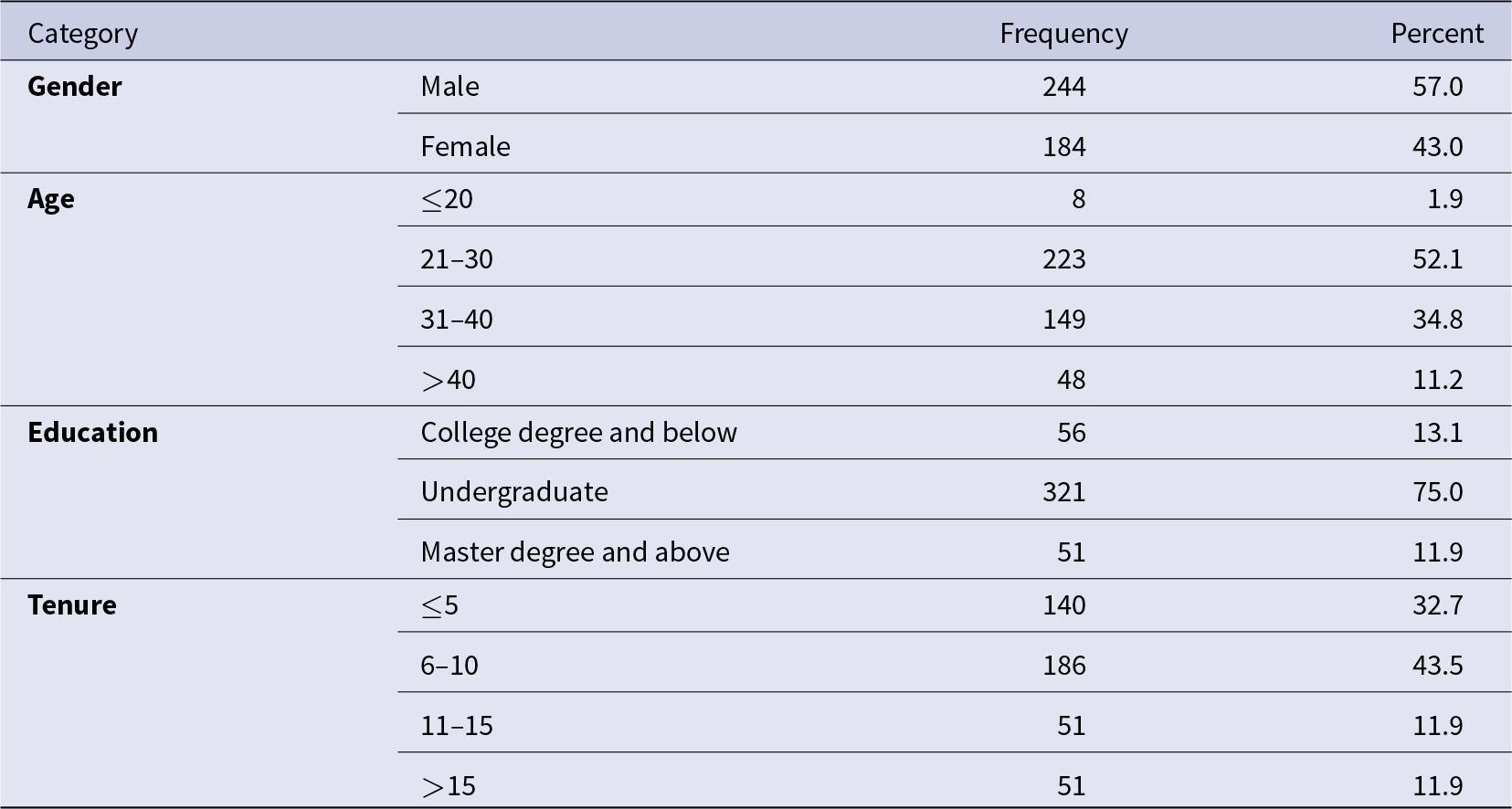
Among the returned valid samples, 57.0% were women, and 43.0% were men. Regarding age, 1.9% were 20 years old or younger, 52.1% were between 20 and 30 years old, 34.8% were between 30 and 40 years old, 11.2% were 40 or older, 11.9% had 10–15 years of work experience, and 11.9% had 15 years or more of work experience. The basic information of samples is shown in Table 1.
Basic information of samples

Note: N = 428.
Measures
Participants were asked to rate each questionnaire item on a 7-point Likert scale, ranging from 1 (strongly disagree) to 7 (strongly agree).
Developmental HR practices
We employed the 21-item scale developed by Kuvass to assess developmental HR practices, which measured the degree to which individual employees perceived that the organization’s HR practices supported their developmental needs (Kuvaas, Reference Kuvaas2008). This scale comprises three dimensions: career development (six items), training opportunities (eight items), and performance evaluation (seven items). Sample items include ‘I believe the organization prioritizes my career development,’ ‘Our employees invest significant effort in their professional development,’ ‘I am content with the training and development I have received,’ and ‘The feedback I receive from the organization aligns with my practices,’ with some items requiring reverse scoring for training opportunities. Cronbach’s α was 0.96.
Employee agility
Employee agility was assessed using a 12-item scale developed by Alavi et al. (Reference Alavi, Abd. Wahab, Muhamad and Arbab Shirani2014), encompassing three dimensions: initiative (four items), adaptability (four items), and resilience (four items). Sample items include ‘I actively seek opportunities for improvement at work,’ ‘I can adapt to new work procedures effectively,’ and ‘I can proficiently complete my tasks in challenging or stressful work situations.’ Cronbach’s α was 0.93.
Thriving at work
We measured thriving at work using a 10-item scale developed by Porath et al. (Reference Porath, Spreitzer, Gibson and Garnett2012), comprising two dimensions: learning (five items) and vitality (five items). Sample items include ‘I am consistently enhancing my skills at work’ and ‘I feel invigorated.’ Cronbach’s α was 0.97.
Workplace spirituality
Workplace spirituality was assessed using a 21-item scale developed by Milliman et al. (Reference Milliman, Czaplewski and Ferguson2003), which includes three dimensions: meaningful work (six items), a sense of community (seven items), and alignment with organizational values (eight items). Sample items include ‘I experience happiness at work,’ ‘I value collaboration with others,’ and ‘I hold positive sentiments regarding the organization’s values.’ Cronbach’s α was 0.96.
Control variables
Based on previous research indicating that employees’ gender, age, education, and tenure influence their agility, we controlled for these four variables in our analysis (Wei, Pitafi, Kanwal, Ali, & Ren, Reference Wei, Pitafi, Kanwal, Ali and Ren2020).
Data analysis
Descriptive statistics and preliminary analyses
We believe that the use of regression analysis as the empirical method in this paper is feasible. Furthermore, the software packages we used include AMOS 22.0, SPSS, and the Process plugin.
Common method bias. Using SPSS statistical software, we performed a Harman one-way test to test the data for common method variance (Podsakoff, MacKenzie, Lee, & Podsakoff, Reference Podsakoff, MacKenzie, Lee and Podsakoff2003). The variables were submitted to factor analysis, requiring no twiddle factor solutions. If no one variable accounts for more than 50% of the variance, it can be assumed that the data are unlikely to be affected by the common method variance. In our study, the total variance explained by one variable was 38.924%, well below the threshold. Therefore, it is certain that our data will not be affected by the common method variance.
Discriminant validity test. Confirmatory factor analysis was performed using AMOS statistical software. It can be seen from Table 2 that the four-factor model fits well: Comparative Fit Index (CFI) = 0.96, Tucker-Lewis Index (TLI) = 0.96, Root Mean Square Error of Approximation (RMSEA) = 0.03, χ2/df = 1.44. The results showed that, the hypothesized four-factor model fit better than other competing models, indicating that the four variables involved in the study had better discriminant validity.
Confirmatory factor analysis results

Note: DHRP stands for developmental HR practices, TW stands for thriving at work, EA stands for employee agility, and WS stands for workplace spirituality.
Henseler, Ringle, and Sarstedt (Reference Henseler, Ringle and Sarstedt2015) demonstrated that the heterotrait-monotrait ratio, developed to address the limitations of traditional discriminant validity assessment, successfully establishes good discriminant validity between variables when the heterotrait-monotrait value is less than 0.9. In this study, heterotrait-monotrait values are presented in Table 3, and all values are less than 0.9. This indicates that good discriminant validity is established among the variables in our research.
Heterotrait-monotrait ratio

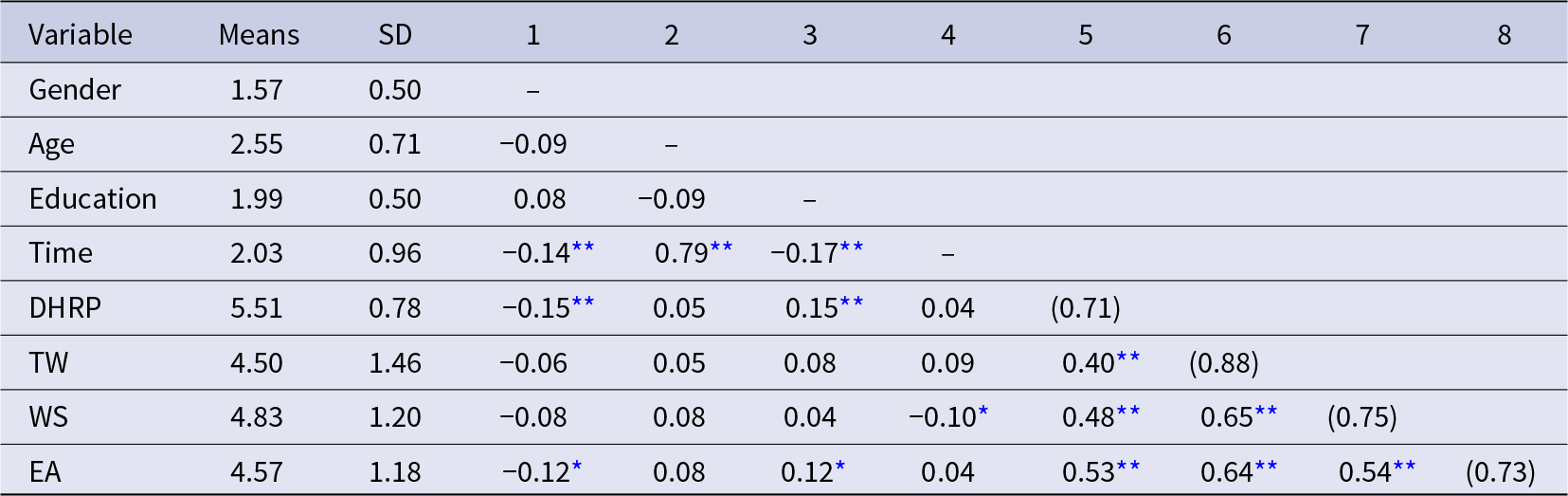
The mean, standard deviation, and correlation coefficient of the variables are shown in Table 4. There is a significant positive correlation between the main variables, which is consistent with the research hypothesis. In demographic data, gender, age, education, and length of service were significantly associated with most of the variables studied. Therefore, we controlled for these variables in our analysis.
Descriptive statistics and correlation analysis results of variables

Note: Values on the diagonal are the square root of the average variance extracted (AVE).
* p < .05, **p < .01.
Hypotheses tests
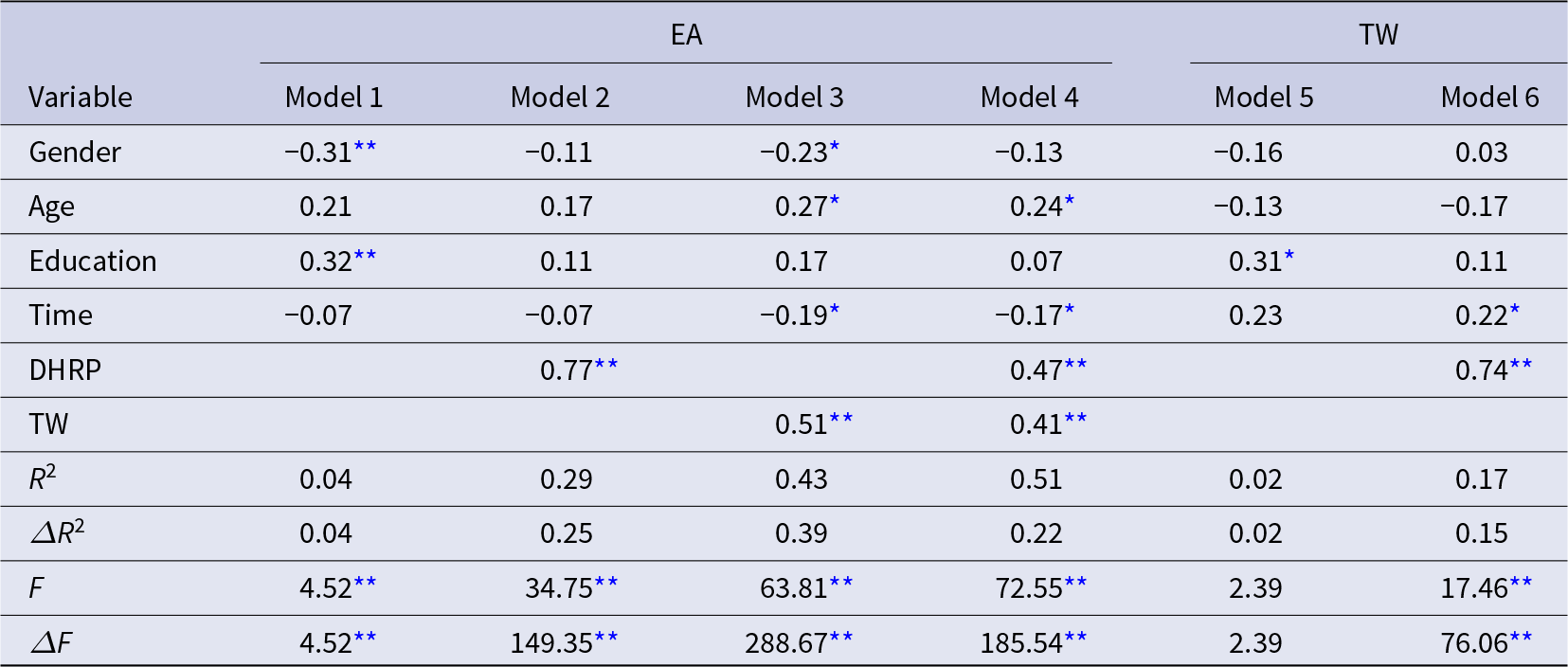
Hypothesis 1 predicts that employee agility is positively related to developmental HR practices. This hypothesis was supported (β = 0.77, p < .01), and we found that developmental HR practices significantly positively affected employee agility.
Hypothesis 2 proposes the mediating role of thriving at work in the relationship between developmental HR practices and employee agility. In order to test this hypothesis, first, the influence of developmental HR practices on thriving at work was tested. The results were as in Table 5 Model 6, developmental HR practices had a significant positive impact on thriving at work (β = 0.74, p < .01); second, to examine the impact of thriving at work on employee agility, the results are as in Model 3, thriving at work (β = 0.51, p < .01) significantly positively affects employee agility; finally, to examine the mediating effect of thriving at work, the results as in Model 4, after both developmental HR practices and thriving at work were included in the regression equation, the impact of developmental HR practices on employee agility was significantly reduced (β = 0.47, p < .01). Therefore, thriving at work partially mediates the effect of developmental HR practices on employee agility (mediation effect = 0.31, 95% CI = [0.22, 0.40]), so Hypothesis 2 is confirmed.
Regressive analysis results of the direct and mediating effects

Note: Unstandardized regression coefficients were reported.
* p < 0.05; **p < 0.01.
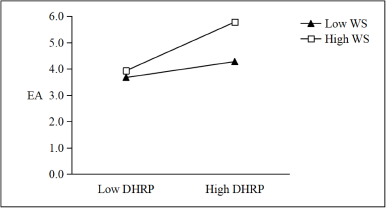
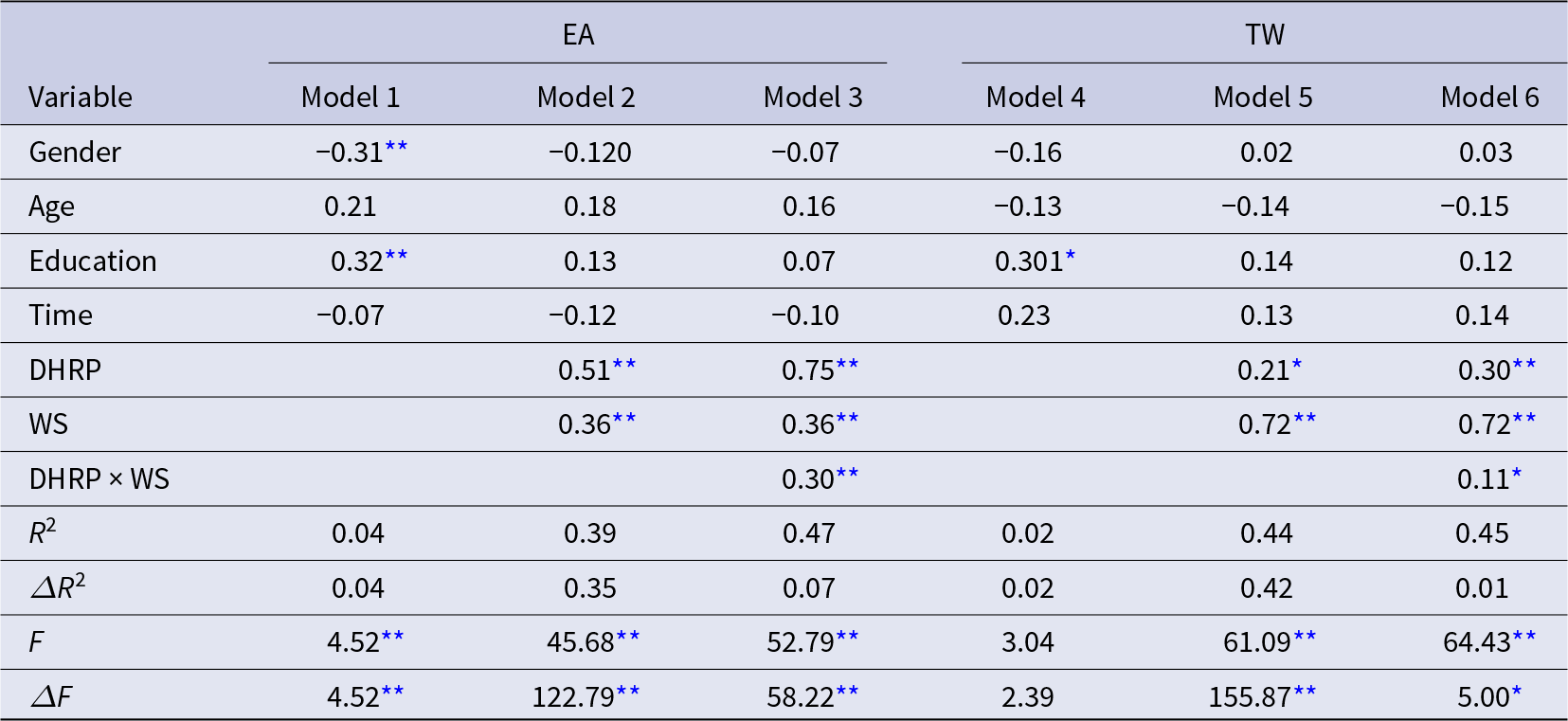
Next, we introduced workplace spirituality as a moderator variable in the model to test Hypotheses 3 and 4. Hypothesis 3 proposes that workplace spirituality will positively moderate the relationship between developmental HR practices and employee agility. The test results of the moderating effect of workplace spirituality between developmental HR practices and employee agility are shown in Model 3 in Table 6. The interaction term of developmental HR practice and workplace spirituality positively affects employee agility (β = 0.30, p < .01), and its moderating effect is shown in Fig. 2. Therefore, Hypothesis 3 is proved.
Moderating effect of WS on the relationship between DHRP and EA.

Regressive analysis results of the moderating effect

* p < 0.05; **p < 0.01.
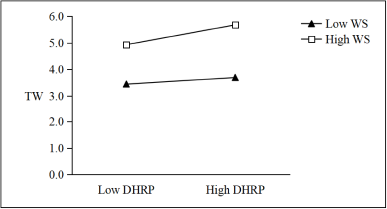
The test results of the moderating effect between developmental HR practices and thriving at work are shown in Model 6, the interaction term of developmental HR practices and workplace spirituality positively affects thriving at work (β = 0.11, p < .05), and the adjustment effect is shown in Fig. 3. Therefore, Hypothesis 4 is proved.
Moderating effect of WS on the relationship between DHRP and TW.

We further examine the moderated mediating role of workplace spirituality between developmental HR practices, thriving at work, and employee agility. As shown in Table 7, when workplace spirituality was high (effect = 0.16; SE = 0.04; 95% CI: 0.08–0.25) but not low (effect = 0.05; SE = 0.03; 95% CI: 0.00–0.13), there is a stronger relationship between developmental HR practices and thriving at work.
Results of moderated mediating effect

* p < 0.05; **p < 0.01.
General discussion
Based on self-determination theory (Ryan & Deci, Reference Ryan and Deci2000), this research explores the relationship between developmental HR practices and employee agility, as well as the mediating role of thriving at work and the moderating role of workplace spirituality. First, we examined and confirmed a significant positive correlation between employees’ perceived developmental HR practices and employee agility. This finding aligns with previous research on HR practices and employee agility (Salmen & Festing, Reference Salmen and Festing2022), which identifies HR practices as a crucial measure for organizations to promote employee agility. Second, research has validated the mediating role of thriving at work in the relationship between workplace support and life satisfaction (Zhai et al., Reference Zhai, Wang and Weadon2020). Our results indicate that thriving at work plays a significant mediating role in the relationship between developmental HR practices and employee agility, providing valuable insights into the mediating role of thriving at work (Alikaj et al., Reference Alikaj, Ning and Wu2021). Furthermore, we have confirmed the moderating role of employees’ workplace spirituality in the relationship between developmental HR practices and employee agility. In the following sections, we will discuss the theoretical contributions and managerial implications of this study.
Theoretical contributions
Our study contributes to the existing literature in three key ways. First, this research focuses on employee agility and investigates the significant role of developmental HR practices as a key antecedent, responding positively to the call for further exploration of specific HR practices’ relationship with employee agility as indicated in prior research (Salmen & Festing, Reference Salmen and Festing2022). It also represents a valuable exploration and addition to the antecedents of employee agility (Talwar, Luqman, Kaur, Srivastava, & Mishra, Reference Talwar, Luqman, Kaur, Srivastava and Mishra2023).
Second, while past studies have examined the influence of proactive personality, psychological capital, and supervisory support on thriving at work (Paterson et al., Reference Paterson, Luthans and Jeung2014; Spreitzer et al., Reference Spreitzer, Sutcliffe, Dutton, Sonenshein and Grant2005), this research, grounded in self-determination theory, investigates and validates the mediating role of thriving at work in the relationship between developmental HR practices and employee agility. This finding extends the application of self-determination theory to the relationship between HR practices and employee dynamic capabilities and provides valuable insights into the underlying mechanisms of their impact (Apascaritei & Elvira, Reference Apascaritei and Elvira2022).
Furthermore, we reveal the boundary effects of workplace spirituality in the relationship between developmental HR practices and employee agility and thriving at work, enriching the existing literature on workplace spirituality (Pawar, Reference Pawar2023). We found that employees with higher levels of workplace spirituality exhibit more positive attitudes and responses when they perceive high levels of developmental HR practices. This leads to greater experiences of thriving at work and stronger employee agility because the organization provides them with opportunities and an environment to realize their value, meeting their needs for self-development.
Managerial implications
This research has various practical and managerial implications. First, by emphasizing the critical role of employee agility in dealing with turbulent internal and external environments, we recommend that managers prioritize the mutual development of employees and organizations from the perspective of HR practices to enhance employee agility. Employee agility reflects the demands of the new era of work. It is the dynamic ability of employees to continuously adjust and respond to job requirements in a dynamic environment, and this ability can be further nurtured through the implementation of developmental HR practices.
Second, our research findings indicate that enhancing employee agility should be achieved through the use of developmental HR practices, such as diversified training, performance appraisal, and career development, to improve employees’ experience of thriving at work. Organizations should focus on fostering employees’ sense of thriving at work and, by actively implementing developmental HR practices, increase employees’ opportunities for learning and vitality. This, in turn, enables employees to respond more agilely to unforeseen events.
Third, workplace spirituality is of paramount importance for employees, organizations, and society as a whole. It can enhance employee agility, performance, and well-being, helping organizations become more competitive and creating a positive impact on society. We recommend that managers pay attention to and nurture employees’ workplace spirituality by establishing a positive, supportive, and motivating work environment that encourages employees to unleash their full potential at work. This allows employees to experience a strong sense of thriving at work and enhances their agility.
Research limitations and recommendations
Despite making some contributions, our research has several limitations. First, the sample used in this study only consists of Chinese employees, and the data source is relatively narrow. Since cultural differences can potentially impact employees’ perceptions of developmental HR practices, the generalizability of the findings in this study needs improvement. Future research can enhance the study’s universality and reliability by conducting cross-national designs and collecting sample data through various channels to examine the influence of individual and cultural factors.
Second, our study measured and examined perceived developmental HR practices as a univariate structure, referencing previous research (Liu et al., Reference Liu, Sha and Yu2022). This was done because the focus of our study was the linkage mechanism between developmental HR practices and employee agility, rather than the impact of the various dimensions of developmental HR practices on employee agility. Future research can explore how the three dimensions of developmental HR practices – training opportunities, performance appraisal, and career development (Kuvaas, Reference Kuvaas2008) – individually affect employee agility. Additionally, comparative analyses between developmental HR practices and other HR practices can be conducted.
Third, although our research further elucidates the significant roles of thriving at work and workplace spirituality in the relationship between developmental HR practices and employee agility, other unaddressed factors may also promote or inhibit employee agility. For instance, considering that leadership styles can influence employees’ perceived tendencies toward company expected HR practices (Dirani et al., Reference Dirani, Abadi, Alizadeh, Barhate, Garza, Gunasekara and Majzun2020), future research can adopt a more relational perspective to examine how leadership styles or the supervisor-subordinate relationship impact employee development and agility. Moreover, future research can explore how HR practices and leadership styles interact to influence employee agility.