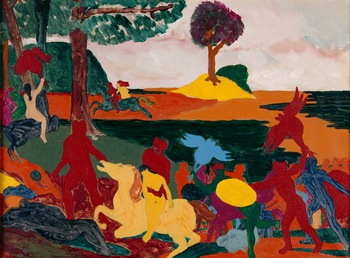


In The Death of Camilla (1964), Black AmericanFootnote 1 painter Bob Thompson fascinates, disturbs, and provokes enduring questions about race in the United States. In this painting (Figure 1), multicolored nudes clash in battle around two figures frozen in a moment of anguish: a light-skinned female warrioress dying in the arms of a dark-hued male opponent.Footnote 2 The power of this painting lies not only in its raw emotion, symbolism, and color, but also in Thompson's daring signification upon the story of Camilla from Vergil's Aeneid and on a seventeenth-century drawing by Nicolas Poussin. While a relatively ‘underknown’ artist,Footnote 3 during his life Robert Louis Thompson (1937–1966) received extensive recognition for his compelling reconfigurations of the European old masters and their Classical (Greco-Roman) subjects. Thompson, according to his early biographer, Judith Wilson, may also be ‘the first American artist to put the nation's interracial sex life/sex fantasies on public view.’Footnote 4 In many of his works of reception, Thompson combines these two artistic preoccupations into compelling pieces that foreground tragic contradictions around interraciality in the United States. In his The Death of Camilla painting, I argue, Thompson expands upon the symbolic trajectory of Vergil's story and ‘colors’ Poussin in such a way as to re-present Camilla as collateral damage of the sort of nation building that necessitates interracial conflict.
Bob Thompson (1937–1966), The Death of Camilla, 1964. Oil on canvas. Detroit Institute of Arts, Founders Society Purchase, Rollyn O. Krichbaum Memorial Fund, F1983.73. © Michael Rosenfeld Gallery LLC, New York, NY.

In the first section of the paper, I examine Thompson's painting, The Death of Camilla, against the backdrop of his life, work, and social context. Little has been written about this work in general,Footnote 5 and this may be the first article on Thompson's Classical reception in this painting. I particularly highlight Thompson's classicism as reflective of the ‘antimodernist’ sentiments prevalent among Black American artists and intellectuals of his time. I also underscore the connections between Thompson's cultural critique and his characteristically conflicted exhibitions of interraciality. At the core of this paper are two close analyses of image and text. I examine the ways that Thompson's The Death of Camilla painting signifies uponFootnote 6 both Vergil's Aeneid (7.803–17; 11.410–915) and a battle scene drawing (c. 1622–23) by the French artist Nicolas Poussin. My analysis of Thompson's reception work reflects methodological approaches outlined by scholars who have begun to explore Black Classicisms in the visual arts. I particularly follow Barnard's Empires of Ruin Footnote 7 and situate Thompson's work as metacritique of exclusionist contradictions inherent within both United States imperialism and the Classical tradition.
Whether Thompson read Vergil cannot be definitively proved; it is likely that he encountered the story through the art historical tradition of Western Europe, which he studied extensively. Nonetheless, Thompson's visual representation aligns in many ways with the Aeneid's tragic account in which a local Italian warrioress rides out to fight for her country against a colonizing force and yet dies in the attempt. Thompson's work, I argue, harnesses the tragic and anti-imperialist qualities of Vergil's story while foregrounding, through his poignant reconfiguration of the two central figures, the devastating effects of the conflict on all involved: people of all colors. With Poussin as well, Thompson preserves the basic structure of the original and yet disrupts the battle scene's content, story, and meaning with abstract male and female figures, tumultuous color, and irreverent, ambiguous bird-symbols. In these ways, I suggest, Thompson uses both Poussin and Vergil as backdrops upon which to revel in interraciality and unmask destructive cultural taboos against cultural ‘mixing’ whether between Black men and white women (or other interracial pairs) or between the African American artist and an exclusivist Classical tradition.
1. Thompson's Life and Work: Antimodernist Signifying and Interraciality
Bob Thompson's The Death of Camilla has received little to no scholarly attention within art history, Africana studies, or Classics. Yet this painting is part of a rich panoply of textual and visual receptionsFootnote 8 of the Classics performed by other Black American creative intellectuals, particularly from the mid-twentieth century through to today. While much work has begun on Classical receptions by Black Americans in literary production,Footnote 9 scholars have only recently undertaken work on artistic receptions and their important contribution.Footnote 10 This paper, then, falls within new research on Black Classicisms in the visual arts and thus follows methodological approaches incorporated in work by O'Meally on Romare Bearden, Barnard on Kara Walker, and Morse on Edmonia Lewis and Carrie Mae Weems.Footnote 11 Each of these Black artists, and Thompson as well, engaged with (or, rather, signified upon) the Classical tradition on their own terms and for their own unique purposes. In particular, as shall be seen, Thompson's classicism in The Death of Camilla resonates with what Barnard has identified as a ‘critical strain’ in African American reception that problematizes ‘the intricate relations between classical tradition and [racialized] structures of power in the United States.’Footnote 12
Thompson painted The Death of Camilla in 1964 while living in New York city between trips to Europe. In this painting (Figure 1), Thompson foregrounds the tragic pain of a dark and seemingly monstrous male figure supporting the limp body of a lighter-colored female in the midst of battle that rages with no end in sight.
Around the central tragedy, however, Thompson paints a clash of color: nude male and female figures of different shades fight, die, elope, or (in the foreground) engage in an almost innocuous game of chase while bearing aloft ambiguous birds. As with many of his paintings, it is difficult to determine whether The Death of Camilla depicts tragedy, comedy, or a provocative mix between the two. A first key to interpreting this painting, I suggest, can be found in the life and perspectives of the painter himself: Thompson's (interracial) social circles, his artistic approach, and the racially polarized times in which he worked.
In this section, then, I outline aspects of Thompson's life and work in order to provide context for the critique presented in The Death of Camilla. I particularly highlight the interracial and artistic culture of which he formed a part, and the social context from which he emerged. Thompson, like many other creatives and intellectuals of the late 1950s and early 1960s, experienced acute ‘antimodernist’ discontent with the naïve optimism of the American dream, of national progress undermined by the color line. At the same time, I argue, Thompson ultimately channels his antimodernist sentiments through relentless returns to Classical myth in the art of the ‘old European masters’ combined with a near-obsession with interraciality, particularly between heterosexual interracial couples.
Thompson's Life and Artistic Context
Bob Thompson's friends remember him as larger than life, extraordinarily self-aware, and unabashedly assertive as a Black man.Footnote 13 Additionally, he habitually chose to defy social boundaries, crisscross the color line, and embrace an interracial cultural milieu throughout his life and work. He had no problem inserting himself into social circles of all races, socio-economic classes, and educational backgrounds, just as he had no problem inserting himself within the Classical tradition and one of its repositories: Western European art.
Thompson first studied the Classical tradition in art at the University of Louisville Hite Art Institute.Footnote 14 He also studied abstract expressionism, and further developed his work in an artistic community of figurative expressionists (such as Jan Müller) in Provincetown MA.Footnote 15 When he moved to New York City in the late 1950s, he exhibited in several galleries and moved among interracial circles of artists, jazz musicians, and members of the Beat community in New York's East Village.Footnote 16 He counted Ornette Coleman, Red Grooms, Amiri Baraka (at that time, LeRoi Jones), Charlie Haden, and A.B. Spellman among his friends. Thompson also married a white woman, Carol Plenda, in 1960.Footnote 17 From 1961 to 1963, Thompson and his wife went abroad on a Whitney Fellowship that he received. This gave him opportunity to develop his work through access to the museums, galleries, and artistic communities in London, Paris, and Ibiza (Spain). After a brief return to New York, in 1965 they went abroad again, but, tragically, in 1966, Thompson died in Rome from complications with a gall bladder surgery. Despite his truncated career, this young artist left behind almost a thousand brilliantly hued paintings that boldly mix cultures, social issues, Renaissance art, and his own private fancy into new creations. Given this background, then, The Death of Camilla emerges as a mixture of Thompson's creative signifying and antimodernist expression focalized through his perspectives on the glories and tragedies of interraciality in America.
Antimodernist Signifying and Interraciality
Thompson's wife Carol recounts: ‘Bob discovered the world in churches, museums, jazz clubs and paintings, particularly paintings of the Old Masters like Francisco de Goya, Nicolas Poussin, and Piero della Francesca.’Footnote 18 And, as Thompson scholars have continually asserted, his mode of signifyin(g) upon the Classics was never a merely integrationist endeavor.Footnote 19 Rather, James writes, Thompson played ‘a rather subtle and complex game, shuffling signs of Blackness and racial otherness together with those of canonical western art which he so often transcribes and adapts’.Footnote 20 Similarly to his peers Bearden and Colescott, Thompson also infused his reconfigurations with creative techniques from jazz: he never just copied, he ‘bent, twisted, extended, and remade’.Footnote 21 At the same time, by choosing to engage with the Classical tradition, Thompson rejected the rigid binary of a Eurocentric or Afrocentric model, but instead blended both in order to express his own inner world.Footnote 22
Yet, although his approach received warm reception in his time, Thompson was not without his anxieties about being a Black artist reworking the Classics in a white American art world during the late 1950s and early 1960s. The years between 1963 and 1965, during which Thompson created The Death of Camilla, marked significant milestones, tragic and otherwise, for the Civil Rights movement: the March on Washington, King's ‘I Have a Dream’ speech, the Birmingham bombing, ‘Freedom Summer’, the rise of Black nationalism, the murder of Malcolm X.Footnote 23 Amid these times of grave injustices, social unrest, and racial polarization, Thompson also found himself under pressure for his interracial marriage.Footnote 24 But Golden suggests that it was precisely during these years, however, that Thompson developed both his ‘narrative sensibility’ and his depictions of the ‘psychosexual drama’ of interracial relationships.Footnote 25 It is within this very context, moreover, that Thompson's The Death of Camilla emerges as a work of distinctly ‘antimodernist’ signification.
In his book Mercy Mercy Me: African-American Culture and the American Sixties, Hall describes ‘antimodernism’ as a postwar ‘dis-ease or disappointment with American culture and the resources, both material and spiritual’ experienced by many Black artists and intellectuals after World War II and into the early 1960s.Footnote 26 As a result of this disillusionment, many African Americans chose to confront the cultural contradictions of the color line by engaging with broader cultural traditions (often through visits or extended stays in Europe),Footnote 27 and by foregrounding the ‘frailty of life’, the inescapable reality of death, and ‘the despairing clarity of race hatred’ in their creative work.Footnote 28 Thompson's life and work also manifest these qualities and approach. In his paintings during these times, Thompson often reveals a preoccupation with vulnerability and death.Footnote 29 This emerges with particular clarity in The Death of Camilla. All the while, Thompson continued to use and reconfigure Old World art as a way of exposing the racial toxicity of the New (and its corresponding physical, psychological, and interpersonal destructiveness).Footnote 30
Thompson's ‘antimodernist’ sentiment is also expressed through his consistent rejection of rigid racialized binaries and his disruptive yet also exultant depictions of interraciality. Based on Stephens’ On Racial Frontiers, I understand ‘interraciality’ as the cultural dynamic of persistent relations (sexual or otherwise) between people of different ethnic groups.Footnote 31 According to Stephens, ‘our very conceptions of “race”…grew out of…the repression of interraciality, in order to construct racial privilege’.Footnote 32 While Thompson may not have articulated this himself, he lived and understood himself as an artist within a broad, generative and ‘mixed’ social and cultural context, a context which comes out consistently in his work. Also, as part of a trend of the late 1950s and early 1960s, as explained by Feimster, Thompson and other African Americans ‘were articulating a new Black sense of self that linked interracial sex with racial equality and Black freedom’.Footnote 33 Thompson himself is distinctly known for the interracial couples he paints cavorting across his canvases or in painfully conflicted erotic postures, such as in The Death of Camilla.Footnote 34 In this way, Thompson, like Stephens, offers a critique of race through an acknowledgement and re-evaluation of the persistent practice of interraciality in the United States and long-standing interracial networks in which Americans have, historically, been enmeshed.Footnote 35 As such and against the backdrop of his life and work, Thompson's The Death of Camilla emerges as a tragic and yet unexpectedly exultant critique of interracial relations—all focalized through his complex, antimodernist signification upon the Aeneid of Vergil and a seventeenth-century drawing by Poussin.
2. infelix Camilla and the Infelicities of Nation Building: Thompson and Vergil
The narrative force of Thompson's The Death of Camilla comes from his riffs on the lesser-known yet tragic story of Vergil's Camilla. This myth forms part of Vergil's Aeneid, an epic which Barnard has termed ‘the foremost epic of nation building in the Western tradition’,Footnote 36 and whose legacy has left an indelible mark on the construction of national identity in the United States.Footnote 37 It is uncertain whether or not Thompson actually read Vergil, although he was an avid reader of world literature as well as European art history throughout his life.Footnote 38 Uniquely, however, at Aeneid 7.803–17 and 11.410–915, Vergil presents Camilla as an inside critique of the imperialist project that he narrates. A renowned native female warrioress, Camilla dies defending her country against the invading Trojans and their local allies. As I argue in this section, Bob Thompson capitalizes on the tragic and subversive dynamics at the heart of Camilla's story and reworks certain aspects of her tradition into a critique of the myth of racial progress in postwar America.
Nature and Innocence Ravaged
In the first place, Thompson retains of much of Vergil's imagery for this heroine but focalizes his painting around the tragic moments of her death. Vergil's Aeneid builds up to Camilla's death with detailed descriptions that outline her significance as a child of nature, a slightly monstrous and yet accepted warrioress, and a female embodiment of pre-colonized Italy. Queen of the female-only Volscian tribe, Camilla is introduced by Vergil in Aeneid 7 as a child of nature, huntress, and an awe-inspiring warrior. She first appears at the end of a catalogue of the Italian host who are arrayed to fight against the forces of Aeneas.Footnote 39
Although an Amazon figure (and therefore, traditionally considered monstrous), Vergil celebrates Camilla as full of potential, skill, and nobility (805–11).Footnote 41 Her own people follow after her with awe (812–14). At Aeneid 11.508, her Rutulian ally Turnus praises her as decus Italiae uirgo (‘the maiden pride of Italy’). In these ways, Vergil depicts Camilla as a true Italian and a symbol of the original glory and unity of the indigenous Italian tribes.Footnote 42
Vergil also connects Camilla, as a pastoral huntress, with all that is lovely and pure in nature, a tragic symbol, as it were, of pre-colonized Italy.Footnote 43 At Aeneid 11.535–94, the goddess Diana describes how Camilla was raised with her exiled father, pastorum et solis…montibus (‘among the shepherds and on lonely mountains’, 569), and nourished equae mammis et lacte ferino (‘with wild animal milk and at the breast of a mare’, 571). As a child, she wore the skin of a tiger (576f.) and hunted birds and other animals in the woods with her spear (573–80). At the time of battle, then, accompanied by fellow ‘daughters of Italy’ (Italides, 657), Camilla takes up again the role of huntress. She is even described at one point as a falcon who overtakes her prey and destroys a dove in midflight (721–4). Yet, when new, foreign hunters invade, Camilla becomes their prey.Footnote 44 By thus situating Camilla within the context of nature, Vergil sets the scene for both personal and communal tragedy. She also becomes a symbol of indigenous Italy itself, unable to resist the destructive thrust of Trojan nation building.
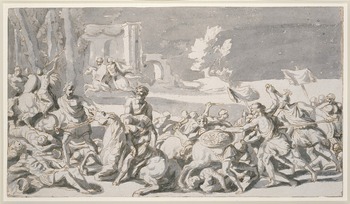
In his visual depiction of the story, Thompson also situates Camilla firmly within nature and to similar effect. While basing the structure of his scene on a drawing by Poussin (see Figure 2 in section 3), Thompson omits the ruined buildings in his painting. Instead, he frames his composition on the left and from behind with large trees and a hedge. Additionally, his abstract figures are nude, stripped of the trappings of civilization. One holds a shield, but others, weaponless, run barefoot, ride horses, or hold aloft captive birds, as if involved in some sort of hunt. Thompson, as a painter, often privileged a naturalistic setting over those situated among built structures.Footnote 45 By setting this scene within nature, however, Thompson, like Vergil, increases the poignancy of Camilla's figure as a symbol of natural innocence about to die within a locus amoenus. Her death, therefore, becomes a brutal violation of the integrity of her body, of nature, and of peaceful relations between neighboring peoples.
Nicolas Poussin (1594–1665), The Death of Camilla (?), c. 1622–23. Slight graphite underdrawing, pen and brown ink, grey wash, 18.5 x 32.4 cm (sheet of paper), RCIN 911936.

Perversions and Provocations of Civil Conflict
Thompson and Vergil also underscore the sexual dynamics of Camilla's tragic death. Vergil depicts her killing as a sexual perversity:
Camilla grew up nursing from the breast of a horse (11.571); she came into battle with her own breast exposed (648f.); and she dies after being pierced there with a spear (803), a sort of perversion of both sexual penetration and of nursing motherhood.Footnote 46 And, at Aeneid 11.818f. and 827–31, Vergil's drawn-out descriptions eroticize the last moments of her death even more.Footnote 47 When an innocent huntress, child of nature, dies in civil conflict, her end takes on a twisted sexual dimension designed to arouse, horrify, and provoke reflection.
Thompson likewise compels his viewers to reflect on the psychosexual dynamics surrounding Camilla's death: dynamics experienced not only by Camilla, but by all involved. In the first place, he draws his male and female nudes with no distinguishing features except the hair on their heads (longer for the females, shorter for the males)Footnote 48 and the pubic hair of Camilla. In an additional and erotic shift, Thompson depicts Camilla's killer not as fleeing, but grasping Camilla's body in a posture similar to the traditional depiction of Achilles and Penthesilea.Footnote 49 Thompson's central red male figure gazes with a sort of helpless desire and despair upon the female warrior whom he (presumably) killed.Footnote 50 The crushed hopes and erotic fantasies of this warrior are, as it were, mirrored by the couple (also painted red and yellow) who flee, alive and free, in the background.Footnote 51 Yet, unlike Arruns’ phallic spear thrust, the sexual passion of this figure (further symbolized through the horse imagery present with both couples)Footnote 52 remains frustrated, and his posture reveals an aching vulnerability.
From within Thompson's symbolic world, the sexual and monstrous aspects of this dark male figure take on additional significance and add to the story a specifically racial critique. In his artwork, Thompson frequently used monsters to represent (and at the same time, criticize) American stereotypes about Black men in relationships with white women. Thus throughout his many depictions of interracial couples Thompson frequently depicted the darker males as monsters in order to expose and, ultimately, dismantle, in the words of Feimster, the ‘twin fiction of the “Black rapist” and the asexual white woman in need of protection’.Footnote 53 In an interview, Thompson himself explained: ‘I did these monster compositions…it had a sort of sexual orientation… The monster was always very much a monster and yet I wanted to make him gentle’.Footnote 54 In The Death of Camilla, Thompson transfers any of Camilla's Amazonian monstrosity to her male opponents; at the same time, two of these monsters must pause from the fight in order to grieve. In Vergil, Camilla's sexualized death is infelix (‘unlucky’, 11.562), undesired, and tragic for her and for her companions,Footnote 55 but, in Thompson, Camilla's death takes place without full consent of either party and to the effect of their mutual devastation—male and female, Black and white.Footnote 56 Ultimately it was another hand that forced them towards destruction.
Thompson's painting as a whole, moreover, leaves one with an impression of unending chaos and futility. Camilla has died, her killer mourns, and the battle continues without promise of relief. Similarly, in Vergil, Camilla's death does not end the conflict; if anything, it only exacerbates it. After Camilla draws her last breath, her female companions mourn (11.805f.), but the chaos increases for all:
crudescit, the central word of line 833, indicates an intensification of raw violence. As the fight continues, the Trojans and their Italian allies push back the defending Italian troops even to the doorsteps of their homes (881) such that even the mothers join in the fray (891–5).Footnote 57 The battle rises to such a peak of frenzy as to produce the ‘most miserable slaughter’ imaginable (miserrima caedes, 885): unwitting destruction of one's own.Footnote 58 This battle had always been fierce, bloody, and destructive, but here it becomes desperate, perverted, and almost apocalyptic as the ferocity of civil war destroys Italy from within.Footnote 59 When Thompson thus co-opts Vergil's story of Camilla into his own work, he also forces his viewers to confront the mutual, continuous, and perverse devastation created by the American imperial project, a project so often predicated on racial polarization and violence.
Through Aeneas’ conquests and colonization, a new Roman world emerges, yet at the cost of civil war, tragedy, and the death of Camilla. A child of nature, Vergil's Camilla is cruelly and perversely cut down by those who are laying the foundation—a forced and destructive e pluribus unum—for Roman civilization. Thompson pitches the sentiments of this Roman foundation myth against the myth of racial progress and the creation of national identity in postwar America. Postwar nation building in the United States likewise involved a certain imperial optimism predicated on race-making and enforcement of the color line (aka, civil war between the neighbors). While reworking Vergil's anti-imperialist story, Thompson gives full expression to his antimodernist sentiments. And, through key shifts to the Aeneid, he highlights the inner tension and outer hostility (aka, ‘a psychology of disintegration’)Footnote 60 experienced by interracial couples caught up in the racial politics and polarization of his time. In these ways, Thompson also expands the symbolic trajectory of Vergil's myth. He re-presents Camilla as the collateral damage not only of colonization, but of the sort of nation building that necessitates the mobilization of a country's people (in his case, white and Black Americans) against themselves.
3. Disruption and Metacritique: Thompson Reworks Poussin
Thompson's reworking of Vergil, however, is only half the story. Thompson also signifies upon a battle scene drawing by Nicolas Poussin. This additional layer of reception positions The Death of Camilla as not only an antimodernist statement about race, but also a playful critique of a European master artist and the Classical tradition itself. In this section of the paper, I demonstrate how, in The Death of Camilla, Thompson significantly disrupts the content and meaning of Poussin's original to resituate it within his version of the Camilla myth. Even more, with riotous color and tragicomic birds, Thompson draws Poussin's battle into his own artistic arena, revels in interraciality, and irreverently mocks the very tradition that he re-presents.
Battle Scene: Admiration and Alteration
As with so many masters of Western European art, Nicolas Poussin (1594–1665) pulled Thompson into dialogue, into a competitive game of signifying. Thompson once expressed in an interview:
I look at Poussin and he's got it all there. Why are all of these people running around trying to be original when they should just go ahead and be themselves and that's the originality of it all, just being yourself. Now you can't do anything. You can't draw a new form. The form has already been drawn. You see? …that total human figure almost encompasses every form there is. You know? …it hit me that why don't I work with these things that are already there…because that is what I respond to most of all…Footnote 61
As a result of this appreciation, Thompson reworked many of Poussin's drawings and paintings throughout his career and especially during the last two years of his life.Footnote 62 But, as Tuite observes: ‘Rather than looking at the output of his forebears, Thompson seems to position himself within it.’Footnote 63 This is precisely how Thompson seems to approach and reconfigure Poussin's The Death of Camilla drawing, the pictorial antecedent for his new creation.Footnote 64 Poussin's drawing (Figure 2) is one of a series of four military scenes depicting early Roman myth and history and created for an early patron, Marino, sometime between 1620 and 1623.Footnote 65 This particular piece depicts a battle between men in more formal battle attire, with helmet, cuirass, shields, swords (presumably, Romans or Trojans), and men without armor or shields but clad in tunics and trousers (presumably, indigenous Italian peoples).Footnote 66
Amid the chaos, two central figures are caught in a moment of pathos and grief, but, from their attire, they seem to be comrades in arms. The two background figures are also armed and helmeted Romans, fleeing the scene on horseback, perhaps in desertion, or perhaps to report the outcome of the skirmish, which seems to be a defeat. By contrast with Thompson and Vergil, moreover, the dying figure does not seem to be female; nor are there any clearly female warriors in the rest of the image.Footnote 67 Despite these discrepancies, however, the image was originally entitled The Death of Camilla by Poussin's posthumous cataloguer, Marinella, who cited several passages from Vergil to justify his attribution.Footnote 68 This title also remained with Poussin's drawing for centuries, so it is likely that Thompson encountered it described as such while visiting museums in London in 1961 or in an art book.Footnote 69
In reworking Poussin's battle scene, Thompson preserves the basic structure and intensity of the original, but ensconces the conflict within his own version of the Camilla story with an interracial twist.Footnote 70 In Poussin, a central, bearded, male warrior holds his fallen male companion and looks to the sky in a gesture and facial expression of grief, pain, unbelief, and even blame.Footnote 71 There may be some erotic suggestions between the central soldier and his youthful dead comrade, but nothing compared with the psychosexual angst of Thompson's monster-man clutching the naked body of his presumed opponent, Camilla. For the most part, also, Thompson replaces Poussin's soldiers with monster figures and the tribal peoples with female warriors.Footnote 72 Significantly, he does not seem to distinguish between the ‘civilized’ and ‘uncivilized’ (or, armed and less armed) in his painting: all are faceless nudes, without any distinguishing apparel. All seem native to the land, caught up in a civil war between Rutulians, Latins, Volscians, male and female, Black and white Americans. As with Vergil so also with Poussin, then, Thompson channels the grief, anger, and conflict of the original towards a critique of the interracial strife of the twentieth-century color line and its devastating psychosocial effects.
Colors and Symbols of Thompson's Critique
Not all is tragedy in Thompson's painting, however. Thompson also hurtles viewers from the grey wash of Poussin into a tumultuous and delightful array of colors emblematic of Thompson's perspective on interraciality in America.Footnote 73 Most of Thompson's males are a reddish brown, whereas the females are either yellow, pink, or some other color. Based on other works done in 1964, it is very likely that at least the central figures (and the two in the background) represent interracial couples.Footnote 74 On the other hand, while the contrast between dark males and lighter-colored females in the painting may be a function of Classical influence, even this pattern does not completely hold up. The prone female in the left foreground and the other in the right foreground, for example, are charcoal and green colored respectively.Footnote 75 Indeed, deliberately ambiguous coloration seems to be a part of Thompson's artistic program. Sims writes that Thompson ‘exploded habitual obsessions about skin color by violating the naturalistic associations of color with pigmentation and suggestively de-privileging the component of color as it is associated with race’.Footnote 76 In these ways, Thompson does not merely use color in The Death of Camilla to foreground the complexities of Black–white sexual relations, but also to highlight the tensions and glories of interracial culture more generally speaking.
Thompson's coloration may also function as a critique of the purist tendencies within the Classical tradition and the Western canon. As Tuite suggests, Thompson habitually ‘reimagines, recasts, and revalues historical European painting’s representational codes, throwing into relief its conventions and thoroughly denaturing them’.Footnote 77 One of the main ways that Thompson does this, I suggest, is by recoloring his pictorial precedents. Sims, for example, suggests that Thompson's colors convey his ‘expressionist irreverence’ for the ‘staid orderly precepts of Renaissance and baroque narratives’.Footnote 78 Poussin's nearly monochrome drawing deeply embodies the Classical tradition, given that he himself used as models the supposedly ‘white’ bas-reliefs found on Roman triumphal columns and other monuments to Classical imperialism.Footnote 79 Through retelling Vergil's story and imbuing Poussin with color, then, Thompson subverts both the New World color line and the rigid imperialism of the Classical tradition and Old World art.
Thompson further mocks the often-impervious dominance of the Classical tradition by disrupting the solemnity of Poussin's scene with his own private symbolism. He removes Poussin's weapons and battle standards and replaces them with strangely comic red and blue chickens. Thompson's chicken-birds in general are probably some of the most discussed and disagreed-upon symbols within his repertoire. Do they represent frustration, freedom, a playful flight of fancy, or a mixture of all three? Perhaps they symbolize the psychological frustration experienced by interracial couples locked in a combat imposed by an imperial narrative that demands the repression of interraciality for the sake of progress.Footnote 80 Golden describes Thompson's birds in The Death of Camilla as ‘crazed, caught creatures…held aloft in the solemn procession, denied the freedom to fly’.Footnote 81 Yet, in an interview with Siegel, Thompson precisely linked his bird imagery with freedom.Footnote 82 Perhaps, then, instead, these fanciful flying creatures reframe Poussin's battle and Vergil's myth as potentially hopeful, as opportunities for Black agency through artistic expression. With these symbols, Thompson denudes the interracial combatants of their weaponry. In this way, he effectively eviscerates the violence upon which this civil conflict, the death of Camilla, and the entire imperial project depends. At the same time, by inserting comical chickens within a work of an ‘old Master’, Thompson seems to deride and undermine the often-impenetrable, elitist façade of the Classical tradition and one of its main repositories, Western European art.
In sum, while maintaining the basic compositional structure of Poussin's battle scene, Thompson changes its color, texture, and meaning for his own purposes. Thompson expresses a much clearer link between his work and Vergil's story of Camilla. Further, by changing the relationship between the two central figures, by splashing the drawing with color, and by replacing Poussin's weapons with harmless and humorous birds, he disrupts and redirects this tragic battle towards a playful critique of the American color line, the futile conflict it engenders, and the exclusivist Classical tradition with which it is often entwined.
4. Conclusion
From an accident of poor cataloguing, Poussin's seventeenth-century pen and ink drawing received the title The Death of Camilla, and, about three hundred years later, Black American artist Bob Thompson encounters and reconfigures this image under the same title. Thompson, however, while maintaining the basic structure and composition of Poussin's battle scene, aligns his work more closely with the story of Camilla from Vergil's Aeneid, a story of tragedy and loss amid a violent and unnecessary conflict between indigenous peoples provoked by the colonizing thrust of the founders of Rome. Thompson, as has been seen, runs with this anti-imperialist story to critique the empty myth of racial progress propagated in postwar America. Like Vergil, Thompson presents Camilla as a figure of innocence, nature, and original unity who becomes an appallingly victim of imperialist nation building, past and present. Thompson maintains these qualities of her depiction, but, with a provocative twist, focalizes her story through the image of a grieving, dark monster figure supporting the limp body of a light-skinned woman in the midst of battle that rages with no end in sight. Through this depiction, Thompson highlights the psychosocial devastation of this conflict as experienced by victims and aggressors alike, in this case, interracial couples. While he depicts a tragedy, at the same time he questions its necessity. Thompson thus channels Vergil's Camilla story into an antimodernist critique of the interracial conflict provoked by the American color line in the late 1950s and early 1960s. Furthermore, through insertion of ambiguous coloration and abstract figurative symbols within a battle scene of Nicolas Poussin, Thompson both directs the viewers gaze towards the agonies and ecstasy of interracial culture and exposes the devastation that results from hegemonic, exclusivist, and polarizing ideologies that suppress it—whether in the Classical tradition or in the project of nation building within the United States.
At the same time, Thompson's The Death of Camilla expresses a liberatory way of being for Black American artists. Through this painting, Thompson unabashedly positions himself within a Classical tradition articulated by Vergil and continued (to a certain extent) by Poussin. He embraces this story and the vexed cultural, textual, and artistic canon in which it is ensconced. In so doing, however, Thompson the antimodernist brings the Old World to bear on the cultural contradictions of the New. He offers, through his art, new critical symbols with which to make sense of and perhaps even transcend the tragedy of the present, the Classical tradition, and where they intersect. With riffing and ridicule, Bob Thompson points a way forward: through creating art, playfully reconfiguring even the most elitist cultural traditions, and exulting in his freedom and ability to ‘mix’.