INTRODUCTION
Pragmatic language is a complex, multi-faceted domain that includes such diverse skill sets as reciprocal conversational skills (e.g. turn-taking), word choice based on specific conversational partners (e.g. register), and the comprehension and use of non-verbal aspects of communication that complement speech. Deficits in pragmatic language are essentially universal in individuals with autism spectrum disorder (ASD; Tager-Flusberg, Paul & Lord, Reference Tager-Flusberg, Paul, Lord, Volkmar, Paul, Klin and Cohen2005), and are often reported to be a significant source of social anxiety for these individuals (Landa, Reference Landa, Klin, Volkmar and Sparrow2000). While pragmatic language has been the focus of considerable research in ASD, many aspects of this complex domain have yet to be investigated. In this study, we use a narrative task to study a specific pragmatic language skill, common ground, and its use in adolescents with and without ASD.
Common ground refers to the tendency of interlocutors to modify how they communicate based on shared knowledge. Common ground is incorporated seamlessly into conversations by both speakers and listeners. Studies of typically developing (TD) adults generally find that speakers use fewer words when they share common ground with an interlocutor (Holler & Wilkin, Reference Holler and Wilkin2009). For example, lengthy referential descriptions are replaced by shortened shared forms. In a seminal study of this referential shortening effect, Krauss and Weinheimer (Reference Krauss and Weinheimer1966) asked pairs of college students to work collaboratively to describe sets of geometric figures (‘tangrams’). At first, participants used extended descriptions of the figures (e.g. “the rectangle with two triangles under it that kind of looks like a coffee table”), but they quickly settled on shorter referential forms (e.g. “the coffee table”) that were used from then on.
Speakers may produce shorter utterances under conditions of common ground due to adherence to Gricean conversational maxims. According to Grice's maxim of quantity, during discourse, speakers should make their contributions sufficiently informative while excluding information that is irrelevant, distracting, or otherwise detracts from the discourse (Grice, Reference Grice, Cole and Morgan1975). This delicate balancing act requires speakers to provide enough information, while not providing so much as to be irrelevant, inappropriate, or tedious. Successful estimation of quantity in utterance planning requires speakers to consider what knowledge they share with listeners (Clark & Bernicot, Reference Clark and Bernicot2008; Horton & Keysar, Reference Horton and Keysar1996; Krauss & Weinheimer, Reference Krauss and Weinheimer1966; Nadig & Sedivy, Reference Nadig and Sedivy2002; Nilsen & Graham, Reference Nilsen and Graham2009; Rossnagel, Reference Rossnagel2000).
Anecdotally, individuals with ASD are known to violate the Gricean maxim of quantity in both directions. Imagine, for example, asking, “Do you have a favorite movie?” An individual with ASD may either provide too little information, responding simply with “Yes”; or too much information, responding, “Yes, my favorite movie is The Lion King, I saw it Tuesday night with my sister Samantha, the lions are Simba, Nala, Mufasa, Sarabi, and Scar, the hyenas are …” . The ‘appropriate’ response falls somewhere in the middle, as in, “Yes, my favorite movie is The Lion King”. What amount of information is appropriate depends on multiple factors, one of which is the common ground shared between interlocutors. Listeners require, and speakers provide, less information when they share common ground; indeed, overly explicit or detailed references act to slow listener comprehension in TD (Hudson-D'Zmura & Tanenhaus, Reference Hudson-D'Zmura, Tanenhaus, Walker, Joshi and Prince1998).
Register, a related construct, refers to changes in language level based on social context. Register is similar to common ground because speakers must infer something about listeners' knowledge and use this information in utterance planning. Register use depends less on interlocutors' direct awareness of each other's knowledge and more on a gestalt change in one's speech. For example, when typical adults address listeners with less knowledge of their language (e.g. foreigners or young children), they tend to simplify their syntax and vocabulary (Andersen, Reference Andersen1990). TD children as young as three years old have been shown to adjust their register when speaking to a baby or a doll (Sachs & Devin, Reference Sachs and Devin1976).
Volden, Magill-Evans, Goulden, and Clarke (Reference Volden, Magill-Evans, Goulden and Clarke2007) found that children with ASD changed register when addressing a ‘young’ or ‘foreign’ puppet by providing briefer descriptions with fewer details. Although generally able to respond to listeners' needs, the ASD group continued to give longer explanations that included more tangential and irrelevant information. This likely reflects general pragmatic deficits. In a related study, children and adolescents with ASD modified their register to make ‘bossy’ and ‘nice’ requests of a puppet (Volden & Sorenson, Reference Volden and Sorenson2009). They were also able to comprehend the same shifts in register, in that they were able to judge when the puppet's requests were bossy or nice.
In addition to register, a small literature indicates that many children with ASD do modify their speech based on a range of pragmatic contexts, though they do less consistently than TD comparison groups. Perner, Frith, Leslie, and Leekam (Reference Perner, Frith, Leslie and Leekam1989), for example, showed that many children (approximately 2/3 of their sample) with ASD modified the order in which they provided information about a toy to an adult, based on whether or not the adult already knew some of the information (i.e. shared some common ground). As a group, the children with ASD made this modification less often than TD preschoolers in a prior study (Perner & Leekam, Reference Perner and Leekam1986); however, they still showed a general tendency to modify their speech based on shared knowledge. The variability in the ASD group reflected the fact that children with ASD were individually less consistent in adherence to pragmatic norms, compared to controls.
Audience design, or the tailoring of utterances to specific listeners and conversations (Clark & Carlson, Reference Clark and Carlson1982), is another closely related construct. Examining a group of school-aged children with ASD, Nadig, Vivanti, and Ozonoff (Reference Nadig, Vivanti and Ozonoff2009) used a referential communication task, in which they manipulated visually shared information, to assess increasingly complex forms of audience design. They found group differences at every level of complexity, with participants with ASD providing less efficient and less context-appropriate descriptions. However, there was a wide range of individual differences within the ASD group, ranging from an absence of any audience design, to a level as sophisticated as that found in the comparison group. This suggests that, while on average, individuals with ASD may struggle to incorporate audience design into utterance planning, some high-functioning individuals deftly tailor their discourse based on specific shared knowledge.
There is considerable debate as to when the use of common ground emerges during typical development. Scholars since Piaget have noted that children's speech tends to be more egocentric, suggesting that they may fail to take listeners' needs into account. Early evidence suggested that children misinterpret listeners' understanding of ambiguous referents until at least kindergarten age (Ackerman, Szymanski & Silver, Reference Ackerman, Szymanski and Silver1990; Glucksberg & Krauss, Reference Glucksberg and Krauss1967). However, more recent evidence suggests that children by age five (Nadig & Sedivy, Reference Nadig and Sedivy2002; Nilsen & Graham, Reference Nilsen and Graham2009), and even as early as two (Clark & Bernicot, Reference Clark and Bernicot2008; O'Neill & Topolovec, Reference O'Neill and Topolovec2001) and three (O'Neill & Holmes, Reference O'Neill and Holmes2002), clarify ambiguous referents based on their listeners' needs, for example, by providing a disambiguating adjective (Nadig & Sedivy, Reference Nadig and Sedivy2002) or gesture (O'Neill & Topolovec, Reference O'Neill and Topolovec2001). Young children may initially interpret communicative contexts from an egocentric perspective (i.e. rather than their interlocutor's perspective), but are able to monitor and correct these initial interpretations (Epley, Keysar, Van Boven & Gilovich, Reference Epley, Keysar, Van Boven and Gilovich2004), a process that is consistent with adult discourse (e.g. Horton & Keysar, Reference Horton and Keysar1996). Overall, the evidence suggests that children consider and respond to their listeners' perspective and communicative needs, though they do so less efficiently than adults do.
Referential shortening specifically (i.e. the tendency to reduce the contents of speech under conditions of common ground) has exclusively been studied in adults (e.g. Holler & Wilkin, Reference Holler and Wilkin2009; Horton & Keysar, Reference Horton and Keysar1996; Krauss & Weinheimer, Reference Krauss and Weinheimer1966; Rossnagel, Reference Rossnagel2000). In the current study, we test referential shortening in adolescents with and without ASD. Adolescents, who have been verbally fluent for many years but who also continue to develop higher-level cognitive and social skills, can help shed light on the developmental processes that underlie a sophisticated, automatic phenomenon such as referential shortening. Adolescents with ASD, who are even more variable in their communicative and cognitive development, allow us to break down this phenomenon even further.
Pragmatic language is often studied by eliciting structured discourse through conversation or narrative. Conversation and narrative both involve a complex suite of processes: linguistic (e.g. syntax), cognitive (e.g. story organization), and social (e.g. maintaining listener interest). The literature on discourse skills in ASD reflects a wide range of difficulties, which, unsurprisingly, relate closely to the core impairments associated with the disorder. Specifically, discourse produced by individuals with ASD reveals general linguistic deficits (Capps, Losh & Thurber, Reference Capps, Losh and Thurber2000; Liles, Duffy, Merritt & Purcell, Reference Liles, Duffy, Merritt and Purcell1995; Norbury & Bishop, Reference Norbury and Bishop2003), limitations in emotion reasoning and theory of mind (Capps et al., Reference Capps, Losh and Thurber2000; Ziatas, Durkin & Pratt, Reference Ziatas, Durkin and Pratt2003), and difficulty understanding causal structure (Diehl, Bennetto & Young, Reference Diehl, Bennetto and Young2006; Liles et al., Reference Liles, Duffy, Merritt and Purcell1995; Losh & Capps, Reference Losh and Capps2003; Loveland, McEvoy & Tunali, Reference Loveland, McEvoy and Tunali1990; Tager-Flusberg, Reference Tager-Flusberg1995). Further, linguistic competence itself may drop as the interpersonal demands of a task increase or the structure of a task decreases, which likely taxes a child's cognitive and emotional resources. For example, Losh and Capps (Reference Losh and Capps2003) compared highly structured storybook narratives to personal narratives in which participants were asked to explain a personal experience such as a favorite vacation. They found that the ASD group used less complex grammar than the TD group in the personal narratives condition only. This finding shows that there is likely a dynamic relationship between linguistic skills and more qualitative aspects of narratives that fluctuates as task demands change.
Within the TD literature, there is a growing body of evidence suggesting that cognitive load may affect pragmatics relevant to common ground. For example, common ground is less efficient when additional cognitive demands are placed on speakers (e.g. time constraints: Horton & Keysar, Reference Horton and Keysar1996; or working memory demands: Schuh, Mirman & Eigsti, Reference Schuh, Mirman and Eigsti2010). Under high cognitive load, speakers both over-specify (Arnold & Griffin, Reference Arnold and Griffin2007) and under-specify (Rossnagel, Reference Rossnagel2000) their descriptions. Further, speakers under high cognitive load make fewer adjustments based on their listeners' perceived needs, suggesting that speakers may tailor their utterances to listeners' needs not as a communicative default, but only when they have sufficient cognitive resources available to do so. Interestingly, the detrimental effect of cognitive load on referential shortening is partially attenuated when participants are highly motivated (Rossnagel, Reference Rossnagel2000). This finding is particularly relevant to populations with ASD, who may lack the social motivation during discourse to meet the demands of high cognitive load involved in common ground (Chevallier, Kohls, Troiani, Brodkin & Schultz, Reference Chevallier, Kohls, Troiani, Brodkin and Schultz2012). Experiments focused on cognitive load's effect on common ground have primarily employed experimental manipulations (such as imposing time constraints). More naturalistic methods for estimating a speaker's degree of cognitive load, for example, through examining increases in speech disfluencies (e.g. Arnold & Griffin, Reference Arnold and Griffin2007) can also be used to test the relationship between cognitive load and common ground.
We are beginning to learn how people with ASD incorporate shared knowledge into their discourse. To date, most studies have used highly structured tasks, such as explaining how a toy works (Perner & Leekam, Reference Perner and Leekam1986), or specifying an object from a visual array (Nadig et al., Reference Nadig, Vivanti and Ozonoff2009). These studies inform our understanding of common ground in ASD, and in particular highlight the fact that people with ASD are often inconsistent in incorporating shared knowledge. Not only is there inconsistency across children, with some being more likely to incorporate shared knowledge than others, but there is inconsistency within individuals, such that individual children will sometimes incorporate shared knowledge and sometimes ignore it. While these studies are high in internal validity, they lack the complexity and naturalistic quality of a narrative design. With the current study, we seek a middle ground between such tightly controlled studies, and more naturalistic, open-ended studies, such as Volden et al. (Reference Volden, Magill-Evans, Goulden and Clarke2007), by experimentally manipulating shared knowledge in a narrative task.
The literature on narratives and discourse in ASD leaves many open questions about how common ground is used in this population. On the one hand, individuals with ASD struggle with multiple aspects of discourse and pragmatic language. On the other hand, certain skills closely related to common ground, such as registral shifts, appear to be relative strengths within the domain of pragmatic language. The current study explored the use of common ground in high-functioning adolescents with ASD using a narrative task. Here we examined the well-known referential shortening effect and offer the following hypotheses:
Hypothesis 1a. Referential shortening is a highly reliable effect of common ground in TD speakers. However, it is not necessarily executed consciously or deliberately. Given the implicit, automatic nature of referential shortening, we predict that speakers with ASD, at the group level, will not show this pragmatic tendency, although the effect will be present in the TD comparison group.
Hypothesis 1b. Given that children and adolescents with ASD tend to vary in their response to shared knowledge (e.g. Perner & Leekam, Reference Perner and Leekam1986; Nadig et al., Reference Nadig, Vivanti and Ozonoff2009), such that some are more responsive to shared knowledge than others, we predict individual differences in referential shortening (i.e. while referential shortening will not be apparent at the group level in ASD, some speakers will show the effect). We will take advantage of this heterogeneity to explore the relationship between referential shortening and dimensional participant characteristics of age, IQ, receptive vocabulary, and social skills.
In addition to the subtle, implicit referential shortening effect, we were interested in other indicators that adolescents with ASD might or might not be sensitive to the existence of common ground. Specifically, we examined explicit references to common ground, speech disfluencies, and communicative quality as rated by college students. With respect to these measures, we offer the following hypotheses:
Hypothesis 2. Because we anticipate that adolescents with ASD will be sensitive to shared knowledge, we predict that, although the implicit referential shortening effect will be reduced in ASD, at the group level, awareness of common ground will be evident through other metrics, including explicit references to shared knowledge, speech disfluencies, and communicative quality ratings.
a. Explicit references to common ground. Referential shortening demonstrates implicit adherence to discourse rules related to common ground. It is possible that adolescents with ASD may be attempting to respond to common ground, but that their response is not complete enough to result in implicit changes such as referential shortening (at the group level). Explicit references to common ground (e.g. “the part we saw in the preview…”) could serve to demonstrate that participants were aware of the shared context, even if this awareness did not result in reductions in story length.
b. Speech disfluencies. Analysis of speech disfluencies will address two questions about attention to common ground. (i) Cognitive load: as described above, incorporating common ground requires significant processing resources. Increases in speech disfluencies have been used as a marker of cognitive load (e.g. Arnold & Griffin, Reference Arnold and Griffin2007); thus, if adolescents with ASD show increased disfluencies in the shared condition (which confers greater cognitive load), this could indicate that they are attempting to tailor their stories, and using greater cognitive resources in the process, resulting in more disfluent speech. (ii) Speech revision: revisions are a specific type of disfluency in which speakers rapidly update the content of their speech. Increases in revisions in the shared condition could serve as evidence that speakers are attempting to tailor their narratives to the listener's specific needs.
c. Communicative quality ratings. Adolescents with ASD tell stories that are generally perceived to be of lower quality than stories told by TD adolescents (de Marchena & Eigsti, Reference de Marchena and Eigsti2010). As an exploratory measure, we will investigate the relationship between story quality, as rated by naive readers, and changes in common ground.
In summary, the existing literature suggests that children and adolescents with ASD are partially successful in adhering to common ground during discourse. Here, we attempt to disentangle some of this variability by examining common ground, and its effect on discourse quality, from multiple angles.
METHOD
Participants
Participants were nineteen adolescents with ASD and nineteen adolescents with TD; groups did not differ on the following key variables: chronological age, gender, receptive vocabulary (Peabody Picture Vocabulary Test, Third Edition [PPVT]; Dunn & Dunn, Reference Dunn and Dunn1997), and verbal, non-verbal, and full-scale IQ (Stanford-Binet, Fifth Edition [SB5]; Roid, Reference Roid2003).
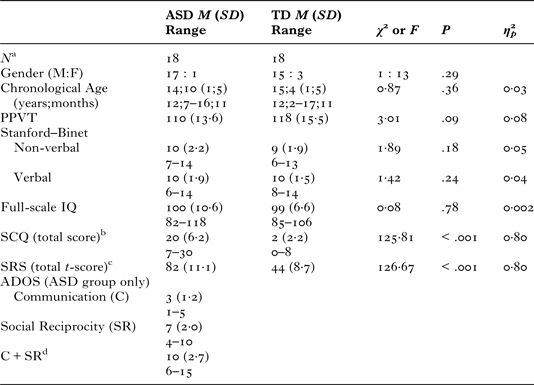
Diagnosis was confirmed in the ASD group using the Autism Diagnostic Observation Schedule (ADOS; Lord, Rutter, DiLavore & Risi, Reference Lord, Rutter, DiLavore and Risi2002), and further confirmed in the ASD group and ruled out in the TD group using the Social Communication Questionnaire (SCQ; Rutter, Bailey & Lord, Reference Rutter, Bailey and Lord2003), and the Social Responsiveness Scale (SRS; Constantino & Gruber, Reference Constantino and Gruber2005). TD participants were excluded if they had any first-degree relatives with ASD, or any history of neurological problems. One participant with ASD was excluded because he moved before completing the study procedures. One participant with TD was excluded because of concerns about his social development, including an elevated score (t-score of 62) on the SRS. These exclusions resulted in a final sample of eighteen adolescents with ASD and eighteen adolescents with TD. All participants in the final sample had IQ and PPVT scores in the average or above-average range. See Table 1 for participant details.
Demographic information for participants with autism spectrum disorders (ASD) and typically developing (TD) control participants

notes:a Of the final sample, four TD participants, and five participants with ASD, also participated in a study of speech–gesture integration (de Marchena & Eigsti, Reference de Marchena and Eigsti2010) conducted in our laboratory two years prior.
b When used as a screening instrument, a cut-off score of 15 is recommended as an indication of a possible ASD (Rutter et al., Reference Rutter, Bailey and Lord2003).
c When used as a screener, t-scores less than or equal to 59 are in the unaffected range, t-scores from 60 to 75 suggest mild to moderate ASD symptoms, and t-scores of 76 or higher suggest severe symptoms.
d On the ADOS, 7 is the cut-off for a diagnosis of ASD. All ASD participants in the final sample, except one, were above ADOS cut-off for ASD; this participant had elevated SCQ (24) and SRS (73) scores, and was judged to carry an ASD diagnosis by clinicians on the study, based on DSM-IV-TR criteria.
This study was approved by the University of Connecticut Institutional Review Board. Before beginning testing, parents and participants gave written consent and assent. Participants received financial remuneration for participation.
Measures
Autism Diagnostic Observation Schedule (Lord et al., Reference Lord, Rutter, DiLavore and Risi2002). The ADOS is a semi-structured assessment for the diagnosis of pervasive developmental disorders, which provides multiple opportunities for social and communicative engagement. Only participants with ASD completed the ADOS.
Social Communication Questionnaire (Rutter et al., Reference Rutter, Bailey and Lord2003). The SCQ is a 40-item parent questionnaire for the screening of ASD symptoms in children. Items on this measure were derived from the Autism Diagnostic Interview – Revised (ADI; Lord, Rutter & LeCouteur, Reference Lord, Rutter and LeCouteur1994), and have established reliability with this measure (Rutter et al., Reference Rutter, Bailey and Lord2003).
Social Responsiveness Scale (Constantino & Gruber, Reference Constantino and Gruber2005). Parents also completed the SRS, a 65-item questionnaire that assesses social and communicative behaviors associated with ASD. The SRS was included, in addition to the SCQ, because it assesses a wide range of social skills and is thought to provide a sufficient range of scores in both ASD and TD samples for correlational analyses (Constantino & Todd, Reference Constantino and Todd2003).
Stanford-Binet Intelligence Scales (Roid, Reference Roid2003). The SB5 is a factor-analytic measure of intellectual functioning from preschool age to adulthood. Participants completed an abbreviated battery which yields both verbal and non-verbal scores.
Peabody Picture Vocabulary Test (Dunn & Dunn, Reference Dunn and Dunn1997). The PPVT is a measure of receptive vocabulary from preschool age to adulthood. The reliability and validity of this measure are well established.
Design
Data presented in this paper were collected as part of a larger battery on communication skills in ASD. For the experimental task, participants told stories based on cartoon stimuli to a listener (described below). The existence of common ground was experimentally manipulated such that participants told stories in one of two conditions: (A) the private condition, in which information about the cartoon was known only to the participant, thus the listener and participant had no common ground, and (B) the shared condition, in which the listener and participant shared knowledge about the cartoon and thus had common ground. Three narratives were told in each condition, for a total of six narratives per participant. During the same task, participants told six additional narratives while their gestures were constrained, as part of a study on non-verbal influences on narrative. Cartoon stimuli were presented in a fixed order to all participants. Conditions were assigned in two counterbalanced orders; see ‘Appendix A’. Due to an unanticipated order effect of gesture constraint on word count, gesture data could not be interpreted in a straightforward manner, and are not presented.
Stimuli
Stimuli for the narrative task consisted of twelve approximately 60-second cartoons clips, selected from six children's cartoons (e.g. Tom & Jerry, The Pink Panther; there were two clips from each cartoon). Cartoons were primarily wordless, although there were occasional brief verbalizations (e.g. “you're never leaving!”). Cartoons depicted a range of possible and impossible events, such as a cat chasing a mouse across a kitchen, or the Pink Panther lighting a light bulb with a match. Cartoon stimuli were presented on a portable DVD player.
Each cartoon clip was preceded by an approximately 30-second ‘preview’ that participants watched before watching the 60-second cartoon. Previews were included as a means to manipulate shared knowledge between speaker and listener; thus the participant either watched the preview with the listener (i.e. during the shared condition, to establish shared knowledge) or alone (i.e. during the private condition, to serve as a control for watching some events twice). Previews contained three approximately 8-second events from the cartoon clip, separated by 3 seconds of a black screen. We selected events that had a clear beginning and ending (e.g. the Pink Panther picks up a welcome mat and walks into a motel holding it). Events were presented in a pseudo-random order to minimize the chance that participants would be able to infer the plot of the full cartoon from the preview (and thus assume the listener had some understanding of the plot).
Procedures
All participants were tested at our laboratory at the University of Connecticut or in their homes or schools in Connecticut and Massachusetts. In all cases, testing was conducted in a private room with a table.
Two experimenters were present for all data collection. One experimenter (the first author) assumed the role of the ‘researcher’. The researcher administered standardized measures, explained study instructions, and presented cartoon stimuli. The second experimenter (trained research assistants and graduate students) assumed the role of the ‘listener’, and was present only to listen to the participants narrate the cartoons. The presence of a second listener who was not the primary experimenter was necessary because it was important that study participants believe that the person to whom they were telling the stories was unfamiliar with the cartoons that he or she was explaining. This was, in fact, the case; research assistants and graduate students serving as the listener never saw the full cartoons, although they were familiar with the cartoon previews. Listeners were trained to respond to participant narratives by nodding attentively, smiling and laughing, and providing non-specific verbal responses (e.g. “oh”, “ok”, “mhhm”) when appropriate. Listeners were specifically instructed not to indicate (either verbally or non-verbally) any confusion or difficulty they may have had in following participants' narratives.
The researcher explained the study procedures by telling the participant that this was a study about communication, in which the participant would be asked to communicate about twelve cartoons with the listener, who had never seen the cartoons before. The participant was told that communication would be assessed by recording their narratives, and by the results on ‘quizzes’ taken by the participant and the listener. Quizzes were included in the study procedures because during pilot testing, participants given general instructions (e.g. “tell the story”) tended to give a thematic or plot summary (e.g. “the cat wants to catch the mouse but can never succeed”) that was insufficient to demonstrate a common ground effect. After brief quizzes were added, pilot participants included more detail in their narrations, and the anticipated effect emerged. Quizzes may also increase participant motivation, thus enhancing the common ground effect (Rossnagel, Reference Rossnagel2000). For a sample quiz, see ‘Appendix B’.
Participants were told that they and the listener would receive the same quiz about some of the cartoons; even though the listener would not be able to watch the cartoons, he or she should be able to respond correctly to some of the questions on the quizzes based on what the participant had communicated about the cartoon. The researcher also explained that participants, and sometimes listeners, would see a brief preview of each cartoon before seeing the whole thing, so they would know something about the cartoon before it started (“like when you see a preview of a movie – you know something about what happens in the movie, but not everything”). Participants were given a chance to ask questions about study procedures and were then given a practice trial (private condition) in which they watched a preview, watched a cartoon, and narrated the cartoon to the listener. The listener and the participant then took a practice quiz. Although listeners were often familiar with the plot of the practice cartoon, they made a genuine effort to respond to the quiz based exclusively on the participant's actual narration. The researcher then reviewed the quizzes and gave constructive feedback.
After completing and reviewing the practice trial, the experimental trials began. During the private conditions, the listener left the room so that it was apparent that he or she could not see the preview and cartoon while the participant was watching them; participants also wore headphones so that the listener could not hear. Headphones were worn during all cartoons as well as during the previews in the private condition. During the shared condition, participants removed the headphones for the preview, and the participant and listener sat next to each other and watched the preview together, to increase the salience of the shared experience. On the first shared trial, the researcher reminded the participant that the listener would also watch the preview, but the participant would then watch the cartoon alone. As such, the listener would know something about the cartoon, but not everything. During the private condition, participants watched the preview alone; this served as a control for the possibility that watching certain cartoons events twice might affect narrations. The twelve trials were presented in four blocks of three cartoons each; blocks were separated by breaks and administration of psychological testing.
Behavioral coding
Speech transcription. Story length was the primary dependent measure of interest for assessing the referential shortening effect. To determine story length (via word count), narratives were fully transcribed by trained research assistants. All complete words were included in the current analyses; non-words (e.g. um) and partial words (e.g. st-) were excluded. Narrations from eight participants (22% of the sample), including four with ASD (for a total of 96 narrations) were independently transcribed by two separate coders for the purposes of obtaining reliability data. Agreement was very high; the intra-class correlation coefficient (ICC) for word count per narrative was .99.
Explicit references to common ground. While a complete analysis of narrative content is beyond the scope of this paper, we did code the narratives for explicit references to the shared previews, as a marker of attention to the shared experience. Some examples of utterances coded as explicit references to common ground include:
(1) … the roadrunner, all he'd have to do was pull a little one, all he had to do was, you saw it in the preview. (ASD, 13;5)
(2) Alright, so in the beginning we see the cat pacing, like you saw, and he starts going up … (ASD, 16;1)
(3) … he painted the tunnel as you remember. (ASD, 16;8)
(4) The preview was out of order. (TD, 15;0)
(5) … it falls back on top of him, as you saw in the preview. (TD, 15;9)
(6) … we saw the whole picture of him drawing the outcome (TD, 16;7)
Speech disfluencies. As an additional linguistic marker of common ground, we were interested in speech disfluencies during narrative production. Disfluencies were classified as revisions, repetitions, or filler words
Revisions were words or phrases that changed or corrected some aspect of the participant's speech. Each revision was counted as a single unit regardless of the total number of words revised:
(7) He was trying to go after the bird and then he, and then the bird escapes … (ASD, 13;5)
(8) … and then he tried, and then he launched himself up … (ASD, 14;8)
(9) The duck jumps out and starts, and dodges the axe … (TD, 12;2)
(10) So he creates this, splits the road into two … (TD, 16;7)
Repetitions were words or phrases that were repeated in full; like revisions, each repetition was counted as a single unit regardless of the total number of words repeated:
(11) Tom found Jerry licking the, the other side of, of his bowl. (ASD, 12;7)
(12) … he, he drank all the milk, all the milk, and it was gone out of the bowl. (ASD, 13;10)
(13) And so as she was saying that, he took a, a cat off his back and put it underneath a bowl on the bottom, on the bottom shelf of a bookcase. (TD, 12;2)
(14) … and then it showed the coyo-, the coyote, at the edge of the cliff. (TD, 14;11)
Filler words were defined as vocalizations with no semantic content:
(15) And, um, Tom was mad so he started running after Jerry … (ASD, 12;7)
(16) Sylvester the cat, um, he brings a wooden box, uh, up to a building … (ASD, 16;7)
(17) And when he's on the counter, uh, the mouse puts his tail in a, um, waffle maker and um after that he's running around, um, and then … (TD, 14;2)
(18) … just as he's about to, uh, swing the axe … (TD, 15;5)
Ratings of story quality. In addition to assessing common ground effects via changes in word count and speech disfluency, we also investigated adult observers’ subjective experiences of participants’ narratives. These observers (n = 49) were college students who were naive to study hypotheses, and did not know until after completing the study that any of the narratives were produced by individuals with ASD. Raters read transcriptions of the narratives and rated them on two dimensions: (i) to assess whether naive raters would have an impression about whether or not interlocutors shared common ground, raters were asked to judge whether or not the speaker had watched the cartoon alone or with the listener (simple forced-choice shared vs. alone rating); (ii) to assess overall narrative quality, raters were asked to judge how easy the narratives were to follow, on a 1 (“very difficult, confusing; the plot didn't make sense”) to 7 (“totally coherent; a very clear plot”) scale. A sample rating sheet is shown in ‘Appendix C’. Raters were also asked about the visuospatial content of the stories for our gesture study; those data are not reported. Narratives were assigned to raters based on one of twelve possible orders of presentation. Orders were counterbalanced such that group, ground, and gesture constraint (the original three independent variables of interest) were presented in a pseudo-random order across raters. Each rater read transcriptions of four cartoons produced by six adolescent participants (i.e. 24 transcriptions each).
RESULTS
Dependent variables were examined for deviations from the assumptions underlying the statistical tests employed. In cases in which assumptions were not met, alternative tests were used, as indicated below. Partial eta-squared (η p2) and Cohen's d are presented as measures of effect size.
The referential shortening effect
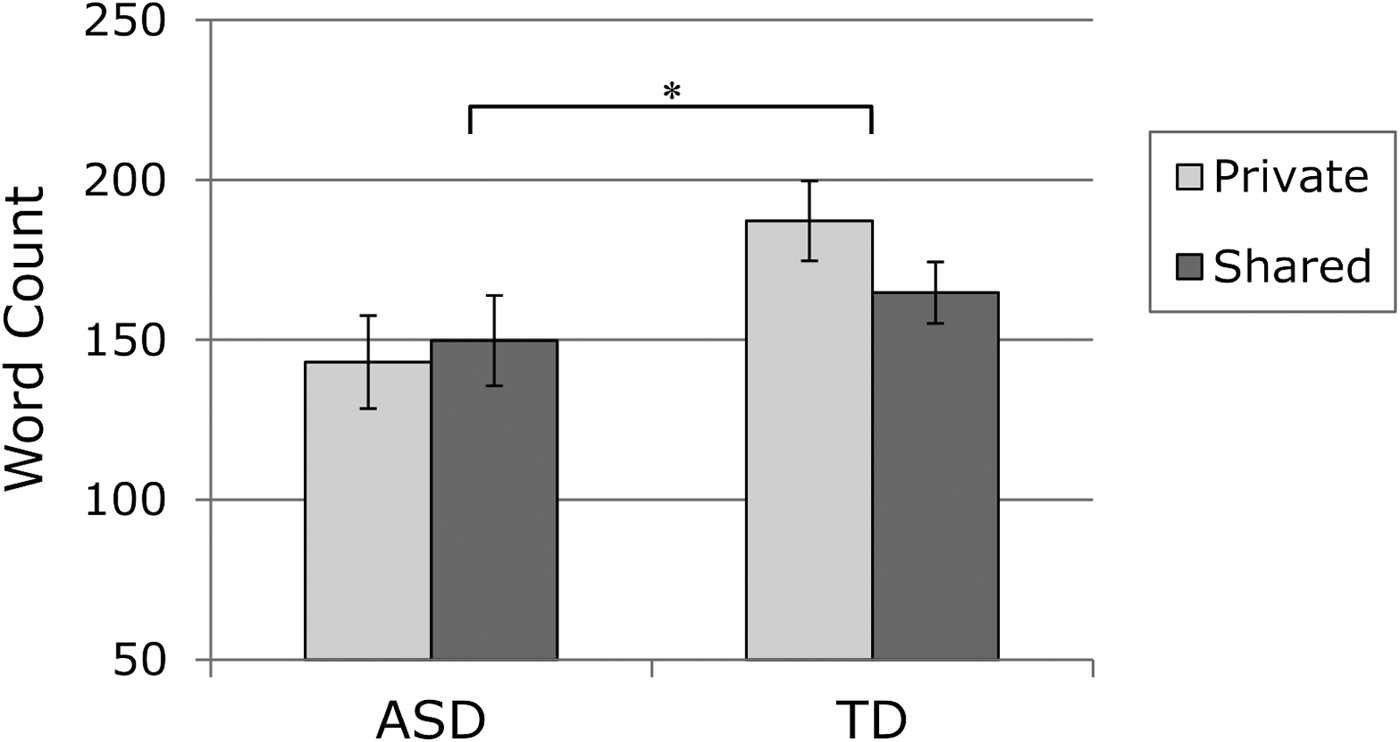
Our primary study goal was to examine the presence or absence of the referential shortening effect (i.e. reductions in story length when information was shared) in adolescents with ASD, and to examine what individual differences underlie its use. To investigate this ‘core’ effect of common ground, we conducted a 2 (group) by 2 (ground) ANOVA with word count as the dependent variable. This analysis revealed a trend for a main effect of group (F(1,34) = 3·02, p = .09, partial η 2 = 0·08), with the ASD mean (SD) word count at 147 (57) words per story and the TD mean (SD) word count at 176 (44) words per story. There was no main effect of ground (F(1,34) = 1·54, p = .22, partial η 2 = 0·04), suggesting that, collapsed across groups, word count was similar for private and shared conditions. Most critically, there was a significant interaction of group and ground (F(1,34) = 5·31, p = .03, partial η 2 = 0·14), see Figure 1. Post-hoc paired-sample t-tests revealed that while the TD group showed a significant drop in word count in the shared condition relative to the private condition (t(17) = 2·78, p = .01, Cohen's d = 0·47), word count in the two conditions was equivalent within the ASD group (t(17) = –0·69, p = .50, Cohen's d = –0·11). This analysis demonstrates that the TD and ASD samples responded differently to the pragmatics of sharing common ground with an interlocutor; specifically, while the TD group reduced the length their stories during the shared condition, consistent with prior studies of common ground, the ASD group failed to do so.
Word count in private vs. shared stories, by diagnostic group.
Individual differences and common ground
To look at the relationship between individual factors and referential shortening, we divided the total number of words used in the private condition by the total number of words used in the shared condition, to create a referential shortening variable. Thus, participants with scores greater than one on this variable used more words in the private condition, showing a referential shortening effect, while participants with scores below one used fewer words in the private condition, failing to show a referential shortening effect. The TD group had a mean (SD) of 1·15 (0·22) on this variable, meaning that, on average, their stories were 15% longer when the listener had not seen the preview (i.e. when they did not share common ground). The ASD group, in contrast, had a mean (SD) score of 0·97 (0·25), suggesting that they used roughly the same number of words regardless of whether or not they shared knowledge with the listener. The difference of these values from 1·00 was tested using a one-sample t-test. This difference reached significance in the TD group (t(17) = 2·80, p = .01, Cohen's d = 1·34), but not in the ASD group, (t(17) = –0·45, p = .66, Cohen's d = –0·22). Again, adolescents with TD clearly showed referential shortening, with a large effect size, while adolescents with ASD did not.
IQ and receptive language. Individual differences that may have affected participants’ tendency to adhere to referential shortening were examined using bivariate correlations. This included full-scale IQ, Verbal IQ, Non-verbal IQ, receptive vocabulary, social skills (as assessed by the SRS), and age. Neither IQ scores or receptive vocabulary were found to correlate with the common ground effect, either within or across groups (all rs between –0·2 and + 0·2, all ps > .3). While this finding may suggest that referential shortening goes beyond basic cognitive and linguistic skills, it should be noted that our samples were selected to be in the normal range on these measures, thus reducing variability.
Social skills. To investigate the relationship between social skills and common ground, we probed for associations between referential shortening and scores on a measure assessing social skills, the SRS. Higher scores on the SRS indicate greater impairment in social skills. Collapsed across groups, SRS score was significantly negatively correlated with the common ground effect (r(34) = –0·34, p = .048), suggesting that social skills were related to subtle changes in linguistic output (note that SRS forms for two participants in the ASD group were not available). However, visual inspection of the data suggested that the correlation between SRS and referential shortening was driven primarily by the fact that the ASD sample as a whole had both higher SRS scores and lower referential shortening effect scores, see Figure 2. A follow-up analysis was therefore conducted with the same bivariate correlation in the ASD group only, to see if social skills were related to referential shortening independent of ASD diagnosis; in this analysis, the significant negative correlation was maintained (r(16) = –0·56, p = .03), suggesting that general social skills were related to the tendency to use referential shortening in adolescents with ASD. SRS scores were also correlated with the referential shortening effect in the TD group, and this analysis revealed a counter-intuitive positive correlation (r(18) = 0·50, p = .04); see ‘Discussion’.
Correlation between SRS score and the common ground effect, by diagnostic group.
Age. Collapsed across diagnostic group, age was strongly and positively correlated with referential shortening such that older participants showed a greater referential shortening effect (r(36) = 0·47, p = .004). Interestingly, after the sample was split by diagnosis, the TD group did not show a relationship between age and common ground (r(18) = 0·29, p = .24), but the ASD group showed a strong positive correlation (r(18) = 0·59, p = .01), with age accounting for approximately 34% of the variance in common ground, as shown in Figure 3. Visual inspection of the data suggested that participants with ASD younger than fifteen had common ground effect variable scores below one; older participants tended to have scores above one, suggesting adherence to referential shortening. A ground (2) by age group (2; under 15 vs. over 15) ANOVA was conducted for the ASD sample with word count as the dependent variable. This analysis revealed no main effect of ground (F(1,16) = 0·25, p = .62, partial η 2 = 0·02), again reflecting that, as a whole, the ASD sample did not reduce their speech in response to shared common ground. The main effect of age group was also found to be not significant (F(1,16) = 1·00, p = .33, partial η 2 = 0·06), demonstrating that both age groups told stories of approximately the same length. However, the ground by age group interaction was significant (F(1,16) = 6·59, p = .02, partial η 2 = 0·29), with older participants showing a decrease in word count from the private to the shared condition, and younger participants showing an increase. The results of these analyses suggest that, while TD individuals may have mastered referential shortening by early adolescence, teens with ASD may be on the path to developing this important pragmatic language skill.
Correlation between age and the common ground effect, by diagnostic group.
Relationship between age and social skills in ASD. Because age and general social skills are so tightly linked (and because the first version of the SRS, used here, does not account for age in standardized scores), we conducted separate analyses to look at the relationship between these variables and referential shortening in ASD. A bivariate correlation showed that there was a significant and strong relationship between age and social skills, as measured by the SRS (r(16) = –0·56), with older participants having lower (i.e. better) SRS scores. To determine which variable was a stronger predictor of referential shortening, age and SRS were entered into a regression with referential shortening as the dependent variable. Taken together, age and SRS predicted 45% of variance in referential shortening (F(2,13) = 5·21, p = .02). When examined independently, age was a marginally significant predictor of referential shortening (β = 0·44, t = 1·78, p = .098); SRS was not a significant predictor (β = –0·31, t = –1·25, p = .23). The results of these analyses demonstrate that age and social skills are tightly linked in adolescents with ASD, which together contribute to gains in referential shortening. However, these variables are so related that when the variance in one is controlled the other no longer significantly predicts referential shortening. Though the data hint that age may be a stronger predictor of referential shortening than basic social skills, this effect did not reach full statistical significance.
Attention to common ground: beyond referential shortening
Referential shortening is a useful tool for examining common ground in ASD, because it is a well-replicated effect that reveals automatic, implicit pragmatic skill. The above analyses suggest that this skill is not present in adolescents with ASD at the group level, but is present in some participants, particularly older participants with stronger social skills. Given the heterogeneity of our sample, we were interested in other markers of attention to common ground that may shed light on how participants were and were not making use of shared knowledge.
Explicit references to common ground. Explicit references to information contained in the shared previews (e.g. “… like you saw, the Roadrunner ran right through.”) were infrequent in both groups: only four participants in the TD group and three participants in the ASD group made any explicit reference to the previews. There was no group difference (χ 2 (4, N = 36) = 3·03, p = .55), suggesting that participants from both groups were equally likely to explicitly refer to the common ground.
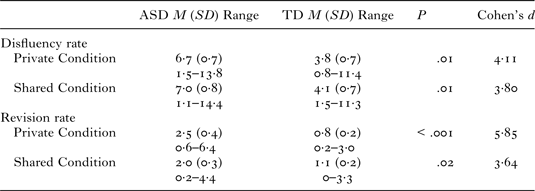
Speech disfluencies. If adhering to discourse rules related to common ground requires increased cognitive load, then speakers may show more disfluent speech in the shared condition relative to the private condition. Thus, an increase in overall disfluencies in the shared condition could provide evidence that participants are attempting to incorporate common ground, even if they are unsuccessful at achieving referential shortening. We looked at the relationship between ground and speech disfluencies using a 2 (group) by 2 (ground) ANOVA, with total disfluency rate (i.e. disfluencies per 100 words) as the dependent variable. As reported in the literature, the ASD group was significantly more disfluent than the TD group (F(1,34) = 8·69, p = .01, partial η 2 = 0·20), see Table 2. The main effect of ground, however, was not significant (F(1,34) = 0·64, p = .43, partial η 2 = 0·02), suggesting that disfluencies did not increase when participants were under conditions of common ground. The interaction of group and ground was also non-significant (F(1,34) = 0·004, p = .95, partial η 2 < 0·001).
Mean overall disfluency and revision rates per group (reported as total number of disfluencies (i.e. revisions, repetitions, or fillers) per 100 words, or number of revisions per 100 words)
Revisions are a specific type of disfluency that reveal moments of discourse during which speakers are correcting, clarifying, or elaborating the contents of their speech. We hypothesized that TD adolescents would use more revisions during the shared condition, reflecting the fact that they were updating their speech more in response to shared knowledge, and that this effect would not hold for adolescents with ASD. We ran the same 2 by 2 ANOVA described above, with revision rate (i.e. revisions per word) as the dependent variable. The main effect of group was significant (F(1,34) = 14·24, p = .001, partial η 2 = 0·30), revealing once again that the speech of adolescents with ASD was much less fluent than for their TD counterparts. The main effect of ground was not significant (F(1,34) = 0·54, p = .47, partial η 2 = 0·02), showing that across groups there was no difference in revisions between conditions. The interaction of group and ground, however, was significant (F(1,34) = 6·76, p = .01, partial η 2 = 0·17). Planned post-hoc paired t-tests tests revealed a marginally higher revision rate in the shared condition (relative to the private condition) for the TD group (t(17) = –1·81, p = .09, Cohen's d = –0·43), and a marginally lower revision rate in the shared condition (relative to the private condition) for the ASD group (t(17) = 1·95, p = .07, Cohen's d = 0·46). Overall, this pattern suggests that adolescents with TD are more likely to increase their revision rate under conditions of shared knowledge compared to adolescents with ASD.
Qualitative ratings of narratives. In addition to looking at linguistic markers of common ground, we asked whether naive raters would have a gestalt impression about any common ground that might be shared between speaker and listener. In other words, regardless of whether or not participants showed the implicit reduction in word count associated with common ground, might there exist other pragmatic features that would cue naive raters that the narrative had been produced in the context of shared knowledge? Raters judged whether they believed a story was describing a cartoon that the speaker had watched alone, or with a listener. Ground (2) and group (2) were entered as within-subjects factors into an ANOVA. In this case, group was a within-subjects factor rather than a between-subjects factor because raters read stories produced by participants both with and without ASD. There was no main effect of group (F(1,48) = 0·66, p = .42, partial η 2 = 0·01), and no interaction between ground and group (F(1,48) = 0·11, p = .74, partial η 2 = 0·002), suggesting that raters responded to the effect of common ground similarly for stories produced by those with and without ASD, and consistent with the finding that both groups explicitly referenced shared knowledge at a similar rate. However, there was a main effect of ground (F(1,48) = 5·74, p = .02, partial η 2 = 0·11); the direction of this effect was the opposite of what was predicted, such that raters were more likely to say that participants had watched the cartoon alone in response to narratives from the shared ground condition. This suggests that listeners reliably misinterpreted common ground cues that were apparent in the narratives.
Although raters were unable to explicitly identify whether or not interlocutors shared knowledge, the possibility remained that the communicative quality of narrations may have been affected by the influence of common ground. Naive adult participants rated how easy the narratives were to follow on a 1 to 7 scale. A group (2) by ground (2) ANOVA revealed a significant main effect of group (F(1,40) = 9·69, p = .003, partial η 2 = 0·20), with a large effect size, with TD participants telling stories that were rated as easier to follow. The main effect of ground was not significant (F(1,40) = 0·49, p = .49, partial η 2 = 0·01); however, there was a significant group by ground interaction (F(1,40) = 11·78, p = .001, partial η 2 = 0·23), with the difference between groups being more pronounced in the shared condition than in the private condition; means are shown in Table 3. Post-hoc, paired-samples t-tests demonstrated that, in the ASD group, stories were significantly harder to follow in the shared condition relative to the private condition (t(40) = 2·1, p = .04, Cohen's d = 0·66), a finding that did not hold for the TD sample (t(48) = –0·96, p = .34, Cohen's d = –0·13). This finding suggests that participants with ASD may in fact have been responding in a detectable way to the common ground they shared with listeners; however, their responses made their narratives more difficult to follow.
Qualitative ratings of narratives: responses to the question “How easy was the story to follow?” rated on a 1–7 Likert scale

Discussion
The current study was designed to investigate how adolescents with ASD modify their speech in response to common ground during narration. We found that adolescents with TD showed a clear referential shortening effect in response to common ground. Adolescents with ASD, in contrast, showed no referential shortening at the group level. At first glance, this finding might suggest that adolescents with ASD are simply unaware of the need to modify discourse in response to common ground. However, three specific findings suggest that these adolescents did respond to changes in common ground. First, although they did not demonstrate implicit use of common ground, as evidenced by decreases in word count, teens with ASD made the same number of explicit references to common ground in their narratives as TD peers (though such references were generally infrequent). Second, participants with ASD were marginally less likely to revise their speech when they shared knowledge with their interlocutor. And third, naive raters observed that narratives produced by participants with ASD were harder to follow under conditions of common ground, suggesting that teens with ASD did modify their narratives based on the presence of shared knowledge. Individual differences in the referential shortening effect demonstrated that TD adolescents clearly have the subtle pragmatic language skills necessary to adhere to Grice's maxim of quantity; adolescents with ASD, in contrast, appear to be in the process of developing this implicit skill, perhaps reflecting a delay in speaker–listener pragmatics rather than true deviance.
With these findings in mind, we revisit the hypotheses presented in the ‘Introduction’, before engaging in a broader discussion of common ground in TD and ASD.
Hypothesis 1a proposed that referential shortening, while present in TD, would be absent at the group level in ASD. Referential shortening is a useful metric for evaluating implicit use of common ground, as it is untaught, easily quantifiable, and incorporates an entire discourse. As a group, the TD sample produced significantly shorter stories when they shared information with their interlocutor. Note that the amount of shared information was small. Preview stimuli consisted of three brief clips (approximately 8 seconds each) from 60-second cartoons. In addition, the clips were presented in a pseudo-random order (i.e. they were not necessarily presented in the order in which they appeared in the cartoon), and although they allowed the listener to understand each of the three isolated events, they did not permit listeners to infer much about the cartoon plot. College students who read transcriptions of the narratives were unable to correctly determine whether or not interlocutors shared knowledge, suggesting that participants modified their linguistic output in a manner that was too subtle to be detected by the naked eye. Interestingly, the effect of common ground present in the current study may even have been too subtle for our trained research assistants to detect. Although we did not explore this idea quantitatively, several of the research assistants serving as listeners reported that they thought the study might not be ‘working’ since participants appeared to be telling stories in the same way regardless of whether or not they shared common ground with the listener. As such, the 12% reduction in word count observed in the TD sample is striking, given the subtlety of both the observable changes to participants’ narratives, and the shared content itself.
In contrast to the TD group, the ASD group failed to demonstrate the referential shortening effect. At a group level, adolescents with ASD did not reliably shorten their stories when they shared knowledge with an interlocutor. This pattern of findings confirms our hypothesis that adolescents with ASD would not show the pragmatic sophistication needed to implicitly fine-tune their discourse in this manner.
Hypothesis 1b proposed that heterogeneity in referential shortening would relate to participant characteristics. We harnessed the heterogeneity of our combined sample to explore individual differences associated with referential shortening. Current results indicated that general cognitive ability (Full Scale IQ: FSIQ) and receptive vocabulary did not significantly correlate with common ground use in either group, suggesting that differences in general cognitive and linguistic skills were not sufficient to account for individual differences in referential shortening. These findings are largely consistent with the results of a recent study on audience design in ASD (Nadig et al., Reference Nadig, Vivanti and Ozonoff2009). In this study, non-verbal IQ, age, ASD symptom severity, and adaptive functioning had little influence on audience design in ASD. In contrast, language level, measured by the CELF-4 (Semel, Wiig, & Secord Reference Semel, Wiig and Secord2003), a comprehensive battery of structural language use, was the only individual factor distinguishing children with ASD who exhibited audience design from those who did not. Their findings suggested that higher-order linguistic skills likely underlie audience design in ASD.
Although IQ and receptive vocabulary did not relate to referential shortening in the current study, social skills (as measured by the SRS) and chronological age did. Participants with ASD with better social skills demonstrated more referential shortening.Footnote 1 Age and social skills were highly correlated in our ASD sample, with older participants demonstrating stronger social skills, a relationship that makes it difficult to interpret the individual contribution of age and social skills to referential shortening. Social skills likely affect multiple aspects of common ground use. Specifically, individuals with better social skills may be more attentive to, and motivated to incorporate, shared knowledge. In addition, more socially skilled adolescents may be better able to use shared knowledge to improve the specificity and quality of their discourse. Our data do not distinguish between these two possibilities, and likely both paths from social skills to common ground are involved.
Chronological age was related to referential shortening in the ASD group, such that participants above the age of fifteen showed the effect, while participants younger than fifteen did not. These findings suggest that, in early adolescence, subtle pragmatic language skills, such as the implicit referential shortening effect assessed here, are not fully developed in ASD, but may be intact by late adolescence. While participants with TD already had sufficient skills necessary to tackle the complex pragmatics of common ground, the ASD sample required additional developmental time. Age and social skills were highly correlated in our sample; regression results demonstrate that age was marginally an independent predictor of referential shortening, suggesting that the advantages conferred with maturation likely go beyond improved social skills. This could reflect general neuropsychological delays; alternatively, social skills themselves may be so taxing for adolescents with ASD that they absorb more cognitive resources than they would in TD teens. Finally, older adolescents have generally spent more time in speech therapy and related interventions, which may improve both the social skills and discourse skills necessary for successful common ground use.
In the TD sample, age did not correlate with the common ground effect, suggesting that even relatively subtle uses of common ground during discourse are firmly established by age twelve. This finding adds to the existing literature on common ground in typical development by describing a referential shortening effect by early adolescence. Some features of common ground use have been studied in children as young as two years old (e.g. Clark & Bernicot, Reference Clark and Bernicot2008; O'Neill & Topolovec, Reference O'Neill and Topolovec2001); referential shortening specifically has not been described in samples younger than college students. Referential shortening, as we discuss below, appears to be a fairly sophisticated pragmatic skill. It is possible that complex pragmatic language skills, which require both social skills and significant information processing, could undergo growth during adolescence in TD. However, our findings show a reliable and stable referential shortening effect in TD adolescents, consistent with that seen in the adult literature.
Hypothesis 2 proposed that adolescents with ASD are responsive to the shared context. Although referential shortening was not observed at the group level in ASD, we saw significant heterogeneity that was related to social skills and age. Given the existing literature, we hypothesized that adolescents with ASD would be aware of the presence of shared knowledge, and aware that shared knowledge should have an effect on how they communicate; however, they would lack the skill to incorporate this shared knowledge in a normative way. To examine how shared knowledge might affect storytelling other than by referential shortening, we examined explicit references to common ground, speech revisions, and communicative quality across private and shared contexts. Across all three sets of analyses, we found evidence that teens with ASD are aware that common ground should impact discourse.
Hypothesis 2a examined explicit references to common ground. Participants in both groups did not tend to explicitly express the fact that they shared common ground with the listener as often as had been expected. However, some participants (from both groups) did at times include phrases such as “like we saw in the preview”, or “after the part you saw”. Both groups produced these explicit references with equally low frequency, suggesting that, at an explicit level, participants with ASD attempted to incorporate common ground to the same extent as the TD group. If this were in fact the case, it would suggest that pragmatic language processes, such as common ground, may have an impact at an explicit level, but not a deeper, potentially more automatic implicit level (i.e. through referential shortening), consistent with observations that individuals with ASD often struggle more with implicit aspects of communication and social interaction as compared to explicit processes.
Hypothesis 2b focused on speech disfluencies as a marker of common ground. We hypothesized that since the shared condition was anticipated to confer greater cognitive load, increases in overall speech disfluencies might suggest that adolescents with ASD were attempting to tailor their stories to the context. The relationship between condition and speech disfluencies was unexpected; we discuss this finding in more depth in the ‘General discussion’, below. Among the different types of disfluencies, we were particularly interested in revisions (sometimes called ‘self-corrections’). Revisions, which occur when a speaker goes back and replaces something that he or she has already said, are unique among disfluencies because they demonstrate that speakers are actively changing plans mid-utterance (as opposed to filler word, such as um or uh, or word/phrase repetitions, which, while they may buy the speaker time or serve other pragmatic functions, do not demonstrate an explicit change in planning). In fact, a study of adults with ASD (Lake, Humphreys & Cardy, Reference Lake, Humphreys and Cardy2011) suggested that revisions may be particularly listener-oriented, as they serve to clarify or correct the contents of speech. Under conditions of common ground, when speakers are tailoring their speech to a specific communicative context, they may show more revisions as they consider and incorporate shared knowledge. This is particularly likely if common ground is incorporated at a late stage of processing, as has been suggested in studies of both common ground comprehension (Hanna, Tanenhaus & Trueswell, Reference Hanna, Tanenhaus and Trueswell2003) and production (Horton & Keysar, Reference Horton and Keysar1996). We thus hypothesized that TD adolescents would use more revisions in the shared condition than the private condition.
On their own, TD adolescents used marginally more revisions in the shared condition than the private condition. The current study may have been underpowered to detect a subtle effect like a change in revision rate, and while we do not want to overinterpret a marginal finding, we believe that this finding suggests that revisions may be a useful linguistic marker for understanding utterance planning in different interpersonal contexts. In future studies, especially those with larger TD samples, longer, more complex stimuli, which elicit more disfluencies, can help clarify the relationship between shared knowledge and speech revision.
Compared to adolescents with ASD, TD adolescents were more likely to increase their revision rate in the shared condition. Here we again show that adolescents with ASD do not respond to the pragmatic context of common ground in the expected way. In fact, adolescents with ASD were marginally more likely to decrease their revision rate in the shared condition. Perhaps because they were aware that their conversational partner knew some details about the story, adolescents with ASD were less inclined to update and clarify the details of their stories as they went.
Hypothesis 2c addressed communicative quality in a private vs. shared context. Ultimately, pragmatic weaknesses in ASD are only important insofar as they affect successful communication and interaction. As a proxy for real-world communicative quality, we asked college students to make subjective ratings of participants’ transcribed narratives. Overall, they rated the stories told by adolescents with ASD as being more difficult to follow than the stories told by adolescents with TD, replicating an earlier finding from our lab (de Marchena & Eigsti, Reference de Marchena and Eigsti2010), and emphasizing the significant general pragmatic weaknesses in this population. This finding also indicates that raters were sensitive to qualitative differences in the stories at a group level.
As an exploratory measure, we also asked raters to give their gestalt impression as to whether or not they believed the speaker and listener shared common ground. Surprisingly, raters consistently misinterpreted common ground status (i.e. they were more likely to say that private stories were told under conditions of common ground), a finding that was consistent across diagnostic groups. This finding, while somewhat difficult to interpret, reflects the highly implicit nature of the common ground, and the fact that we may have very limited access to exactly how we modify our speech to serve Gricean conversational maxims.
With respect to communicative quality ratings, collapsed across groups, stories produced in both the private and shared conditions were equally easy to follow. However, for the ASD sample only, stories were harder to follow when produced under conditions of common ground. This finding suggests that raters may in fact have been sensitive to something that our participants with ASD were doing communicatively when they shared knowledge about the cartoons with the listener. Participants with ASD may have been attempting to tailor their narratives to what the listener knew during the shared condition, resulting in narratives that were harder for raters, who had no knowledge of the cartoons, to follow. An alternative explanation is that participants with ASD actually put less effort into telling high-quality stories in the shared condition, because they were aware that their interlocutor already knew some details of the cartoons. This interpretation nicely parallels the above finding that adolescents with ASD revised their speech less under conditions of common ground, and suggests that the presence of shared knowledge may in fact decrease motivation by teens with ASD to exert the considerable effort needed to tell a coherent story. While entirely anecdotal, a speech sample from one participant with ASD's explicit reference to common ground may reflect such a process (“… the roadrunner, all he'd have to do was pull a little one, all he had to do was, you saw it in the preview”). The participant appears to give up on explaining a complicated part of the story because of his awareness of the listener's pre-existing knowledge of this event. Note that either of these interpretations – (i) that adolescents with ASD are trying and failing to tailor their stories to common ground, or (ii) that they are exerting less effort when common ground exists – suggests that adolescents with ASD are aware of and attentive to the shared context, and recognize that the change in context requires, or allows for, a different communicative approach.
General discussion
Our findings show evidence that adolescents with ASD are not only aware of the shared context, but that they communicate differently under conditions of common ground. Despite this awareness, adolescents with ASD do not achieve ‘success’ on the task, as indexed by the typical referential shortening effect. Further, and somewhat discouragingly, they appear to be less successful communicators when shared knowledge exists. Here we frame these findings within the broader literature on pragmatic language in ASD, and argue that successful pragmatic skill is tightly linked to task complexity. Adolescents with ASD, who present with a wide range of subtle weaknesses in cognitive and linguistic skills, as well as significant weaknesses in social interaction, are faced with a particularly complex task when trying to adjust discourse to the pragmatic context of shared knowledge. In addition, adolescents with ASD may have less motivation to engage in a complex and cognitively demanding task for social purposes (e.g. Chevallier et al., Reference Chevallier, Kohls, Troiani, Brodkin and Schultz2012), further reducing their chances at success.
The broader literature on pragmatic language in typical development suggests that, although audience design and language adjustments based on common ground are driven in part by interlocutors’ sensitivity to their conversational partners’ perspective and needs, these adjustments require substantial amounts of information processing (e.g. Horton & Gerrig, Reference Horton and Gerrig2005; Horton & Keysar, Reference Horton and Keysar1996; Rossnagel, Reference Rossnagel2000). The finding that SRS scores correlated with referential shortening is consistent with the theory that perspective taking is required for effective common ground. The finding that age was correlated with referential shortening in the ASD group is consistent with the theory that these adjustments require substantial amounts of information processing. The proposal that processing demands may limit the fluent use of pragmatic language in ASD (e.g. Volden, Reference Volden2004) has been directly tested in a study by Arnold and colleagues (2009). This group looked at referential pronouns in children and adolescents with TD and ASD as they narrated a cartoon. Overall, the ASD group was quite successful at the task, and there were few group differences. The authors found a relationship between cognitive load (as indexed by disfluent or lengthy clauses) and the production of pronouns, suggesting that adhering to discourse rules about pronoun usage requires significant cognitive resources. The results of this study suggest that cognitive load is important in discourse processing in both TD individuals and those with ASD.
We tested the relationship between common ground and cognitive load by looking at speech disfluencies produced in participants’ narratives. We hypothesized that speech disfluencies, which are often used as a marker of increased cognitive load (e.g. Arnold & Griffin, Reference Arnold and Griffin2007), would increase when common ground existed between the participant and the listener. This hypothesis was not supported by the current findings. Consistent with the literature (Lake et al., Reference Lake, Humphreys and Cardy2011; Suh, Eigsti, Naigles, Barton, Kelley & Fein, Reference Suh, Eigsti, Naigles, Barton, Kelley and Fein2014), adolescents with ASD were much less fluent in their narratives, producing approximately twice as many disfluencies per word as the TD sample. However, disfluencies did not increase in the shared condition, either across groups or in the TD group alone. There is ample evidence in the literature that incorporating common ground requires increased cognitive resources, and we do not believe that this finding argues against this phenomenon. Rather, speech disfluencies, while often interpreted as a marker of increased cognitive load during narrative (independent of common ground), may not be especially sensitive at picking out the relationship between cognitive load and common ground. In fact, there may be an interesting relationship between cognitive load and common ground via referential shortening. On the one hand, when speakers share knowledge, they tend to shorten their utterances, and shorter utterances themselves require less cognitive processing. On the other hand, when speakers share knowledge, there is extra information to consider when planning utterances, leading to increased cognitive demand. Thus the overall rate of disfluencies may be pulled in both directions as common ground increases, resulting in no gross difference between conditions.
The relationship between age and referential shortening, which was observed in ASD but not TD, further supports a relationship between processing demands and effective pragmatic language. This is not the first study of pragmatic language to find age-related differences in task performance in an ASD sample when no differences were apparent in control groups. Arnold, Bennetto, and Diehl (Reference Arnold, Bennetto and Diehl2009) looked at pronoun usage in nine- to seventeen-year-olds with TD and ASD. Although no differences in pronoun use were observed in the TD sample by age, the authors found that the youngest group of participants with ASD (nine- to twelve-year-olds) was more likely to use overly explicit terms (e.g. a character name, Tweety, or description, the bird) rather than pronouns. A wide range of skills that likely underlie pragmatic language improve with age. For example, social skills, which were highly correlated with age in our ASD sample, may increase sensitivity to, and motivation to act on, pragmatic subtleties, such as pronoun use and referential shortening. Beyond social skills, grammatical problems, which are known to affect discourse quality, have also been observed in younger (ten- to thirteen-year-old) but not older (fourteen- to seventeen-year-old) ASD samples (Eigsti & Bennetto, Reference Eigsti and Bennetto2009), a finding that offers another potential source for the improvement observed in this study.
It has been suggested, based on evidence from communication-disordered populations, that pragmatic skills more broadly may be epiphenomena arising from more basic cognitive and linguistic factors, as described above (Perkins, Reference Perkins1998). In fact, there is significant debate about how much of the discourse weaknesses observed in ASD can be attributed to limitations in language skills. Although some studies have demonstrated that pragmatic deficits during discourse go beyond general impairments in language skills (Eales, Reference Eales1993), the majority of studies find that general cognitive and linguistic skills contribute significantly to narrative and discourse abilities in this population (Capps, Kehres &Sigman, Reference Capps, Kehres and Sigman1998; Capps et al., Reference Capps, Losh and Thurber2000; Liles et al., Reference Liles, Duffy, Merritt and Purcell1995; Norbury & Bishop, Reference Norbury and Bishop2003). In their study of audience design in ASD, for example, Nadig and colleagues (2009) found that general language skills were the only predictor of audience design (in an analysis that also included ASD symptom severity and adaptive behavior skills, among others).
A final piece of evidence for the relationship between task complexity and successful production of pragmatic language comes from the contrast between our findings and Joanne Volden's work on register and ASD. Volden and colleagues (Reference Volden, Magill-Evans, Goulden and Clarke2007, Reference Volden and Sorenson2009) reported intact register shifting in younger children with ASD, which is inconsistent with the current finding that adolescents with ASD did not show intact referential shortening. Several methodological differences may account for the discrepancy in findings; interestingly, the distinctions between our studies are related to differences in information processing demands. In Volden's studies, speakers were explicitly instructed either that their listener did not understand well, or that they should make ‘bossy’ or ‘nice’ requests specifically; participants’ responses immediately followed this instruction, reducing the need to retain and respond to changes in listener characteristics. In contrast, in the current method, participants had to infer that they should alter their communicative style between these two conditions. Second, in the Volden studies, no within-discourse modulation was required – the change in register extended for the entire discourse. In our task, participants had to track what information was shared in the previews, and use this specific information to modify their speech. Again, our design required greater processing. In fact, within Volden and colleagues’ (Reference Volden, Magill-Evans, Goulden and Clarke2007) study, when the task was simplified, participants were even more likely to change register, further pointing to the fact that these pragmatic skills require substantial cognitive resources. By comparing these studies, we conclude that, although individuals with ASD can make use of pragmatic common ground skills, impairments in other domains, or in the higher-order integration of processes such as planning, working memory, vocabulary choices, syntactic organization, prosody, and gesture, may be preventing referential shortening, a complex, discourse-wide skill.
Our study specifically investigated common ground production. Studies of common ground comprehension are also consistent with the theory that complex pragmatics require greater cognitive resources for individuals with ASD. Other research in our lab has explored how children and adolescents with ASD interpret common ground as listeners in a problem-solving task (Schuh et al., Reference Schuh, Mirman and Eigsti2010). This project used a referential communication task to examine on-line processing of shared and private information about a visual puzzle. Using eye-tracking, the authors found that children and adolescents with ASD were sensitive to their partner's perspective. In addition, cognitive load was manipulated, and as cognitive load increased, task accuracy decreased in both groups. A significant task by load interaction suggested that the ASD group was significantly more affected by increases in cognitive load. We have also found discrepancies in how individuals with ASD are able to use shared knowledge to reason over objects (de Marchena, Eigsti, Worek, Ono & Snedeker, Reference de Marchena, Eigsti, Worek, Ono and Snedeker2011). In this study, children and adolescents with ASD were able to effectively reason over shared knowledge when the information was simple (i.e. object names); however, when shared knowledge was more complex (i.e. a fact about the object), participants with ASD were less effective than controls at using this information to draw inferences about new objects, despite comparable recall of the shared information.
Within the context of the broader literature on pragmatic language in ASD, our findings suggest that the general complexity of the task at hand may best predict whether or not participants with ASD are successful. Consistent with this, older participants with ASD are often more successful on pragmatic language tasks, potentially reflecting the fact that those with greatest available overall processing resources are better able to handle the many demands of social language. Communicative quality of narratives produced by teens with ASD appears to deteriorate under conditions of shared ground, suggesting that these adolescents may be attempting to incorporate shared knowledge but are not yet fully successful in doing so. Taken together, these findings suggest that some pragmatic language skills that may have been thought to be absent in ASD samples may simply be later emerging, either through the influence of effective interventions, or through the delayed acquisition of cognitive, linguistic, and social skills. These findings provide hope that a wider range of pragmatic language skills can be mastered and spontaneously employed, especially with the help of appropriate interventions.
The current study has several limitations that highlight the need for more research on this complex domain. Our sample size was relatively small, and did not cover a wide age range, which limits our ability to fully explore the extent to which common ground is incorporated from childhood to adolescence. Further, our design is cross-sectional; while the overall pattern of our data suggests that referential shortening emerges over the course of adolescence in ASD, a longitudinal design is required to fully establish the protracted developmental trajectory of the discourse skills that we describe here. In addition, our study was not designed to assess compensatory mechanisms that may have been used by older adolescents with ASD (which could result in similar performance, but a deviant developmental/processing pathway). Future studies elucidating possible compensatory mechanisms could address questions about developmental delay vs. deviance, and could also inform treatments attempting to hasten pragmatic language development in this population.
In the current study, we chose to use a narrative format based on cartoons rather than a conversation or personal narrative. Structured narratives based on experimenter-provided stimuli appear to be easier than personal narratives for individuals with ASD (Losh & Capps, Reference Losh and Capps2003). Our choice of procedure is advantageous in that narratives are based on consistent, known stimuli, allowing us to closely compare narratives across participants; however, it also could potentially have obscured interesting group differences that may have been apparent with a more challenging, open-ended task. The discussion of common ground presented here has focused primarily on the role of the speaker and the role of the listener as separate processes. This method is useful for disentangling what the speaker and listener each bring to the communicative table. However, it also necessarily oversimplifies the communicative process. The early referential communication studies beautifully demonstrated that communication is in fact a back-and-forth dynamic process, and that what the ‘speaker’ contributes can never be fully separated from what the ‘listener’ does, since, in reality, the two roles are constantly in flux. Future studies of common ground in ASD may be able to utilize referential communication tasks to examine the more dynamic processes of common ground.
APPENDIX A
Counterbalancing
APPENDIX B
Example quiz with correct answers circled and filled in
Practice Quiz
1 What happens when the roadrunner first runs really fast?
a. He takes off like an airplane
ⓑ The road wobbles
c. He becomes invisible
d. He erases the lines on the road
2 What does the coyote use to watch the roadrunner?
a. Infrared glasses
b. A telescope
ⓒ Binoculars
d. A webcam
3 What is the coyote holding while he's chasing the roadrunner?
A fork and a knife___________________________________________
4 Describe the expression on the coyote's face after the roadrunner runs off:
His jaw drops to the ground___________________________________
5 Which event was in the preview?
a. The introduction of the roadrunner's scientific name (‘Accelleratii Incredibus’)
b. The coyote watching the roadrunner from a cliff
ⓒ The coyote putting on his bib
d. The coyote dashing off to the hills
Appendix C
Questions given to undergraduate story raters