Natural and technological hazards, including hurricanes, earthquakes, oil spills, labor strikes, or infrastructure damages, can result in disruptions to the maritime transportation system. Such hazards can interrupt the distribution network, including land- and maritime-based delivery methods, and hinder the functionality of ports, routes (including navigation), and/or ships.Reference Tanner, Dowlatabadi and Chang 1 For example, a 2010 maritime collision and subsequent oil spill fully closed the Sabine Naches Waterway for 5 days.Reference Gonzalez and Malik 2 A storm surge from 2012 Hurricane Sandy impaired berths, piers, and critical equipment,Reference Sturgis, Smythe and Tucci 3 and the 2011 Japanese earthquake and associated tsunami caused tremendous damage to a wide range of port facilities.Reference Kazama and Noda 4
Many of the potential causes of maritime transportation disruption can also simultaneously lead to public health emergencies. Public health emergencies result in health consequences that overwhelm routine capabilities.Reference Nelson, Lurie, Wasserman and Zakowski 5 As such, an event (eg, earthquake, oil spill, maritime accident) that yields a maritime disruption may concurrently yield emergent requirements for health care supplies and personnel above and beyond everyday needs – increasing demand at a time when typical supply chain functionality may be compromised.
Island-based or geographically isolated coastal communities that rely on maritime transportation for the daily importation of commodities and people may be increasingly vulnerable to the health care impacts of a maritime transportation disruption due to their reliance on limited modes of transportation. The just-in-time delivery of supplies, although economically beneficial, can exacerbate repercussions from a primary hazard because of low levels of resource stores in the local community that can be accessed in the event of interruption to the regular delivery of supplies.Reference Tanner, Dowlatabadi and Chang 1 The readiness, or availability of health care workers (HCWs) to report promptly for duty, can also be impacted by maritime transportation disruptions if they are reliant on maritime transportation to get to work.Reference McCabe, Barnett, Taylor and Links 6
Using a regional case study approach, this study sought to characterize the facilitators and barriers of acute health care delivery following a maritime disruption in maritime transportation-dependent communities, such as island communities in the Pacific Northwest and Caribbean, and coastal communities in Canada. Specifically, this study identified vulnerabilities of the health care supply chain and workforce to maritime transportation disruptions, as well as specific measures that could enhance system-level resilience. The results of this study may be applicable to many remote or geographically isolated communities.
Regional Case Study
The impacts of maritime disruption on hospital-based acute health care delivery were analyzed in 2 maritime-dependent communities in coastal British Columbia (BC), Canada: an urban center, Greater Victoria, and a smaller, more remote community, Powell River Regional District. Both communities can be accessed only through maritime or air transportation methods, and share a high risk of experiencing a maritime transportation disruption from an earthquake.
Greater Victoria has a population of approximately 400,000 residents spread over 13 municipalities, including Victoria, the capital city of BC, on the Southern tip of Vancouver Island.Reference About Victoria 7 While Greater Victoria is moderately connected to other communities on Vancouver Island,Reference Tanner, Dowlatabadi and Chang 1 , Reference About Victoria 7 it remains highly dependent on maritime transportation for the movement of people and goods given its island geography. A major earthquake is expected to disrupt most ports on Vancouver Island, BC.Reference Smart 8
The Powell River Regional District comprises the City of Powell River and surrounding areas at the north end of BC’s Sunshine Coast, and has a population of nearly 20,000 residents. 9 Powell River Regional District is located north of Vancouver between the Straight of Georgia and a coastal mountain range, 9 and is not connected to the rest of mainland Canada by road.
The Canadian Province of BC has a publically financed health insurance provider that funds medically necessary services to all eligible residents of BC. 10 The province has 5 regional health authorities within the provincial Ministry of Health oversee and deliver health care services in discrete geographic areas. 11 Vancouver Island Health Authority services Greater Victoria, and Vancouver Coastal Health Authority services Powell River. 12 The British Columbia Clinical and Support Services (BCCSS) Society centralizes contracting, materials management (purchasing, warehousing, and distribution), and accounts payable for all health authorities in the province. 13
METHODS
Semi-structured key informant interviews were conducted from September 2016 through January 2017 to understand the impact of a maritime transportation disruption to the availability of hospital-based acute health care supplies and personnel, and to identify potential and ongoing measures to enhance resilience.
Individuals were selected to serve as key informants due to their knowledge of the hospital-based acute health care supply chain and workforce and associated emergency management plans and procedures in Greater Victoria, BC, and/or Greater Powell River, BC. A purposive sample was initially used to identify key informants based on coordination with practice-based partners. Purposive sampling was an appropriate sampling strategy given the limited number of individuals familiar with the subject matter and the restricted geography of the inquiry. Snowball sampling was subsequently used until data saturation was attained.
Interviews focused on identifying impacts and measures to enhance the resilience of the health care resources necessary for hospital-based acute health care delivery – including supplies and personnel – related to a maritime transportation disruption. An interview guide was used to facilitate discussion.
Interviews were recorded, transcribed, and thematically analyzed. A codebook was developed a priori and used to organize data into key themes. The codebook was updated throughout the research process based on the emergence of new themes, and all changes to the codebook were documented. Codes were systematically applied to transcribed text using NVivo for Mac qualitative data analysis software (QSR International Pty Ltd., Version 10, 2014).
A summary of key points from each interview was sent to the key informant to validate accuracy. Analytic memos were developed to document themes that emerged. The University of British Columbia’s Behavioral Research Ethics Board approved this study. The study also received Operational Research Approval from Vancouver Island Health Authority and Vancouver Coastal Health Research Institute.
RESULTS
Twenty-five key informants were interviewed during 19 semi-structured interviews. Eleven key informants worked in the Powell River Regional District community; 6 worked in the Greater Victoria community; and 8 worked at the provincial/federal government. Informants represented the health care, public health, transportation, emergency medical services, and emergency management sectors (Table 1). Because investigators are unaware of the number of individuals contacted via snowball sampling, a response rate cannot be calculated.
Key Informants by Sector and Primary Job Function

* One key informant had two primary job functions.
** Includes provincial employees whose purview of responsibility is limited to a specific health authority.
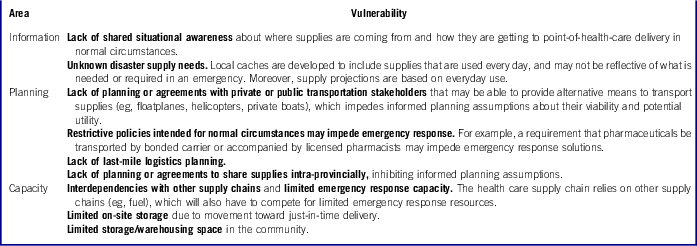
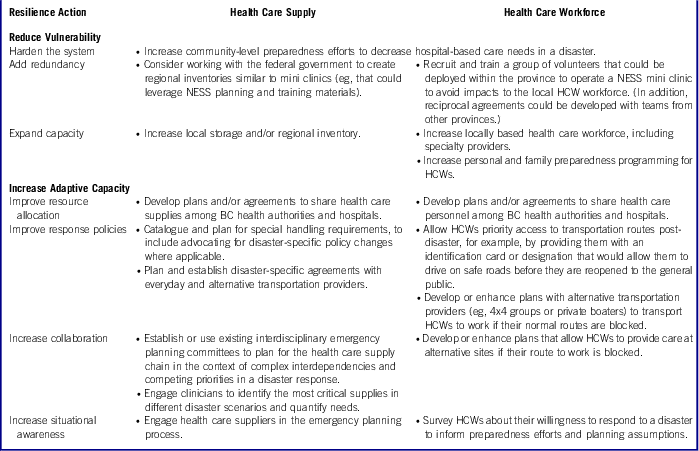
Herein, we will describe key-informant-identified vulnerabilities of the health care supply chain, including those related to supply transport and supply storage. We will then examine vulnerabilities of the health care workforce that may impact the acute health care delivery system in the event of a maritime transportation disruption. Table 2 presents a list of information, planning, and capacity-related vulnerabilities that may be generalizable to other maritime transportation-dependent, coastal, or geographically isolated communities. Table 3 presents a list of key informant proposed actions to enhance acute health care supply and workforce resilience.
Acute Health Care Supply Chain Vulnerabilities

Key Informants’ Proposed Actions to Enhance Acute Health Care Supply and Health Care Workforce Resilience

BC=British Columbia; HCW=health care worker; NESS=National Emergency Strategic Stockpile.
Health Care Supplies
Supply Transport
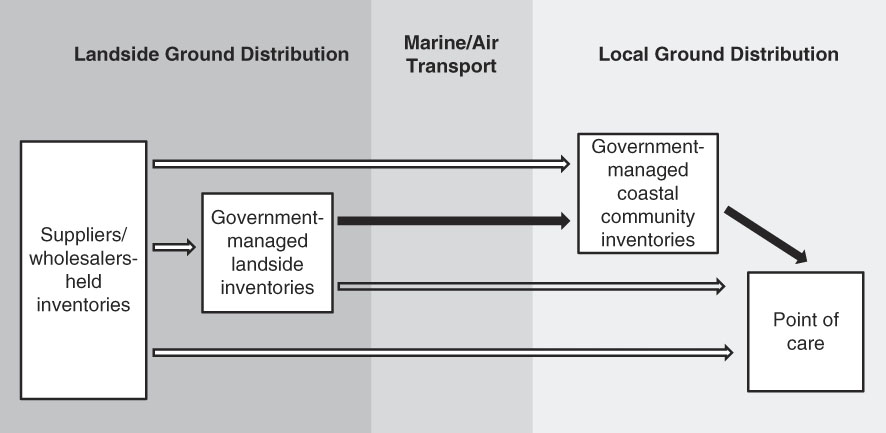
Both communities reported large dependencies on maritime transportation to transport health care supplies (Figure 1). Although BCCSS oversees supply chain management for all provincial health authorities, each health authority has the discretion to order supplies from a BCCSS-managed warehouse or directly from the supplier. In Powell River, the majority of non-pharmaceutical supplies arrive via barge from a BCCSS-managed warehouse in metro Vancouver. In Greater Victoria, most health care supplies are sent directly from health care suppliers, rather than from the provincial warehouse. Because health care suppliers did not respond to invitations to participate in this study, it remains unclear how maritime transportation is used to transport goods to this community. Further, we received conflicting information from key informants on how these goods are transported into metro Vancouver (ie, whether they are coming from somewhere else in mainland Canada by road or arriving by barge directly into metro Vancouver from another country) before regional distribution, highlighting the need for increased coordination and/or collaborative planning.
British Columbia Coastal Community Health Care Supply Chain. *White arrows represent study information gaps secondary to equally credible informants providing conflicting information, no informants being able to provide information, and/or lack of supplier engagement with project.

Because the health care supply chain is reliant on the maritime transportation network, it is concurrently dependent on other supply chains (eg, fuel) and transportation infrastructure (eg, roads). For example, the fuel supply chain will need to remain operational to transport supplies and workers to hospitals, and to ensure operation of health care facilities and equipment. Yet, these supply chains and infrastructure rely on health care to be operational to ensure their workers are able to come to work. These complex interdependencies create challenges in post-disaster prioritization in light of a limited emergency response capacity.
Several key informants suggested that alternative transportation providers, such as private floatplanes, private boats, and helicopters, could potentially transport resources in the event that normal maritime transportation routes are in operational. However, these groups would have to be engaged in formal planning or agreements in advance. Further, it was assumed that the proposed alternative transportation solutions (ie, floatplanes, private boats, and helicopters) and the resources and infrastructure necessary for their use would withstand the hazard that warranted their use, and that others would not be competing for their use. One key informant acknowledged that earthquakes, a catastrophic hazard of concern, is likely to result in debris or infrastructure interruptions (eg, harbor fuel supplies) that would impact alternative maritime transportation assets (eg, float plane) from providing assistance. It was also noted that, although multiple maritime transportation routes, ports, and vessels service these communities, a catastrophic event, such as an earthquake, could simultaneously disrupt all maritime ingress/egress routes.
Transportation regulations that are imposed under normal circumstances may result in emergency response impediments. For example, in Canada, it was reported that certain pharmaceuticals could be transported by only bonded carriers or if accompanied by a licensed pharmacist. It was also reported that there is a shortage of licensed pharmacists in the region. Without advance planning, this could limit the ability of alternative transportation providers, such as floatplanes or private boats, to legally contribute during an emergency response.
Last mile logistics – or the movement of people or goods from a transportation hub to the final destination (in this case, the point of health care) – was described as a key and often overlooked component of the supply transport process. This is an important planning consideration when coordinating with alternative transportation providers, particularly floatplanes and private boats, because fuel, dock, and/or road access may be limited.
It was also suggested that larger maritime transportation assets (eg, ferries) could be repurposed to provide health care services onboard during a disaster. However, it was noted that these ferries require a large crew and have limited capacities for fuel, water, and waste that would limit their suitability for this purpose. Further, the emergency response may impose competing demands or priorities for these vessels, including to transport people or goods.
Storage
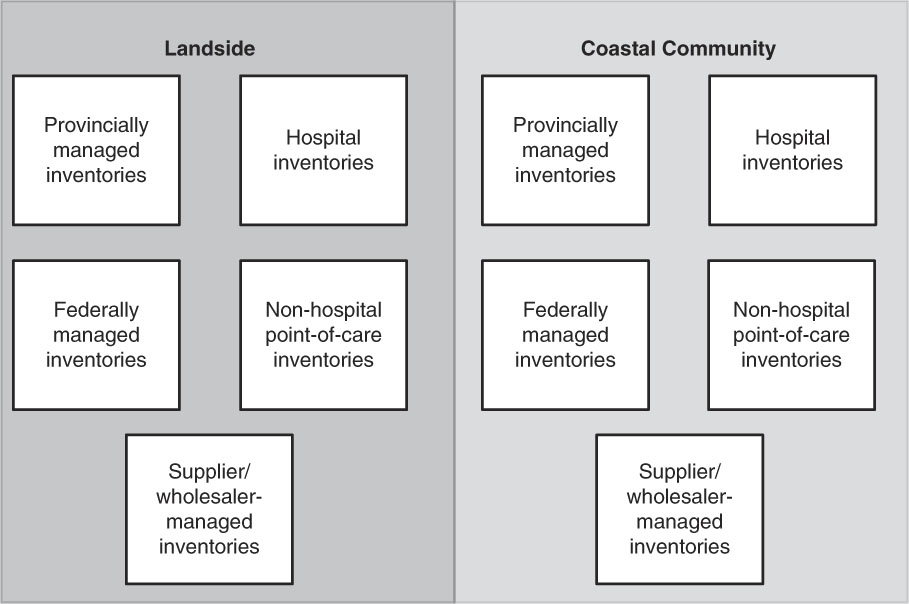
In BC, supplies possessed by any health authority or health authority-affiliated provider are technically provincial assets because the provincial Ministry of Health centrally controls the health authorities that deliver health care. Supplies are stored at several sites in the province, including in the coastal communities and on the mainland (Figure 2). It was noted that the provincial health authority system, coupled with longstanding personal relationships and intimate knowledge of organizational systems, enabled sharing of supplies across these entities without formal plans or agreements. Planning and agreement development could, however, clarify and test assumptions about the number, type, and timeline of required and available resources. Moreover, it could eliminate or reduce person or relationship-dependent systems for resource sharing.
British Columbia’s Health Care Supply Storage Locations. Note: Not to scale

Local storage is limited to the most highly used supplies; however, it was noted that the most highly used supplies might not be the most critical during an emergency. Informants provided various answers about the most critical supply needs in an emergency, including blood and gauze. There was an acknowledgment that there is a need to engage clinicians to identify the most critical supplies that will be necessary in the event of an emergency (eg, an earthquake), as well as the number of supplies required to inform stockpiling requirements. Current supply projections are based on everyday use and would likely be rapidly exhausted in a disaster when more people may be in need of medical assistance. Moreover, because inventory management systems at the hospital unit level are not automatized, there may be hoarding/stockpiling and/or supply gaps that are not captured by existing systems.
Local storage is limited in Powell River due to a lack of off-site warehousing, and in Greater Victoria due to increased movement to just-in-time delivery at all hospitals. Just-in-time delivery is being driven by everyday financial and space reasons. Although it was acknowledged that there is an increasing movement toward requiring suppliers to maintain local warehouses of essential supplies, the quantity or resilience of supplier-based local inventory is unclear.
In the event that additional supplies become necessary and cannot be accommodated via existing mechanisms or resource-sharing arrangements, hospitals can direct requests for additional support to a regional Health Emergency Management British Columbia (HEMBC) representative. HEMBC, through the provincial emergency operations center, can make requests to the federal government for additional health care supplies. The Canadian federal government’s National Emergency Strategic Stockpile (NESS), managed by Public Health Agency of Canada, includes mini clinics that are strategically prepositioned in federal warehouses across the country, with 1 currently in lower mainland BC and 1 currently on Vancouver Island. They have supplies to care for 100-200 low-acuity patients, and Public Health Agency of Canada has committed to resupplying them in the event of a disaster. However, they are not currently readily packaged for air transport.
The Powell River community is aware that there will be several competing priorities for maritime resources during catastrophic events. The community’s concurrent awareness of its geographic isolation has yielded a culture of self-reliance. For instance, key informants suggested innovation (eg, by using outdated or alternative supplies) to meet health care supply demands in a catastrophic event, and maintenance of informal stockpiles (eg, by consistent over-ordering).
Health Care Workforce
The vast majority of HCWs in Powell River and Greater Victoria live locally and do not rely on maritime transportation to get to work. In the event of a maritime disruption, there may be impacts to resident HCWs that are out-of-town (eg, for regularly scheduled vacation) and transportation of supplemental HCWs into the area. An increase in patients or impact to the existing locally based HCW supply will create a need for supplemental HCWs to be brought into the area via maritime or air transport to meet patient care needs.
Impacts to ground transportation infrastructure will make it difficult for HCWs to get to work. It was acknowledged that HCWs will only report to work if and when they know their families are safe; however, the willingness of HCWs to respond in a disaster has not yet been assessed, and there is little work being done to enhance HCW personal and family preparedness. Supplemental HCWs may also be necessary to staff NESS mini clinics, provide backfill for regular HCWs, and/or provide higher acuity or specialty care for patients who would normally be transported for care. In normal circumstances, some specialty care is not provided in coastal communities, and patients commute to specialists via maritime transportation. If patients can no longer commute because of a disruption, they could lose access to certain specialty care. Further, demand for certain specialties (eg, orthopedics) may increase secondary to disaster induced casualties. These issues are compounded by an ongoing HCW shortage in both Greater Victoria and Powell River.
The provincial government has memoranda of understanding to access supplemental HCWs post-disaster from the Pacific Northwest and other Canadian provinces. Moreover, the BC Emergency Health Services Act provides authorization for HCWs licensed in another jurisdiction to work in BC for up to 72 hours without a BC license. While memoranda of understanding/agreement to promote the exchange of HCWs exist extra-provincially, there are no such agreements for sharing HCWs among BC health authorities. While described as not legally necessary, planning and agreement development could clarify assumptions about the number, type, and timeline of required and available resources.
DISCUSSION
In coastal communities that are highly dependent on maritime transportation, a disruption to this system will impact the availability of health care supplies and supplemental personnel. Resilience can be enhanced by reducing vulnerability (eg, hardening the system, adding redundancy, expanding capacity, or increasing modularity) or by increasing adaptive capacity (eg, improving resource allocation, response policies, collaboration, and situational awareness).Reference Tanner, Dowlatabadi and Chang 1 , Reference Omer, Mostashari, Nilchiani and Mansouri 14
Given the complex interdependencies in maritime transport dependent communities, it is critical that the hospital-based acute health care resilience issues are addressed in the context of community-level emergency planning efforts.
While many key informants suggested that they would contact local, private transportation (eg, boats, floatplanes, and helicopters) to facilitate the transport of critical health care supplies, they noted that they have not engaged in planning with private organizations that could clarify planning assumptions, inform prioritization of these assets, and yield protocols to streamline operations. Coordination across the supply chain and consideration of the different incentives and priorities of stakeholders have been described to have the potential to enhance response speed, increase efficiency, and reduce cost in emergency response.Reference Brandeau, Hutton, Owens and Bravata 15
A review of the academic literature found little evidence related to the use of private maritime transportation assets in an acute health care response.Reference Brandeau, Hutton, Owens and Bravata 15 As such, additional research is necessary to inform the ways in which volunteered maritime assets – spontaneous and planned – can be used to complement formal disaster response operations to facilitate acute health care operations. However, spontaneous volunteerism among the maritime community is possible, as evidenced when nearly 500,000 people were rescued by private boaters from Manhattan Island on September 11, 2001, the largest sea evacuation in history.Reference Kendra and Wachtendorf 16 Spontaneous volunteers have been described as a helpful and important resource to augment the capacity of a wide range of disaster-response activities, including those related to medical care, supplies and provisioning, and coordination.Reference Twigg and Mosel 17 , Reference Sauer, Catlett, Tosatto and Kirsch 18 However, their emergence can pose training, integration, credentialing, coordination, communication, health, safety, and liability challenges to responding agencies and organizations.Reference Twigg and Mosel 17 , Reference Sauer, Catlett, Tosatto and Kirsch 18 By taking spontaneous volunteerism into account in emergency planning, spontaneous volunteers can be used as a community resource.Reference Sauer, Catlett, Tosatto and Kirsch 18 Structured mechanisms for integrating spontaneous volunteers can enhance a safe and effective disaster response.Reference Sauer, Catlett, Tosatto and Kirsch 18 Limited local storage will exacerbate impacts caused by maritime disruption. While perhaps an economically sound strategy, just-in-time delivery and associated storage-related policy decisions must consider disaster risks, especially those associated with maritime disruption. Effective inventory management, such as regionally held supply stores, can enhance the speed of response and be cost-effective. Reference Brandeau, Hutton, Owens and Bravata 15
Although local HCWs may not be significantly affected by a maritime transportation disruption, disaster-related impacts, including personal or infrastructure damages, may limit the ability of HCWs to get to work. There may also be an increase in demand for health care, requiring supplemental workers that would rely on maritime transport. Efforts to minimize local workforce impacts (eg, by increasing their personal preparedness) and the demand for care (eg, by establishing nurse triage phone lines) could minimize the need for supplemental workers and, thus, the impact of a maritime transportation disruption on acute health care delivery. Key informants noted that workers’ families would take precedence over their jobs, and some would be unwilling to come to work. Enhancing HCW willingness can reduce the need for supplemental workers and facilitate a quality emergency response.Reference McCabe, Barnett, Taylor and Links 6 Curricular interventions to enhance public health worker willingness and modify perceptions of self-efficacy, response efficacy, and threat to specific hazards have been shown to benefit emergency response willingness, and could be used to enhance willingness among this population.Reference Harrison, Errett and Rutkow 19 Moreover, community-level preparedness and risk communication could keep the “worried well” out of hospitals and direct other, less serious injuries to more appropriate levels of care.
It was suggested that teams of HCWs could be trained to run NESS mini clinics. They could be deployed to a disaster site to minimize needs for, and disruptions to, local HCWs. Such teams of trained personnel available for deployment to affected localities have been described as a potential way to reduce costs and improve response to bioterrorism events.Reference Brandeau, Hutton, Owens and Bravata 15 Yet, transportation of these teams into the affected areas in the event of a maritime transportation disruption needs to be part of the planning process.
BC’s health care system is largely publically financed and administered. The Province, not any particular hospital, owns health care supplies located at hospitals. As such, key informants believed that the barriers to transferring supplies were limited to financial and administrative issues, which could be easily worked out after a disaster. However, this led to a lack of planning. Additional planning was identified as having the potential to clarify assumptions related to required and available resources to facilitate the development of protocols for streamlined resource sharing and decision-making that can save time and promote efficiency during a disaster response.
Health care supply chain and worker vulnerabilities may be different in communities that have private or semi-private health care systems, such as those in the United States. It could be hypothesized that private health care systems have a profit-driven business incentive to ensure a robust supply chain and workforce in the event of a disaster; on the other hand, these systems may have more disparate parts that enhance overall vulnerability. As such, additional research is required to identify commonalities and differences in vulnerabilities to the availability of health care supplies and personnel in health care systems with different structures or financing mechanisms.
Limitations
Because key informants participated in this study in the context of their professional role, they may have been hesitant to disclose perceived or actual vulnerabilities. The researchers attempted to minimize this bias by reporting findings in aggregate, allowing key informants to remain anonymous and allowing key informants to review and edit summaries of key findings from their interviews. A primary limitation of this study is gaps in information resulting from multiple key informants providing conflicting information or key informants being unable to provide the information requested. We believe, however, that these gaps in information are also a finding in and of themselves, in that they reflect the need for enhanced coordination, information sharing, and collaborative planning. Notably, the investigative team made efforts to contact health care supply companies that were identified as providers of the most utilized items in the province. However, representatives from supply companies did not respond to study interview invitations. This left gaps in information on how the maritime transportation system is used for local delivery of health care supplies on a daily basis and, thus, the inability to identify disaster-specific vulnerabilities. Moreover, health care supplier emergency preparedness (eg, business continuity planning, structural resilience of supplier-owned warehouses) is not accounted for in this study. As BC begins health care supply chain logistics planning in earnest,Reference Smart 8 supplier engagement is essential. Finally, our use of a regional case study approach may limit generalizability to other coastal communities with geographically specific hazard profiles or vulnerabilities.
CONCLUSIONS
Maritime transportation disruption has the potential to impact hospital-based acute health care delivery by disruption of supply transport and supplemental workers to coastal communities. Lack of local storage or HCW preparedness will exacerbate these impacts. Multi-agency action to address vulnerability can enhance system resilience in light of complex interdependencies and competing priorities. Additional research and supplier engagement are necessary to quantify potential impacts of maritime transportation disruption on the hospital-based acute health care system.
Acknowledgments
This work was supported by Canada’s Networks of Centres of Excellence Program’s Marine Environmental Observation Prediction and Response (MEOPAR) Network, and received Operational Research Approval from Vancouver Island Health Authority and Vancouver Coastal Health Research Institute. The authors are grateful to the practice-based partners who contributed to this study.
Conflict of Interest Statement
The authors declare no conflict of interests.
Funding
This study was supported by Canada’s Networks of Centres of Excellence Program’s Marine Environmental Observation Prediction and Response (MEOPAR) Network.