


Despite the increased attention to the topic of work–family balance (see Allen & Martin, Reference Allen and Martin2017), many employees continue to experience high levels of stress due to work–family conflict (WFC; APA, American Psychological Association, 2017b; Bethune & Bossolo, Reference Bethune and Bossolo2013; Williams & Boushey, Reference Williams and Boushey2010). As defined in the literature, WFC occurs when family demands and job demands are incompatible, and, as a result, one or both family and job suffers. Employees who experience WFC are more likely to have higher rates of absenteeism (Hammer, Bauer, & Grandey, Reference Hammer, Bauer and Grandey2003), burnout (Kelloway, Gottlieb, & Barham, Reference Kelloway, Gottlieb and Barham1999), and depression (Frone, Russell, & Cooper, Reference Frone, Russell and Cooper1997; Vinokur, Pierce, & Buck, Reference Vinokur, Pierce and Buck1999). Furthermore, employees who struggle with managing work and family roles are less likely to be satisfied with their jobs (Grandey, Cordeiro, & Crouter, Reference Grandey, Cordeiro and Crouter2005; Kinnunen, Feldt, Mauno, & Rantanen, Reference Kinnunen, Feldt, Mauno and Rantanen2010).
Past research demonstrates that organizations and supervisors can provide workplace family-support (e.g., emotional or instrumental) that mitigate the strain associated with WFC (Carlson & Perrewé, Reference Carlson and Perrewé1999; Frye & Breaugh, Reference Frye and Breaugh2004). For example, supervisors can provide emotional support by carefully listening to the problems of subordinates and acting accordingly by being attentive and empathetic. Indeed, emotional support plays an important role in providing valuable resources for workers who must cope with stressors. Results of the APA's 2015 study found, ‘the average stress level for those with emotional support was 5.0 out of 10, compared to 6.3 for those without such support’ (Alvord, Uchino, & Wright, Reference Alvord, Uchino and Wright2015). Recent studies suggest workers worldwide are dissatisfied with workplace family-support (e.g., Fahlén, Reference Fahlén2014). For example, in the United States, the percentage of US workers who reported they were satisfied with workplace family-support dropped from 42% in 2009, to 36% in 2011 (Clay, Reference Clay2011), to 30% in 2013 (Bethune & Bossolo, Reference Bethune and Bossolo2013). Given the decline in satisfaction of workplace family-support and the evidence that such support would help employees with WFC, this study offers a timely investigation of workplace family-support.
Beyond external support, employees also have individual strategies to manage demands associated with work and family roles. Employees erect mental, physical, and emotional boundaries between work and home life as a ‘means of simplifying and ordering the environment’ (Ashforth, Kreiner, & Fugate, Reference Ashforth, Kreiner and Fugate2000: 3). That is, employees may engage in different boundary management strategies to cope with WFC, such as either segmenting (i.e., keeping separate) or integrating these roles to more effectively balance conflicting demands. For instance, by choosing to segment work and family roles (e.g., not checking work emails at home), an employee may avoid experiencing negative spillover between the dueling roles. Alternatively, employees may prefer to integrate their roles to gain more flexibility in how they meet the demands of each to reduce WFC.
There has been increased attention in WFC by organizations and researchers alike in recent years (see Allen & Martin, Reference Allen and Martin2017), and the ongoing trend in declining dissatisfaction with workplace family-support certainly warrants further research in this area. In this study, we test an explanation for the lack of satisfaction with workplace family-support, which is misallocated support from supervisors. That is, supervisors and subordinates may have different and sometimes incompatible preferences for managing the boundaries around work and family roles. Since employees are diverse and have differing needs when it comes to family-support, work–family policies and supervisor support may be inappropriate to meet the needs of some employees. Recent research indicates that when a supervisor has congruent values with his/her subordinate with regard to boundary management styles, his/her subordinates experience lower levels of WFC (Pan & Yeh, Reference Pan and Yeh2012; Thompson, Brough, & Schmidt, Reference Thompson, Brough and Schmidt2006). The process through which supervisor–employee value congruence impacts WFC has yet to be established in the literature, and researchers do not yet fully understand why value congruence regarding boundary management strategies might reduce WFC. Therefore, the primary goal of the current study is to examine the process (i.e., mediating mechanism) through which value congruence regarding boundary management strategies with one's supervisor reduces WFC.
The current research is positioned to make two important contributions to the literature. Using Bakker and Demerouti's (Reference Bakker and Demerouti2007) job demands-resources (JD-R) model, we suggest that when subordinates have values that match their supervisor's, the supervisor is more likely to allocate support and assist subordinates in a manner that supports employees' preferred strategy of balancing work and family demands. We suggest that value congruence reduces the strain in experiencing WFC because it facilitates the allocation of suitable family-support from the supervisor (family-supportive supervisor behaviors; FSSB). We use the JD-R model of stress to explain how value congruence reduces WFC by ensuring the provision of valued resources, namely FSSB. In doing so, we address an important gap in the work–family literature and provide evidence for the psychological process through which value congruence reduces WFC.
Because supervisors generally have multiple employees, they are unlikely to share values regarding boundary management with all of them. Recognizing this limitation, Marescaux, Rofcanin, Las Heras, Ilies, and Bosch (Reference Marescaux, Rofcanin, Las Heras, Ilies and Bosch2020) called for research that explores ‘whether and how supervisors can adapt their FSSBs to fit with employees' preference for either segmentation or integration.…whether FSSBs can be individually tailored’ (p. 14). We directly answer that call by investigating how supervisors may help their employees balance work–family demands without changing their own values by individually tailoring family-support to fit their employees, through implementing procedural justice strategies (Crain & Stevens, Reference Crain and Stevens2018). Specifically, we suggest that employees whose supervisors do not share their values regarding boundary management strategies may still feel supported if their supervisor considers their views and allocates family-supportive resources fairly. The second contribution of our study is to explain how fairness perceptions can also serve as a resource that mitigates and buffers the negative impact of low value congruence on FSSB and by extension WFC.
In the sections that follow, we first briefly review the WFC literature. Then, we leverage the JD-R model (Bakker & Demerouti, Reference Bakker and Demerouti2007) to explain the process through which we expect value congruence to impact WFC, through the provision of resources that directly impact the management of work and family demands (i.e., FSSB).
Work–family conflict and boundary management strategies
The incompatibility between work and family demands is known as WFC (Greenhaus & Beutell, Reference Greenhaus and Beutell1985). Having an imbalance of personal and work demands can negatively affect important employee attitudes and behaviors (Allen, Herst, Bruck, & Sutton, Reference Allen, Herst, Bruck and Sutton2000). For instance, employees who experience high levels of WFC tend to exhibit higher rates of absenteeism (Hammer et al., Reference Hammer, Bauer and Grandey2003), job dissatisfaction (Ford, Heinen, & Langkamer, Reference Ford, Heinen and Langkamer2007), and lower levels of productivity (Witt & Carlson, Reference Witt and Carlson2006). Furthermore, WFC is also associated with psychological and physiological ailments including burnout, depression, substance abuse, and work and family-related strains (Allen, Reference Allen2001).
The JD-R model (Bakker & Demerouti, Reference Bakker and Demerouti2007) emphasizes the role of resources in preventing strain outcomes. According to the JD-R model, in order to handle job demands, perform well, and experience less strain (i.e., physical or emotional effort exerted for tasks at work or home), one must have an adequate supply of resources (e.g., time, effort). The JD-R model states that when job demands increase (e.g., workload, mandatory work hours) or job resources decrease (e.g., less supervisor support), employees may experience negative outcomes such as job dissatisfaction and burnout. Overwhelming daily demands between work and family roles can lead to WFC through resource depletion. For example, when family demands deplete one's resources, dealing with job demands becomes more challenging and straining. In a longitudinal diary study conducted by Sanz-Vergel, Rodríguez-Muñoz, and Nielsen (Reference Sanz-Vergel, Rodríguez-Muñoz and Nielsen2015: 1), they found evidence that employees often experience ‘a negative spiral of daily conflicts’ that contributes to WFC and employee strain. Social support such as supervisor and family-support decreases WFC by providing employees with the emotional and instrumental resources necessary to cope with specific job and family demands (Kossek, Pichler, Bodner, & Hammer, Reference Kossek, Pichler, Bodner and Hammer2011).
Indeed, past research has supported the notion that external social support can serve as a resource via the self-regulatory strategies that employees use to handle stress from work or family life (e.g., Luk & Shaffer, Reference Luk and Shaffer2005; Unger, Niessen, Sonnentag, & Neff, Reference Unger, Niessen, Sonnentag and Neff2014). Extending JD-R, supervisor and organizational family-support may decrease strain (i.e., WFC) by increasing the resources that employees can use to handle job demands. Supervisors in particular play a pivotal role in delegating responsibilities and supplying resources to employees, and these actions can influence WFC by controlling employees' scheduling and work demands. Moreover, supervisors can provide interpersonal support through listening, caring, and empathizing (i.e., socio-emotional resources) to enable employees to better manage stressors and increase resistance to strain (e.g., Hammer, Kossek, Zimmerman, & Daniels, Reference Hammer, Kossek, Zimmerman, Daniels, Perrewé and Ganster2007). When individuals feel they have access to adequate emotional and instrumental resources from social support (e.g., supervisor support), they are able to cope with daily stressors and demands (Jex, Reference Jex1998). Because supervisors play such a critical role in the resource management process, the dynamic between supervisors and employees, including their similarity, has been studied considerably over the years. For example, researchers have found that family-supportive supervision is rated highest when subordinates are similar to supervisors in both gender and race (Foley, Linnehan, Greenhaus, & Weer, Reference Foley, Linnehan, Greenhaus and Weer2006). Other research suggests that similarity on other aspects, such as values, predicts employee well-being outcomes. Subordinates whose family values are congruent with their supervisors' values report less WFC (Pan & Yeh, Reference Pan and Yeh2012) and greater job satisfaction (Thompson et al., Reference Thompson, Brough and Schmidt2006).
Employees and their supervisors may also share values regarding how they prefer to manage and maintain the boundaries between family and work roles. For instance, in order to more effectively cope with dueling work and family demands, some employees may prefer to keep their work and family life separate from each other whereas others may prefer to integrate them (Ashforth et al., Reference Ashforth, Kreiner and Fugate2000; Clark, Reference Clark2000). The degree of similarity (or lack thereof) between employee and supervisor preferences for managing family and work roles is likely to impact employees' WFC by increasing the likelihood that supervisors provide support that is aligned with employee needs. To explain, we introduce the theory of boundary management.
Boundary management: segmentation and integration
The theories behind WFC stem from the idea that individuals must balance the resources (e.g., time, energies) required by various roles in their lives. To that end, employees often erect mental, physical, and emotional boundaries between work and home life as a ‘means of simplifying and ordering the environment’ (Ashforth et al., Reference Ashforth, Kreiner and Fugate2000: 3). Both boundary theory (Ashforth et al., Reference Ashforth, Kreiner and Fugate2000) and border theory (Clark, Reference Clark2000) offer explanations regarding the seemingly thin and elusive distinctions employees strive to maintain between family and work roles.
According to boundary theory (Ashforth et al., Reference Ashforth, Kreiner and Fugate2000), employees have specific preferences for the constitution of boundaries that separate work and personal domains and must actively manage these boundaries on a daily basis in order to effectively manage how they allocate resources to both arenas.
Employees' boundaries vary in flexibility, permeability, and role identities. Flexibility refers to the degree to which the boundaries (both spatial and temporal) are malleable. A flexible boundary does not constrain where and when roles can be enacted. For example, a telecommuting parent working from home can fulfill the role of ‘employee’ or ‘mother/father’ at any time or place. Boundaries between work and family also differ on levels of permeability. Permeability is the degree to which a person can be physically involved in one role but psychologically or behaviorally involved in another role. For example, a permeable boundary allows an employee to be at work but take a phone call from home. Finally, role identities refer to ‘the extent that a role cues or connotes a certain persona—replete with specific goals, values, beliefs, norms, interaction styles, and time horizons’ (Ashforth et al., Reference Ashforth, Kreiner and Fugate2000: 475). The contrast between roles describes how compatible each role identity is with the other (e.g., loving parent vs. stern manager).
Employees are generally motivated to construct their environments to match their preferences for flexible (or inflexible) and permeable (or impermeable) boundary characteristics. Those with a high preference for segmentation prefer to keep work and home separate. These employees might not talk about their family, display family pictures in their office, or take phone calls from a spouse or child while at work. Thus, ‘segmentators’ have inflexible and impermeable role boundaries and have high contrast for role identities. Individuals with a high preference for integration between work and family can handle and often prefer such integration. ‘Integrators’ have flexible and permeable role boundaries and have low contrast for role identities. For example, integrators may prefer flexible work arrangements like telecommuting, which allows them to integrate work and family roles.
Supervisor–employee value congruence
Clark's (Reference Clark2000) border theory categorizes supervisors as a type of ‘border-keeper’, in that he or she ‘[negotiates] … what constitutes the domains and where the borders between them lie’ (p. 762). In particular, supervisors are pivotal border-keepers because they have the most control over employees' scheduling and work demands. For this reason, Clark argues that the supervisor holds the most influence over the boundary between work and family for employees. This influence over subordinates' borders is oftentimes perceived as workplace family-support. For instance, a supervisor who allows an employee to work from home in order to tend to a sick child not only influences the employee's boundary management, but also provides resources to handle demands with workplace family-support. However, supervisors may not always see eye-to-eye with their subordinates in regards to a preferred boundary management strategy. Drawing from JD-R, this lack of congruence may leave employees with inappropriate and insufficient resources to cope with work and family demands, thereby leaving them vulnerable to greater WFC. For example, supervisors who prefer to segment work and family life may communicate their values by discouraging subordinates from working from home, even if those subordinates prefer to integrate work and family life.
Although past work–family research has examined the influence of general value congruence/fit (e.g., sex similarity, Luksyte & Avery, Reference Luksyte and Avery2015; person-organization fit, Scott, Ingram, Zagenczyk, & Shoss, Reference Scott, Ingram, Zagenczyk and Shoss2015) on employee outcomes, few have extended the idea of value congruence to preference for segmentation and integration (Pan & Yeh, Reference Pan and Yeh2012). Thompson et al. (Reference Thompson, Brough and Schmidt2006) found evidence for work–family value congruence with one's supervisor having a negative effect on employee WFC, job satisfaction, and emotional exhaustion. However, the specific values on which the supervisor and employee were congruent were not clearly delineated (i.e., work–family value congruence was measured with items such as ‘My supervisor and I have similar views regarding work–family issues’). In contrast, Pan and Yeh (Reference Pan and Yeh2012) examined the congruence of values regarding segmentation and integration specifically. They reported a significant direct effect of value congruence on WFC (r = −.13). That is, subordinates with high value congruence with their supervisor (i.e., both segmentators or both integrators) reported less WFC compared to employees with low value congruence with their supervisor.
Like Pan and Yeh (Reference Pan and Yeh2012), we study how supervisor–employee value congruence in regards to boundary management preferences affects employee WFC. For the sake of parsimony, we henceforth refer to supervisor–employee value congruence based on boundary management preferences simply as ‘value congruence.’ Following JD-R, we expect a lack of value congruence with supervisors will leave employees deficient of the suitable resources to cope with their specific work and family demands. We posit:
Hypothesis 1. Value congruence is negatively related to WFC.
Supervisor family-support
With the exception of Pan and Yeh (Reference Pan and Yeh2012), the mechanism through which value congruence negatively impacts WFC has been largely unexplored. Drawing from supervisor–employee fit theories, Pan and Yeh (Reference Pan and Yeh2012) suggested that perceived supervisor support (PSS) mediates the relationship between value congruence and WFC. They argued that when value congruence is high, both the employee and supervisor benefit from a stronger and more constructive relationship due to higher fit. This more constructive relationship should manifest in greater supervisor support that acts as a social resource for employees and decreases stressors such as WFC. However, Pan and Yeh (Reference Pan and Yeh2012) did not find a significant effect of PSS on WFC and found no evidence that PSS acts as a mediator between value congruence and WFC. One reason for their null finding may be that PSS, which is defined as ‘employees’ general views about the degree to which their supervisors value their contributions and care about their well-being’ (Eisenberger, Stinglhamber, Vandenberghe, Sucharski, & Rhoades, Reference Eisenberger, Stinglhamber, Vandenberghe, Sucharski and Rhoades2002: 501; Kottke & Sharafinski, Reference Kottke and Sharafinski1988), may be too broad to explain the value congruence–WFC relationship. PSS indicates the extent to which supervisors provide adequate support in general, but it does not explicitly address the provision of adequate workplace family-support for subordinates. The JD-R model emphasizes the role that resources play in helping employees meet the demands they face. Thus, resources need to be directly relevant to the specific demands employees face to be effective. We suggest that rather than general supervisor support, the perception of low value congruence instead affects WFC through the distinctive workplace family-support received from the supervisor. Thus, put in JD-R terms, we suggest that value congruence is associated with lower WFC because value congruence facilitates the provision of supervisor family-support (i.e., resources) directly relevant to the management of work and family demands in the preferred boundary management strategy.
These FSSB (Hammer, Kossek, Yragui, Bodner, & Hanson, Reference Hammer, Kossek, Yragui, Bodner and Hanson2009) consist of four dimensions: emotional support, instrumental support, role modeling behaviors, and creative work–family management. Supervisors who offer emotional support consider the feelings of subordinates and correspondingly offer reassurance. Instrumental support occurs when a supervisor handles subordinates' WFC on a day-to-day basis based upon crises that may arise. Role modeling behaviors in the FSSB context denote that supervisors mentor subordinates specifically to handle work–family crises (Thompson et al., Reference Thompson, Brough and Schmidt2006). In fact, role modeling behaviors from supervisors can boost performance and job satisfaction of the subordinates (Greenhaus & Singh, Reference Greenhaus, Singh, Ragins and Kram2007). Lastly, creative work–family management refers to a strategic, proactive strategy in which managers restructure work demands to adequately balance family demands.
Applying the JD-R model, FSSB represents a resource specific to meeting the demands directly associated with managing work and family roles. Thus, when employees have higher value congruence with their supervisor, they are more likely to receive family-specific support from their supervisor that aids them in managing their work and family demands in a manner consistent with their boundary management preferences. In turn, the resources (i.e., support) provided by the supervisor should decrease strain, in the form of WFC. For example, Judge, Ilies, and Scott (Reference Judge, Ilies and Scott2006) argued that supervisors can provide support in the form of role modeling in handling work–family stressors. They postulated that a supervisor who effectively deals with WFC in his or her own life can aid subordinates dealing with their own WFC through role modeling. However, when supervisors and subordinates have low value congruence, the behaviors modeled by the supervisor may not help the subordinate effectively cope with WFC. For example, a segmenting supervisor may show how he or she handles work and family through segmentative boundary management (e.g., not taking personal calls at work). However, this type of segmentative-role modeling may not help an integrative subordinate manage his/her flexible and impermeable boundaries to reduce WFC. Thus, and consistent with JD-R, we suggest that the reason value congruence reduces WFC is through the provision of resources that can be directly applied to managing dueling work and family demands (i.e., FSSB). As such, we propose:
Hypothesis 2. The relationship between value congruence and WFC is mediated by FSSB.
Fairness perceptions of supervisor family-support
Thus far, we have argued that value congruence may reduce WFC by facilitating employee perceptions that their supervisors are supportive of their need to balance work and family demands. However, employees who do not share boundary management values with their supervisors may still feel supported as long as family-supportive resources are provided in a fair and just manner in a way that responds to their individual needs. In this study, we characterize perceived fairness of workplace family-support in terms of procedural justice, which is the perception of fairness regarding the decision-making process itself (Colquitt, Reference Colquitt2001). In particular, we look at perceived fairness of workplace family-support as the extent to which employees perceive their supervisors as making decisions and implementing work–family policies which are: (1) equitably distributed, (2) applied consistently and free of bias, and (3) distributed based on the personal needs and preferences of the employee (i.e., the employee has some influence over the implementation of these work–family policies).
Indeed, research indicates that fair treatment in general may reduce WFC. Judge and Colquitt (Reference Judge and Colquitt2004) applied the justice judgment model (Leventhal, Reference Leventhal, Gergen, Greenberg and Willis1980) to examine the relationship between justice and WFC. This model posits that organizational decision makers (e.g., supervisors) can facilitate perceptions of fairness by making decisions in a manner that considers employees' input at every stage of the process and is consistent, unbiased, based on accurate information, and ethical. Thus, supervisors who consider employees' input to ensure the equitable distribution of workplace family-support among their subordinates are likely to reduce WFC by being more responsive to employees' specific work–family needs. Consistent with the justice judgment model, Judge and Colquitt found that justice perceptions were negatively related to WFC and employee strain. Following the JD-R model, perceived fairness itself may act as a resource that reduces WFC by facilitating the provision of adequate workplace family-support that meets the specific demands of employees' needs. Grandey (Reference Grandey and Cropanzano2001) described how fairness and workplace family-support are intimately related. Overall, she discussed how family-friendly policies which are integrative or segmentative in nature can be inappropriate for some employees. For example, nonusers of segmentative work–family policies such as onsite childcare may report the policies as ‘unfair’ (p.149).
Supervisors can influence employee fairness perceptions and attitudes in the way they allocate workplace family-support. Supervisors who are more responsive to work–family matters of their employees will fairly consider employees' input and make sure the distribution of work–family support is equitable among their subordinates. This is a central component of servant leadership in which servant leaders prioritize the needs of their employees and puts the needs of others above all else (Greenleaf, Reference Greenleaf1977). Findings from servant leadership literature demonstrate that a leader's unique ability to respond fairly and consider the individual needs of employees can mitigate employees' WFC through the trickle-down effects of supervisor family-support (Rofcanin et al., Reference Rofcanin, Las Heras, Jose Bosch, Berber, Mughal and Ozturk2021; Tang, Kwan, Zhang, & Zhu, Reference Tang, Kwan, Zhang and Zhu2016).
Consistent with JD-R, strain outcomes like WFC can occur when resources are threatened or insufficient to meet demands. We have previously asserted that value congruence acts as a resource that facilitates the provision of FSSB. However, when employees do not share boundary management values with their supervisors (i.e., low value congruence), employees may still feel supported in their efforts to manage work–family demands if their supervisor provides support in a fair manner. That is, perceptions of fairness can act as a resource that compensates for low value congruence.
In keeping with other work–family researchers (e.g., Konovsky & Cropanzano, Reference Konovsky and Cropanzano1991; Parker & Allen, Reference Parker and Allen2001), we examine a narrow form of fairness that pertains directly to the workplace family-support received from a supervisor. Specifically, we focus on the extent to which employees perceive their supervisors as making decisions and implementing work–family policies that are equitably distributed, applied consistently and free of bias, and distributed based on the personal needs and preferences of the employee. Thus, a supervisor who distributes workplace family-supportive resources fairly is likely to consider the boundary management strategies employees value and provide employees with appropriate (i.e., value-matched) family-supportive resources regardless of whether employees' values are congruent with his/her own. In this way, having a fair supervisor can mitigate the negative impact of low value congruence on FSSB and by extension, WFC.
Hypothesis 3. The relationship between value congruence and FSSB is moderated by fairness perceptions such that high fairness will mitigate the negative consequences of low value congruence. Specifically, the relationship between value congruence and FSSB will be more strongly positive for employees who perceive low levels of fairness than for those who perceive high levels of justice (Figure 1).
Hypothesized model.

Method
Participants and procedure
Participants were 815 full-time staff members recruited from four universities in the southern US. Employees indicated their age (M = 40.90), tenure (M = 8.24 years), gender (61% female), ethnicity (54% White, 15% Hispanic, 12% African-American, 4% Asian, 2% American Indian/Native American, 12% indicated they preferred not to respond), number of dependent children (56% had none, 15% had one, 13% had two, 4% had three, 2% had four or more, 10% indicated they preferred not to respond), marital status (45% married, 27% single, 10% divorced, 6% unmarried/living with partner, 12% indicated they preferred not to respond), and living status (31% had one other person currently residing in the home, 18% had two, 16% had none, 12% had three, 8% had four, and 4% had five, 11% indicated they preferred not to respond). They worked in a wide range of jobs including technical service craft (e.g., electrician, custodian), administrative/clerical (receptionist), advising, information technology, law enforcement, and all levels of management (e.g., assistant managers to deans and associate vice presidents).
Data were collected via an anonymous online survey. An invitation to complete the survey was included at the end of a larger survey designed to assess staff morale which was completed by 1,777 staff. To incentivize their participation in our survey, respondents were told they could enter into a drawing to win one of two $50 Amazon gift cards. In total, 815 staff (45.9% of the morale survey participants) completed our survey, in 2015.
Measures
Value congruence
We measured value congruence (α = .97) using the same method as Pan and Yeh (Reference Pan and Yeh2012). The three scale items were rated from 1 (Strongly Disagree) to 5 (Strongly Agree). Also, to emphasize work–family value congruence, we included the same introductory sentence as Pan and Yeh (Reference Pan and Yeh2012: 275).
Some people like to distinguish between work and family activities. For example, they don't spend additional time dealing with job-related matters when they leave the workplace. But others like to integrate their work and family lives. For example, they often talk with coworkers about family matters during work hours.
Sample items are ‘the things that I value in life are very similar to the things that my supervisor values’ and ‘my personal values match my supervisor's values and preferences.’
FSSB
We measured FSSB with 14 items from the FSSB scale by Hammer et al. (Reference Hammer, Kossek, Yragui, Bodner and Hanson2009; α = .98). The scale measured emotional support, instrumental support, role modeling behaviors, and creative work–family management. The response scale ranged from 1 (Strongly Disagree) to 5 (Strongly Agree). Sample items are ‘my supervisor is willing to listen to my problems in juggling work and nonwork life’ and ‘my supervisor is a good role model for work and nonwork balance.’
Fairness perceptions
Fairness perceptions of supervisor's workplace family-support were measured using seven items from a modified version of Colquitt's (Reference Colquitt2001) Procedural Justice Scale (α = .95). The response scale ranged from 1 (a small extent) to 5 (a great extent).
The prompt read:
Supervisors often support employees’ efforts to achieve work-family balance in a variety of ways such as making decisions and implementing work-family policies that benefit their subordinates. The following questions refer to decisions made by your manager regarding work-family policies.
Sample items are ‘have you been able to express your views and feelings during those procedures?’ and ‘have you had influence over work–family policies arrived at by those decisions?’
WFC
We measured WFC with 18 items from Carlson, Kacmar, and Williams (Reference Carlson, Kacmar and Williams2000; α = .93). The response scale ranged from 1 (Strongly Disagree) to 5 (Strongly Agree). Sample items are ‘my work keeps me from my family activities more than I would like.’ and ‘due to all the pressures at work, sometimes when I come home I am too stressed to do the things I enjoy.’
Results
Table 1 provides the descriptive statistics (means and standard deviations), scale reliabilities, and the intercorrelation matrix. All α levels were >.85, indicating adequate intrascale reliabilities.
Descriptive statistics, α reliabilities, and correlation matrix

Note. Numbers in parentheses along the diagonal are estimated (α) reliabilities, where applicable. FSSB, family-supportive supervisor behaviors; value congruence, supervisor–employee value congruence based on boundary management preferences. For gender, 1 = male, 2 = female.
*p < .05, **p < .01.
To test the main effect of Hypothesis 1, that value congruence is negatively related to WFC, we used simple regression analyses with and without using age and gender as control variables. We chose to control for age and gender for two main reasons. First, age and gender are commonly used control variables in work–family research as they are highly related to reports of WFC (e.g., Parker & Allen, Reference Parker and Allen2001), but were not highly related to our predictors (e.g., value congruence). Second, they partial out extraneous variance when testing the relationship between work–family constructs (value congruence, WFC). The results of the simple regression analysis indicate support for Hypothesis 1 that value congruence was significantly, negatively related to WFC both without controlling for age and gender (b = −.17, p < .01) and after controlling (b = −.18, p < .01). Thus, we found support for Hypothesis 1.
Next, we used PROCESS (Hayes, Reference Hayes2012; Preacher & Hayes, Reference Preacher and Hayes2008) to test Hypothesis 2, that FSSB mediates the relationship between value congruence and WFC. PROCESS is a macro that can be used with SPSS and SAS statistical software packages to analyze several models, including simple mediation, serial mediation, and moderated mediation. PROCESS uses bootstrapped confidence intervals, is fairly robust against assumptions of normality, and provides more accurate estimates of standard errors and confidence intervals. Effects are significant if the 95% confidence interval does not contain zero.
We used PROCESS’ model 4 (Hayes, Reference Hayes2012) to test our simple mediation hypothesis, Hypothesis 2. As shown in Figure 2, both the indirect effect of value congruence on WFC through FSSB (b = −.12, 95% CI [−.17, −.07]) and the total effect (b = −.17, p < .01) were significant, but the direct effect was not (b = −.04, ns). This demonstrates that FSSB fully mediated the relationship between value congruence and WFC. Thus, Hypothesis 2 was fully supported.
Unstandardized path coefficients for value congruence to WFC through FSSB. Note. Bootstrapped confidence intervals were constructed using 1,000 resamples. The direct effect is presented in parentheses. FSSB, family-supportive supervisor behaviors; value congruence, supervisor–employee value congruence based on boundary management preferences; WFC, work–family conflict. Indirect effect of value congruence on WFC through FSSB was significant (b = −.12, 95% CI [−.17, −.07]). *p < .05, **p < .01.

Hypothesis 3 stated that fairness moderates the relationship between value congruence and FSSB. To test this hypothesis, we conducted multiple regression in several steps (i.e., models). In the first model, we included the control variables age and gender as predictors of fairness perceptions. In the second model, we added value congruence and fairness perceptions as predictors. In the last model, we added the interaction term value congruence × fairness as a predictor of FSSB. The results find support for fairness perceptions moderating the relationship between value congruence and FSSB (see Table 2). In other words, the product term of fairness perceptions and value congruence in predicting fairness was significant in the third model (b = −.10, p < .01).
Results of moderated regression analysis predicting FSSB
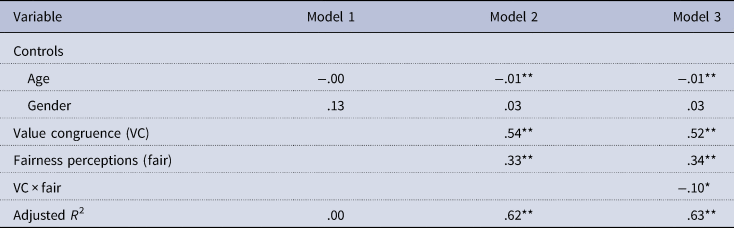
Note. FSSB, family-supportive supervisor behaviors; value congruence, supervisor–employee value congruence based on boundary management preferences.
*p < .05, **p < .01.
In order to visualize the direction of the effect, we followed the steps suggested by Aiken and West (Reference Aiken and West1991) to graphically display the significant interaction (see Figure 3). Value congruence and fairness perceptions were grand-mean centered prior to analysis to help with interpretation. As shown by Figure 3, under low fairness (−1 standard deviation), the relationship between value congruence and FSSB is more positive than with high fairness (−1 standard deviation), which demonstrates support for Hypothesis 3.
Fairness perceptions moderating the relationship between value congruence and FSSB. Note. Metric for value congruence and fairness perceptions is in standard deviations. Fairness, fairness perceptions of supervisor family-support; FSSB, family-supportive supervisor behaviors; value congruence, supervisor–employee value congruence based on boundary management preferences.

Additionally, we conducted analyses for moderated mediation (or conditional indirect effects) to see if the effect of value congruence on WFC through FSSB differs depending on levels of fairness perceptions. After analyzing the conditional indirect effects in PROCESS’ model 7, the results replicate the findings that the interaction was significant in predicting FSSB (as indicated in the previous set of results); however, the moderated mediation was not significant. Specifically, the mediation of FSSB stayed relatively constant at different levels of fairness perceptions: at the mean (b = −.09, 95% CI [−.13, −.05]), at low levels (−1 SD) (b = −.11, 95% CI [−.15, −.06]), and at high levels (+1 SD) (b = −.07, 95% [CI −.11, −.04]). Due to the overlapping confidence intervals of indirect effects at three levels of fairness perceptions, the results suggest that FSSB does not moderate the mediation (see Table 3).
Results of PROCESS for conditional effects of value congruence on work–family conflict at values of the moderator (fairness perceptions) through FSSB

Note. Mean approach represents −1/ + 1 SD and the mean value of the moderator. Bootstrapped confidence intervals were constructed using 1,000 resamples. CI, confidence interval; SE, standard error; LL, lower limit; UL, upper limit; Fairness, fairness perceptions of supervisor family-support; FSSB, family-supportive supervisor behaviors.
Confidence intervals that do not contain 0 are deemed significant.
Discussion
The purpose of this study was to investigate the psychological process through which supervisor–employee value congruence concerning boundary management preferences influences WFC. As predicted and consistent with the JD-R model (Bakker & Demerouti, Reference Bakker and Demerouti2007), we found that the relationship between value congruence and WFC was fully mediated by FSSB. That is, employees who have similar values with their supervisors were more likely to report receiving family-specific supportive resources from their supervisor (i.e., FSSB), which in turn enabled them to better manage their work and family demands and experience less WFC. Furthermore, we found that fairness perceptions moderate the relationship between value congruence and FSSB. Specifically, high perceived levels of fairness of family-support mitigate the negative consequences (i.e., low FSSB) associated with low value congruence.
Contributions to theory
Our finding that FSSB mediates the value congruence–WFC relationship fills an important gap in the work–family literature by illuminating the psychological process through which value congruence reduces WFC. Consistent with the JD-R model, our results suggest that having a supervisor who has similar preferences with respect to either segmenting or integrating work and family life serves to facilitate the receipt of valuable social resources that may reduce strain (i.e., WFC). In other words, when employees and supervisors have similar values regarding boundary management strategies, employees are more likely to perceive their supervisors as family-supportive because the emotional and instrumental support that supervisors provide is consistent with employees' preferences. Such value-congruent supervisor family-support may then serve as a valuable resource to meet the demands from work and family that employees utilize to reduce WFC. However, when employees' values regarding preferred boundary management strategies are incongruent with their supervisors' values, employees may perceive less FSSB because supervisors may model and provide support/strategies that are contrary to employees' preferences. These findings elucidate the process through which congruent values regarding boundary management strategies act as an important antecedent to employees perceiving and utilizing supervisor family-related support to reduce WFC.
Given that employees differ in their preferred boundary management strategy, supervisors are unlikely to share values with all of their employees. Our findings additionally suggest that in the absence of value congruence, employees may still perceive high FSSB so long as their supervisor allocates family-supportive resources in a fair manner. Thus, our study builds on previous work by using JD-R to demonstrate that the fair allocation of workplace family-support can act as a resource that compensates for low value congruence. This important finding makes a unique contribution to the field of FSSB by demonstrating how supervisors can provide individually tailored family-support to employees, namely by ensuring that the provision of family-support is administered in a procedurally just manner.
Practical implications
The results of this study offer numerous practical implications for managers and organizations. Ultimately, managers should be aware that ‘not one size fits all’ when it comes to family-support. Employees have specific and differing preferences when it comes to strategies for managing the boundaries around work and family. Whether or not those preferences are shared with supervisors appears to impact employee perceptions that supervisors are supportive/nonsupportive of balancing work and family demands. These perceptions of support may affect employee strain, in the form of WFC. However, our finding that fairness mitigates the impact of low value congruence on FSSB suggests that managers can still foster employee perceptions of support by allocating workplace family-support in a fair manner that considers employees' views.
Therefore, we suggest that managers take notice of their subordinates' behaviors and seek employee input regarding their preferences for managing work and home life. In doing so, managers should be able to identify and offer the kind of support that is appropriate for each employee. For example, managers may encourage work–family ‘integrators’ to take advantage of flextime policies so that they can attend to family demands at their discretion knowing that those employees will recoup any lost productivity during nonbusiness hours. Similarly, managers may choose to respect ‘segmentator’ employees' preferences by allowing them to remain offline on evenings and weekends by limiting communication and deadlines during those times. More broadly, supervisors should also strive to make family-support equitably distributed, applied consistently, free of bias, and allocated based on the personal needs and preferences of the employee such that the employee has some influence over the implementation of these work–family policies.
The results of the study indicate employees may benefit by having their managers undergo training which teaches them about work–family boundary management and balance and how to equitably allocate workplace family-support. Results of past research support the use of similar trainings which emphasize the advantages of positive work–family balance (e.g., van Steenbergen, Ellemers, Haslam, & Urlings, Reference van Steenbergen, Ellemers, Haslam and Urlings2008).
Strengths and limitations
There are many strengths of the present study. First, a strength of our study was the use of PROCESS, a relatively new and powerful statistical tool for researchers. This is the first study to our knowledge to utilize PROCESS to specifically examine value congruence and WFC. Another strength of our study was the utilization of a diverse sample of employees working in a variety of jobs, including managers, administrative professionals, information technology specialists, and physical plant staff.
Our study did contain some limitations. First, the FSSB scale contained items that referred to ‘work’ and ‘family’ as ‘work’ and ‘nonwork,’ respectively. For instance, one item from the scale reads, ‘My supervisor is willing to listen to my problems in juggling work and nonwork life.’ Many researchers in the work–family domain are pushing toward calling family ‘nonwork’ or ‘life’ as to not exclude single or childless employees (Fisher, Bulger, & Smith, Reference Fisher, Bulger and Smith2009). So, by using different terminologies of a construct within the same survey, the survey may have led participants to answer using a different mental framework, which could impact the results of the study.
Another limitation of the study was the use of single-source, self-report data which may raise concerns of common method variance (Podsakoff, MacKenzie, Lee, & Podsakoff, Reference Podsakoff, MacKenzie, Lee and Podsakoff2003). Common method variance refers to relationships among variables being artificially inflated simply due to the similarity in the source of the ratings. However, Spector (Reference Spector2006) notes several studies which examined large samples with self-report questionnaires and did not detect common method variance between self-report variables. While common method variance is still at the center of debate in organizational research, there is an inconsistent consensus regarding whether common-method significantly biases the results of psychological studies. Because of the dyadic nature of the supervisor–employee value congruence construct, it would be beneficial for future research to obtain data from multiple sources to control for common method bias.
Moreover, although our sample represented a variety of jobs, all participants worked for institutions of higher education. Therefore, whether these findings are generalizable to employees in other kinds of organizations (e.g., finance, technology, etc.) remains to be seen. Lastly, our study was conducted in a cross-sectional format, so causality and directionality of the observed relationships cannot be established.
Directions for future research
There are many avenues of future research that are appropriate for the continuation of the present study. For example, future research can examine how spousal preferences for segmentation and integration affect the employee. Just as a supervisor can provide inadequate support due to poor value congruence, the spouse may interact in such a way which could compound WFC (such as an integrator-spouse constantly calling their segmentator-spouse regarding family demands when the segmentator-spouse is at work).
One unexpected finding of the study could also lead to researchers further investigating the relationship between gender and work–family variables. Surprisingly, the men in our sample reported greater WFC than women (r = −.08, p < .05; male = 1, female = 2). There are many lay perceptions that women experience greater WFC (e.g., Lean In, Sandberg, Reference Sandberg2013). Since men are increasingly playing a greater role in sharing responsibility for family demands, it should not come as a surprise that they can experience greater WFC. In fact, a recent meta-analysis of more than 350 studies across three decades from people around the world suggests that there is less of a gender difference in WFC than previously assumed (Shockley, Shen, DeNunzio, Arvan, & Knudsen, Reference Shockley, Shen, DeNunzio, Arvan and Knudsen2017). In an interview with the primary investigator of the study, Shockley states ‘I do think it's harming men, who are silently struggling and are experiencing the same amount of work-family conflict, but no one is acknowledging it’ (APA, 2017a). The results of this study seem to support the results of recent work–family research regarding gender and Shockley's statement that men silently suffer with WFC.
In our sample of participants, job categories were disparately dispersed among men and women, which may have affected the levels of WFC. For instance, 16% of men were in technical and service craft professions, while only 2% of women were in such positions. Conversely, 29% of women report having administrative/clerical assistant positions, as opposed to only 8% of men. The natures of these jobs are sometimes vastly different. For instance, the technical and service craft positions, which include physical plant work, may require more inflexible and unpredictable hours (i.e., shift work), whereas administrative assistants have predictable job hours. Past research demonstrates that shift-work can make balancing work and family more challenging (Root & Wooten, Reference Root and Wooten2008), so the gender inequality among job categories may also account for the difference in WFC. This gender representation amongst full-time and part-time staff may also be influenced by location factors, as the participants were all in the southern US, and some research has found that gender gaps in employment can vary across location (OECD, 2019). More research is needed to explore how and why men might report higher WFC in modern day.
The COVID-19 worldwide pandemic in 2020–2021 has also likely impacted perceptions of work–family boundaries and management styles. Recent research has indicated that approximately 45% of workers in the US went from working in person to remote work, and approximately 16% plan to stay remote (Bartik, Cullen, Glaeser, Luca, & Stanton, Reference Bartik, Cullen, Glaeser, Luca and Stanton2021). Furthermore, due to the COVID-19 pandemic, workers are more likely to have children and spouses at home during work. Future research could compare these findings which were studied before the COVID-19 pandemic to after to see if there are any changes to perceptions of work–family boundaries, WFC, or supervisor family-support.
Future research could also explore the interaction of value congruence at the team-level in how employees and coworkers perceive each other's segmentation preferences. That is, incongruent segmentation values among team members could introduce friction and inhibit team-level outcomes like team performance and team commitment.
The results of this study open up many doors for future researchers who wish to study the impact of preference for segmentation and supervisor–employee value congruence. Work–family research has been prevalent for many years and, as such, has made great strides in our understanding of work–family balance (e.g., Ashforth et al., Reference Ashforth, Kreiner and Fugate2000; Clark, Reference Clark2000). Unfortunately, employees still report an alarming rate of dissatisfaction with their current workplace family-support (APA, 2017b; Clay, Reference Clay2011). Our study suggests that perhaps workplace family-support, even when it is provided, is not deemed appropriate by some employees. Because employees have personalized needs and preferences when it comes to balancing work and family demands, these preferences should be taken into consideration when offering workplace family-support. In fact, this is especially true for supervisors, as they are the foremost source of support for employees. Perhaps the results of this study will instigate not only future research in this area, but also persuade some organizations to more carefully consider how to implement work–family policies and supervisor support.
Conflict of interest
None.
Lisa Sublett is an Assistant Professor of Industrial/Organizational Psychology in Houston, TX.
Lisa Penney is a Professor of Management in Sarasota, FL.
Cody Bok is a Senior Quantitative Analytics Associate in Westerville, OH.



