Introduction
Field bindweed, a member of the Convolvulaceae family, is a serious perennial weed in major agricultural areas in temperate regions (Weaver and Riley Reference Weaver and Riley1982; Mitich Reference Mitich1991). Interference by field bindweed can severely reduce crop yields because of its competition for water, light, and nutrients, as well as the ability of its vines to climb, shade crops, and hinder harvesting (Karkanis et al. Reference Karkanis, Bilalis, Efthimiadou and Katsenios2012; Vasilakoglou et al. Reference Vasilakoglou, Dhima, Paschalidis, Gatsis, Zacharis and Galanis2013). In recent decades, field bindweed has increasingly become a problematic weed in cotton (Gossypium hirsutum L.) fields and orchards in northwest China (Zhang et al. Reference Zhang, Xi, Lin, Liu, Yu, Sun and Zhao2016) because of a lack of effective control methods (Westwood and Weller Reference Westwood and Weller1997).
Difficulty in controlling field bindweed has been attributed to the persistence of its perennial root system (Swan and Chancellor Reference Swan and Chancellor1976; Jurado-Expósito et al. Reference Jurado-Expósito, López-Granados, González-Andújar and García-Torres2004). Root fragments and rhizomes are commonly used to regenerate field bindweed plants for experimental purposes such as biological or herbicide control studies (Boydston and Williams Reference Boydston and Williams2004; Vasilakoglou et al. Reference Vasilakoglou, Dhima, Paschalidis, Gatsis, Zacharis and Galanis2013). However, collection and pretreatment (cleaning, cutting, and measuring) of root fragments is time-consuming, and it is difficult to conserve these fragments in vitro and obtain uniform fragments for experiments as compared to seeds. Although field bindweed as a rule spreads vegetatively in cropping systems, it can also spread by seed; an average plant can produce up to 550 seeds in one growing season (DeGennaro and Weller Reference DeGennaro and Weller1984). Establishment by direct seeding can be more efficient than planting rhizomes or root fragments for experimental purposes. The seed coat of field bindweed is impervious to water, and over 95% of mature seeds have hard seed coats (Brown and Porter Reference Brown and Porter1942). Because of the hard, impermeable seed coat, field bindweed can remain dormant and retain viability for as long as 60 yr in soil (Bond et al. Reference Bond, Davies and Turner2007; Wright et al. Reference Wright, Elmore and Cudney2011), resulting in the potential for continuous re-infestation for several years. Brown and Porter (Reference Brown and Porter1942) reported that 50-yr-old seed samples of field bindweed were 8% germinable, 54% impermeable, and 38% nonviable, and seedlings continued to emerge for over 20 yr after all the adult plants had been removed from an area (Timmons Reference Timmons1949).
Different methods of inducing hard seeds to germinate have been reported in the literature (Rolston Reference Rolston1978). Brown and Porter (Reference Brown and Porter1942) reported that immersion of impermeable field bindweed seeds in concentrated sulfuric acid (H2SO4) for 45 to 60 min resulted in rapid seed germination. Jayasuriya et al. (Reference Jayasuriya, Baskin and Baskin2008) also reported that manual scarification and dipping seeds in boiling water for 10 s broke seed dormancy of field bindweed. However, no information is currently available on other methods for breaking field bindweed seed dormancy, and no studies have been conducted to determine the effects of methods for breaking dormancy on seedling growth. The objective of this study was to evaluate the effects of mechanical and chemical scarification, hot-water scarification, cold stratification, gibberellic acid, and potassium nitrate for breaking field bindweed seed dormancy as well as to determine subsequent germination and seedling growth.
Materials and Methods
Seed Collection and Pretreatment
Mature seed capsules of field bindweed were collected in October 2015 from a naturally occurring population at the research farm of Tarim University (40.55° N, 81.30° E, 1100 m a.s.l.), Xinjiang Province, China. The collection site has a continental extreme dry climate in a warm temperate zone, with a mean annual temperature of 10.7 C, annual rainfall of 50 mm, and annual sunshine hours of 2,900 h. Immediately after collection, seeds were extracted by manually cracking capsules, cleaning, and removing insect-damaged seeds. Seeds were then stored in paper bags at room temperature (approximately 20 C) in darkness until the beginning of the experiments in August 2016. Weight of 100 field bindweed seeds was 1.154 g (±0.010, n=5, range 1.127 to 1.190).
Seed viability and dormancy were tested before initiation of experiments using 100 untreated seeds in four replicates. The potential seed germination under optimal temperature conditions (30/20 C, 14 h light/10 h dark photoperiod; Brown and Porter Reference Brown and Porter1942) was tested in Petri dishes, and little germination (7.5±1.2%) had occurred after 7d. After the germination assessment, the viability of nongerminated seeds was determined by the imbibed-seed crush test (Sawma and Mohler Reference Sawma and Mohler2002). All examined seeds contained a firm embryo and were treated as viable but dormant, indicating that field bindweed seeds had strong physical dormancy. Pretreatment germination tests were conducted twice.
Experiments for Breaking Seed Dormancy
To evaluate the effects of different methods on breaking dormancy and enhancing seed germination, seeds of field bindweed were exposed to mechanical scarification, sulfuric acid scarification, hot-water scarification, cold stratification, and chemical treatments.
Experiment 1: Mechanical scarification. The effect of mechanical scarification on seed dormancy was investigated via two separate tests. Seeds were manually rubbed between two sheets of sandpaper (P60 grade) for 30 min until approximately 50% of seed coats were separated. In the other test, seeds were soaked in water for 24 h at room temperature, and then the seed coat was pierced with a surgical knife (blade scarification).
Experiment 2: Sulfuric acid scarification. To scarify the seeds chemically with sulfuric acid, samples of dry seeds were soaked with 50%, 80%, or concentrated (98%) sulfuric acid for 15, 30, and 60 min, respectively (i.e., nine seed samples) and then washed thoroughly with tap water for 5 min.
Experiment 3: Hot-water scarification. To evaluate the effect of hot water on seed dormancy, three sets of tests with 19 treatments were conducted. Seeds were soaked in 40 C water for 5, 10, 15, 30, 60, and 120 min, in 70 C hot water for 1, 2, 4, 8, 12, 16, 20, and 24 min, or in boiling water (100 C) for 5, 10, 20, 30, and 60 s.
Experiment 4: Cold stratification. To evaluate the effect of cold stratification on seed dormancy, seeds were spread between two sheets of filter paper (Whatman No. 1) in Petri dishes moistened with 4 ml of deionized water. The Petri dishes were sealed with Parafilm and stratified at 5 C in darkness for 2, 4, 6, and 8 wk in a refrigerator.
Experiment 5: Gibberellic acid and potassium nitrate treatment. To evaluate the effect of gibberellic acid and potassium nitrate on seed dormancy, four to five concentrations of gibberellic acid (0.03, 0.06, 0.14, 0.29, and 0.58 mM) or potassium nitrate solutions (0.2, 2, 20, and 200 mM) were added to Petri dishes containing intact seeds or those seeds pretreated with sandpaper. The Petri dishes were then sealed with Parafilm and subjected to the germination test. Intact or sandpaper-scarified seeds incubated in distilled water were used as controls.
Germination Tests
After pretreatment, seeds were then subjected to the germination test. Four replicates of 25 seeds were evenly placed in 90-mm-diam Petri dishes on two layers of filter paper moistened with 4 ml of deionized water or the solution appropriate for the experiment (i.e., sulfuric acid, potassium nitrate, gibberellic acid). Dishes were sealed with Parafilm to minimize water losses from evaporation. The dishes were then randomly placed in an incubator set at fluctuating temperatures of 30/20 C with 14 h light/10 h dark photoperiod and a photosynthetic photon-flux density of 150 µmol m–2 s–1 provided by cool white fluorescent tubes. The number of germinated seeds was counted daily for 7d, after which no more germination was observed. Seeds with visible radicle protrusion from the seed coat were considered germinated. In all treatments, the viability of nongerminated seeds was examined by squeezing the seeds with a pair of tweezers to determine whether they contained a firm embryo (Sawma and Mohler Reference Sawma and Mohler2002).
Seed germination percentage was calculated by multiplying the ratio of germinated seeds to a total number of viable seeds in a single Petri dish by 100. Germination rate (GR) was calculated with the formula:
 $$GR{\equals}\mathop{\sum}\limits_i^n {{{S_{i} } \over {D_{i} }}} $$
where S i is the number of germinated seeds on day i, D i is the incubation days of the seeds, and GR is the germination rate expressed as seeds per day.
To determine the effect of pretreatment on seedling growth, 20 seedlings (5 for each replicate) from each treatment with germination percentage of 75% or greater were randomly selected and used to measure radicle and hypocotyl length after the germination assessment. All the treatments were conducted twice.
Statistical Analyses
Percentage germination data were arcsine square root-transformed before ANOVA to improve homogeneity of variance, but nontransformed data are presented. All data were subjected to ANOVA and pooled for analysis because of no significant experimental run effect. Treatment means were separated by the Tukey’s HSD test at P=0.05. Data were presented as means±SE. Statistical analysis was performed using SPSS Version 13.0 for Windows (SPSS Inc., Chicago, IL).
Results and Discussion
Effect of Mechanical Scarification
Sandpaper and blade scarifications were significantly effective in breaking seed dormancy, resulting in 92.0±2.4% and 98.5±1.1% germination, respectively. However, sandpaper scarification enhanced the onset of germination and accelerated germination rate (53.4±2.05 seeds/day) compared to blade scarification (42.2±1.91 seeds/day). Seeds scarified with sandpaper reached 70.9% germination after one day of incubation, whereas only 28.5% germinated after blade scarification. Mechanically scarifying seeds of field bindweed in this study resulted in high germination (92% to 98.5%), indicating that seeds of this species have only physical dormancy. Convolvulaceae is the only family in the evolutionarily advanced asterid clade that produces seeds with physical dormancy caused by a water-impermeable seed or fruit coat (Baskin et al. Reference Baskin, Baskin and Li2000; Jayasuriya et al. Reference Jayasuriya, Baskin and Baskin2008).
Effect of Sulfuric Acid Scarification
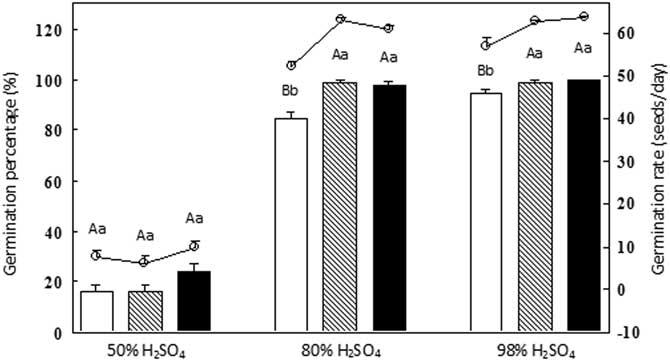
Pretreatments by low concentration of sulfuric acid (50%) partially broke seed dormancy of field bindweed (Figure 1). The germination percentage of seeds soaked with 50% sulfuric acid for 15 to 60 min ranged from 16% to 24.2% and was not significantly different (P=0.094). Similarly, germination rates were not significantly different among the three soaking times (15, 30, and 60 min) in 50% sulfuric acid (P=0.208).
Germination percentage (open bar: 15 min; hatched bar: 30 min; solid bar: 60 min) and germination rate (open circles) of field bindweed seeds treated by sulfuric acid in different concentrations. Vertical bars represent standard errors. Different lowercase letters indicate significant differences among germination percentages; different capital letters indicate significant differences among germination rate (P=0.05).

However, higher concentrations (80% and 98%) of sulfuric acid were effective in breaking seed dormancy, and their effects on dormancy increased with increasing duration of sulfuric acid scarification. For example, seed germination increased from 84.5±2.5% to 99.0±0.7% when soaking time increased from 15 to 30 min with 80% sulfuric acid solution. However, germination was not significantly different between the two longer durations of treatment (30 and 60 min) (P=0.670) at 80% sulfuric acid. Similarly, germination rate increased with increasing sulfuric acid scarification time. Breaking seed dormancy by chemical scarification using concentrated sulfuric acid is mostly attributed to breaking hard seed coats, which increases seed permeability to water (Susko et al. Reference Susko, Mueller and Spears2001).
Effect of Hot-Water Scarification
Pretreatment using 40 C water failed to break seed dormancy of field bindweed at any of the timings (1 to 120 min). Germination was 2.5% to 6.0% without statistical difference (P=0.546).
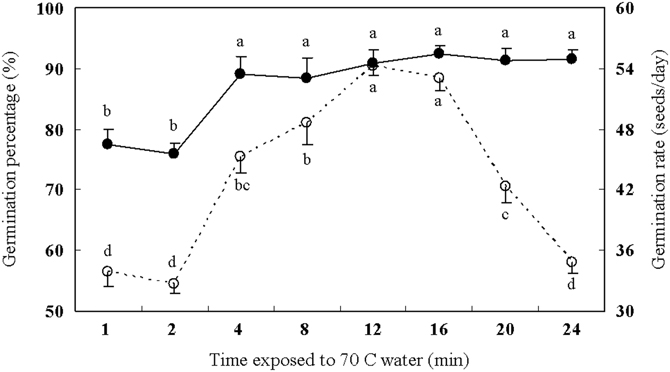
Seed dormancy was effectively broken by soaking in 70 C hot water (Figure 2), and germination differed with duration of treatment (P<0.001). Germination was greater than 75% when seeds were exposed to 70 C hot water for 1 to 2 min, and increased rapidly to 89.0% (±3.0%) after 4 min of scarification and 92.5% (±1.2%) after 16 min of scarification. There was no difference in germination between scarification durations from 4 to 24 min. However, germination rate was increased with increasing duration of scarification between 1 to 12 min and then decreased rapidly as soaking time increased (P<0.001).
Effects of exposure durations to 70 C hot water treatments on germination percentage (solid circles) and germination rate (open circles) of field bindweed seeds. Vertical bars represent standard errors. Vertical bars with the same letters do not differ significantly (P=0.05).

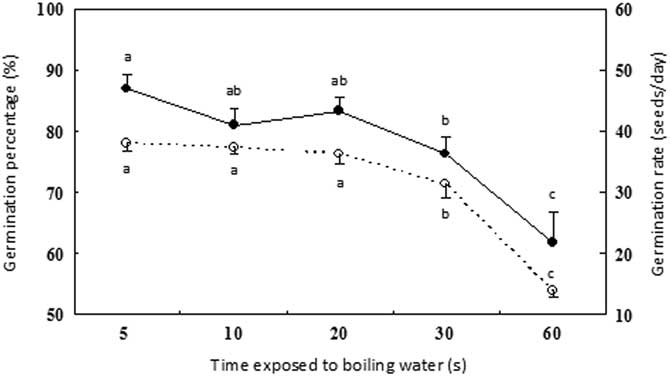
Germination differed among boiling-water treatments (P<0.001) (Figure 3). Seed germination was the highest following exposure to boiling water for 5 s (86.9±2.3%), even though it was not different from the 10-s (80.9±2.8%) and 20-s (83.4±2.3%) treatments. However, germination percentages decreased when seeds were treated for 30 s or more. Susko et al. (Reference Susko, Mueller and Spears2001) also showed that long duration of treatments in boiling water for 60 s or more was not conducive to germination of kudzu [Pueraria lobata (Willd.) Ohwi] seeds. The dynamic change in germination rate with duration of soaking in boiling water was similar to that of germination percentage (Figure 3). Souza de Paula et al. (Reference Souza de Paula, Delgado, Paulilo and Santos2012) reported that thermal hot-water scarification resulted in change of specialized structures (“water gaps”) on the seed coat, whereby the micropyle was opened more in golden medallion tree [Cassia leptophylla Vogel (Leguminosae)] and the lens region ruptured in fedegoso [Senna macranthera (Collad.) H.S. Irwin & Barneby], which enhanced water entry. Exposure to high alternating or constant temperatures in wet and dry conditions in the laboratory are effective methods to break physical seed dormancy in most temperate species (Van-Klinken Reference Van-Klinken2005; Patanè and Gresta Reference Patanè and Gresta2006; Hu et al. Reference Hu, Wu and Wang2009). However, high temperatures in nature can also induce secondary seed dormancy in some weed species (Roberts and Lockett Reference Roberts and Lockett1978).
Effects of exposure durations to boiling-water treatments on germination percentage (solid circles) and germination rate (open circles) of field bindweed seeds. Vertical bars represent standard errors. Vertical bars with the same letters do not differ significantly (P=0.05).

Effect of Cold Stratification
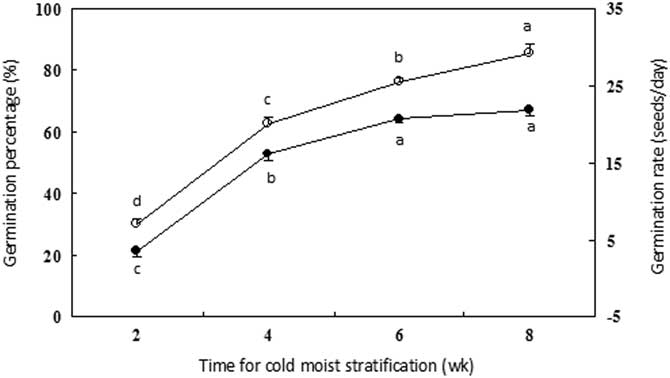
Cold moist stratification at 5 C for 2 to 8 wk influenced release of seed dormancy in field bindweed. Germination percentages as well as rates differed among cold stratification durations (germination percentage, P<0.001; germination rate, P<0.001) (Figure 4). Only 21.2% germination occurred when seeds were exposed to a cold moist environment for 2 wk. The germination percentage increased with increasing chilling period from 4 to 8 wk. Percent germination was 64.2 (±1.1%) and 67.0 (±1.6%) for the 6- and 8-wk treatment durations, respectively. Prechilling the hard seeds of crenate broomrape (Orobanche crenata Forssk) permitted water entry and enhanced seed germination (López-Granados and García-Torres Reference López-Granados and García-Torres1996). Seeds with shallow physiological dormancy typically required cold stratification to break dormancy (Baskin et al. Reference Baskin, Chester and Baskin1992; Rouhi et al. Reference Rouhi, Sepehri, Sefidkhani and Karimi2015). However, several studies have shown that cold moist stratification had no effect on dormancy release of seeds with physical dormancy [bigroot morningglory, Ipomoea pandurata (L.) G. Mey; see Horak and Wax Reference Horak and Wax1991; Kudzu, Susko et al. Reference Susko, Mueller and Spears2001].
Effects of cold moist stratification on germination percentage (solid circles) and germination rate (open circles) of field bindweed seeds. Vertical bars represent standard errors. Vertical bars with the same letters do not differ significantly (P=0.05).

Effect of Gibberellic Acid and Potassium Nitrate
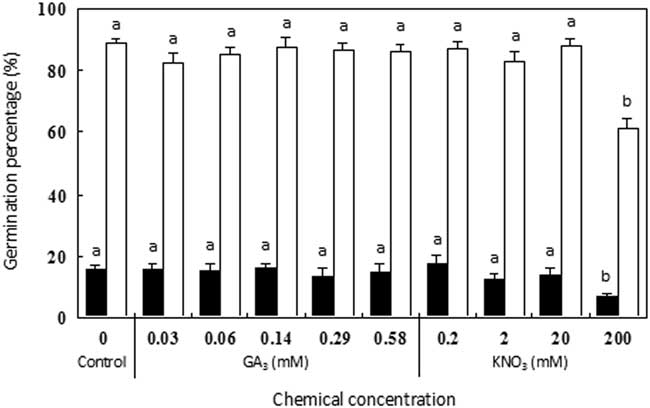
For the control treatment, seeds pretreated with sandpaper had higher germination percentage (88.9%) than the untreated intact seeds (15.6%). However, treatments with gibberellic acid at 0.03 to 0.58 mM did not further increase germination of untreated intact seeds (P=0.971) or sandpaper-treated seeds (P=0.608) (Figure 5). Similarly, potassium nitrate treatments at 0.2 and 20 mM did not improve germination of either intact or sandpaper-treated seeds (P=0.014 for intact seeds; P<0.001 for seeds scarified with sandpaper). However, potassium nitrate at 200 mM reduced germination of both intact and sandpaper-treated seeds. These results show that neither gibberellic acid nor potassium nitrate was effective in breaking seed dormancy and improving germination after breaking seed physical dormancy, indicating that dormancy of field bindweed is nonphysiological and not regulated by embryo or hormone.
Effects of gibberellin acid (GA3) and potassium nitrate (KNO3) on germination percentage of intact seeds (solid bars) and seeds pretreated with sandpaper (open bars of the control) of field bindweed. Vertical bars represent standard errors. Vertical bars with the same letters do not differ significantly (P=0.05).

Effect of Pretreatment on Seedling Growth
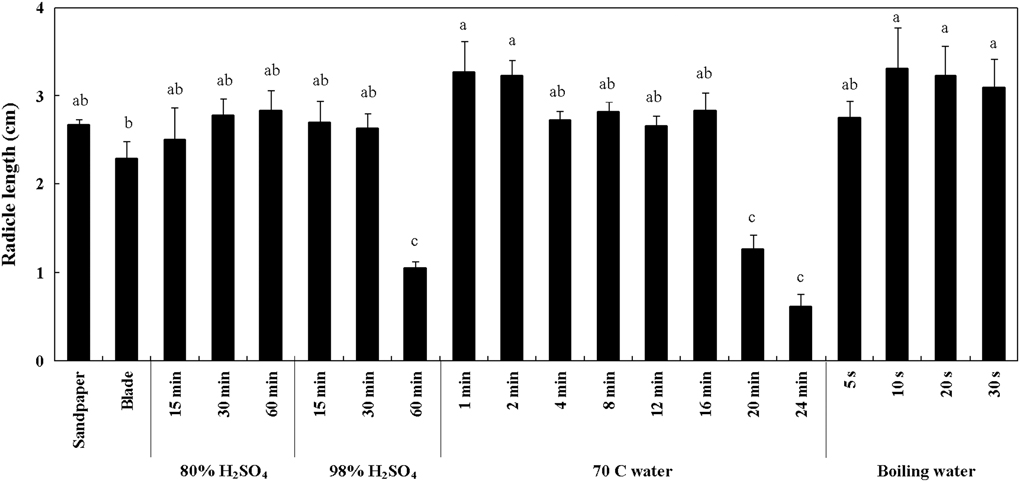
None of the dormancy-relieving pretreatments affected hypocotyl growth of field bindweed (P=0.436, data not shown). In contrast, pretreatments with 98% sulfuric acid for 60 min and 70 C hot water for 20 and 24 min had negative effects on radicle growth. Radicle lengths for these three treatments were significantly shorter than the other 17 dormancy-breaking treatments evaluated (P<0.001) (Figure 6). Roots of abnormal seedlings were absent or shorter than radicles of untreated seeds and had weak secondary root systems. It is worth mentioning that the blade scarification treatment also reduced radicle length, indicating the potential of accidental damage to the seed when using mechanical scarification.
Effects of pretreatments on radicle length of field bindweed seeds after 7 d of experiment. Vertical bars represent standard errors. Vertical bars with the same letters do not differ significantly (P=0.05).

As has been reported for many species of Convolvulaceae (Jayasuriya et al. Reference Jayasuriya, Baskin and Baskin2008), seed dormancy of field bindweed is physical and can be released by methods increasing the imbibition of seed coat. Chemical stimuli such as gibberellic acid and potassium nitrate are the most successful pre-sowing treatments for seeds with physiological dormancy (Otroshy et al. Reference Otroshy, Zamani, Khodambashi, Ebrahimi and Struik2009; Rouhi et al. Reference Rouhi, Sepehri, Sefidkhani and Karimi2015); however, these treatments did not release seed dormancy of field bindweed. Although manual scarification with a blade is an effective method for alleviating dormancy in seed of field bindweed, seeds have to be treated one by one, often making this treatment labor intensive. The blade scarification might also cause accidental damage to the seed, reducing the radicle growth. Therefore, this method is not recommended for processing large amounts of seeds. In contrast, scarification with sandpaper has the advantages of simple operation and high efficiency, making it a rapid method to release seed dormancy of field bindweed for experimental purposes.
Acid and wet-heat treatments are widely used to overcome hard seed coat–imposed dormancy, because they can increase the permeability of the seed coat to water and oxygen and improve germination within a relatively short period (Tadros et al. Reference Tadros, Samarah and Alqudah2011; Abudureheman et al. Reference Abudureheman, Liu, Zhang and Guan2014). Results showed that both sulfuric acid and hot-water scarification could break seed dormancy of field bindweed, depending on sulfuric acid concentration, water temperature, and pretreatment duration. Pretreatments with 50% sulfuric acid did not break seed dormancy of field bindweed. Seed germination, of up to 99%, was promoted with higher concentrations of sulfuric acid (more than 80%). However, pretreatment with 98% sulfuric acid for 60 min had a negative effect on radicle growth. This result is consistent with a report that seed dormancy of giantseed goosefoot (Chenopodium hybridum L.) was effectively released by soaking in concentrated sulfuric acid scarification for 30 min, but germination rate decreased when soaking time was prolonged to 40 to 60 min (Hu et al. Reference Hu, Pan, Min, Fan, Ding, Fan, Baskin and Baskin2016). To minimize the potential damage of concentrated sulfuric acid on seeds, treatment duration between 15 and 30 min is recommended.
Similarly, pretreatment with 70 C hot or boiling water, rather than 40 C water, alleviated seed dormancy of field bindweed; pretreatment duration was a determinative factor for seed germination. Seed germination rate decreased and radicle growth was less when immersion time increased from 12 to 16 min to 20 to 24 min in 70 C water. Moreover, seed germination decreased when seeds were boiled for 30 s or more. For these reasons, sulfuric acid concentration, water temperature, and treatment durations should be adjusted to minimize seed damage that could result in abnormal seedlings or dead seeds (Susko et al. Reference Susko, Mueller and Spears2001; Kandari et al. Reference Kandari, Kulkarni and Van Staden2011).
In this study, 4 to 8 wk of cold moist stratification at 5 C was enough to partially break seed dormancy of field bindweed, and germination percentage increased with the increase of treatment time. In northwest China, seeds of field bindweed mature around October and November and are exposed to a cold winter period (about 5 mo, natural cold stratification), which may help them to break dormancy and improve germination under natural environments. This phenomenon was also reported by Meulebrouck et al. (Reference Meulebrouck, Ameloot, Van Assche, Verheyen, Hermy and Baskin2008), who found that low autumn and winter temperatures tended to partially remove seed physical dormancy in the holoparasite dodder [Cuscuta epithymum (L.) L.].
Practical Implications
This study has identified some rapid and effective methods to alleviate seed dormancy that should facilitate the propagation of field bindweed seedlings for research purposes and enable a flexible experiment schedule. These methods are sandpaper scarification, pretreating seeds with 80% to 98% sulfuric acid for 15 to 30 min, and soaking seeds in 70 C water for 4 to 16 min or in boiling water for 5 to 20 s. Results of this study will assist weed researchers and ecologists to reduce the time and labor needed to release seed dormancy and rapidly propagate large numbers of uniform seedlings of field bindweed for experimental purposes.
Results of this study showed that prolonged chilling treatments effectively broke seed dormancy of field bindweed, indicating that a long cold winter (about 5 mo) in northwest China can break seed dormancy and improve germination and emergence in the coming spring. Management options should strategically focus on the control of young seedlings to gradually exhaust the seed bank of field bindweed. It is worth mentioning that field bindweed is a perennial weed, spreading by both seeds and the roots. How to exhaust and kill the perennial root systems is another dimension if field bindweed is to be managed effectively. A long-term management plan is necessary for this persistent perennial weed.
In addition, this study showed a strong physical seed dormancy of field bindweed, a key contributory factor in the prolonged seed persistence in the field (Bond et al. Reference Bond, Davies and Turner2007; Wright et al. Reference Wright, Elmore and Cudney2011), which presents significant challenges in managing field bindweed. It is therefore important to use appropriate chemical and nonchemical options to minimize seed production to reduce the replenishment of seed into the soil seed bank. Strategic soil inversion tillage is another available option to manage weeds with hard seed coats, as it can bury weed seeds deep in the soil to reduce the emergence (Chauhan Reference Chauhan2016).
Acknowledgments
The authors wish to acknowledge Bopeng Wang for his assistance in the laboratory. Financial support was provided by the National Natural Science Foundation of China (Grant No. 31660525). No conflicts of interest have been declared.