Introduction
Dementia is defined as a syndrome characterized by global cognitive decline, in the absence of a reduction in level of awareness, leading to impairment in at least two cognitive functions and/or behavior, where cognitive or behavioral symptoms must interfere in the ability to perform habitual occupational or social activities (Frota et al., Reference Frota2011; McKhann et al., Reference McKhann2011). In its initial stages, diagnosis can be aided by the application of cognitive screening tests (Aprahamian et al., Reference Aprahamian, Martinelli, Neri and Yassuda2010; Frota et al., Reference Frota2011).
Early detection of dementia represents an important challenge for primary healthcare services in Brazil due to the heterogeneous educational background among seniors. Thus, there is a need to study easily applied cognitive screening instruments appropriate for this setting, given that the MMSE, the most commonly used test worldwide, can be lengthy and complex for non-specialists.
The Cognitive Abilities Screening Instrument (CASI) is an instrument designed for identifying cognitive changes in the elderly. The CASI can also be used to track the progression of dementia. The short form of the instrument (CASI-S) may be useful for dementia screening in primary care. However, the instrument has not yet been extensively studied in Brazil or worldwide.
The original version of the CASI was produced in English and called the CASI E-1.0 (Teng et al., Reference Teng1994). It encompasses the assessment of semantic memory (e.g. number of minutes in an hour), repeating three words, backwards digits, recall of three words, subtractions, temporal and spatial orientation, generation of names of four-legged animals, verbal commands, among other sub-tests. In clinical practice, the suggested cut-off points for differentiating dementia from normal cognition are: 49/50 points for illiterate elderly; 67/68 for elderly with one to five years of education, and 79/80 points for elderly with six or more years of education (Lin et al., Reference Lin, Wang, Liu and Teng2012). The Chinese version of the CASI (CASI C-2.0) has been used in clinical and epidemiological studies in Taiwan. The findings showed that scores on the CASI are influenced by education, and, therefore, normative data for total and sub-domain scores should be stratified into educational levels.
The CASI has also been examined for its ability to assess the severity of dementia. Liu et al. (Reference Liu2002) compared scores on the CASI of 475 patients with Alzheimer's disease (AD) of varying levels of severity according to the Clinical Dementia Rating Scale (CDR). For total score and nine domains, mean score decreased with the severity of dementia (except for short term memory) and the majority of patients had below-average scores with worsening of the disease.
McCurry et al. (Reference McCurry1999) investigated the effect of age and education on CASI performance in a cross-sectional, descriptive, population-based study. A total of 2,524 cognitively intact elderly over 65 years of age, members of a health organization, were assessed. Correlations were detected between score on the CASI and age and schooling. As to sex, women exhibited a slightly greater distribution in score. More recently, Gibbons et al. (Reference Gibbons2009) studying a cohort of 3,045 individuals aged 65 years or over, 96% were Japanese descents, found that both age and schooling correlated with scores on the CASI, yet there were no sex differences.
In a longitudinal study, Jorm et al. (Reference Jorm, Masaki, Petrovitch, Ross and White2005) examined cognitive deficits preceding a dementia diagnosis in a population sample of 3,734 elderly from Honolulu. The study included American men of Japanese ancestry aged 71–93 years. The elderly were assessed every three years using the CASI and a questionnaire on subjective memory. Of the participants who remained in the study, 52 individuals exhibited dementia and 1,559 remained as healthy controls after six years. Three years before dementia onset, a decline in performance on the CASI for tests of episodic memory, language, verbal fluency, and orientation was evident among those who developed dementia conditions.
In its short version, the CASI-S assesses temporal orientation, verbal fluency (four-legged animals in 30s), spontaneous recall of three words, with semantic cue (category) and recognition (Teng et al., Reference Teng1994). In Brazil, Damasceno et al. (Reference Damasceno2005), in a university hospital setting, applied the CASI-S to 43 AD patients and 74 normal controls, with age between 40 and 88 years, schooling of 0–20 years, and AD diagnosis based on the DSM-IV, NINCDS-ADRDA and on CAMDEX scores (Cambridge Mental Disorders of the Elderly Examination). Educational level correlated with scores on the CASI-S. The ROC-curve showed 0.87 diagnostic accuracy with a cut-off point of 23 points (sensitivity of 76.7% and specificity of 86.5%).
No studies on the use of the CASI-S in primary care were found. Previous studies involving this instrument have been conducted in hospitals or were population-based. Studies regarding its psychometric characteristics were not identified either. Given its briefness (approximately five minutes) and ease of application relative to the MMSE, the CASI-S can be of great value to screen for dementia in the primary care setting. Therefore, the aims of this study were: (1) to assess the applicability of the CASI-S in primary care; (2) to describe the performance of elderly with and without dementia on the CASI-S and examine its diagnostic accuracy; (3) to analyze its internal consistency and test-retest stability; (4) to examine the correlation between the CASI-S and other cognitive instruments.
Methods
Participants
A total of 102 individuals aged over 60 years, registered in two PCUs located in the eastern region of São Paulo, took part in the study. In Brazil, the public health system is structured in three levels of assistance: primary care, specialized ambulatories, and hospitals. In most of the territory, each neighborhood has one PCU which has the mission to treat simple diseases (e.g. flu, diarrhea), identify complex health problems, and move patients to higher levels of care and promote health. Some PCUs have implemented the family health strategy which consists of health teams (physician, nurses, and community health workers – CHW) who visit families monthly to screen for common diseases and encourage health promotion.
Training sessions about dementia diagnosis were offered for the CHWs in order to increase dementia awareness. Next, CHWs were asked to identify seniors with cognitive complaints and dementia diagnosis in their catchment area. The identified elderly and caregivers were contacted by phone and invited to come for an interview in the PCU. Families who were not willing to come to the PCU were visited in their home by a neuropsychologist and a gerontologist who applied the research protocol.
The CASI-S and the neuropsychiatric questionnaires were applied by the gerontologists who did not participate in the consensus diagnostic meetings. The protocols were later discussed by the neuropsychologists and the physician who have vast experience in dementia diagnosis and the participants were grouped into those with and without dementia, based on the results of the MMSE (Brucki et al., Reference Brucki, Nitrini, Caramelli, Bertolucci and Okamoto2003), CAMCOG (Bottino et al., Reference Aprahamian, Martinelli, Neri and Yassuda1999), IQCODE (Sanchez et al., Reference Sanchez and Lourenço2009), BADL (Folquitto et al., Reference Folquitto2007), and supplementary information (age, educational level, comorbidities). Cut-off scores from previous national studies were used for each instrument (Chaves et al., Reference Chaves2011). The gold standard for dementia diagnosis was clinical, based on the criteria of the DSM-IV for dementia.
A sub-sample of 33 normal controls was used for the analysis of temporal stability. All normal control participants were contacted by phone and invited to complete a brief assessment for a second time. This sub-sample represents those who accepted to participate. There were no significant differences between this sub-sample (mean age = 74.0, SD = 6.50; mean schooling = 4.19, SD = 2.99) and the overall group of normal controls (n = 55) or the group who refused to be re-assessed (n = 22).
Individuals presenting severe visual and/or auditory deficits, signs of advanced dementia, neurological/psychiatric syndromes (except dementia), or diagnosed with depression or delirium, were excluded. The data in the present analysis were drawn from a larger study whose goal was to validate a set of screening instruments for application in Brazil. The present study compared normal and dementia patients assessed during the first phase of the study.
Instruments
Socio-demographic and health data were collected. For patients with dementia, these variables were collected from family members. Schooling referred to the number of complete years the participant remained in school. Economic classification was established using the socio-demographic questionnaire of ABIPEME Criteria Brazil (2008), which constitutes a socio-economic scale or classification built by attributing weights to a set of domestic items, in conjunction with the educational level of the head of the household.
The CASI-S comprises four subtests: (1) registration of three words (0–3 points); (2) temporal orientation (0–11 points, attributed according to the accuracy of response); (3) categorical verbal fluency (0–10 points); and (4) word recall (0–9 points, attributed according to whether the participant needs prompting or not), with a maximum total score of 33 points. There are three different versions for the three words to be encoded and recalled, which allows reapplication while reducing the risk of a learning effect. The words shirt, brown, and honesty were used in the present application. It is noteworthy that the words used in the CASI-S are different from the ones used in the MMSE, as only one represents a concrete object. The second one is a color and the last word is an abstract substantive.
The MMSE provides information regarding seven cognitive domains: temporal orientation (5 points), spatial orientation (5 points), registration of three words (3 points), attention and calculus (5 points), recall of three words (car, vase, brick – 3 points), language (8 points), and visual constructive ability (1 point). The MMSE score ranges from 0 to 30 points (Brucki et al., Reference Brucki, Nitrini, Caramelli, Bertolucci and Okamoto2003).
Procedures
The duration of the testing session was around 90 minutes. Thirty-three control participants were reassessed on the CASI-S, within an average of 30 weeks, after the first application, to assess the temporal stability of the instrument. All participants filled out the free and informed consent form prior to undergoing the first assessment. The project was approved by the Research Ethics Committee of the Municipal Secretariat for Health under the Research Protocol no. 476/11 and by the Research Ethics Committee of the University of São Paulo School of Medicine.
Statistical analyses
The χ2 test was employed to compare categorical variables between groups. The absence of a normal distribution for the continuous variables dictated the use of non-parametric tests, namely, the Mann–Whitney and Kruskall–Wallis U-tests. When p-values were lower than 0.05, multiple comparisons z-values test were carried out. The correlation between the CASI-S and the other variables was calculated using Spearman's correlation. Internal consistency was calculated using Cronbach's α, while temporal stability was established by assessing the correlation between test and retest scores. Statistical analysis was carried out using the SPSS v.20 software program. The level of significance adopted for the statistical tests was 5%, corresponding to a p-value < 0.05.
Results
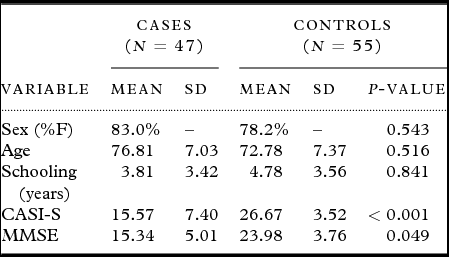
Table 1 shows the socio-demographic characteristics of the participants grouped into cases and controls. Among the 102 elderly interviewed, 47 were classified as dementia patients and 55 as normal controls. No significant differences were found between the groups for age and schooling. A significant difference in performance on the CASI-S and MMSE was identified, with normal controls attaining higher scores.
Socio-demographic data of patients grouped into dementia cases and normal controls

Note. p-value refers to Student's t-test, for sex; p-value refers to the χ2 test. CASI-S = cognitive abilities screening instrument – short, MMSE = Mini-Mental State Exam.
The analysis of the internal consistency of the CASI-S revealed a high Cronbach's α value (α = 0.848). On the reliability analysis (n = 33), the correlation between test and retest was 0.688, suggesting adequate temporal stability. Within this sub-sample, the means for the first CASI-S score (M = 26.72, SD = 3.58) and the means for the retest score (26.28, SD = 3.44) were compared statistically by a paired t-test and no difference was found (p = 0.368).
The CASI-S score was compared for men and women grouped into cases and normal controls. No significant differences between sexes were found (data not shown).
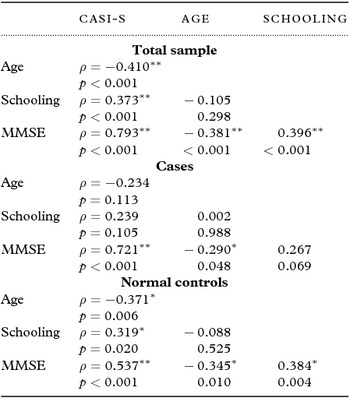
Table 2 depicts the correlations for the total sample (n = 102) between the CASI-S and the other variables studied and the correlations for the diagnostic groups separately. In the total sample, the correlations revealed a significant association between the CASI-S and age and schooling. Among those with dementia, CASI-S correlated with the MMSE. Among controls, the CASI-S was associated with the MMSE, age, and schooling.
Correlation between CASI-S and socio-demographic and clinical variables for total sample (n = 102), cases (n = 47) and normal controls (n = 55)

Note: r (Spearman's correlation coefficient) and p (p-value). *Significant correlation < 0.05. **Significant correlation < 0.01. CASI-S = cognitive abilities screening instrument – short, MMSE = Mini-Mental State Exam.
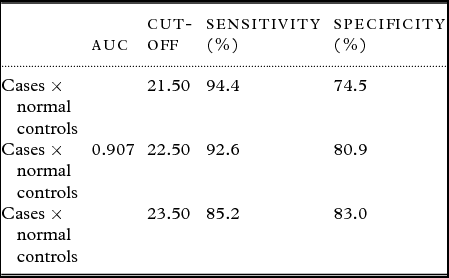
In the ROC-curve analyses, the area under the curve was 0.907 for the identification of dementia patients, with a cut-off point of 22/23 points generating sensitivity of 93% and specificity of 81% (Table 3 and Figure 1).
Results of accuracy analysis for the CASI-S (n = 102)

Note: AUC: area under the curve.
ROC curve between normal controls and dementia patients.

Discussion
It is important to study the applicability of the CASI-S in primary care as it may prove to be extremely useful for dementia screening. The instrument differs from others in that it is brief, easily applied and, at face value, seems to be less influenced by schooling effects (Damasceno et al., Reference Damasceno2005). Early detection of dementia represents a challenge for primary healthcare services in Brazil and worldwide, given that cognitive changes may go undetected during routine visits in the absence of active investigation (Jacinto et al., Reference Jacinto, Nitrini, Brucki, Porto, de Mello Franco and de Albuquerque Citero2013).
The aim of the present study was to assess the applicability of the CASI-S in primary healthcare units, describing the performance of elderly with and without dementia on the CASI-S, its internal consistency, test-retest stability, convergent validity with instruments previously validated for use in Brazil, and diagnostic accuracy. Overall, the researchers observed the CASI-S was easily applied in primary care. The scores on the CASI-S differentiated elderly with dementia from those without the disease. Additionally, the internal consistency and temporal stability were found to be high. In the total sample, correlations revealed a significant association between the CASI-S and the variables age and schooling. A strong correlation between the CASI-S and the MMSE was also identified.
Regarding the ability of the CASI-S to identify possible cases of dementia, the scores among patients with and without dementia were found to differ significantly in this study. The sensitivity and specificity of the test for diagnosing dementia in primary care were similar to the ones reported in a previous Brazilian study conducted in a neurology outpatient clinic (Damasceno et al., Reference Damasceno2005). In addition, Teng et al. (Reference Teng1994) reported high values of sensitivity (89% – 95%) and specificity (88% – 94%) for the original CASI for dementia detection in studies carried out at two different locations in the USA and two sites in Japan. Similar results were found for the Chinese CASI (Lin et al., Reference Lin, Wang, Liu and Teng2012) in its long version. In all, these results suggest the CASI, in its long and abbreviated versions, has high accuracy for the detection of dementia syndromes.
As to the psychometric characteristics of the CASI-S, present results suggested high internal consistency. The test-retest reliability analysis suggested adequate temporal stability, especially considering there was a relatively long interval between assessments. No previous studies were found regarding the internal consistency and the temporal stability of the CASI-S; therefore, these findings represent a novel contribution.
With regards to the relationship between the CASI and the socio-demographic variables, McCurry et al. (Reference McCurry1999) reported associations between CASI scores (long) and both age and schooling in a cross-sectional, descriptive, population-based study. The authors also reported a difference between sexes, with women performing better. Gibbons et al. (Reference Gibbons2009) found that both age and schooling correlated with scores on the CASI (long) but there were no differences for sex. Our results suggest, in line with previous findings, that the CASI-S is influenced by age and education, yet, not by sex.
A study on the Chinese version of the CASI (CASI C-2.0) showed that scores were influenced by schooling (Lin et al., Reference Lin, Wang, Liu and Teng2012) and consequently cut-off points for dementia were adjusted by educational level. Damasceno et al. (Reference Damasceno2005), in a sample of Brazilian elderly, found age to be negatively correlated and schooling to be positively correlated with CASI-S scores. These studies suggest that, as the MMSE, the CASI, in its different versions, is subject to the influence of educational experience and age (and perhaps sex, as indicated in some studies) and, therefore, the interpretation of scores should take in to account the individual's socio-demographic characteristics. Present results corroborate these earlier findings.
The results indicated that the CASI-S exhibited a significant correlation with the MMSE for the total sample and each diagnostic group. This finding confirms earlier studies on the concurrent validity between the CASI-S and the MMSE, suggesting that these scales assess similar constructs (Graves et al., Reference Graves, Larson, Kukull, White, Teng, Corain, Iqbal, Nicolini, Winblad, Wisniewski and Zatta1993), and that according to the clinical context, the CASI-S may be used in substitution of the MMSE. Teng et al. (Reference Teng1994), for example, reported a correlation of (ρ = 0.92) between the CASI-S and the MMSE. Recently, Rezende et al. (Reference Rezende, Cecato and Martinelli2013) also found a significant strong correlation between the CASI-S the MMSE in a Brazilian sample (ρ = 0.75).
Cognitive screening may assist in the early diagnosis of dementia and it may also track disease progression and effects of treatment (Aprahamian et al., Reference Aprahamian, Martinelli, Neri and Yassuda2010). The results of the present study suggest that the CASI-S can be a valuable dementia screening tool in primary care. Limitations of the present study include the relatively small sample size, the absence of a sub-sample with higher education, and the fact that the CASI-S was not applied by non-specialists. Future investigations should continue to explore the relationship of CASI-S scores with socio-demographic variables in population-based studies with a longitudinal design. Further investigations involving this instrument are warranted as the CASI-S has shown to have adequate psychometric characteristics and it can be easily applied in a variety of clinical and research settings.
Conflict of interest
None.
Description of authors’ roles
G. M. de Oliveira, J. E. Yokomizo, L. S. V. Silva and L. F. Saran collected data and carried out data analyses. G. M. de Oliveira wrote the first draft of the paper. All authors helped design the study and revised the final version of the paper. C. M. C. Bottino and M. S. Yassuda were responsible for the study.