Introduction
In Spain, the study of the helminth communities of small mammals has been a very important line of research in the field of parasitology for more than 60 years. There are many species of rodents and insectivores that have been the subject of helminthological studies, especially in past decades (Feliu et al., Reference Feliu, Renaud, Catzefelis, Hugot, Durand and Morand1997, Reference Feliu, López, Gómez, Torres, Sánchez, Miquel, Abreu-Acosta, Segovia, Martín-Alonso, Montoliu, Villa, Fernández-Álvarez, Bakhoum, Valladares, Orós and Foronda2012; Fuentes et al., Reference Fuentes, Cerezuela and Galán-Puchades2000, Reference Fuentes, Sainz-Elipe and Galán-Puchades2005a, Reference Fuentes, Sainz-Elipe and Galán-Puchadesb; Torres et al., Reference Torres, Trelis, Espert, Ribas, Toledo, Casanova, Roman, Arrizabalaga, Esteban and Feliu2003; Sainz-Elipe et al., Reference Sainz-Elipe, Galán-Puchades and Fuentes2007), focusing mainly on the wood mouse, Apodemus sylvaticus (Fuentes et al., Reference Fuentes, Saez, Trelis, Galán-Puchades and Esteban2004a, Reference Fuentes, Sáez, Trelis, Muñoz-Antolí and Estebanb), the most widespread sylvan small mammal in the Iberian Peninsula (Torre et al., Reference Torre, Arrizabalaga and Díaz2002). Some of these works have cast a great deal of light on the wood mouse–helminth system and its role in the ecosystem from an ecological point of view, reaffirming its application as a biological tag (Torres et al., Reference Torres, de Lapuente, Eira and Nadal2004, Reference Torres, Peig, Eira and Borrás2006; Fuentes et al., Reference Fuentes, Sainz-Elipe and Galán-Puchades2007a, Reference Fuentes, Sainz-Elipe and Galán-Puchadesb, Reference Fuentes, Sainz-Elipe, Sáez-Durán and Galán-Puchades2009, Reference Fuentes, Sainz-Elipe, Sáez-Durán and Galán-Puchades2010; Torre et al., Reference Torre, Arrizabalaga, Feliu and Ribas2013). Nevertheless, most of the studies present a general overview, but there are many areas in the country that have never been studied. Thus, the characterization of the helminth community from limited and particular regions would be required for a comprehensive ecological comparison between different natural ecosystems.
The Erro River valley (Navarre, Spain), for instance, is an important ecosystem where only the helminth community of the Mediterranean mouse, Mus spretus, has been analysed ecologically (Sainz-Elipe et al., Reference Sainz-Elipe, Galicia, Imaz, Galán-Puchades and Fuentes2004). This article commented on the potential role of this rodent as a reservoir of Calodium hepaticum, the causal agent of the fatal human hepatic disease calodiosis (Fuehrer et al., Reference Fuehrer, Igel and Auer2011). Other authors have reported interesting data about the richness of the helminth community of other species of Arvicolidae, specifically Microtus gerbei, M. agrestis and Arvicola sapidus, in the Navarre region (Feliu et al., Reference Feliu, Renaud, Catzefelis, Hugot, Durand and Morand1997).
Here the helminth community of the wood mouse from the Erro River valley (Navarre, Spain) is analysed, considering qualitative, quantitative and ecological aspects. Its main objective was to gain insight into the helminth fauna of the wood mouse in this ecosystem, never before studied. Furthermore, and given that other rodents from the same biogeographical area are hosts of zoonotic helminth species, the secondary objective was to research the presence of zoonotic helminths in this rodent, which can act as a potential reservoir of relevant helminthic zoonosis in this ecosystem.
Materials and methods
Collection and examination of mice
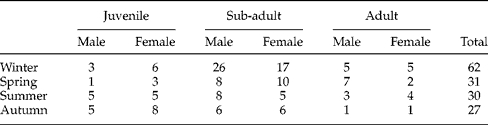
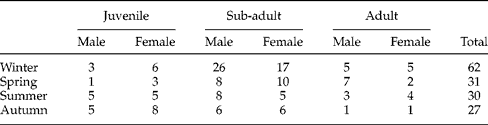
The study area comprises the western Pyrenean valley of the Erro River flowing into the Aragon River and finally into the Ebro River (43°00′36″–42°45′36″N; 1°23′24″–1°28′12″W). This valley is 50 km long and descends from 820 m to 460 m above sea level. The climatology is sub-Atlantic in the highest part and sub-Mediterranean in its middle and lower parts. The dominant vegetation in its highest part consists of acidophile Atlantic forests with lush pastures and beech trees; oak trees are predominant in its middle part; its lower part is used agriculturally and only a small part along the river bank is occupied by Portuguese oak trees (Galicia & Escala, Reference Galicia and Escala2009). The zoological material analysed consisted of a total of 150 individuals of wood mice, A. sylvaticus, 78 males and 72 females. All mice were captured in the various parts of the valley between February 2001 and July 2002, carrying out seasonal samplings during the winter (January, February and March), spring (April, May and June), summer (July, August and September) and autumn (October, November and December) (table 1).
The number of Apodemus sylvaticus examined in the Erro River valley during 2001–2002, relative to host age, sex and season.
The helminthological techniques used concerning extraction and collection of helminths, as well as the study and identification of helminth species, were carried out according to Fuentes et al. (Reference Fuentes, Cerezuela and Galán-Puchades2000). Morphometric characteristics were always used as criteria for helminth identification, especially in very similar species which could parasitize the same microhabitat. Specifically, for the genus Syphacia, various body measures of the females and the morphology of the tail and the length of the spicule and the gubernaculum of males were used as criteria to distinguish between them (Roman, Reference Roman1951; Quentin, Reference Quentin1971).
Data analysis
The study concerning the helminth community composition, structure and components was carried analysing the following aspects: biological cycle, prevalence, mean abundance, median intensity, range and total number of helminths according to Bush et al. (Reference Bush, Lafferty, Lotz and Shostak1997); frequency of occurrence of the number of helminth species; frequency distribution of helminths of each infrapopulation, calculated by means of the Lefkovitch index (L), ranging from − 1 (positive binomial or uniform distribution), 0 (Poisson or random distribution) and +1 (negative binomial or aggregated distribution); abundance index, following Pence & Eason (Reference Pence and Eason1980), classifying the helminth community into four categories, i.e. dominant species (those characteristic of the community (I>1)), co-dominant species (those contributing significantly to the community composition, but doing well in other habitats (0.1 ≤ I ≤ 1)), successful immigrant species (those that occur infrequently and, although they develop and reproduce, they are not characteristic of the community and belong to another habitat (0 < I < 0.1)) and unsuccessful immigrant species (those species that gain access to the habitat, but do not mature or reproduce, contribute little to the community and are always characteristic of another community (I = 0)); diversity/uniformity using the Shannon index, the Simpson index (D) expressed as 1 − D and the Berger–Parker index (d), also expressed as the reciprocal 1 − d (Magurran, Reference Magurran1988). The 95% confidence intervals of prevalence were calculated following Sokal & Rohlf (Reference Sokal and Rohlf1981), especially when the prevalence was below 50%.
The helminth infracommunity structure was analysed using mean helminth abundance, mean species richness, the Brillouin index, a diversity index for infracommunities (Pielou, Reference Pielou1975; Magurran, Reference Magurran1988), and the Brillouin index for infected hosts only (excluding uninfected mice from the calculation of this index), considering intrinsic (host age and sex) and extrinsic (season of capture) factors.
The distribution of the helminth community was assessed, and the assumption of normality was rejected. The helminth community and all helminth infracommunities followed a negative binomial distribution ( = aggregated distribution). Consequently, and to avoid data transformation (Sokal & Rohlf, Reference Sokal and Rohlf1981), non-parametric tests (chi-square, logistic binary regression, Mann–Whitney and Kruskal–Wallis) were applied to analyse the roles played by intrinsic and extrinsic factors in determining the prevalence of the helminth community and the component (prevalence>10%) helminth infracommunities, species richness, helminth diversity and helminth abundance.
Stat View 5.0 (SAS Institute Inc., Cary, North Carolina, USA) and IBM SPSS 19.0 (SPSS Inc., Chicago, Illinois, USA) for Windows were used for statistical procedures. Statistical significance was established at P< 0.05.
Results
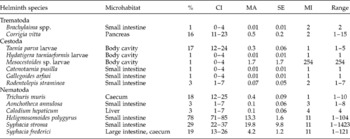
One hundred and thirty-six A. sylvaticus (90.7%) were found to be parasitized by 14 helminth species (table 2). Heligmosomoides polygyrus was the most prevalent species (78.0%), while Syphacia stroma was the species with the highest mean abundance (19.8). The helminth infracommunity comprised no more than five species, and the most frequent infracommunity consisted of two species.
The composition of the helminth community of 150 Apodemus sylvaticus from the Erro River valley; prevalence (%), 95% confidence intervals (CI), mean abundance (MA), standard error (SE), median intensity (MI) and range in the number of parasites.

The ecological analysis of the helminth community revealed the higher prevalence for monoxenous species (89.3% of the total host population and 98.5% of the parasitized hosts) in contrast to heteroxenous species (35.3% of the total and 39.0% of the parasitized hosts). These differences were statistically significant: χ2= 90.862; df = 1; P< 0.0001 for the total hosts; χ2= 109.519; df = 1; P< 0.0001 for the parasitized hosts. The logistic binary regression results showed that host age (χ2= 17.106; df = 2; P< 0.001) was the most important factor determining the helminth community prevalence. Concerning component helminth infracommunities, the influence of host age on the prevalence of Corrigia vitta, Taenia parva larvae, H. polygyrus and S. stroma stood out. Moreover, other factors, such as host sex and season of capture, were detected to have an influence on the prevalence of T. parva larvae (host sex and season), H. polygyrus (season) and S. stroma (host sex).
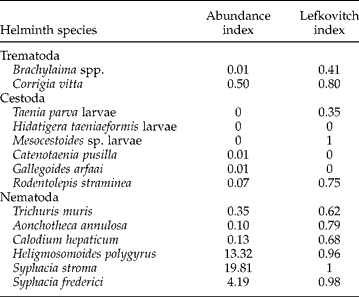
The values of the Shannon (1.26), Simpson (0.64), Berger–Parker (0.51) and Shannon evenness (0.48) indices reflect the diversity/uniformity of the helminth community. The abundance index values allowed establishment of the following helminth community structure: H. polygyrus, Syphacia frederici and S. stroma as dominant species; C. vitta, Trichuris muris, C. hepaticum and Aonchotheca annulosa as co-dominant species; Rodentolepis straminea, Catenotaenia pusilla, Gallegoides arfaai and Brachylaima spp. as successful immigrant species; larvae of Hydatigera taeniaeformis and Mesocestoides sp. as unsuccessful immigrant species without reaching maturation in mice, and responsible for incidental infections; and T. parva larvae also as an unsuccessful immigrant species, which cannot be considered incidental due to its relatively high prevalence of 17% (table 3).
The abundance and Lefkovitch indices of the helminth community of Apodemus sylvaticus in the Erro River valley.
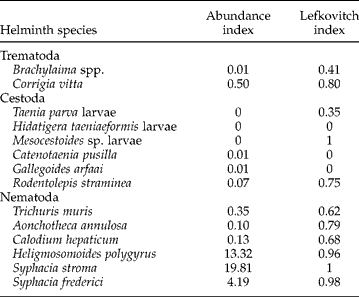
The Lefkovitch index showed that all dominant and co-dominant species presented a negative binomial distribution, while most of the remaining species presented a random distribution, with the exception of Mesocestoides sp. larvae presenting an aggregated tendency (table 3).
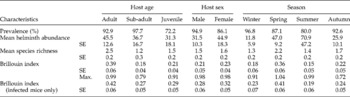
The helminth infracommunity structure is more uniform in the juvenile and sub-adult sub-populations than in the adult sub-population. Taking into account host sex, the infracommunity structure is very uniform. However, a lower uniformity was found with respect to the season of capture, with a high helminth burden in spring and even higher in summer (table 4).
Diversity characteristics of the helminth infracommunities in Apodemus sylvaticus in the Erro River valley during 2001–2002.

The analysis of the mean helminth abundance showed statistically significant differences when referring to infracommunities determined by season of capture as well as the infracommunities determined by host age and sex. The value of the mean abundance was higher in the adult sub-population in general (H = 32.193; df = 2; P< 0.001) and particularly in the male sub-population (U = 2087.500; df = 1; P< 0.01) in spring (H = 7.974; df = 3; P< 0.05) (table 4).
With regard to species richness, statistically significant differences were found between infracommunities determined by season (H = 14.427; df = 3; P< 0.01) and host age (H = 30.550; df = 2; P< 0.001), but not by sex. Species richness reached its lowest values in the juvenile sub-population in summer (table 4).
The diversity of the infracommunities, determined by the Brillouin value index, taking into account the total of each infracommunity as well as the total of infected hosts only, revealed a greater diversity in sub-adults compared with adults and juveniles (H = 24.847; df = 2; P< 0.001). The infracommunities determined by season of capture also presented significant differences of diversity (H = 12.826; df = 3; P< 0.01), with the lowest diversity in summer. On the other hand, there were no significant differences of diversity with respect to infracommunities determined by host sex.
Discussion
The helminth fauna of A. sylvaticus in the Erro River valley is in accordance with that reported in the general frame of the Iberian Peninsula (Feliu et al., Reference Feliu, Renaud, Catzefelis, Hugot, Durand and Morand1997). Fourteen helminth species were found in this study, a number equal to or higher than those reported in other studies (Portolés et al., Reference Portolés, Granel and Esteban2000; Torres et al., Reference Torres, Trelis, Espert, Ribas, Toledo, Casanova, Roman, Arrizabalaga, Esteban and Feliu2003; Fuentes et al., Reference Fuentes, Saez, Trelis, Galán-Puchades and Esteban2004a, Reference Fuentes, Sáez, Trelis, Muñoz-Antolí and Estebanb; Torre et al., Reference Torre, Arrizabalaga, Feliu and Ribas2013) but lower than those reported by Fuentes et al. (Reference Fuentes, Sainz-Elipe and Galán-Puchades2007a, Reference Fuentes, Sainz-Elipe, Sáez-Durán and Galán-Puchades2010) for various enclaves of the Iberian Peninsula.
Heligmosomoides polygyrus has also displayed the highest prevalence in other hinterland enclaves of the peninsula (Fuentes et al., Reference Fuentes, Sáez, Trellis, Cruz, Sarmento, Casanova, Torres, Feliu and Esteban2003, Reference Fuentes, Saez, Trelis, Galán-Puchades and Esteban2004b; Torres et al., Reference Torres, Trelis, Espert, Ribas, Toledo, Casanova, Roman, Arrizabalaga, Esteban and Feliu2003; Eira et al., Reference Eira, Torres, Vingada and Miquel2006) but not in some Mediterranean enclaves (Fuentes et al., Reference Fuentes, Cerezuela and Galán-Puchades2000, Reference Fuentes, Saez, Trelis, Galán-Puchades and Esteban2004a). Behnke et al. (Reference Behnke, Eira, Rogan, Gilbert, Torres, Miquel and Lewis2009) concluded that H. polygyrus has an effect on other co-infecting helminths in wood mice, and therefore that quantitative interactions between helminths infecting wild wood mice exist and contribute to the infracommunity structure at individual host level, and to the component community structure at population level. Thus, this nematode might play an important role in helminth community stability, explaining the high prevalence of infection detected. Other studies have reported a low prevalence or even the absence of this nematode in perturbed areas, supporting the association between the presence of H. polygyrus and population stability (Fuentes et al., Reference Fuentes, Sainz-Elipe and Galán-Puchades2007a, Reference Fuentes, Sainz-Elipe, Sáez-Durán and Galán-Puchades2010). Moreover, the oxyurid S. stroma had the highest abundance, which agrees with other similar studies reporting a high helminth burden of Syphacia species (Behnke et al., Reference Behnke, Lewis, Zain and Gilbert1999; Fuentes et al., Reference Fuentes, Sáez, Trellis, Cruz, Sarmento, Casanova, Torres, Feliu and Esteban2003, Reference Fuentes, Saez, Trelis, Galán-Puchades and Esteban2004a, Reference Fuentes, Sáez, Trelis, Muñoz-Antolí and Estebanb; Torres et al., Reference Torres, Trelis, Espert, Ribas, Toledo, Casanova, Roman, Arrizabalaga, Esteban and Feliu2003; Eira et al., Reference Eira, Torres, Vingada and Miquel2006; Milazzo et al., Reference Milazzo, Di Bella, Casanova, Ribas and Cagnin2010) and with the ecology of this nematode, directly transmitted host to host.
The absence of helminths with an aquatic life cycle is surprising, as this ecosystem is characterized by an abundant source of good-quality water during the year (Leunda et al., Reference Leunda, Miranda and Escala2004), providing a suitable environment for sub-aquatic gastropods, potential intermediate hosts. Nevertheless, a previous study carried out on the Mediterranean mouse in this ecosystem (Sainz-Elipe et al., Reference Sainz-Elipe, Galicia, Imaz, Galán-Puchades and Fuentes2004) reported the same tendency, not having detected any species with an aquatic life cycle. Moreover, the great similarity between both helminth communities, sharing five of the six helminth species reported in M. spretus, indicates that these two murids might share an important part of their habitat, habits and diet.
The finding of the capillarid C. hepaticum, already detected in this enclave by Sainz-Elipe et al. (Reference Sainz-Elipe, Galicia, Imaz, Galán-Puchades and Fuentes2004) in M. spretus, stands out. These authors also reported this helminth as a co-dominant species. Considering the host spectrum of this helminth in murid hosts, it is not surprising that this parasite had been found in the wood mouse (Fuehrer, Reference Fuehrer2014). Moreover, the presence of C. hepaticum and the role of all these rodent species as potential reservoirs of this parasite, being the causative agent of hepatic capillariosis and spurious infections in humans (Fuehrer et al., Reference Fuehrer, Igel and Auer2011), has to be highlighted. In addition, the report of two other helminth species, namely the hymenolepidid R. straminea and the larvae of H. taeniaeformis, is also remarkable, as both helminth species could be considered potential human parasites, and, thus, the wood mouse might act as their potential reservoir host.
Although a large number of parasite species with an indirect cycle were found, the high prevalence of monoxenous helminths stands out. This high prevalence is mainly due to nematode species with direct biological cycles and consequently with a faster and easier way of transmission. In fact, these nematodes are dominant and co-dominant species of the helminth community. This dominance of monoxenous helminth species has already been reported by other authors in the Iberian Peninsula (Fuentes et al., Reference Fuentes, Saez, Trelis, Galán-Puchades and Esteban2004a) and in the same ecosystem concerning the Mediterranean mouse, M. spretus (Sainz-Elipe et al., Reference Sainz-Elipe, Galicia, Imaz, Galán-Puchades and Fuentes2004).
The high prevalence of infection contrasted with the infracommunity composition, consisting mainly of 1–3 helminth species. These results correlated with the values of the Shannon, Berger–Parker and Shannon evenness indices, showing a low richness or diversity, whereas the Simpson index presented higher values, which might have been due to the low number of dominant species detected. With the exception of H. polygyrus and S. stroma, which presented the highest prevalences, the remaining helminth species had a prevalence value below 20%, some of them reaching only 1%. The helminth community, all dominant and co-dominant species, as well as well as Mesocestoides sp. larvae, presented a negative binomial distribution, and consequently exercised a low destabilizing capacity on the wood mouse population. As Anderson & May (Reference Anderson and May1978), Dobson (Reference Dobson1988) and Shaw & Dobson (Reference Shaw and Dobson1995) affirmed, a higher aggregation of the parasite population in a small proportion of the host population always increases the stability of the parasite–host relationship.
Concerning the intrinsic and extrinsic factors influencing the helminth community of the wood mouse, and in agreement with other authors (Montgomery & Montgomery, Reference Montgomery and Montgomery1990; Abu-Madi et al., Reference Abu-Madi, Behnke, Lewis and Gilbert2000; Eira et al., Reference Eira, Torres, Vingada and Miquel2006), the present study also reports significant differences among species richness values as well as the diversity of the infracommunities determined by the season of capture, reporting the lowest prevalences in summer, probably due to summer droughts causing the demise of herbaceous vegetation. This could be the reason for the reduced transmission rate of infection, especially in those helminth species which depend on environmental conditions to complete their life cycle.
In general, host sex did not play a role in the determination of helminth prevalences and abundances, also reported in other helminthological studies on the wood mouse, with the exception of those carried out, for example, by Behnke et al. (Reference Behnke, Lewis, Zain and Gilbert1999) in England and Eira et al. (Reference Eira, Torres, Vingada and Miquel2006) in Portugal. Concerning host age, although the higher abundance, species richness and helminth diversity were found in the adult sub-population, the highest prevalence of infection was observed in sub-adult mice. This result disagrees with those of other studies (Behnke et al., Reference Behnke, Lewis, Zain and Gilbert1999; Abu-Madi et al., Reference Abu-Madi, Behnke, Lewis and Gilbert2000; Fuentes et al., Reference Fuentes, Saez, Trelis, Galán-Puchades and Esteban2004a, Reference Fuentes, Sainz-Elipe and Galán-Puchades2007a, Reference Fuentes, Sainz-Elipe, Sáez-Durán and Galán-Puchades2010; Eira et al., Reference Eira, Torres, Vingada and Miquel2006). It has been suggested that the host age effect is related to the worm burden accumulated with time as well as to the fact that increasing host age involves an increase in total time to exposure to helminth infections (Behnke et al., Reference Behnke, Lewis, Zain and Gilbert1999). Given that the prevalence detected in the juvenile sub-population was very low, this hypothesis could be supported on the basis of the results of this study.
This study has shown that intrinsic and extrinsic factors affect some of the component helminth infracommunities. The host sex effect found in S. stroma and T. parva larvae is in agreement with previous studies that reported the same effect in T. parva larvae (Eira et al., Reference Eira, Torres, Vingada and Miquel2006) and S. stroma (Behnke et al., Reference Behnke, Lewis, Zain and Gilbert1999; Eira et al., Reference Eira, Torres, Vingada and Miquel2006). The season of capture effect detected in T. parva larvae could be explained through the seasonal changes of the wood mouse and its definitive host, Genetta genetta, populations in the study area (Fuentes et al., 2007a). In the case of the H. polygyrus infracommunity, numerous studies have reported the effect of the season on its prevalence (Montgomery & Montgomery, 1988; Abu-Madi et al., 1998; Behnke et al., Reference Behnke, Lewis, Zain and Gilbert1999; Eira et al., Reference Eira, Torres, Vingada and Miquel2006; Fuentes et al., 2007a), which could be due to the susceptibility of this parasite to seasonal changes, since the infective larval stage of this species lives in the environment and is more affected by climatic changes. The most frequent effect was the host age effect, likely to be related with changes in the host diet, showing, as other authors have already found (Behnke et al., Reference Behnke, Lewis, Zain and Gilbert1999; Fuentes et al., 2007a), a lower risk of infection in the younger mice.
The present study casts additional light on the helminth community of the wood mouse originating from an ecosystem not previously studied. Nevertheless, future studies are required to confirm the role of this rodent as a reservoir of some human parasites in this ecosystem. Additionally, new helminthological studies should be carried out in other ecosystems to further understanding of the ecology of this host and the biology of its helminths.
Conflict of interest
None.