It is now a commonplace assertion among scholars of regulation to say that new regulatory statutes follow “crises,” “tragedies,” or “scandals.” The content and form of these critical events varies considerably. They include acts of journalism or research such as the publication of the Nader Report (which purportedly led to new federal automobile safety regulations) or Upton Sinclair's The Jungle (which eased the path for the Pure Food and Drugs Act of 1906). They include instantaneous disasters such as the Union Carbide gas leak in Bhopal, India, as well as slowly materializing epidemics like the thousands of horrific birth defects that resulted from widespread use of the sedative thalidomide in Europe and Australia in the late 1950s. As Lawrence Rothenberg describes this argument, it amounts to a meta-narrative of the origins of regulation, an alternative to capture theory. In the tragedy narrative of regulation, “public opinion becomes energized by some dramatic event or condition illustrating the pitfalls of a market's unobstructed operation; the outcry spurs elected officials to promulgate governmental regulation.” This story, as he notes, is at least as old as the work of Marver Bernstein and Anthony Downs.Footnote 1
So widely held is the claim that regulation follows from crisis that it remains virtually unexamined in empirical and historical analyses. The connection between “critical” events and the legislation that supposedly follows from them is vague, the implied causal mechanisms either poorly described or altogether evanescent. This unfortunate state of empiricism prevails widely, but not for lack of theoretical guidance. A decades-old body of literature in political science and sociology has confronted the issue of how supposed exogenous “conditions” become pressing “problems” for which public-sector engagement is appropriate and feasible. Operative metaphors in these literatures include “agenda-setting” in political science and “problem definition” in sociology. Spurred and represented largely by the work of political scientist John Kingdon, these analyses direct our attention to the endogeneity of “problems” in need of policy “solutions.” Significant policy change usually requires the simultaneous alignment of a “solution stream” with a “problem stream” and the “political stream.” A policy tool (solution) becomes matched to a crisis (problem) at a time when political conditions favor action.Footnote 2
As Deborah Stone has recognized, the alignment of policy streams and solution streams, of technologies with crises, often requires direct human action in the form of a causal story. Politicians, voters and organized interests must believe a counterfactual. Had the proposed technology (policy change) been in place, the problem would not have happened or would have been ameliorated. The counterfactual is then transformed into a prediction about the future. If the policy technology is adopted, future problems of the sort recently experienced will disappear or decline in severity or frequency. Stone observes the existence of a politics of claims-making about events, with political actors aligned and ready to “deliberately portray” conditions and issues “in ways calculated to gain support for their side.”Footnote 3
American politics and regulatory struggles are full of such stories, but many of them lack particularity. How specifically is an event transformed into a focusing event? Who does the focusing and the framing, to which audiences and with which mechanisms? From what soup of contending proposals, from what solution stream, does the eventual policy emerge? In this article, we elaborate the dynamics of agenda setting, problem definition and the formation of causal stories by means of historical political science. We examine one of the most important regulatory statutes in American and indeed global history—the Food, Drug, and Cosmetic Act of 1938. The 1938 act gives the U.S. Food and Drug Administration (FDA) sole authority to determine the ex ante marketability of any pharmaceutical product. Along with the Durham-Humphrey Amendments of 1951, the 1938 act also undergirds mandatory prescriptions in the United States. Taken together, these statutes put pharmaceutical consumers at second remove from an ethical drug they wish to consume. In order for an American patient to consume most drugs, the FDA must first approve them, and then the consumer's doctor must prescribe them. The premarket review provisions of the 1938 legislation have been emulated the world over, and institutions structured upon this rationale now govern pharmaceutical research, development, and marketing in the European Union and its member nations, in Australia, Brazil, Canada, India, Israel, Japan, South Africa, South Korea, and many other nations.
By most accounts, the Food, Drug, and Cosmetic Act of 1938 issued from crisis. Historians have traditionally attributed the 1938 Food, Drug, and Cosmetic Act to some combination of New Deal forces and the sulfanilamide tragedy of 1937, which occurred when the anti-infective drug, “Dr. Massengill's Elixir Sulfanilamid,” caused 107 deaths and became the subject of national controversy.Footnote 4 This is not to deny that other interpretations are possible. More recently, other scholars including political scientist Harry Marks have argued that the law conforms to an industry capture explanation, as the rulemaking that occurred after the Act's passage largely conformed to the wishes of the organized pharmaceutical industry.Footnote 5
The Idea of Policy Tragedy. In the particular creation of modern pharmaceutical regulation—and as a more general allegory for policy change—the combination of event, framing, and policy solution is well represented by the combined performative and political metaphor of a “policy tragedy.” In a policy tragedy, someone has been harmed, and wrongly so. The “victim” may be individual or collective, and the latter is often represented by the former in the manner of an exemplar or “poster child.” A culprit (often the system, perhaps represented by a single individual, or corporation or government actor) is responsible in a causal, nearly criminal fashion. The public (the tragedy's “chorus”) points a finger at essential and observable features of the regulatory regime, the status quo, as causing or failing to prevent the harm or injustice in question. Yet in a policy tragedy, unlike the criminal or judicial realm, the culprit is not to be punished but reformed. The ultimate causal inference concerns policy, and it is drawn by the choral public and its representatives, even as it may be preceded and assisted by the lessons drawn and publicized by political elites, media organizations, and other actors. By assigning emotive weight and causal rationality to an episode—by linking the harm with a condition, and by spinning the counterfactual that the harm would not have occurred (and will not occur henceforth) with appropriate reform—the construction of policy tragedies can align the problem and solution streams of agenda-setting.Footnote 6
Policy tragedies are historical and political products. They are complex combinations of the (intended) results of political framing and story-telling and the (often unintended) results of everyday portrayals of facts by popular media and public officials.Footnote 7
As scholars have long recognized, history is no more owned by official chroniclers than is religion by the highest priests. There is an element of indeterminacy and contingency in agenda-setting that historical political science must recognize. We need not embrace relativism to acknowledge that in everyday life, as well as in formal politics, any set of facts is amenable to numerous (though often finitely many) interpretations. Hence it is useful to distinguish between the concept of an episode, a sequence of brute facts of the situation that are relatively consensual, and a tragedy, which may be conceived as a particular narrative linking the facts of the episode together, in such a way as to generate “lessons.”
Tragedies are woven from episodes (or sequences of facts) when human agents engage in framing, selective highlighting, and distillation of facts to present a sense-making portrait of history that also includes policy lessons for the action of others. The fundamental “facts” of an episode constrain the possible interpretations, but they often leave open more than one alternative story to tell. Echoing and elaborating upon Kingdon's work, we observe that certain episodes become tragedies and crises only when powerfully situated political actors convert a sequence of facts into a narrative with ready-made lessons for public and political consumption. Nothing about this process implies a lie of any sort. The process is about selective emphasis—drawing attention to some features of the problem rather than others—and not fabrication.
Key to our account is whether the stories embedded in policy tragedies have lessons. We may think of a lesson as a prescription for action or policy, a prescription which follows a story sequentially, and a prescription whose truth, allure or persuasive value depends heavily upon the story told. Lessons can be taken as ammunition for the course and continuation of policy debates. Lessons if sufficiently powerful can change the course of politics and policy making. These lessons are often implicit; a story may be told in such a way as to suggest strongly to its audience that a certain action be taken or avoided. In other cases, the explicit lessons are part of the story, woven into it. Most narratives converting episodes to tragedies, we think, embed both implicit and explicit lessons.Footnote 8
Because lessons are part of a larger political sphere in which claims and proposals are bandied about, one might fairly wonder how well narrative lessons compete with statistical lessons, philosophical lessons or other forms of argumentation. One potential answer lies in the nature of beliefs and memory. Beliefs about social phenomena often reside not in abstract representations (a demand curve, the proletariat) or estimates (the rate of inflation, the added death risk from smoking), but in stories. One of many reasons for the persistence of narrative is the active role of imagination and prospecting in memory construction. In some ways, stories are often more evocative, more vivid, and more memorable to a wider range of people than are other forms of data. In other ways, stories better lend themselves to the simulation of future events that have mental and emotional relevance for those involving in making new policy.Footnote 9
Multivocality, Framing and the Power of Implicit Narrative. An episode is converted into a tragedy when there is an identifiable change in the way that the story is told from one time to another. The facts can limit the range of possible interpretations and narratives to only a few; however, they can also create multivocal possibilities. Although only a finite number of stories can be told, the number of possible stories is almost always greater than one. The agent can emphasize some features of the episode without fabricating. Hence the multiplicity of possible stories is not unlike the problem of underdetermination in statistical modeling. It remains fundamentally different in that for competing narratives there exists no clear “information criterion” or “model success statistic” with which people can consensually choose one framing over another.Footnote 10
Framing is active and passive. Events that are later interpreted as a “tragedy” do not come to public attention undigested. Or, as Kingdon remarked, “Problems are not self-evident by the indicators.” They require “focusing events.” Much of the distillation process occurs directly, and consciously and strategically. Yet much of it occurs in ways that cannot be traced to active and conscious manipulation. The conscious or unconscious adding of a certain word or image to dialogue may invert the preexisting framing of an event and portray its winners and losers in new, more compelling or more forgettable ways.Footnote 11
Victimhood, Policy Beneficiaries, and the Target Populations of Regulation. We note, finally, that in policymaking and policy tragedies, the narrative must embed a representation of the victim or the beneficiary (or both). If a policy solution is to be a credible response to a tragedy, then the victim whose fate could have been saved or improved must be accessible to public understanding and empathy. Put differently, the potential beneficiaries of the policy must be either identifiable (as in distributive politics) or imaginable (as in the politics of collective welfare). Scholars of welfare policy have described this dynamic as one of the social construction of “target populations.” Exactly how deserving or benefit-worthy the imputed targets of a policy are depends upon factors such as race, gender, ethnicity, age, and observed behavior. A focus on policy tragedy links the social construction of target populations in regulation to the political construction of victimhood in regulatory crises.Footnote 12
We hope that our narrative demonstrates the allure of a productive nexus between the collective endeavor of American political development and the scholarship of agenda-setting. To political scientists, sociologists, and other students of agenda-setting and framing, the tale spun here is at turns both familiar and surprising. It is familiar because it echoes and tangibly embodies much of the theoretical architecture of modern political science and institutional sociology. Yet the narrative offers surprises because most agenda-setting accounts lack the historical particularity and contingency to which American political development scholarship is attentive. What is missing from many agenda-setting accounts is an elaboration of the possible frames, the role of particular situated actors in shaping the agenda, a symbolic analysis of particular tragedies—how they were interpreted, what sorts of emotions and rhetoric were summoned, how the tragedies set in motion a contest of causal and symbolic interpretation—and their yield of specific regulatory products (statutes, rules, administrative actions). Agenda-setting and symbolic analyses bring to American political development a useful battery of ideas and methods. Yet with its focus on durable shifts in authority, upon institutional formation and upon state actors, American political development brings useful technologies and concepts to the study of historical agenda-setting, tools that have been too little deployed in agenda-setting research.Footnote 13
I. Linking Crises and Regulation
The claim that regulation follows certain critical events (either actual events or journalistic exposes) is common to historians of numerous fields of regulation. Scholars ranging from Oscar Anderson to James Harvey Young and Daniel Carpenter have partially ascribed final passage of the Pure Food and Drugs Act of 1906 to publication of Upton Sinclair's The Jungle, an expose of sub-standard hygienic practices in Chicago meat packing plants that sold more than a million copies in the first year of its printing. Scholars from Paul Quirk (“The Food and Drug Administration”) to Milton Friedman (Free to Choose) have noted that the thalidomide tragedy of the late 1950s eased the passage of the 1962 Kefauver-Harris Amendments to the 1938 Food, Drug, and Cosmetic Act, which substantially tightened FDA drug approval standards. Pundits and scholars alike have noted the correspondence between events and legislation in cases ranging from Three Mile Island and nuclear facility regulation, to Love Canal and toxic waste cleanup laws, and to visible pollution and environmental regulation. Consider, for instance, Evan Ringquist's assessment of the origins of environmental regulation:
Environmental regulation exploded on to the national agenda in the late 1960s. Like most regulatory policies, environmental regulation is profoundly affected by crises or focusing events external to the regulatory environment itself. Following a series of focusing events, from the publication of Silent Spring in 1962 to the outbreak of drinking water contamination in Milwaukee in 1993, federal responsibilities in environmental protection have grown to include the regulation of air and water pollution, solid wastes, hazardous wastes, noise and radiation pollution, pesticides, and most toxic chemicals traded in interstate commerce.Footnote 14
We cite Ringquist here because his argument is much clearer than those of other scholars who point to crises or tragedies as a cause of regulation. He posits a specific mechanism—the process of “focusing”—by which a certain event or publication might induce governments to pass new regulatory statutes and create new regulatory agencies. The other term used in the regulation literature is that of “outcry,” a signifier for a change in public opinion that is induced by critical events.
Even so, it is not clear how the process of focusing necessarily implies any direct connection to the political processes by which regulation is produced. Do “focusing” events lead “outcrying” voters to demand new forms of regulation by exposing failures or imperfections in the marketplace? Do politicians observe these events and anticipate voter reaction, taking up and passing new forms of regulation in order to minimize the effect of these events upon their re-election outcomes? If so, which officials—legislators, executives, judges, administrators—are most induced to take new action?
Or consider different mechanisms. Do well-informed (and well-heeled) interest groups or agencies take up the aegis of reform after critical events or tragedies? Might they, with the help of favorable media coverage, attempt to frame the event in such a way that voters and politicians are led inexorably from the fact of the event to certain policy conclusion, from a positive fact to a normative prescription for change? Or is it the case that critical events and tragedies give cover to rent-seeking interests who can frame self-serving legislation as publicly beneficial, as a solution to the crisis?
Another puzzle is that many episodes potentially worthy of the appellation tragedy or crisis occur, but clearly not all of them have focusing power or lead to new regulation. There were numerous deaths and widespread morbidity reported from use of patent medicines in the 1920s and 1930s, yet none of these but the sulfanilamide episode led to meaningful and sustained reform. Devastating mining accidents were a feature of the industrial landscape from the mid-nineteenth century through the twentieth; however, not until the 1950s through the 1970s did stringent mining safety regulation get enacted. Although it lies outside of the realm of economic regulation, neither the 1999 shooting at a Columbine, Colorado, high school, nor numerous other school-related shootings has, at this writing, led to broad-based reform of any state's gun laws.Footnote 15
Our criticism of existing scholarship, then, is not that it gets the account wrong. Ringquist and other scholars are, we think, probably correct to point to the Cuyahoga fire and Carson's Silent Spring as events which have some causal relationship to the emergence of more stringent environmental regulation in the late 1960s and 1970s. Our concern is rather narrative specificity. What is it about focusing events, tragedies, and crises that induces politicians to consider and pass new legislation? Scholars generally lack any sort of causally and narratively specific account of the historical and political mechanisms by which such new forms of regulation are traceable to critical events.
A Counterfactual Condition. We believe that the traceability of legislative or regulatory change to a specific event (and to a framing of that event) requires that a particular form of counterfactual be true or at least strongly defensible. Speaking hypothetically, let us say that the analyst observes an event, a framing of that event (frame), and a subsequent regulatory change (a regulation). The event and the frame may be combined conceptually into a single object, the event-frame. In order for the political scientist or political historian to argue cogently and persuasively that the event induced the change in some causal sense, it must be the case that, in the absence of the event-frame match, the new regulation in question would not have materialized, would not have materialized when it materialized, or would not have materialized in the form that it materialized. Causal inference may not be possible or desirable in many cases, but if it is to be relied upon, the analyst must go further than this statement. Since new regulations in republican and democratic systems are the result of particular processes of institutional action, then the relationship between the event, the event-frame and the eventual regulation must satisfy one or more of the following conditions:
1. In the absence of the event and the event-frame, the proposed regulation would not have become part of the policy agenda.Footnote 16
2. In the absence of the event and the event-frame, certain crucial votes would have been cast against the regulatory change, or for some competitive alternative, such that the final law would not have materialized.
(a) In the absence of the event and the event-frame, public opinion regarding the proposed regulatory change would have remained in favor of the status quo or insufficiently supportive of change.
(b) In the absence of the event and the event-frame, an executive actor would have either vetoed the final law or would have refrained from lobbying in such a way as to have eased its passage.
(c) In the absence of the event and the event-frame, certain lobbying organizations (interest groups, civic organizations, or bureaucracies) would have refrained from lobbying in such a way as to have eased the law's passage.Footnote 17
3. In the absence of the event and the event-frame, a different law would have been passed.
Note that a given event and a given frame may satisfy more than one of these conditions. To the degree that more than one of the statements is satisfied, the narrative connecting the event will always be more complex. We do not regard narrative complexity as a weakness of any account—it is more commonly a strength—but we believe that the analyst should call attention to it when present.
The 1938 Act as a Canonical Example. Previous accounts of the 1938 Food, Drug, and Cosmetic Act have pointed uniformly to the sulfanilamide tragedy as perhaps the principal causal factor in the passage of a new law. Charles Jackson, who has authored the most thorough monograph on the 1938 law, writes that the “Elixir Sulfanilamide disaster … for the first time really brought about a heated public demand for legislation.” James Harvey Young, probably the most prolific historian to write on the history of food-and-drug legislation and the patent-medicine industry in the United States, writes that in response to the sulfanilamide deaths, “The public, shocked into a new awareness that the [1906] law had loopholes, urged Congress to remedy the fault.” Speaking more generally of the history of food and drug regulation, Young writes that “The thalidomide near-disaster, like the meat-packing scandals of 1906 and the sulfanilamide tragedy of 1937, forced the Congress to enact a major new protective law.” The FDA's staff historians have ratified this conventional wisdom, suggesting that the sulfanilamide tragedy “propelled the bill itself through Congress.”Footnote 18
This is not to deny that other interpretations of Act have been advanced. Harry Marks argues that the law conforms better to a capture account of regulation along the lines of Gabriel Kolko's interpretation of Progressive Era regulatory laws. Marks shows that organized pharmaceutical companies extracted noteworthy concessions in the writing of the 1938 act, and were perhaps even more successful in seeing their interests met in post-1938 administrative rulemaking by the FDA. Marks's evidence is fresh, interesting and undoubtedly merits further exploration. Yet it is questionable whether his evidence truly supports a standard capture account. For one, businesses might be politically successful in blunting the force of a new regulatory statute, but this fact (even if well established) falls well short of evidence for capture. The essential notion behind a capture account is that existing or large producers are able to design regulation to function as an entry barrier against smaller or potential competitors. A second reason to doubt Marks's argument is that, as Jackson points out, most business lobbying was of a defensive nature: “The support [of the 1938 law] by many segments of the affected trades was forced as a defensive reaction.” Patent medicine and established pharmaceutical manufacturers were alike aligned against FDA-strengthening legislation before 1935.Footnote 19 Resigned to the inevitability of a new regulatory statute after November 1937, organized pharmaceutical manufacturers tried their best to blunt a law while supporting the general reform initiative.
Marks's arguments notwithstanding, no historian of whom we are aware is willing to weave the narrative of food and drug regulation in the late 1930s without pointing to the sulfanilamide tragedy as a central if not historically necessary event in the reform process. Again, however, these existing accounts are lacking in narrative and causal specificity, making it difficult to trace the new law directly to the act. Jackson's claim that the law brought about a “heated public demand” for legislation, while plausible, remains unsupported by evidence from correspondence, media coverage, polling data and the like. Young's similar claim that the public was “shocked” by the tragedy and subsequently pressed for a new law is similarly devoid of empirical support. Consider the possibility that politicians responded to the tragedy by anticipating public reaction or by considering the loopholes of the 1906 law themselves, without prompting or communication from the public. Neither Jackson nor Young offers any evidence to disprove this hypothesis. Or consider what the nefarious concepts of public, public outcry, and public opinion mean in these accounts. Was there a genuine public outcry for reform in the sense that it was distributed widely among citizens of all classes, all geographic sections, all ages, both parties, and both sexes following the sulfanilamide deaths? Jackson, Young and other authors refer to a “public outcry” and “public pressure” without specifying whence or from whom the voices came.
We investigate these questions below. In order to understand the policy tragedy of sulfanilamide and the food-and-drug-regulation reform initiative of the 1930s, one must comprehend the economic and social context of the markets and commodities that politicians sought to regulate. We begin with a brief look at the early twentieth-century market for proprietary medicines.
II. Proprietary Medicines and the “Right of Self-Medication”
Two related forces had opposed passage of FDA-strengthening legislation: the proprietary medicine industry, and votaries of the doctrine of self-medication. These twin pillars of nineteenth-century health practice were mutually sustaining. The proprietary medicine industry was premised upon behavioral alternatives to professional medical practice and counsel. The doctrine of self-medication, centuries old but waning, was viable only in the presence of purchasable medications to which the consumer had relatively unimpeded access.
Proprietary drugs (or patent medicines) have long been described in highly anachronistic terms, as “nostrums” marketed by “snake-oil peddlers,” or as products whose manufacture and sale are equated with quackery. Such language might imply that the market for such medicines was a trifling sideshow to the emergence of medically prescribed pharmaceutical products in the economic history of the West. Indeed, nothing could be further from the truth. The market for patent medicines in the United States grew from the colonial period and, by the early twentieth century, accounted for hundreds of millions of dollars in annual sales. Such products accounted for millions of dollars in advertising revenue in periodicals and medical journals nationwide, including the Journal of the American Medical Association, which depended heavily upon patent medicine ads until 1905.Footnote 20
It is difficult to demarcate patent medicines from their more legitimated “non-patent” counterparts. Patent medicines were just as likely not to have received a federal patent as to have one. Until the mid-twentieth century, patent medicines were commonly prescribed by fully licensed and board-certified physicians, and they were frequently listed on official pharmacopoeia. The operative distinction became clearer in the late 1800s, when pharmaceutical companies began restricting their advertising to doctors and began to list the contents of their medications on the sides of the bottles. Thus proprietary medicines were usually distinguished by (1) the absence of chemical or pharmacological information on their labels and (2) their heavy reliance upon direct-to-consumer advertising.Footnote 21
Over the course of the nineteenth century the market for proprietary medicines—which ranged from novel pharmacological concoctions to filling empty pharmaceutical containers with water or grain alcohol and reselling them—exploded in size.Footnote 22 An 1804 New York drug catalog listed some 80 or 90 names of patent medicines, but by 1858 the number of products ranged from 500 to 1,500, depending upon the estimate used. By 1905, Druggist's Circular listed more than 28,000 patent medicines; a year later, congressional testimony put the estimate at 50,000. By 1859, the proprietary medicine business was valued in census figures at $3,500,000 in annual revenues. By 1904, that revenue estimate reached $74,500,000, a figure which, by 1912, had increased by approximately 60 percent to more than $110 million. By mid-century, congressional investigators estimated annual revenues of the proprietary medicine industry at $1 billion to $2 billion.
The set of drugs marketed as patent medicines varied widely in their composition and therapeutic claims. They included Robert Harper's “Cuforhedake Brane-Fude,” a “brain food” supplement containing a dangerous combination of alcohol and acetanilid whose title subtly offered to cure headaches.Footnote 23 Anti-impotence medications and sexual stimulation drugs with names such as “Persenico” and “Revivio” were very common. Within ten days of consuming “Persenico” the patient would have success “in combating neurasthenic impotence, pre-senility, low vitality, and general nervous ailments, particularly . . . of sexual origin.” The love-sex hormone “Revivio” offered men the chance to “improve your vigor.” Those suffering from gastrointestinal constipation or “piles” could purchase, with a money-back guarantee, “Dr. Young's Rectal Dilators.” The dilators purportedly used “natural methods” to strengthen rectal muscles by “imitating Nature's own process.”
These medications had far more pervasive effects of might be implied by the morbid historical curiosity that they inspire today. There were at least three deleterious outcomes of the widespread marketing of these drugs. The first was equilibrium fraud. Consumers were buying products with the belief that they held curing power when in fact they usually held none or were in fact harmful to health. With the possible exception of aspirin (whose contents were usually published) and several analgesics, no widely sold patent medicine of the late-nineteenth to early-twentieth century was later shown to have significant marginal clinical curative power for its consumers.Footnote 24 Perhaps worse, many patent medicines were associated with high toxicity and other safety hazards. Most “soothing tonics” for babies and children were laced with alcohol, opium, or some combination of the two. “Gouraud's Oriental Face Cream” led to “genuine facial beauty,” but government investigators later learned that it did so by imparting significant mercury to its consumers, thereby inducing skin discoloration.
The truly severe harm associated with proprietary medicines concerned not hazards in the medicines themselves but the treatment foregone by their consumption. There were two rational or semi-rational mechanisms that engendered such an outcome. First, knowledgeable consumers would often forgo the opportunity to consume even legitimate pharmaceutical products out of awareness of the hazards associated with fraudulent varieties. Second, and most important, for every consumer trying to reduce morbidity and/or mortality by consuming a non-curative patent medicine, valuable medical treatment was forfeited. In some cases, consumers would experiment with different drug products until they found something that worked for them. Even in cases where they eventually happened upon a remedy with true curative value, their consumption of other patent medicines in this auto-experimental process usually implied a serious delay in effective treatment. In other cases, superstitious learning led to an even worse outcome. In cases where the consumer's ailment would have gone away on its own, the consumer often wrongly reasoned that the patent medicine had in fact cured a disease, a conclusion which induced further consumption of the drug, and (via observation and informational transmission through interpersonal networks) heightened consumption by others.Footnote 25
The staying power of patent medicines in the United States and other Western nations was linked to a set of beliefs about the relationship between individual agents and the curing of disease. The philosophy or ideology of self-medication or auto-therapy was centuries old and linked to organized challenges to the medical and pharmacological professions. The set of movements intertwined with these beliefs is far too diverse and complex to be discussed here, but it suffices to note that the social, economic and political authority of organized medicine came at the expense of organized homeopathy, chiropractic practice, holistic medicine and other movements. The emergence of a national market for proprietary drugs was in some ways akin to, in other ways vastly different from, these movements. Patent medicine makers commonly advertised their drugs as a means of avoiding the expense and personal intrusion occasioned by a visit to the doctor. (The latter point explains why patent medicines were popular among women living under cultural norms of Victorian domesticity, and among men seeking treatment for gonorrhea and syphilis.) Yet patent medicines competed powerfully with alternative medicine and indeed drove out of business many nineteenth- and twentieth-century practitioners of the (non-medical) healing arts.Footnote 26
The set of specific beliefs described by the right of self-medication emerged with greater cultural force during the antebellum period and continued in force through the early 1900s. At their core, claims for the primacy or privileged status of self-medication depended upon beliefs in consumer autonomy and judgment.Footnote 27 Votaries of self-medication frequently voiced their support for stronger labeling disclosure requirements for drug manufacturers, in part out of the belief that “the intelligent layman” needed maximal information to render an informed pharmaceutical purchasing decision. Yet the supporters of auto-therapy usually disdained state and federal regulatory measures. One of the most relevant political implications of their ethic was a time-honored right of self-medication. In operation, this included the absolute liberty of the consumer or patient to purchase any and all medications for the amelioration of his or her ailments. Whatever the disease, and whatever the purported cure, the layman should be able to exercise his own scientific judgment in drug purchasing decisions.Footnote 28
The proprietary medicine industry entered the twentieth century almost completely unregulated. Aside from some state-level statutes passed to regulate food in the 1880s and 1890s, no government regulation of the proprietary medicine market existed. The signal change in Progressive-Era regulation of drugs came in 1906, when Dr. Harvey Wiley of the USDA's Bureau of Chemistry successfully completed a twenty-year campaign to pass a federal food and drug regulation bill. The 1906 law gave USDA power to seize articles of manufacture deemed “fraudulent” or falsely advertised, and prodigious cooperation between Wiley and officials at the Post Office Department was successful in prosecuting hundreds of cases in the Progressive period. Yet such cases were always prosecuted ex post, and the associated penalties were minimal. Robert Harper's marketing of “Brane-Fude,” for instance, brought him a fine of $700. Compared with the $2 million in profits he had made on the product, it was a trifling fine.
Whether due to the unevenness of state regulation or the greater staying power of self-medication ideologies in the South, southern states provided, by the 1930s, a truly comfortable home for many firms in the proprietary medicine industry. Indeed, the proprietary medicine industry was characterized by some exclusively regional markets. Some nostrums sold in California were virtually unheard of on the in the East, and many more drugs marketed in southern states were generally unavailable or not widely purchased in states outside the former Confederacy.
III. The Emergence of New Regulatory Alternatives: Bureaucratic Agenda-Setting and the Power of Organized Women
Calls for a revision of the 1906 Pure Food and Drugs Act were largely unrelated to changes in the proprietary medicine industry or to consumer tragedies of the 1920s and early 1930s. Instead, two forces—the FDA (backed by Roosevelt administration officials in the Department of Agriculture) and organized women's groups—exercised strong leverage in pressing for changes to the 1906 law. One of their principal successes was finding able legislative sponsors, principally Senator Royal Copeland (D–NY) and Representative Virgil Chapman (D–KY). From 1934 to 1937, Copeland in particular authored a succession of bills that would have substantially strengthened the FDA.
FDA officials had long been disappointed with the operation of the 1906 act, repeatedly lamenting that manufacturers were able to exploit loopholes in the statute, that successfully prosecuted proprietary manufacturers quickly relabeled their products and entered the market again, and that dangerous and worthless medications were entering the market. Patent medicine manufacturers circumvented the labeling and fraud restrictions of the 1906 act by veiling their therapeutic claims (hence “Cuforhedake”) or by removing information from the label altogether.
The first bill addressing these problems, S. 1944 (introduced in December 1933), was authored by FDA personnel and sponsored by Copeland. Along with its successors, S. 2800 and S. 5 (both introduced in 1934), S. 1944 attempted to rein in the patent medicine industry. S. 1944 required disclosure of ingredients on labels, removed the 1906 act's requirement that the FDA had to prove intent to defraud in order to seize shipments of a good, gave the FDA power to seize multiple shipments of misbranded goods, and rendered advertisers and manufacturers alike legally liable for fraudulent claims. The bill also gave to the FDA power over pharmaceutical advertising. S. 2800 and S. 5 relaxed many of these provisions, in particular by introducing judicial constraints on seizures and by relaxing the formula disclosure provisions of earlier bills. As the legislation progressed through congress, debates over labeling, seizure and advertising regulation would attract the greatest energy and debate.
Administrative leaders at the FDA, most notably Walter Campbell and Paul Dunbar—careerists who had trained under USDA Chief Chemist Harvey Wiley before 1910—made use of three strategies in advancing the case for strengthening the 1906 act. First, they allied with friendly forces in the Roosevelt administration, most notably Rexford Tugwell. Tugwell was FDR's assistant secretary of agriculture and perhaps the most powerful liberal voice in the administration in the early 1930s. He desired for the pharmaceutical industry a system of industrial oversight not unlike that envisioned in the National Recovery Administration (NRA) or antitrust law, where “fair and responsible competition” would be a primary policy goal. His continued support of FDA-strengthening legislation was crucial in light of a salient fact about the food and drug regulatory struggle: Roosevelt was not supportive of the FDA's or of Copeland's efforts. At a general level, the president was generally uninterested in regulatory measures and more interested in laws specifically aimed at economic recovery and national infrastructure. More specifically, Royal Copeland was a New Deal dissident, and New Dealers in Congress and the administration resented his sponsorship of the bill.Footnote 29
The FDA's second stratagem was a skilled and indirect publicity campaign aimed at demonstrating the hazards of adulterated food and medicines to the nation's press. The FDA had been prevented from direct lobbying and publicity efforts in the Deficiency Appropriations Act of 1919, yet the FDA found creative ways to circumvent this rule, distributing pamphlets such as the one entitled Why We Need a New Pure Food Law and making radio talks on S. 2800. FDA Information Officer Ruth Lamb successfully invited press outlets to give fresh attention to Copeland's first Senate bill (S. 1944), and she used her own time and money to author a popular book on the hazards of patent medicines entitled The American Chamber of Horrors (1936).Footnote 30
The FDA's third strategy was one that required coordination but not persuasion. FDA officials drew upon their decades-old alliances with women's groups and organized consumer unions. Two women's groups—the General Federation of Women's Clubs (GFWC) and the Women's Christian Temperance Union (WCTU)—were instrumental in lobbying for the 1906 act. As Theda Skocpol and Elizabeth Clemens have argued, the GFWC and the WCTU were some of the most powerful lobbies of their time, almost single-handedly waging successful campaigns for mothers' pensions and child-labor laws. Joining the women's groups, moreover, was the increasingly assertive and powerful Consumers' Research (CR). CR was founded in 1929 with 1,000 members and by 1933 had ballooned to 45,000 members. As Jackson describes the union, “CR's influence and significance far exceeded its actual membership. The organization served as a coordinating body for congressional and other sympathizers of consumer legislation.” Rexford Tugwell found “astounding” the “receptive attitude of the general public” toward CR.Footnote 31
Despite the seemingly favorable circumstances—an overwhelming Democratic majority in Congress with pro-regulation impulses, a Democratic president, supportive women's groups and a well-coordinated rhetorical campaign—several factors combined to blunt the FDA's initiative for food and drug law reform in the mid-1930s. The first was well-organized and well-represented opposition from the affected industries. As Jackson describes the rise of opposition, “Many existing trade bodies were turned almost immediately into vehicles of resistance. Especially militant were the Proprietary Association [PA] and the United Medicine Manufacturers of America [UMMA].” The PA and UMMA sponsored protest gatherings, radio advertisements, and coordinated petition campaigns against FDA-strengthening bills. The manufacturers found able legislative defenders such as Senators Josiah Bailey (D–NC) and Arthur Vandenberg (R–MI).Footnote 32
Two other difficulties were related less to the opponents of reform than to its supporters. Rexford Tugwell was the lightning rod of the early Roosevelt administration, was disliked by rural Democrats and conservatives, and his visible association with the Copeland bill soon become a serious liability for the FDA. Opponents of S. 2800 and S. 1944 sounded alarms of “Tugwellmania” and referred to the Copeland measure as “the Tugwell bill.” A New Deal dissident whom administration Democrats resented, Copeland himself was perhaps a more serious liability, at least early on. FDR withheld endorsement for his home state's senator in the 1934 midterm elections and made no secret of the fact. Roosevelt loyalists in the Democratic Party, including Alben Barkley and other southerners, were determined to keep Copeland an arm's length away from political or moral victories on food and drug regulation.
Opponents of reform landed an apparent deathblow in 1935, when the Senate passed Copeland's S. 5, but only after attaching the infamous “Bailey amendment,” which vitiated the measure. The Bailey amendment prohibited the FDA from regulating any aspect of pharmaceutical advertising and would give all such control to the Federal Trade Commission (FTC). From the vantage of the 1906 law, this was a step backwards for the FDA. Even under the Progressive Era statute, the FDA had at least ex post control over fraudulent advertising. Once Bailey's amendment was approved, S. 5 passed the Senate but was doomed from criticisms from both the left and the right. S. 5 then died in the House by an overwhelming 190–70 vote.
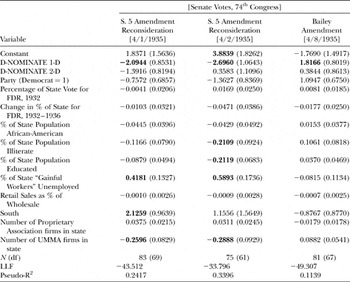
Roll call votes are available for three crucial votes on the Senate measure in the 74th Congress (1935–1936), and we analyze these votes here to test for the impact of observed ideology, party, region and organized interests. The first two votes were on procedural measures to reconsider an amendment that had been attached to S. 5 during committee. Those who favored a stronger FDA wanted to revisit the committee's decisions and voted “yes” on this measure. The third vote was a vote on the Bailey amendment prohibiting the FDA from regulating pharmaceutical advertising. Proponents of reform voted “no” on this measure, while most opponents of reform voted to pass it.Footnote 33
We conduct probit regressions of these three votes in the 74th Congress. Our regressors are chosen to unearth patterns of support for FDA-strengthening regulation before the sulfanilamide disaster. We first include two general measures of ideology or voting propensity, namely first and second-dimension D-NOMINATE scores. We also include the senator's party (1 if Democrat) and the underlying Democratic strength of his constituency, measured by the percentage of vote for FDR in the 1932 election. To this we add a variable measuring the shift in voter support for FDR from 1932 to 1936 as a way of measuring political trends within each state. We also include demographic and economic variables measuring the state's rate of unemployment in 1930, the percentage of its residents between the ages of 18 and 20 in school, the percentage of its residents who were illiterate as defined by the Census, and the percentage of its residents who were African-American. These variables capture salient political, social, economic and cultural features of states, features we include as controls in the hopes of properly estimating the contribution of ideology and business influence in a well-specified statistical representation of voting. To these we add a “South” dummy variable indicating the states of former Confederacy. We do not attempt to attach expectations to these variables and their coefficient estimates. The ethic of self-medication, for instance, interacted in complicated ways with literacy and education. The illiterate and less educated were more easily misled by patent medicine promoters and sellers, and they were less aware of more legitimized health treatments. Yet the more educated and more literate were also more able to read the newspapers and pamphlets in which patent medicines were sold to the public. Literacy and education could, at this time, be a double-edged sword in the genesis and reproduction of health fraud.Footnote 34
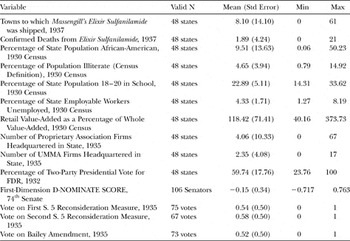
To test industry capture and rent-seeking hypotheses, we employ two variables measuring the presence of organized patent-medicine and pharmaceutical manufacturers in a state. The first measures the number of industry members of the Proprietary Association whose headquarters were in a state. The second measures the number of primary (above associate) members of the United Medicine Manufacturers' Association whose headquarters were in a state. Table 1 gives the summary statistics for these and other variables used in our analyses.
Descriptive Statistics for Selective Variables

The vote regressions in Table 2 suggest several factors. First, the first dimension D-NOMINATE score has a negative coefficient estimate in the first two regressions and a positive estimate in the third. Since higher scores indicate more conservative members, this result implies that more liberal senators were more likely to vote for the first two measures and less likely to vote for the third. Conditioning on this effect, Democrats appear to be slightly more likely to vote against FDA-strengthening legislation, but these coefficient estimates are statistically indistinguishable from zero. The variables measuring support for FDR are also insignificant, suggesting that underlying Democratic support in one's constituency did not, net of other factors, induce more or less support for reform.
Probit Analyses of Three Votes on S. 5 (Senate Votes, 74th Congress)

Notes: Asymptotic standard errors in parentheses. Bold coefficient estimate implies statistical significance at p < 0.05 (two-tailed test). UMMA firms and PA firms variables correlated at 0.5598. Removal of UMMA firms variable results in negative but insignificant estimate on PA firms variable.
A key result from the Table 2 regressions is that rent-seeking hypotheses are strongly rejected. The variable measuring UMMA firms headquartered in a state is negatively associated with “yes” votes for the first two reconsideration measures and positively associated with votes for the Bailey amendment. In other words, pharmaceutical interests aligned themselves against the legislation, and their legislative representatives followed suit. The variable measuring state-level presence of proprietary manufacturers is insignificant at the p < 0.05 level in all regressions.Footnote 35 In addition, senators from states with higher unemployment rates were more likely to support the reconsideration measure, which may reflect anticipated effects of tighter regulation upon proprietary manufacturers in the state. This result is not, however, predicted by a rent-seeking perspective.
Rent-seeking and industry capture explanations are not, then, supported by our probit regressions. Indeed, a hypothesis which runs counter to the capture perspective receives strong support. Affected industries, particularly the organized pharmaceutical firms that would have benefited from removed proprietary competition, nonetheless agitated against the legislation, and their representatives were more likely to vote against FDA-strengthening measures.
Indeed, pharmaceutical and proprietary opponents of the Copeland bill won the early battles. While the 1936 election confirmed FDR's popularity, strengthened the hand of liberals in the Democratic Party, and solidified Democratic congressional majorities, it did not generate added momentum for passage of new pharmaceutical regulation. Perhaps the most important reason was the rise of the Conservative Coalition in Congress, a cross-party alliance of southern Democrats and Republicans that frustrated many of Roosevelt's legislative initiatives through voting and through control of the House Rules Committee. For this reason, the challenge for Copeland and FDA officials was all the greater. Some of the most steadfast opponents of regulatory reform had just become more institutionally formidable.Footnote 36
IV. The Sulfanilamide Episode of 1937
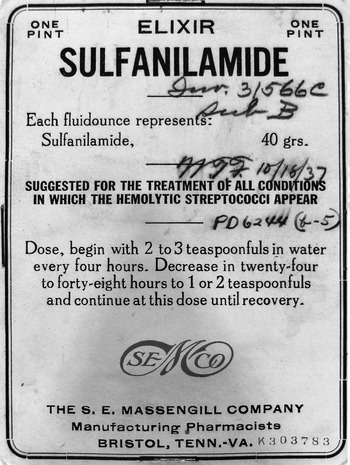
In the summer of 1937, Royal Copeland confided to friends and colleagues that S. 5, along with other hopes for strengthening the FDA's power over the pharmaceutical market, was dying. Months later, the FDA began to hear reports of several deaths in Tulsa, Oklahoma, associated with a proprietary drug called “Elixir Sulfanilamide,” an anti-infective drug manufactured by the patent medicine concern Dr. Massengill, of Bristol, Tennessee (Figure 1). FDA officials began investigating the Tulsa deaths, but as they did so, a number of other reports of mortality and morbidity, many of them among children, were making rounds in medical and regulatory and medical networks.
An Elixir Sulfanilamide Label, 1937 (RG 246, National Archives).

Dr. Massengill's Elixir Sulfanilamide was manufactured as part of a larger trend toward the use of sulfanilamides in the 1930s. Popular in Europe for the treatment of common colds, pneumonia and other infections, sulfanilamide was now making its way into many medicines manufactured in the U.S. FDA officials therefore suspected that the problem lay not in the sulfanilamide itself but rather in the elixir solution in which it was suspended for pharmacological delivery. Dr. Massengill's solvent, as it turned out, was diethylene glycol, which remains an essential ingredient in antifreeze and is highly toxic even in small doses.
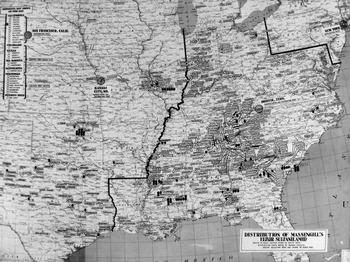
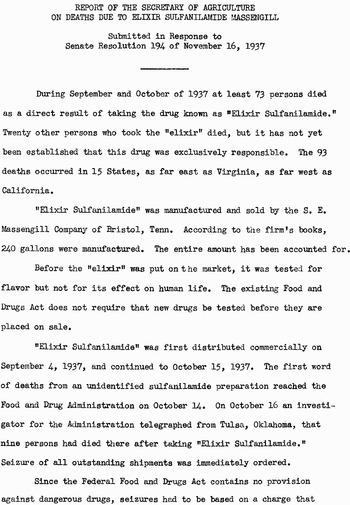
Dr. Massengill's Elixir Sulfanilamide began to ship to localities from three distribution points—New York City, Bristol, and San Francisco—in September 1937. By late October, seventy-three persons had perished in ways that doctors could directly attribute to having consumed the elixir. Another twenty deaths were suspected to be related to the drug, but the FDA and doctors lacked sufficient autopsy evidence to make a direct link in these cases. In the fall of 1937, an emergency session of the Congress called upon the Department of Agriculture (USDA) to make a report regarding the tragedy, and the secretary published a highly detailed report of the deaths that was cited repeatedly in the press and in congressional testimony. At the end of this document, the USDA published a map showing all of the shipment points to which the elixir had been distributed, as well as all localities in which any deaths occurred, as well the number of deaths occurring in a locality. A reproduction of this map appears in Figure 2.
Distribution of Massengill's Elixer Sulfanilamid (USDA Report to Congress, 1937).

As it turns out, the deaths from sulfanilamide were not as widely distributed, and the public outcry was not as broad, as blunt scholarly descriptions would have us believe. Jackson reports that “Fatalities took place in fifteen states, as far east as Virginia and as far west as California.”Footnote 37 Yet he fails to mention that most of the deaths occurred in southern and border states, and that some states of the former Confederacy were spared relative to others. There were six deaths in East St. Louis, Illinois, and another eight in Charleston, South Carolina. Louisiana experienced no fatalities, while Oklahoma experienced eleven, and Mississippi witnessed twenty-one. Part of the problem is that the map, which is in the legislative archives of the House of Representatives, was not published with the secretary's report. As a result, USDA officials and members of Congress saw the map, but the public (as far as we can tell) did not. Yet the concentration of deaths (and shipments) suggests something about the mechanisms by which the drug was propagated through a large population of consumers. The prescription and consumption of elixir sulfanilamide was probably dependent upon local referral networks and the idiosyncratic practices of individual physicians.
In order to get a richer understanding of the sulfanilamide tragedy, we conducted maximum likelihood count regressions of the number of deaths and the number of towns receiving shipments of elixir sulfanilamide, using two different levels of geographic aggregation (state and county). These analyses appear in Table 3, which reports the results of four negative binomial regression analyses. In each analysis, one of two variables—(a) the number of towns receiving shipment in a county/state or (b) the number of deaths in a county/state—is regressed upon several economic and demographic variables. These include all of the measures used earlier to proxy for education, literacy, racial composition of the population, unemployment, and retail/wholesale composition of the local economy. To these, plus the South dummy used earlier, we add the percent of the population that is in a classified “rural” area (farm and non-farm) and the log of value-added in manufacturing (a measure of aggregate wealth). The rural measure in particular is one that we hope will help to characterize some of the information networks that may have influenced prescription and consumption of elixir sulfanilamide.
Negative Binomial Regression Analyses of Shipments and Deaths From Elixer Sulfanilamide, 1937

Note: “Shipments” is not actual number of shipments but number of towns in the county/state that received at least one shipment of the elixir.
The count regression analyses show that the Massengill Company was more likely to ship elixir sulfanilamide to the South, to areas where the population was less educated, and both (1) to areas that were characterized by greater manufacturing value-added and (2) areas with more population in rural residence. The percentage population rural variable is insignificantly related to shipments and deaths in the county-level analyses, but significantly related in the state analyses. The reason probably has to do with the large number of rural counties in Southern and middle Western states, which have many more counties per state than do eastern and Pacific Coast states. Conditioned on the number of towns receiving shipment, deaths were unassociated with all of the variables in our analyses except the South dummy, a result that might simply imply that consumption conditional on shipment was higher in southern states than in non-southern states.
The brute facts of the sulfanilamide episode, then, were as follows. A product called “Elixir of Sulfanilamide-Massengill” was manufactured and distributed. Many consumed it after prescription as an antibiotic or as a treatment for venereal disease. Use of the medicine was most common in the upper-country South (Tennessee) and in the plains Midwest (southern Illinois, Oklahoma), and appears to have been disproportionately common among African Americans. People became seriously ill from its consumption, and, by late October 1937, at least seventy-three of these had died. The FDA, assisted by state and local health officials and the American Medical Association, commenced an effort to secure as much of the compound as possible before any more as consumed.
V. Sulfanilamide from Episode to Tragedy: The FDA and the National Media
How did the deaths resulting from elixir sulfanilamide use reach news organizations, Congress, and the public? How was the episode distilled into a tragedy, and what were the lessons of that tragedy?
The first reports of illness and death resulting from elixir sulfanilamide came not to the FDA but the American Medical Association. On 11 October 1937, Dr. James Stevenson, president of the Tulsa (Oklahoma) County Medical Society, sent a telegram to the AMA's Chemical Laboratory, stating that six deaths had occurred after prescription and administration of the elixir. Communications between the AMA and Tulsa area physicians continued, and the AMA Chemical Laboratory messaged immediately for a shipment of the Elixir, which the Massengill Company promptly sent. Upon cursory analysis and laboratory tests with experimental animals, the Chemical Laboratory concluded that diethylene glycol and not sulfanilamide was the causative factor in the deaths. Based upon this information, as well as new and independent reports of deaths coming from East St. Louis, Illinois, the Editor of JAMA issued a public warning on 2 October then again on 18 October, which also appeared in the 23 October issue of JAMA.Footnote 38
On 14 October 1937, three days after the initial Tulsa inquiry at the AMA, the first word of elixir sulfanilamide deaths reached the FDA. On 16 October, an FDA investigator telegraphed headquarters with news that nine persons in the Tulsa area had died there from taking the elixir. From this point forward, and for about three weeks, reporting of the deaths was shared by the FDA and the American Medical Association. There was a degree of mutual dependence in this reporting. The Administration relied upon AMA reports and its own investigators; the AMA relied upon FDA reports and its own information from networks of physicians.Footnote 39
The AMA's 18 October warning was reported a day later in various newspapers, using Associated Press wire reports. The Washington Post's title and subtitle were exemplary:
Venereal Disease ‘Cure’ Kills 8 of 10 Patients in Oklahoma
Sulfanilamide, Hailed as Remedy, Used in Fatal Preparation; Doctors Blame Other Drug;
Firms Seeks to Recover 375 Cases on Market.Footnote 40
As Post's headline suggests, the very initial accounts of sulfanilamide deaths never mentioned the FDA. The AMA had broken the story, and it was the manufacturer Massengill and not the FDA to which was attributed the attempt to remove Elixir Sulfanilamide from the market.
Additional insight into the character of the deaths can be gleaned from attention to the details of these early accounts. Although the elixir had been prescribed for various conditions, early reports described it as a “Venereal Disease Cure.” This was true in many cases, leading individual physicians to refuse to reveal the names of their patients to whom they had prescribed the elixir. Connected with this stigma, the early discussion of the drug and its using population also had subtle racial undertones. In the initial JAMA report, an AMA reporting chemist noted “In the last several days I have seen four deaths in patients using a product called “Elixir of Sulfanilamide” and sold by Massengill & Company. These patients, all Negroes, were treated by a Dr. Weathers of East St. Louis, Ill.” Dr. Morris Fishbein, editor of JAMA, had made an implicit reference to young black males purchasing the drug as a venereal disease cure when he stated that “the association had learned of widespread purchases in one city by youths attempting to treat themselves for venereal disease.”Footnote 41
By the end of the week (Saturday, 23 October), and certainly by the end of October 1937, the primary source of information on the sulfanilamide episode had become Campbell and the FDA. With the FDA feeding daily reports of its search and investigation activities to the Associated Press, media attention turned to the mounting death toll and whether the FDA could “round up” the medicine “in time” to save those who, with the elixir still in their medicine cabinets, were still at risk. Newspaper stories told of FDA officials working late nights and weekends to inform the public, of commandeering airplanes and academic chemists to search far and wide for remaining samples of the drug, and generally of a vast, nationwide operation centered in the FDA.
Seizure of Deadly ‘Elixir’ Saves Marylander as U.S. Hastens to Check Toll Already at 29
Death in Salisbury, Md., from the use of the drug “elixir of sulfanilamide” was narrowly averted yesterday while airplanes and chemists hastily drafted into service failed to save nine lives in other parts of the Nation.
…
From coast to coast, in large cities like New York and backwoods communities of the South, West and Midwest, field agents are desperately fighting against time to save lives of potential victims who have the elixir in their medicine cabinets.
With only four of these drug detectives available to cover Alabama, Mississippi, Louisiana and two-thirds of Texas, airplanes were chartered yesterday for the sake of speed. “We have never had an outbreak like this,” said Campbell, whose office in the south building of the Department of Agriculture is the nerve center of the life-and-death roundup.
“The only thing we are concerned with is taking the compound out of circulation, removing it from wholesale houses, drug stores, homes and wherever else it may be.” (Washington Post, 23 October 1937)
NEAR END OF CHASE FOR DEADLY ELIXIR. Government Agents Hope to Recover Today the last of 700 Bottles.
A nationwide race with death, seeking recovery of more than 700 bottles, mostly pints, of a new liquid medicine named elixir of sulfanilamide, which has already caused thirty-six verified deaths, was described today at the headquarters of the American Medical Association.
Every agent of the United States Food and Drug Administration is scouring the country to recover the bottles, said Dr. Morris Fishbein, spokesman of the medical association. By some time tomorrow, according to J. O. Clarke of the Food and Drug Administration, it is hoped that all the outstanding shipments will be recovered. (New York Times, 25 October 1937)
Nurse, Herself a Victim, Saves Six from “Elixir.”
While 200 agents of the Federal drug office yesterday scoured the Nation for bottles of deadly sulfanilamide and diethylene “elixir” still unaccounted for, Evelyn Sharborough, a pretty 28-year old nurse in Mount Olive, Miss., was caring for six patients surviving from 13 who were treated with the mixture.
…
In Washington officials of the food and drug administration spent Sunday within reach of telephones. Dr. J. J. Durrett, chief of the drug section, said the list of verified deaths from the elixir still stood at 37. (Washington Post, 25 October 1937)Footnote 42
FDA officials wasted little time in trying to frame the episode as evidence of the weakness of the 1906 laws and its patchwork of supplementary regulations. Technically nothing in the elixir sulfanilamide disaster implied that the Massengill Company had broken a single law. There was little basis in federal statute for prosecuting Bristol. The only charge against Massengill that stuck was an arcane mislabeling charge, namely that “elixir” implied alcoholic content yet “Elixir Sulfanilamide” contained no alcohol. On 19 October, just the second day of media reporting on the sulfanilamide deaths, Walter Campbell noted that only a thread of the current law prohibiting misbranding allowed the Administration to round up the elixir. Campbell said that the fatalities “are new evidence of the need for tightening the Nation's food and drug laws and predicted legislation to that end will be pressed at the coming session of Congress, in spite of failure to enact loophole plugs in the last few years.”Footnote 43 By the end of the week, a tidy bundle of facts and policy recommendations were consistently and almost imperceptibly bandied about news reports, including the fact that the elixir had violated federal law only by being misbranded:
Need for New Drug Laws Cited.
…
Calling attention to the need for drastic tightening up of the Federal food and drug laws, toward which numerous bills have been introduced, but none enacted, Bureau Chief Campbell and Dr. Durrett cited the following handicaps in the present emergency:
Intervention of the Food and Drug Administration is justified only because of the alleged misbranding, the “elixir” on the label being challenged, and not because the liquid contained poison.
Even though the preparation is known to have death-dealing properties, the Federal Government cannot legally make a seizure unless it has been shipped across a state line.
Confiscation of a bottle whose seal has been broken cannot be made.Footnote 44
Along with Campbell, Durrett, and their FDA associates, there were two other voices distilling policy lessons from the sulfanilamide episode. The first was Morris Fishbein of the AMA. In the Journal's 23 October editorial, he drew larger policy implications from the sulfanilamide episode:
The possibilities are unlimited because we are here concerned with a preparation not standardized by any reliable agency, semisecret in composition and apparently hastily rushed into the market to meet an overenthusiastic reception of a new remedy. This tragic experience should be a final warning to physicians relative to the prescribing and administration of this type of preparation.
Despite the presence of organizational distrust between the AMA and the FDA, Fishbein himself proved to be one of the FDA's biggest supporters.Footnote 45
A resounding political echo began to boom from the second voice, the national women's organizations who had long befriended the FDA. In a letter to her members on 28 October 1937, League of Women Voters President Marguerite M. Wells declared that the sulfanilamide events “point tragically to the need for Federal legislation ensuring a governmental check on such products before they are distributed to a helpless public.” Like other women's organization officials, she blamed “special interests” for Congress' failure to pass legislation revising and strengthening the 1906 act.Footnote 46
One week after the first media reports of deaths, observers commonly agreed that reform was likely. Yet despite the intensive media attention to the deaths and to the FDA's hunt for the elixir, nothing in the bills that had yet been floated before Congress contained a pre-market review provision of the sort to which Fishbein and Wells alluded. There was no sustained call for a gatekeeping clause or any form of regulatory licensure. The Washington Post editorial page noted the political status quo on 26 October 1937:
it seems certain that the current sulfanilamide incident will insure, at least, some improvement in food and drug regulation. The pending bill would broaden the definitions of, and put teeth into the penalties for, adulteration. It would also permit prosecution for misrepresentation, without requiring proof of fraudulent intent, as at present. It would not provide for Federal analysis and licensing of proprietary medicine as has worked so successfully in the case of vaccines. But even without this, it would be expected to prevent deaths similar to the “elixir” tragedies.Footnote 47
The Post editorial revealed how far the FDA, Congress, organized interests, and the organized public were from agreeing upon any form of gatekeeping provision. While it was certain that “improvement” would come, the Post's best guess was that licensure of patent medicines would not be among those improvements.
Had the elixir sulfanilamide story died out in late October 1937, it is quite possible that no premarket provision would have accrued to the FDA in the 1930s. Yet the sulfanilamide story endured, for several reasons. First, the deaths had occurred while Congress was out of session, and when the second session of the 75th Congress resumed in November 1937, FDA officials and Royal Copeland seized an opportunity to place the episode and its tragic meaning at the center of the legislative agenda. Second, the reports of deaths were still trickling in, creating something of a news cycle and fastening reporters to FDA officials week after week.
Ironically, the first synthesized report issued on the elixir sulfanilamide deaths was issued not by the FDA but in the Journal of the American Medical Association on 6 November 1937. The AMA's Chemical Laboratory, under the direction of Paul Nicholas Leech, commissioned a team of investigators from the University of Chicago and Johns Hopkins University and assessed the physiological effects of administration of three treatments: (1) diethylene glycol alone, (2) sulfanilamide alone (not suspending in diethylene glycol) and (3) repeated dosages of Elixir Sulfanilamide-Massengill. The results were unequivocal; diethylene glycol and not sulfanilamide was to blame for the deaths and illnesses.Footnote 48 Yet Leech (and probably Morris Fishbein) added language extolling the FDA's effort in securing unconsumed shipments of the elixir.
Deaths and clues of deaths were reported to the American Medical Association headquarters by various press services, by information received from physicians, and chiefly clues from the Food and Drug Administration. The latter organization placed a tremendous force of inspectors in the field. It obtained a list of approximately 700 shipments from the manufacturer. The inspectors then traced every shipment to its final destination. If the bottle had been opened, they inquired to whom it had been dispensed. It was in this manner that most of the deaths were traced after the original reports from Tulsa and East St. Louis.Footnote 49
Leech and Fishbein's acknowledgement was more than symbolic, for it pointed to a wider transformation in public responsibility for information provision in the wake of the elixir deaths. By the second week of November, when the Senate had reconvened and had asked (in Senate Resolution 194) the secretary of agriculture to issue a report on the deaths resulting from use of the elixir, the FDA's role in information provision about the episode had eclipsed that of the AMA. News reports of the elixir episode now mentioned the FDA almost exclusively, the AMA hardly at all. And the AMA, too (as Leech's editorial thanks to the Administration suggests) also relied heavily upon the FDA's reporting for its analysis. By November 1937, the agency had cornered a near monopoly on information about the deaths and the elixir.
Walter Campbell and the Wallace Report. From the very earliest stages of the sulfanilamide episode, Walter Campbell and his FDA associates saw an opportunity to add a pre-market licensing provision to the nation's food and drug statute. On 19 October, Campbell issued a press release advocating for a “[g]overnmental licensing system.” The release was largely ignored at the time, but Campbell kept up his campaign more quietly. In correspondence with Clark Gavin, managing editor of National Consumer News, Campbell confided on 28 October that,
In my opinion, full and complete public protection can be guaranteed against the preparation and sale of harmful medicines only by the adoption of proper preventative measures. Such products, in my judgment, should be marketed under Governmental supervision. This would require legislation authorizing control by the issuance of licenses . … a Governmental licensing system, at least for new and potent medicines, probably will be required if the tragic experiences growing out of the sale and use of this poisonous elixir of sulfanilamid are not to be repeated.Footnote 50
To underscore the point that support and publicity from mouthpieces such as Gavin's magazine and other consumerist outlets would be necessary for passage of FDA-strengthening legislation, Campbell added a sober prognosis of the prospects for near-term reform. Citing “powerful opposition to the enactment of a food and drug bill” he argued that “The promptness with which legislative action may be contemplated, and the adequacy of the law passed, will depend in large measure, if not entirely, upon the extent and the aggressiveness of consumer interests displayed.”Footnote 51
Campbell's next stratagem was to turn to Royal Copeland and the Senate. On 26 October, Copeland wrote Campbell and asked whether S. 5 as currently written would have prevented the elixir sulfanilamide episode. On 29 October, Campbell replied with a vivid and reasoned negative.
To seize these hastily concocted and untried preparations after discovery of their lethal effect, or to prosecute the manufacturer criminally, is not enough. It is our view that the bill [S. 5] should be amended to require a license from the Government preliminary to the distribution of all drugs containing any potent ingredient or combination of ingredients, the use of which has not become well established in medical practice.
In the interest of safety, society has required that physicians be licensed to practice the healing art. Pharmacists are licensed to compound drugs. Even steamfitters, electricians and plumbers are required to have licenses. Certainly a requirement that potent proprietary medicines be manufactured under license can be justified on the ground of public safety.Footnote 52
Campbell then closed the letter with a promise of full cooperation in drafting appropriate legislation.
I recognize the extreme difficulty that there may be in drafting suitable language for the amendment I am recommending. We shall be glad to make ourselves available for any help we can be of to you, to the Legislative Counsel, or to others whom you may ask to work on the problem.Footnote 53
The next crucial step, perhaps the crucial step as far as Congress and much of the reading public was concerned, was the release of Secretary of Agriculture Henry A. Wallace's report on the deaths. From the very first page of the report, Wallace and his FDA colleagues distilled one overwhelming lesson from the tragedy: the absolute necessity of pre-market review of drugs to assess their safety profile:
Before the “elixir” was put on the market, it was tested by the firm for flavor but not for its effect on human life. The existing Food and Drugs Act does not require that new drugs be tested before they are placed on sale.
… Since the Federal Food and Drugs Act contains no provision against dangerous drugs, seizures had to be based on a charge that the word elixir implies an alcoholic solution, whereas this product was a diethylene glycol solution. Had the product been called a solution, rather than an elixir, no charge of violating the law could have been brought.
… The fatal “elixir” was rushed onto the market without adequate test to determine whether or not diethylene glycol may be safely used as a solvent for sulfanilamide, despite previously published reports in scientific literature showing that diethylene glycol might be dangerous when taken internally. A few simple and inexpensive tests on experimental animals would have quickly demonstrated the toxic properties of both diethylene glycol and the “elixir.”Footnote 54
Wallace's report began with this “executive summary” of the sulfanilamide story. The implied causal inference was clear. Not only did elixir sulfanilamide cause at least seventy-three deaths, but deficiencies in the process by which the drug was brought to market, which were equivalent to deficiencies in the 1906 law, also caused those deaths. Just as clear as the implied causal story was the counterfactual: “A few simple and inexpensive tests,” the sort that would be performed by the company before marketing and analyzed in a pre-market review process by the FDA, would quickly have evinced the elixir's “toxic properties.” Translation: with a pre-market review process, none of this would have happened.
The structure of the Wallace report also laid bare the nature of the tragedy and the FDA's intended policy solutions (see Table 4). It proceeded, not unlike a court brief, from facts to conclusions in a near deductive manner. The USDA report started on its strongest footing, dealing first those facts of a scientific character, then the facts of historical and legal ones. It then proceeded methodically to limitations of the 1906 statute and suggestions for reform. It was also succinct, consuming twenty-three pages of double-spaced text.Footnote 55
Subject Headings in the USDA's Report on Elixir Sulfanilamide (November, 1937)

For several reasons, the Wallace report rendered the sulfanilamide tragedy even more evocative and memorable than it had been. First, USDA officials and news reports connected the deaths together in a way that wove the entire affair into a single narrative, making it ready for consumption by news hungry reporters and editors. Some portions of the narrative were particularly vivid, even visually so. Only a few deaths were among young children who had taken the drug to combat an infection. Yet one of these was the single most publicized death, both in congressional debates, in USDA reports, and (from what we can tell) newspaper coverage of the sulfanilamide episode. The most widely known story was prompted by a letter from Mrs. Maise Nidiffer of Tulsa—whose six-year-old daughter Joan died from taking the drug—to President Roosevelt. Nidiffer wrote of her daughter's harrowing death, “her little body tossing to & fro … & that little voice screaming with pain and it seems as tho it drive me insane [sic].” She pleaded with the president that he would “take steps to prevent such sales of drugs that will take little lives & leave such suffering behind and such a bleak outlook on the future as I have tonight.” Along with the letter she enclosed a photograph of her smiling but now deceased child, a print that made its way into several newspaper reports and into the USDA report on the tragedy (Figure 3). In the entire reporting on the deaths due to elixir sulfanilamide, the Joan Nidiffer story did not (so far as we can tell) surface until the Wallace report.Footnote 56
The Joan Nidiffer Photo, in Report of the Secrectary of Agriculture, 1937.

Maise Nidiffer's letter and the photograph of her daughter impelled and expressed the conversion of episode to tragedy. Together, text and image took what had been a series of scattered deaths among patients—many of them syphilitic black men—and purged it of blackness, of sexual maturity, and of social isolation. The victim of American policy failure was now a daughter connected to a mother and a loving family, a smiling white child who could not be said to have courted the agony that sulfanilamide wreaked upon her body.
In the pages immediately following the Nidiffer letter and the photo of the elixir's adorable young victim, the FDA turned immediately to the decisive action it took under the current law and the existing limitations of that law. Then, bringing the report to its culmination, Wallace issued four policy recommendations.Footnote 57 The department first offered an explicit argument for licensure, not of firms, but of products. And the Wallace report reflected the carefully chosen words of Walter Campbell in his letter to Copeland of a month earlier.
1. License control of new drugs to insure that they will not be generally distributed until experimental and clinical tests have shown them to be safe for use.
… It is the Department's view that no other form of control will effectively safeguard the public from the dangers of premature distribution of new drugs. To increase the penalties for violations and to require label disclosure of ingredients would be helpful, but by no means fully adequate.
In the interest of safety society has required that physicians be licensed to practice the healing art. Pharmacists are licensed to compound and dispense drugs. Electricians, plumbers and steam engineers pursue their respective trades under license. But there is no such control to prevent incompetent drug manufacturers from marketing any kind of lethal potion.
The first USDA suggestion seemed innocent enough, but it stood as the most far-reaching licensure provision to be enacted for any agency during the New Deal. The bills leading to the National Industrial Recovery Act (NIRA) of 1933 had proposed licensure of firms prior to market entry, but this idea was scrapped long before the bills came to a vote. Beyond this, the pre-market review provision that Wallace was calling for would give Congress (and ultimately the FDA) power to define what a new drug is.
However broad the power to define new drugs would be, there was a problem with relying on pre-market review alone. Drugs already on the market were not coverable under a licensure statute. So Wallace asked for FDA authority to prohibit these outright.
2. Prohibition of drugs which are dangerous to health when administered in accordance with the manufacturer's directions for use. This would provide a more appropriate basis of action than that on which proceedings were instituted against the “elixir.” A number of dangerous drugs are not on the market against which not even a trivial charge of violation can be made.
When passed, this provision and the pre-market review procedure would foretell the deathblow of the patent medicine industry in the United States. Not long in following were stringent labeling requirements, such that every adverse effect of which the manufacturer had prior evidence must be stated on the label.
3. Requirement that drug labels bear appropriate directions for use and warnings against probable misuse. Much injury results from insufficient directions and from lack of warning against overdosage, or administration to children, or use in disease conditions where the drug is dangerous, or the possibility of drug addiction.
Finally, FDA officials received their long-sought wish of a compulsory disclosure requirement for all ingredients (inactive as well as active) on the label of the drug. Diethylene glycol, after all, had not been the active ingredient in “Elixir Sulfanilamide-Massengill,” just a solvent. And as the report stated, this provision was intended to serve as much as a control on foreign firms as on domestic patent medicine manufacturers.
4. Prohibition of secret remedies by requiring that labels disclose fully the composition of the drug. Many foreign countries now impose this requirement. Many drugs manufactured in the United States are exported to such countries under labels bearing such disclosure. The same drugs are sold to our citizens under labels that give no hint of their composition.
Henry Wallace's report has long since disappeared from public memory, relegated to congressional and USDA archives and the appendices of aging legal histories of the 1938 legislation. Yet it is no understatement to say that Wallace's document forms the originary basis of modern pharmaceutical regulation in the United States and much of the industrialized world. The four enumerated powers—(1) pre-market review requirements, (2) prohibition (or withdrawal authority), (3) labeling regulation, and (4) compulsory disclosure of all drug contents (active and inactive)—have become assumed and core legal features of pharmaceutical markets ranging from European national economies and the European Union to Japan, India, Australia, Canada, and South Africa. While crucial provisions and procedures have been added to these powers, the origins of government gatekeeping authority over the pharmaceutical marketplace can, in many respects, be traced to this document.
More immediately, Wallace's report occasioned the biggest single flood of news reporting since the original deaths were reported. Headlines from New York and Washington area papers were noteworthy in their attribution of a drive or demand for new legislation that the Wallace report, the elixir deaths and the FDA's successful “roundup” of the drug had now created.
COPELAND ASKS CURB ON ELIXIR. Joins Wallace in Move for Tighter Law. AIMS TO PROTECT PUBLIC. Secretary of Agriculture has 4-Point Program to Guard Lives.
FEDERAL ROUNDUP OF ELIXIR REVIVES DRUG BILL DRIVE. Copeland Backs Wallace Rules as Secretary Tells How Deaths Were Stopped.
Elixir Deaths Result in Demand for Law.Footnote 58
On the House floor, Edward Herbert Rees (R–KS) complained that,
newspapers and periodicals are crowded with information and of incidents where individuals and companies have taken advantage of people by the hundreds and the thousands, by falsification of advertising and adulteration as well as misbranding of foods and medicines.Footnote 59
In this respect, the reaction to the disaster was not simply confined to the actual deaths but also to fear of numerous medications marketed under the title of “elixir,” as well as fear of other sulfanilamide drugs that were not suspended in a diethylene glycol solution. Worried consumers flooded FDA investigators and county and state medication societies with questions about whether they had taken a deadly medication, or whether anything in their medicine cabinet was safe. For this reason, the pattern of shipments of Elixir Sulfanilamide Massengill was just as important politically as the pattern of deaths it caused. Virtually every town that received at least one shipment of Massengill's elixir later hosted several or more FDA investigators, state food and drug regulators, members of state and local presses, and visitors from local and state medical societies.Footnote 60
The success of the FDA in quickly ridding the country of the elixir shipments was notable and noted. By December 1937, FDA officials had removed 99.2 percent of the 240 gallons of the elixir that were originally sent out in September. In his Federal Food and Drug Laws—Leaders Who Achieved their Enactment and Enforcement, Fred B. Linton offered a horrifying counterfactual: had the entire shipment of Dr. Massengill's Elixir Sulfanilamide been consumed, and had deaths occurred in the same proportion as they had to earlier levels of consumption, over 4,500 persons would have died from the elixir.Footnote 61
VI. The Sulfanilamide Tragedy and the Passage of the Food, Drug, and Cosmetic Act of 1938
The media reporting in the wake of the Wallace report bespoke a much deeper transformation (Figure 4). In late October 1937, even with the national news craze over the mounting death toll and the FDA's hunt for the remaining elixir bottles, there was no discussion of a gatekeeping provision. The Wallace report not only introduced this possibility, it also established the idea as the dominant alternative to the status quo. The USDA report tied the threads from news coverage, private experience (Joan Nidiffer), medical investigation, regulatory detail, and other features together into a story that made sense—a story in which the moral of policy reform followed narratively from the apparently brute facts. Media coverage of the momentum for new legislation now attributed the demand and drive for a new law to the elixir deaths, the Wallace report, and the quickness with which federal agents had tracked down the sulfanilamide supply and had removed it from the marketplace.Footnote 62
The Wallace Report of 1937—Progenitor of Modern Pharmaceutical Regulation.

In this light, Royal Copeland's introduction of a pre-market review provision was a reaction to the USDA's proposals, not a forerunner. Wallace's report was the first official proposal for gatekeeping authority. None of Copeland's bills had a gatekeeping provison before the report, and Copeland's first bill after the report wrote the USDA's recommendations in to a proposed law.
On 1 December 1937, Copeland introduced a new measure to replace S. 5. Copeland's S. 3073 had many of the provisions of S. 5, but added the pre-market review provision in Section 505, which remains today the basis for FDA review of new drugs. The bill required manufacturers to supply the USDA with records of their clinical and non-clinical experiments, a list of the drug's ingredients, a plan for manufacturing practices, and examples of labels. The secretary of agriculture would then certify the drug for sale or give reason why the drug was refused marketability. A proprietary trade journal warned that, under S. 3073, “the Food and Drug Administration would become absolute dictator, the overlord of the drug industry.”
In February 1938, Copeland's S. 3073 was considered again in the Senate. Women's groups and public health leagues now lobbied intensively for its passage, and their rhetoric made the clear the centrality of the Wallace report in the new deliberations. The Public Health Federation recorded itself as “heartily in favor of the recommendations of the Secretary of Agriculture, to protect the public against drugs like elixir of sulphanilamide.”Footnote 63 It passed the Senate again, and again unanimously, and was combined with S. 5 into a new S. 5, which went to the House, where the Commerce Committee, chaired by Clarence Lea (D–CA), again stalled the bill. The Lea Committee reported the House's version of the bill in April 1938, but with at least two significant differences from the Senate version. First, the Senate version provided explicitly for the regulation of combination drugs—bundles of drugs which were individually already on the market, but which were possibly new as a combination—whereas the House did not provide for regulation of these products. Patent medicine interests could exploit this loophole, it was feared, by selling combination products which, by virtue of their components' previous marketing, would bypass the FDA review process.
The second amendment to emerge from the Lea Committee was something of a poison pill that threatened the entire measure. Lea's committee attached a provision requiring the secretary of agriculture to respond to any suit against any regulation by withholding the entire enforcement of the regulation until court review, and conduct public hearings in response to any suit brought by a private party. The ostensible source of this amendment was the apple-growing interests of Washington State, who had been burned by tightened restrictions on lead arsenic in their pesticide sprays. It was later claimed by the St. Louis Post Dispatch that patent medicine makers and Washington farmers had secretly agreed to the court review provision as a means of killing Copeland's bill. The minority of the House committee, led by Kentucky Democrat Virgil Chapman, expressed its fear that “the bill, if enacted with this [court] review provision, will not any substantial improvement over the terms of the present law.” An Emporia Gazette editorialist lamented that “it is a pity the good things in the bill have no chance of being put into operation.” Reform supporters seemed now convinced that the court review provision had vitiated entirely the gatekeeping procedures of the bill. As a coalition of fourteen women's groups stated, “We are convinced that this proposal for judicial review of regulations more than offsets the improvements over the present law contained in this bill.” Representative John Coffee (D–WA) echoed this position when he asked “If the right to sell poison unbranded is a vested right—since when?”Footnote 64
In House debates in April and June 1938, the elixir tragedy loomed large. Coffee invoked the Wallace report's “excellent recommendations” and lamented that the bill reported by the Lea Committee had followed Wallace's suggestions “but in part.” He gestured poignantly to “such utterly needless and inexcusable tragedies” as the elixir disaster, “Shall we have to wait for another hundred deaths before we get proper preventative measures?” Jerry Joseph O'Connell (D–MT), with echoes of Maise Nidiffer's letter, shifted the focus from apple-grower interests to the elixir victims.
This [court review] section, as written, is decidedly for the benefit of the producer and not for the consumer.
It has been stated that the issue here is whether you are going to wipe out the investment of these poor apple growers, but I contend that the issue in this court review section and the issue in this bill is whether you are going to permit these young children and men and women to be killed by spurious patent medicines and by all the fake drugs and cures that are flooding the market today, which are far more involved in this bill than the question of the production of apples.
The question further is whether little children are going to die in vain and whether all this agitation over such poisonous deaths is to be in vain. The question is whether we are going to wipe all that out now in order to help a few apple growers in this country. I maintain that human life is far more important than profits.
Are we going to legislate for the great benefit of the American people and for the consumers of the United States or are we going to legislate for this little group?Footnote 65
S. 5 passed the House with the court-review provision intact. The end result of the provision, had it passed both chambers, would have wrought significant change in U.S. administrative law. No longer would courts be limited to reviewing administrative rules ex post; instead, rules would have to survive court review before they could ever take hold. USDA officials rightly foresaw that the court review provision was an invitation to endless delay of effective regulation by interminable lawsuits and complaints. In a composite letter of 22 April 1938, and sent to the House, representatives of fourteen women's groups threatened to lobby President Roosevelt to veto the measure entirely.Footnote 66
The FDA, Wallace, and Copeland saw their final triumph in the House-Senate conference committee that reported a consensual version of the bill on 11 June 1938. The court-review provision was dropped, and the conferees made it clear that the secretary of agriculture could promulgate regulations to define combination drugs as new drugs. After unanimous passage in both chambers, Roosevelt signed the bill into law on 25 June 1938.
For historical purposes, an essential puzzle is this: Why did Congress move from unanimous Senate support of a weaker bill in the first session of the 75th Congress (May–August 1937) to a generally unanimous approval of a stronger bill in the second session of the 75th Congress (April–June 1938)? There are several possible explanations other than the thalidomide tragedy, not least a host of possible narratives connected to the 1936 general election and perhaps the impending 1938 midterms. We discuss these below. Before examining this transition, however, we note that the voting data with which we can do so is rather limited. We have none of the House votes at our disposal, and all we know about the final outcome of the Senate is that it was unanimous.
Yet voting data are not the sort of data needed (much less sufficient) to address this question. We know that the 75th Senate passed a weaker version of regulation in its first session (1937), and a stronger version of regulation with gatekeeping authority for the FDA in its second session (1938). In both cases the House served to defeat or delay passage of the Senate legislation. What changed was not voting patterns but the content of the proposed legislation. What is needed to explain the 1938 legislation and its difference from 1937 bills, then, is not voting analysis but narrative.Footnote 67
Perhaps the easiest and starkest comparison can be conducted between the 1937 and 1938 versions of S. 5. This is something of a “test” of the effects of thalidomide—and in particular the Administration's framing of the episode—upon the legislation of the 75th Congress.
As the comparison in Table 5 suggests, virtually nothing else changed in the legislation from the S. 5 passed in 1937 to the final 1938 act. The electoral composition of the legislature was identical, the leadership of Congress and of the relevant committees were identical, the votes were identical, and all of the other provisions affecting food, cosmetics, inspection and seizure authority remained the same.
Comparison of S. 5 before and after Sulfanilamide Tragedy and Wallace Proposal

The tabular analysis, then, allows us to answer the counterfactual evidence posed earlier. In the absence of the sulfanilamide tragedy—the episode framed by the FDA and converted into a tragedy with specific political lessons—the 1938 Food, Drug, and Cosmetic Act would not have contained a pre-market review provision.
What of the 75th Congress? Several possibilities related to the 1936 election are evident as partial explanations for the 1938 legislation, in the sense that the composition of the 75th Congress may have been a necessary condition for the 1938 act's passage. It might be that many or most of the opponents from the 74th Congress were replaced by more liberal, pro-regulatory members. Another possibility is that increased competition from liberal Democrats in the home states and districts of conservative opponents may have led otherwise recalcitrant conservatives who remained in the 75th Congress to adopt a more pro-regulatory stance, as a way of making peace with FDR or to demonstrate to concerned voters that they could be friendly to some kind of consumer protection regulation.
While considering this, it is important to note the backdrop of the 75th Congress. It is significant that the 75th Congress was famous not for its liberalism but for its conservatism, namely the institutional emergence of the Conservative Coalition and its hostile takeover of the House Rules Committee. This coalition effectively frustrated many of Roosevelt's New Deal initiatives. Figure 5 sheds some light upon the possibility of change in the composition of the Senate. Using measures of congressional ideology that are directly comparable over time, we observe that the Senate became only marginally more “liberal” in its voting propensity from the 74th Congress to the 75th Congress. This difference, moreover, is not statistically significant.Footnote 68
Changes in DW-NOMINATE Medians, 69th–78th Congresses (Senate).

Part of what happened was a partisan transformation. The Democratic majority in the Senate went from 69–25 in the 74th Congress to 76–16 in the 75th Congress. In order for this shift to help explain the movement in regulation voting, however, it must have been the case that opponents of S. 5 were more likely to be replaced than those senators voting for it. We create a “replacement” variable scored 1 if a senator voting on FDA-related legislation in the 74th Senate was replaced and 0 if not. We then regress this variable on the votes for the three bills analyzed in Table 2. The t-statistics are −1.45 and −2.16 for the recommitment measures and −0.09 for the Bailey amendment. Only in the case of the second recommitment measure is there a significant relationship. There is indeed nothing resembling a systematic pattern here, and the votes on the Bailey amendment, which killed S. 5 in the 74th Congress, are entirely unrelated to replacement dynamics.
Of course, replacement and ideological shifts can only provide context. The 75th Congress, after all, passed a weakened reform initiative in 1937, before the sulfanilamide tragedy. So, too, FDR had lashed out at the Copeland measure in a press conference on 23 February. The Commerce Committee had dramatically weakened S. 5 and, while it then passed the Senate, it did so over the objections of Copeland, the FDA, and consumers' and women's groups. To make matters worse, the Senate in March 1937 passed the Wheeler-Lea Act giving control over all advertising regulation to the Federal Trade Commission. In the House, meanwhile, Copeland's much-weakened Senate measure was pigeonholed in the Senate Commerce Committee. The upshot of these developments is that the 75th Congress was, until the sulfanilamide tragedy, acting more conservatively on matters related to pharmaceuticals than was the 74th.
FDR's broadsides against the Copeland measure in February 1937—Copeland was the most vigorous Senate opponent of the President's court-packing plan—suggest one other thing. The shift in legislative fortunes for FDA-strengthening legislation was not one induced by FDR's warming to the Copeland bill. If FDR did warm to stronger FDA regulation of patent medicines and pharmaceuticals, this was a shift directly related to the fall 1937 tragedy.
A Southern Deathblow: The Geographic Burden of Elixir Sulfanilamide. While it appears that the sulfanilamide episode registered on a nationwide consciousness and agenda, it is also true (see Section VII and Tables 6–7) that the sulfanilamide deaths were somewhat geographically concentrated. In a way that seems symbolic now but was evident to few at the time, the pattern of elixir shipments, deaths and subsequent FDA visits struck in the very region that housed the most vocal defenders of the right of self-medication, and of the patent medicine industry. Newsweek reported that FDA officials were morbidly “jubilant” over the fact that the elixir was produced in the district of Carroll Reece (R–TN), a consistent and vocal opponent of FDA-strengthening legislation. The concentration of sulfanilamide deaths in Tennessee was also noted by Senator Josiah Bailey, a Senate foe of Copeland's measure who received mail asking him to change his stance on regulation “so to make impossible a repetition of the recent Sulfanilamide tragedy.”Footnote 69
Bivariate Correlation between Shipments of Elixir Sulfanilamide and D-NOMINATE 1-D

The Relationship between Sulfanilamide Shipment Incidence and Anti-Regulatory Propensity, 1937 (Senate Votes, 74th Congress)
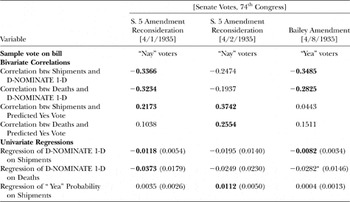
Notes: Asymptotic standard errors in parentheses. Bold estimate implies statistical significance at p < 0.05 (two-tailed test). * implies statistical significance at p < 0.10. “Univariate regressions” always include a constant term. “Predicted Yea Votes” and “Predicted Nay Votes” based on Table 2 models.
There is some narrative evidence to support a more specific hypothesis, namely that the sulfanilamide deaths may have peeled Southern members of the anti-regulatory coalition from its ranks and have moderated their opposition to FDA control. In the last, very brief Senate debate on S. 3073 in May 1938, Arthur Vandenberg still expressed his reservations about the measure, but Josiah Bailey, who was the most vociferous and public opponent of earlier reform bills, did not (even though he was apparently on the floor).Footnote 70
An explanation centered upon the framing of sulfanilamide plausibly accounts for the shift in votes from a divisive battle over a weak bill to stronger support for a vigorous law. It does, moreover, perform better than the available alternatives, which are irreconcilable with the anti-regulatory posture struck by the early 75th Congress. It is fully consistent with our argument, though not necessary to it, to hypothesize that the tragedy convinced everybody—whether their constituency was affected or not—that additional regulation was needed. The symbolic character of the tragedy made a gate-keeping provision more palatable to all those who had previously opposed strengthening the FDA, in part because neither Copeland nor Tugwell nor anyone else had written such a provision into any seriously considered bill. The key, in our analysis, is that the symbolic character was in part intentionally framed, emphasized and presented to the organized public and Congress by USDA-FDA officials.
Hardcore opponents of FDA authority continued to speak out against the Copeland legislation, implying that the unanimity observed in the vote was not indicative of a full embrace of the 1938 Act by all those who voted for it. Although the final House margin of passage was “overwhelming” (but also unreported), FDA opponents there continued a vigorous defense of the right of self-medication and loudly voiced their worries about the continued accretion of bureaucratic power to federal agencies.
VII. Conclusion: Lessons of the Policy Tragedy of Elixir Sulfanilamide
New regulations often follow tragedies, but not reflexively so. The reason that scholars and pundits call some adverse events “tragedies” and that others fail to enter the annals of popular and recorded history is that active political agents seek to frame and reinterpret episodes into tragedies. Of course, this process is loaded with unintended consequences and is rarely one in which any single agent takes full control. But because the FDA possessed a near monopoly on information relating to sulfanilamide and the deaths resulting from it, the conversion of sulfanilamide from episode to tragedy was in large measure the effective work of a single organization. Our analysis of the policy tragedy of sulfanilamide generates historical conclusions that may have broader application in the analysis of American political development.
1. The Debility of Capture. One of our strongest conclusions is a negative one. Rent-seeking and industry capture explanations of the 1938 Food, Drug, and Cosmetic Act fare poorly in explaining either the process of agenda-setting or the votes on regulatory legislation. Indeed, our analyses support not merely the null hypothesis that affected industries were uninvolved in buying protection from the legislative process, but the opposite conclusion that affected industries, including and especially those who stood to profit from entry barriers that would be created in the 1938 act, were opposed to new regulation. Both narratively and statistically there is consistent support for this claim.
This is not to deny the importance of the organized pharmaceutical industry and patent medicine associations in shaping the legislation and (perhaps) its administrative implementation. The emergence of American pharmaceutical regulation did witness business influence, particularly in successful attempts by industry allies before the fall of 1937 to weaken, sidetrack, or altogether gut the USDA's legislative proposals. Yet if business influence is observed, industry capture—the rigging of regulation by economic “incumbents” in order to restrict competition and create a marketplace with rents—is not.Footnote 71
2. The Political Timing of Episode and its Conversion to Tragedy. Second, the timing of the sulfanilamide tragedy allows us to gain some perspective on its precise contribution to the new regulation. The sulfanilamide deaths occurred after FDA leaders had, through steady and entrepreneurial political action, established an FDA-strengthening measure as the dominant alternative to the status quo. By the autumn of 1937, there was already a relatively structured debate between those who favored the existing body of law accumulated from the 1906 Pure Food and Drugs Act (or a slightly modified version thereof that would have given the Federal Trade Commission more power), and those who favored a bill that would have given the FDA broader regulatory authority over cosmetic and pharmaceutical products. In other words, the sulfanilamide tragedy did not “spur elected officials to promulgate governmental regulation,” as historian Charles Jackson has argued. Many features of the regulation had been proposed and refined before the deaths occurred. It was because of this context, not in spite of it, that the 1938 law passed.
With attention to the timing of the reform, the substantive political move that centers the narrative of American pharmaceutical regulation can also be understood. The most significant feature of the 1938 act was its inclusion of a gatekeeping provision—allowing pre-market rejection by the FDA of any drug intended to be introduced into interstate commerce the United States. Comparing legislation passed by one house of Congress, and before the tragedy, to legislation passed after the tragedy, we observe a crucial difference in the appearance, for the first time, of a provision for pre-market review of pharmaceuticals. Underlying voting patterns did not shift appreciably. It is the content of the bill that changed.Footnote 72
Because the FDA was successfully able to frame the sulfanilamide episode as exemplary of the defects of existing law, and as an instance in which the agency acted quickly and forcefully within its limited capacities, the sulfanilamide tragedy induced a change in the policy agenda. The form of regulatory legislation considered by Congress changed unalterably, as House and Senate leaders, at the prompting of FDA officials, attached a gatekeeping provision (Section 505 (a)–(c)) to the food and drug bill. The tragedy also shifted preferences among previously reluctant Southern Democrats and conservative Republicans, leading them to abandon the rhetoric of self-medication, to drop their resistance to FDA-strengthening legislation and to take up and pass the core legislation comprising the 1938 Act. Since 1937–1938 coincides with the emergence of a “conservative coalition” of southern Democrats and Republicans in Congress, the timing of the tragedy was particularly powerful.
Yet it is also worth reflecting on the historical context. The sulfanilamide tragedy occurred when the Senate and House were already well informed about alternative regulatory measures facing them. In both chambers of Congress, the FDA had found able and energetic sponsors for drug reform (Copeland and Virgil Chapman). Much of the costly work of building coalitions behind legislation had already been accomplished. Had the sulfanilamide tragedy occurred at another time, when FDA regulation as the dominant alternative to the status quo was not advanced by bureaucratic leaders, the Act would either not have passed or would have taken a much different form. In this respect, we can with some confidence reject the counterfactual that, had the sulfanilamide tragedy not occurred, regulatory reform in food and drugs would not have been on the agenda in the 75th Congress. It indeed was on the agenda of the 75th Congress in the spring of 1937. This is not to say that pharmaceutical regulation was warmly embraced by that legislature. What the sulfanilamide tragedy did, once distilled by USDA-FDA rhetoric, was to change the specific legislative agenda from regulation without licensure to regulation with licensure.
3. Framing: The Inversion of Victimhood, the Admixture of Race and Innocence. The third conditional feature of the tragedy concerns not its timing but its framing. In part due to the thorough and relentless efforts of FDA officials to turn and frame the sulfanilamide episode to the agency's advantage, in part due to media coverage (which relied heavily upon the FDA's information), two social facts became attached to the sulfanilamide episode. These facts and the episode constitute the “event-frame” match that propelled a more muscular version of FDA-strengthening legislation through the 75th Congress. First, the tragedy was seen as a nationwide disaster affecting primarily white victims, especially children. In fact, most of the sulfanilamide deaths occurred in the upper-country South and lower Midwest, and African-Americans were probably disproportionately affected by consumption of the elixir. Second, the FDA acted quickly to remove the entire product supply from the market, and its careful yet trumpeting presentation of this action both vaulted its reputation and left politicians and consumer advocates decrying weaknesses in the 1906 law. These were not fully consistent tenets, and the ultimate success of the FDA's activity was to bundle them into a logical, sense-making whole.
Perhaps the most striking reframing of the episode came in the way that first the USDA, then the 75th Congress and the American media, inverted the status of chemical victimhood and reframed the “target population” of pharmaceutical regulation. Whereas the early medical reports described a drug popular among mature men, many of them black, many of whom were seeking a quick and private treatment for syphilis, the Administration had, by the late autumn of 1937, morphed the exemplar of a sulfanilamide victim, and the visible casualty of policy failure, into the darling face of Joan Nidiffer. The victimhood of American policy failure had been inverted, from black, male, and possibly sexually licentious, to white, virginal and deserving. Although the contribution of the Nidiffer story to the act's passage is impossible to know with causal precision, it merits reflection that, in the 1937 and 1938 congressional debates, not one of the black male, rural male, or syphilis patient consumers of sulfanilamide was mentioned as a tragedy.
It is important, then, to consider how other advocates interpreted the sulfanilamide tragedy and how they read its lessons into rather different policy implications and statutory proposals. One of them was embedded in Charles Wesley Dunn's proposal to add another misbranding charge to any medicine that had not, before its market entry, proved its therapeutic claims. This would have changed the FDA's authority and the basis of a “misbranding” charge, but federal regulation of medicines would still have been regulation ex post approval, as it was from 1906 to 1938. Dunn's alternative proposal would have recognized the severity of the sulfanilamide episode but would not have gleaned from the tragedy the necessity of explicitly preventative measures.
Another set of alternative framings—admittedly less concrete and quite manifold—were all the other versions of the Copeland bill that had received serious consideration before October 1937. When the Washington Post and other news outlets waxed prophetic on the likelihood of new legislation, their editors had in mind the S. 5 that had passed the Senate in the first session of the 75th Congress, but which had stalled in the House. That bill, too, lacked a gatekeeping provision.
Our general conclusion, then, is that crises can in fact “lead to” or “cause” regulation, but the way in which they do so is politically contingent on the action of framing, an action that no one actor can entirely control. There is nothing in our argument or the primary evidence suggesting that anyone in the Food and Drug Administration deliberately or consciously misrepresented any feature of the sulfanilamide episode. Some features of the sulfanilamide affair were in fact tailor-made for re-interpretation. Some facts and sequences lend themselves to the production of lessons more than others do. Throughout the FDA was constrained by some “factual” features of the sulfanilamide episode. What its officials did—quite skillfully, it now appears—is to emphasize some features of the law more than others.
The policy tragedy of sulfanilamide also demonstrates the power of causal stories that are not backed up by statistics and logical argumentation, but are instead supported by logic that remains inescapably implicit, emotive, and moral. Storytelling and tragedy-weaving exercise a particular hold upon the political imagination, so much so that a narrative or a moving picture can be more persuasive than a research article. While the authority of statistical argumentation in modern politics is not in doubt, that authority is continually challenged by more symbolic and interpretive forms of policy argument.Footnote 73
4. The Role of the Audience. An essential feature of a tragedy is the presence of a judgmental audience.Footnote 74 In Sophocles' Antigone, it is the public chorus that interjects its assessments in the unfolding of the drama and, at the end, this same chorus distills lessons from the events of the preceding narrative. The tragic framing of the sulfanilamide episode was, throughout, dependent upon audiences in medical journals, in national and regional newspapers, and, most important, in Congress. Like the choruses of Sophocles and Euripides, these were not passive audiences. Morris Fishbein and Royal Copeland actively inserted their judgment and energy into the struggle over food and drug law reform. Yet the fundamental reshaping of the narrative of elixir sulfanilamide was accomplished by federal officials in the USDA. The crucial features of the USDA's framing were three: (1) its exposure of apparent weaknesses in existing law, (2) its conversion of victimhood from black to white, from maturity to childhood, and (3) its equation of such undeserved sulfanilamide deaths with tragedies that could and must be explicitly prevented through licensure.
5. Bureaucracy and the Interpretative Monopoly. It is, finally, worth remembering that a government agency, one well equipped to reveal and interpret the sulfanilamide affair, acted as the narrator of record in this story. In the act of framing, privileged access to the facts that are being distilled can generate greater authority and credibility of the interpretation produced. If she has monopolistic access to information about the case or events that others do not have, the agent can offer selective portrayal and selective emphasis, without being easily challenged on the facts.
This feature of the sulfanilamide tragedy helps to inform contemporary understanding of bureaucratic politics. Agencies often possess immense informational advantages, particularly when the facts in question are intimately known only by those who administer the specifics of policy. This has been of particular advantage to bureaucratic actors who wish to change policy not only through “standard” administrative means, but through the legislative process itself and in particular through to weaving of a coherent and alluring narrative that supports particular policy changes. In some respects, then, the making of the 1938 Food, Drug, and Cosmetic Act stands as another instantiation of bureaucratic autonomy, though different from notions recently advanced in institutional political science.Footnote 75
The endeavors of Walter Campbell, Royal Copeland, and Henry Wallace are forgotten now. Yet they shaped the American and global history of medicine and pharmaceutical development for decades in ways that have yet to be appreciated, and perhaps never will. Their actions amount to a form of political innovation, a feat shared in this case between a career bureaucrat (Campbell), an administrator emerging as a national politician (Wallace), and a career legislator (Copeland).Footnote 76 The saga of American pharmaceutical regulation and its origins demonstrates that political innovation and entrepreneurship, in its most powerful and enduring moment, consists in symbolic politics—in the interpretation, framing and public distillation of observable history.