


INTRODUCTION
Studies in the literature have described differences between offenders and non-offenders in terms of personality traits and adaptive patterns of behavior as well as the need to consider the individual differences among offenders and the level of engagement in delinquent behavior, not only the type of offense (Gibbons Reference Gibbons2002). It has been shown that each individual has a particular delinquent behavior trajectory with a level of engagement that varies according to the age of onset, duration and severity (frequency and seriousness) of the behavior (Piquero and Moffitt Reference Piquero and Moffitt2008). It is possible to group different individual delinquent behavior trajectories by similarities, using mathematical models in order to establish meta-trajectories, and visualize general patterns of behavior and study the associated conditions (Le Blanc Reference Le Blanc2003).
Komatsu and Bazon (Reference Komatsu and Bazon2015), for example, described a typology of adolescent behavior in institutionalized Brazilian offenders and non-offenders, based on their self-reported delinquent behaviors. The authors verified the existence of clusters going from “without offenses” to “with frequent and diversified offenses with early onset”.
The topographic heterogeneity of delinquent behavior points to the importance of looking at the personal and social variables associated with each meta-trajectory at any point of the individual’s development. According to Fréchette and Le Blanc (Reference Fréchette and Le Blanc1987), this variability in the intensity of the delinquent behavior implies a concomitant degree of social and psychological problems. For the great majority of juvenile offenders, who have a “common or normative delinquency”, personal factors play a secondary role in delinquent behavior, when compared with circumstantial and social factors. However, personality and psychological aspects become more important when considering delinquent behavior of adolescents with a persistent delinquency trajectory (Le Blanc Reference Le Blanc2003). Thus, the understanding of delinquent behavior improves when heterogeneity and psychological factors are taken into consideration for constructing categories that are used to create typologies. This systematization helps with etiological understanding and indication of different treatments (Tolan Reference Tolan1988; Le Blanc and Fréchette Reference Le Blanc and Fréchette1989; Worling Reference Worling2001; Espelage et al. Reference Espelage, Cauffman, Broidy, Piquero, Mazerolle and Steiner2003; Kamphaus, DiStefano, and Lease Reference Kamphaus, DiStefano and Lease2003).
Empirical typologies are derived from data using patterns of behavior (Lorr Reference Lorr1983) and studies have classified offenders using psychological typologies. In the classic study developed by Hewitt and Jenkins (Reference Hewitt and Jenkins1946), offenders were classified in three patterns of maladjusted behaviors based on their personality structures: “Socialized Delinquent Behavior”, “Overinhibited Behavior” and “Unsocialized Aggressive Behavior”. The “Socialized Delinquent Behavior” group shows a normal inhibition level when compared with the normative group. The “Overinhibited Behavior” group shows a chronic state of internal conflict and anxiety due to difficulties with expressing negative feelings. Furthermore, the “Unsocialized Aggressive Behavior” group shows personality that is marked by a difficulty with self-regulation and negative emotions, expressing them directly into the environment (acting out). The adolescents who have this profile may be in constant conflict, mainly with figures of authority. Several other studies in the literature have described similar profiles described by Hewitt and Jenkins (Reference Hewitt and Jenkins1946) with few variations.
More recent studies in the literature have used personality inventories such as the Minnesota Multiphasic Personality Inventory (MMPI) and the Millon Adolescent Clinical Inventory (MACI) for creating their typologies (Alarcón, Vinet, and Salvo Reference Alarcón, Vinet and Salvo2005; Fleckenstein Reference Fleckenstein2006; Williams Reference Williams2009). Another used inventory is the Jesness Inventory (JI), which distinguishes offenders from non-offenders in ways that are relevant to psychological management and treatment (Martin Reference Martin1981; Singh Reference Singh1983; Jesness Reference Jesness2003) through psychological profiles (Jesness Reference Jesness1983, Reference Jesness2003; Jesness and Wedge Reference Jesness and Wedge1984; van Voorhis Reference van Voorhis1988; Hubbard and Pealer Reference Hubbard and Pealer2009). The JI accesses the level of delinquent behavior engagement considering the antisocial values and attitudes (Saunders and Davies Reference Saunders and Davies1976; Graham Reference Graham1981) and predicts recidivism (Fraas and Price Reference Fraas and Price1972; Saunders and Davies Reference Saunders and Davies1976; Graham Reference Graham1981; Benda, Corwyn, and Toombs Reference Benda, Corwyn and Toombs2001; Benda, Toombs, and Peacock Reference Benda, Toombs and Peacock2002).
The 155-item JI yields age-normed T-scores on 11 personality trait/attitude scales: three empirically derived (Social Maladjustment, Value Orientation and Immaturity), seven based on cluster analyses (Autism, Alienation, Manifest Aggression, Withdrawal, Social Anxiety, Repression and Denial) and one developed from a discriminant function analysis (Asocial Index; AI) (Jesness Reference Jesness1964). Of further note, the AI is a composite measure generated from weighting selected personality scales and reflects the extent to which the youth engages in delinquent behavior and contravenes general social norms.
The Revised Jesness Inventory (JI-R) has the same factor structure of the original version; however, it contains five extra items that allow for the creation of two new scales that can be used for screening psychiatric evaluation need. So, the JI-R is composed of 160 true or false items that evaluate personality aspects related to antisocial conduct and delinquent behaviors, personal dispositions such as impulsivity, aggression, hostility, sensation seeking, and adaptive patterns such as antisocial attitudes, feelings and thoughts about oneself and others as well as defense mechanisms (Jesness Reference Jesness2003).
The JI-R has been studied in Brazil since 2012, when the instrument was submitted to an adaptation process to the Brazilian Portuguese language. On this occasion, the first studies of reliability and validity of the instrument were carried out, with sample data from Brazilian adolescents (Manzi-Oliveira Reference Manzi-Oliveira2012). Further validity studies are underway, and the results of all these studies provide evidence of good reliability and validity. Thus, we have the Brazilian version of the JI-R (JI-R-Br) (Bazon Reference Bazon2016).
So, the main objective of this study was to describe a personality typology of a sample consisting of institutionalized Brazilian male adolescent offenders, using their scores obtained using the Brazilian validated version of the JI-R (the JI-R-Br). The specific objectives were to identify different psychological profiles within the sample, and characterize them using the parameters of the JI, comparing them with a normative group and with the ones found in the literature.
METHODS
We administered the JI-R-Br to 858 institutionalized male adolescent offenders. We used principal components analysis (PCA) with varimax rotation using the instrument’s 10 personality scales and the AI. Sampling adequacy was obtained using the Kaiser–Meyer–Olkin (KMO) test which was .6, indicating that PCA could be used. We also used the Bartlett test of sphericity (<.001) which indicated that the null hypothesis is rejected, and the use of PCA is adequate.
However, the correlation matrix indicated a low correlation between one specific JI-R-Br scale (Repression) and the other scales, with r between –.26 and .11. Thus, this scale was removed and the PCA was recalculated with the 10 remaining scales. In the second analysis, the scales were reduced to two main components, resulting in 78% of the explained variance and the KMO and Bartlett values were .66 and <.001, respectively. Using the two components obtained, the Hopkins statistic (Lawson and Jurs Reference Lawson and Jurs1990) was used to assess the clustering tendency of the dataset. The result was H=.3, which is considered adequate for cluster analysis. Therefore, the data were clustered using the algorithm K-means method. Initially, the quantity of clusters was not established, since our cluster analysis was exploratory. To define the appropriate number of clusters, we used NbClust.
Alongside this, we also used the JI-R-Br data from 572 non-offender male adolescents (students) in order to acquire the parameter of comparison for the average scores of the scales in each cluster based on age. This was the normative group (group 4).
Descriptive analyses were used in order to characterize the clusters (groups 1, 2 and 3) and the normative group, representative of the student population (group 4) in terms of main measures and deviation related to age and scales. Analysis of variance was used to identify significant differences among the means for the scales in each one of the clusters. Tukey’s post hoc test was used to identify significant differences among the groups. The mean scores for each scale was normalized using the mean scores obtained from the offenders and comparing them using line graphs.
RESULTS
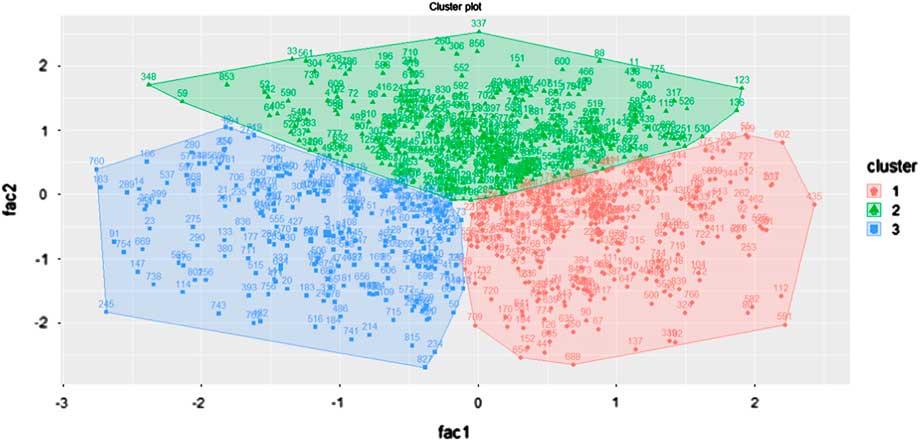
We identified three clusters based on the JI-R-Br scores: group 1 (32.2%), group 2 (40.3%) and group 3 (27.5%). Figure 1 shows the dispersion of the sample and the clusters. The x axis shows self-control values and the y axis shows the antisocial orientation values, according to the JI-R-Br.
Sample dispersion (n=858) according to the principal components. fac, Factor. For a color figure, see the online version of the article

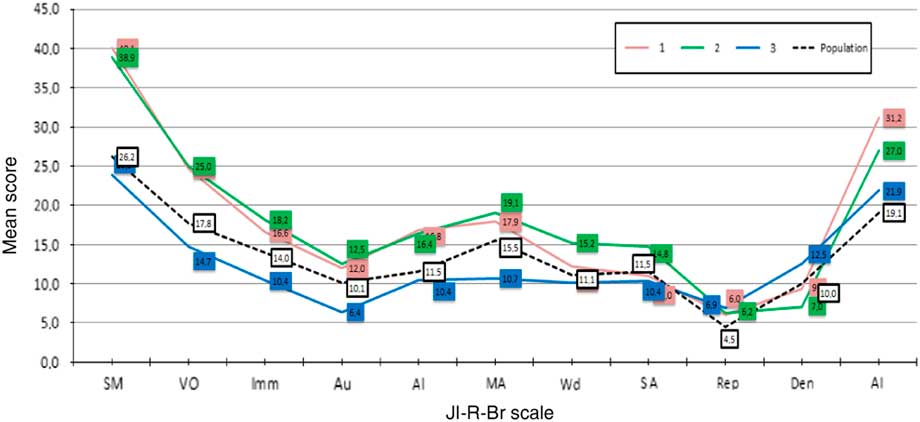
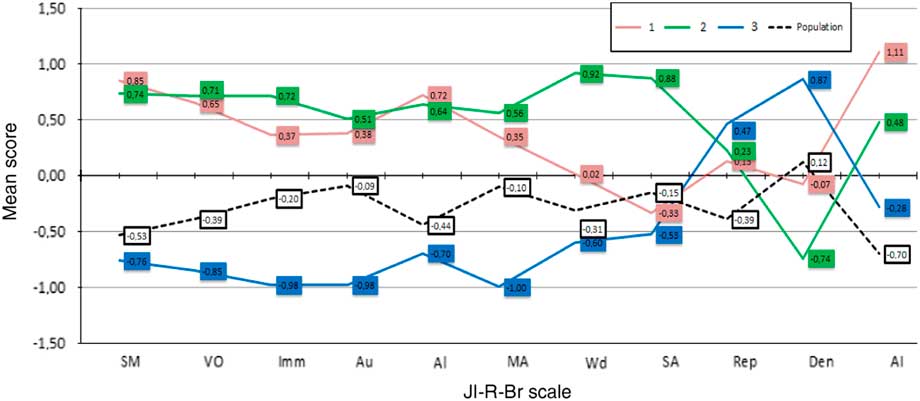
Figures 2 and 3 show the average profile of each cluster created from the average JI-R-Br scales. While Figure 2 shows the JI-R-Br typology for the three clusters identified and described based on the mean scores of each scale as well as the average profile of group 4 (normative group), Figure 3 shows the normalized data.
Brazilian version of the Revised Jesness Inventory (JI-R-Br) typology and average profile of the groups in the present study, including the normative (population) group. SM, Social Maladjustment; VO, Value Orientation; Imm, Immaturity; Au, Autism; Al, Alienation; MA, Manifest Aggression; Wd, Withdrawal; SA, Social Anxiety; Rep, Repression; Den, Denial; AI, Asocial Index. For a color figure, see the online version of the article

Brazilian version of the Revised Jesness Inventory (JI-R-Br) normalized typology and average profiles for all the groups in the present study, including the normative (population) group. SM, Social Maladjustment; VO, Value Orientation; Imm, Immaturity; Au, Autism; Al, Alienation; MA, Manifest Aggression; Wd, Withdrawal; SA, Social Anxiety; Rep, Repression; Den, Denial; AI, Asocial Index. For a color figure, see the online version of the article

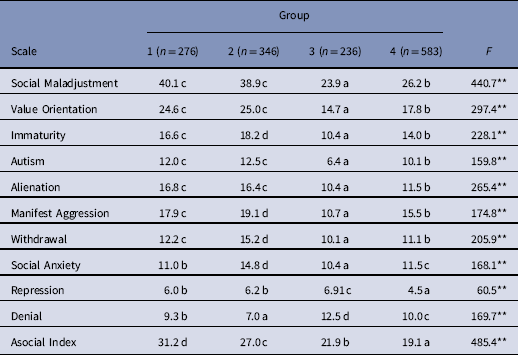
Table 1 summarizes the mean scores for all the groups including the normative group (group 4) in the different scales of the inventory and shows the significant differences among the profiles.
Comparison of mean scores for the Brazilian version of the Revised Jesness Inventory (JI-R-Br) scales found for each group

** Mean values within a row with unlike letters are significantly different (p<.001; Tukey’s post hoc test).
Even though mean ages of the participants were slightly different in each cluster, the only significant difference found was between group 3 (17 years) and group 4 (16.7 years) (p≤.05). Nevertheless, since all of the adolescents in the present study are between the ages of 16 and 17 years, they are considered to be in the same age group, which is the second half of adolescence. Thus, personal dispositions and behaviors are no longer exploratory; that is, they tend to express patterns and these reveal a personality in the process of consolidation (Le Blanc 2010).
DISCUSSION
We confirm that the JI-R-Br can be used to discriminate different psychological profiles among adolescent offenders, based on the three clusters in our delinquent adolescent sample. Thus, we can suggest that the inventory can be used for creating typology, corroborating the propositions of Jesness (Reference Jesness1963, Reference Jesness1983, Reference Jesness2003). The profiles determined by the instrument are different, mainly at the level of antisocial behavior motivation (antisocial attitudes) and behavior self-regulation ability (self-control), as well as other personality characteristics related to inter- and intra-personal relationship patterns. Due to this distribution, group 1 was called Asocial, group 2 Neurotic Antisocial, and group 3 Normative.
Group 1, the Asocial, comprised of 32.2% of our offenders, had the adolescents with higher antisocial motivation when compared with the other clusters, as well as low self-regulation of their own behavior. An antisocial motivation refers to an orientation (drive) that develops through social interactions and it is defined by distrust in authority figures, seeing them as disloyal, unfair and unreliable. Thus, the adolescents with this drive develop rejection of conventional values and rules, being prone to violate the norms represented by authority figures. Rejection of conventional values and rules contains adaptive patterns that can be labeled antisocial and is characterized by a deep inability to consider demands of the environment in a socially approved way. In the field of social interaction this group tends to be skeptical, especially of people who have a position of authority, when compared with the other groups, especially group 2.
However, the adolescents in this group tend to be less critical of their parents, even though they have a position of authority. The problems and conflicts living with their parents would be denied/repressed through the idealization of the parent’s figure and by directing negative feelings like anger and dissatisfaction, which come from family relationships, to society or other authority figures. These adolescents tend to blame other people for their problems, and project part of their feeling onto them, denying their own struggles in their relationships. They would feel misunderstood, hypersensitive to criticism, and thus prefer being alone. This psychological functioning would lead to a hostile attitude toward others, especially those outside of their families.
The adolescents in group 1 seem to have problems evaluating their motivation and intention as well as those of others, since they explain events and behaviors in a rigid way, have a self-centered way of thinking and struggle with insights. Thus, they would maintain beliefs about the benefits of becoming an adult earlier and attribute great value to physical strength, when resolving conflicts. Their fragile self-regulation capability leads to problems with controlling their own behavior. This happens due to their personal traits such as impulsivity (sensation seeking through risky activities) and a lack of psychological resources to deal with their negative feelings. In spite of these negative feelings, these adolescents maintain an appearance of strength and self-sufficiency, hiding their insecurity and negative self-concept. Negative self-concept is manifested in two ways: a decreased sense of self-worth, and distrust of and hostility toward others, which damage their capacity for establishing and maintaining social relationships. Negative self-concept prevents individuals from realizing and understanding the negative social consequences of their behaviors. Their psychological balance is easily disturbed by internal and external events, resulting in aggressive and hostile behaviors.
These characteristics mentioned above, found in our Asocial group (1), have been mentioned in other studies in the literature. The “Unsocialized Aggressive Behavior” profile described by Hewitt and Jenkins (Reference Hewitt and Jenkins1946) lists the same conflicts with authority, low self-regulation of negative emotions and aggressive behaviors. Our group 1 profile also has similarities to the type II profile described by Quay (Reference Quay1964a, Reference Quay1964b, Reference Quay1966, Reference Quay1977), the “Psychopathic Unsocialized”, defined by distrust in figures of authority, self-centered and impulsive disposition and aggressive behaviors.
Group 1 also has similarities to other profiles described in the literature obtained with evaluation instruments, such as the Minnesota Multiphasic Personality Inventory-Adolescent (MMPI-A). The “Psychopathological” profile, described by Fleckenstein (Reference Fleckenstein2006), shows a very damaged psychological functioning characterized by elevated levels of anger/hostility, using projection as the main psychological defense. The “Withdrawn Detached” profile, described by Williams (Reference Williams2009) also has similarities to our group 1, such as social and emotional isolation, and a generalized feeling of dissatisfaction without the resources to ask for help. However, unlike the adolescents in our group 1, this profile is apathetic, vulnerable in front of others, with depressive characteristics.
Other studies using the MACI have shown profiles similar to our group 1. In the typology proposed by Stefurak et al. (Reference Stefurak, Calhoun and Glaser2004), the “Disruptive, Antisocial” profile has aspects in common with the profile of our group 1. According to the authors, this profile is composed of adolescents with hostile and oppositional behavior, marked by a deep disregard for others and emotional superficiality. Alarcón et al. (Reference Alarcón, Vinet and Salvo2005) describe “Transgressor” individuals as those whose main characteristic is their antisocial attitude and who are not capable of understanding other people’s needs because they are centered on their own. This group eventually develops disruptive behaviors with transgression of social rules.
Our group 1 has similarities with more than one profile established in another empirical study using the JI: the “Aggressive Unsocialized” and the “Passive Unsocialized” (Jesness Reference Jesness1964). In the study published in 1964 by Jesness (van Voorhis Reference van Voorhis1994), the first profile comprises individuals with a solid negative attitude toward conventional rules, tending to show an antisocial, unpredictable and aggressive behavior. The second group comprises adolescents with a negative self-concept, with a tendency to show socially inadequate but non-aggressive behaviors.
The adolescents in our group 1 show high scores for aggression, so they would tend to act in an aggressive manner, having intense negative feelings and no behavior and emotional control. Maybe, our group 1 could be described as a hybrid profile, with characteristics from more than one profile. Butler and Adams (Reference Butler and Adams1966) presented initial clinical validation for the empirical profiles that they described using the JI, by professionally working with adolescent offenders. According to the authors, the professionals indicated the existence of mixed profiles. In their view, there were no pure profiles.
The mixed profile in our group 1 can also be explained by the methodology we used; statistical criteria only. Moreover, the more the sample is divided in clusters, the greater the likelihood of finding new and more specific profiles. In conclusion, it is possible to have subgroups from a theoretical point of view inside group 1 as seen in other studies. This possibility must be explored in future studies.
Our group 2, the Neurotic Antisocial, was composed of 40.3% of the offenders. The individuals in this group showed a strong antisocial motivation (but lower when compared with group 1) and a low self-regulation (similar to group 1). Like group 1, these adolescents also feel invaded by feelings of unhappiness, affliction and anger. Aware of these negative feelings, they would have a reactive behavior and would be more concerned about controlling their own behavior, when compared with group 1. These adolescents would have discomfort due to negative feelings but have concerns about showing them to other people.
During social interactions, these adolescents feel an elevated level of anxiety, differentiating them from all the other groups. They see people and social interactions as uncontrollable, feeling nervous, tense and inadequate in these circumstances; they show themselves as shy and retracted. Thus, they behave in a passive way, isolate themselves even when they feel loneliness, thinking of themselves as sad and depressed.
The emotions and the negative feelings experienced by them are related to disappointment with others, especially family members, and to feeling frustrated because despite their efforts, they cannot understand and feel good about themselves. So, they develop a negative self-representation and a low self-esteem. The abilities needed for social interaction and impulse control are very damaged in these individuals. The resources to deal with these difficulties are few, according to the average profile of group 2. They would be so immature and self-centered that their thoughts would be naive, rigid and distorted, making the comprehension of their feelings difficult. Just like group 1, they also maintain beliefs about the benefits of becoming an adult earlier and about the importance of using physical strength in order to solve their conflicts.
Comparing the description above with the studies in the literature, this profile seems to have similarities with profiles described in different typologies. The “Overinhibited Behavior” profile described by Hewitt and Jenkins (Reference Hewitt and Jenkins1946) with an elevated level of anxiety and internal conflict, personality marked by the development of overinhibition, is one of them. Group 2 also has similarities with the “Neurotic Disturbed” profile proposed by Quay (Reference Quay1964a, Reference Quay1964b, Reference Quay1966, Reference Quay1972), and their hypersensitivity to criticism, with a strong feeling of inferiority, anxiety, depression, shyness and introversion that lead to very few social skills.
Group 2 also has similarities with the “Interpersonally Sensitive” profile, proposed by Fleckenstein (Reference Fleckenstein2006), using the MMPI-A. This profile describes apathetic individuals who have feelings of loneliness, with a sense of inquietude and are sensitive in their social interactions. The “Withdrawn Detached” profile, proposed by Williams (Reference Williams2009), also using the MMPI-A, refers to our group 2 profile with feelings of anxiety/affliction, depression, fear of being misunderstood, paranoia and vulnerability in front of others.
Other studies that use the MACI, The Millon Adolescent Clinical Inventory, useful in the psychological evaluation of troubled adolescents (Stefurak et al. Reference Stefurak, Calhoun and Glaser2004), describe “reactive, depressives”, proposed by Stefurak et al. (Reference Stefurak, Calhoun and Glaser2004), and the “Inhibited-Avoiding”, proposed by Alarcón et al. (Reference Alarcón, Vinet and Salvo2005), which have similarities to our group 2. In both studies, the mentioned profiles have a negative self-concept, leading to a decreased sense of self-worth, as well as depression and insecurity in their social interactions.
The “Active Neurotic” and “Anxious Neurotic” profiles, presented by Jesness in 1964 (see van Voorhis Reference van Voorhis1994), have similarities with group 2. The first one describes individuals with a negative attitude toward conventional rules, having conflicts in their interpersonal relationships, tending to act passively during conflicts. The second profile describes individuals with a positive attitude toward conventional rules but with elevated levels of anxiety and insecurity. As happened with our group 1, group 2 is probably showing characteristics of more than one group.
The last established cluster of institutionalized offenders (group 3) is composed of 27.5% of the sample and was labeled normative in the present study. Although the cluster gathered adolescents with delinquent involvement, they do not show psychological characteristics that are much different from the adolescents from group 4, formed by adolescents–students of the population, according to JI-R-Br evaluation. For example, the adolescents from group 3 did not have a significant antisocial orientation, not even a self-regulation deficit, which suggests, at a first glance, that they do not have a significant delinquent engagement.
Group 3 can be characterized as having the most realistic and critical point of view about experiences, with a good capacity of understanding events and human behavior, when compared with the other groups (including the normative). Moreover, they do not experience many negative feelings like anger or sadness, do not distrust figures of authority and do not feel too much anxiety in social interactions. Group 3 has lower levels of depression and anxiety when compared with the normative group (group 4) and this can be explained by the difference in age between group 3 and group 4. Group 3 has the oldest participants and the maturational factor could have affected the results.
However, group 3 scored higher for defense mechanisms, when compared with the other groups. They have a higher score of Denial which indicates an attempt to avoid dealing with flaws, difficulties seen in themselves or others, mainly their parents. This mechanism would help them to not be affected by negative relationship aspects, especially family relationships. On the other hand, they also have higher scores for Repression, indicating a tendency to exclude any negative feeling and emotion from their consciousness. The frequent use of this defense mechanisms indicates a need to deny and repress aspects in order to maintain psychological well-being. This seems to contradict the idea that group 3 has a positive psychological functioning. A possibility of analyses to integrate the data would be to consider that due to having a good understanding of reality, this group’s defense mechanisms would be necessary and adaptive when the environment is too adverse, especially in the family context.
Others typology studies, using a psychological evaluation instrument or not, also mention the existence of one profile that is more pro-social, like our group 3. Fleckenstein (Reference Fleckenstein2006) described a “normative” profile. According to the author, individuals with this profile do not have high scores in the evaluated scales. They could be described as healthy without a tendency to have psychological problems. Alarcón et al. (Reference Alarcón, Vinet and Salvo2005), using the MACI, also identified a group without clinical scores, whose functional pattern is equivalent to the normative population. According to the authors, their offender behavior could be understood as a struggle to be accepted by their group of friends and as a search for gratification in social and affective terms. Focusing in a typology description based on the JI, according to van Voorhis (Reference van Voorhis1994), the “Cultural Identified” profile also describes individuals with positive attitudes toward social rules, having the resources and a social adaptation capacity, similar to the main characteristics of our group 3.
FINAL CONSIDERATIONS
Summarizing, the typology described here shows the existence of three personality profiles for the institutionalized adolescents sample, which correspond to the profiles described in other studies of typology found in the literature. The comparative typology analyses indicate the following similarities: description of profiles with considerable psychological problems and a profile without psychological problems. The ones characterized as the most damaged, such as group 1, have characteristics found in the “Sociopath” profile (Fréchette and Le Blanc Reference Fréchette and Le Blanc1987; Lykken Reference Lykken1995) and in others like the “Asocial” profile (Kinch Reference Kinch1962; Warren Reference Warren1971; Smiley Reference Smiley1977); these descriptions are of individuals whose development took place in an environment with deep deficits, who learned to be centered in their own needs, becoming hostile and thus creating fragile social bonds.
Group 2 showed similarities to the “Neurotic” profile (Fréchette and Le Blanc Reference Fréchette and Le Blanc1987; Warren Reference Warren1971) and others like the “Antisocial” profile (Kinch Reference Kinch1962; Smiley Reference Smiley1977), describing adolescents with many internal conflicts, elevated levels of anxiety and depression, as well as social isolation despite their desire and capability to bond with people.
Our group 3 does not have relevant psychological problems and shows similarities to the “normative” profile, describing adolescents who do not have special antisocial orientation or difficulties controlling their behavior, and the “Cultural” profile, describing adolescents who have criminal beliefs and values, probably due to being exposed to these ideas in their social group, but have normative psychological functioning (Hewitt and Jenkins Reference Hewitt and Jenkins1946; Quay Reference Quay1964a, Reference Quay1964b, Reference Quay1966, Reference Quay1972; Warren Reference Warren1971; Fréchette and Le Blanc Reference Fréchette and Le Blanc1987). Profiles cited in the literature contribute to the understanding of our group 3, since this group showed lower scores when compared with the normative group in almost all scales of the JI, but showed a slightly higher score in the scale that evaluates antisocial orientation (AI).
The greatest contribution of this type of scientific production is undoubtedly to bring to light offenders’ subjective experiences and personality formation. As argued by Fleckenstein (Reference Fleckenstein2006), without proper insight about the subjective experiences of offenders and the formation of their personality, their behaviors will always be superficially understood and punishment will always be the most defended treatment to modify their behavior. It is a very relevant problem, since punishment, besides constituting a revictimization of the individual, is a factor aggravating offenders’ psychological difficulties.
In addition, this type of study clearly shows the psychological differences among adolescent offenders. This is incontestable and cannot be ignored by the juvenile justice system. Only through this differentiation is it possible to identify the diverse configurations of needs and difficulties that these adolescents may have, which must guide the psychosocial and juridical intervention, in an effective personalized way, as confirmed by the Doctrine of Integral Protection, substantiated by The United Nations Convention on the Rights of the Child (UNCRC). Unfortunately, like the criticism made by Warren in the 1970s about the North American reality, the Brazilian Judicial System remains irrational: The decisions and intensity of the interventions are applied only when considering the nature and history of known offenses; the decisions are imposed before any evaluation of the case and without any rational decision that would justify psychosocial intervention (Warren Reference Warren1971).
Acknowledgements
The present study was funded by the São Paulo Research Foundation (FAPESP; 2015/11075-7): Jesness Personality Inventory: adaptation for the Brazilian context.
Marina Rezende Bazon is Associate Professor in the Department of Psychology at the Faculdade de Filosofia, Ciências e Letras de Ribeirão Preto, University of São Paulo. She graduated in Psychology from the University of São Paulo (1991), and earned a Master in Science in Psychoeducation from the University of Montreal/Canada (1995) and a Doctorate in Psychology from the University of São Paulo (1999). She is an Associate Member of the Brazilian Society of Psychology and a Member of the International Society of Criminology. She is the Coordinator of the Studies and Research Group in Development and Psychosocial Intervention (GEPDIP; University of São Paulo).
Lais Sette Galinari graduated in Psychology from the University of São Paulo (2016) and is a Master's student in the postgraduate program in Psychology at the Faculdade de Filosofia, Ciências e Letras of the University of São Paulo in Ribeirão Preto. She is a member of the Studies and Research Group in Development and Psychosocial Intervention (GEPDIP; University of São Paulo).