

I. Introduction
In a United States (US) House of Representatives Subcommittee on National Security and Foreign Affairs hearing in 2010, a panelist stated that the law of armed conflict with non-state actors, including terrorists, ‘does not fit neatly within any of the paradigms that have been discussed here today’, and that the law regulating counterterrorism was ‘fraught with dispute and contentiousness’. Footnote 1 The panelist was arguing that the international legal framework for counterterrorism operations lacks clarity and consensus, and that this indeterminacy in the law has enabled heightened contestation. Footnote 2 I argue that this contestation of international law in counterterrorism is shaped by a foundational disagreement: a legal interstice that lacks consensual rules between international humanitarian law (IHL), also known as the law of war, and international human rights law (IHRL). This indeterminacy in the international law of counterterrorism is the product of its uncertain place between the law enforcement and war paradigms. Prior to 11 September 2001 (hereafter 9/11) terrorist attacks, counterterrorism was primarily perceived as a law enforcement responsibility which would include the continued applicability of IHRL, but the invocation of a ‘War’ on Terror by the US and the subsequent use of the armed forces to combat terrorism in the Middle East left the status of IHRL in counterterrorism uncertain.
In other areas of international law, interstitial rules guide legal interpretation in these instances of overlap or ambiguity. These interstitial rules operate when more than one law is believed to apply to a particular scenario, or when unclear boundaries of a law’s application interfere with its regulation of any given issue. Footnote 3 US officials, in basing their legal justifications of counterterrorism operations on self-defence and the existence of an armed conflict, offer potential interstitial rules concerning the applicable legal framework to counterterrorism, but this approach is contested. This is evident in the proliferation of alternative legal paradigms between law enforcement and war to govern counterterrorism and drone warfare, and in the persistent calls for a return to a law enforcement model of counterterrorism throughout both the Bush and Obama Administrations.
This article takes up the concept of interstitial rules to understand both the overlap of legal frameworks and the persistence of legal contestation in counterterrorism. In doing so, it expands upon this concept by recognising that contextual factors can lead to legal overlap or ambiguity and by identifying the relationship of disagreement on interstitial rules to contestation of the law. While features of the law itself have been previously identified as the cause of interstices, defined as the areas of legal overlap and ambiguity between legal frameworks, the significance of contextual factors is evident in the War on Terror. The ‘irregular’ warfare of terrorism, innovations in weapons technology and the expansion of human rights norms and IHRL into areas traditionally regulated by the laws of war have destabilised the boundaries between these two areas of the law. The lack of agreed upon interstitial rules in counterterrorism has enabled contestation of core legal principles and previously accepted legal interpretations. This is particularly evident in the customary law of self-defence, the principle of distinction and the right of non-intervention.
The US is not the only state articulating a vision of international law in counterterrorism. However, as Evangelista argues in relation to bombing practices in general (including the use of drone strikes against terrorist), ‘The United States sets the standard for bombing practices and remains the focus of efforts to change those practices.’ Footnote 4 As the target of the largest single act of terrorism in history and thus the state most responsible for the counterterrorist response, the actions and legal justifications of the United States have taken on a higher degree of influence and importance, and, as a powerful state, it has the ability to substantially impact both custom and opinio juris. While the practices of other states, notably Israel, have also affected international law in counterterrorism, the scope and implications of the War on Terror and the use of drones for targeted killings in Afghanistan and, more problematically, in Pakistan, Yemen and Somalia are the foundation of much of the contestation of international law in counterterrorism. Footnote 5
In the next section, I define interstitial law and describe the process of interstitial rule-making. Then, I turn to the case of international law in counterterrorism in the US War on Terror. I identify the overlap between IHRL and the laws of war, examine why existing interstitial rules are insufficient and find support for this in the continued calls for a return to law enforcement and the proliferation of alternative frameworks for regulating counterterrorism. Finally, I trace these developments throughout the Bush and Obama administrations, and identify the consequences of this legal ambiguity in the contestation of other laws and rules, from customary laws of war to sovereignty, with special consideration of the principle of distinction.
II. Interstitial rules in international law
International relations and international law scholarship has only recognised interstitial rules (also referred to as interstitial law) in passing but they should be considered a core concern. Footnote 6 Political agents attempt to address ambiguities in the intervening spaces between legal frameworks with legal and normative interpretations designed to regulate this space. Areas of overlap and ambiguity between legal frameworks are interstices, and the rules that regulate them are interstitial rules. As a form of secondary rules, these contribute to the precision of primary legal obligations. Footnote 7 In contrast, unaddressed ambiguity undermines the law, as indeterminate rules tend to yield further to private interests. Footnote 8 In counterterrorism, the significance of these rules is made evident by the consequences of their absence. This includes disagreement over which legal framework should apply, contestation in the laws of war, and undermining of the rule of law, legal restraints on the use of force, human rights norms and the efficacy of counterterrorism operations. Footnote 9
The recognition that rules operate in the overlap of legal frameworks also emphasises the incomplete and contested character of international law. This point also marks a contribution this article makes to the first comprehensive account of interstitial rules written by Vaughan Lowe in 2000. In first articulating a vision of interstitial rules in international law, Lowe argued that they address interstices within or internal to the law. According to Lowe, interstitial rules can be described as ‘modifying norms’ which exist between primary legal norms when this space is indeterminate. Footnote 10 This is the case either when laws are believed to overlap in their application or lack definite boundaries. Footnote 11 Lowe’s account can be considered institutional ambiguity, or legal overlap that is the result of factors internal to international law.
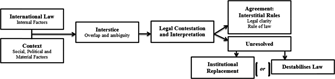
While agreeing with Lowe’s approach to interstitial law in general, I expand upon his conception of the origins of legal overlap or ambiguity. While Lowe sees this overlap as a product of the internal dynamics of international law, I argue that this can also be the result of changing social, political and material contexts in which the law operates (see Figure 1). Footnote 12 As such, interstitial rules address one aspect of the general problem of how law reacts to social and political change: the overlap of two or more primary norms. This can occur between any two (or more) areas of the law if overlap between them is plausible, and, in counterterrorism specifically, includes the overlap of human rights law and the laws of war resulting from changing social norms and the growth of irregular warfare. Footnote 13 I base this argument in an approach to international legal change that places legal interpretation, contestation and context at its centre. In the next two sections, I provide an account of how contextual change can create legal overlap, followed by a more detailed discussion of interstitial rules.
The process of legal ambiguity and interstitial rule-making

Context driven ambiguity in international law
Overlap of two or more areas of the law can occur either as a result of factors internal to international law or as a result of contextual changes. The former include the language of treaties or other sources of law, and the institutional processes of applying and enforcing the law. The latter refers to the social, political and material context of the law. Footnote 14 These factors may change over time, and may either spur the development of new legal interpretations, which themselves can contribute to overlap or ambiguity, or create new social and political conditions unfamiliar to old laws. Footnote 15 I label these sources of change the contextual reinterpretation of law and the changing environment of the law.
Contextual reinterpretation of the law occurs when social, political or material change leads political actors to develop changing interests or normative beliefs regarding the law. While interstitial law in the domestic context is a judicial practice designed to fill legal gaps by elaborating on, in the US context for example, ‘statutory patterns enacted in the large by Congress’, Footnote 16 in the international context there is no authoritative court within an established hierarchy to interpret the law or a legislature to create new laws. Footnote 17 Lacking these institutionalised mechanisms for change, political actors may perceive contextual changes as a reason to reinterpret the law, or to call for institutional creation or replacement. Footnote 18 With changing legal interpretations comes the possibility that actors will disagree on the meaning of a rule, or will seek to redefine a rule to match their interests. In such cases, the law becomes contested. Footnote 19 In other cases, new legal interpretations may garner agreement and rise to the level of customary law. In either case, the changes the law undergoes present new opportunities for ambiguity or overlap.
This legal change need not be conflated with legal or normative progress. Instead, international law in counterterrorism demonstrates how political actors can wield their influence in ways that destabilise rather than reassert contested laws. As will be seen in the case of the War on Terror and drone warfare presented here, legal interpretation can become an endemic problem for the rule of law when it falls within an unresolved interstice. This is because, lacking agreement on basic questions of legal framing, unresolved interstices can confound the identification of shared understandings.
Changes in the social, political and material environment of the law can also enable legal change. These environmental factors influence the law through its dependence on language. While the formal characteristics of law bestow a degree of ‘permanence’ to the meaning of legal obligations, this ‘permanence’ ultimately proves to be malleable, as the application and influence of the rule is wedded to communicative interaction and language. Footnote 20 Kratochwil argues that language is more than just the sounds of speech or words on paper: people tap into semiotic structures in order to articulate shared meanings, which constitute social order. Footnote 21 Likewise, Kratochwil has argued that legal interpretations cannot ‘be decided by a quick look at statutes, treaties, or codes’ but only through ‘the performance of rule application’. Footnote 22 This rule application crosses historical contexts, as the language of the original legal agreement must be made sense of in light of changing social norms, political interests, and material reality. When contextual factors differ from the moment of a law’s institutionalisation, the presuppositions upon which these rules were built are undermined, leaving them exposed to the pressures of contestation and the potential for either the reaffirmation of an original interpretation of a rule or the introduction of a novel interpretation. Footnote 23 In the War on Terror, these environmental changes are represented by the increased saliency of irregular warfare, developments in weapons technology and the growth of support and institutional enforcement of human rights norms.
Interstitial rules
Revisiting Lowe’s account of interstitial law, overlap within the institutions of international law produces ambiguity, which, as I have just argued, can also occur as the result of contextual change. Ambiguity between areas of the law means a lack of clear consensus on the law that thus exposes it to multiple possible interpretations. If the legal community identifies and agrees upon a clear interpretation that addresses these spaces of overlap or ambiguity, this amounts to the articulation of a new interstitial rule. Interstitial rules are not a functional category of law. Instead, the process is as fraught with contestation as is the application of law or the production of opinio juris in customary law. Not based in treaties or other written law, interstitial rules are the result of legal arguments that rise to the level of shared meanings. In this sense, the process of interstitial rule creation is similar to the process by which opinio juris is formed and disseminated in customary international law, as both are rooted in legal interpretation. Footnote 24
However, the similarity of the process of interstitial rule formation and customary law formation begins and ends with their common basis in shared legal meanings. Unlike customary law, interstitial rules are not wedded to custom and opinio juris. Footnote 25 While customary law is the law of consistency and of widespread agreement, interstitial rules are the law of absence or ambiguity. Customary law comes about through the sedimentation of expectations into law, while interstitial rules come about after the upending or disruption of expectations through previously unknown circumstances, as represented by the significance the War on Terror holds for the US and others involved in the interpretation of international law.
Despite this difference, the interaction of customary law and interstitial rules is significant, as either can effect change in the other. First, the legal overlap interstitial rules address can be the result of the failure of treaty law or customary law to present a clear legal solution to an issue. As such, while custom is a ‘slow vehicle for change’ in international law, it is nonetheless a source of change and thus a potential source for new areas of legal overlap. Footnote 26 Likewise, opinio juris, defined as ‘a subjective obligation, a sense on behalf of a state that it is bound to the law in question’, can lead to new areas of overlap, as the perceived applicability of a law expands or contracts. Footnote 27
Second, interstitial rules (or the lack of) also impact custom and opinio juris. International law is made of interdependent institutional features: written law, customary law and interstitial rules are in a co-constitutive relationship. As such, when overlap and ambiguity increase, as I argue is the case with the laws of war and human rights law today, this both instigates interstitial rule-making in the long term while also making it less clear which legal framework should be applied in the short term, which can undermine the effectiveness of customary and written law. Because interstitial rules are meant to guide the application of two or more legal frameworks, the absence of these rules infers an uncertain, contested basis for legal interpretation and application. As actors settle into customary actions and issue legal opinions over time, a lack of consensus on interstitial rules infers a contested basis for the law and will produce more contestation than agreement. Furthermore, this contestation will be more difficult to resolve without first building consensus around interstitial rules, and, in turn, the more contestation spreads across multiple issue areas within an area of the law, the harder it will be to resolve that interstitial tension.
While international relations and international law scholarship has recognised the concept of interstitial rules only occasionally, there are identifiable empirical examples of legal contestation and interstitial law-making. One such example comes from the report of the 2006 Study Group of the International Law Commission. This report, drafted to address the increasing complexity of the international legal system, noted the problem of ‘specialized law-making and institution-building’ with ‘relative ignorance of … adjoining fields and of the general principles and practices of international law’. Footnote 28 The Study Group found that this leads to conflicts between legal regimes, such as the ‘law of the sea’, ‘humanitarian law’, ‘human rights law’, ‘trade law’ and so on. In essence, this report identified the issue of interstitial rules and legal overlap (in all but name) when areas of the law collide without custom to guide their adjudication. Other examples include the Gabcikovo Case highlighted by Lowe and the contested overlap of the legal framework governing international trade with environmental, labour, women’s rights and other concerns. Footnote 29 As will be seen in the following section, such is also the case when a category of international conflict overlooked during institutional creation, state conflicts with transnational non-state actors, rises suddenly to the fore of international concern.
III. Legal interstices in US counterterrorism and contestation of the law of war
While the Bush Administration initially received international support for its claim of a right to self-defence, since 2001 the legal framework of the War on Terror – a substantial influence in the broader development of international law in counterterrorism – has been contentious. I argue that this contestation of international law in counterterrorism is shaped by a foundational disagreement: a legal interstice that lacks consensual rules between international humanitarian law, also known as the law of war, and international human rights law. This interstice is directly connected to the contested boundary of a war framework for counterterrorism operations versus a law enforcement framework; the acceptance of the former being related to the suspension of certain human rights laws and the latter to their full applicability. Footnote 30 This is, I argue, what has enabled the persistent contestation of a number of legal concepts in counterterrorism, including the boundaries of what constitutes an armed conflict, who constitutes a party to an armed conflict, the customary law of self-defence, the sovereign right of non-intervention, the distinction of civilians from combatants, and the lex specialis triggers of jus in bello.
Counterterrorism was not always a part of a ‘War’ on Terror. Within the United States, the pre-9/11 consensus on counterterrorism viewed it as a primarily law enforcement responsibility, with military involvement the exception to the rule. Footnote 31 Likewise, the various conventions, resolutions and statements made against terrorism by the international community prior to the September 11 attacks reinforce law enforcement as the dominant paradigm for counterterrorism at that time. Footnote 32 The application of a law enforcement paradigm to counterterrorism also meant that international human rights law (IHRL) would continue to apply to counterterrorist operations. While terrorism was seen as a violation of both criminal law and the law of war (when civilians were targeted or when the users of violence dressed as civilians) the language of these legal instruments suggests that counterterrorism was a wholly law enforcement and human rights law affair, as, for example, the statement on international terrorism adopted by the leaders of seven industrial democracies in 1986 called for ‘Improved extradition procedures within due process of domestic law for bringing to trial those who have perpetrated such acts of terrorism’, Footnote 33 and as customary international law had dictated the continued application of human rights law to law enforcement operations.
However, in the period since the September 11 attacks, the legal community’s consensus on law enforcement as the primary legal framework for counterterrorism has broken down, and the international law of counterterrorism is now contested. The legal debate concerning the applicability of either a war or crime framework in counterterrorism goes back to at least the 1980s, when the ICJ issued its ruling in the Nicaragua v U.S. case, but the US, UN and other responses to the September 11 attacks reinvigorated this debate. The Bush Administration’s initial choice of a ‘war paradigm’ based upon claims of self-defence in the conflict with al-Qaeda and the Taliban, and Congressional approval of an armed conflict in the Authorization for Use of Military Force Against Terrorists (AUMF), led the laws of war to be the applicable legal framework for US counterterrorism operations. This was done at the expense of the prior criminal law approach to counterterrorism, and left the status of human rights law in counterterrorism uncertain and potentially overshadowed by humanitarian law.
Enabling legal change: Interstitial ambiguity and overlap in IHRL and the laws of war
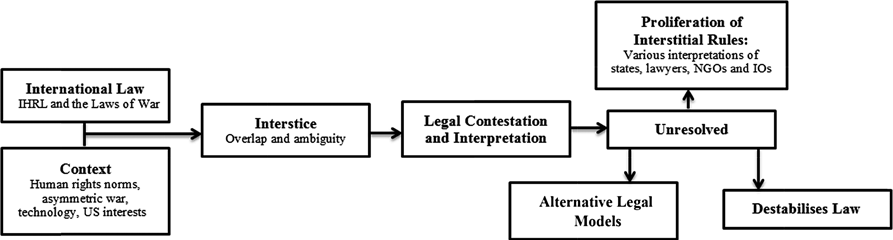
The competing influence of a law enforcement paradigm versus a war paradigm has led to indeterminacy as to whether human rights law or the laws of war apply to counterterrorism (see Figure 2). This is partially the result of the substantial overlap built into these two legal frameworks as a result of their concurrent development. However, factors external to international law also contribute to the shift from law enforcement and IHRL to the laws of war, and to changes in the interaction of these two bodies of law over time. There are some interstitial rules already addressing the overlap of IHRL and the laws of war. However, as I explain here, while the UN and ICRC have elaborated on lex specialis and the definition of an armed conflict to clarify the overlap of these two bodies of law, these rules have failed to address the ambiguity and overlap specific to counterterrorism. This is the result of competing rules articulated by the US, the fact that the UN and ICRC rules are reducible to the choice of states, and the changing context of law, including developments in technology, warfare and human rights norms. The continued ambiguity and overlap of these two bodies of law is evident in the proliferation of novel alternative frameworks for regulating counterterrorism.
Legal ambiguity and interstitial rule-making in US counterterroism

The overlap of IHRL and the laws of war has developed since their creation. Despite the significance of the post-WWII period for both IHRL and the laws of war, a report of the International Committee of the Red Cross (ICRC) states that they were treated as separate bodies of law at the time of the adoption of the Universal Declaration of Human Rights in 1948. Footnote 34 This began to shift, however, starting with the 1968 Tehran International Conference on Human Rights. Footnote 35 Now, international courts, international organisations, TNGOs and international lawyers recognise the overlap of the laws of war and human rights. Footnote 36 This overlap is attributable to both internal and contextual factors of the law. For the latter, the expanding influence of human rights norms and the proliferation of human rights institutions have increased the scope of IHRL. Indeed, the United Nations Human Rights Council (UNHRC) acknowledged in resolution 9/9 that IHRL protections continued to apply in armed conflicts. Footnote 37 The increased scope of IHRL and its application in war has led to a corresponding increase in occasions of overlap and opportunities for new interstitial rules.
Rules governing the interstice between IHRL and the laws of war already exist. For example, UNHRC resolution 9/9 states that IHRL can be superseded by the laws of war when applied as lex specialis given the existence of an armed conflict. Footnote 38 Furthermore, the UNHRC has issued guidance, in light of ‘a number of decisions by human rights and judicial organs’ which have ‘concluded that international human rights law applies at all times, irrespective of whether there is peace or an armed conflict’, on which body of law takes precedence if their rules provide opposing obligations. Footnote 39 In these cases, the UNHRC states that the lex specialis derogat legi generali principle provides a widely accepted approach to legal interpretation for the resolution of conflicts. According to this principle, ‘a more specific rule’ should always ‘take precedence’ over ‘a general standard’. Footnote 40 Applied to armed conflict, the UNHRC states that ‘cases involving the killing of civilians in an attack by a party to a conflict imply the application of the international humanitarian law principles of distinction and proportionality as lex specialis, with the relevant provisions of the Covenant being applied as complementary norms’. Footnote 41
Reliance on lex specialis as the interstitial rule in counterterrorism operations is also dependent on the definition of an armed conflict. The situation to which an armed conflict applies is designated by Article 2 common to the Geneva Conventions along with Additional Protocol I, Footnote 42 but neither actually provides a definition of an armed conflict. As such, commentary to the Geneva Conventions has sought to overcome this in both the case of international armed conflict (IAC) and non-international armed conflict (NIAC), defining the former as a conflict between two states’ armed forces and the latter as between a state and a non-governmental armed group. Footnote 43 Likewise, further clarification by the ICRC of the definition of a NIAC (which both the Supreme Court and the Obama Administration have declared the US conflict with al-Qaeda to be) has identified the intensity of hostilities and the organisation of non-governmental forces as the two factors determining the application of the laws of war. ICRC commentary provides more detailed descriptions of both factors:
First, the hostilities must reach a minimum level of intensity. This may be the case, for example, when the hostilities are of a collective character or when the government is obliged to use military force against the insurgents, instead of mere police forces.
Second, non-governmental groups involved in the conflict must be considered as ‘parties to the conflict’, meaning that they possess organized armed forces. This means for example that these forces have to be under a certain command structure and have the capacity to sustain military operations. Footnote 44
Together, these factors are meant to trigger the lex specialis application of the laws of war in the case of a conflict between a state and non-state armed group.
While this rule may seem clear, the ICRC’s definition of intensity is based on a state’s decision to use military force, effectively giving the state control over which body of law to apply. For example, the Supreme Court’s decision in Hamdan v Rumsfeld found that either IAC or NIAC rules must apply if the government treats US counterterrorism operations against al-Qaeda like an armed conflict. Footnote 45 The significant role of state action in determining the existence of an armed conflict exposes the legal framework of counterterrorism to both political and legal contestation. This is demonstrated by the controversial choices made by the Bush Administration regarding the application of an armed conflict legal designation. First, the initial decision to use armed force against al-Qaeda rather than law enforcement broke with established international and domestic practices in counterterrorism. Second, the Bush Administration then argued early in the War on Terror that its actions against al-Qaeda fit neither the category of IAC or NIAC, and were instead a heretofore non-existent ‘transnational’ armed conflict. Though this was overruled by the Supreme Court in Hamdan v Rumsfeld, US actions in the War on Terror were placed in a legal vacuum prior to this decision.
The changing context in which the law operates has also undermined the ability of lex specialis and legal definitions of armed conflict to regulate the overlap of IHRL and the laws of war. Changes in technology and the expanding influence of ‘irregular’ or ‘asymmetric’ warfare have destabilised prior understandings of a minimum level of intensity, organised armed forces, command structures, and a number of other identified features of an armed conflict. Technological innovations, including long-range artillery, chemical weapons, exploding bullets and now drones and cyber warfare (among many others), have long encouraged legal innovation. Footnote 46 However, the increased access of individuals and non-state groups to technology has enabled more actors to commit an act of violence that could credibly be seen as reaching a ‘minimum level of intensity’ for an armed conflict. Likewise, in the War on Terror and drone warfare, US officials’ most oft-cited impetus for the reinterpretation of legal obligations is the development of irregular or asymmetric warfare. Footnote 47 Terrorism and counterterrorism arguably undermine the traditional premise of the battlefield, Footnote 48 lead to the intermingling of civilians and the battlefield, Footnote 49 and undermine established notions of ‘Clausewitzean’ conflict, generally speaking. Footnote 50 The marginal position that non-state armed groups occupy in the written text of the laws of war is arguably indicative of the differences of a time when state authority over violence was presumed compared to the erosion of this authority today. Footnote 51 While states react to non-state armed groups as if they were part of an armed conflict, it is questionable as to whether or not these groups, particularly terrorist networks, fit the description of ‘organized’ armed forces with a given ‘command structure’ as laid out in the definition of armed conflict.
The reliance on lex specialis to govern the overlap of IHRL and the laws of war does not sufficiently control for the government’s framing of a conflict and the real tensions that occur when traditional concepts of armed conflict change. That these factors have complicated agreed upon understandings of what constitutes an armed conflict is evident in the contestation of the US claim that its counterterrorism operations in the Middle East do, in fact, constitute an armed conflict. For example, the International Law Association and the ICRC both disagree that terrorism triggers an armed conflict, and, consequently, that counterterrorism operations can be carried out in a manner that applies the laws of war as the more specific rule instead of IHRL. Footnote 52
The proliferation of alternative legal models (beyond law enforcement and IHRL, and the laws of war) to regulate counterterrorism is demonstrative of the lack of agreement on interstitial rules. For example, Braun and Brunstetter recommend a new legal concept titled jus ad vim that is designed to address the limitations of jus ad bellum and jus in bello. They base this recommendation on the perception that war and armed conflict ‘do not adequately capture the full spectrum of force available to statesmen’, as drone warfare and counterterrorism operations fall outside of both. Footnote 53 Likewise, in the 2010 Congressional Hearing, Glazier argued in favour of a ‘piracy model’ for counterterrorism that is ‘essentially conducted under laws more akin to law enforcement rules’ but is ‘considered to be beyond the scope of law that ordinary law enforcement agencies can deal with’, and thus requires the occasional use of military force. Footnote 54 The ‘Drone Accountability Regime’ recommended by Buchanan and Keohane, the vis perpetua model of conflict identified by Enemark and ‘modified preemptive war’ identified by Finkelstein are all also suggestive of the perceived need for a model beyond either law enforcement or war in counterterrorism. Footnote 55 Finally, Blum and Heymann conclude that the regulation of targeted killings fits ‘both a more constrained war paradigm and a more law lax enforcement paradigm’, demonstrating that neither is the clear fit. Footnote 56
Existing rules have so far failed to generate agreement on the application of either IHRL or the laws of war to counterterrorism. Much of this contestation can be traced back to the decision by the Bush Administration in the weeks following the 11 September 2001 attacks to abandon a law enforcement approach to counterterrorism. Furthermore, this choice and the contestation of the law of counterterrorism that it contributed to have persisted into debates surrounding counterterrorism operations in the Obama Administration, specifically the use of drone strikes in Afghanistan, Pakistan, Yemen and Somalia.
The war on terror versus the crime of terror: The Bush Administration and the war paradigm
While the international law of counterterrorism was based in law enforcement prior to the 11 September 2001 attacks, the US response broke with this tradition. In the immediate aftermath of the attacks, President Bush first responded with language aligned with a law enforcement framework for counterterrorism. On the evening of 11 September 2001 the President stated that he had ‘directed the full resources of our intelligence and law enforcement communities to find those responsible and to bring them to justice’. Footnote 57 While this suggested the continued application of a law enforcement approach to counterterrorism, in this same speech the President noted that the US and its allies would stand together in a ‘war against terrorism’. Footnote 58 The meaning of this comment would come to light with the passage of the Authorization for Use of Military Force against Terrorists (AUMF) by the US Congress on 14 September 2001. Subsequently, the President told a joint session of Congress on 21 September 2001 that ‘enemies of freedom committed an act of war against our country’, and that ‘We will direct every resource at our command … and every necessary weapon of war – to the disruption and to the defeat of the global terror network.’ Footnote 59
While the passage of the AUMF provided the domestic legal basis for counterterrorism operations in the War on Terror, the Bush Administration also invoked a right to self-defence against al-Qaeda and the Taliban under international law, and this claim received international support. The United Nations Security Council both reaffirmed the right to self-defence after the September 11 attacks and the need to ‘combat by all means … threats to international peace and security caused by terrorist acts’. Footnote 60 Outside the UNSC, recognition by the North Atlantic Treaty Organization and the Organization of American States that September 11 was an armed attack warranting a proportional response, participation or assistance of 76 states in Operation Enduring Freedom (the joint military operation against the Taliban and al-Qaeda), Footnote 61 vocal support from Russia, China and some Arab states, and a lack of condemnation from the Organisation of Islamic Cooperation, the League of Arab States and the members of Asia-Pacific Economic Cooperation all amounted to either direct or tacit support of the US claim of self-defence and the right to a proportional response. Footnote 62
Despite this support for US claims of self-defence, there were also arguments against the use of the armed forces to enforce those claims. Some state leaders were sceptical of the use of military force against terrorism. For example, Indonesian leaders worried that the War on Terror would be ‘some kind of anti-Muslim “crusade”’. Footnote 63 In the US, the Executive Director of Human Rights Watch, Kenneth Roth, defended the merits of a criminal law approach that would bring terrorist suspects to trial in a debate in Foreign Affairs. On the other side of the debate, Ruth Wedgwood saw the possibility of gathering sufficient legal evidence against a terrorist as doubtful. Footnote 64 Finally, criticism of the President’s ‘rhetorical transition’ between the law enforcement and war models was identified by Luban in 2002, who described the US approach to counterterrorism as a ‘hybrid war-law approach’ in which the US simply chose portions of each model that best fit its interests. Footnote 65
Furthermore, the declaration of a right of self-defence against an attack by a non-state actor broke with the standard set by the International Law Commission and International Court of Justice (ICJ) in 1980 and 1986 that self-defence could only be exercised by a state against another state. Footnote 66 For the ICJ, this opinion can be inferred from the decision in the Nicaragua v U.S. case, in which it was determined that self-defence could be triggered only when a state sent non-state ‘armed bands, groups, irregulars or mercenaries’ in an armed attack against another state. Footnote 67 Notably, it was after this decision that the US withdrew from the court’s compulsory jurisdiction. The ICJ reaffirmed this opinion in the 2005 case Democratic Republic of the Congo v Uganda, where it rejected Uganda’s right to use force in the Congo against non-state armed groups originating there. Footnote 68
The Bush Administration’s actions in the War on Terror provoked other areas of legal contestation beyond the applicability of the war model and the declaration of the right of self-defence against an armed attack. This includes the previously mentioned argument that the conflict with al-Qaeda was a ‘transnational’ armed conflict, and not an IAC or NIAC as regulated by the Geneva Conventions, which was overturned by the Supreme Court in the Hamdan decision. Footnote 69 Other attempts at law avoidance by the Bush Administration were the more prominent legal controversies of the War on Terror. The decision by the Bush Administration to revoke prisoner of war status for terrorist detainees by dubbing them ‘unlawful’ enemy combatants, the subsequent suspension of habeas corpus rights for those individuals, and the use of torture and other harsh interrogation practices stand out as the most legally contentious counterterrorist practices of the War on Terror.
The tension between IHRL and the laws of war and the contestation of core law of war principles has continued beyond the initial years of the War on Terror into the Obama Administration. This has included, in particular, the legal controversy surrounding the use of drone strikes against terrorists not only in Afghanistan, but in territories such as Pakistan, Yemen and Somalia that fall outside of the original application of the AUMF. On 3 November 2002 the first drone strike outside of Afghanistan occurred in Yemen, followed 18 months later by a CIA strike in Pakistan on 17 June 2004. Footnote 70 Since then, the US military has issued drone strikes in Afghanistan, while the Central Intelligence Agency (CIA) is reportedly operating drone programmes in Pakistan, Yemen and Somalia. The Obama Administration had reportedly killed 2,464 people by drone strikes as of February 2015, and, while drone strikes alone may be legal under the laws of war, these strikes occur in the legally contested context of the international law of counterterrorism. Footnote 71
An expanded air war: The persistence of legal contestation in the Obama Administration and the consequences of unregulated legal interstices
The Obama Administration dropped the language of a ‘War on Terror’, adopted friendlier language vis-à-vis the laws of war, and altered some legal justifications of US counterterrorism policy. Footnote 72 Yet, US counterterrorism under the Obama Administration has continued the trajectory of its predecessor in the reliance on the laws of war. Footnote 73 Despite dropping the ‘enemy combatant’ designation its predecessor had developed to justify the practice of indefinite detainment, its policy regarding the targeting and detainment of terrorist suspects actually expanded to include not only the Taliban and al-Qaeda but also ‘associated forces that are engaged in hostilities against the United States’. Footnote 74 Likewise, while the ‘War on Terror’ label was dropped, the President continued to invoke the rhetoric of war to describe US counterterrorism operations, stating, for example, that the response to the September 11 attacks was ‘a different kind of war’ and that ‘We have now been at war for well over a decade.’ Footnote 75
The expansion of potentially targetable or detainable terrorist suspects is also related to the Obama Administration’s particular use of the AUMF and the right of self-defence pursuant to Article 51 of the UN Charter. Legal scholars have pointed out that the Obama Administration appears to have linked particular combat operations to the ongoing claim to self-defence set out in the AUMF, establishing what Corn calls ‘self-defense targeting’. Footnote 76 Decisions concerning which individuals may be declared combatants and thus may become the target of a drone strike are based in an ongoing determination of self-defence based on an anticipated, future terrorist attack rather than an actual attack. This policy has coincided with a sharp increase in the number of individuals targeted by US drone strikes during the Obama Administration, particularly in Pakistan. Footnote 77 Likewise, this ongoing reference to self-defence has made it appear to be the Administration’s legal basis for counterterrorism operations, which conflates the jus ad bellum principle of self-defence with jus in bello regulations of combat operations. Footnote 78
Criticism of the legality of drone strikes in Pakistan, Yemen and Somalia led the Obama Administration to break a long silence on the legal justification of drone warfare that lasted from the Bush Administration’s first use of drones in Yemen in 2003 until a speech by Attorney General Eric Holder in 2012. On 5 March 2012, Holder reaffirmed the right to self-defence, stating that it had not been ‘changed by the fact that we are not in a conventional war’, and that the legal use of armed force went beyond the battlefield in Afghanistan as the conflict is with ‘a stateless enemy, prone to shifting operations from country to country’. Footnote 79 Obama also reiterated the ongoing reliance on self-defence claims as justification for the use of force in and outside of Afghanistan and the legality of drone warfare in May 2013, and again in 2014. Footnote 80 In 2013, the President stated that the scale of the threat of terrorism was still comparable to the threat faced on September 11, and that, while counterterrorism should no longer be considered a ‘boundless global war on terror’, ‘targeted efforts’ were still needed in not only Afghanistan but also in Pakistan, Yemen, Somalia and Mali. Footnote 81 Likewise, in this speech the President simultaneously argued the legality of drone strikes under domestic law by invoking the AUMF while also promising to pursue its repeal at some point in the future. Footnote 82 The President clarified this policy in 2014, arguing that in response to ‘decentralized al Qaeda affiliates and extremists’, ‘we have to develop a strategy that matches this diffuse threat—one that expands our reach without sending forces that stretch our military too thin’. Footnote 83 The Administration’s legal justification of the use of targeted killings rests on the notion that al-Qaeda and its affiliated network still pose an imminent threat to the United States or its allies, and therefore trigger the right to an armed attack in self-defence.
Obama Administration policy on drone warfare has been contentious in both domestic and international audiences. Pushback against the US interpretation of the right of self-defence led Congress to call a hearing on the legality of drone warfare in 2010. Here the Administration’s claim of the continued applicability of a right to self-defence was met with some support. In his written statement to Congress, Anderson argued that US drone strikes in Pakistan, Somalia and Yemen could still be legal under the doctrine of self-defence. Footnote 84
But other arguments made in the 2010 Congressional Hearing also highlighted the contentiousness of legal debates on drone warfare, and the distinction between the law of war versus IHRL and law enforcement in counterterrorism continues to be central. In her statement, O’Connell repeatedly referred back to the rights and obligations of law enforcement personnel pursuant to criminal law and IHRL. She began by distinguishing the right to use drone strikes in armed conflict along with the prohibition on their use outside of conflict. She argued that drone strikes are a ‘significant kinetic force’ which are ‘permitted on the battlefield’ but not when ‘carrying out law enforcement activities’, a distinction that was significant when, as she argued, an armed conflict could only be recognised in Yemen and Pakistan to the extent that those states were already engaged in a conflict with a non-state actor in their territory. O’Connell argued that the US could conduct drone strikes in these states’ territories with their permission only when assisting in such a pre-existing conflict, but could not extend the boundaries of its own conflict there. Lacking this permission to participate in a pre-existing conflict, the US would have the right to use lethal force ‘only in situations of immediate necessity to save a life’, which is the same right ‘we give the police’. Footnote 85 This is because, according to O’Connell, either no armed conflict could be said to exist in these territories, or the US could not be said to be involved.
Other examples of the continued relevance of the choice of the ‘war paradigm’ over that of law enforcement abound. For example, Brooks argues that the choice amounts to the dilemma of the ‘duck-rabbit’, or a single image that can interpreted two ways:
Like Wittgenstein’s duck-rabbit, the 9/11 attacks can be seen as crime, as war, or as isolated armed attack—and just as the duck-rabbit may strike the viewer differently when surrounded by a backdrop of rabbits versus a backdrop of ducks, a great deal depends on whether one views 9/11 against a backdrop of crimes or a backdrop of military attacks. Considered alongside the Oklahoma City bombing, the murderous activities of Mexican drug cartels, or the Rwandan genocide, the 9/11 attacks look like crimes: crimes on a massive scale, even crimes against humanity, but crimes all the same. Considered alongside the 1976 hijacking of an Air France jet or the 1998 bombings of US embassies in Kenya and Tanzania, the 9/11 attacks might look like isolated violent incidents that could nonetheless trigger a temporary right to respond with armed force in self-defence. Considered alongside the 1996 World Trade Center bombing, the 1998 embassy bombings and the 2000 attack on the USS Cole, the 9/11 attacks look like another stage in an ongoing armed conflict. Footnote 86
A 2015 ICRC report likewise reinforced O’Connell’s conclusions about drone strikes in ‘non-belligerent’ states such as Yemen, Somalia and Pakistan and stated that a ‘civilian participating in hostilities’ located in one of those states should be ‘dealt with under the rules governing the use of force in law enforcement’. Footnote 87 President Obama also contributed to this confusion in his 2013 speech when he suggested that law enforcement operations should come before combat operations: ‘America does not take strikes when we have the ability to capture individual terrorists; our preference is always to detain, interrogate, and prosecute.’ Footnote 88
Also in the 2010 Congressional Hearing, Glazier noted that the US view confusingly accords terrorists the rights of combatants by applying the laws of war while also treating any terrorist conduct as a criminal violation. Footnote 89 Applying the laws of war to counterterrorism against al-Qaeda accords its members the status of lawful combatants and the right to attack US military personnel in the course of conflict. However, when these individuals use terrorist tactics, they are likewise assumed to be detainable as criminal civilians. The US approach has created this indeterminacy, wherein terrorists are both criminals and combatants with competing and indeterminate sets of rights.
While the Obama Administration has accepted the Supreme Court’s determination that this conflict is regulated by NIAC rules, the application of these rules to counterterrorism is contested. The UNHRC, for example, continues to dispute whether al-Qaeda and its affiliates can be a party to a NIAC and whether the involvement of the CIA in drone strikes is a violation of international law. Footnote 90 In addition to the UN, Amnesty International and Human Rights Watch have both criticised the argument that the US has the rights of a belligerent in a NIAC against a ‘stateless’ enemy. Footnote 91 Similarly, the European Parliament issued a resolution in February 2014 which stated that IHL ‘does not permit the targeted killing of persons who are located in non-belligerent states’, a comment similar to the argument made by O’Connell in the 2010 Congressional hearing and likely aimed at US drone strikes in Pakistan, Yemen and Somalia. Footnote 92 A statement by the UN Special Rapporteur on Counter-Terrorism and Human Rights criticised the US approach by placing it on a spectrum: on one end criminal law is seen as the appropriate body of law and the laws of war do not apply, and the other, which the Special Rapporteur associates with the Obama Administration, sees all Western democracies engaged in a conflict with a ‘stateless enemy, without geographical boundaries’. Footnote 93 Even accepting the argument that a non-state group could be party to a NIAC given a certain level of hostilities and organisation of the group, the ICRC has noted that it is not clear whether a now-degraded al-Qaeda organisation continues to meet these criteria. Footnote 94
The lack of agreement on interstitial rules governing the applicable laws in counterterrorism has spread contestation to other areas of the law of war. The principle of distinction provides an illustrative example. The basis for the principle of distinction is Additional Protocol I (API) of the Geneva Conventions, and, while the US is not a signatory to API, it is considered customary law and the US has vocally supported these principles. Footnote 95 In API, the principle of distinction attributes the status of combatant when hierarchically ordered armed groups wear insignia, carry arms openly and abide by the law. As part of the laws of war, distinction becomes the applicable rule regarding the killing of civilians engaged in hostilities and combatants in the context of an armed conflict, while IHRL and the protection of a right to life exist outside of armed conflict. Had terrorism remained under the purview of law enforcement, the use of lethal force against a civilian would not be prohibited in all cases, lethal force would be allowed given the immediate necessity to save a life, but the standard for killing would be higher than in the laws of war where the right to use lethal force is assumed.
The Obama Administration’s application of distinction replaces the standards of API with behavioural cues of individuals that suggest they are affiliated with al-Qaeda. Harold Koh, previously a legal advisor of the Department of State in the Obama Administration, described the Administration’s approach to distinction as relying ‘critically on who he is and what he has done’. Footnote 96 Likewise, the Joint Chiefs of Staff’s Joint Publication 3-60 (JP 3-60) on Joint Targeting provides guidelines for ‘target development’ that are based upon the functional characteristics and relationship of an individual within an ‘enemy system’. Footnote 97 Based upon their function and relation to this ‘enemy system’, individuals may become ‘planned targets’ or ‘targets of opportunity’, and may be monitored or possibly killed. Footnote 98 This approach relies on the accumulation of data and surveillance of individuals’ actions to determine affiliation, rather than military dress and command structure. Once affiliation is determined, that individual may be targeted at any time. Footnote 99 In contrast, ICRC commentary states that a civilian can be lawfully targeted only for such time that he or she takes direct part in hostilities. Footnote 100 The ICRC approach is, according to Kenneth Anderson, problematic, particularly in the area of ‘part-time combatancy or civilians who take some part in hostilities’ and then return to their lives as civilians. Footnote 101 The problem is that terrorists do not fit the traditional standards of the law of war principle of distinction, and the selection of the war paradigm for counterterrorism has allowed the common interpretations of these principles to stretch to a point where they may become less effective in regulating state behaviour. Footnote 102
IV. Conclusion
Both the protracted contestation of core principles in the law of war and the proliferation of completely novel legal frameworks to govern counterterrorism operations suggest the profound effects of unresolved interstices. The transition from a mostly law enforcement approach to a mostly law of war approach to counterterrorism in the period following the September 11 attacks has made customary laws of war elusive. The contestation of the principle of distinction, as well as calls for alternative legal models for counterterrorism, are both the consequences of and evidence for the significance of unresolved interstitial rules. Lacking consensus over where war and its accompanying legal framework begins and ends has produced significant confusion for a number of its principles, and the continued influence of law enforcement and human rights based arguments for counterterrorism have contributed to this confusion and produced even more diverse legal interpretations for lawful action in counterterrorism.
Disagreement on the interstitial rules for the law of counterterrorism has consequences beyond the laws of war, including human rights norms, sovereignty, the rule of law and those directly affected by armed conflict. Brunstetter and Jimenez-Bacardi note that the War on Terror appears to be a perpetual suspension of human rights, as the war framework has displaced many of the rights normally afforded to civilians or criminals. Footnote 103 Likewise, Brooks has argued that current problems with the law of war in drone warfare have undermined the force of law, Footnote 104 and Brooks and others have identified significant problems that drone strikes in particular pose for sovereignty and the right of non-intervention. Footnote 105 Finally, the contested legal framework of counter terrorism has had consequences for those experiencing the conflict first-hand, potentially leading to more permissive uses of force and the altering of safety or combat zones in the course of conflict based upon the ongoing disagreement over who or what may be lawfully targeted in counterterrorism operations. Footnote 106 Now, it is not simply a case of returning to only a law enforcement paradigm or only a law of war paradigm, but of negotiating the multiple points of contention that 15 years of an armed conflict approach to counterterrorism has produced.