I. INTRODUCTION
Recently, lanthanide upconversion nanocrystals (UCNs) have evoked considerable attention due to their unique optical properties and promising applications in biological fields.Reference Wang and Liu1–Reference Li and Lin4 Upon the excitation of near-infrared (NIR) light, these kinds of nanocrystals can give various visible emissions through sequential upconvertion of two or three NIR photons into a visible photon. Since most biological species absorb minimally in the NIR window, application of these nanocrystals in fluorescent imaging will enable high degree of light penetration in tissues and minimize autofluorescence from biospecies and surroundings.Reference Li and Lin4–Reference Xiong, Yang, Yang, Xu and Li8 Furthermore, lanthanide UCNs show superior photostability in various environments as the luminescent lanthanide ions are doped within the nanocrystal core and well protected by the host lattices.Reference Wang, Peng and Li9, Reference Shen, Sun and Yan10 Moreover, since lanthanide ions give sharp emissions with a long lifetime, these UCNs can also serve as efficient electron donors and greatly improve the efficiency in fluorescence resonance energy transfer (FRET) detection, a sensitive and popular technology widely used in biological detection.Reference Wang, Yan, Hao, Wang, Zeng, Bao, Wang, Peng and Li11, Reference Liu, Liu, Liu, Li, Sun and Li12
In the last few years, lots of methods have been successfully developed to synthesize lanthanide UCNs with controllable size and shape. For example, Yan et al. developed a high-temperature decomposition route to prepare uniform NaYF4 nanocrystals using mixed trifluoroacetates as precursorReference Mai, Zhang, Si, Yan, Sun, You and Yan13; Li et al. reported a liquid-solid-solution synthetic strategy to obtain regular NaYF4 nanocrystalsReference Wang and Li14; we also presented a high-temperature recrystallization process to get NaYF4 nanocrystals with controllable shapes.Reference Li and Zhang15 Although high-quality and monodisperse NaYF4 nanocrystals could be prepared with above methods, the obtained nanocrystals possessed a hydrophobic surface, since some ligands such as oleic acid/oleylamine were required to control their growth kinetics. For utilizing these nanocrystals in biological applications, surface-modification is preliminarily required to make them water-soluble and biocompatible.Reference Chen, Chen, Hu, Yu, Li, Zhang, Zhou, Tao and Huang16, Reference Li, Zhang and Jiang17 Although some attempts to obtain water-dispersible NaYF4 nanocrystal with hydrophilic surfactants were also achieved, these nanocrystals were generally associated with big sizes, low photoluminescence, or undesirable uniformity, which limited their practical applications in many biological systems.Reference Yi, Lu, Zhao, Yue, Yang, Chen and Guo18–Reference Olesiak-Banska, Nyk, Kaczmarek, Matczyszyn, Pawlik and Samoc21
Development of well-defined NaYF4 nanocrystals in aqueous solution with both strong luminescence and hydrophilic surface will be of great importance. To achieve monodisperse nanostructures in aqueous solution, it may be a feasible route to apply uniform presynthesized nanocrystals in other system as precursor. Nanocrystals prepared by such route are expected to inherit both high uniformity and strong luminescence from the precursors except their surface. To realize this strategy, we present a facile method to synthesize hydrophilic NaYF4 nanocrystals by using hydrophobic NaYF4 nanospheres as precursor. Interestingly, uniform NaYF4 nanorods are obtained through shape transformation of the NaYF4 nanospheres during hydrothermal treatment, accompanied with the change in surface property from hydrophobic to hydrophilic. The prepared hydrophilic NaYF4 nanorods also display strong upconversion (UC) emissions if lanthanide ions are predoped in the nanospheres precursor. To the best of our knowledge, synthesis of such high-quality hydrophilic NaYF4 nanorods in aqueous solutions is still challenging.
II. EXPERIMENTAL
A. Synthesis of NaYF4 nanospheres
Hydrophobic oleic acid (OA)-capped NaYF4 nanospheres were synthesized according to a user-friendly protocol we previously developed with slight modification.Reference Li and Zhang15 In brief, 0.78 mmol yttrium (III) chloride (YCl3), 0.2 mmol ytterbium (III) chloride (YbCl3) and 0.02 mmol erbium (iii) chloride (ErCl3) powders were dissolved in a mixed solution of 6 mL OA and 17 mL octadecene (ODE) at 160 °C. At room temperature, a methanol solution containing 4 mmol ammonium fluoride (NH4F) and 2.5 mmol sodium hydroxide (NaOH) was then added into the solution and reacted for 30 min. Subsequently, the methanol was evaporated off and the solution was degassed for 10 min before heating to 300 °C. After maintaining at 300 °C for 1 h, the solution was cooled down to room temperature by natural cooling. NaYF4 nanospheres were precipitated off the solution by adding acetone and centrifuging at 5000 rpm for 10 min. The nanocrystals were then washed with ethanol/water at least thrice and finally dispersed in cyclohexane to form a transparent solution.
B. Synthesis of hydrophilic NaYF4 nanorods with hydrophobic precursor
For the synthesis of NaYF4 hydrophilic nanorods, 0.05 g cetrimonium bromide (CTAB) and 0.1 mmol NaYF4 nanospheres in 2 mL cyclohexane were sequentially added to 20 mL water. Cyclohexane in the solution was evaporated by slowly increasing temperature to 80 °C. The solution was then transferred into a 30 mL Teflon-lined autoclave and was heated to 160 °C for 24 h. After ensuring natural cooling down to room temperature, the products were collected by centrifugation at 8000 rpm. The products were then washed with ethanol and deionized (DI) water, respectively, and finally dispersed in water for further analysis.
C. Characterization
Transmission electron microscopy (TEM) images and High-resolution TEM were recorded on JEOL 2010F TEM (Tokyo, Japan). Fourier transform infrared (FTIR) spectra were obtained by an attenuated total reflection FTIR (Varian 3100 FTIR, Palo Alto, CA). Fluorescence spectra were acquired by Edinburgh FLS920 spectrometer (Edinburgh, UK) equipped with a commercial 980 nm NIR laser. Digital images were taken by Nikon D300S camera.
III. RESULTS AND DISCUSSION
A. Synthetic strategy to prepare hydrophilic NaYF4 nanorods with hydrophobic precursor
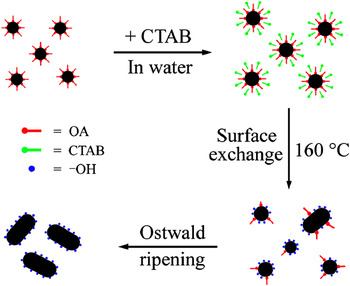
The synthetic strategy to prepare NaYF4 nanorods is illustrated in Fig. 1. Since OA-capped NaYF4 nanospheres can be dispersed only in a nonpolar solution such as cyclohexane, transferring these nanocrystals into water is the key to enable sequential hydrothermal treatment. Here, we have used CTAB as a surfactant to achieve this goal since CTAB can efficiently enter into hydrophobic chains of OA around the nanocrystals through dipole–dipole interaction and leave its ionic heads outward. Therefore, a double surfactant layer consisting of OA and CTAB is obtained that enables well dispensability of these nanocrystals in water, after cyclohexane is evaporated out from the mixed solution. Since hexagonal phase NaYF4 nanocrystals have a propensity to grow along the (001) direction, sequential hydrothermal treatment would induce Ostwald ripening of these nanocrystals for reaching a new thermodynamic state inside the boiling and pressurized water.Reference Zeng22, Reference Wu and Xie23 Thus, formation of bigger rod-like NaYF4 nanostructures would be favored due to crystal growth habit of hexagonal-phase crystals and requirement of system thermodynamics.
Schematic illustration of the strategy to prepare hydrophilic NaYF4 nanorods using hydrophobic NaYF4 nanospheres as precursor.

B. Morphological characterizations of NaYF4 nanorods and nanospheres precursor
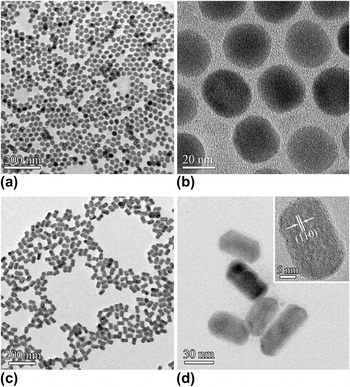
TEM images of the presynthesized NaYF4 nanospheres are shown in Figs. 2(a) and 2(b). The nanocrystals self-assemble on the copper grid attributable to the presence of OA on their surface. Each nanocrystal displays a spherical profile due to its polyhedron shape. The diameter of these nanocrystals is 18–20 nm. After hydrothermal treatment of these nanocrystals in water, obvious change in morphology appeared [Figs. 2(c) and 2(d)]. The formed NaYF4 nanostructures display a rod-like profile with uniform diameter of 28–30 nm and length varying from 40 to 70 nm. This result clearly shows that the NaYF4 nanospheres have been transformed into NaYF4 nanorods after hydrothermal treatment. HRTEM investigation on an individual NaYF4 nanorod was also performed [inset in Fig. 2(d)]. The interplane distance along the lateral direction is measured to be 0.32 nm, corresponding to the (110) plane of NaYF4 crystals. It reveals that these NaYF4 nanorods have grown along the (001) direction.
(a) and (b) are TEM images of presynthesized NaYF4 nanospheres; (c) and (d) are TEM images of NaYF4 nanorods prepared through hydrothermal treatment of the NaYF4 nanospheres. Inset in (d) is HRTEM image of a single NaYF4 nanorod.

C. Surface properties of NaYF4 nanorods and nanospheres precursor
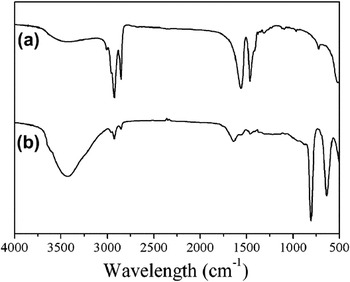
Surface properties of the synthesized NaYF4 nanorods and its precursor-NaYF4 nanospheres have been investigated by FTIR spectrometry. In Fig. 3(a), two peaks at 2930 and 2856 cm−1 are characteristic peaks of -CH2 stretching, and other two peaks at 1565 and 1463 cm−1 are attributed to C = O stretching of –COOH group. These peaks indicate that a layer of oleic acid is indeed attached on the NaYF4 nanospheres. After hydrothermal treatment and purification of these nanospheres, the peak from OA dramatically reduces and instead a strong peak at 3426 cm−1 (-OH stretching) appears [Fig. 3(b)] that shows a huge amount of –OH groups have been produced on the products. At the same time, two peaks at 797 and 643 cm−1 also came forth in the fingerprint region. These peaks could be indexed to neither OA nor CTAB, which might have resulted from the coordination between surface Y ions and –OH groups. The result suggests that most of hydrophobic OA ligands on the nanocrystals have been exchanged by the hydrophilic –OH groups. As a result, the produced NaYF4 nanorods can be well dispersed in aqueous solution rather than nonpolar solvents.
FTIR spectra of the presynthesized NaYF4 nanospheres (a) and the prepared NaYF4 nanorods (b). Both samples were carefully dried and measured in powder form.

D. Possible transformation mechanism
Control experiments using the similar size NaYF4 nanorods or NaYF4 nanoplates with a bigger size as precursors have also been performed (see Figs. S1 and S2 in supporting information). However, no obvious morphology change has been observed in any case except the modification of their surfaces. It is known that NaYF4 nanospheres are generally synthesized with a large amount of OA as ligand to control its size and anisotropic growth, while NaYF4 nanorods and nanoplates have been synthesized with sufficient growing time and with less OA, respectively. In comparison, the nanorods and the nanoplates are thermodynamically stable shapes while the nanospheres are just kinetically stable. If the surface ligands on the NaYF4 nanospheres are exchanged, these nanospheres will have a tendency to transform into thermodynamically stable shape such as rod or plate. Therefore, the spherical shape and relatively small size of the NaYF4 nanospheres should be responsible for the shape transformation during the hydrothermal treatment.
E. Upconversion photoluminescence of NaYF4:Yb, Er nanorods
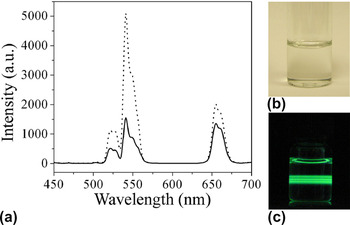
When lanthanide-doped nanospheres such as NaYF4:Yb, Er are used as precursor, corresponding NaYF4:Yb, Er nanorods (see Figs. S3 and S4 in supporting information) with a strong UC luminescence can be also produced [Fig. 4(a)]. Under the excitation of 980-nm wave length, two strong and characteristic emissions at 539 and 651 nm appeared due to the transitions from 4S3/2 and 4F9/2 to 4I15/2 of Er3+ ions.Reference Li and Zhang15 However, both emissions from the nanorods have some decrease in comparison to its precursors—the nanospheres. This phenomenon might be ascribed to two aspects. One is the surface –OH groups on the nanorods, which are notable fluorescence quenchers, particularly to green emission.Reference Heer, Kompe, Gudel and Haase24 The second is the relatively poor crystallinity of the nanorods synthesized in hydrothermal condition in which more crystal defects may be produced, when compared with nanocrystals synthesized in organic/surfactant system. Despite the decrease in fluorescence, these NaYF4 nanorods can well disperse in aqueous solution and it may be seen that they have thoroughly changed their hydrophobic surface [Fig. 4(b)]. Furthermore, naked-eye fluorescence can be easily observed in the colloidal solution [Fig. 4(c)]. These features ensure their potential for various biological applications. This kind of surface-modification route is also impressive for its convenience and easy control when compared with some conventional routes such as silica-coating and polymer grafting, as also the well-controlled shape transformation.Reference Chen, Chen, Hu, Yu, Li, Zhang, Zhou, Tao and Huang16, Reference Li, Zhang and Jiang17Reference Qian, Yuan, Yi and Chow,25
(a) UC spectra of the precursor NaYF4:20% Yb,2% Er nanospheres (dash-line) and the prepared NaYF4:Yb,Er nanorods (solid-line). Transparent solution of NaYF4:Yb, Er nanorods dispersed in water before (b) and after shinning with a NIR laser (c).

IV. CONCLUSION
To conclude, we have demonstrated a facile method to prepare uniform hydrophilic NaYF4 nanorods using hydrophobic NaYF4 nanospheres as precursor. Throughusage of CTAB to form a double surfactant layer, hydrophobic nanospheres can be transferred to aqueous solution. Sequential hydrothermal treatment of the nanospheres not only changes its surface properties but also induces anisotropic growth of these nanocrystals through Ostwald ripening. Lanthanide-doped NaYF4 nanorods with strong UC fluorescence can be also synthesized in a similar way.
ACKNOWLEDGMENT
The authors acknowledge financial support from National Nature Science Foundation of China (No. 20901068) and Zhejiang Qianjiang Talent Project (No. 2010R10028).