In 1900, performer Junie McCree debuted a new character on the stage of vaudeville theatres in New York City. In a short playlet written by McCree entitled The Dope Fiend; or, Sappho in Chinatown, the actor took to the stage in a black suit, fedora, and thick mustache to perform a comic version of an opium-smoking addict from the West of the United States. McCree's addict was marked by his slumped posture, his wisecracks and chicanery, and a broad assortment of inventive slang that was intended as a sign of the character's frontier roots. Undermining expectations regarding addicts as vicious or subhuman, this vaudeville dope fiend was charming in his insouciance and playfully eccentric in behavior. McCree's interpretation was distinct from the already established stage drunk or tramp clown; he was not sloppy or bedraggled, but more the figure of a slow-moving but cunning saloon poet.Footnote 1 McCree quickly became famous for the portrayal, spawning numerous imitators who helped make the vaudeville dope fiend a standard character convention, recognizable to Progressive Era audiences of variety entertainment, but almost entirely ignored by modern scholarship. Dissecting the anatomy of McCree's characterization, including its sources and cultural impact, this article argues for the inclusion of the comic dope fiend in the pantheon of stage characters from the period and calls attention to popular entertainment's contribution to the national debate over drug addiction.
The condition of addiction was relatively unfixed in the popular imagination during the Progressive Era (a period typically delineated as occurring between 1890 and 1920). Addiction was simultaneously a medical ailment to be treated by physicians and a moral failure related to an individual's inner corruption or lack of self-control. As opium was a product of Asia, and the practice of smoking it was principally connected to Chinese immigrants, being addicted also signaled a racial contamination as the foreign substance penetrated the body and altered a person's core; it was a kind of symbolic miscegenation with a culture at the time considered savage and alien. Manifesting this concern, McCree's performance can be read as a commentary on the dilution of white racial purity and the deterioration of gender norms. Both were issues that, during a period of mass immigration and the upheaval of Victorian mores, deeply troubled the standard-bearers of traditional Anglo-American society. As I hope to show, McCree culls the link between eroded masculinity and addiction from earlier literary tropes and from the period's interest in inheritance and eugenics.
The comic dope fiend's Western roots created similar associations. McCree's assertion of a connection between addiction and the frontier propagated concerns over the nation's rapid expansion and growing regional diversity. The vaudeville dope fiend became an important vehicle by which McCree's primarily Eastern audiences could craft their perceptions of the nation's regional identities, especially through his use of frontier vernacular. His audiences could experience and imagine the nation's foreign corners through the character's language. At the same time, his comic treatment of drug addiction helped to assuage the concerns of his middle- and working-class audiences over real-life addicts. Addiction was particularly troubling because it had no outward signifiers in the way that race or ethnicity could often be written on the body. Furthermore, addiction was egalitarian in that it affected people regardless of gender, class, or upbringing. McCree helped fix the image of a particular addict—one who was white, male, and native—in the public's mind, thus easing worries that any person on the street (or even across the dinner table) might be an addict. While he demonstrated the degenerative effects of the widely available opium product, his impersonation hinted that these particular addicts were still human and therefore deserving of sympathy.
Examination of McCree intersects with and extends existing scholarship on the cultural work of the popular stage during the Progressive Era by historians such as J. Chris Westgate, Sabine Haenni, and Rick DesRochers.Footnote 2 For example, illustrating Westgate's consideration of slumming as a definitive cultural activity in the period, McCree offered his audiences safe access to an untoward character typically hidden out of sight from “respectable” life. Similarly, McCree's undermining of traditional mores of self-control while providing audiences a way of conceptualizing the primarily urban problem of addiction fulfills Haenni's assertions of “leisure's transgressive potential” and its capacity to “resolve the problems of urbanity.”Footnote 3 DesRochers's explication of the Progressive Era's “New Humor” as an aggressive vaudeville that “intentionally unsettled Anglo-American middle-class values,” and challenged Victorian social strictures fits McCree's humorous take on a troubling and potentially dangerous character.Footnote 4
Perhaps more intriguingly, McCree's performance situates the label of “addict” as an identity or subject position, rather than simply a moral or medical condition. Thus, we can investigate his characterization in ways that parallel scholarship focused on the performance of ethnic and racial “outsiders” and other marginalized figures in the period. McCree's characterization is both informed by and challenges Eric Lott's work on blackface, Harley Erdman's work on the stage Jew, Katie Johnson's investigation of fallen women, George Chauncey's history of gay entertainments, and Amy Hughes's analysis of nineteenth-century representation of inebriates in temperance dramas.Footnote 5 Popular entertainment was host to conventionalized versions of each of these figures, and the related scholarship clarifies ways of interpreting their social and cultural significance and their legacies. What is fascinating is that the addict seems to hint at a number of these paradigms while evading exact imitation and introducing a number of new considerations. More than simply tracking the presence of McCree and his legacy, this essay seeks to formulate a useful way to think about addiction in the period, taking into consideration not only the way McCree reflected perceptions of drug addiction, but the ways in which drug addiction was a loaded cultural phenomenon, a composite site where racial, national, medical, social, and political anxieties overlapped.
While McCree seems to be hiding in plain sight, his absence from the historical record may be the result of a number of factors.Footnote 6 The first is that, save for writing on Mary Tyrone—the morphine-addicted matriarch of Eugene O'Neill's Long Day's Journey into Night—there is little prior scholarship on theatrical representations of drug addicts. Meredith Conti's book, Playing Sick: Performances of Illness in the Age of Victorian Medicine, came out only in 2018, and, despite its excellence, the single chapter on Sherlock Holmes and Dr. Jekyll as addicts just scratches the surface. Work by Johnson and Westgate has considered the popular melodramas set in opium dens that primarily played in the decades bracketing the turn of the century, but their studies do not closely consider the addict characters or how narratives of addiction are central to those works. Drug addiction has been effectively overshadowed by the wealth of scholarship on the temperance movement's relation to the theatre, a blind spot only enhanced by the fact that the reform efforts regarding narcotics are far more limited and less spectacular than the alcohol temperance activism undertaken throughout the nineteenth century. Members of the Woman's Christian Temperance Movement breaking into saloons and smashing bottles had no counterpart in the legislative negotiations over narcotics and the pharmacopeia, most of which happened in the halls of government, rather than in the public sphere of the streets and newspapers. Lastly, there is an assumption that scholarship on alcohol temperance naturally covers other addictions. It is true that today we define alcoholism as an addiction, but there has historically been a division between those addicted to the legal, social lubricant of alcohol (consumed in public) and the controlled substances that we smoke, snort, or shoot (often in solitude). A Chicago Daily Tribune article from 1906 clarifies: “A man may drink whisky and retain some of his moral if not his physical stamina; he may even smoke cigarets [sic] to excess and retain something of the qualities that once made him a man; but he cannot use ‘dope’ without soon losing every vestige of moral and physical fitness.”Footnote 7 This sentiment signals another potential reason that McCree has remained unrecognized until now. That is, with the hyperbolic fear that drug addicts were unsalvageable reprobates, finding a comic version of the corrupted figure at the turn of the century seems a historian's unlikely pipedream.
McCree's skit survives only in part. I have acquired a copy of the first scene of the playlet, which McCree registered for copyright with the Library of Congress in August 1900. For further clarification, I have identified substantial periodical evidence that reveals the plot of the piece, McCree's style of performance, and the reception of his act. I have also located published essays and poems by McCree about drug addicts, which compellingly show that the vaudeville performer was considered an expert on addiction. Together, these sources provide clarifying details of McCree's characterization and the source of the comedy.
McCree's dope fiend was both a reaction to and a generative element of the first “drug scare” to affect the United States broadly. Ironically, the dominant drug addicts in the nineteenth-century United States were white, upper-class women addicted to narcotics such as morphine, laudanum, and chloral hydrates, which medical officials tended to overprescribe to that particular population.Footnote 8 Like Mary Tyrone, most of these women suffered quietly as family secrets while public attention was focused on the more spectacular practice of smoking opium in urban dens.Footnote 9 Researchers Charles E. Terry and Mildred Pellens explain in their 1928 study of US drug use, The Opium Problem, that “As so frequently happens in social reform, it required this more spectacular method of opium use, the character of the places in which it was smoked, chiefly in Chinatown, and the attendant social evils, to awaken public and official interest.”Footnote 10 It was the alienness of not only the vice, but also the people and places involved that drew attention. Opium smoking had been introduced to the country by Chinese immigrants in the mid-nineteenth century, and it was typically thought a distasteful, though legal, vice limited to that racialized immigrant population. However, in the last decades of the twentieth century, the growing awareness that white men and women had begun to take up the pipe as a leisure activity spawned widespread concern, particularly among reformers and journalists, who disseminated that fear to their congregants, audiences, and readers.Footnote 11 Crossing the racially demarcated lines into Chinatowns and mixing with foreign bodies of both genders in basement dens, opium smokers were feared not simply because of their inebriety, but also because their behavior signaled the active eroding of a host of social norms and standards of rectitude.
Awareness of opium smoking and the opium den came by way of a range of experiences. Fascinated adventurers could take slumming tours to Chinatown dens, and even try a pipe (which reformers warned could instantly lead to addiction). For those less daring, popular periodicals such as Harper's and the National Police Gazette offered meticulous descriptions of den life in their reportage. Detailing the den experience in Macmillan's Magazine in 1907, Herman Scheffaner writes of “the rank air reeking with a mephitic virulence, the thin streams of smoke curling upward in serpentine forms, the red glow of the pipes and the sickly glimmer of the tiny oil-lamps in the semi-darkness and the silence, made a scene full of a strange and awful enchantment.”Footnote 12 Scheffaner's prose appropriately wavers between the repellent and the sensual, highlighting how responses to the den were a mix of revulsion and intrigue.
Reformers of the period also did their part to draw attention to the den, and reformist rhetoric concerning drug use tended toward the apocalyptic. In his widely circulated work How the Other Half Lives (1890), Jacob Riis described opium addicts as “hapless victims of a passion which, once acquired, demands the sacrifice of every instinct of decency to its insatiate desire.” Those addicts, according to Riis, are left “worshipping nothing save the pipe that has enslaved them body and soul.”Footnote 13 This complete loss of self was standardized in narratives of addiction, establishing the condition as antithetical to the very principles that defined the Progressive Era. Between 1890 and 1920, the working and middle classes embraced the newly idealized paradigm of the “self-made man,” putting a premium on self-discipline, restraint, productivity, and self-determination. This privileging of moderation and self-possession in the era has been noted by cultural critics such as Marshall Berman, Alan Trachtenberg, and Timothy Hickman.Footnote 14 The addict, by his or her very nature, represented the abandonment of self-control and the surrender to desire. Hickman notes that “[n]arcotic addiction thus embodied the otherwise abstract threat that stalked the autonomous individual in a newly interdependent, modern society.”Footnote 15 Not only a threat to the individual body, addiction was established as also a threat to the body politic. Appointed the US Opium Commissioner in 1909 and tasked with developing a national drug policy, Dr. Hamilton Wright declared in a New York Times interview that “The drug habit has spread throughout America until it threatens us with very serious disaster.”Footnote 16 National disintegration via drug addiction became a standard theme in reformist discourse, often preached with a decidedly anti-Chinese bent when it came to the opium pipe.
While the popular press and reform movements sought to protect the nation against the scourge of addiction, the medical community fumbled for an official explanation and cure for the condition. Though numerous etiologies of addiction existed at the turn of the century, it was the work of Eduard Levinstein that established the influential “disease model” that was widely adopted by the medical community.Footnote 17 His Die Morphiumsucht (1875), translated into English in 1878 as The Morbid Craving for Morphia, spawned a belief that addiction was an illness that could be treated through a number of prescribed courses. However, when it came to representations of addiction in the theatre, dramatists and performers typically recapitulated general perceptions that combined late-century disease models with mid-century morality models. As Meredith Conti notes, in abeyance of growing pathologies that saw addiction as treatable, widespread belief maintained that “each addict remained morally accountable for his transgressions.”Footnote 18 Essentially, the addict was never simply a patient in need of treatment, as the taint of vice was unshakeable and incurable.
Representations of addiction are, perhaps, best understood in the light of Max Nordau's broad theory of degeneracy. Nordau's Entartung (1892) was translated into English in 1895 as Degeneration and came to dominate the thinking of the period. “Degeneracy” became shorthand for all types of perversity, including criminality, homosexuality, prostitution, and decadence. Nordau suggests that degenerates were especially susceptible to narcotic stimulation and vulnerable to addiction. He saw addiction as simultaneously a cause and a symptom of degeneracy.Footnote 19 Nordau was working from morally based assumptions about the internal corruption of certain people more than empiric observation. As a loose extension of social Darwinism, Nordau's pseudoanthropological theorizing promoted the fear of racial devolution through the spread of inherent degeneracy. This “cultural drift” signaled the potential fall of Anglo dominance in the West, and the resultant crumbling of modern societies. Such catastrophic thinking made degeneracy a useful term in the reformist rhetoric of those like Wright. It is my contention that McCree's portrayal of the addict's adulterated (or even queered) masculinity, together with his embodiment of fears regarding the negative effects of the nation's expansion, manifested Nordau's concepts and entwined narratives of individual and national disintegration.
Craig Reinarman argues that all drug scares feature what he calls “media magnification” or the “routinization of caricature,” in which worst-case scenarios are “rhetorically re-craft[ed] … into typical cases and the episodic into the epidemic.”Footnote 20 Reportage, reform, and the popularized pseudoscience of those such as Nordau helped craft and disseminate this epidemic conceptualization of opium smoking, but the theatre's contribution to this process has gone unnoticed. I hope to show that McCree's popularity made him part of this process of routinization yet also allowed him to undermine and subvert standard perceptions of addiction.
Unmanning the Morphodite
Junie McCree was the stage name of Gonzalvo Macrillo, born in Toledo in 1866 of Italian and German parentage. McCree is primarily remembered among scholars of vaudeville and burlesque as one of the most sought-after skit writers and lyricists in variety entertainment as well as one of the early presidents of vaudeville's first performer's union, the White Rats.Footnote 21 McCree began his stage career as a member of the Bella Union Stock Company in San Francisco, where he took part in typical burlesque fare, the occasional stock play, as well as blackface routines and “coon” songs. The choice to change his name from the ethnically conspicuous “Macrillo” to an ambiguously Irish-sounding “McCree” may have been a way to place himself among the many Irish performers who performed in blackface.Footnote 22 After a tour brought him East, McCree debuted his dope-fiend act in a city where the character would have been received as novel.
McCree's early career in the West, and specifically San Francisco, gave his performance of an opium smoker the impression of authenticity. The city was home to the oldest and largest Chinatown in the United States and was thought to be the center of the opium trade. San Francisco passed the nation's first anti–opium smoking law in 1875 to combat the growing enterprise, though to little effect. By 1885, the city's Board of Supervisors reported that there were twenty-six dens in operation, providing 320 bunks that were open to the public, most of which were located in Duncombe Alley of Chinatown.Footnote 23 Denver too had a famed “hop alley” where dens were located and, in fact, McCree performed a later iteration of his act under the title The Man from Denver, stressing the character's western origins. Experts on drug use such as H. H. Kane were explicit in asserting that it was in the West that white people first began to smoke opium. Kane promoted the idea that the vice quickly pullulated among whites, spreading East like a contagion.Footnote 24 Thus, the West took on the semblance of the opium smoker's natural habitat, much as it had for the Chinese immigrant. Adding to this was San Francisco's reputation as a vice district. The area known as the Barbary Coast was notorious for its bawdy entertainments, the roughness of its honky-tonks, and the openness with which licentious activity was undertaken. Prostitution was so widespread and institutionalized that one could purchase a number of competing so-called gentleman's guides to the city that included the names of madams, their addresses, and a listing of the women they employed.Footnote 25 Due to this impression and a general fascination with the frontier as the source of both fortune and ruination, McCree quickly gained popularity.
The Dope Fiend; or, Sappho in Chinatown is a short, three-scene playlet that burlesques the popular stage play Sapho, which opened on Broadway in 1900 to great controversy. Sapho was an adaptation by Clyde Fitch of the French novel and play by Alphonse Daudet. The US production starred the English actress Olga Nethersole, who was famous for her feminist politics, revealing costumes, and the heightened sexuality that she brought to her performances. In Fitch's adaptation Nethersole played Fannie LeGrand, a loose woman who lures and then discards her male lovers. The play hinges on LeGrand's choice to stay with one such lover who returns from prison and offers to support both her and their illegitimate child. In doing so, she rejects her true love and denies herself happiness. Thus, the play dramatizes LeGrand's maternal selflessness for the sake of her son. The controversy over the drama was more connected to Nethersole's staging than to the plot. Famously LeGrand and her lover ascended a long set of stairs to a bedroom; the raising and lowering of the curtain signaled the time that passed during their coitus. Almost immediately after opening the police shut down Nethersole's production and arrested the actress, her costar (Hamilton Revelle), and the show's producers on charges of indecency. Nethersole was found innocent after a captivating trial and media circus and, thanks to the scandal, she went on to perform Sapho to capacity crowds.Footnote 26
Sappho in Chinatown cleverly plays upon Nethersole's drama by undermining any maternal or romantic heroism on the part of the LeGrand character. In McCree's skit Ruby Belle is a fast city woman, described by one reviewer as an “adventuress,” who lives the highlife by scamming money from her many lovers.Footnote 27 A former lover, Ludwig von Katzenfeldt, returns to claim her after being freed from prison (where Ruby sent him in the first place).Footnote 28 Ruby declares that she is married and promises to produce her husband, sending Molly, her maid, to find a man to play the spouse. Molly returns with a slightly bewildered opium addict named Bill, played by McCree, and through quick thinking, comical subterfuge, and wild slang, Bill is able to convince Katzenfeldt that he is indeed Ruby's new husband. He “eventually brings peace from chaos,” and sends the suitor off.Footnote 29 Once successful, Bill announces his plan of spending the money Ruby has given him to “get fifty dollars worth of room rent, and fifty dollars worth of dope and have a jubilee.”Footnote 30 As an exit line, Bill exhibits underworld sagacity, advising Ruby, “sister—when you mix up with a guy like that, cop his pocketbook, but don't monkey with his heart.”Footnote 31
In the skit, Bill functions as a reimagined Harlequin in a traditional comic structure. He is the clever servant who solves the conflict for the sake of his mistress. However, he undermines the blocking figure (here, Katzenfeldt) not to bring two innamorati together as in classic commedie degli Zanni tradition, but to ensure that Ruby can continue her life of corruption and extortion. Rather than having the dope fiend infiltrate high society for comic effect, the addict appears among con artists and convicts, offering what a reviewer from the Toledo Blade fittingly called “a study in life's subway.”Footnote 32 In its original intention as a burlesque of Nethersole, the depiction of the Fanny LeGrand character as a low-class hustler in cahoots with a drug addict served to deflate Nethersole's celebrated status. The original Sapho was an articulation and promotion of feminist beliefs regarding the repression of women's sexuality. LeGrand was forced to sacrifice her liberty for the sake of societal expectations regarding her position as woman and mother. But McCree's version lampoons this feminist liberation by turning the LeGrand figure from a politically savvy and “emancipated” woman into nothing more than an oversexed schemer.
McCree's characterization and dramaturgy depart from earlier theatrical portrayals of drug use that were typified by what might be called “opium-den dramas,” which featured upper-class women falling from grace after acquiring an addiction to the pipe. As historian David Courtwright relates, “The beautiful aristocrat enchanted by the pipe became a stock melodramatic character,” and images of recumbent young women in varying states of undress holding an opium pipe appeared so frequently on theatre posters, dime novel covers, and magazines as to qualify as a Progressive Era obsession.Footnote 33 Opium-den dramas typically appeared in cheap “ten-twent’-thirt’” theatres that specialized in spectacular melodramas for the working- and middle-class audiences that also attended vaudeville. The plays often pitted a middle-class hero against an evil Chinese gangster and involved the rescue of an innocent woman from the clutches of both that lecherous highbinder and the opium pipe. Plays such as The White Rat (1895), The King of the Opium Ring (1896), The Queen of Chinatown (1899), The Bowery after Dark (1900), and Slaves of the Opium Ring (1908) all feature scenes in opium dens where women fall into the hands of Chinese villains, and almost all are set on the country's West Coast.Footnote 34 These plays were a direct response to the “White Slave Panic,” a hysteria based on the belief that Chinese and Southern European immigrants were kidnapping white women (often by tricking them into smoking opium and thus lowering their defenses) and forcing them to join harems, turn tricks, or marry immigrant men. Agencies like New York City's Committee of Fifteen and John D. Rockefeller Jr.’s Bureau of Social Hygiene eventually debunked the existence of “white slavery.”Footnote 35 However, the terror over miscegenation and the assumption that Chinese men desired white, female flesh persisted as the anti-Chinese and, more generally, xenophobic movements gained momentum in the late nineteenth century, especially through organizations such as the Immigration Restriction League.Footnote 36
Prior to 1900, there are only two examples I can find in which a white male addict is given center stage: the little-known play John-a-Dreams by Haddon Chambers, which had a short-lived Broadway run in 1895, and the more popular Sherlock Holmes, which premiered in 1899 and made William Gillette a household name in the title role. Neither of these plays feature addicts of opium smoking. Rather, they focus on aristocratic Englishmen of genius who abuse medically sanctioned narcotics for the purposes of intellectual and spiritual exploration.Footnote 37 These portrayals do overlap with McCree in expressing addiction as “the atrophying of Victorian masculinity,” thus demonstrating this theme as axiomatic in narratives of drug use when it came to male users.Footnote 38 However, that is the extent of the similarities, as neither Chambers nor Gillette engage with the comic in their portrayals and neither delve into the low or reveal the underworld of drug use, which was such a draw for McCree.
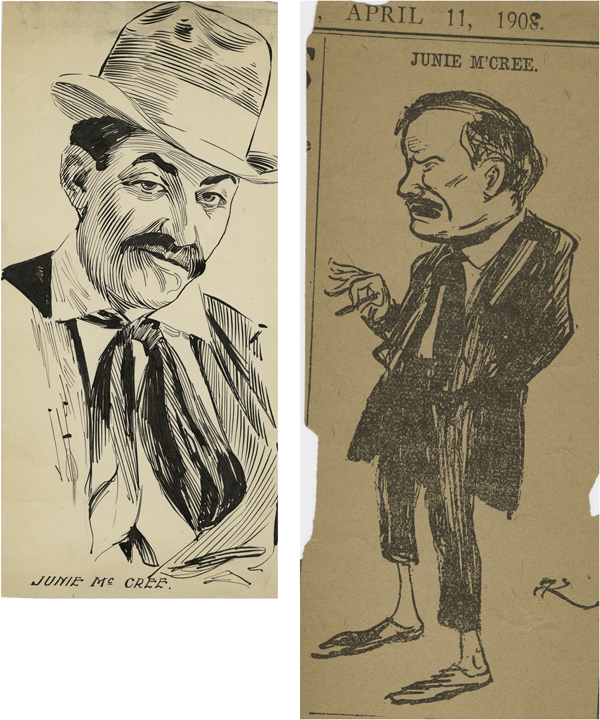
Thus, McCree presented a wholly new character and narrative in The Dope Fiend. His addict was an American-made figure, with no resemblance to Holmes and his genius. Various renderings show McCree in character, with a mustache, fedora, three-quarter-length black coat, and Western-style neckerchief, carrying a cigar (Fig. 1). The outfit connects him to the frontier and its underworld of saloons and gambling houses. Fittingly, Bill's mentions that his former occupation was as a casino card dealer in Arizona. The neckerchief also has connotations of bohemian artists of the time, a group often connected to the counterculture and drug use, especially via the Decadent writers, such as Arthur Symons and Ernest Dowson, who produced most of the well-known literature on drug use in the period.
Images of McCree in character, 1907 (left) and 1908 (right). Courtesy of Billy Rose Theatre Division, The New York Public Library for the Performing Arts, Astor, Lenox, and Tilden Foundations.

Much as those Decadent authors explored the lower depths of the city in their writing, McCree's performance was tantamount to a form of theatrical slumming, as outlined by Westgate, that combined “titillation and transgression” by “contravention of traditional boundaries of taste, propriety, and morality by bringing the ‘hideous reality’ of slums” to the public.Footnote 39 The den dramas were also slum plays, but McCree's vaudeville performances lacked any menacing immigrant figures or the presentation of den activities that were so thrilling in those melodramas; to the point, McCree never actually smokes opium onstage. McCree enabled a slumming experience less in line with the opium-den dramas and more typical of the pantheon of recognizable racial and ethnic stage characters from the period. These comic characterizations offered patrons of vaudeville access to a potentially dangerous or socially stigmatized figure from the safety of theatre seats. McCree's dope fiend joins the stage Jew, stage Irishman, “Dutch” act, yellowface “Chinee,” blackface minstrel, and the tramp in the way they helped clarify and delineate the politics of identity in the era. These essentialized caricatures helped to establish parameters of normalcy and national identity by offering markers of abnormality, artificiality, and unacceptable social behavior.Footnote 40 This process supported the glorification and dominance of Anglo-American identity and culture in the country by the repetitive portrayals of “otherness” as inferior. Audiences could define themselves both oppositionally and analogously to these outsiders. For example, McCree simultaneously demonstrated the need for “clean” living and restraint, while allowing audiences to revel in the rejection of those very principles. He did so by appearing as corrupted, yet harmless, as freakish, yet familiar, and as unmasculine, yet male.
To this last point, it is noteworthy that McCree's addict is not a potential suitor to the woman he serves. As he is a comic stand-in for Ruby's husband, one can imagine a scenario in which she falls for the drifter, closing the sketch with strange but true love that promises to reform both sinners. Traditional commedia form might have McCree's clown coupling with Molly, the saucy maid. But McCree's inadmissibility as a love interest is significant in a number of ways. McCree recounts, in various interviews and in articles he wrote about opium smokers, that dope fiends are generally disinterested in women. In a 1907 essay, McCree relates a story from his time in Tacoma, Washington about a drug addict called “Shorty” Wilson. When an attractive woman walks by, a friend remarks:
“Shorty, … if I had the coin there's a girl that could cop me out all right, all right.” “Bill,” answered Shorty in his lackadaisical laconis [sic], “if I had the coin she couldn't cop me out—not if I was a lame man.” … [T]his illustrated how little a dope fiend cares for the things that normal men admire.Footnote 41
In McCree's estimation, the dope fiend is not a voluptuary, as the phallic pipe has robbed him of his potency.
In a similar article in Variety, McCree sums up the opium addict as a man devoid of normative desires:
The “dope” fiend is a passive creature to whom nothing in life outside of getting opium is of much consequence. He is as blasé and indifferent as the most pampered man of the world who has been satiated with every luxury… . He is calloused to everything.Footnote 42
Earlier literary tropes established the male addict as impotent, effeminate, or as having a queered sexuality. Though McCree may not have been aware of specific precursors, his performance registers their widespread influence. Thomas De Quincey's 1821 memoir Confessions of an English Opium-Eater casts a long shadow on literary formulations of drug addiction into the twentieth century. For example, Fitz Hugh Ludlow's The Hasheesh Eater (1857), which gained popularity in the United States, is one of many drug memoirs styled in the tradition of De Quincey. In these works, the authors record their fall into addiction and detail their fantastical hallucinations. Seemingly as a rule, these memoirs are devoid of carnality. This may be surprising as opium was a product of the Orient, and traditional orientalist perception was that Asia was a place of indefatigable erotic enjoyment. By consuming the product, De Quincey and Ludlow experience the perceived sumptuousness of the East, literally flying through the exotic landscapes in their dreams, but they both do so without the particulars of lust; Ludlow's memoir lacks women entirely save for two female demons who signal that he has descended into hell. The first novel (as opposed to memoir) published in the United States to feature a drug addict was E. P. Roe's Without a Home (1881). The work follows the deterioration of a middle-class father addicted to morphine. Throughout, his addiction constitutes the loss of his manhood in that it involves his inability to control his own impulses, desires, and baser nature. As the father falls deeper into addiction, Roe writes, “every moment with more terrible distinctness revealed to him the truth that he had lost his manhood.”Footnote 43 Fittingly, McCree's poem “Give Him Just Another Chance,” published in Variety in 1907, ends with plea that those who meet an addict, “Give him one more chance to be a man.”Footnote 44
Other literary precursors are even more explicit in their portrayals of drug addiction's withering effect on male sexual desire. Théophile Gautier's account of his experiments with hashish, “Le Club des hachichins” (1846), plainly states that, under the influence, Romeo would forget about his Juliet, as “the prettiest girl in Verona, to a hashisheen, is not worth the bother of stirring.”Footnote 45 Similarly, Charles Baudelaire in his “The Poem of Hashish,” which was translated into English in 1895, concludes with the warning that the solitary pleasure seeking of the addict inspires a kind of onanistic “admiration of himself” that hurtles him toward the same fate as Narcissus.Footnote 46 McCree expresses this morbid self-gratification in materialist terms as the “indifference” to “every luxury that money can buy” save “the procuring of opium.” In part, this unnatural preoccupation makes Bill harmless, diminishing anxieties regarding the dangers the dope fiend posed. His status as a gelding ensures that there is no transference of the Chinese immigrant's supposed lechery that made him so dangerous to white women. It also made McCree's character the perfect foil for Ruby Belle as she stands in for the sexually liberated Fanny LeGrand/Olga Nethersole. McCree manufactured a scenario in which the emasculating woman, whose sexual appetites troubled standards of Victorian decency and who was celebrated when embodied by Nethersole, is snubbed and thereby disempowered by the lowliest of male creatures, whose particular vice frees him from her control.
The dope fiend's eroded masculinity is explicit in the humor of the skit. In the opening scene, when Ruby orders Molly to find someone to play her husband, Molly asks, “What kind of man do you want? A tall man, a short man, a fat man or a skinny man?” Ruby responds, “Anything, so long as he is a man.” This carries over to Molly's first interaction with Bill on the streets of Chinatown.
Molly: Are you a man?
Bill: I've often been accused of being one.
Molly: Are you sure you're a man?Footnote 47
Having just finished telling a highly dubious story to the audience about beating up Tom Sharkey, the prizefighter, Bill's appearance and demeanor are meant to portray the opposite of all traditional signifiers of robust manhood. McCree's representation of degraded—specifically white—masculinity was especially troubling during the Progressive Era as, according to John F. Kasson, there was a “widespread sense of gender malaise,” in which “manhood seemed no longer a stable condition—absolute and unproblematic—but rather an arduous, even precarious achievement that had to be vigilantly defended.”Footnote 48 This was part and parcel of the racial and national decay against which Nordau and Wright warned.
Considering the inextricable coupling of gender and sexuality, we must confront the ontological link between perceptions of the addict and the homosexual at the time. Eve Kosofsky Sedgwick argues that in nineteenth-century literature, “drug addiction is both a camouflage and an expression for the dynamics of same-sex desire and its prohibition.”Footnote 49 Under the category of “decadence,” addiction and same-sex libidinousness were imagined as compulsive behaviors that were simultaneously the result of moral failings (vice) and of pathology (disease). Both were considered deviant conditions stemming from uncontrolled desire for unnatural gratifications. The surrogation of “natural” erotic and reproductive desire with the addiction to opium may be seen as what Michel Foucault deems an interior gender “inversion” of the masculine and the feminine as it was perceived in the late-nineteenth century. The penetration of the male body by the narcotic through the phallic pipe—wielded by the requisite male Chinese den proprietor—easily reifies this inversion.
However, in the case of McCree, I am more inclined to heed Susan Zieger's clarification that failed heterosexuality does not “by virtue” equal homosexuality in turn-of-the-century representational practice.Footnote 50 There is little in The Dope Fiend to signal that McCree's redirected physical cravings were interpreted euphemistically. His enslavement left him indifferent to flesh, regardless of gender. (As vaudeville managers were interested in creating more family-friendly entertainment, the absence of the carnal would have helped McCree make the bill.) Sedgwick makes room for this clarification in the extension of her investigation to argue that the camouflage of the nineteenth-century literary canon shifts to a twentieth-century paradigm in which issues of will are categorized as corresponding to desires that are either “natural,” and therefore defined as “needs,” or artificial, and thus labeled collectively as “addictions.” Appearing in 1900, McCree may be an early incarnation of this shifting paradigm in which the entanglement of the substance abuser in the hetero–homo binary gives way to a “new opposition” between the natural and the artificial that problematizes “almost every issue of will.”Footnote 51 The pathologizing of failures of will is a symptom of its importance at the turn of the twentieth century, especially in the formation of masculinity. E. P. Roe's focus on his character's loss of manhood as the loss of will, or the lionizing of the power of will that could transform Theodore Roosevelt from an asthmatic whelp into the brawny definition of “man,” evince this importance. As Kasson demonstrates, the invention of new modalities of American masculinity venerated man's physical, mental, and psychological powers of will. For example, the massive brawn and graceful refinement of the famous bodybuilder Eugen Sandow stood in stark opposition to McCree's sloped spine and debased self-indulgence.Footnote 52 The addict represented the antithesis of the self-made/self-willed man.
Under the rubric of this collective label of addiction, McCree's character is also pointedly antonymous to middle-class, “American” values. His rejection of normative desire was a rejection of dominant ideologies of “class mobility, reproductive sexuality, and gender compliance.”Footnote 53 Bill's indifference exhibits a sexual identity that leaves him out of the national project that made family centrality a compulsory element of national life. McCree establishes a benign version of a dangerous figure by neutering him, but he also creates an addict that is incompatible with family—and therein national—health (a particularly troubling facet of the character at a time when fears of “racial suicide” through miscegenation and sterility were at a high point). Audience members could affirm their own normative positions by recognizing McCree's deficiency.
At the same time, Bill's insouciance from a position of moral, social, and economic destitution, and his ability to produce laughter from his audience, creates an entertainingly enviable figure. His contentment in his humble status resembled that which made the tramp comedians of vaudeville so popular. They both seemed untouched by the pressures to conform or progress. In part, McCree performs a comic version of the “legerdemain” enacted in vampire narratives that turn the protagonist's loss of individuality and autonomy “into a pleasurable seduction.”Footnote 54 Finding pleasure in the loss of control was not only dangerously seditious, considering the glorification of Victorian restraint at the time, but was in strict dramaturgical opposition to the narratives of the popular temperance plays of the era that depicted the loss of willpower by the inebriate as the greatest of horrors. Hughes has demonstrated how the performance of the delirium tremens by actors in temperance dramas powerfully communicated the terrifying effects of liquor and were effective tools of persuasion in the arsenal of temperance reformers.Footnote 55 Whereas the shaking and temporary insanity embodied by actor William H. Smith in The Drunkard (1844) was meant to dissuade audiences from drink and often impelled them to sign the temperance pledge before leaving the theatre, McCree's comic portrayal of addiction provided an enjoyable fantasy for audiences. He offered a way of fulfilling the “unusual desire to be freed of the normative obligations of freedom.”Footnote 56 At a time when aspirations of class ascension, self-improvement, and moderation weighed heavily upon the country's citizenry, McCree's character was happily submissive to a simple, singular dependence. McCree's performance playfully intimated that to be a willing slave to a narcotic was a way to an unfettered existence.
Slang from the Other Side
The definitive motif of McCree's performance, and the element that most clearly carried into future dope-fiend performances, is the slang his character used. By 1908, seven years after its premiere, commentators referred to The Man from Denver as a “slang classic” and acknowledged McCree as the “creator of ‘dope’ slang.”Footnote 57 Even after McCree stopped performing the character and focused solely on writing for the stage, reviewers continued to celebrate him as a “comedian-philologist” and refer to the inventive use of slang by other performers as “Junie-esque quips.”Footnote 58 McCree asserts in a Variety article that “most of the ‘dope’ fiends are clever at repartee,” and he offers a number of examples he claims to have overheard in the West, such as a man at a bar requesting “three soft-boiled eggs, and one of them must be good,” or declaring, in response to the high price of drinks, “Give us another round and make it grand larceny.”Footnote 59 This kind of aggressive verbal wit was central to the vaudeville aesthetic in the United States. Ethnic acts especially, such as Weber & Fields's “Dutch” act or Julian Rose's stage-Jew monologues, traded in wordplay and malapropisms.Footnote 60 However, where the stage Jew and other ethnic acts played upon the immigrant's struggle to master American English, McCree's Bill made English strange to those who already spoke it.
In the skit, Bill has a number of fanciful turns of phrase. In his first appearance, he explains his financial situation as “I'm flying lighter than a cork, if you'd cut my suspenders, I'd go up like a balloon. I hain't [sic] actually handled enough dough in the last three weeks to buy a canary bird his breakfast.”Footnote 61 After Molly's initial request that he help her, Bill demands more information, saying “put me wise, put me wise. Hand this to me straight, turn on your calciums and let me see this thing.”Footnote 62 “Calciums” refers to the calcium light (or limelight) that theatres used throughout much of the nineteenth century, and manifests Bill's desire for illumination through language. When Ruby asks him if he'd like a smoke, Bill assumes she means opium and describes the needed paraphernalia as “a clarinet and a lamp without a chimney.”Footnote 63 Similarly, he refers to Ruby's home as a “land office” and a “slab.” Regarding the latter, the terms “slab-hut” or “slab-cottage” were in use by the 1890s to describe a cheaply made home of coarse board, but the truncated version may be a McCree original.Footnote 64 The joke is that Ruby is living quite luxuriously on the money she has stolen from Katzenfeldt. McCree was most certainly the originator or chief disseminator of a number of other cant terms. Laurence Senelick identifies the expression “coffin nails” for cigarettes as one of many that lexicographers have yet to recognize as coming from the performer.Footnote 65
In an American Speech article from 1928, psychologist Richard Paynter declares, “My observations have led me to believe that the drug addict is ‘hooked’ by ‘dope’ talk as well as by the ‘dope’ itself.”Footnote 66 He goes on to conclude that drug vernacular is so deeply connected to the pathology of addiction that if the therapist could crack the code of “‘dope’ talk,” he could reveal the addict's “peculiar and isolated psychology.” As suggested by Paynter more than twenty years after McCree, the comic's inventive slang manifests the drug experience. The argot of the addict conveys his or her altered consciousness, as the infiltration of the dream into reality is embodied in alienating and poetic expression. Following the whirling logic of the metaphors in McCree's speech was a way to understand the addled mind of the drug user. Perhaps more than this, McCree's slang was a vehicle for understanding the frontier.
McCree lists as sources for his wordplay the faro table of gambling houses, the racetrack, the tramp, and the gangsters and “yeggmen” of the criminal underworld.Footnote 67 Each had associations with the West and the lawlessness of frontier cities. Thus, McCree's language enabled audience members to engage with and experience these locales that were so notorious for their prurience and danger. By understanding McCree's slang and laughing at the references in his dialogue, audience members were privy to a special body of knowledge, one typically reserved for those who ventured westward.
We can see how McCree's performance of the West informs divisions within US national identity. McCree often explains that the opium smoker was an individual who had failed in his efforts to conquer the frontier. In essays, he describes the average addict as the “disappointed prospector [who] got rid of his money and then went in for the pleasure pipe.”Footnote 68 Elsewhere, he remarks that
[I]n the West one sees many victims. The freedom of a new country is partly accountable for the vices of opium smoking, drinking and gambling… . [M]en go West to endure hardships for the sake of acquiring fortunes. But their patience gives out if fortune doesn't smile upon them immediately. Then they turn to the faro bank or roulette and to drown their sorrow at their losses take to drink; then to the drug.Footnote 69
There was significant concern over the fall of those who sought their fortunes out West and the influence of the “freedom” that McCree mentions. The frontier was supposedly the source of the nation's manhood, where boys transformed themselves into men and those who emigrated from Europe could metamorphose into red-blooded Americans by battling the rugged terrain. Many ascribed to the belief stated by historian Frederick Jackson Turner in 1893 that “the frontier promoted the formation of a composite nationality for the American people.”Footnote 70 This “composite nationality” was a romanticized homogenization of identities that maintained Anglo-American dominance in the national makeup. Whereas urban enclaves of immigrants allowed ethnic and foreign traditions to survive, the frontier could wipe out those histories through toil and attainment of “self-made” status—thus proving the immigrant's deservedness of the label “American.” This was a standard Progressive Era privileging of “melting pot” or assimilationist ideology. But McCree called attention to a paradox in this theoretical American-making process. The perception of the West as the forge of naturalized citizens was matched by a belief that frontier cities were modern Sodoms and Gomorrahs in which those well-meaning speculators came under the influence of unnamable vice. McCree's Bill represented the unfortunate refuse of this process. In his failure to find success out West, he becomes infected by the wickedness of places such as San Francisco and Denver.
According to McCree, these fallen men were responsible for the “wave of slang that is washing away pure English all over the country.”Footnote 71 The use of slang became a marker of Western contamination, while the East could celebrate its refinement and civility through the differences in its vernacular. McCree's performance helped cultivate this demarcation and perpetuation of regional identities. Audience members could enjoy McCree's slang while affirming their superior position as natives of the fully developed areas of the country where they maintained a “pure” English and an unsullied mind. McCree's demonstration of the linguistic difference seems to challenge the “unified fields of exchange and communication” and “fixity to language” that Benedict Anderson asserts as a prerequisite for the formation of the “imagined communit[ies]” that were the source of nationalism and “nation-ness.”Footnote 72 With the notion of a unified nation already struggling under the weight of the country's growing diversity, McCree added a new, seemingly unassimilable figure whose language highlighted the vast gap between East and West, between Victorian rectitude and frontier survival, and between those who lived clean and those who were secretly initiated.
The Dope Fiend's Descendants
McCree moved away from performing the dope fiend around 1907 to focus on writing, and by 1910 other actors were playing Bill on variety stages.Footnote 73 A number of performers created their own versions of the comic dope fiend, building off of McCree's original. Charles Nichols did a “Western Style” dope act with a character called “Dopey Dan from Cheyenne”; Tom Barrett, who, as one reviewer notes, “looks like June [sic] McCree,” had a dope-fiend song called “Opium Tree”; comedy team Ashley and Lee had a bit called “Chinatown” that featured a dope fiend using “bright, snappy talk”; and Cassidy and Logan did an act that portrayed the “hop dream of the dope fiend.”Footnote 74 At some point, it became standard to use a green spotlight for single acts doing a dope-fiend character, and Charles Nichols, Joe Tenner, and Tom Barret featured this in their acts. The unnatural color matched the disconnected dream state that the opium smokers supposedly experienced when intoxicated.
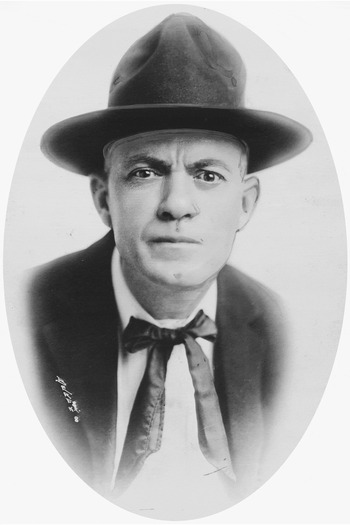
The most successful imitator of McCree is unquestionably Lew Kelly, who became more famous playing his character “Professor Dope” or “Doctor Dope” than McCree ever did as Bill. Gaining attention as early as 1911, Kelly played the character on burlesque stages into the 1920s, eventually starring in his own variety show, which often closed with the burletta “The Dream Man.”Footnote 75 By 1918, The Billboard reported on the “mammoth salary” that Kelly was making, and by 1920 The Hartford Courant called him “so well known that it seems foolish to even attempt to introduce his line to the readers.”Footnote 76 Kelly played the character in a costume almost identical to McCree's, with a Western-style fedora or cowboy hat and a neckerchief, and his performance included a similar kind of wild verbal play (Fig. 2). However, Kelly seems to have distanced his characterization from the rough and tumble roots of McCree's card dealer. Discussing the ways to catch a “Hump Back Herring,” and moaning about eating “skinless bananas,” Kelly's language is described by reviewers as “ludicrous” and “delightful,” rather than reminiscent of the Barbary Coast.Footnote 77 Though Kelly claims to have invented his characterization, an obituary notice for McCree in The Billboard asserts that he had written Kelly's earliest material as an elaboration of the original “Sappho” sketch.Footnote 78 A bit that Kelly used, called “The Most Contented Man on Earth,” may have been from McCree, as the title alone sounds like McCree's conception of the addict as “blasé and indifferent,” and “calloused to everything.”Footnote 79 Kelly's success in the character came despite the national prohibition of opium smoking in 1909. His Professor Dope may have taken on a more general identity of a drug user, rather than specifically an opium smoker. At the same time, with fewer addicts in the streets and the dens closed, audiences could enjoy the character as old fashioned, rather than presently menacing.
Lew Kelly in costume, 1923. Courtesy of Billy Rose Theatre Division, The New York Public Library for the Performing Arts, Astor, Lenox and Tilden Foundations.

With the demise of variety entertainments in the 1920s, the comic dope fiend lost his natural performance environment. However, elements of McCree's characterization, especially his language, proliferated as drug use continued to intrigue audiences of the Jazz Age and beyond. Many of McCree's original phrases appear in the “jive” dictionaries of the later decades that educated the uninitiated on the language of the hip. It was in the 1930s that drug slang was linked specifically to African Americans, suturing drug culture to black culture primarily through jazz music and the cabarets of the “Negro Vogue.”Footnote 80 For instance, Cab Calloway made a career of performing songs that supposedly revealed Harlem's underworld of drug use and its attendant slang. Similar to the experience that McCree offered his Eastern vaudeville audiences, Calloway's performances were a form of theatrical slumming for the whites-only audiences of New York's Cotton Club.Footnote 81 Much as the fear of Chinese traffickers was an efficient motivator for antiopium legislation, the linking of drug use to black and Latin communities ushered in a host of new propaganda and ordinances on narcotics. These lay the foundation for the out-and-out criminalization of addiction and the present-day policies that unfairly target minority populations, including mandatory minimums and “three-strikes” prosecutions.Footnote 82 The official vilification of the addict caused comic portrayals to evaporate in the 1940s and 1950s. By the time performers such as Cheech and Chong made comic drug use palatable again, the draconian measures of the “war on drugs” were already well entrenched. The comedy and pathos of McCree's performance was enabled by the fact that he arrived before the addict was officially labeled a criminal in the public's mind.
Conclusion
Junie McCree died in 1918 at the age of fifty-two. There is evidence that he struggled with substance abuse himself. In 1903 he was reportedly hospitalized for “alcoholic mania,” and his drinking may have contributed to his early end after he had lost most of his money. An obituary note in Variety lists “apoplexy” as the cause, and the term often referred to the paroxysms caused by alcoholism.Footnote 83 It may be a reach too far to imagine that his own struggles influenced his sympathetic portrayals of the opium addict. Either way, he established a characterization that stood far apart from the horrifying images of opium smokers that audience members found in almost every other representation of the drug user. McCree's humanized and approachable parody of the addict gave cultural cachet to the demonized figure, turning the signifiers of his ill repute into charming idiosyncrasy. His onstage presence dulled the edge of the rhetoric promoted by Hamilton Wright or the National Police Gazette that dominated the conversation over opium smoking and drug addiction. As popular entertainment so often does, McCree allowed audiences to take pleasure from that which was deemed unacceptable by polite society. Even in his portrayal of addiction's depravation of white masculinity, he maintained a nonthreatening and even enviable glee.
McCree's performance (and those of his imitators) gave external form to the internal disorder of addiction. Signified by a particular costume, physicality, language, and delivery, addiction took on a performativity, called into being in its presentation. The immoral taint of Nordau's degeneracy could manifest outwardly, as in the typologies of Cesare Lombroso's criminal anthropology. (Nordau, seemingly endorsing the idea that degeneracy could have outward signifiers, had dedicated his volume to Lombroso.) However, the reception of the addict's encoded physicality by popular audiences as comic was dependent on particularities of gender, race, and ethnicity. The empathetic response McCree generated was reserved for addicts who were white, male, and native; it did not extend to Chinese immigrants or African Americans. Courtwright's oft-quoted claim that “what we think about addiction very much depends on who is addicted” indicates how certain subject positions were available only to certain addicts.Footnote 84
Thus, scholars must be wary of codifying how they interpret stage addicts in forums other than vaudeville. McCree's dope fiend may share physical traits with other addicts, but as the social and biological makeup of the individual addict affected how he or she was received, any critical interpretation must adapt to consider the varying narratives related to the character's social position. In each case, there is what Jeffery Mason calls an “intricate and reflexive exercise in cultural self-definition.”Footnote 85 It is this very factor that makes the representation of addiction such a complex, slippery, and intriguing subject of study. With McCree, we find a negotiation between him and his audience that imbricates the addict with gender norms and national identities, demonstrating the far-reaching cultural work that the popular theatre accomplished. This broad significance hints at the potential depth of meaning that the drug addict might reveal as historians further explore the figure's importance.