


Background
In the UK, bibliotherapy schemes (Dobson, Reference Dobson2003) have become a widespread source of mental health information and support for people with common mental health disorders such as depression. These schemes often operate through a partnership between health providers and public libraries. Mental health services generally recommend a book list to be stocked by libraries and accessed by patients after recommendation or “prescription” by a mental health or primary care professional.
This popularity is a consequence of a variety of factors. First, depression, anxiety and other mental health disorders are common in primary care, with an annual prevalence rate of around 16% (Office for National Statistics, 2001). Second, despite additional funding (Johnson, Reference Johnson2007), lack of access to psychological therapies remains a serious problem for the NHS (Wilkinson, Reference Wilkinson2007), made more visible since the National Institute for Health and Clinical Excellence (NICE) issued guidelines that recommended cognitive and behavioural treatments (CBT) for depression and anxiety (National Institute for Clinical Excellence, 2004a, 2004b). Third, these types of schemes fit in well with recent government policy initiatives focusing on self-management of chronic conditions (Department of Health, 2001) and also with service user views of the importance of self-help strategies (Faulkner and Layzell, Reference Faulkner and Layzell2000).
The growing prevalence of these schemes has been documented in a recent report that estimated that over half of all English library authorities are operating some form of bibliotherapy intervention, the most common format being the books on prescription model (Hicks, Reference Hicks2006). Hicks also notes that there has been a “recent upsurge in activity”. For example, the Welsh Assembly launched Book Prescription Wales in 2005 to extend the scheme from localized pilots to the whole of the principality.
We recently conducted a survey of self-help books in order to identify the number of books available for people with depression or mixed anxiety and depression in the UK and to describe their principle characteristics (Richardson, Richards and Barkham, Reference Richardson, Richards and Barkham2008). We concluded that many of the available books demand a high level of literacy from their readers, and that we could find neither a relationship between the popularity and readability of a book nor the extent to which it was evidence-based. Martinez et al. reached a similar conclusion regarding the high reading ages of popular self-help books for depression in their recent survey (Martinez, Whitfield, Dafters and Williams, Reference Martinez, Whitfield, Dafters and Williams2008).
The evidence base for bibliotherapy remains unconvincing. A recent review found that “pure” (as opposed to “guided”) self-help had a minimal effect size (0.06) in depression (Gellatly et al., Reference Gellatly, Bower, Hennessy, Richards, Gilbody and Lovell2007). Hicks acknowledged that the evidence base for book prescription and other bibliotherapy schemes is “relatively fragmented and undeveloped” (Hicks, Reference Hicks2006). These two findings are of concern as bibliotherapy schemes may represent an ineffective treatment and may also be harmful to patients by delaying their entry into more effective alternatives.
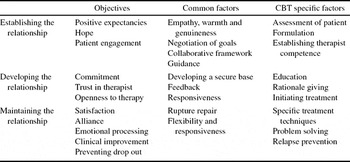
We have previously argued that the “contribution of ‘common factors’ that operate in personal therapeutic encounters, for example, therapist responsiveness and the patient-therapist alliance, may be one possible overlooked reason for the reduced effectiveness of self-help materials” (Richardson and Richards, Reference Richardson and Richards2006, p. 13). This might help to explain the better effectiveness of guided, as opposed to stand alone, self-help. However, we also argued that it could be possible to incorporate such common factors into self-help materials in order to provide the potentially missing therapeutic ingredient. Consequently, we have adapted a published model of common factors (Cahill et al., Reference Cahill, Barkham, Hardy, Gilbody, Richards, Bower, Audin and Connell2008) in order to develop a framework within which common factors might be incorporated into CBT and CBT based self-help books (see Table 1).
Objectives of the three stages in the therapist-patient relationship and the role of common and CBT specific factors

Cahill et al.'s (Reference Cahill, Barkham, Hardy, Gilbody, Richards, Bower, Audin and Connell2008) model defines three stages in a therapeutic alliance – “establishing”, “developing” and “maintaining” a relationship – and some of the factors or behaviours necessary for building and sustaining the therapeutic alliance. This paper extends our survey work (Richardson et al., Reference Richardson, Richards and Barkham2008) to report the analysis of a sample of current books and use of this model to determine the extent to which these books display examples of common factors used to establish, develop and maintain therapeutic relationships.
Research aim
The aim of this study is to ascertain to what extent a sample of self-help books for people with depression displays characteristics of common factors consistent with authors attempting to establish, develop and maintain therapeutic relationships with readers.
Method
Three evidence-based self-help books for depression were selected from 24 books identified in our previous survey and which were based on treatments recommended by NICE (National Institute for Clinical Excellence, 2004a). Prior to sample selection, the 2005 search was updated but this produced no additional books beyond the original 24. All 24 were based on CBT or a specific variant, rational emotive behaviour therapy (REBT) (Richardson et al., Reference Richardson, Richards and Barkham2008).
Sample selection
In our previous survey (Richardson et al., Reference Richardson, Richards and Barkham2008) we found that many self-help books were popular but required high literacy skills. For the current study, we wished to obtain a small sample of books for in-depth analysis, from across the reading ability range. Therefore, we divided the 24 books into three groups based on their reading age (calculated from a sample page) and our previous survey findings: the “low reading age” group covered ages 9.4 to 12.6; “medium” group 13.7 to 14.9; “high” group 15.4 to 17.0+. We then chose the most popular book from each group. The Amazon bestselling rankings were used as a proxy to rate popularity. The most popular book in the low group was A Self-Help Guide to Managing Depression (Barker, Reference Barker1997); in the medium group, Overcoming Depression (Gilbert, Reference Gilbert2000) and in the high group, Mind over Mood: change how you feel by changing the way you think (Greenberger and Padesky, Reference Greenberger and Padesky1995). Martinez et al. also found Mind over Mood to have a higher reading age than Overcoming Depression; they did not include A Self-Help Guide to Managing Depression in their survey (Martinez et al., Reference Martinez, Whitfield, Dafters and Williams2008). We analysed these three books in more depth.
Analysis
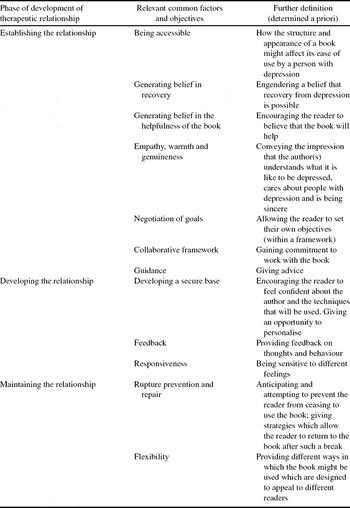
We used a qualitative method based on Miles and Huberman's (Reference Miles and Huberman1994) framework analysis to look for examples of common factors in the texts of the selected books. The framework used was based on an adaptation of our original model of common factors to account for the use of additional elements such as generating belief in recovery and the helpfulness of the book, which many authors use as specific techniques in their books. We also added “being accessible” as a common factor as this seemed particularly important in the context of a book. The final model is shown in Table 2. We extracted example text according to this framework, where these common factors were being used by book authors. We also extracted examples of counter evidence where authors were expressing themselves in ways that might potentially damage the therapeutic alliance. One author (RR) extracted the examples as data that were validated or challenged by a second author (DR). A dispute resolution process was set up using the third author (MB). To judge accessibility we looked at text size and density, reading age, average chapter length, availability and any other factors that might affect the accessibility of the book. We have included definitions of other common factors in Table 2 to explain how we identified these within the books.
Final model of common factors in relation to a self-help book

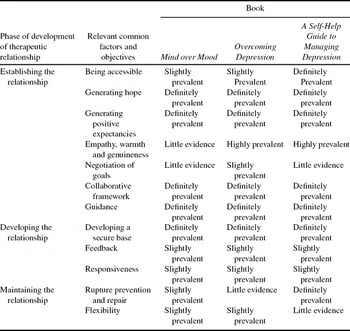
Our analysis is qualitative and thus we present example text quotes that fit our a priori definitions of each common factor. Although qualitative research does not “count” phenomena, we have included a summary (Table 3) in which we have given an indication of the overall prevalence of the common factors in each book, taking into account any sections that militate against a particular common factor. Given the qualitative nature of our analysis, rather than count prevalence, we have described prevalence using one of four descriptions: Highly prevalent, Definitely prevalent, Slightly prevalent, and Little evidence.
Prevalence of common factors in the books

Results
Establishing the relationship
Being accessible. Both Overcoming Depression and Mind over Mood are easily available. Both occupy high positions on the Amazon bestseller charts and appear frequently on the lists of Books on Prescription schemes. A Self-Help Guide is less available: it consistently appears lower down in Amazon listings and does not appear on the Books on Prescription lists. For example, a search using the term ‘depression’ in the books pages of the Amazon UK website carried out on 10 June 2008, found Mind over Mood listed second and Overcoming Depression listed eighth when results were listed in bestselling order. A Self-Help Guide was listed at number 562 (Amazon, 2008), perhaps in part due to its non-appearance on the Books on Prescription lists.
Our three books represented a range of a priori selected reading ages: A Self-Help Guide to Managing Depression (SHG) has the lowest at 9.9, whilst Mind over Mood (MOM) has the highest at 16.0. Average chapter length varies from 12 pages (SHG) to 20 pages (Overcoming Depression, OD). The text size in all of the books is small, although in two (SHG and MOM) the text is less dense: there is plenty of white space that makes the text easier to read. One book (SHG) contains 10 pictures to help clarify certain points.
Potentially militating against accessibility, one of the books (OD) contains much detailed and technical information. There are three chapters about evolution, animal behaviour and psychology that the author suggests missing out if necessary. The Foreword and Introduction are detailed essays arguing for the benefits of CBT.
Generating belief in recovery. The authors aim to engender hope that recovery from depression is possible in two main ways: through positive comments in the text and through case studies that illustrate the recovery process. Examples of positive comments include, “What understanding can do is offer a way to move out of depression rather than plunge further into it” (OD – p. xxiii), “depression can almost always be helped” (MOM-p. 160) and “some people are more likely to become depressed than others. This has something to do with how their bodies work. This is similar to saying that some people are more likely than others to become overweight or tense or frightened of flying . . . But people can learn to overcome such problems. In much the same way, you can learn to conquer your depression. It will take a lot of hard work, but it can be done.” (SHG – p. 4).
Mind over Mood is largely made up of the case histories of four people whose experience of CBT and progress towards recovery is illustrated. For example, in the early chapters, “Marissa” is depressed and experiencing suicidal thoughts but by the Epilogue (pp. 210–11) she “has not made any suicide attempts in the past two and one-half years” and “feels more hope for the future”. “Don” in Overcoming Depression (pp. 311–314) learnt how to challenge his thinking and “began to lose his depression when he began to accept that his ideal might not be possible and that he may have to grieve for some of the lost years”.
Overcoming Depression, however, contains a comment that may make a reader less hopeful about recovering from depression. In the Preface to the revised edition, the author states, “Sadly, there is no indication that the rates of depression have been falling in the five years since I began to write the first edition of this book” (p. xvii).
Generating belief in the book being helpful. There is evidence of the authors encouraging the reader to believe that the book will help them. All three list the authors' credentials on the back cover and use statements about their role and clinical experience. This is supplemented by editorial comment on the merits of CBT and the books: “this manual shows you how to improve your life using cognitive therapy – one of the most effective and widely practised forms of psychotherapy” (MOM – back cover). Quotations are also used: “It's an excellent guide to finding the way out of misery for those affected, their friends and family.” My Weekly” (OD – back cover). Overcoming Depression contains two essays by different clinicians, as discussed above, written to generate positive beliefs about CBT and the book (OD – pp. ix-xvi). Mind over Mood also uses testimonials from patients on its back cover: “This workbook served me well as a problem solving tool. I literally didn't leave home without it.”
The books also contain examples of how therapy might work: “You will learn how changing the way you think can change the way you feel” (SHG – p. 5); “As you complete the worksheets in this book, you will learn how to identify and change your thoughts, moods, behaviors, physical responses and environment” (MOM – p. 25); “I will outline some of the approaches that you might be able to use for yourself, to help you cope with any difficulties you may be experiencing or at least feel less overwhelmed and pessimistic about them.” (OD – p. 69).
In terms of counter-evidence, two of the books (OD and MOM) include official disclaimers relating to the fact that the book should not be viewed as a substitute for contact with health professionals, which would not contribute to believing the book will help. Furthermore Overcoming Depression notes, “self-help books are not a universal substitute for professional help, although they may give you the insight and courage to seek it” (p. 225) and “self-help books can be very useful, but do not necessarily eliminate the need for professional help” (p. 345). The reasons why the authors and publishers give these cautions are obvious and yet perhaps militate against generating positive expectancies of the book. Likewise Overcoming Depression states, “Importantly there are many things that can be done to help people who are depressed. There are some good drugs (antidepressants) available and many effective psychological treatments” (p. 11). The absence of self-help books in this list does not inspire confidence in the efficacy of this genre.
Empathy, warmth and genuineness. We found a great deal of evidence of authors displaying these characteristics both through direct statements and through the use of case studies illustrating how it feels to be depressed. Overcoming Depression includes many statements intended to show empathy for the reader with depression, for example, “My key message to you, if you suffer from depression, is that if you feel a failure, if you have a lot of anger and hatred inside, if you are terrified out of your wits, if you think life is not worth living, if you feel trapped and desperate to escape, whatever your feelings, you are not the only one.” (p. 10); “When we are depressed, all the activities we have to perform each day can seem overwhelming” (p. 69) and “Depression is one of the darkest winters of the soul” (p. 343). Likewise A Self-Help Guide to Managing Depression contains empathic statements including “At first you may feel that nothing can be done to help you. Perhaps you want to change things but feel that you do not have the energy.” (p. 2) and “You may cry when there is nothing to cry about” (p. 3). This book uses an interesting technique in which the majority of the book is written in the first person in that the text is written as if the reader were talking to him or herself, for example, “Often, I feel that I deserve to be miserable” (p. 43). We can understand this as the author encouraging the reader to become their own therapist, “I need to start charting what I do. This will show me how I am spending my time.” (p. 9). We understood this technique to be an attempt by the author to show empathy to the reader. However, it is not clear if such first person narrative is successful. It can equally be argued that it may diminish the opportunity for the reader to feel that that s/he has a high quality one-to-one relationship with the writer and the book.
The case studies contain descriptions of the feelings associated with depression and are designed to give the reader material with which to identify and to show empathy on behalf of the authors. Examples include: “In response to questions about her life and what made it so painful to her, Marissa described intense sadness all day long” (MOM – p. 7) and “Mary is depressed. She can't seem to do anything to shift it. She tries reading but can't concentrate.” (SHG – p. 61). In Overcoming Depression the author discusses his own experiences of depression (p. xix) as an attempt to empathize with the reader. However, such self-disclosure of personal experiences in a therapist is often seen as potentially counter productive to the alliance (Hill and Knox, Reference Hill, Knox and Norcross2002). The extent to which it may be helpful or not in a book requires further investigation.
The authors show empathy when they recognize the impact that depression may have on the reader's ability to engage with the book, for example, “The book should be read slowly, step by step. The next step should be taken when the last has been mastered. This is not easy when too depressed to concentrate, but a page at a time is manageable.” (SHG – back cover). Conversely, there are examples of vocabulary and concepts that might be difficult for people with impaired concentration to read, as noted above. The inclusion of such content does not recognize the needs of the target reader.
The authors convey warmth with statements including, “What is important to remember is that depression is not about human weakness.” (OD – p. 3) and “Our journey together may be a long one, but I hope it will equip you with some ideas of how to move out of depression.” (OD – p. xxiii). Displays of sincerity or genuineness are evident when the authors either discuss their own feelings, “In my own case, my poor English has often been a source of mild shame.” (OD – p. 214) or emphasize their experiences as therapists, “Philip Barker has stood beside many people in this dark place and realised that part of the resolution of sorrow lies with the sufferers regaining, and sometimes learning for the first time, to take control of their lives and to provide the gifts of kindness and power for themselves.” (SHG – back cover).
It is difficult to quantify the prevalence of common factors in self-help books of such different lengths and formats. However, in Mind over Mood we found little evidence of empathy, warmth and genuineness. There are not many instances where the authors attempt to talk directly to the reader about the suffering associated with depression. One possible reason is that this book is also aimed at people experiencing other problems, for example difficulties with anger management. Nonetheless, MoM is certainly more focused on the tasks or “specific factors” of therapy rather than including much text displaying common factors such as warmth or empathy.
Negotiation of goals. Neither Mind over Mood nor A Self-Help Guide for Depression encourages the reader to set goals that they might wish to achieve through using the book. Overcoming Depression contains a small section (pp. 104–105) in which the reader is encouraged to set goals, but there is little guidance on how to set achievable goals. The book does not give any space for the reader to write down their goals.
Collaborative framework. The authors use a variety of techniques to build a collaborative framework with the reader. The most obvious example is the use of exercises in which the reader is encouraged to undertake specific tasks. An example is the completion of “Thought Records” in Mind over Mood. The reader is guided through the process of completing a Thought Record over several chapters and encouraged to use this tool to challenge their own thoughts. A Self-Help Guide advises the reader to complete an activity diary and minimizes the effort that this will involve, “For the first few days of this exercise, I shall write down what I am doing just now. Just ordinary, everyday things. I don't need to do anything special. I shall just practise using the record sheet.” (SHG – p. 10).
The case studies are often used to show how therapy will work, thereby encouraging the reader to collaborate. Mind over Mood provides this example, “Marissa remained quite hopeless while discussing this evidence with her therapist. But when she wrote it down on her Thought Record, she discovered that seeing it all at once did make her feel somewhat more hopeful and less depressed. Similarly, you will benefit more from writing down the evidence in your own life rather than simply thinking about it” (MOM – p. 76). The authors also offer explanations of why they are asking the reader to complete specific tasks; A Self-Help Guide emphasizes that the homework is important as “These notes will be helpful when you are trying to change the way you think” (SHG – p. 5) as well as general explanations of how the therapy will work, “You learn to test the meaning and usefulness of various thoughts you have during the day and to change the thinking patterns that keep you locked into dysfunctional moods, behaviours, or relationship interactions” (MOM – p. 2).
The authors address the reader directly through the use of the first and second person to try to encourage a collaborative framework. For example, “Let's explore some typical challenges/disputes to overgeneralization” (OD – p. 135) and “If you are frightened of the feelings of anger, try expressing anger when you are alone.” (OD – p. 282). Direct questions are also used to engage the reader, “What sort of feelings am I getting? What sort of thoughts are related to these feelings?” (SHG – p. 25). As noted above, A Self-Help Guide is actually written in the first person to encourage the reader to become their own therapist. Occasionally, the authors offer different options for the reader to try and to see what works best, “Be your own adviser: test out whether these ideas are helpful to you and decide which best suit you” (OD – p. 67). This again is a tactic to encourage the reader to participate in therapy.
Guidance. All three books offer guidance to the reader, either in the form of general advice, or guidance on completing the exercises. Examples include, “To remember to fill out the Activity Schedule, carry a copy with you” (MOM – p. 165); “If I find doing something difficult, I shall tell my body what to do” (SHG – p. 31) and “If you do feel sorry for your poor behaviour, then it is useful to express this as sadness rather than as anger” (OD – p. 257).
In general, we found that the three books displayed many examples of the types of content that one could equate to a therapist establishing a relationship with a patient, although we also found some “counter-evidence”. There is some overlap between the various categories, although it does seem that the use of empathy, warmth and genuineness is particularly well developed.
Developing the relationship
Developing a secure base. Many of the techniques that the authors use in generating positive expectancies are relevant to the development of a secure base. The authors are attempting to encourage readers to have confidence in them. Emphasizing their own clinical experience and expertise will serve this purpose. Information about the effectiveness of CBT helps to build confidence in the techniques that will be used. Likewise, the technique of clearly explaining the rationale for the various exercises serves to create a feeling of security as well as helping to build a collaborative framework.
Both A Self-Help Guide and Mind over Mood contain a great deal of “white space” (i.e. blank space around the text) that would enable the reader to personalize the book by adding comments and thoughts. Mind over Mood gives enough room in the worksheets to allow the reader to complete them in the book. Both these tactics would seem to encourage the reader to feel secure with the book by allowing them to make it their own. The combination of the development of beliefs about the helpfulness of the book and the facility to individualize the book helps to create the feeling of a secure base.
Feedback. The case studies provide generic feedback on various types of behaviour. Although these are not tailored to the reader, s/he may identify with the situations and thus with the feedback given. Examples include “Charlie” who has negative thoughts about his achievements at work and is encouraged to make flash cards to challenge them. Charlie does not do this successfully and the author discusses why this has happened and the lessons to be learnt (OD – p. 112). In A self-Help Guide the case study of “Mary” illustrates how it feels to try behavioural activation and a reader may identify with the feelings and reactions described (p. 61–2).
The exercises also generate specific feedback for the reader. For example, Overcoming Depression encourages the reader to “Take a specific difficulty that you might have and consider the pros and cons of changing your situation. Not only focus on the advantages, but also try and spot some of the disadvantages that might be stopping you from changing” (p. 120). A Self-Help Guide advises the reader to complete activity records that “will be helpful in challenging my belief that I do nothing, or that I enjoy nothing” (p. 23).
A Self-Help Guide also contains several examples of messages that the reader can give to themselves to give feedback on their thoughts or actions. For example, on pages 20–21, the author lists various “unhelpful thoughts” and gives an answer for each, “It's too difficult. It just seems that way because I'm depressed. I've done more difficult things than this before”. It is, of course, difficult to imagine how a book could give personal feedback to a reader.
Responsiveness. All three books attempt to be responsive to people with differing presentations of depression by offering case studies that reflect these. Mind over Mood includes case studies of people of different ages and genders to try to appeal to as many readers as possible. The authors also discuss the various features of depression, for example, “You feel different. You may cry when there is nothing to cry about. You may feel sad and alone in the world. You may lose interest in yourself or others. You may blame yourself for trivial faults or shortcomings. You may even feel guilty about things which happened a long time ago” (SHG – p. 3). This approach is designed to ensure the book is responsive to as many readers as possible.
Overcoming Depression and A Self-Help Guide both offer different responses that can be used in particular situations or to counter particular thoughts. Examples include “A Quick Guide to Making Your Own Flash Cards”, which offers thoughts to deal with particular feelings and ideas (OD – p. 359) and “ten questions which might help me challenge my negative thoughts” (SHG – p. 38–9). Although the books attempt to respond to the different feelings associated with depression, we found no evidence of them attempting to respond to the change in people's feelings over time
There was less evidence for content in the books that could be mapped to the “developing the relationship” phase of therapy. This may be due to the fact that this phase of the relationship demands more of an individualized response to the patient.
Maintaining the relationship
Rupture prevention and repair. The most evidence for authors attempting to anticipate and prevent a rupture in the therapeutic relationship can be found in A Self-Help Guide. Examples include Section 1L, “What's the point of all this?” (p. 23) in which the author lists reasons for persevering with the therapy and Chapter 6, entitled “Setbacks”, in which the author gives advice on dealing with setbacks, for example, “This is just another stage on the road to recovery. They are not a sign that I shall never overcome my depression” (p. 64). The author offers strategies to deal with setbacks, for example, “If I don't seem to be able to solve the problem, I don't need to despair. I don't need to give up. Time and a little sustained effort on my part is what is needed.” (p. 67).
Case studies sometimes show people feeling sceptical about therapy or finding the exercises challenging and this can then be used as a tool for preventing rupture. For example “when Marissa's therapist first showed her a Thought Record, Marissa felt overwhelmed and depressed. The therapist used this reaction to help Marissa complete her first Thought Record” (MOM – p. 36). Her progress is then illustrated. Mind over Mood also encourages the reader to fill in a “Depression Inventory” to record depression scores. They note, “You may find that your scores fluctuate from week to week or do not improve each and every time you fill out the inventory. . .This is not unusual nor is it a bad sign; in fact, it reflects a pattern of recovery.” (p. 154). There was little evidence in Overcoming Depression of the author anticipating and attempting to deal with a rupture of the therapeutic relationship.
Flexibility. There is mixed evidence for the authors encouraging readers to use the books flexibly. On several occasions Overcoming Depression advises readers to miss out certain sections if they are too difficult or not relevant, as does Mind over Mood. The last three chapters of Mind over Mood provide information “that can help you reduce the frequency and severity of five moods that create distress for people: depression, anxiety, anger, guilt and shame. You can read only those chapters that describe the moods you would like to understand and change” (p. 153). Section III of Overcoming Depression discusses several specific problems associated with depression, again to reflect the different experiences of readers. However, although the author acknowledges that some of the problems may not apply to the reader, he advises working through the chapters in the order given as they “make more sense” (p. 185). He advises skipping, but returning to, sections you don't understand. This seems to make the book less flexible for the reader.
Chapter 5 of Overcoming Depression does give advice on physical strategies to help with sleep, diet and exercise and both this book and Mind over Mood give advice on medication. None of the books recommend any other psychological approaches, although this is to be expected given our CBT-based selection criteria. It is interesting to note that the recently published Competencies required to deliver effective cognitive and behavioural therapy for people with depression and with anxiety disorders (Roth and Pilling, Reference Roth and Pilling2007) lists both cognitive therapy and behavioural activation as being important for dealing with depression. A self-Help Guide offers both behavioural and cognitive strategies, whereas the other two books focus on cognitive therapy.
In general, therefore, we found the least evidence of common factors when considering the Maintaining the Relationship phase.
Discussion
We found considerable evidence that the authors of our three selected self-help books for depression use common factors in their writing. There is more evidence of certain types of common factors, e.g. empathy, warmth and genuineness, than of others, such as flexibility. Common factors used to establish a relationship are more prevalent than those used to develop and maintain the alliance. There are also sections in the books that perhaps threaten the development of a therapeutic relationship between author and reader. We also found variation in the prevalence of examples of common factors between each of the books. Despite the short length (74 pages) of A Self-Help Guide to Managing Depression examples of the author establishing, developing and maintaining a therapeutic relationship with the reader are multitudinous. In contrast, sections of Overcoming Depression are highly technical and may be difficult for someone with impaired concentration to read. It is more difficult to find evidence of empathy in Mind over Mood. However, despite including the most common factors, A Self-Help Guide is less accessible in other ways since it is far less popular, confirming our previous survey finding that popularity is a self-reinforcing, sales driven concept unrelated to book content.
Limitations
We analysed a very small sample of available books, although in some depth. Our operationalization of common factors and identification of these in the text depended on much interpretation and this analysis would benefit from cross-validation from a wider community.
Implications
The overall conclusion of this analysis is that although some types of common factors are easier to incorporate into a written format than others, self-help books can and do use some examples of common therapeutic factors. Our original broad hypothesis that non-guided self-help is ineffective in part because of the lack of common factors in self-help books is, therefore, challenged by this finding. However, the scarcity of particular common factors that are designed to develop and maintain therapeutic alliances, compared to the relative proliferation of factors that establish the relationship, may provide a more sophisticated alternative hypothesis.
Our revised hypothesis is that the performance of non-guided self-help may be impaired by the specific lack of common factors designed to develop and maintain the therapeutic relationship. All therapists know the importance of holding people in therapy through difficult stages – developing and maintaining the therapeutic relationship – and dealing with ruptures and setbacks flexibly and responsively. The popularity of self-help books – analogous to the establishment of a psychotherapeutic relationship – is self-evident from book sales. That systematic reviews find them ineffective without human guidance (Gellatly et al., Reference Gellatly, Bower, Hennessy, Richards, Gilbody and Lovell2007; Hirai and Clum, Reference Hirai and Clum2006) might be better explained by their lack of responsiveness (Stiles, Honos-Webb and Surko, Reference Stiles, Honos-Webb and Surko1998), flexibility and rupture repair (Stiles et al., Reference Stiles, Glick, Osatuke, Hardy, Shapiro, Agnew-Davies, Rees and Barkham2004), all sophisticated therapeutic behaviours thought by psychotherapy process researchers to be important in the development and maintenance phases of therapeutic alliances. When things do go wrong with non-guided self-help, current books find it difficult to be sufficiently flexible and responsive and to repair the breakdown. Once a book is put down, it might be that it is more difficult to pick it back up than to repair a similar rupture in an alliance between a therapist and a patient.
This may be a result of the relative difficulty of including such factors into fixed text. However, the extent to which this is possible within a fixed text format (as opposed to an intelligent responsive computer programme for example) is a matter for further research. Indeed, many other books from diverse literary categories can be “impossible to put down”. An analysis of what takes a book such as a novel into this category could aid the future writing of second generation self-help books. We suggest, therefore, that future generations of self-help books should pay explicit attention to the use of common factors in developing and maintaining the therapeutic relationship, in particular how more sophisticated responsive factors can be woven into the text. It would be possible to test our hypothesis in a research study by comparing the effectiveness of a text in which attempts had been made to incorporate all types of common factors against one in which much less attention had been paid to the therapeutic relationship.
Alternatively, it may not be possible to replicate the sophisticated therapeutic behaviours necessary to develop and, in particular, maintain alliances through extended use of self-help materials. This may explain the positive effects found for guided self-help, where supporters, facilitators or coaches provide the flexible, responsive input to maintain the alliance. The providers of bibliotherapy services could consider what extra types of support might be needed for readers to achieve the full benefit of the books prescribed, certainly with the current generation of the books that are available.
Conclusion
Self-help books have the potential to provide a valuable adjunct to services for people with depression, but further work is necessary to develop the books that are used and the specific support given with them, Currently, it is not possible to argue that Books on Prescription schemes should be further developed to provide a mainstream choice in evidence-based psychological therapies. Before further trials are funded, we suggest that researchers should undertake work within the early theoretical, developmental and modelling phases of the complex interventions framework recommended by the MRC and others (Medical Research Council, 2000, 2008; Campbell et al., Reference Campbell, Murray, Darbyshire, Emery, Farmer, Griffiths, Guthrie, Lester, Wilson and Kinmonth2007). Urgent developmental work is required to define and refine the component parts of the bibliotherapy intervention, particularly the common factors that accompany the evidence-based CBT specific factors, before any further trials are carried out. In the meantime, self-help programmes such as books on prescription should be accompanied by guidance and support from mental health workers.



Comments
No Comments have been published for this article.