The provision of public services is beneficial for the protection of citizens’ rights and the promotion of national prosperity,Footnote 1 but may also worsen social inequalities.Footnote 2 The experience of China since reform and opening up is one potential demonstration of this dual impact: on the one hand, the country has achieved rapid economic development and improved the quantity and quality of public services; on the other hand, social inequalities have been increasing.Footnote 3 The Chinese Communist Party (CCP) has recognized this; in a report to the 19th National Congress in 2017 it was stated that “socialism with Chinese characteristics has entered a new era, and the main contradiction of society has transformed into the contradiction between the people's growing need for a better life and unbalanced and insufficient development.”Footnote 4 Is the widening of social inequality associated with active government provision of public services in China? This study examines one local government programme that tried to innovate in governance by bypassing the household registration (hukou 户籍) system to counter institutional discrimination against migrants in the hope of enhancing social equality and harmony by providing them with free and equitable community education. We find, however, that the actual outcomes of the policy deviated from the goals, as those who took up the service were mainly better educated local hukou holders, while less educated migrant groups were significantly excluded. A public policy aimed at improving social integration through reducing educational inequality ironically widened the inequality between locals and migrants.
Existing studies of the non-take-up of public services in China have examined the causes mainly from the perspectives of formal institutions, such as the hukou system, and culture, for example, anti-migrant stigma and discrimination,Footnote 5 but much less so from the perspective of public administration.Footnote 6 In recent years, academics have paid increasing attention to “administrative burden” to explain the non-take-up of public services, a factor behind increasing inequality. These studies argue that administrative burdens are both consequential and distributive.Footnote 7 They affect the effectiveness of public servicesFootnote 8 and impact the exercising of “basic citizenship rights”;Footnote 9 meanwhile, they affect some groups, who usually are the vulnerable, more than others, and in so doing they “often reinforce existing inequalities.”Footnote 10 Based on this theoretical perspective, this paper proposes an interaction mechanism – which we term “selective affinity” – between the policy process and individuals’ human capital that leads unintendedly to disproportionately heavy administrative burdens on the disadvantaged, to explain their non-take-up of public services, thereby contributing to growing social inequality.
Literature Review: Non-take-up of Public Services from the Administrative Burden Perspective
On the issue of non-take-up of public services, the focus of academic approaches has undergone a process of change: moving from institutionalism to the policy process, and then to individuals’ experiences.
In the literature on public policy “targeting” specific groups in society, most studies focus on the governmental and individual behaviours involved in the policy process from the perspective of organisational behaviour.Footnote 11 However, these studies have difficulties explaining why the outcomes in the provision of a particular public service vary greatly under the same institutions and policies.Footnote 12 Janet Currie offered the following critique: “Historically, economists have paid much attention to rules about eligibility and virtually no attention to how these rules are enforced or made known to participants.”Footnote 13 Therefore, factors outside of institutions must be included. Looking at the case of poverty alleviation programmes, Kanbur, Keen and Tuomala note that “once the potential incentive effects of such programs are recognized, previous discussions of optimal targeting [will] require revision.”Footnote 14
In addition to focusing on formal institutions and policies, scholars have also looked at policy processes and contexts to find the causes of non-take-up. For example, numerous studies in welfare economics have shown that there is a great deal of evidence that potential recipients of in-kind transfers are sensitive to application costs.Footnote 15 Political science is also concerned with similar issues. Indeed, academic debates about the dysfunctionality of government programmes and regulations have a long tradition in political science.Footnote 16 Scholars of public administration have also noticed that public policy might best be understood at the “street level.”Footnote 17 In other words, public policy and services are not entirely self-executing, but depend on a process of implementation and clients’ cooperation for their production, as such they constitute “extra-legal” outcomes.Footnote 18 Successful take-up of social programmes requires a match between the “institutional capacity to delivery rights and services and people's capacity to benefit from those rights and services.”Footnote 19 In other words, as the outcome of a public service, (non-)take-up has a dual attribute: It is not only a phenomenon of administrative organisation, but also a social phenomenon; not only a process of the implementation of public policy and the result of its action on society, but also a process of individual experience and the responses of society to the state and its policies. Therefore, we need to adopt a perspective that combines the policy process and government–citizen interaction.
In recent years, based on the citizen-centred perspective, scholars have used the administrative burden framework to examine the factors that hinder individuals’ access to public services in their interactions with the state. This not only links the input side and output side of public services but also effectively reveals the interrelationship of these elements in the policy process as they affect non-take-up. Administrative burden has been defined as “an individual's experience of policy implementation as onerous”Footnote 20 and is clarified as encompassing three types of costs (learning, compliance and psychological) involved in accessing public services.Footnote 21 This conceptualizes the nature of the burdens that citizens experience in their interaction with government and offers a basis for further empirical studies. Thus it differs from the rules, “pointing instead to the costs that individuals experience in their interactions with the state.”Footnote 22 It also illustrates “the important political and social implications of administrative burden associated with government–individual interactions.”Footnote 23 The above definition of the administrative burden has two important contributions:Footnote 24 First, it distinguishes between organisational practices and the experiences of individuals. Second, the definition acknowledges differences in the presence of administrative burdens among individuals and directs us to factors that can explain these differences. Administrative burden is therefore an important part of governance as it relates to barriers to clients’ access to services, the exercising of citizens’ rights and the realization of citizenship, democracy and social equality.Footnote 25 Furthermore, it can further shape clients’ “orientations towards government institutions and policies”Footnote 26 as well as their willingness to participate and their trust in government.Footnote 27 For the government, a focus on administrative burdens also helps to better understand the sources of administrative costs.Footnote 28
Empirical studies of administrative burden have mainly focused on its causes in specific contexts, which are clarified as three types of interactions, intra-organisational, citizen–state and citizen–citizen.Footnote 29 These explanatory factors come from two main sources, namely organisational factors (formally prescribed and informally created) and extra-governmental, or citizen, factors.
Organisational factors are elements and practices embedded in policy implementation. Peeters constructs a comprehensive framework that divides the organisational origins of administrative burden into four ideal types, based on two dimensions: (in)formality and (un)intentionality. Thus, administrative burdens can be either deliberate or unintended, or intentional and unintentional, and can be designed as formal structures or emerge from organisational practices, which covers many different streams of research.Footnote 30
Extra-governmental or citizen factors refer to the contextual factors of the policy process and the characteristics of services’ clients, which exist prior to state–citizen interactionFootnote 31 and are respectively conceptualised as cultureFootnote 32 and human capital.Footnote 33 Human capital influences how clients engage with administrative processes.Footnote 34 Variation in human capital helps to explain clients’ different responses to the same programmes,Footnote 35 or “disparities in citizen outcomes such as take-up of services and benefits, civil engagement and feelings of political efficacy.”Footnote 36 Culture may frame or influence the agenda, process and output of social policy,Footnote 37 which may exist at the macroscopic and microscopic levels. Macro-level research reveals that public “deservingness” criteria,Footnote 38 popular preferencesFootnote 39 and partisan political ideologiesFootnote 40 can underpin perceptions of a “just distribution of burdens.”Footnote 41 Micro-level research reveals that, in policy design, the mismatch between administratively defined need and different social perceptions of need,Footnote 42 and in policy implementation, the habitual attitudes and practices of street-level bureaucrats and of the social to specific groups of clients, which are manifested as stigmasFootnote 43 and stereotypes,Footnote 44 could give rise to enormous costs involved in accessing services. On the side of service clients, their knowledge or perceptions of policy or government, such as citizen trust,Footnote 45 policy feedback,Footnote 46 individual preferences,Footnote 47 cognitive resourcesFootnote 48 and so on, may impose considerable psychological costs to interacting with a service-providing agency.
In summary, existing research on the causes of administrative burden primarily focus on policy implementation and the characteristics of clients’ human capital; “government–individual interaction” is primarily embodied as clients’ passive “administrative encounter” in their specific context. Much less attention has been paid to the relations between these various factors. It is hardly convincing that the systemic exclusion of disadvantaged clients is due to various factors which are arbitrarily distributed in the various stages of the whole policy course. This paper explores a case where the government provided free community education, but disadvantaged groups were systematically excluded due to various administrative burdens imposed on them at different levels. We propose that the selective affinity mechanism, i.e. the interaction between the policy process and clients’ human capital, leads unintendedly to this disproportionate administrative burden, preventing the disadvantaged from accessing the service.
Research Methodology
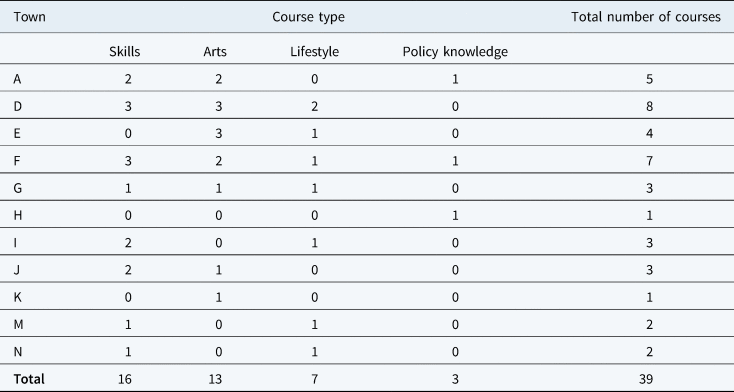
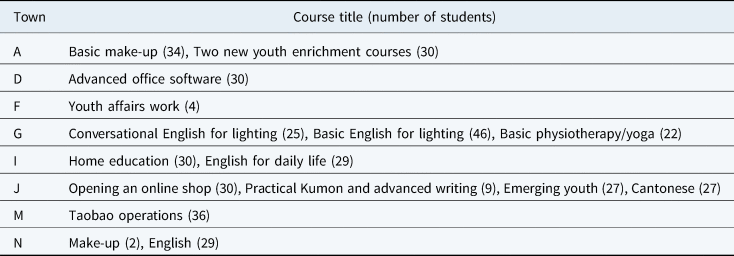
We adopted mixed methods of interview, participatory observation and questionnaire-based surveying to assess the outcomes of one public service, the Youth Community College Programme (YCCP) in Z City, China. We first communicated with the local governments of each of the 24 towns in the city three times beginning in January 2015, and then conducted interviews with students and teachers from eight towns’ YCCP colleges to learn more about their courses, management, faculty recruitment and the process of registration. To find the experiential reality of potential clients, we conducted in-depth interviews with youths who were aware of the programme and their eligibility but did not participate in the programmeFootnote 49 and those who initially did not but later did join a YCCP course. Finally, we also learned from these latter interviewees about the reasons why their friends did not participate in the programme. The total number of people interviewed was about 50. From May 2015 to June 2016, we collected two sets of questionnaire data from some students and teachers of the programme. The questionnaires were designed to gain basic background information about the respondents, their course participation, and their evaluations of the courses. The survey was conducted through a proportional sampling method in each town, with a sample of eight towns and 39 courses (Table 1). We focused on young people living and working in Z City and aged between 18 and 40, including individuals from both the local and migrant populations. We distributed 1,200 questionnaires and 892 valid responses were collected, of which 434 were from students taking skills courses (approximately 48.7 per cent). The details of the survey participants’ enrolment in skills courses in each town are shown in Table 2.
Summary of Different Types of Courses in Each Town's YCCP College, 2015–2016

Source: The data in this table were collected and processed by the authors.
Course Titles and Number of Students for Courses Surveyed by the Authors, 2015–2016

Source: The data in this table were collected and processed by the authors.
The Case: Non-take-up of the YCCP
Public services in many Chinese cities are facing severe pressures. With the rapid development of the economy, many cities are seeing a huge wave of migrant workers, who even outnumber the local population in some cities. Conflicts between local and migrant populations have occurred, and Z City has experienced such problems. On 25 June 2012, a serious clash occurred between local and migrant residents in the city. In response to pressure for social stability, the Z City government introduced more public services for migrant residents, including the YCCP. In July 2012, the Youth League Committee (YLC) in Z City started this project, which was reported on in Z City Daily.Footnote 50 The YCCP aimed to improve the access of disadvantaged groups to practical training and to facilitate the community integration of the migrant population by providing free education to them in a so-called “academy without walls.”Footnote 51 Therefore, the students targeted by the YCCP were mainly migrants, especially those who came from rural areas with low levels of education and who were relatively disadvantaged in Z City.
Local governments attached great importance to the development and promotion of the YCCP and invested significant administrative and financial resources in it. The programme's entry requirements, teaching facilities, teachers and curriculums were carefully designed to ensure the quality of the programme. The admission requirements were low so as to include most migrant workers: all people who were “living and working in Z City” and “between the ages of 18 and 40” were eligible for free admission.Footnote 52 In terms of teaching facilities and teachers, they made full use of every town's YLC facilities, as well as youth clubs (qingshaonian gong 青少年宫), teaching locations of the local radio and television university (guangbo dianshi daxue 广播电视大学) in 12 towns, and other facilities and their teachers, to ensure high-quality instruction. In terms of curriculums, in order to meet the needs of the students, they conducted two rounds of questionnaire surveys every semester. The first round was conducted in the preparation phase of the courses, targeting the youth from various organisations and enterprises in the towns and focusing on their educational interests and course preferences. The state newspaper China Youth Daily reported that the YLC in Town A conducted door-to-door questionnaire surveys,Footnote 53 while the YLC in Town B distributed many questionnaires on the streets.Footnote 54 They tried to ascertain the training needs of local youth, especially those of migrant workers. The next round of surveys took place at the end of the courses, focusing on students’ suggestions for programme improvement. In order to increase public awareness of the programme, local governments used a variety of publicity tools, such as organizing promotional events in local shopping malls and squares and posting information about the courses on online platforms such as the “Z City Youth” mobile app and WeChat.Footnote 55
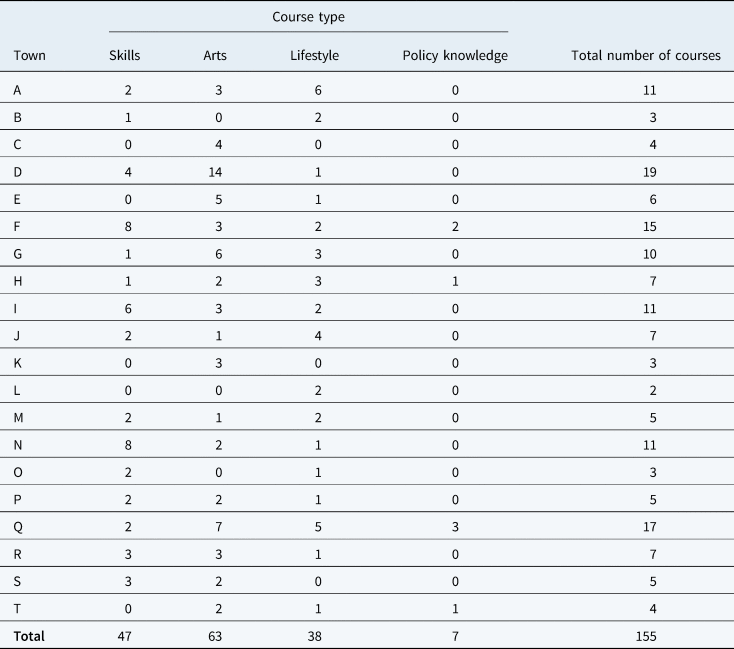
Through the local governments’ considerable efforts, the programme was rapidly promoted and garnered favourable feedback from higher levels of government and active participation from local communities. China Youth Daily reported that YCCP courses in Towns A and B were almost always full.Footnote 56 Z City Daily summarized that during the three years that the YCCP college in Town D was in operation, the YLC invited 25 private-sector teachers and 14 public-sector teachers to offer more than 100 courses; nearly 20,000 students received free training; and more than 2,300 received diplomas.Footnote 57 In the schedule from March to August 2015, for example, a total of 155 courses were offered in 20 towns, covering skills, arts, life and policy knowledge (Table 3). Thanks to these efforts, the YCCP in Z City also won a series of honorary titles, such as a “Provincial Law and Order Cultural Construction Demonstration Zone,” “Provincial Community Education Experimental Zone,” “Social Management Innovation Project” and “Characteristic Cultivation Project in 2012.” Overall, in 2015, the YCCP had achieved full coverage of the 24 towns in Z City, offering 92 courses and enrolling 3,176 students. In 2016, the programme expanded to offer 176 courses to 5,280 students. Because of its value as a public service model, the programme also attracted numerous study tours from other provinces and even from the central government.
Number of Courses Offered by the YCCP in the First Half of 2015

Source: The data in this table were collected and processed by the authors.
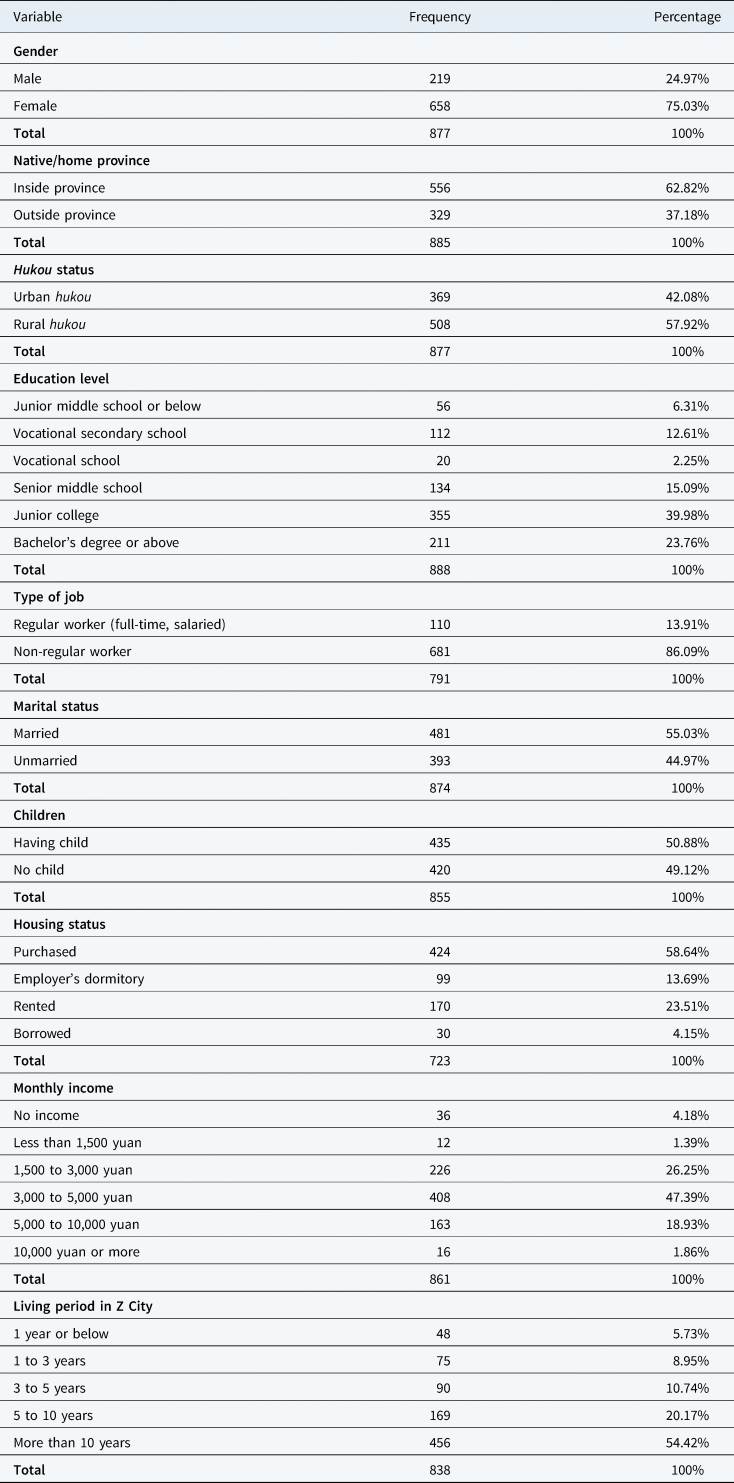
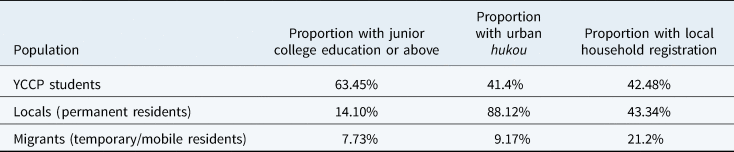
However, our survey found that this public service did not fulfil the local governments’ goal as well as it appeared initially. Using descriptive statistics from the two surveys (Table 4), we examined education and hukou differences between the overall City Z population and the YCCP students in 2015 (Table 5). In terms of education level, the proportions of the migrant population (liudong renkou 流动人口, temporary/mobile residents without local hukou) and local population (changzhu renkou 常驻人口, permanent residents with or without local hukou), with tertiary education were 7.73 per cent and 14.10 per cent, respectively, in Z City; in stark contrast, this proportion among YCCP students was far higher, at 63.45 per cent, indicating that the students belonged to a relatively advantaged group in terms of education level. In terms of urban and rural hukou status, the proportions of the migrant and local populations in the city with urban hukou status were 9.17 per cent and 88.12 per cent, respectively; however, the proportion of the programme students with urban hukou status was 41.4 per cent, much higher than that of the overall migrant population in Z City, indicating that the students belonged to an advantaged group in terms of hukou status as well. In terms of local household registration, at the city-wide level the proportions of locally registered households among the migrant and local populations were 21.2 per cent and 43.34 per cent, respectively; in contrast, the proportion of locally registered households among the YCCP students was 42.48 per cent, which was obviously higher than that among the migrant residents but very close to that among the local population. This further indicates that the YCCP students belonged to a relatively advantaged group in terms of local hukou status. Furthermore, some other indicators in Table 4, such as the students’ income, also show that relatively higher-income students were the majority, while the main policy target, the low-income residents, were the minority in the programme.
Descriptive Statistics of the Survey Results

Source: The data in this table were collected and processed by the authors.
Differences between YCCP Students, Locals and Migrants in Z City, 2015

Source: The data on YCCP students were collected and processed by the authors; the data on the resident and migrant populations of Z City in 2015 were collected from the Statistical Yearbook of Z City 2015 and the Bulletin of Z City: National Economy and Social Development 2015 (issued by the Bureau of Statistics of Z City), as well as Basic Characteristic Data on the Migrant Population in China: G Province (issued by the National Science and Technology Infrastructure and National Earth System Science Data Sharing Infrastructure). Further details are available upon request.
In summary, these educational and social background indicators show that the YCCP students belonged to a relatively advantaged group in Z City's overall population. The programme had been designed to target the disadvantaged to improve their skills and capabilities, and, as a result, promote their deeper integration with local communities; however, the disadvantaged had a much lower level of access to the programme. This issue was also observed by some local governments. As one CYL supervisor noted in an interview with the authors, “We have also gradually found that those who came to the college were mainly those with good qualifications and [academic] foundations, and much fewer of those with low qualifications and skills enrolled in the programme. We have done a lot, but we have not been able to solve this problem.”Footnote 58 Evidently, it is necessary to determine why the non-take-up of the YCCP was so severe among the disadvantaged in Z City.
Explaining the Non-take-up of the YCCP: The Selective Affinity Mechanism
The above statistical results suggest that migrant populations were systematically excluded from the YCCP. According to the typology of administrative burden, we find that three types of administrative burden, participation cost, learning cost and psychological cost, exist simultaneously in the YCCP and at different levels: policy content and individual perceptions.
Participation Costs and Learning Costs: Hidden Thresholds in Policy Content
“Organizational practices (both formally prescribed and informally created) are complicated, confusing, or cumbersome, they can add hidden costs to claiming, in some cases raising costs beyond the capacity of individuals to ‘pay’.”Footnote 59 Although the target population of the YCCP was migrant workers, it is clear from its specific policy content that there were some hidden thresholds which induced participation and learning costs for migrant workers. We find four thresholds in the policy content.
First, in terms of the timing of courses, the courses were offered at times convenient for those with standard working hours. This schedule made it difficult for migrant workers, who usually had irregular working hours, to attend the courses, which were usually scheduled on weekday evenings and weekends.Footnote 60 As one interviewee noted, “The colleges have strict attendance requirements, but our work time is often in conflict with the class time, discouraging many of us from enrolling.”Footnote 61
Second, in terms of course locations, the colleges operated in local town centres, in institutions such as youth clubs, sports and recreational centres, teaching locations of the radio and television university and government offices. These locations were suitable for those living close to the town centre, who are usually local residents, while it was difficult for young migrant workers living in remote districts to attend. The latter often live in dormitories near factories and in rural rented accommodation because they cannot afford housing near to the town centre. As some scholars have mentioned, time and commuting distance can be heavy compliance costs for the disadvantaged.Footnote 62 As one interviewee noted, “We live in remote areas and the transportation is not convenient, so when we go home after school at night, we don't have buses to take. Many of us give up this free education opportunity for this reason.”Footnote 63
Third, in terms of the course contents, the programme focused on arts, lifestyle (e.g. wine-tasting, yoga) and skills classes. In order to attract attention, they also incorporated various fashionable elements, including wine-tasting (Town E), baking (Town F), calligraphy and painting (Town G), Wing Chun (a school of martial arts) (Town H), photography (Town A) and yoga classes (offered in almost every town). These classes were meant to enrich students’ cultural lives, but they were usually attended by people with higher incomes and education, certain life pursuits and more leisure time. The contents of these courses were not well suited to the needs of most migrant workers. The spare time of most migrant workers is basically spent in the same way, “either work an extra job or rest at home in one's free time,” and they generally did not have interest in, or the requirements for, enrolment.Footnote 64
Fourth, in terms of the policy benefits, the courses were linked to the “points for local household registration” policy. By completing a course, students could obtain four points (up to a maximum of five courses, or 20 points in total), which was equivalent to the points earned by a personal investment of 400,000 yuan, payment of income tax of 4,000 yuan within five years or 100 hours of voluntary community service. By accumulating enough points, the students could apply for local hukou status, access to social welfare benefits (e.g. public school enrolment for their children) and even designation as “urgently needed talents for economic and social development in the town.” However, most people who wanted to take advantage of this policy to apply for local hukou status already had stable jobs and income. They hoped to earn enough points for local household registration because they had the financial capacity to live in the city permanently. Migrant workers were less attracted by this benefit because of their unstable jobs, low incomes and other obstacles that made it difficult for them to accumulate enough points and live in the city for the long term, even if they earned some points through the YCCP. Two respondents explained this as follows: “We are not stable in our jobs, we don't earn much, and we haven't considered whether to apply for a local hukou yet”;Footnote 65 “We will work here for a few years, and maybe later, we will go somewhere else.”Footnote 66 As a result, these provisions, which appear to be designed to attract migrants to settle in the city, in fact serve as a marker of identity distinction, because it is the advantaged who find the policy more applicable, not the disadvantaged. Thus, for most migrant workers, to whom these provisions are not really applicable, these are implicit thresholds that increase their learning costs, hindering their participation.
In summary, the four elements mentioned above are different types of administrative burden. Specifically, time and commuting distance are compliance costs and course contents and policy benefits are learning costs, which all make the “bite” of administrative burden potentially bigger,Footnote 67 and shape the motivation of migrant residents to non-participation.
Psychological Costs: The Human Capital Perspective
The demand-side origins of burdens, i.e. citizens’ experiences, expectations and resources, can also profoundly affect their willingness and capacity to engage with bureaucrats.Footnote 68 “The impact of burdens depends upon on how individuals construe the world, not on objective measures of costs and benefits. This construal is shaped by contextual factors that frame burdens and interact with individual psychological processes, including cognitive biases that may generate disproportionate response to burden. This basic insight explains why burdens that seem minor and defensible when designed by the administrator may exert dramatic effects when experienced by citizens.”Footnote 69 We sought to understand these individuals’ perceptions by interviewing those who were present at the YCCP registration site but did not register and by asking the participants why their colleagues or friends had not come.
First, perception mismatch in the service requirements plays an important role in their non-participation. Table 5 shows that those with a higher level of education were active participants, but those with a lower level of education, who were in more urgent need of continuing education, were excluded. Research on education finds that the effectiveness of education and training largely depends on both the programme provider and the students’ willingness to participate. In the case of the YCCP, advantaged groups were more able and willing to seize learning opportunities and achieve self-empowerment; by contrast, disadvantaged groups, despite having a greater need for education, were less able to do so and often rejected educational opportunities.Footnote 70 Furthermore, their limited academic experience actually weakened their willingness to study; as one respondent put it, describing non-up-take of an English-language course, “Colleagues who had no English foundation were afraid of being embarrassed.”Footnote 71 This reflects that the disadvantaged feel different stimulations or pressures from the usual learning requirements based on their specific human capital. The theory of administrative burden takes such psychological costs as a cognitive bias; such biased risk and probability perceptions of a public service can make the disadvantaged feel that take-up of the service will be “onerous” and inhibits their willingness to do so.Footnote 72
Second, feeling alienated from a service programme can also be an important factor in non-take-up. In the case of the YCCP, although the courses could enrich one's personal hobbies, upgrade skills and improve quality of life, they were only adapted to the life goals of modern society. Weber was concerned with a similar phenomenon, arguing that those with traditional values were more addicted to the slower lifestyle to which they were accustomed.Footnote 73 It was difficult for them to respond actively to policies that embraced modern standards. Many migrant workers found recreational activities, such as playing electronic games, visiting friends and drinking, more attractive than education.
I used to love playing mahjong and played it every day after dinner…Now I have learned a lot through the YCCP, volunteered and served the community, and feel that my life has changed…it's meaningful…to meet more people, and it is also good for my business…But most of my migrant friends are from the old days, they won't come with me, they just think these are not interesting, and only playing mahjong is interesting.Footnote 74
They put learning on the relative back burner for the time being.
They are short of money…they are young now, and they are only interested in play, but a few years later, they will understand they have to do something and then they will want to know how to study.Footnote 75
When we asked those coming with their friends to the YCCP registration site why they did not sign up for the courses, they basically answered that they were not interested.Footnote 76 They presented a kind of “present orientation”; such an orientation affects people's willingness to expend effort to overcome costs and their tendency to overvalue the short term and hyperbolically discount long-term outcomes.Footnote 77 However, human capital exists prior to state–citizen interaction.Footnote 78 It is the result of the policy that the disadvantaged in Z City found the service inconvenient and unfriendly, and the provisions mismatched to their needs and preferences. Why could the policy not be specially arranged to adapt to their human capital, for example, by setting some triggers in the programmes for their interests, and highlighting English language courses tailored to those with no English experience?
Administrative burdens are constructed.Footnote 79 Policy affects participation through conveyed messages that imply “who belongs, whose interests are important, what kind of ‘game’ politics is, and whether one has a place at the table.”Footnote 80 Taking into account the aforementioned implicit thresholds, it's not hard to understand the sense of alienation in the phrase “these are not for us.”Footnote 81 “For these people, the state is ‘far away’ – both geographically and metaphorically.”Footnote 82 These psychological costs indicate that the policy is mismatched to the needs of the disadvantaged and structure their disincentive to participate.
The Selective Affinity Mechanism of Administrative Burden Distribution
In the above analysis, we have identified the extra administrative burdens unintentionally imposed on the migrant residents that contributed to their significant exclusion from the YCCP. But why was the policy not able to be designed or revised to adapt to the human capital of the disadvantaged, so that it would meet their needs better? We propose an interaction mechanism between the policy process and human capital, which we call “selective affinity,” to explain the case of the YCCP more comprehensively.
The selective affinity mechanism has been studied in both the natural and social sciences.Footnote 83 In chemistry, it refers to the difference in the ability of different substances to aggregate and repel each other. In social sciences, it refers to the association of different social factors. Max Weber used this term (Wahlverwandtschafit) to summarize the close relationship between Protestant beliefs and capitalism, and the different worldviews of individuals and the class interests behind them.Footnote 84 Zygmunt Bauman used the affinity between German capitalism and the rise of the Jewish people to explain the inevitability of the Holocaust.Footnote 85 Guillermo O'Donnell used the close relationship between bureaucratic authoritarianism and modernization to explain institutional change in South American countries.Footnote 86 Linda Weiss used this concept to reveal the strong connection between government-sponsored networks of government–business relationships and the US system as an important variable in explaining US technology development.Footnote 87 This paper applies this concept to define an interaction mechanism between policy design and human capital that gives rise to a disproportionate distribution of administrative burden among different groups, making seemingly neutral and fair public services actually more convenient for some groups and less accessible for others, and consequently, significantly preventing the latter from enjoying a given public service.
Selective affinity is an interaction mechanism in the policy process. On the one hand, the society conditions a government's policy process. Specifically, clients’ human capital constrains the policy options available to government in terms of risks and costs. With a certain political economy and limited resources, policy design must make a choice among the available options. In terms of the risk consideration, the YCCP had to adhere to the principles of political expedience and public welfare, which meant that all course content must remain politically correct and must not be mixed with market elements, otherwise it would be “one vetoed.”Footnote 88 This put a lot of pressure on local governments to control the process, and they only chose the models of schooling that had high political credibility and were less difficult to regulate. For example, for YCCP courses, they chose sites in public institutions rather than sites in private businesses, sites close to the government rather than sites far from the government, sites within government units rather than flexible private training providers, teachers within the government system rather than those from the training market, etc. One leader of the YCCP said, “The course cycle is long and we cannot follow and monitor the whole process. Therefore, we must first choose credible and reliable providers.”Footnote 89 The head of the CYL in Town I said, “Those commercial training institutions are indeed more flexible [in course content, location, time, etc.], but our programme is government public welfare, so it is not allowed to charge fees. Commercial institutions would always try to add their own advertising and paid items to the training, which will create a lot of trouble for our management. Our own agencies generally do not mess around because they also suffer when things go wrong.”Footnote 90 In terms of the cost considerations, due to the lack of sufficient teaching space and teachers, local governments tried to reduce operational costs by borrowing resources and finding partners. Under the banner of a political mission, they used spaces and teachers belonging to vocational schools, cultural centres (wenhua zhan 文化站), art groups and sports schools at low prices (or even for free). Such government units and public schools are located in central areas of the city, not in remote suburbs, and community education in these locations could only be conducted after the regular work hours of these units. These can explain why all the 24 colleges share similar courses arrangements of time, location and partners, and also reflects the overriding principle of political economy that is their common concern.
On the other hand, the policy process (both policy design and implementation) shapes clients’ orientations and willingness to participate. “Bureaucracies are simply often required to differentiate among recipients. Confronted with more clients than can readily be accommodated street-level bureaucrats often choose (or skim off the top) those who seem most likely to succeed in terms of bureaucratic success criteria.”Footnote 91 In the case of the YCCP, after identifying specific risk and cost scenarios, governments could only arrange the specifics according to the characteristics of these times and places to match the needs of the most likely participants. As mentioned earlier, their questionnaires, content innovations and programme promotions mostly reflected the needs and preferences of local residents or the middle class, which meanwhile created extra burdens for the disadvantaged. The interaction of the policy process and human capital takes place in the two stages, policy design and policy implementation, and the latter functions as a reinforcement for the former. Therefore, whoever has the kind of human capital that is more “affinitive” to the government's underlying political economy is more likely to experience the public service in question as considerate and convenient and thus is more likely to join the programme, while others who are less affinitive to government's requirements will feel that uptake of the service is more burdensome, and therefore, will be much less likely to participate.
This interaction mechanism is also constructed within China's specific authoritarian system. “Administrative burden is a venue of politics, that is, the level of administrative burden placed on an individual, as well as the distribution of burden between the state and the individual, will often be a function of deliberate political choice rather than simply a product of historical accident or neglect.”Footnote 92 Thus through it we are able to discover “a deeply engrained structure and behavioral pattern in public administration”Footnote 93 and the policy process. In China's authoritarian governance structure, the government dominates the entire process of public service provision, and the overriding principle of political economy is to manage political risks and costs. When heterogeneous human capital shapes the political costs of different policy options, as in the case of the YCCP, bureaucracies’ first-choice option will be determined according to underlying political factors, and not according to the formally prescribed aims. In authoritarian states, when bureaucracies face political risk in the policy process, they tend to be more politicized than meritocratic,Footnote 94 “the primary orientation of bureaucrats is compliance with rules rather than their factual (or even intended) outcomes.”Footnote 95 The needs of the targeted population are pre-empted by political considerations, which is an example of goal displacement and biases the targeting of the service. Thus, the selective affinity mechanism reveals an interaction between the policy process and clients’ human capital that contributes to the disproportionate distribution of administrative burden in the context of China's authoritarian political economy.
Conclusion and Limitations
This paper adopts the theoretical perspective of administrative burden to study the non-take-up of one public education programme in China. It has addressed the following research question: why were disadvantaged migrant residents of Z City, as the main targeted clients, significantly excluded from this public service? We argue that the mechanism of selective affinity leads to disproportionate administrative burden on the disadvantaged, and subsequently, the widening of existing inequalities. The contribution of is study may be seen in three respects.
First, the paper extends the understanding of the causes of non-take-up of public services and administrative burden on the disadvantaged. Previous studies have mainly discussed certain factors from the perspectives of policy content, implementation, cultural perceptions, behavioural context and so on; in contrast, selective affinity is an interaction mechanism in the policy process. And crucially, the influence of “vulnerableness” in this mechanism is quite different from previous studies. Previously, in explaining vulnerable groups’ non-take-up of public services, the concept of “vulnerableness” has been adopted as indicating social habitual attitudes towards certain populations,Footnote 96 or certain groups’ (in)effective opportunities to take-up policy programmes.Footnote 97 In this study, however, vulnerableness is represented as a kind of policy option for political cost and risk, which is constructed and traded-off under an authoritarian political economy. As such, how to take into account the human capital of vulnerable groups in the policy process is an important consideration in improving their take-up of public services.
Second, the paper reveals that within China's authoritarian political economy there is goal displacement and a dysfunctional relationship between state and society. Existing theories tend to explain the existence of goal displacement in terms of the politics–bureaucracy interface, which mainly focuses on the problem of socio-economic development.Footnote 98 Specifically, it has been argued that in many developing states, the collusive relationship between bureaucracy and politics, which fosters patronage, clientelism and arbitrary management, impedes development policies.Footnote 99 Meanwhile, China adopts a collaborative model, as indicated by the close relationship between Chinese bureaucratic and political elites, together with the autonomy shared by a highly skilled and meritocratic bureaucracy, which is central to the effective use of industrial policy that leads to economic development.Footnote 100 However, the selective affinity mechanism proposed in this study reveals that even in this collaborative model, political considerations pre-empt policy goals due to the authoritarian political economy, which results in the dysfunction of social policy. From the point of view of state–society relations, it can be seen that authoritarian states cannot fully achieve the prescribed impacts on society, even when they use socially beneficial and desirable policy instruments, which does not come from the weakness of state capacity or social boycott, but from the process of state–society interaction under its authoritarian political economy.
Third, this mechanism sheds light on the issue of inequality reproduction and poverty governance in China. Previous research on inequality in China has focused on the impact of various formal institutions, such as the hukou system and discrimination against migrant workers. However, this case study reveals that even after local governments have removed these formal institutional constraints and attempted to provide non-discriminatory public services, the vulnerable were still significantly excluded from the public services, actually widening social inequalities. This raises the issue that when authoritarian governments try to promote national prosperity by aggressive provision of universal public services (e.g. healthcare, education, etc.), it might unintendedly enlarge existing inequalities. Although through political mobilisation and political mandates, the Chinese government can specifically address the economic inequality of disadvantaged groups with programmes such as targeted poverty alleviation, it is also important to reduce the reproduction of inequality in ordinary public services.
This study has several limitations, which may provide directions for future research. First, the research methodology of this paper is the case study. Whether the selective affinity mechanism derived from the case of the YCCP has sufficient explanatory power should be tested by quantitative studies using larger samples within and across countries. Second, this study is only uses cross-sectional data, and lacks observation of whether the selective affinity has changed over a longer period of time. Is it possible that over time, these services can effectively cover the disadvantaged groups? If this indeed occurs, it must be done by adjusting policy design to match the human capital of disadvantaged clients, which the selective affinity mechanism has highlighted.
Acknowledgements
Thanks to the many colleagues who participated in this study, and especially to Ms Mei Dongfang, who helped us a lot with her meticulous and rigorous quantitative analysis.
Conflicts of interest
None.
Ou Wang is an associate professor in the School of Public Administration, South China University of Technology. His main research areas are social governance, public policy and state building.
Dongtao Qi is a senior research fellow at the East Asian Institute, National University of Singapore. His main research areas are state–society relations, Taiwanese and Chinese nationalism, US–China–Taiwan relations.
Yangge Liu is a PhD candidate in the School of Government, Peking University. His main research areas are authoritarian politics and political economy.